Washington’s Tantrum: Syria Returns to the Arab League … Kazerooni and Prince go freelance – May 27, 2023 – Transcript – Part Two
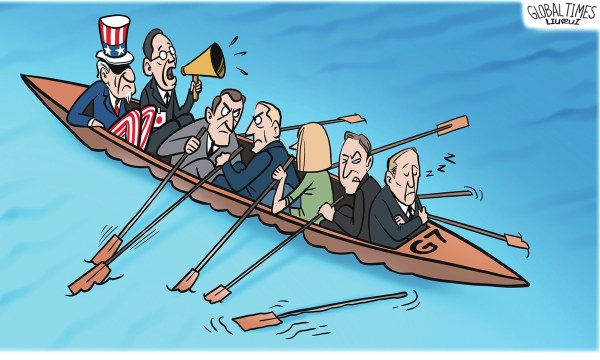
G-7 … up the creek, losing a paddle?
______________________________________
What we’re seeing in the Xian and Jeddah meetings is a laboratory towards the construction of a new multipolar world. The Hiroshima meeting is representative of the thinking and strategies of the old, weakening “unipolar” global organization. The term “unipolar world” is a euphemism for a world dominated by U.S. hegemony. We have another description for it back in the day and that is U.S. Imperialism. It’s weakening, losing its hold over global geo-political processes; through sanctions, military intervention – either direct or through proxies – it’s trying to find different mechanisms to cling to its receding power.
Rob Prince
In a nutshell, we can say that the G-7 summit was nothing more than jingoism with the other six following “the master” and the United States dictating the narrative.
Ibrahim Kazerooni
______________________________________
Summary: the Jeddah Arab League Meeting and the First China-Central Asian Summit of the Shanghai Cooperation Organization meeting in Xian both concentrated on economic and social integration, the construction of infrastructure, the possibility of exchanges “beyond the dollar.” The Jeddah meeting saw Syria return to the Arab League – both a near-death blow to U.S. plans for regime change in Syria and a turning point in Arab History as a region separated and partitioned by the Sykes-Picot Agreement of 1917 begin to find common grounds for cooperation. In contrast, the G-7 meeting in Hiroshima was mostly an attempt to strengthen an anti-Chinese alliance and produced little of substance of a positive nature (increased trade, economic development).
Transcript continued from Part One
Hiroshima G-7
Rob Prince: How is it that the United States has greeted the possibility of peace in Syria? Congress has extended sanctions against Syria, tightened the already existing sanctions against any country that tries to participate in Syrian reconstruction. So the United States has not given up on overthrowing the Syrian government even as the prospect of doing so dims with each passing day.
Moving on to the G-7 meeting. It had such a different feeling from the Xian and Jeddah summits. Xian and Jeddah were positive, constructive meetings about trade, infrastructural develop, reducing regional tensions but then there is the G-7 meeting, it has an entirely different chemistry.
What we’re seeing in the Xian and Jeddah meetings is a laboratory towards the construction of a few multipolar world. The Hiroshima meeting is representative of the thinking and strategies of the old, weakening “unipolar” global organization. The term “unipolar world” is a euphemism for a world dominated by U.S. hegemony. We have another description for it back in the day and that is U.S. Imperialism. It’s weakening, losing its hold over global geo-political processes; through sanctions, military intervention – either direct or through proxies – it’s trying to find different mechanisms to cling to its receding power.
First of all it takes place, in of all places, Hiroshima. That cannot be accidental and there is obvious some kind of message in the chosen site. (continue 17:09). The countries involved are Canada, France, Germany, Italy, United Kingdom and the United States. The European Union is involved and in this particular Hiroshima session, Volodymyr Zelensky was also in attendance. So basically what we are talking about is the “old core” of the global economy – The United States, Canada, Western Europe and Japan. Currently the global influence of the G-7 is declining – as is their percentage of global manufacturing production. They are being challenged economically and politically – in what is becoming something close to a stampede to join, by the combined economic weight of the BRICS’ countries (Brazil, Russia, India, China, South Africa) with more than 19 other countries knocking on the BRICS’ door to join. In the past, many of the countries of the Global South were lining up to participate in the G-7 meetings. Today so many of them want to join the BRICS.
Oddly enough the G-7 Summit took place in Hiroshima. No mention – none – of which country dropped two nuclear weapons on Japan, the first on Hiroshima, the second on Nagasaki. The very fact that the meeting takes place in the first city onto which a nuclear bomb was dropped I find a bit disturbing. Is the United States “sending China a message; we did this to Hiroshima and you had better take care or we’ll do it to China”? There is no contrition involved, none. The United States has never apologized for dropping two nuclear bombs, one on Hiroshima, the other on Nagasaki.
Call it a remix of the early 2000s “you’re either with us or against us.”
That’s one part of it.
The Hiroshima G-7 meeting produced a forty page document. Reminds me of an organization I used to work for that was always “issuing grandiose statements” that had little bearing on the course of events and that few took seriously. G-7 statement, a kind of imperial dictate. I read the whole thing. In contrast to the Arab League and Shanghai Cooperation Organization Summits, it comes close to being a declaration of war against China. – well China and Russia to be frank, but China is by far the main target. While there are seven nations involved , it is essentially a document, which reflects U.S. foreign policy with other members thinking just tagged along for good measure.
It places China at the center of all key topics of interest, be it economic or security concerns, poses serious threats to global stability and peace. Most of the meeting – reading the documents – was centered around increasing tensions with China Main focus – if carefully read – an anti-Chinese, anti-Russian diatribe. The meeting gave the impression of an increasingly limited international coalition preparing for war. The G7’s key strategic objective is the defeat of Russia, followed by the subjugation of China. For the G7/G9, these – real – powers are the main “global threats” to “freedom and democracy.” The corollary is that the Global South must toe the line – or else.
The G-7 conference is a different kind of meeting than Jeddah and Xian. The contrast is really remarkable. It threatens, it provides little socio-economic visions of cooperation, it is trying to stop, to interfere with economic and social global growth that it does not control, that is out of its hands, it smacks of giving orders, dictates, threats to the rest of the world.
Jeddah: reversing Sykes Picot
Ibrahim Kazerooni: In a nutshell, we can say that the G-7 summit was nothing more than jingoism with the other six following “the master” and the United States dictating the narrative. What else can be said about this document that covered so many pages, covered so many issues. On the other side come the G-7 meeting to the other summits, the Chinese and Saudi (Jeddah) meetings. Their goals were, at the end of the day, very simple: reunification, getting together, getting over differences, building a new future peacefully with one another, sharing resources together, etc. etc.
There is nothing here of flexing power muscles, dictates, threats.
At least as concerns the Jeddah summit, one could say that this is a reverse of Sykes-Picot. The Sykes-Picot Agreement was a secret agreement between England, France and, at the time, Russia – which essentially carved up the former Ottoman Empire into what were “zones of influence”, essentially colonies by another name. Sykes-Picot was a program to divide the Middle East 105 years ago. Now there is a “reconvergence” taking place opposite to what Sykes-Picot was about.
When Daesh (the Islamic Movement of Syria and Iraq) moved from Iraq into Syria and Jordan they removed the borders and said in so doing they were breaking with the Sykes-Picot arrangement and going back into Arab reunification of these three countries (Syria, Iraq, Jordan). What has happened in Jeddah is the same principle but more properly structured, done with the consent of the various political leaders involved.
Rob Prince: In fact what this Jeddah Arab League meeting was about is the undoing of Sykes-Picot, or at least the beginning of its undoing.
For those of you unfamiliar with the Sykes-Picot Agreement, let’s concentrate on that for a moment.
At the end of World War I a conference took place in Versailles that many of you are familiar with where Europe was reconstructed and divided up. But also the Middle East was. Basically the Middle East was treated as if it were a big cake to be divided between the World War I winners. France got one part, Britain got another piece. Sykes-Picot is essentially the partition of the Middle East between France and Britain with no input whatsoever from the people of the region. The countries of the region that are still with us today were created, came into being as a result of that agreement. The essence of Sykes-Picot was to divide what had previously been a unified region of the Ottoman Empire into small chunks so that they could be more easily manipulated and controlled by Western powers rather than having to deal with the whole of the Arab World as one larger, more influential entity.
There is a precursor to Sykes-Picot and that is called the Congress of Berlin which took place in 1884 or there abouts. That agreement carved up Africa among European powers without any input from the indigenous peoples. The borders of Africa thus created were completely artificial; these borders had nothing to do with African interests, cultural themes, socio-economic processes. It was basically a case of how much territory could Britain grab before it ran into French or German interests – or the contrary.
It is the same with Sykes-Picot. The key architects of these Middle East new boundaries were Lawrence of Arabia and Gertrude Bell, who worked together to craft the borders and create the countries involved. So here we have two Brits who determined Middle Eastern borders that we are still dealing with 105, 106 years later.
One other thing about Sykes-Picot, it was a response to the region’s growing strategic importance which was about grow dramatically because of oil and natural gas. Oil is used for the first time in a major war in World War I. From this point on, oil will become a strategic resource and most of the oil in the world – then and now – comes from the Middle East. So the region is being sub-divided into little chunks …
Ibrahim Kazerooni: Rob, British Petroleum, the so-called company that was designated and became well known globally. It was in Iraq and Western Iran that they established themselves. It was also in Iraq that the British first used weapons of mass destruction – poison gas against the Iraqi population.
Rob Prince: Yes, under Churchill’s direction at the time
People think that history can be forgotten, that it is irrelevant – but it can’t be forgotten and it isn’t irrelevant. And what we’re seeing in the Jeddah Summit is the beginning of the undoing of the Sykes-Picot Agreement. That is not just rhetoric. Of course it’s not just the formation of one Arab state but it’s the beginning of growing cooperation between countries that have been forced against one another; Add to that growing cooperation for all of the Middle East countries. Example: not only does Iran want to end the hostility with the Arab World, it wants to enter into an era of cooperation with it.
There is another country, a NATO member, who also wants to improve its ties with the overall region, be it with Iran or the Arab countries and that is Turkey. Yes, there are tensions that remain – they don’t disappear overnight – but what we’re beginning to see is that the different constituencies in the Middle East are saying to one another “what the heck is going on here, we have to find ways to cooperate”.
Ibrahim Kazerooni: I want to segway from what you started to develop.
The problem for the western powers is that the way that the Saudis and the Arab League are trying to transition from the divisions that they find themselves caught up in, into not necessarily one unified country, but at least they want to find common denominators for standing in solidarity with one another. Mohammed Bin Salman and Bechar al Assad both indicated the Arabs will not be able to achieve this solidarity unless foreign meddling of the United States and western powers into Middle Eastern affairs ends,; we want to resolve our own (regional) differences and settle them within our own communities. rather than permit outside interference. Once we are able to establish such relations among ourselves -ending the outside meddling and working towards resolving our differences – then we will be in a position to move forward with a common goal, objective that the interests of the Arab World by themselves rather than being dictated by others.
Rob Prince: My final point – what is it that brought Iran and Saudi Arabia together? Some of it is that both sides realized that, hey, this conflict between us has gone to far, and the situation is getting dangerous. A war between Saudi Arabia and Iran would have not just a regional, but a global impact., in fact, a devastating impact. But there was something else that was happening that pushed the process of reconciliation to its climax – and it’s pushing the entire region and that is that the common interests that all the countries in the region – despite their social systems – have to become a part of China’s Belt and Road Initiative. They see in the Belt and Road initiative and in strengthening their ties with China – they see possibilities for greater economic and cultural growth, possibilities not realized in 78 years of post World War II U.S. hegemony.
As China and Russia find ways to improve their ties and coordinate more closely and resolve their differences, many of the countries in the Middle East are inspired by their example and they too are looking for ways to resolve conflicts so that development, which is really the unfulfilled promise of the United States and Western Europe in the Arab World. The Arab World is looking for new avenues for development and they are all turning East. and are doing so with such speed that we cannot keep up with all the new breakthroughs.
Ibrahim, do you have any final comments?
Ibrahim Kazerooni: It’s quite clear that even concerning “turning East” even the Yemeni government responded to the Jeddah Summit announcing the establishment of a common Arab goal, they immediately contacted China and invited them into Yemen to help develop their oil and industry, their navigation system,. Africa is turning East as well, particularly to China, as well as to Russia. As soon as the Americans leave the region, the reconstruction can begin. Chinese, Russians, Iranians will all benefit from and assist in the reconstruction. For the Turks to be a part of this process, they have to relinquish their old colonial (Ottoman) claims on northern Syria and recognize Syria’s right to extend its authority on every part of its territory. This is the U.S. problem: while they occupy Syria, stealing its oil and wheat, they talk about the Russian incursion into Ukraine
_______________________________________________
Just after posting came across this on the Shanghai Cooperation Organization meeting in Xian. It’s quite good.
 View from the Left Bank: Rob Prince's Blog
CHANGE E-DRESS. new=. mooretr3038@gmail.com mooretr3038@gmail.com.
Please use mooretr3038@gmail.com mooretr3038@gmail.com Remove mooretr@centurylink.net mooretr@centurylink.net from your previous recipients file Thanks Tom Moore
>
Will do