Transcript and Audio, Part Two: From Doha To Jeddah – – An Arab Spring Revival. Taped interview with Ibrahim Kazerooni and Rob Prince. Recorded June 16, 2023.
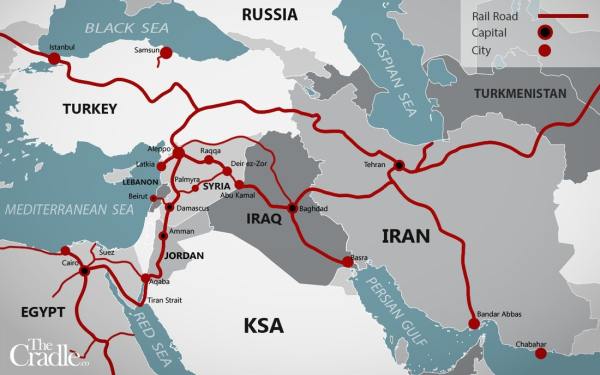
Iran and Turkey growing Middle East crossroads
_______________________________
Here is something else I am wondering about. U.S. influence was defeated in Syria – and now we see these U.S. allies – including little Tunisia, Algeria – it looks that U.S. influence in the Middle East is not just declining but crumbling before our very eyes and the Biden Administration doesn’t seem to have a clue as to what to do about it.
Rob Prince
When you have the Chinese being able to create an improved relationship between Saudi Arabia and Iran without Washington’s participation this is indicative of the degree to which U.S. influence in the region is in decline. The day before yesterday, the Saudi foreign minister was in Teheran opening up a new embassy and last week an Iranian delegation was in Riyadh opening up their embassy, these gestures were unheard of only months ago. There is a huge amount of Saudi investment targeting the Iranian oil and gas infrastructure as well as money invested in a lithium mine recently discovered in Iran. These are resources that Chinese investment are supporting as well. The Americans are unable to do anything about this.
The worst blow to U.S. regional interests would be if the Iranians and Egyptians are able to establish a diplomatic relationship; here we have the most populous Arab country along with the Middle East’s most populous non-Arab country re-establishing relations. If they can work together with finance coming from Saudi Arabia, China and Russia – it’s a new Middle East that the United States has contributed little to nothing to encourage.
Condoleezza Rice’s 2006 pontificating that there is a “new Middle East” in the making is coming back to haunt Washington and Erdogan’s Turkey is a part of the process. Yes, we are beginning to witness a renewed Arab Spring, but from the top down rather than from the bottom up, this is taking shape but not in the way the United States wanted.
Ibrahim Kazerooni
_______________________________
Part Two
Rob Prince: There is something important that has to be added to your comments Ibrahim and that is that the role that Turkey was playing in the Middle East was essentially as a proxy for Washington at a time when Washington and Turkey’s interests converged. Turkey was one of a number of Washington proxies in the Middle East. What is going to change is Turkey’s relationship to Washington over the years since 2010. Turkey is not playing the “proxy” role to the extent that it was thirteen years ago anymore.
I want to talk a little bit about the U.S. posture towards Turkey. To do so, we need to go back in time even more than a hundred years. We have to go back to the Sykes-Picot Agreement because what we’re actually seeing (in terms of U.S. policy today), what the plan was to partition Syria … I consider it “Sykes-Picot II”.
Ibrahim Kazerooni: Yes, You’re right
Rob Prince: For those of you unfamiliar … the Sykes-Picot Agreement was a secret agreement negotiated during World War One, a plan to partition the Arab lands of the Ottoman Empire, once the war was over and the Ottoman Empire was defeated. The original countries involved were the Russian Empire, Great Britain and France to carve up the Middle East and to divide it between these three imperial powers. The Russian Revolution took place and the Communists come into power. One of the earliest actions by Lenin was to expose the details of Sykes-Picot to the world and to withdraw Russian participation in the plan.
With Russia withdrawing, the agreement itself is limited to France and Great Britain dividing up the region between themselves, carving up the entire Middle East. The partitioning of the region had a number of purposes, among them:
● The colonizing entity are competing with each other, both trying to extend their spheres of influence at the expense of the other
● Politically the goal was to prevent the Middle East from becoming a single Arab nation with a population and resources that, if developed locally, could have challenged European power.
● The agreement also included a scramble for control of oil, one in which the British essentially sidelined its French partners (and competitors).
● Control of world trade, dominating the Suez Canal, was another element to the agreement.
From the French- British perspective, it was important to divide the region into smaller units that would be more manageable from a colonizing viewpoint.
I mention this because the current political structure, the boundaries between nations in the Middle East, is based upon “Sykes-Picot I”.
What is “Sykes-Picot II”?
“Sykes-Picot II” is basically an American plan to further fragment, partition the region beyond the parameters of “Sykes-Picot I”.
I am not sure exactly when Washington devised this plan but we do know that during the 2006 failed Israeli invasion of Lebanon that then U.S. Secretary of State, Condoleezza Rice, spoke of Washington’s plan to “create a new Middle East” – an indirect reference to “Sykes-Picot II”. Basically what the “new Middle East” was about was the further partitioning of the region.
We could see that in Iraq (de facto partitioned) – it remained one country but in reality is divided into three almost independent segments that relate to one another only marginally. Then we witnessed the destruction in Libya, another de facto partition. Basically the plan for Syria was also to break it up into segments – a part for Turkey, another for Jordan, Israel retain the Golan Heights.
The failure of the United States and its proxies – particularly Turkey – to overthrow the Assad government represents a major turning point – nothing less than the failure of “Sykes-Picot II”.
Ibrahim Kazerooni: Rob, what you said regarding Condoleezza Rice in 2006 was absolutely correct but if we return to 2001 General Clark commented (on DemocracyNow!) – it’s available on YouTube – he said he visited the Defense Department where they were talking of invading a number of countries to overthrow their governments – Iran, Afghanistan, Libya among them – but the primary goal at that time was to break these countries up into smaller enclaves.
The plan for Iraq was quite clear: break it up.
During the 2003 occupation of Iraq, there was a blueprint to divide Iraq into three segments: the Kurds in the north, the Sunni Arabs in the center and the Shi’ites in the south. I remember arguing against this during a lecture I gave at Korbel (University of Denver’s Korbel School of International Studies).
As concerns Syria , the Doha Protocol as you said quite correctly, was also part of “Sykes-Picot II” represented a further breaking up of the region.
It is also significant, that when Daesh and other terrorists occupied northern Iraq and overran the border between Iraq and Syria, as their pick up trucks were arriving in Syria, they referred to this as the “reversal of Sykes-Picot”. They were mindful of the fact that Sykes-Picot had divided the region into small enclaves – and that the Doha Protocol was the blueprint, the first stage for “Sykes-Picot II”.
Rob Prince: So they were conscious of this too.
What we have here, Ibrahim, is the following: by 2016, 2017 – this period when the Russians come to the assistance of Syria at the invitation of the Damascus government. The plans to overthrow the Syrian government and partition the country fail at that point.
Thus, one part of this “Turkish Tango” – Ankara’s change in orientation – has to do with its understanding that its plans for Syria had failed.
Ibrahim Kazerooni: Yes.
Rob Prince: But there are other things going on at the same time on another level, Ibrahim, and they are on the economic and social levels. Part of it has to do with Turkey’s frustration in dealing with Europe both immigration issues which are very serious, but also in the realm of economic relations.
Turkey’s being rejected by the European Union; that is a fact plain and simple. So there is this political aspect, but there is also the economic aspect which is “that the action in the global economic is to Turkey’s east, and much less to the European Union and Turkey wants “a part of the action.” In terms of economic relations, Europe and North America are offering Turkey less and less while Turkish opportunities these days and from all appearances well into the future are in Central Asia, China, Russia, Iran and India.
So it’s not just the failure of Sykes-Picot II – the Doha Protocols – which is at the base of Turkey’s recent policy shifts but these economic factors as well. It is these changes that are taking place in the global economy – this longing to be a part of Europe has shrunk considerably – which are at the base of the Turkish Tango towards Asia.
Ibrahim Kazerooni: Turkish desire to become a part of the European Union was primarily driven by economic concerns, which didn’t happen.
But when it comes to Erdogan’s failure in Syria, and more broadly in the Middle East, there is a social factor which Erdogan ignored to his regret but which he thought being close to the United States would compensate for it – the historical antibodies in the Middle East – Erdogan did not realize that many Arabs, like many Greeks, still view Turkey quite negatively as their former colonial overlord (during the Ottoman period).
In addition to the miscalculation of only putting its eggs in one basket this social factor (Arab suspicions of Turkish neo-Ottoman goals) would not allow Turkey to be able to dictate – or at least command the region the way it once did, so that it would be able to establish “the old empire”. In addition to the fact that Europe wasn’t able to provide anything substantial for Turkey. All the development money coming into Turkey is coming from China, Russia.
What we have here is a classic example where one power is ascending and another power ascending. Turkey finds its role somewhere in the middle. If it had stuck to the old power – the descending power (Washington, NATO), it would have sunk with it. It had no other alternative but to navigate these uncertain waters – and swallow the pill – that its policy (intervening in Syria for US/NATO) failed in the region but at least to salvage whatever it can by moving, shifting towards China, Russia and Iran.
Who would have thought that two, three years ago that Erdogan hints that he is prepared to sit with Bashar al Assad to resolve the Syrian crisis. Two days ago Bashar al Assad made public his final condition: the only way that he, Assad, is going to sit down with Erdogan is with a clear time line for the withdrawal of Turkish troops from northern Syria (Idlib Province) combined with ending support for the terrorist elements in Idlib.
All these are factors – I don’t know if we have the time to go into more detail, but certainly it’s a many sided complex issue – economically, socially, politically.
As you have indicated, Erdogan has realized that there is no hope in the West.
In a meeting he had with Ali Hosseini Khamenei in Teheran many years ago, Ayatollah Khamenei reminded Erdogan not to be deceived by American “glamour” or its European allies. What they offer is all hype. If you want power, friends, a solid geopolitical base, you’ll find it within the region and East.

Rob Prince: It sounds as if Erdogan took Khamenei’s advice.
It appears that these shifts in Turkish policy, this “Turkish Tango”, that there is a very strong element of pure and simple opportunism.
Where are Turkey’s opportunities for growth now and in the future? I wouldn’t necessarily call it a principled shift in policy or a principled vision. There is something about Erdogan’s position that I’d like to hear your take on.
In this polarized world the idea of walking a tightrope between the U.S./NATO on the one hand and Russia/China on the other, can Turkey continue to be in NATO on the one hand and a part of the Belt and Road Initiative on the other?
Ibrahim Kazerooni: Reflecting on this particular point, I believe if it wasn’t for this factor – that’s my understanding – if it wasn’t for the huge investment that the West has done in Turkey, under normal circumstances NATO would not have tolerated what Turkey is doing in the region and how it’s shifting away from them, causing problems concerning possible additional members, the BRICS, Russia and everything else that is happening.
If it wasn’t for the huge investment in Turkey I think NATO would have given up on Erdogan and Turkey. But they have no other alternative other than to accept that this “unruly” member of NATO is there and they have to deal with it. Erdogan knows he has this economic leverage. This is why he is “pushing the envelope” and is trying to develop an alternative source of support. And here is China with $2 trillion in cash to be invested around the world. If Turkey can absorb some of that money it will compensate for what they might lose from the West.
I was watching a program regarding the railroad that is being constructed as a part of the New Silk Road that the Chinese are building. It is going into Iran, through Iraq and from there straight to Turkey. The Russians are supporting it as an alternative form of global transportation that bypasses the Suez Canal.
Rob Prince: Correct.
Both the north-south corridor and the Belt and Road Initiative (east-west), both of which go through Turkey. Here is where the global economic dynamism is – it’s in Eurasia and Turkey is very well located for that.
I noticed something else before we wind down here and that is that Turkey has applied to become a part of the BRICS – Brazil, Russia, India, China and South Africa. Interestingly enough there are three Middle Eastern countries applying: Turkey, Saudi Arabia and Egypt, three of what were considered some of the more solid allies of Washington applying for this body which is non-aligned – or at least trying to be so.
Here is something else I am wondering about. U.S. influence was defeated in Syria – and now we see these U.S. allies – including little Tunisia, Algeria – it looks that U.S. influence in the Middle East is not just declining but crumbling before our very eyes and the Biden Administration doesn’t seem to have a clue as to what to do about it.
Is that a fair estimate?
Ibrahim Kazerooni: Totally correct.
When you have the Chinese being able to create an improved relationship between Saudi Arabia and Iran without Washington’s participation this is indicative of the degree to which U.S. influence in the region is in decline. The day before yesterday, the Saudi foreign minister was in Teheran opening up a new embassy and last week an Iranian delegation was in Riyadh opening up their embassy, these gestures were unheard of only months ago. There is a huge amount of Saudi investment targeting the Iranian oil and gas infrastructure as well as money invested in a lithium mine recently discovered in Iran. These are resources that Chinese investment are supporting as well. The Americans are unable to do anything about this.
The worst blow to U.S. regional interests would be if the Iranians and Egyptians are able to establish a diplomatic relationship; here we have the most populous Arab country along with the Middle East’s most populous non-Arab country re-establishing relations. If they can work together with finance coming from Saudi Arabia, China and Russia – it’s a new Middle East that the United States has contributed little to nothing to encourage.
Condoleezza Rice’s 2006 pontificating that there is a “new Middle East” in the making is coming back to haunt Washington and Erdogan’s Turkey is a part of the process. Yes, we are beginning to witness a renewed Arab Spring, but from the top down rather than from the bottom up, this is taking shape but not in the way the United States wanted.
End Part Two.
Additional Readings:
Kemalism vs. Kemalism in Turkish Elections
Sasha Breger Bush: Global News Roundup for June 2, 2023
 View from the Left Bank: Rob Prince's Blog
Thank you so much for these astute analyses. I look forward to the next one!