Guest Blogger Chiara Cruciati: Tunisia: But what kind of stability can grow from the soil of poverty?
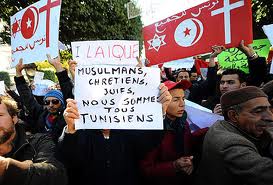
Poster reads – Secular: Moslems, Christians, Jews – We are all Tunisians. What about Black sub-Saharan African immigrants living there, forced from their countries of origin by extreme poverty war, corruption intensified by IMF structural adjustment loans?
_______________________________
(Publisher’s note – I was in the process of gathering materials for a blog entry on Tunisia and Algeria applying for membership in the BRICS group but personal and other responsibilities prevented me from putting it all together (along with the video program I hoped to do with colleague Ibrahim Kazerooni.) A long time friend “back East” happened to send me the article below. It makes pretty much all the points I would have made and does so eloquently, even in translation from the Italian)
_______________________________
Il Manifesto – Global Edition
The Tunisia myth: An unstable democracy and no economic justice
by Chiara Cruciati – July 9, 2023
Analysis. Tunisia’s success narrative was built on a liberal shorthand that sees elections and civil rights as the ultimate expression of an inherently democratic system. The reality is a hardening of socio-economic injustice and political-economic authoritarianism.
The merciless violence on display by a part of the population of Sfax against sub-Saharan migrants is managing to achieve what so many analyses had failed: that is, to debunk the myth of Tunisia as “the only successful Arab revolution.” (1)
This is a myth that has misrepresented the reality of the democratic process undertaken by the North African country after its Jasmine Revolution, which broke out in December 2010 after the self-immolation of Mohamed Bouazizi, a market seller from Sidi Bouzid, deep in Tunisia’s hinterland. He had killed himself after yet another abuse at the hands of the police, in a symbolic and desperate attempt to wrest the monopoly on violence from those in power.
From Tunisia, the revolt spread to North Africa, the Gulf, the Levant. And Tunisia would end up being the setting for an apparent democratization process which was cast as a success story.
It was such a story, at least in part. One recalls the celebration of that success at the 2015 Nobel Prize ceremony in Oslo, with the Nobel Peace Prize awarded to the “Quartet” of Tunisia’s institutions: the historic UGTT trade union, the industrialists’ association, the League of Human Rights and the Tunisian Order of Lawyers.
In stark contrast to its neighboring countries, which have remained trapped in counterrevolutions and civil wars since 2011, Tunisia has notched achievement after achievement, both small and of major importance: free elections, one of the most secular and progressive constitutions in the Arab world, family law reform, gender equality, civil marriage.
But the success narrative was built on the “liberal shorthand” that sees elections and civil rights as the ultimate expression of an inherently democratic system. This narrative excludes the key demand put forward by the Jasmine Revolution: socio-economic justice and equality and an end to the political-economic authoritarianism of the state.
That kind of democracy was never achieved in Tunisia. The pyramidal structure of society is intact, in no way affected by the windfall of billions of dollars that rained down on Tunis from the West, the EU, the US, the IMF.
Now the windfall has dried up, leaving behind inflation, unemployment, shortages of food, medicine and fuel, and the exclusion of the poorer hinterlands, with the coastal areas swallowing up infrastructure investments for the benefit of international tourism.
Long before we did, the Tunisians realized that democracy had never really arrived. They expressed their disillusionment in many ways, which seem contradictory on a superficial look: a significant number joined the ranks of Islamist movements which offered them wages (Tunisians are the most represented nationality among ISIS’s foreign fighters); others chose emigration to Europe, while others protested in the streets.
“Spring” has not come, stifled by the lethal symbiosis of authoritarianism and neoliberalism. In Tunisia, this is on display in the form of the lights and skyscrapers lining the waterfront, the touristic streets and cafes on every corner, the neoliberal hallucination sweeping the misery of the Tunisian people under the rug. Today, their rage is being diverted into a war between the poor: until recently, the people of Sfax used to take to the streets against the political elite, but now they’re doing so to drive out migrants, intoxicated by the racist and nationalist rhetoric broadcast from Tunis.
This is the country of the failed spring, of the myth of “democracy” that pits civil rights against social rights, and of the facade of “stability” in the service of the defense of Europe: both a bulwark against terrorism and Brussels’ outsourced border.
Over the years, the strikes, clashes with police and union activism trying to secure public services and living wages have never stopped, across the whole country: in Tunis, Kasserine, Jebeniana, Sidi Bouzid, Mornag.
The people wanted their “Spring”: what they got instead was outside-facing austerity and internal authoritarianism.
A third IMF loan, worth $1.9 billion, depends on Tunis saying yes to a package of measures that will bring more pain and suffering: cutting subsidies on bread and fuel (with a cascading impact on the prices of other goods), radical cuts in the number of civil servants and their salaries, restructuring state-owned companies (i.e. privatization), raising VAT, devaluing the currency to attract foreign investment. This is hardly the path towards social justice – as Egypt, Morocco or Jordan can testify.
On the internal front, hard-won freedoms have been gradually shrunk, as they often are, with the authorities invoking the specter of terrorism: since 2015, Tunisia has been under a state of emergency, with the overt goal of narrowing the public space for dissent, until the culmination of this process with President Saied’s institutional coup.
“Spring” has not come, stifled by the lethal symbiosis of authoritarianism and neoliberalism. In Tunisia, this is on display in the form of the lights and skyscrapers lining the waterfront, the touristic streets and cafes on every corner, the neoliberal hallucination sweeping the misery of the Tunisian people under the rug. Today, their rage is being diverted into a war between the poor: until recently, the people of Sfax used to take to the streets against the political elite, but now they’re doing so to drive out migrants, intoxicated by the racist and nationalist rhetoric broadcast from Tunis.
This is the country of the failed spring, of the myth of “democracy” that pits civil rights against social rights, and of the facade of “stability” in the service of the defense of Europe: both a bulwark against terrorism and Brussels’ outsourced border.
But what kind of stability can grow from the soil of poverty?
___________________________________
- Cruciati is referring to racist violence against sub-Saharan Africans in Sfax, Tunisia’s second city along the Mediterranean coast. “Racist Violence Targets Black Refugees”
 View from the Left Bank: Rob Prince's Blog
Under the current leadership, the country keeps turning round and round in circles, with no perspective in sight .
Even the last desperate attempt to join the BRICS is likely to fail, for the obvious reason that Saied & his Government proved totally unable to deliver on anything, let alone to give any guarantee on how to pay back a chunk of the existing external debt, which the Government must come to terms with, in the coming weeks, before the deadline expires.
The BRICS, just like the IMF and the World Bank, they are in it only to make profit, and why wouldn’t they? Yet Tunisia doesn’t look like it is going make the first round, regarding the BRICS, and has got nothing to offer, realistically, when it comes to resources . Actually, we have moved from CCC+ to CCC- which means that Tunisia has reached the bottom of the ranking list ( next to Somalia, Venezuela, Cuba…). But our everlasting problem is that we import more dan we export. It’s simple Math . And on top of that, a large portion of the Budget is spent on pay checks, because here the State is still the main employer, while it shouldn’t be. You have around 600K employees receiving a monthly check from the Government. So in Tunisia, there’s on average ONE employee, for every 20 citizens. The figure is just too skew. By comparison, take for instance Morocco that has a population, threefold the population of Tunisia, but with approximately the same number of employees, and which makes Morocco have an average of ONE employee per 46 citizens. A huge difference, namely in financial terms.
There is also another major problem of contradiction going on, between Saied and his Government, with regard to the IMF loan . On one hand, Saied, after signing the IMF agreement last December, which kick started the negotiations on the 1st payment of $500 Million (the total amount is $1.9 Billion, spread over a four-year-period), Saied is now refusing to accept the agreement, with his signature on it. Hasn’t he read it, before signing it ? Seemingly he has no advisers around him. His Chief of Staff, Akacha, resigned a year ago, and has not since been replaced. There are indications that Saied’s sister-in-law is in charge. Yet again, turning politics into family business, by the one of whom we thought he’d only gather the best experts around him, at the very least. Bottom line is : Saied is not governing. He’s rather improvising, and making decisions at random, many of which were being doomed to fail.
On the other hand, the Government is telling us a different version than Saied’s, which is to go ahead with the implementation of the IMF proposed measures (lifting subsidies on fuel, wheat etc,,,as well as to discontinue recruiting, and also to start sending people to early retirement).
It’s pretty clear that Saied & his Government aren’t at all on the same wavelength. It has actually led the negotiations to stall, but Saied, strangely, doesn’t seem to care. He issued a warning to all members of Government, urging them not to talk about the subject, or else they’ll be shown the door. As a result, and if the Ministeries are not allowed to “talk”, how are we supposed to be kept informed about the course of things, since it concerns us all to know what kind of package deal Saied is trying to lure us into, but why does he insist on keeping us not informed / misinformed ?. Looks fishy to me. Honestly, if this Slapstick continues, the people of this country are in for an even lousier time.
Taking all into consideration, it’s safe to compare this country to a wasp’s nest, where you have a lot of nasty stinging going on.
Almost four full years gone by, and with one year left, of his 5-year-term, Saied hasn’t been able to deliver for the Tunisian people. He is too complex a person to deal with. When his rhetoric betrays him, he switches to fear mongering speeches, and to manipulation / cheating. His state of mind tells him that people would believe him anyway. A typical populistic stand that always seems to work in Politics, and Saied doesn’t feel bothered by being close friends with Meloni, Mussolini’s grand daughter, when he shook her hand, kept holding it, and didn’t wanna let go, for a minute or so. Only when eyes locked, did he tell her right in the face, that he admires her “enormous courage of being a woman with guts, who says the things that other men won’t dare to say…”. I truly don’t know what he meant. Is he wishing her success with her Alt Right policies, based on hate and on polarizing?
In return, Mrs. Meloni has managed to “seduce” our President in signing an agreement, between Italy and Tunisia, whereby Tunisia should become the refuge of deported illegal aliens, from Italien territories. Perhaps something like a Guantanamo enclave, on Tunisian territory, so that Tunisian law is applied. Does Saied realizes how Meloni outsmarted him. Has anyone, in the palace, made him aware of the consequences.
In the mean time, the opposition is in prison, doing time without any proof of “plotting-against-the-State”, and for which they’re being detained. The Courts are under an immense pressure, and Judges fear for their career, if they grant freedom to any opposition figure, even in the absence of any evidence to reinforce the claim. In other words, the idea is to linger their detention as long as possible, till after the elections of 2024. That way, the coast is clear for Saied to win re-election, without the opposition standing in his way. However, Saied might have already made up his mind, to simply not call for elections, if he has no guarantee to win it. As a matter of fact, I’ve heard him a couple of weeks ago saying, that he “won’t turn the presidency over to anyone non-patriotic”, and he means business. But he didn’t elaborate further, on the word “non-patriotic”. Saied must be the only patriotic here in town.
We can imagine that Saied got addicted to power, and doesn’t think about quitting, because he has got no other option. If he leaves office, he will be treated like he has treated the opposition, and live a miserable life, which he deliberately brought upon himself. He could have served his term quietly, without being engaged in Kamikaze politics, and in daydreaming. He’d better stay where he is, if he were to ovoid a pile of charges against him.
Sfax, with all that turmoil that took place, had no Governor and still hasn’t got one. Saied is reluctant to appoint one. The same goes for a number of Governorates, also without Governors yet. Saied also demolished all Town Hall Councils & Mayors, and sent everybody home. The city of Tunis is leading its daily life without a Governor.
Quite an interesting statement
Rob,
Wish you were here .
Kerim – Where are you these days if it isn’t improper to ask
Rob,
Thanks for asking. Don’t you think that my cover will be blown? Saied’s men will locate me :) But I believe it isn’t hard for you to figure out where I am.
My regards.
Keep up the good work.
Last thing I want to do is blow your cover!! That said, if you come across some interesting articles (English, French – even Arabic – I am finding that Google Translate, while not exact, is usually pretty decent. Best regards. Oh, I wish I were there too…
Yeah sure . I will copy the link and post it here on the site, so you can translate them.
I never use google. I can read and write in 4 languages. Only 4 !!!
Only 4? I wish I didn’t have to use google either; for the moment stuck with it
Why not, as long as it helps you gain new information. It needs only one click. But in my case, it’s all in the head. I do consult the dictionary every now and then, but the translations happen in the mind, instantly. Funny.
Rob,
By the way, I forgot to mention that Mrs. Meloni is expected to travel to Tunis, on Sunday, accompanied by Mrs. von derLeyen (Euro Parliament) and Dutch Prime Minister. Most probably to seal the final deal. It doesn’t look very promising.
My condolences
Rob,
Found 1 recent article in English, and 2 articles in French .
The Guardian :
https://www.theguardian.com/world/2023/jul/14/eu-to-give-tunisia-1bn-to-fight-trafficking-and-prop-up-ailing-economy
Le Monde :
https://www.lemonde.fr/afrique/article/2023/07/13/en-tunisie-chaima-issa-et-lazhar-akremi-deux-opposants-de-premier-plan-vont-etre-remis-en-liberte_6181878_3212.html
Nicolas Beau :
(this article was published 2 month ago. It’s an impression on how Saied actually deals with freedom of expression)
https://mondafrique.com/decryptage/tunisie-la-plus-lourde-condamnation-dun-journaliste-tunisien/
Beau – an old “Tunisia hand” wrote two devastating critiques about Ben Ali as I recall. Kerim, Thanks A LOT for these citations, for the YEARS of dialogue, for putting up with and old grouchy man
Definitely so. Beau was a real pain in the neck, for Ben Ali. I believe he wrote “La régente de Carthage”, and he revealed the hidden side of the Trabelsi Clan. Still he’s got his own manner of presenting the facts.
Yes you got it. Still I wonder about him?
Well, yes he is indeed a peculiar figure.
Rob,
Don’t mention it. You deserve the credit more than I do .
Credit schemit – irreverent
There’s a misunderstanding here.