 West Africa: New Global Flashpoint for War?
There is growing concerns that a new flashpoint in the tug of war between the old and the new – the unipolar world headed up by the United States and NATO and the emerging multipolar world in which China, Russia and in general the BRICS country – has emerged in West Africa. The danger that the region could explode into warfare, with Nigeria this time playing the role of Washington and Paris’s proxy, is indeed real, if not imminent, at least as it appears at the moment.
As detailed in a fine article at People’s Dispatch,(1) a Marxist source of some quality, Vijay Prashad and Kambale Musavuli describe the beginning of the military coup in the Sahel region of Africa, former french colony which, even since independence, has maintained a stranglehold on Niger’s economy and political system:
“The coup in Niger follows coups in Mali, Burkina Faso, and Guinea. Each of these was led by military officers angered by the presence of French and US troops and by economic crises inflicted on their countries”
“At 3 a.m. on July 26, 2023, the presidential guard detained President Mohamed Bazoum in Niamey, the capital of Niger. Troops, led by Brigadier General Abdourahmane Tchiani closed the country’s borders and declared a curfew. The coup d’état was immediately condemned by the Economic Community of West African States, (ECOWAS) by the African Union, and by the European Union. Both France and the United States—which have military bases in Niger—said that they were watching the situation closely. A tussle between the Army—which claimed to be pro-Bazoum—and the presidential guard threatened the capital, but it soon fizzled out.”
While international public opinion appears to have clear condemned the coup – including remarks made by Russia and China – still, opposition to any Western military intervention to bring deposed President Mohamed Bazoum back to power is, outside, the U.S. and France, thin to nonexistent. The map above exemplifies how the regional divisions are breaking down. The four countries that have experienced nationalist military coups are pretty much standing together in solidarity with Niger. The leadership of Mali and Burkina Faso has gone so far as to promise military solidarity should Niger be attacked.
In a statement to the people of Niger, coup leader Gen. Abdourahmane Tchiani warned his constituents of the hard times ahead:
“We therefore call on the people of Niger as a whole and their unity to defeat all those who want to inflict unspeakable suffering on our hard-working populations and destabilize our country”.
In response to the intimidation heaped on it, the full court hybrid warfare press being put in place by the U.S. and France, Niger’s coup leaders announced that they have nullified a number of current military agreements with France, that they have “ended” the diplomatic missions of their country’s ambassadors with France, the United States, Nigeria and Togo. It is possible that current realities will force both U.S. and French troops to leave the country; something that would be a serious blow to both. They, the coup leaders, also pledge to respond “immediately” to any aggression against their country by ECOMAS. They have also banned two French media outlets – RFI (Radio France Internationale) and France 24, upsetting the French authorities that much more.
In a similar move, Niger ally, the President of Burkina Faso ordered the expulsion of a Canadian mining company from the country and the confiscation of 200 kilograms of gold.
The countries in gray, making up the ECOWAS (see above quote), headed up by Nigeria – Africa’s largest country, have expressed open opposition to the Niger coup and indeed, the Nigerian government has given the coup leaders until the weekend – that is in a few days – to return Bazoum to power “or else” – “or else” being the threat of a Nigerian led military invasion. ECOWAS, funded by the United States and France in the main, is supposed to be an organization coordinating trade and commerce between fifteen West African states. Among those countries lining up behind Nigeria for a military offensive against Niger is Senegal. The Senegalese Government has announced that it will send Military Forces to Support any kind of Armed Intervention led by ECOWAS against the Military Junta which has taken Control after the recent Coup d’état in Niger; so far the ECOWAS Members of Nigeria, Senegal, and Ivory Coast have all stated they will assist with a Military Operation against Niger.
ECOWAS has morphed into little more than a military alliance that resembles the Zelensky government in Ukraine, the Taiwan government in East Asia, the Israeli government in the Middle East – ie, that is, nothing less than a proxy of Western powers, particularly the United States and France. Playing the ECOWAS card gives France an African cover for the military intervention it badly wants to do (and has done throughout Francafrique for decades). If Ukrainians are dying to increasing large numbers in support of intensified American pressure against Russia, should war out in West Africa, it will be Nigerians and their allies dying for American oil interests and French mining companies like Orano (the former Areva), the operator of the Somaïr uranium mine in Niger and owner of the Imouraren site in the same country, as well as Trekkopje in Namibia.The goal of such a misplaced military intervention is not only to return Bazoum to power in Niger, but to reverse the military coups in Burkina Faso, Mali and Guinea, brining their governments “back into line” with their traditional neo-colonial role that has plagued former french colonies in West Africa for so long: nominally independent perhaps, but towing Paris’s line as the “hewers of wood and the drawers of water” for France’s raw material needs.
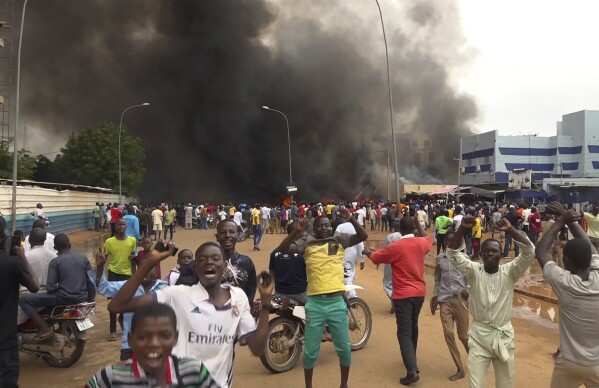
With the headquarters of the overthrown ruling party in flames behind them, backs of the Niger coup demonstrate in Niamey, Niger’s capitol. AP photo by Fatahoulaye Hassane Midou
The Heart of the matter
As noted by Indian retired diplomat, M.K. Bhadrakumar, strange as it might appear to American ears, the head of the “Wagner Group,” Yevgeny Prigozhin, expressed his views on the root of the problems in Niger and that rather aptly:
“I will answer what is the basis for the change of power in Nigeria. The basis is the economy. The population of Niger has been driven into poverty for a long time.
For example, a French company that extracted uranium sold it on the market for $218, while paying Niger only $11 for it. You can work with investors on a 50-50 or 30-70 (%) basis, but it’s impossible to give back to the indigenous people of the country, who were born in this country, who live in this country, and who expect that the natural resources of this country belong to them, and according to the Constitution, they belong to them, only 5% of the wealth you receive.
To cover up these economic crimes, the country was saturated with a huge number of terrorists. This enormous number of terrorists, theoretically, should have been controlled by a vast number of different troops, financed by the UN, the European Union, Americans, the British, and others. As a result, the population of Niger, which should have been free and happy due to the economic opportunities in their country, was robbed, and to keep them silent, they were kept in fear for decades.
To show that these thieves and plunderers are needed in the state’s territory, I mean Western countries like France, the USA, and so on, crowds of soldiers were sent there who did nothing but received enormous budgets that were also embezzled at various levels. That’s why the transformation in Niger was simply necessary. The power that was in league with Bazoum (ousted president) and his followers, simply covered up, allowing the coalition of people who plundered the nation to be present in Niger’s territory. That’s it. Therefore, this is a liberation struggle, a liberation movement for the independence of this country, and God grant them success.”
For example, a French company that extracted uranium sold it on the market for $218, while paying Niger only $11 for it. You can work with investors on a 50-50 or 30-70 (%) basis, but it’s impossible to give back to the indigenous people of the country, who were born in this country, who live in this country, and who expect that the natural resources of this country belong to them, and according to the Constitution, they belong to them, only 5% of the wealth you receive.”
The role of Algeria
If some of Africa’s larger, pro-Western governments have lined up against the coup and in support of a Nigerian military intervention in Niger, Niamey has one critical strategic ally: its northern neighbor, Algeria. Immediately after the coup, Algeria – ironically a country that has, either behind the scenes or quite openly, been essentially run by its military and security apparatus, condemned the coup and called for a return of the country’s elected president to return to office. But as the drums of war and open threats of a Nigerian led military invasion got louder as they did almost immediately thereafter, the Algerian position shifted completely: Algiers will not tolerate any military intervention into its southern neighbor, Niger. As reported in Memo: Middle East Monitor, while calling for “the restoration of constitutional order in Niger and for respect for the requirements of the rule-of-law”, the Algerian Ministry of Foreign Affairs warned against any foreign military intervention in Niger to overturn the coup, a statement directed squarely at Nigeria and ECOWAS – as well as towards France and the United States:
“Algeria cautions, calls for prudence and restraint in the face of aspirations of foreign military intervention, which unfortunately appear to be real and feasible options, while being factors that only complicate and exacerbate the current crisis,” the ministry said in a statement.
With one of the largest and best trained militaries in Africa, Algeria’s opposition to any Nigerian military offensive complicates Washington’s plans to engage Nigeria in a proxy war against Niger. Specifically, Algeria has the second largest military in Africa (after Egypt). Its defense budget is over $10 billion. The country has an active military of 130,000 with another 150,000 in reserve. It possesses a large arsenal of military equipment including fighter jets, tanks and artillery. Nigeria military budget 2.4 billion dollars per year, quite modest by international standards, barely a week of Ukraine’s military expense. Algeria who has 4 times larger military budget could oppose Nigeria in its mad adventure against Niger should it come to a military clash.
While Algeria has over the past 23 years since the end of its brutal “Dirty War” drawn more closely to the United States, especially where it concerns security and military affairs, those warming relationships somewhat cooled after the NATO led invasion of Libya which overthrew the government of Muammar Khadaffi and threw North Africa and the Sahel into a permanent state of insecurity. Algeria’s clear cut opposition to Nigerian threats of military intervention also clear sets it a part from its former colonial master, the same France that Niger is trying to extricate itself from. Given the long and deep ties between Algerian and French intelligence that some argue still guide French-Algerian relations since Algeria’s 1962 independence, the Algerian position, unambiguously in opposition to that of Paris, is particularly interesting. (2)
The U.S. and France: Hybrid Warfare at its most obnoxious: classic destabilization campaign in the making.
Almost immediately after the coup, both France and the United States went something close to ballistic putting in motion one of restrictive forms of hybrid warfare against Niger not unsimilar to what it has done targeting Cuba, Venezuela and Iran., same old song, hoping an economic strangulation and political isolation of Niger, the third poorest country in the world by many standards, will collapse under the pressure, its people turn against the new government so that Bazoum, a faithful and corrupt neo-Colonial thane, can return to power and Orano, the French mining giant, can breath easily again. The World Bank has cut off all assistance to Niger. In a shameful act, an attempt to paralyze and destroy the Niger economy and thus bring down the new government, Nigeria, which provides 70% of Niger’s energy has cut off electricity. It is likely that this is just the beginning of a typically cruel sanctions program.
For France, they have watched helplessly as their military was kicked out of Mali (3) and then earlier this year (2023) from Burkina Faso . French President Macron immediately condemned the Niger coup “dangerous” for the Sahel, a rather interesting way of saying that it is probably considerably more dangerous for France, that gets a goodly portion of the uranium it uses to fuel its energy, than for Nigeriens, most of whom seem to be celebrating France’s removal from their country. Along with Washington, France and a few African proxies have given the new Niger government a week to step down and restore Bazoum to power before unleashing Nigeria and friends to do the job militarily. The week is up in a few days and at least at this writing (August 3, 2023) there is no indication on the part of the coup leaders to give up power. None.
In the usual high sounding language that hides both its panic and aggressive intentions regarding any African attempt to define its own future, on August 2, the U.S. State Department issued the following statement:
The United States rejects all efforts to overturn Niger’s constitutional order, and stands with the people of Niger, the Economic Community of West African States (ECOWAS), the African Union, and other international partners in support of democratic governance and respect for the rule of law and human rights.
Usual stuff “support for democratic governance” (that is laughable) and “respect for the rule of law”, the rules of which Washington makes at its own preference. If there is any doubt that Washington intends to do all in its power to overthrown Niger’s new government, U.S. Secretary of State’s recent statement clarifies the issue in a statement feinting concern but oozing with imperial hubris :
The US Secretary of State Anthony Blinken told (deposed) Niger President Mohamed Bazum in a telephone conversation that Washington intends to return the “legitimate” government to power. This was included in a written statement by the head of the press service of the State Department, Matthew Miller.
Let’s not forget what should be obvious but isn’t in American mainstream media: France still has 1500 troops in Niger, many who were shifted over when Mali kicked them out and the U.S.A. has 1000 (or so) along with the largest drone base in the world in Agadez, Niger. As reported in the New York Times, the CIA also operates an airbase in Niger near Dirkou. In 2012, the Pentagon scouted this exact location because it was the closest airport to Niger’s northeast frontier and “could be used to rapidly deploy forces to counter border incursions”—i.e. from Libya. Of course such a base could also be used in the current crisis for other purposes.
How will these foreign military forces coordinate with a possible Nigerian invasion?
The shifting international setting: Niger events a part of the global movement to multipolarity global politics. Sankara and Gaddafi are watching from up there
The Niger coup, one essentially a nationalist revolt against French economic, financial and political domination, took place at a special moment, a moment when the overwhelming majority of African countries – all but five of them (including among the no-goers, Nigeria and Kenya) – were attending the second Russian-African Summit in St. Petersburg. The summit needs to be understood in relation to the large global geopolitical shifts taking place: the energetic emergence of what is called a “multipolar” world system, one that builds on the foundation of former Non-Aligned Nations movement of the 1950s, 1960s and since. Using worn cliches of “Chinese” or “Russian” influence, as was the case of the Non-Aligned Movement that preceded it, the multipolar system seeks to ally itself neither with “East” or “West”, or in modern lingo with the United States or China. It seeks trade and commercial relations with whomever can offer the countries involved – quickly developing to be much of the world.
The struggle between the “new” multipolar approach and the “old” unipolar identity (basically being in Washington’s political and economic camp) is global in nature. No doubt it has been heating up in Africa for a good fifteen years. At the St. Petersburg meeting, some of the strongest supporters of a multipolar approach were former french African colonies – Mali, Burkina Faso – the remarks of which were exceedingly hostile to both U.S. and French policies in Africa.
More on the global context, considerations in the next entry in the series.
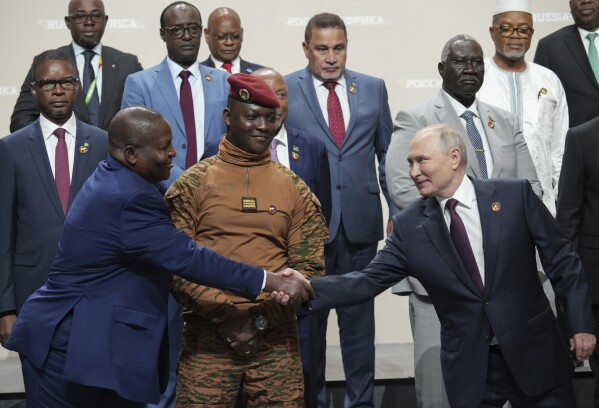
Russian President Vladimir Putin, right and Mozambique President Filipe Nyusi shake hands during a “family photo” opportunity during the Russian Africa Summit in St. Petersburg, Russia, Friday, July 28, 2023. (Alexei Danichev, Sputnik, Kremlin Pool Photo via AP)
___________________________
- People’s Dispatch. I am unfamiliar with this publication, or was, until a few days ago. It appears to be a serious source of information and analysis from an anti-Imperialist perspective. It describes itself as follows:
Peoples Dispatch, formerly The Dawn News, is an international media project with the mission of bringing to you voices from people’s movements and organizations across the globe. Since its establishment three years ago, it has sought to ensure that the coverage of news from around the world is not restricted to the rhetoric of politicians and the fortunes of big companies but encompasses the richness and diversity of mobilizations from around the world.
Peoples Dispatch also seeks to bring to you breaking news from a perspective widely different from that of the mainstream media.
We invite people’s movements and political organizations everywhere to send us information and news from their countries.
You can reach us at contact@peoplesdispatch.org
✔Subscribe to our YOUTUBE channel https://www.youtube.com/c/PeoplesDispatch
✔For news update on Telegram, click here: https://t.me/peoplesdispatch
✔For Email Newsletter, send an email to contact@peoplesdispatch.org
2. More on the relationship between the French and Algerian Intelligence cooperation and how it has played out throughout North Africa and the Sahel in later blog entries.
3. French forces didn’t “withdraw” from Mali, they were “invited to withdraw”, ie, they were booted.
 View from the Left Bank: Rob Prince's Blog