
Niger, uranium, and the politics of empire
The Global News Roundup collects news stories from entirely international (non-US) media sources on variety of pressing global issues and events.
News out of Niger over the past two weeks opens a window into two, overlapping dynamics currently working to reshape the global economy. First, a mercantilist economic system is emerging as the international balance of power shifts from a US-dominated system toward a more multipolar system in which power is shared more equally among a greater number of rival states. In the Roundup from April 28 about trade wars and economic weapons, I noted: “Lately, governments are rushing to implement new kinds of economic policies, ones that involve heavier regulation of global trade and finance and that benefit themselves and their allies at the expense of their rivals and enemies. In the history of global capitalism, this kind of system—called a “mercantilist” global economy—is the rule, not the exception.” Commodities markets have been an important arena for economic warfare over the past couple of years, for example with US and EU sanctions on Russian natural gas, Chinese bans on exports of rare earth metals to the US, and with Ukrainian wheat and the Black Sea Grain Deal from which Russia recently withdrew.
In Niger’s case, the new government is using its natural resources, and France’s reliance on those resources, as a tool to push back on and reshape its relationship with its former colonizer and the EU more generally. For their part, the US and EU are vying with Russia for influence in west Africa and access to Niger’s resources, and both “sides” have insinuated they may resort to military force in an attempt to resolve the matter.
Second, a lot of countries in Latin America, the Middle East, Africa, and Asia—many of them former Western colonies—have grown more powerful in recent decades and are actively rejecting and pushing back against Western power. In some cases, smaller nations with less power are joining forces and working together to pursue mutual, anti-imperial interests. Among other recent examples, I’ve discussed this issue in terms of Saudi Arabia’s pushback against the US (here), Brazil’s stance against the Ukraine war and pushback against “Washington Consensus” development policies (here and here), El Salvador’s defiance of the IMF and adoption of Bitcoin as legal tender (here), and the delegation of six African countries working together to push the US and Europe to negotiate peace in Ukraine (here).
In Niger, not only is the new government challenging its exploitative and highly unequal relationship with France, but the junta has received strong support from governments in neighboring countries Mali and Burkina Faso, both also former French colonies. Meanwhile, the deposed president has garnered the support of other west African nations, including Nigeria, which are outraged by the overthrow of a pro-Western and democratically elected leader .
Niger is a land-locked country in west Africa, bordering the Sahara Desert. It has a population of about 25 million, average life expectancy around 61 years, real GDP per capita of about US$550 per year, and an extreme poverty rate of 42% (data sources: here and here). The map below shows the nations of west Africa.
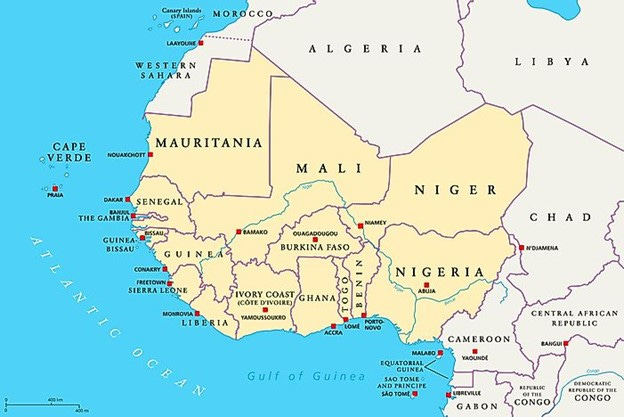
(Image: Map of west Africa, from World Atlas, here).
The French empire began systematically colonizing west Africa in the late 19th century, competing for resources and territory with the British and Portuguese empires which also had footholds in the region. Economic historian L.S. Stavrianos notes how quickly the European powers worked to annex and divvy up the continent during this period, in what he calls “the greatest land grab in history”: “In 1879 the only colonies in Africa were those of France in Algeria and Senegal, of Britain along the Gold Cost and at the Cape, and of Portugal in Angola and Mozambique. By 1914 the entire continent had been partitioned, except for Ethiopia and Liberia” (Stavrianos, Global Rift, 1981, p. 282).
French colonial holdings in Africa by the WWI period were extensive, including in North Africa (Tunisia, Algeria, Morocco), west Africa (including modern-day Niger, Mali, Mauritania, Senegal, Guinea, Burkina Faso, Cote d’Ivoire, Togo, and Benin), central Africa (Republic of Congo), and east Africa (Djibouti and Madagascar). Niger formally became a French colony in 1922.
As with most other imperial enterprises, gaining cheap and steady access to Africa’s natural resources was a major motivation for colonization, from gold and aluminum to cocoa, coffee, and cotton. Uranium, a radioactive metal used to power nuclear reactors and make weapons (among other applications), was first discovered in Niger in 1957, three years before it won its independence from France.
Commercial production began in 1971, dominated by the French mining firm Orano (formerly named Areva). Today, Niger is the world’s 7th largest uranium producer (it has the highest-grade ore among African producers). Orano and Niger’s state-owned Sopamin jointly own and operate a large open-pit mine near the town of Arlit, an industrial center in the north-central part of the country. It is the only active mine, though there are two additional inactive sites also owned by Orano. While the French dominate uranium production and trade out of Niger, Canada-based GoviEx Uranium has an 80% stake in a new mine project that is permitted for development, with plans in place to develop the site. Niger also has substantial gold reserves, with mining operations beginning in the early 2000s, as well as oil reserves. China, with Canada, also has substantial investments in gold, and China has further invested in oil production.
Writing for Venture Africa, Suotunimi Orufa notes how central especially uranium and gold are to Niger’s economy, as well as how important Niger’s uranium is for France: “Uranium and gold are two of Niger’s most significant exports, accounting for 40% and 20% of its total exports respectively. According to the International Atomic Energy Agency, Niger earned about $300 million from uranium exports in 2019, which represented about 5% of its government revenue. As of 2021, Niger still produced 311,110 tonnes of uranium, which accounted for over 5% of world uranium output. Most of this uranium was exported to France.” The Lebanese outlet Al Mayadeen further notes that, based on 2021 data, Niger is the largest supplier of uranium to the EU. Another report confirmed that Niger supplied 25% of the EU’s uranium in 2021 and that 35% of all uranium used in French nuclear reactors came from Niger in 2020. France derives about 70% of its electricity from nuclear energy.
On Wednesday July 26, the day before the Russia-Africa summit began in St. Petersburg, there was a military coup in Niger. Niger’s President Mohamed Bazoum was taken and is still being held prisoner by the presidential guard with the military’s backing. The new government suspended the constitution and on Friday the 28th, General Abdourahamane Tchiani—who has the support and backing of the Russian government as well as the Russian mercenary company Wagner—declared himself head of a new interim government. The Brussels Signal reported that, “On July 30, angry protesters waving Russian flags gathered outside the French Embassy in Niger’s capital Niamey. Demonstrators chanted anti-French slogans and demanded the closure of foreign bases in Niger. A number of them tried to break into the building and were pictured smashing windows.” Russia has been steadily expanding its economic and military presence Africa in recent years.
On Monday the 31st, General Tchiani announced the suspension of all uranium and gold exports to France: “The decision…is seen as a way of asserting Niger’s sovereignty and challenging France’s influence and interests in the region.” The website for France’s Ministry for Europe and Foreign Affairs documented the following short Q&A with the press on July 31:
Q– : Today, Niger stated that they will stop exporting uranium and gold to France. What is Paris’ reaction to this decision? Does this situation fall under the category of “any attack against France and its interests” mentioned by the Elysée yesterday and might it be followed by a response from France?
A– :There are no French companies operating gold mines in Niger. Regarding uranium, we have an extremely diverse supply and Niger only makes up 4% of global production.
Le Monde reported on the 31st that Orano’s normal operations had not been disrupted at the mine near Arlit, though it had “activated a crisis unit to watch over its uranium mines”.
(Interesting media note: I found repeated confirmation of the uranium and gold trade suspension across a variety of media outlets from Africa, Europe, and elsewhere, including the admission above from an official French government website. See here, here, here, here and here. However, Reuters issued a “fact check” on August 2nd denying the suspension and then ran another piece in which EU officials denied any risk to EU energy supplies “if” Niger were to cut supplies, implying they had not yet done so. Hmm….)
The coup was quickly condemned by the US, Canada, the UK and EU, as well as by ECOWAS (Economic Community of West African States, of which Niger is a member) and the AU (African Union, which has 55 member states from Africa). All demanded that President Bazoum be immediately released and restored to the presidency. France, the EU, and the UK suspended development aid and budget support to Niger on Saturday. ECOWAS imposed sanctions on Niger on Sunday, and Nigeria cut off electricity exports to Niger on Wednesday as part of the ECOWAS sanctions package. The IMF is further slow playing a loan disbursement that was approved for Niger in early July. The US has not yet suspended aid, nor has Canada, but both warned they could do so in the future. (This timeline from Al Jazeera is helpful).
A report from The Guardian on Wednesday was entitled, “Military intervention in Niger is ‘last resort’, says west African bloc”, referring to ECOWAS. Yesterday, Russian news agency TASS volleyed back:
The initiative to conduct a military operation in Niger, where rebel presidential guards ousted head of state Mohamed Bazoum in late July, is being spearheaded by France and Nigeria…
Niger is crucial to France as it is a source of almost 20% of uranium fuel for its nuclear power plants. Niger hosts a large French Air Force base and a contingent of about 1,500 troops. After the withdrawal of its army units from Mali and Burkina Faso, Paris hates the idea that it may suffer another setback and beat a hasty retreat again – this time from Niger. In that case the only large French contingent in the region will be the one in Chad, but from there it will be difficult to intervene in Mali, Burkina Faso, Niger and other countries of the Sahel zone…In fact, Niger is now the West’s main support base in the Sahel, as there are also two US military bases in that country.
Niger’s coup is the latest in a string of political upheavals in west Africa, including military coups in Mali (in 2020) and Burkina Faso (in 2021), both of which ushered into power anti-French and pro-Russian juntas. According to Al Jazeera, the governments of Mali and Burkina Faso this week warned “that any military intervention against last week’s coup leaders in Niger would be considered a “declaration of war” against their nations.” Last week, Yevgeny Prighozin told a news outlet in Cameroon that Wagner was ready to increase its presence in Africa.
In other radioactive news, Japanese restaurants and eateries in China are preparing for tough business conditions following reductions in Chinese seafood imports from Japan and the Chinese government’s recent decision to perform more safety checks on imports. Japan has been approved by international agencies and is preparing to release treated radioactive water from the damaged Fukushima nuclear plant into the Pacific Ocean. While Japanese officials say the water is “purified”, the Chinese government fears it is “contaminated”. There is widespread concern about Japan’s plan on both sides of the Pacific, which is a major source for seafood globally and an important ecosystem, including extensive reefs that support a wide variety of plant and animal species.
Things I’m keeping an eye on:
1. EU-Latin America relations: Last week the Community of Latin American and Caribbean States (CELAC) had its first meeting with EU officials since 2015, with the EU seeking to increase Latin American energy and resource exports to Europe and to counter China’s expansion in the region. While some reports indicated progress on “green energy” partnerships, Mena FN reported that the meeting was full of disagreement and was “nearly derailed over the EU’s embrace of controversial opposition figures from Venezuela, Cuba, and Nicaragua. A European Parliament resolution passed days before the start of the summit criticized the Cuban government for alleged human rights abuses and called for political exclusion of various countries.”
2. The US economy: It’s been a bumpy couple of weeks for the US financial system. Kansas-based Heartland Tri-State Bank was closed by regulators last week, the 5th US bank to be shuttered by the FDIC this year. This week, on Tuesday, Fitch, the prominent ratings agency, downgraded US Government debt to AA+ from AAA, putting the US “in level with the likes of New Zealand, Austria and Canada, below countries such as Denmark and Luxembourg, and within touching distance of France, Ireland and Czechia”, reported the Financial Times, continuing on to note that “In Fitch’s view, there has been a steady deterioration in standards of governance over the last 20 years, including on fiscal and debt matters…”. Then, on Thursday, Fitch additionally downgraded other kinds of debt, including some municipal housing bonds secured by mortgage backed securities issued by Ginne Mae/Fannie Mae/Freddie Mac, debts that are “directly tied to the creditworthiness of the United States or its related entities.” For context, see here for my recent article on the Whole World Debt Crisis.
3. Ukraine war: More peace plan ideas keep surfacing. This time, the US is organizing a peace summit with Saudi Arabia to which Russia is not invited, but which China will attend. The summit will be held this weekend, August 5-6.
 View from the Left Bank: Rob Prince's Blog
Sounds like a reprise of the Great Game, but this time in Africa, rather than Asia. All the same, I can’t see that Putin’s Russia is a more trustworthy partner for African states than France.