


In partnership with

In 1991, American neoconservatives — many of whom would become part of the administration of George W. Bush two decades later — were unsatisfied that the Gulf War ended merely with the liberation of Kuwait from Iraqi occupation. What they really wanted was to topple President Saddam Hussein and his Ba’ath Party, arguing that they needed to install a democratic, Western-friendly regime in Iraq.
This unfinished agenda played a major role in the decision to invade Iraq in 2003 under the framework of the “War on Terror.” The United States crushed the Ba’ath establishment, but shattered the country in doing so. The attempt to build a cross-sectarian coalition in Iraq failed. The global superpower folded.
U.S. President Joe Biden appears to have tried to instill this bitter experience in the Israeli establishment during his visit to Tel Aviv last week. Biden gave Israel a warm and loving embrace, yet asked it to think reasonably. It was a meeting of an older, experienced, and concerned president with a traumatized country and its frantic leadership. And though the president hugged publicly, inside the meeting room of the war cabinet, he asked Israel’s leaders tough questions about what it was trying to achieve with its latest war in the Gaza Strip.
What could this action plan look like? Even if it so desired, the Israeli leadership cannot achieve the mass deportation of Gaza’s Palestinian population into Egypt (in part because Cairo itself has flatly rejected the idea), nor can it annihilate the strip’s two million Palestinians.
Nevertheless, the war cabinet is made up of politicians and generals who were responsible for formulating and managing Israel’s failed policies toward the Palestinians for the past 15 years. And even though their entire approach collapsed on Oct. 7, and despite hearing Biden’s warnings, it appears that they will not propose any new path.
Until Oct. 7, Israel’s policy was based on the idea of creating a single regime between the Jordan River and the Mediterranean Sea, governed by Jewish-Israeli supremacy, while separating the Palestinians into different groups. Still driven by this principle, Israeli authorities will likely try to filter the Hamas establishment out of Gaza’s population and kill many of the movement’s members, since — according to Netanyahu — they are “Nazis.”
Israel may choose to do this by slicing up the Gaza Strip; instead of one large prison, in which Israel has kept two million Palestinians since 2007, it will build several smaller prison cells. Using its technology and surveillance systems, it could then identify Hamas operatives through biometric information, photographs, information from collaborators, and interrogation of prisoners.
Initially, Israel will try to implement this policy in the northern Gaza Strip. In the southern strip, where the army ordered residents of the north to evacuate to, Israel could target Hamas members on a more specific basis. The government apparently hopes that the Israeli hostages are being held in the north, and that it will be able to reach most of them alive. In general, this is uncertain.
Alongside the massive forced population transfer, Israel will have to go from house to house in northern Gaza while imposing curfews on certain areas. This will likely be its method of finding Hamas members with minimal losses to Israeli forces. Even if the confrontation with Hezbollah in Lebanon stays confined to Israel’s northern border, this method in Gaza will surely take months.
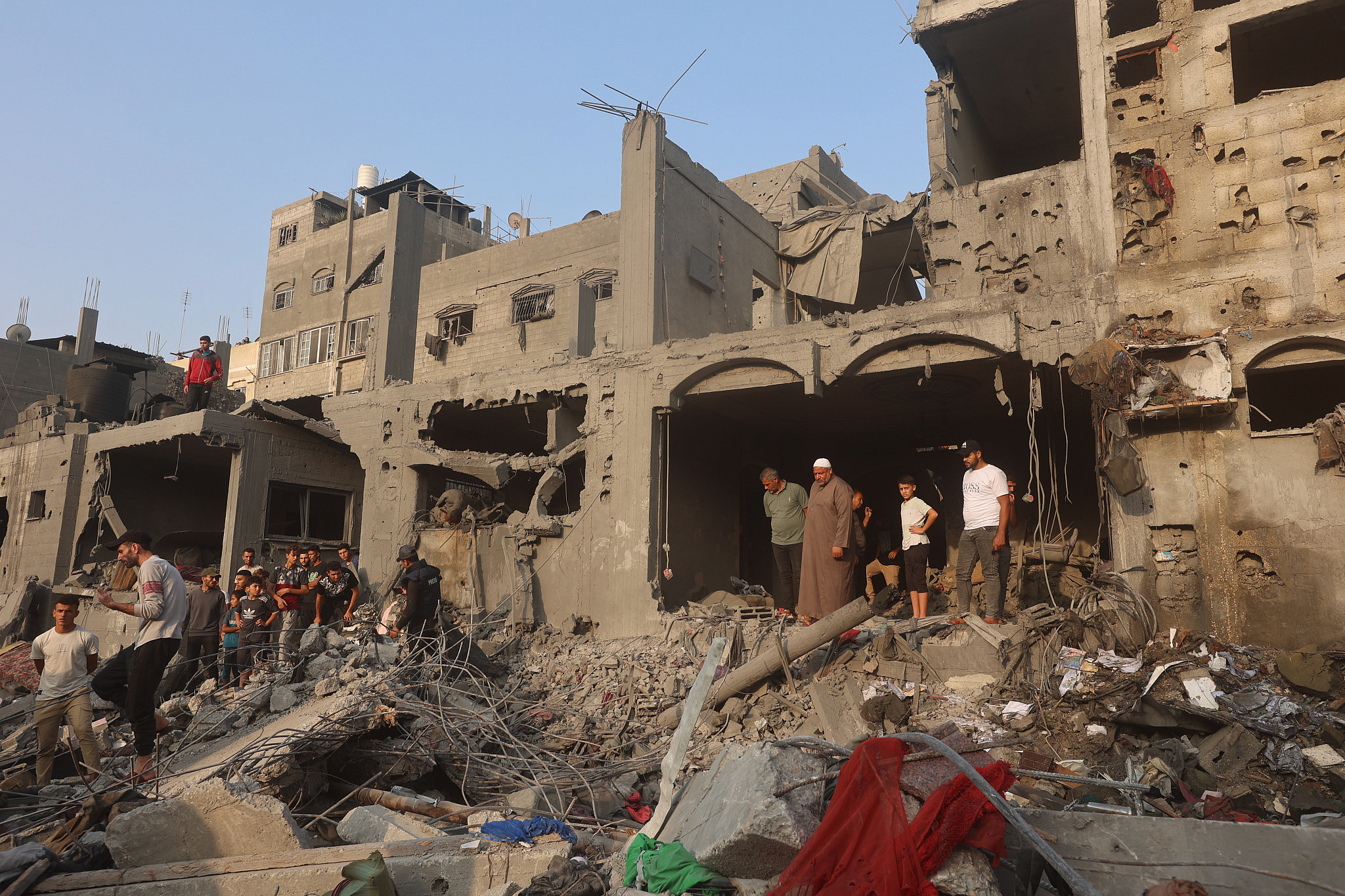
A war of attrition is liable to develop in the northern strip, and it is uncertain whether the Israelis who were evacuated from the Gaza border region will be able to return to their homes. Israel would eventually have to take over the management of northern Gaza. The southern strip, Israel apparently hopes, will be managed by an international body comprising members of Qatar, Egypt, the UN, and other international aid agencies.
One can expect Israel’s national-religious government to push for the establishment of settlements in the northern Gaza Strip, ostensibly for “security reasons,” meaning, control. But every day Israel imposes this order, it will generate resistance to it. This is what we saw in Lebanon. In the first days of Israel’s invasion in 1982, some Lebanese residents welcomed the army with rice grains. There will be no such reception in Gaza; the besieged Palestinian residents there don’t even have rice to spare.
The Israeli ground invasion is expected to be conducted with great force, with a large number of revenge-seeking soldiers and tanks on a small battlefield. Hamas’ armed forces will have nothing to lose, but other elements may join the resistance to Israel. It will neither be easy nor quick. As the number of Israeli and Palestinian casualties increases, public criticism in the country will increase, and internal political divisions will widen accordingly.
An illusion
But a sharp internal divide is the living space of Netanyahu and his ilk. The prime minister and his followers will intensify their incitement and, under the guise of a state of emergency, may further undermine the lame democracy that exists today. We are already seeing signs of this in the media and academia, and in the persecution of Palestinian citizens of Israel. And as the number of Palestinian civilian casualties rises, international criticism will also increase, as will pressure on Western heads of state to stop Israel.
The “preventive” detentions in the West Bank of dozens of Palestinians whom Israel defines as Hamas members indicate that Israel fears resistance in the West Bank, too. Already, armed settlers are clashing with Palestinians. These confrontations may only escalate. The Palestinian Authority is weak, dysfunctional, and illegitimate in the eyes of its residents; the chances that it will agree or be able to rule part or all of the Gaza Strip under Israeli auspices are nil.
Israel may not even agree to a symbolic PA presence in Gaza, since this will undermine the policy of separation that Israel has maintained for decades. Alternatively, Israel may seek local Palestinian collaborators, similar to the “Village Leagues” Israel tried to establish in the West Bank in the 1970s to counter the PLO.
The assumption that most residents of Gaza want only quiet and welfare, and that they will accept a regime imposed by Israel in the form of limited autonomy, is an illusion. The war cabinet and its spokespeople are incapable of freeing themselves from the erroneous policy that guided them until Oct. 7, and thus will try to restore it. They would do well to learn from America’s mistakes.
A version of this article was first published in Hebrew on Local Call. Read it here.
XXXXXXXXXXXXXXXXXXXXXXXXXX
 View from the Left Bank: Rob Prince's Blog