Palestine Tet – 67 – Sétif (Algeria) 1945; Gaza (Palestine) 2023 – Part Three
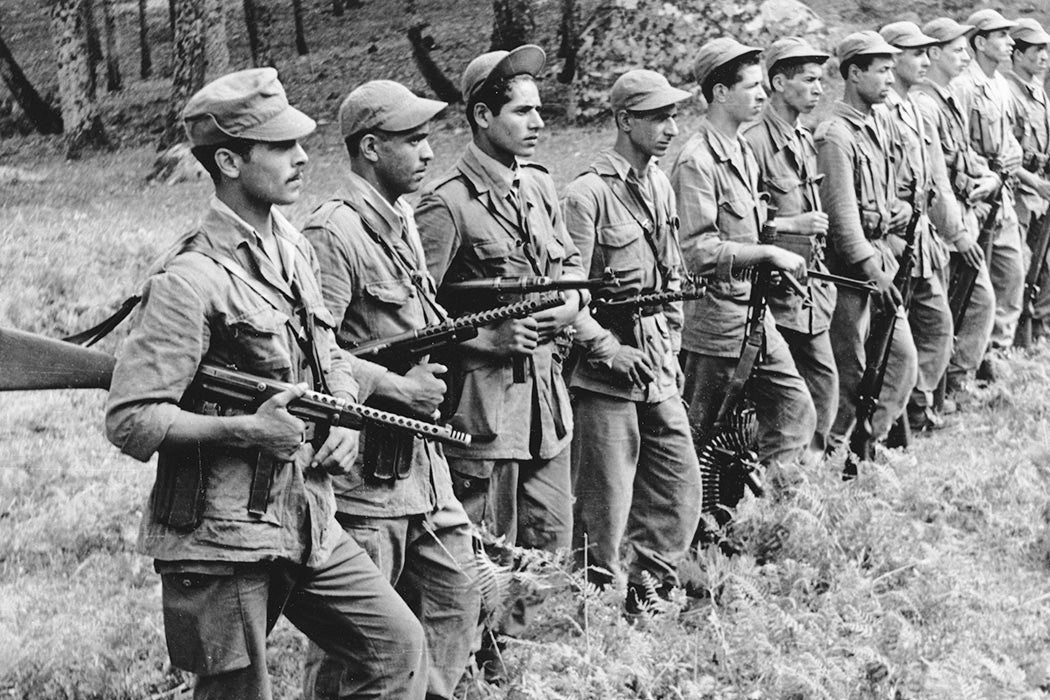
Members of Algeria’s national liberation front guerilla army. Late 1950s
__________________________
__________________________
There is nothing more nauseating than seeing these videos of Israeli soldiers dancing, partying, laughing and all other manner of merrymaking while massacring thousands of people and turning #Gaza into a wasteland.
Linda Mamoun
__________________________
1.
The same year, 1966, that Gillo Pontecorvo’s movie, The Battle of Algiers, went into movie theaters around the world, I arrived in Tunis, Tunisia where I spent the next two years plus as Peace Corps Volunteer. I have a distinct memory of the long defunct Pan American Airways airplane taking off from Kennedy Airport, myself feeling like a tree that was suddenly uprooted; it was with a mixture of anticipation and fear that I began a journey which would alter my life. Then descending from the plane at Tunis Airport, a wave of south Mediterranean heat nearly knocked me over.
So it began.
A few months later, in early 1967 if I remember correctly – not sure – The Battle of Algiers opened in Tunisian movie theaters where I went to see it. Such was the memorable experience that I still remember details now 57 years later. It is not quite the same to see the film in New York City or Denver than to view it in Tunis (and later in Algiers itself) where the presence of the hope and the horror which was Algeria’s eight years of independence was ever present.
I am pretty certain – again memory is a funny thing – that part of my curiosity, my interest in visiting Algeria resulted from seeing the film. I had never seen a film so honest, so historically accurate, so vividly brutal about the Algerian War. Nor could I help making comparisons between the tortures, the horrors that the French inflicted upon the Algerians with what the Johnson Administration was inflicting upon Vietnam at the time.
In fact, even those days, before any kind of political awakening that would soon follow – Algeria was Vietnam and visa versa. “The Battle of Algiers” mixed in my mind with “The Battle of Saigon.”
Still does.
That connection was made even more pronounced when traveling through Algeria’s eastern regions I was informed that the fires which had charred the slopes of the mountains delineating the border between Algeria and Tunisia had been napalmed by the French, the weapon “generously” offered to the French government by the Eisenhower Administration.
While I was doing my best squirming in my seat, trying to absorb a bit of Maghreb recent history, but one with which I was unfamiliar, the rest of the theater was alive with cheers whenever the French were hit, boos when Algerians were being tortured or killed. The degree to which the whole theater was so totally emotionally involved in every second of the movie cannot be exaggerated. Many sat in that dark theater weeping. And if the movie strayed even the tiniest bit from reality, people would shout out in Arabic or French “that’s not right”, it “didn’t happen quite that way,” etc. Then others would chime in, giving their commentary as well.
It was as if for a moment – only five years after the Algerian War of Independence had ended – that the whole audience was living the war itself.
2.
A half a century later, at the University of Denver’s Korbel School of International Relations where I taught for nearly a quarter of a century, the Battle of Algiers was still being shown, not so much by Palestinian or Arab Student groups but by profs teaching courses on counter-insurgency and by a faculty member who had earlier served in the Israeli Defense Force that had invaded Lebanon to the gates of Beirut in 1982.
Some of those same profs showing Battle of Algiers also required their students for assignments to design plans to overthrow the Islamic Republic of Iran’s government while high ranking military officers who has helped plan and execute the 2003 U.S. led invasion of Iraq were brought in to “teach” courses military strategy and of all things, diplomacy.
These profs – Israeli or American – were far less interested in Battle of Algiers ending which declares the hard won victory of the Algerian Revolution, but far more interested in the main storyline: the destruction through extensive torture, imprisonment and assassination of the national liberation movement’s Algiers operation.
It was, actually, a classic example of counterinsurgency and not of the failure of such methods but of its success! It mattered little that the French might have lost the war and been exposed for the sadistic nation it has long been, because on a smaller scale, they, the French, had won the battle!
The film has been used by imperialists, reactionaries, Argentinian and Chilean fascists ever since as a model of how to conduct counter-insurgency operations against rebel movements the world round. It was shown throughout Latin America to prospective intelligence officers and torturers. The Israelis have studied it in depth also and learned from it different tactics for defeating (or trying to defeat) Palestinian national aspirations.
Few have been more interested in “learning the lessons” of counter-insurgency and applying them than the Israelis themselves. Although they assiduously deny comparing French colonial domination in Algeria with Zionist ethnic cleansing and occupation of Palestinians, actually Israeli political leaders know well that the comparison is apt. They have learned everything possible about counter-insurgency the French practiced in Algeria to be able to apply it against the Palestinians everywhere: create divisions among the colonized, exaggerate intra-communal tensions along religious, political and gender lines, neutralize rebel leadership either by buying a small group of them off, or eliminating, assassinating those they cannot break, etc. etc.
For the Israelis – and not just the current Netanyahu government with its more pronounced fascistic tendencies – the French crushing of the Algiers resistance movement is nothing short of a laboratory, a practice run for Israeli treatment in Gaza, the West Bank, and among the Palestinians living in Israel itself. Israel has always feared, with good reason, that it would suffer a fate similar to that of French Algeria, that its “colonizer” elements (Jewish Zionist elements) will someday be expelled as the French colons were from Algeria in 1962.
3.
The military defeat of French colonialism in Indochina symbolized by the 1954 Battle of Dien Bien Phu was a humiliation of the highest order for postwar France. The totality of the defeat threatened French colonial interests elsewhere in the world, especially in Francophone Africa and in the French colonies of the Maghreb (North Africa). A serious study of how it was that a nation of poor peasants and fisherman could thoroughly defeat one of the world’s great colonial power was undertaken.
Analyzing the elements that led to the Vietnamese victory, the French military kept returning to the writings of Chinese Communist leader Mao Tse Tung and his extensive analysis on how China’s communist forces were able first to defeat Japanese imperialism and the U.S. supported (armed, financed and trained) Kuomintang armies of Chang Kai Shek.
Key to Mao’s military victories over seemingly greater and better equipped forces was the support his movement had won from the rural areas, the countryside, so much so that the rebels and rural peasants merged into one unity, difficult or impossible to tear apart. Key to Mao was winning the support of the population as much as possible prior to the outbreak of the military confrontation. To counter Mao’s revolutionary warfare, counterinsurgery warfare would declare war against the entire population of a country, such as Israel is currently doing in Gaza where no distinction is made between guerilla fighters and the civilian population.
In studying Mao’s writings France hoped and planned to suppress similar movements of its former colonies in Africa and in particular to prevent a successful revolution in France’s most economically and strategically important colony, Algeria. Two French military theoreticians, David Galula, a Sfax Tunisia born Jew and Robert Trinquier provided the intellectual foundation for the many episodes in counter-revolutionary warfare in the decades that followed, in Latin America, Vietnam, Indonesia, and neither the last, nor the least, Israel.
David Galula’s seminal counter-insurgery guide was entitled “Pacification in Algeria“. It was published by the infamous Rand Corporation in 1963. As noted in the Rand Corporation’s description of the book:
This groundbreaking work retains its relevancy as a challenge to traditional counterinsurgency tactics and presents approaches to predicting, managing, and resolving insurgent and guerilla conflict
Robert Trinquier’s “La guerre moderne” was published around the same time (two years prior). It is a precursor to what is today referred to as hybrid warfare, ie, using unconventional military tactics combined with elements of psychological and economic warfare to defeat insurgency movements.
Trinquier is a theorist on the style of warfare he called Modern Warfare, an “interlocking system of actions – political, economic, psychological, military – which aims at the overthrow of the established authority in a country and its replacement by another regime.” (Modern Warfare, Ch. 2). He was critical of the traditional army’s inability to adapt to this new kind of warfare. These tactics included the use of small and mobile commando teams, torture, the setting-up of self-defense forces recruited in the local population, and their forced relocation in camps, as well as psychological and educational operations.
While both Galula and Trinquier encouraged the use of torture, Trinquier was more enthusiastic about this method of gaining information than Galula appeared to be. In fact Trinquier encouraged the use of torture as a fundamental element in fighting and defeating subversion. The ideas of both were formalized into military study courses at France’s École Militaire de Paris where not only French military personnel were trained in counter-insurgency warfare but also military representatives of many other countries, among them Argentinian General Alcides Lopez Aufranc who transmitted his new understanding of the value of torture and targeting civilian population to his countries dictators. Pinochet’s Chile was well versed in “the lessons of Algeria” according to the thinking of Galula and Trinquier as well. The same lessons would be applied by the U.S. in Vietnam in the form of the infamous Phoenix Program.
The Israeli military is well schooled in the Galula and Trinquier’s ideas of counterinsurgency. The military attache to the Israeli embassy in Paris was also one of the participants in the École Militaire “educationals” on counterinsurgency and in how those lessons were applied in Latin America, some of which, as was the case of Guatemala, it participated in.
What Tel Aviv hoped to learn was how to avoid the kind of defeat from the Palestinians which France suffered at the hands of the Algerian rebels. Indeed it is nothing less than an obsession for Israel not to meet the same fate.
_____________________________

 View from the Left Bank: Rob Prince's Blog