New Tensions in the Horn of Africa and the Red Sea – Is a region so rich in potential about to implode? A Series. Part One: Yemen and the Horn of Africa in two parts.
_____________________
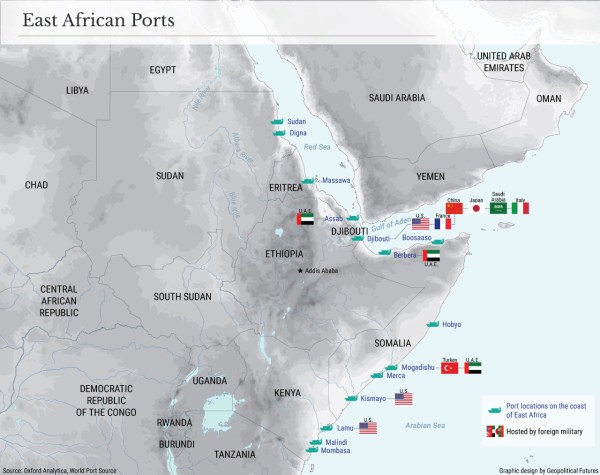
The Horn of Africa, where the Red Sea descending south from the Suez Canal meets the Gulf of Aden and the Indian Ocean. As the map above suggests, a region filled with foreign military bases, American, French Italian, Chinese, U.A.E. Saudi and who knows which other countries!
The Horn is usually defined as including Eritrea, Ethiopia, Djibouti and Somalia. Yemen sits just across the Red Sea and Bab el Mandeb Strait from the Horn; although part and parcel of the Arabian Peninsula, its proximity to the Horn has resulted ins vibrant economic, social and cultural exchanges.
The whole region is populated by 140.6 million people. The two main macro groups in the Horn are the Cushitic-speaking Cushitic peoples traditionally centered in the lowlands and the Ethio Semitic-speaking Ethiopian Highlanders and Eritrean Highlanders centered in the highlands. It contains such diverse areas as the highlands of the Ethiopian Plateau, the Ogaden desert, and the Eritrean and Somalian coasts and is home to the Amhara, Tigray, Oromo, and Somali peoples, among others.
Given the strategic importance of Yemen, it current role as a part of the Axis of Resistance that brings together Iran, forces in Iraq, the Syrian government, Hezbollah in Lebanon and Hamas in Gaza, I want to start this series with a piece on Yemen. Although Yemen is not on the Horn itself, there is what can be considered a “Red Sea-Gulf of Aden Culture” which has existed for millenia. Developments in Yemen affect the Horn and visa versa. From the viewpoint of global geopolitics it is a focal point of merging and conflicting interests as a result of its strategic location for maritime trade between East Asia, India, the Persian Gulf, East Africa and the Eastern Mediterranean. the Bab El Mandeb Straits has long been a strategic chokepoint for global trade. I’ll discuss some of the socio-cultural interactions between Yemen and
From the outset I want to acknowledge that while I am familiar with both Yemen and the politics of the Horn of Africa in General, that a two part video series (Part One, Part Two) done by Eritrean journalist Elias Amare and Ethiopian-Somali scholar/diplomat Mohammed Hassan is what has stimulated this series. That plus my growing discomfort at the prospect of a regional implosion as new tensions rise between Ethiopia and Somalia over Somaliland, the increasingly dangerous situation within Ethiopia itself which could easily explode into civil war, from which the whole region could implode, an occurrence which could destabilize all of Africa … and beyond. There are some voices, among them, Professor Mohammed Hassan, who argue that an implosion of Ethiopia could lead to Rwanda-sized genocides.
How to prevent such dark scenarios? What is Washington – be it either Democratic or Republican Administration – doing to either exacerbate or calm the situation?
The Yemeni Factor – Plan B
Afghanistan has been called the “graveyard of empires.” Yemen can also be considered the same.
The Ansar Allah movement in Yemen, controlling 80% of that Arabian Peninsula country,
Yemen’s – that of Ansar Allah, commonly referred to as “the Houthis” – entry into the fray has had an electrifying impact on the wars in the Middle East. Just after the Palestinian “October 7 surprise”, the country mobilized – literally – a million men to go to Gaza to fight alongside Hamas and the other Palestinian resistance groups. How they would get there was problematic as this enormous army would have had to march across Saudi Arabia, a snippet of Jordan, enter Israel and proceed to Gaza. Saudi rejection of safe passage nicked the plan.
Undeterred, Yemen embarked upon “Plan B” to show it solidarity with Gaza.
As Max Blumenthal (the GrayZone) succinctly put it:
“The Ansar Allah movement controls the majority of Yemen after fending off a brutal U.S. and U.K. backed military campaign led by Saudi Arabia. After Israel began its bloodstained assault on the besieged Gaza Strip this October, Ansar Allah, known popularly as the Houthis, enacted a naval blockade targeting Israeli-linked shipping in the Red Sea as a means of putting pressure on Israel to end its attack on Gaza.
The Biden Administration responded with attacks of its own. striking targets across Yemen”
The Yemeni attack on Red Seas shipping has shaken the region and the world, and thrown a monkey wrench into global container trade in a number of ways. The volume going to Europe through Bab El Mandeb, the Red Sea and Suez Canal has nearly halved amidst continuing attacks by Ansar Allah rebels. For the European economy, already skirting a mild recession as it tries to shake off high inflation, prolonged trade disruption could derail plans by central banks to start cutting interest rates this year.
The Israeli port city of Eilat which sits at the top of the Gulf of Aqaba, a major Israeli destination of Red Sea container ship trade, is largely closed down, its businesses and economies suffering. While container shipping has led the way in veering away from the Suez, as highlighted in the most recent weekly market report from Alphaliner, other sectors including LNG, oil and dry bulk are following suit.
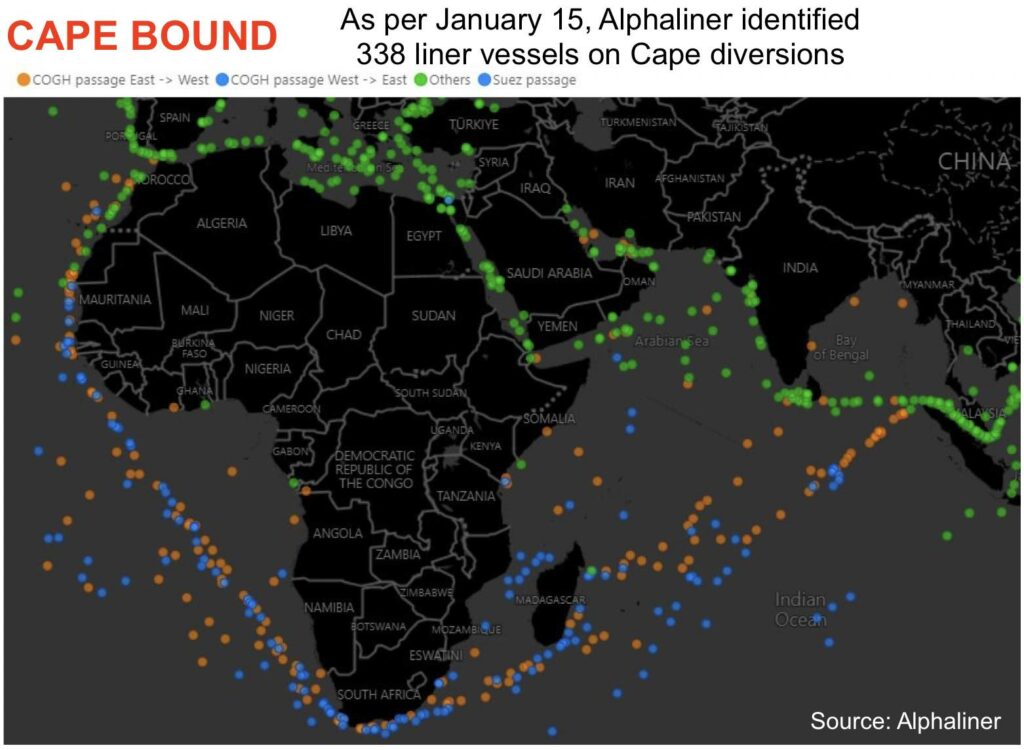
Multiple oil companies such as Shell, ADNOC and Reliance Industries have this week joined BP in suspending their sailings through the Red Sea.
Attempts to compensate for the Red Sea blockade of Israel-bond ships have not amounted to much. There is an Israeli plan to bypass Red Sea maritime trade by setting up an overland trucking connection through Saudi Arabia and Jordan to Israel. Besides adding a great deal to the cost of the shipped goods as a result of fuel and other transport costs, at least to date, the system has not worked. While rerouting Red Sea bond containers around Africa’s Cape of Good Hope has picked up, many of the ports along the route, necessary for restocking, repairs and the like, are unequipped to handle such large ships, some of which hold 30,000 or more containers. Shipping insurance costs have spiked as well. Combined all these factors with fuel global inflation some.
It should be recalled that Yemen is among the world’s poorest, if not the poorest, countries. Not only is this “David” standing up to Washington and London “Goliaths”, but poor, bombed out Yemen appears to be undaunted, completely fearless in the face of the West’s current bombing campaign. Ansah Allah’s response to the U.S. State Department declaring Ansah Allah as a terrorist organization, Yemen’s Ansar Allah parliament has indicted both the United States and the United Kingdom as “global terrorist networks“.
Besides embarrassing if not humiliating both the U.S. and U.K. for their inability to intimidate or threaten the Global South’s creative version of slapping sanctions on the world’s great powers, Ansar Allah’s Israel-bond shipping blockade has electrified the Arab and Muslim world. In the Arab World, the broader Islamic World, indeed pretty much the whole Global South, respect for Yemen is soaring. Arab leaders, rather timid and even frightened to stand up to Israel in solidarity with the Palestinians, are extremely nervous that the pervasive anger mounting over Israel’s Gaza suicide, fear popular rebellions from below.
Yemen and the Horn of Africa – Millenia of friendship, cross fertilization
Civilized life in Yemen stretches way back before the time of Christ. It has had a number of civilizations over the centuries. Its civilization has had an impact on the nearby Horn of Africa. The alphabet now used in Ethiopia and Eritrea come from Yemen. They have practiced farming since time immemorial. The early Yemenis developed new irrigation techniques that have been introduced as far east and Indonesia and China. Master stone workers, their stone work is reflected in their unique architecture which is famous worldwide.
In ancient times, a sizable percentage of the population there was Jewish. Later on Islam was introduced. Tthe idea of “a nation” is a modern concept and new development but Yemenis also ruled by different rulers, different groups like the Hadramut, a big part of southern Yemen; then there is the center of southern Yemen, the middle of the country the Tais area – it’s also a mountainous area. There is also the area of Sana’a-to Sa’ada. This is the Zaidi region in the north. After they left Saudi Arabia the Zaidis made their home in Yemen; Imam Zaid is the third Imam of the Shi’a. But it is the Zaidis who have created a sort of system that has kept colonialism, imperialism and even other hegemonic forces at bay
Although Yemeni society exists within a specific geographical framework, they have been traders and travelers whose influence extended far east to India, China, Indonesia all of which established stable Yemeni communities. Yemeni Americans are Americans of Yemeni ancestry. According to an estimate in 2010, more than 100,000 Yemenis live in the United States. Many were recruited by Henry Ford early in the 20th Century to work in the Detroit area auto plants.
Yemenis expanded far throughout Africa , to Asia
Another character of the Yemenis – because of their capacity as traders, merchants is they have expanded to Indonesia. There is a huge community of Yemeni origin in Indonesia; they are also in Malaysia for example; the family of the ideologue of the ruling Malaysian party comes from Yemen. His name is Abdullah.
Because of their location, slowly, slowly the people of Yemen have become closer to the people f the Horn of Africa – Eritrea, Ethiopia, Somalia. There are organic linkages of the Horn of Africa to the Gulf of Arabia historically as well as in modern times. In many ways, the Yemenis have become close to the people of the Horn of Africa over the centuries:
- A lot of Yemenis came, settled in Eritrea, created their own communities there; they brought their food habits to the region.
- Later, by allying with Italian fascists, Northern Yemen brought a lot of workers to build the road between Asmara and Addis Ababa
- Yemenis also are those who introduced markets everywhere in Ethiopia. They are merchants all over Ethiopia, south, east and west.
- Yemenis also were used by the British, they were paid in the British conquest of Southern Somalia that was conquered by Yemeni soldiers.
Another character of the Yemenis – because of their capacity as traders, merchants is they have expanded to Indonesia. There is a huge community of Yemeni origin in Indonesia; they are also in Malaysia for example; the family of the ideologue of the ruling Malaysian party comes from Yemen. His name is Abdullah.
So you could see that the Yemenis expanded far throughout Africa , to Asia.
There has long been a certain dichotomy between the inland and more northern Yemenis from those living along the coast of the Gulf of Aden and the Red Sea. With the coming of Imperialism and British control of Aden and gradually expanding and controlling other tribal areas, they created a region that became known as South Yemen, made up of the Hadramawt and other southern provinces. British control did not extend to the north which remained in the hands of the imamate but imperialist interferences happened now and then but the imamates kept their independence; to a certain extent they did not allow others to colonize them.
The only Western or other European power could successfully penetrate and create alliances with the imamate was Fascist Italy of Mussolini. Mussolini had the idea to create an empire, including Yemen and the Red Sea; He had his own mini program to create that. He created a cordial relationship with Yemen. Gradually Italy helped the Northern Yemeni army modernize – the modernization was started by the fascist state.
Italian fascists never controlled northern Yemen; but they were present there.
Returning to the main trajectory of modern Yemeni history, it could be said that the transformation in Aden into a major British port speeded processes of modernization along the coastal areas; it brought foreign workers, foreign elements, the good number of whom were Somalis and Indians, the gradual expansion of British colonialism to bring other tribal groups under its control, all this led to tighter British control over Aden and its surroundings.
At one time Aden became the most important harbor and economic hub in the region. It is where people from all over the Horn and Red Sea area people shopping there. This was just prior to independence and the creation of South Yemen. Its influence was regional; new dress for women was introduced in Somalia; new Somali music came into being. The best musicians, oud players in Yemen (introduced from India) gradually was integrated into Somali music. Some of the best Somali musicians from the last century were born and grew up in Yemen.
The second biggest community in Aden were Somali speakers, another Yemeni-Horn of Africa cross fertilization. The more modern thinking which developed in the Aden area of Yemen was also transferred to Somalia.
Turning to more modern Yemen … First let’s concentrate on the North and then on the South.
North Yemen and Saudi Arabia in the 1960s
In the 1960s the Egyptian leader Gamal Abdul Nasser intervened on the side of the Republicans to help them in the fight against the royalists (those allied with Saudi Arabia). Just before he died, in 1969, Nasser was said to have repeatedly noted that one of his worst mistakes was the Yemen intervention because the Yemenis were such fierce opponents. The Egyptians lost 9000 soldiers and Nasser was very unhappy about that and the Saudis subsidized the money, brought mercenaries and weapons but they could not overthrow the republican government.
In the North, progressive officers, influenced by Nasser, came to power, overthrew the imamates and came to control state power. This resulted in external intervention. This new thinking not only effected Yemen. It also spilled over into Saudi Arabia. Young members of the royal family defected to Cairo; pilots also defected. So this concept of modern thinking was established and was also penetrating Saudi Arabia.
This placed the House of Saud in danger.
After the U.S. led oil industry was built in Saudi, the Saudi working class grew; U.S. specialists were working in the industry; a trade union consciousness developed; and soon, as trade unions are wont to do… in short order they began to strike for better wages, working conditions. King Faisal wanted to roll back what was happening in Yemen. The “nationalist virus” was coming too near and infecting Saudi Arabia itself.
Egypt’s intervention in Yemen came once Saudi Arabia decided to roll back the republican government and intervened in support of the imamates. The imamates fled to Saada; they went to Saudi Arabia as well. King Faisal of Saudi Arabia thought that “this virus” has to be stopped because there can be spill-over damage and will result in a similar situation in our country.
Pan Arabism frightened the House of Saud. Modernism, trade unions, republicanism and such, it threatened the Saudi royal family; they feared being overthrown because they had seen that King Farouk of Egypt had been overthrown by Nasser; they saw that the Iraqi monarch was similarly overthrown; same in Syria. Thinking that they were encircled by these “republican ideas”
Modernism, trade unions, republicanism and such, it threatened the Saudi royal family; they feared being overthrown because they had seen that King Farouk of Egypt had been overthrown by Nasser; they saw that the Iraqi monarch was similarly overthrown; same in Syria. Thinking that they were encircled by these “republican ideas” Saudi Arabia intervened. Egypt’s intervention in Yemen came once Saudi Arabia decided to roll back the republican government and intervened in support of the imamates. The imamates fled to Saada; they went to Saudi Arabia as well. King Faisal of Saudi Arabia thought that “this virus” has to be stopped because there can be spill-over damage and will result in a similar situation in our country.
King Faisal’s brother-in-law, the one heading up the intelligence service, was a sophisticated and farsignted man for his time. He’s of Albanian origin; his sister is married to King Faisal. This is the man who said that to “stop this virus of Republicanism” there is only one solution: Saudi Arabia should not have a modern working class. He considered “a modern working class by itself is a virus.”
It means trade unions; from there will come patriotism. Demands will increase – democratization issues will come; republicanism will come and the monarchy will disintegration. So he said, we should not create a Saudi working class!
That was a very farsighted decision. From that day onward, Saudi Arabia decided not to have a working class except for guest workers.
The Egyptians lost 9000 soldiers and Nasser was very unhappy about that and the Saudis subsidized the money, brought mercenaries and weapons but they could not overthrow the republican government but it (the Saudis) had weakened it. Finally a compromise solution was put together. Saleh, the Republican leader had to resign and a milder, more centrist leader Mohammed al Iriani took over
The relationship between Saudi Arabia and Yemen, especially N. Yemen improved and became smoother. Saudi Arabia also made certain concessions to the Yemenis. Yemeni workers were permitted to enter Saudi Arabia; a special type of work permit was created for Yemeni workers – a residence permit. It gives Yemenis certain liberty of action; they are not controlled by Saudi contractors. They have the right to do business; they have the right to work. A considerable number of working class Yemenis thus went to Saudi Arabia.
South Yemen Emerges as a major link on global maritime networks
In S. Yemen, the situation was totally different.
First of all because Aden is a cosmopolitan center; a good number of Yemenis from the South had also studied outside the country and gotten western educations. Some of the same kind of political movements that existed in the north, – anti-colonial, progressive nationalist movements, also developed in the south.
These movements took up arms against the British colonial system, To neutralize the growing revolt, the British sent a special advisor to S. Yemen to study the independence movement, counter insurgency expert, Edward Kennedy Trevaskis. Trevaskis had had experience both in Rhodesia and Eritrea.
Elias Amare: Yes and he was knighted and became Sir Edward Kennedy Trevaskis. He wrote a book about Eritrea “A Colony in Transition” , pubished in 1960. In fact, Trevaskis is the “father of the Gulf countries. He’s the one who created the Gulf countries. He also wanted to change S. Yemen – minus Aden – and other Gulf states, appointing clan leaders to be autonomous but the struggle in Yemen intensified; it matured, it brought together a united front of forces – Nasserite forces, Baathist forces from Libya, Syria and Iraq.
A member of the politburo of the Indonesian Communist Party, of Yemeni origin from Hadramawt came and influenced the national movement and brought Socialism and the idea of Marxism-Leninism by a Yemeni-Indonesian.
1970 was the year that British colonialism in Yemen ended; a new post-colonial socialist country, the People’s Democratic Republic of Yemen as it was called – the PDRY – came into being. A year later, a Socialist Party came to power and became the ruling party. But in the Socialist Party there were different forces contending with one another – the two Baathist parties – the Iraq and Syrian Baathists, Nasserites and also Communists which is Abdul Fattah Ismael. So within the leadership there were contradictions.
The first contradiction – the Iraqi Baathists revolted against the Party and they were crushed. The internal struggles in the PDRY among the ruling elite devastated the party and soon the Socialist Party was overthrown its leadership purged. What is somewhat ironic is that the program of the Socialist Party in the South was essentially the same as the program of the parties ruling the North. Both believed in the unity of Yemen; that unity which is sacred for both the North and the South.
Then in 1979 a young officer, Ali Abdullah Saleh took over the reigns of power in Sana’a and brought about the reunification of the country. Yemen became unified.
In 1990 the war against Iraq started. Yemen paid a very big price for refusing to support the U.S. led invasion. The U.S. cut aid and IMF/World Bank support This is the beginning of the modern Yemeni crisis. Because of its position in the UN Security Council a huge number of workers, who worked in Saudi Arabia were expelled to Yemen; Yemeni currency weakened; inflation increased.
There was a second element to the Yemeni crisis. The right wing of the S. Yemenis in 1993 unilaterally decided to succeed but this movement was crushed by all other Yemeni forces including Ali Abdullah Saleh. That was his great success; it boosted his prestige … as well as his ego.
Despite the continuing economic crisis Ali Abdul Saleh joined “the war against terrorism” after September 11, 2003. This resulted in his becoming an ally of both the United States and Great Britain. The latter used a lot of drones to kill different Yemeni personalities. The killing increased; the opposition to Yemen’s alliance with Washington and London increased, leading to a popular revolt. It started from Saada to Sana’a; shortly thereafter it spread nationwide. Ali Abdullah Saleh was overthrown; he turned power over to his vice president, Abdrabbuh Mansur Hadi of united Yemen but the popular revolt undercut Saleh-Hadi’s mass base. Yemen could not be controlled.
The popular revolt started from the North among “the Houthis”. Where does this name, “the Houthis”, come from? They don’t call themselves “Houthi”; they call themselves Ansar Allah. “Houthi” is the name of the leader who marched from Sa’ada to Sana’a and later on he was killed.
To be continued in Part Two
 View from the Left Bank: Rob Prince's Blog