Costa Rica 4 – It’s beautiful rainforests aside, What’s the deal?
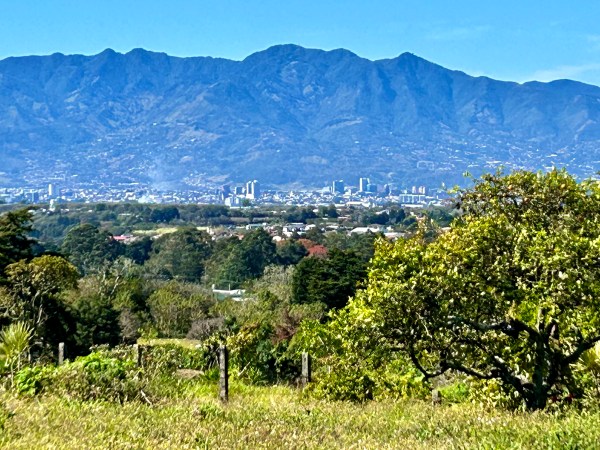
San Jose from San Isidro, Heredia
The time that Nancy and I spent in Costa Rica on vacation with ex-pat friends living there was enriching, enjoying, relaxing in every way.
Most things that seem too good to be true … are just that. So I have to wonder about this place where we spent so much enjoyable time, and to which, I admit, I hope to return, next time with camera and “bazooka gun” lens to photograph birdlife.
For a brief moment – two weeks – we could (kind of) escape the world’s ugliness to enjoy this Central American country’s extraordinary natural wonders without much delving into the country’s seamy side.
I did very little of that actually although the last day a number of questions, beginning to scratch below the surface began to gnaw away at my Marxist soul, among them:
In 1948 as a part of an arrangement with the United States, Costa Rica abolished its military in an exchange for a commitment from the United States to insure its security. Without the punishing burden of military expenditures Costa Rica has been able to develop social programs, a W. European-like social contract that remains 75 years on in tact and in many ways impressive, and no doubt socially stabilizing.
- What did Washington get (and still maintains) in return? An open environment for investment on Washington’s terms? A strategic outpost for monitoring its strategic neighbors, Panama with the canal? Nicaragua with its Sandinista government that has managed to survive (kind of) all these years? Dunno. Just wondering
- With its rainforests, explosive diversity of flora and fauna and general social stability, Costa Rica is both a tourist Mecca and the hope for a large ex-pat community that numbers some 70,000 from the USA and Canada, “a friendly place” for North Americans both to visit and retire to, a kind of more interesting (to my tastes), more “authentic” southern Florida. The place is crawling with North Americans, Western Europeans. Yet tourism is actually an unstable basis on which to build the foundation of economic and social development as it fluctuates with the ups and downs of the global economy. What are the advantages, the costs of such an approach?
- From the point of view of global political economy, the country finds itself in the periphery with some semi-peripheral industries. The top exports of Costa Rica are Medical Instruments ($4.32B), Bananas ($1.23B), Tropical Fruits ($1.14B), Orthopedic Appliances ($1.01B), and Other Edible Preparations ($638M), exporting mostly to United States ($6.31B), Netherlands ($1.18B), Belgium ($729M), Guatemala ($727M), and Panama ($585M).
- What are the environmental impacts of mass producing pineapples, bananas and the like for North America and Europe. A friend on social media mentioned water pollution from pesticide usage on pineapple farms. Raised the question in my mind about sustainability, what lies under the surface of Costa Rica’s ecotourism.
- On a geostrategic level, one that guides my thinking worldwide, what role does Costa Rica play in the United States’ overall policy for Latin America and the Caribbean? How does U.S-Chinese economic competition play out in the country. Our host, Daniel Walker pointed out a major sports/concert stadium in downtown San Jose built by the Chinese. But Chinese economic investment, trade is slowing to a trickle and did not take off after its construction. What’s that about?
- In a region where any leader who challenges U.S. prerogatives doesn’t last very long – (think Guatemala, Hondorus, Nicaragua, Panama, Grenada, Cuba, Haiti, Dominican Republic – and probably others) – how is it that Costa Rica has enjoyed relative stability? It’s kind of a mutant example of stability in the region. A number of “Costa Rica – like” examples that Washington has used as “models” for “development” in the Global South that I am more familiar with came to mind – Tunisia in N. Africa, Ghana in West Africa. Although suffering from punishing debt both these countries, are often portrayed as development successes resulting from U.S. and (of all things) World Bank/IMF aid. Yet a close examination suggests that in both these countries, social instability and increased class polarization plague their political landscape as their economies are pried open for foreign investment and forcing core-produced finished products down their throat.
Is Costa Rica merely the Central American example of Tunisia and Ghana (or visa versa)?
Again, here more questions than answers to all of these points. “Just wondering” as friends would say.
 View from the Left Bank: Rob Prince's Blog
thoughtful questions, as always, but largely answered by the simple fact that Ticoland is effectively a wholely-owned subsidiary of US capital, its guarantee of CR’s security a yoke of subordination.
I was hoping you in particular might clarify that.