Palestine Tet – 108 – Algeria weighs in at the Security Council in support of a ceasefire; the Biden Administration vetoes the effort now for the fourth time.
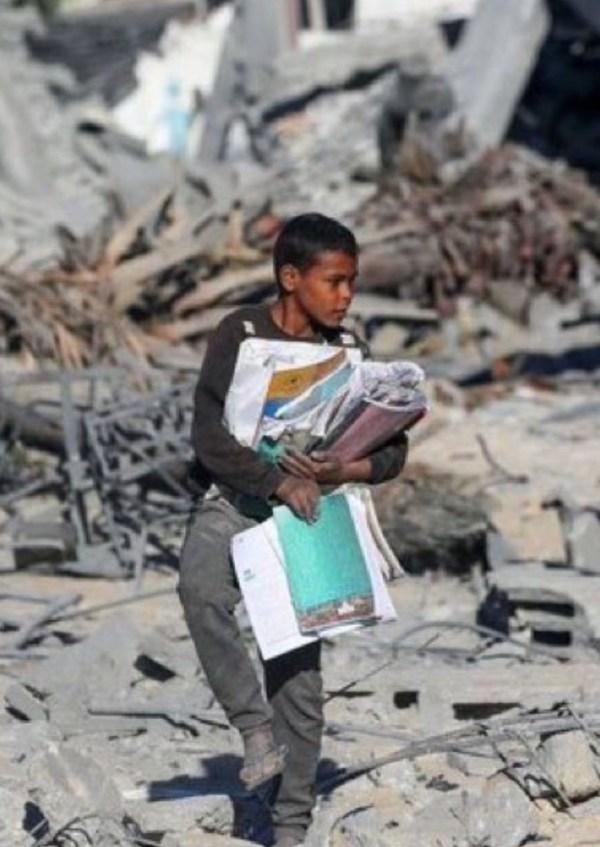
This boy saved his books after Israel blew up his school
(Note: This is a Google Translation French-to-English of an article found on Algeria Watch, excellent website. Most of its articles are in French and/or Arabic but occasionally there is one in English.)
War against Gaza: Lula accuses Israel of genocide
BY AW · FEBRUARY 19, 2024
Amel Blidi, El Watan, February 19, 2024
Despite repeated calls from the international community to end the war, the United States has threatened to veto the draft resolution to the UN Security Council, submitted by Algeria, calling for a cease-fire. immediate humanitarian fire.
While the international community is trying to negotiate a ceasefire in Gaza, notably through a draft resolution to the Security Council submitted by Algeria, the prospects for peace seem to be fading, exacerbating the suffering of the Palestinians in Gaza. trapped in an endless war.
Despite repeated calls from the international community to end the war, the United States threatened to veto this draft resolution to the UN Security Council, submitted by Algeria, calling for a cease. -immediate humanitarian fire.
The decision of the International Court of Justice in January, calling on Israel to prevent any potential act of genocide in Gaza, gave new impetus to diplomatic efforts. But the fact is that the United States is blocking all initiatives aimed at ending the war against the Palestinians in Gaza.
The decision of the International Court of Justice in January, calling on Israel to prevent any potential act of genocide in Gaza, gave new impetus to diplomatic efforts. But the fact is that the United States is blocking all initiatives aimed at ending the war against the Palestinians in Gaza.
The latest version of the text, on which Algeria has requested a vote for tomorrow, Tuesday February 20 – and has already been put in “blue” – “requires an immediate humanitarian ceasefire which must be respected by all parties”, while the Israeli offensive in Gaza left 28,858 dead, the vast majority of them civilians, according to the Palestinian Ministry of Health in Gaza.
The draft resolution “refuses the forced displacement of the Palestinian civilian population” and calls for an end to this “violation of international law”. He also calls for the release of “all hostages”. At the beginning of February, the American ambassador to the UN, Linda Thomas-Greenfield, claimed, according to comments reported by AFP, that Algeria’s initiative for a new resolution risked being “derailed” negotiations for a truce including further releases of hostages – negotiations still ongoing.
“We believe that it is now high time for the Security Council to adopt a resolution on a humanitarian ceasefire,” argued for his part, a few days ago, the Palestinian ambassador to the UN , Riyad Mansour, believing he had been “more than generous in giving more time”. “There is massive support among the members of the Security Council,” he assured, despite the uncertainty over the American position.
It should be remembered, in this regard, that Israel and its American ally had blocked previous resolution attempts because they did not contain a firm condemnation of the Hamas attack of October 7.
It should be remembered, in this regard, that Israel and its American ally had blocked previous resolution attempts because they did not contain a firm condemnation of the Hamas attack of October 7.
“The negotiations have not been promising…”
The problem is that even truce talks seem to be stalling. These negotiations, led by Egyptian, American and Qatari mediators, have not yet resulted in an agreement.
Hamas threatened to leave these talks if “(humanitarian) aid was not delivered to northern Gaza.” Its leader, Ismaïl Haniyeh, repeated that his movement demanded a ceasefire and Israeli withdrawal from Gaza. Conditions rejected several times by Israel, which continues to raze entire neighborhoods with impunity, displacing 1.7 million of the 2.4 million inhabitants and causing a major humanitarian crisis, according to the UN.
“The negotiations have not been very promising in recent days, but we will do our best to get closer to an agreement,” Qatar Prime Minister Mohammed bin Abdelrahmane Al Thani said yesterday in Munich. Meanwhile, on the ground, Israeli Prime Minister Benjamin Netanyahu remains determined to continue a ground offensive in Rafah, despite international calls for restraint.
Serious concerns have been expressed around the world, including by the American ally, for the civilians, most of them displaced, in this city located on the closed border with Egypt. During a telephone call with his French counterpart Emmanuel Macron, Egyptian President Abdel Fattah Al Sissi, according to the AFP agency, repeated “Egypt’s categorical position of rejecting the displacement of Palestinians (towards its territory, editor’s note) in any form”.
In recent days, an Egyptian NGO and the Wall Street Journal reported that Egypt was building a closed and secure camp in the Sinai intended to accommodate Palestinian refugees in the event of an Israeli offensive on Rafah. Israeli military operations are now focused on Khan Younes, leaving the local population in an increasingly precarious situation.
At the heart of this crisis is the Nasser hospital, which has been reduced to ruins by the incessant bombings of the occupying army.
 View from the Left Bank: Rob Prince's Blog