Costa Rica 5 – Toucan Rescue Ranch
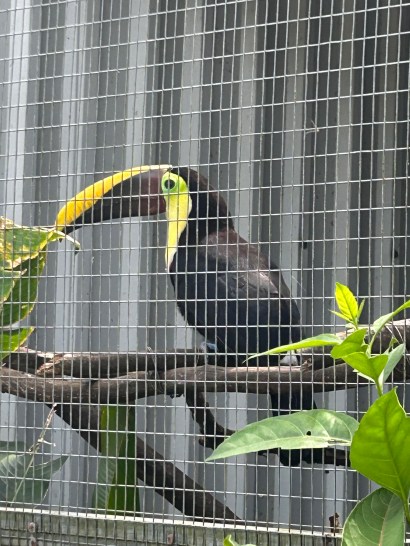
a Yellow-throated Toucan. Heard one in the wild near Sarapiqui
________________________
(Learn how the Saving Sloths Program was created)
No doubt, one of the highlights of our two weeks in Costa Rica was a visit to the Toucan Rescue Ranch. Located northeast of San Jose in the Central Valley, the “ranch” was originally opened to receive wounded toucans (see photo) but before very long it was opening its doors to wounded and abandoned animals of all sorts, “rescued from various serious situations.”
At the ranch, they are repaired and cared for, and when possible – which is quite frequently – released back into the wild somewhere in the country’s vast rain forests.
The Toucan Rescue Ranch has been releasing wildlife at this property for over 10 years. Here, we’ve released toucans, parrots, parakeets, sloths, owls, hawks, falcons, opossums, reptiles, and other wildlife. As a part of the program TRR has large soft-release enclosures that allow professionals to create natural environments in order to train rehabilitated animals natural behaviors and skills to be successful once released into their natural habitat.
Besides several toucans housed there we were introduced to ocelots – one that the tour guide Andreas claimed to have been a drug lord’s pet -, jaguarundis, crested Caracaras, bat falcons, an array of parrots and the adorable (from a distance) sloths.
The ranch employs an international team of veterinarians, maintenance and financial management people who are involved in everything from animal healthcare, preparing releases into the wild, leading tours, etc.
My initial impression was of a well run, professionally staff set of folk deeply dedicated to their mission and very good at it. As ecotourism is big business in Costa Rica I was surprised to learn the Toucan Rescue Ranch receives no government funding; thus it is funded completely by private donations. Founded 20 years ago (2004) by American ex-pat Leslie Howle, a long time Costa Rica resident, the Ranch claims as its goals:
TRR GOALS
- To establish a captive breeding program for all six species of Costa Rican toucans.
- To accept, evaluate and treat rescued animals in need.
- To rehabilitate and release injured wildlife back to its’ natural environment.
- Provide educational programs, research sites, and facilities across Costa Rica.
- Provide volunteer opportunities for national and international individuals.
The sloths
No doubt one of the prime attractions at the Toucan Rescue Ranch are the slow moving two-toed sloths. I certainly enjoyed the stimulating discussion of sloth behavior given by our guide, Andreas, himself one of the world’s few experts studying sloth behavior. They are curious animals who seem to move in slow motion almost all the time a result of a somewhat inefficient digestive system that fails to get all the energy out of food necessary for sloths to move more quickly. Indeed the sloths we saw were experts at conserving energy.
I was reminded of an evolutionary process called parallel evolution where two species look quite alike, but have actually diverged many millions of years ago and are actually only distantly related. The classic example among primates are the differences between old world and new world monkeys. Yes both are monkeys… but based upon closer skeletal and now genetic evidence it turns out they are more 3rd or 4th cousins rather than siblings. So it is with sloths; the two toed having actually diverged from their three-toed relatives million’s of years ago.
Sloths belong to a family of mammals called edentates (or toothless mammals). Actually it is not that they are toothless – sloths have very sharp teeth but that all the edentates lack canine teeth, suggesting that they are mostly vegetarian and not carnivorous. Their closest living relatives include anteaters and armadillos all of whom have relatively small brains in relationship to body size.
Although a relatively isolated, insignificant variety of mammals today, sloths have quite a history. They emerge, at least what the fossil record suggests, some 35 million years ago as a generalized part of mammalian species expansion taking place at that time. At one time, our Toucan Rescue Ranch guide related, there were as many as 800 varieties that exploded into different species all over the world. Ancestral sloths included the giant ground sloth that was six feet tall and weighed more an a modern day elephant, megatherium that had a long successful run from 35 million to 11,000 years ago and whose bones are found in the La Brera Tar Pit in Los Angeles, a maritime sloth Thalassocnus, the fossilized bones of which are found near the shores in Chile and Peru and who spent most of its time underwater (although clearly a mammal). All this just a small sampling of what was a great sloth diversity and of which very few forms remain.
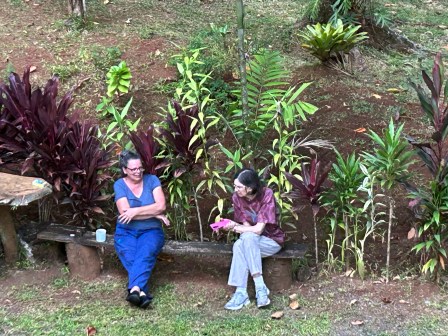
Carol Friesen and Nancy in Sarapiqui. Somewhere nearby us is the place where the Toucan Rescue Ranch releases patched up animals able to return to the wilds. Until recently Carol had done TRR’s books.
It was a stimulating very interesting visit. I have a sense that many of Costa Rica’s animal rescue facilities are little more than tourist traps. The Toucan Rescue Ranch is not one of these. It is a serious, wondrous place, one that the Costa Rican government knows is of high quality. The Costa Rican government could do a lot worse than to adequately fund it and insure its future.
 View from the Left Bank: Rob Prince's Blog