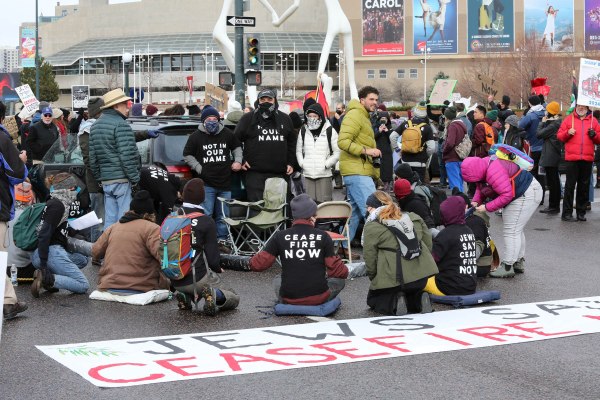

 (Photo Credit: Hussein Malla/AP)
Israel has informed its western sponsors of a 15 March deadline to reach “a political settlement with Lebanon,” after which Tel Aviv says it plans to “escalate military operations to a broad war,” according to western diplomats that spoke with Lebanese daily Al-Akhbar.
The report comes after the most recent visit to the region by US special envoy Amos Hochstein, who Israeli Defense Minister Yoav Gallant told that Hezbollah’s continued operations are bringing the country closer to a “decision” about expanding its operations inside Lebanon.
“Hochstein has become convinced of the difficulty of stopping the fighting in Lebanon before it stops in Gaza, and he is also convinced that Hezbollah does not want escalation,” Al-Akhbar cites the western diplomats as saying. Furthermore, Lebanon’s Nidaa al-Watan quoted western officials on Thursday as saying that Hochstein “has backed down from the condition of Hezbollah’s withdrawal” from the border region and that “he is no longer mentioning this matter in his meetings” with Lebanese officials.
The diplomats added, “His entire demand has become a ceasefire with guarantees from both parties.” Nevertheless, Nidaa al-Watan’s sources also revealed that Hochstein has “formed a US work group led by US Ambassador Lisa Johnson that will hold meetings at the embassy and devise a political paper for implementing Resolution 1701.”
US intelligence agencies recently determined that Tel Aviv was considering launching a ground operation in southern Lebanon as early as “spring or early summer.”
Washington and Paris have been pushing a de-escalation proposal on Lebanon since early February. The leading demand of the western initiative is a withdrawal of Hezbollah from the border region. However, the proposal does not include any Israeli concessions to Lebanon, such as a withdrawal from areas that have been illegally occupied for decades.
The western deal also includes an ambiguous border demarcation agreement, which Lebanon’s foreign minister recently called a “partial” solution. The Lebanese government has not officially responded to the proposal.
On 4 March, Hochstein said during a visit to Beirut that Washington “is committed to working with the government of Lebanon to end the violence that began on 8 October,” adding that “any truce in Gaza will not necessarily extend automatically to Lebanon.”
Hezbollah has vowed that it will not stop attacking Israeli sites until the war in Gaza is brought to an end.
“The position is clear. As long as the war continues in Gaza, this means that the Lebanon front is affected by it, and when it stops in Gaza, it stops in Lebanon,” Hezbollah Deputy Secretary-General Naim Qassem told Lebanese news channel LBCI on Tuesday. “When there is a truce in Gaza, we will have a truce … the US envoy Amos Hochstein can say what he wants, and we will say what we want.”
“We are not concerned with the messages that Hochstein sends and any discussions or answers he receives from state officials, and we do not interfere [with his talks with Lebanese officials]. Usually, we exchange messages with the US side. As for what Hochstein said and what he intends, it does not mean anything to us,” Qassem added before stressing that the Lebanese resistance is “90 percent sure that there will not be a large-scale war in Lebanon … the remaining 10 percent is if Israel or the US changes its mind.”
 View from the Left Bank: Rob Prince's Blog