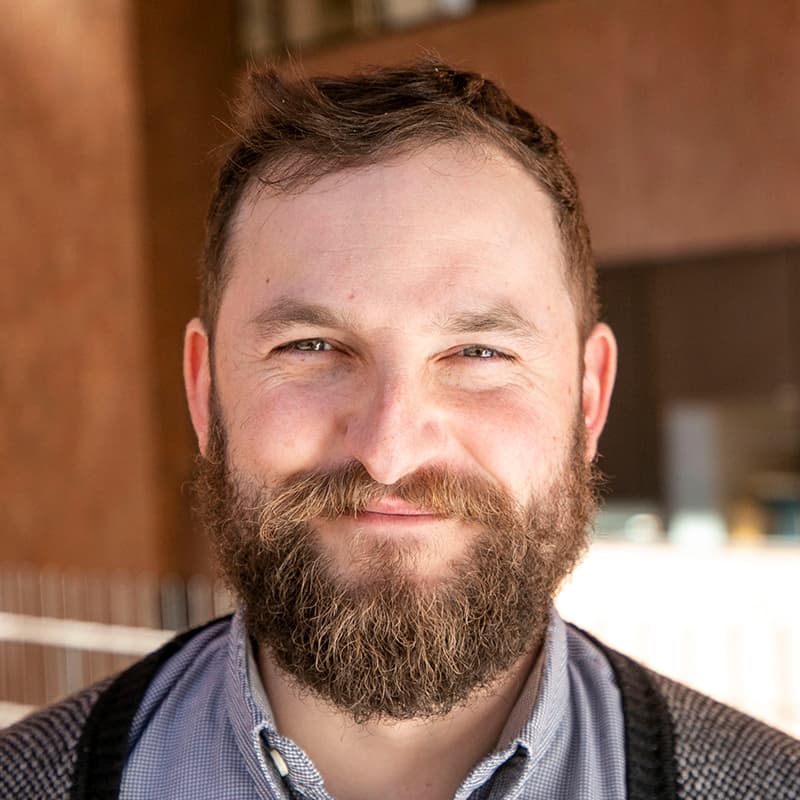
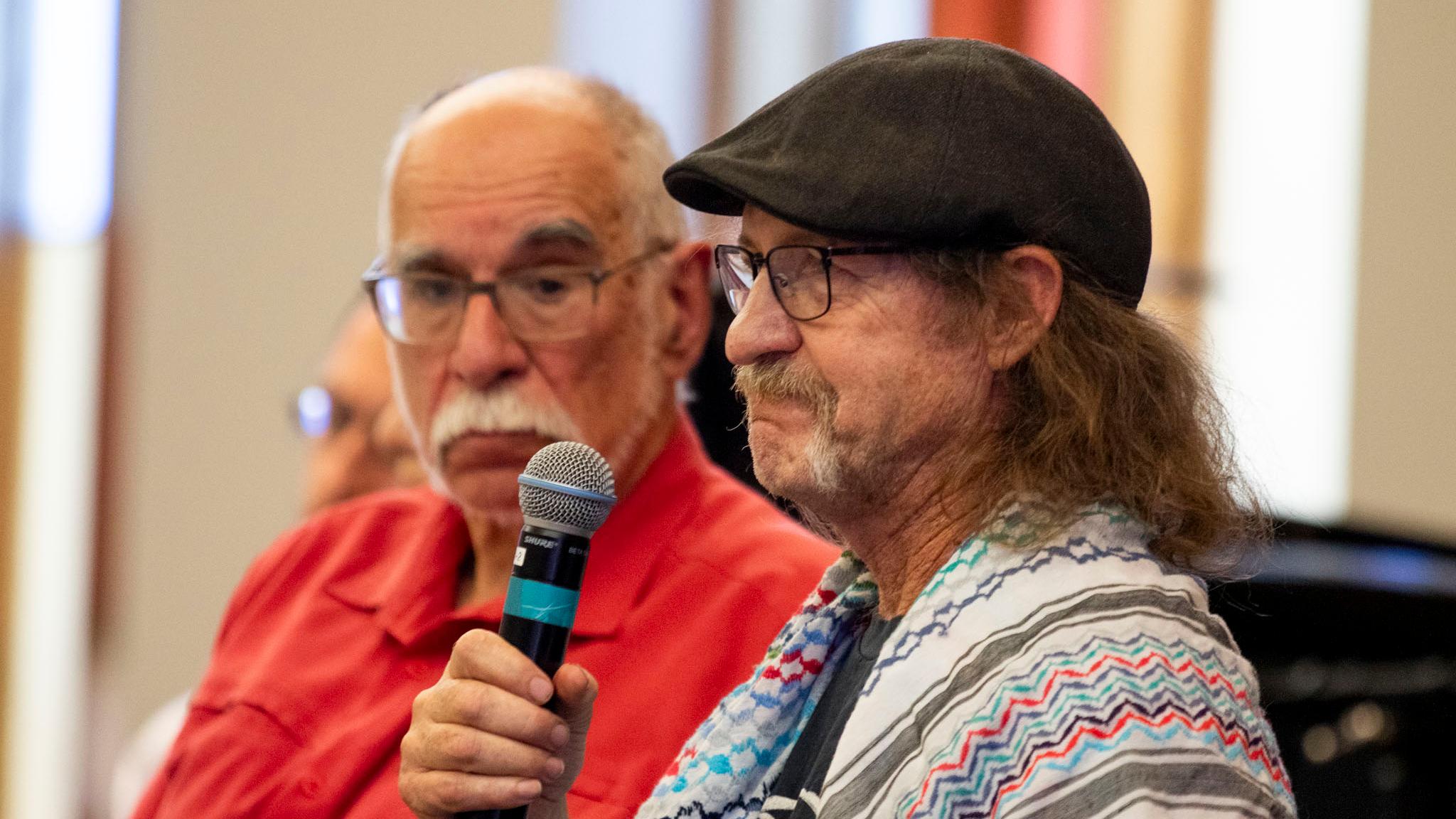
“I was, at one time going to consider taking a plea [deal],” he said from the First Unitarian Society of Denver’s stage. “Then one thing after another in Gaza. The bread massacre … the 6-year-old girl that got killed by an Israeli tank. One disaster after another. And I just became actually very angry.”
On Dec. 3, 2023, Carter joined a protest organized by Jewish Voice for Peace, which shut down Speer Boulevard to call out the Jewish National Fund’s Global Conference for Israel happening at the convention center nearby.
The protest was one of many following Hamas’ attack on Oct. 7, where the group killed over 1,200 people and took hundreds of hostages, according to Israeli officials. Since then, tens of thousands of Palestinians have been killed or wounded in Gaza by Israeli forces.
It turned out to be less black and white. Carter went to court, beat three of the four charges and ended up with similar penalties as his compatriots, all while keeping the message for a ceasefire front and center. His willingness to stand before a jury may ripple beyond this moment.

Merrill “Arnie” Carter and Rob Prince can be seen standing in the middle of protestors with arms bound together in the intersection of Speer Boulevard and Champa Street, protesting the Jewish National Fund’s annual Global Conference for Israel happening across the street. Dec. 3, 2023.Eli Imadali for Denverite and CPR
Carter describes himself as a ‘working class guy from Denver.’
He grew up in Park Hill, he said, when people like his blue-collar parents could afford it.
“I saw how my family struggled. I saw how people of color in Park Hill struggle even more,” he told us as he walked into the Lindsey-Flanigan Courthouse on Thursday. “I see how marginalized people are cast aside and thrown away and it happens all over.”
It was with that angst that he got involved in activism. He’s been a staple at protests and vigils for years, and said he could not look away as the civilian Palestinian death toll grew. This wasn’t his first arrest doing something he thought was right.
In December, Carter was arrested as other protesters formed what’s known as a “sleeping dragon,” locking their arms together in PVC and chicken wire to occupy the intersection and slow police’s attempts to move them out of the street.
He was charged with obstructing a public street, failing to obey a police order, interfering with police and possessing “obstruction equipment.” That last charge is a subsection of law prohibiting dangerous weapons, but specifically refers to gear like the sleeping dragon that might be used to block a roadway.

Arnie and Rolina Carter walk into Denver’s Lindsey-Flanigan Courthouse before Arnie’s his first day in court, for an arrest related to a pro-Palestinian protest in December. July 11, 2024.Kevin J. Beaty/Denverite
This is a fairly rare look at what happens after protesters are arrested.
While the city has faced an ongoing parade of lawsuits brought by protesters who’ve claimed police brutality since 2020, we don’t always get to see how protesters are treated when they’re on trial.
As few as 1 percent of Colorado’s criminal cases go to trial. Many people take plea deals, like those accepted by people arrested with Carter. Some of the highest-profile arrests of protesters in 2020 ended with dropped charges.
Civil rights attorney Tyrone Glover, who represented Carter in court, said state charges for protesting do tend to get dropped. Denver’s city attorneys tend not to let those go.
“They go to trial more often than other jurisdictions, but still they don’t go to trial all that often,” he told us.
They argued he was connected to the sleeping dragon via the bike lock. They pointed out that he didn’t leave during officers’ initial warnings. They tried to get Carter to admit his purpose that day was to block traffic.

Merrill “Arnie” Carter’s supporters greet him with love as he prepares for his first day in court, for an arrest related to a pro-Palestinian protest in December, at Denver’s Lindsey-Flanigan Courthouse. July 11, 2024.Kevin J. Beaty/Denverite
When Carter took the stand, they resisted letting him get too deep into why he was there.
“Talk to us about some of the lead-up and your decision to be there on that day,” Glover said to him.
“I was watching, reading, listening to accounts of civilians being intentionally targeted, children being intentionally targeted and killed on mass scales,” Carter responded. “I was reading about hospitals and medicine being withheld and used as a weapon of war. I was reading and hearing about food being withheld and used as a weapon of war. And those are all war crimes. Those are all illegal internationally —”
“Objection,” a prosecutor said, cutting him off.
Establishing intent is part of this process, Glover said, adding he suspects members of the jury took what they did hear from Carter into account when they deliberated. They acquitted him of all but the charge of blocking a road. He was sentenced to 40 hours of “useful public service” — what his buddy, Prince, said was what they thought we were doing out there in the first place.
Glover said it’s important for protesters to take charges like these all the way to a jury.
Everyone else who took a plea deal, including Prince, succumbed to what Glover described as Denver’s attempts to “kill” free speech.
“The playbook oftentimes with the city — in this city in particular — is to bring a whole bunch of charges and try to force a plea deal,” he told us. “If you bring a whole bunch of scary charges and then give them a good plea offer, most of the time they’ll take it, right? But it’s not the right thing to do.”
Carter said going to trial helped him continue to spread protesters’ messages for a ceasefire. But Glover said it may also help push back against Denver’s interest in prosecuting protesters more generally.
“You don’t want to send a message that they can essentially chill this type of action or speech by weaponizing the criminal justice system,” he said. “Prosecutor’s offices, knowing that these cases don’t come easy, protects all of our constitutional rights to air our grievances, whether you agree or disagree with Mr. Carter. And so I think him going all the way on this has done a service to all of us.”
The Denver City Attorney’s Office did not respond to questions about their tactics, but we’ll update this story if we hear from them.

Auraria Police carry an arrested protester, who refused to walk, to a bus as he and others advocate for the end of Israel’s offensive in Gaza are cleared from the Tivoli Quad. April 26, 2024.Kevin J. Beaty/Denverite
Carter was arrested months ago, but campaigns to stop the death in Gaza have continued.
In the lead-up to his trial, Carter was surrounded by activists who led actions against the Zionist conference last year and organized encampments at local universities.
Linda Amin Badwan, who is from the Palestinian West Bank and an organizer with the Colorado Palestine Lobbying and Advocacy Group, said protesters don’t set out to get arrested, though some are willing when their tactics ultimately attract police.
“It’s about, first and foremost, educating people about what’s happening there,” she told us, adding that most people had little concept of what the Palestinian territories even were before Hamas’ attack on Oct. 7 and Israel’s ensuing offensive.
The conversation over this violence has continued to miss the mark, she and her colleagues told us. Some Americans still conflate their objection to Israel’s military occupation as anti-Semitism. They don’t understand many protesters just want the killing of civilians to stop.

Linda Amin Badwan speaks at a pro-Palestinian protest encampment on the University of Denver’s Carnegie Green. May 21, 2024.Kevin J. Beaty/Denverite
Still, she believes activism here and across the country has begun to shift those misunderstandings.
When the dust from his trial settled, Arnie Carter said he viewed this episode as a “small victory.” He had a chance to keep hammering that message beyond the occupation of Speer Boulevard last winter, and he felt good about his decision to fight a deal that could have kept him silent.
“I got to talk on the stand about why I did it, and many, many people were there in support and were part of this victory,” he said. “I feel very, very good at this moment.”
 View from the Left Bank: Rob Prince's Blog
great article, thank you!