Both Sides-ism: The Battle of Narratives … Reframing and Softening the Israeli Occupation. Some Reflections on the play “The Israeli-Palestinian Conversation” playing at the Dairy Arts Center, Boulder, Colorado.
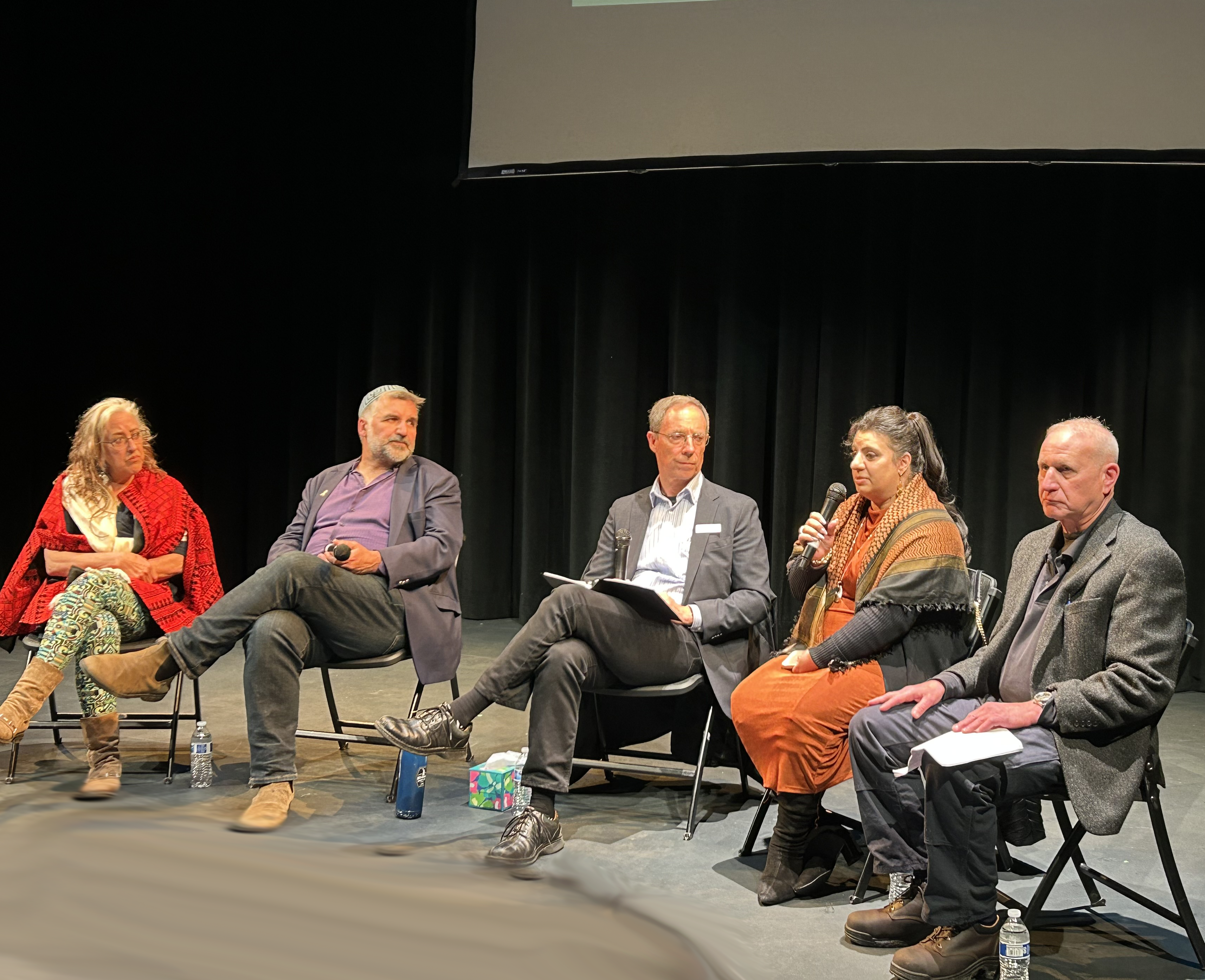
From the panel discussion at the play’s end. Left to right: Julia Halaby, Rabbi Mark Soloway, Moderator (sorry forgot his name), Reema Wahdan. Dr. Zach Levy.
The Battle of Narratives … Reframing – and softening – the Israeli Occupation. Some reflections on the play “The Israeli-Palestinian Conversation” playing at the Dairy Arts Center, Boulder, Colorado.
1. The Battle of Narratives
I used to hear it all the time growing up.
“Well, that’s your opinion.”
One way to deal with controversy is to say “that’s your opinion”. When I was younger it happened to me until I learned that what it really meant was “I have another opinion which is equally valid”. Sometimes opinion is based upon fact; other times it’s based on prejudices. So it is when defining conflicts as “narratives”.
Sometimes reducing current political controversy to narratives obscures their true meaning. I have been thinking about this since seeing a play in Boulder, The Israeli-Palestinian Conversation, this past Sunday at the Dairy Arts Center. The play itself is part of a series in which dialogue/conversation is difficult.
The play was written and produced by Ami Dayan, who also is one of the actors. He is an Israeli ex pat living in Boulder. The play attempts and, in some measure, succeeds in presenting the two sides of the Israeli-Palestinian conflict as a conversation, a painful one. There is hardly any place these days where supporters of Palestine or Israel can be found in the same space. For that alone, the play is worth it. The acting was fine; involving the audience was effective; the Palestinian and Israeli viewpoints were expressed in detail.
That the play is even taking place is a big step forward, a genuine effort at a thorny dialogue. It is also more than that: it is Ami Dayan’s way of acknowledging what many Israeli supporters deny: that the Palestinians have suffered at the hands of Israel and that the Palestinian cause/narrative cannot be glibly tossed aside as irrelevant. Following the play was a panel discussion though unfortunately much of the audience left before that.
All in all, the play is a positive contribution to public understanding, and to peace-making. Could such a play even be produced anywhere else?
2. “Both Sides-ism”
Unfortunately, The Israeli-Palestinian Conversation does have a flaw. An ex-Israeli friend refers to this as “both sides-ism”: the idea that both Palestinians and Israelis have equally valid narratives. This approach denies the basic power relationship between the two.
Both sides-ism denies the oppressive and racist essence of Zionism, its long-held practices of ethnic cleansing and, in the case of Gaza, outright genocide. Do the Palestinians owe a sympathetic telling of the Zionist narrative?
The play reflects the voice of liberal Zionist ideology (in contrast to the more messianic, religious Zionist trend). Liberal Zionism does not deny Palestinian suffering but in an effort to save the Zionist project itself, it continues to claim victimhood. Without justification, Zionists transfer the crimes of the Nazis and European anti-Semitism on to the Palestinians who had nothing to do with Jewish suffering during World War II.
Other questions:
What kind of “conversation” can the Palestinian victims of the current Israeli genocide in Gaza have with the Israelis?
What kind of dialogue is possible between fascist-oriented settlers in the West Bank and the Palestinian communities whose land Zionists are making increasingly unlivable?
While the play itself did not articulate the red lines that are unacceptable for liberal Zionists, in the panel discussion that followed a number of points were raised revealing the limits of the conversation. In response to a question from the audience, Professor Levy, a visiting scholar at the University of Colorado unequivocally opposed any ceasefire proposal. Yet, to oppose a ceasefire is another way to continue to support Israel’s genocidal repression of Gaza Palestinians, many of whom now are starving to death.
In a similar fashion, Rabbi Soloway commented that criticism of Israel is permitted but some are out of bounds. These included referring to Zionism as “settler colonialism”, speaking of Zionism as “racist” and using the term “genocide” in reference to Gaza. Not to acknowledge the nature of Zionism as a settler colonial, racist state that is committing genocide is hiding your head in the sand.
One further troubling point about the play. A play that does not explore U.S. active support for Israel’s actions is missing a key part of the conversation.
Worth seeing? Yes, definitely.


At the request of a friend who is in the cast, I sent a letter in support of the production to the Dairy Arts Center, because it had been intimated (including in your blog a few days ago) that the Center was getting pressure to shut down the show (see below). I have thought since Trump’s comments after Charlottesville in 2017 that one of the worst things about “both sides-ism” is that it gives open mindedness a bad name. Among the reasons to stand up for freedom of expression in the se terrible times is that the supression of free expression always helps Zionism and imperialism and always hurst the Palestinian cause. The best reason to support Ami Dayan’s production is not that “the Zionists have an equally valid case to make” (they don’t), but becuase it brings us one step closer to getting the Palestinian truth heard by the mainstream of what Judith Butler calls “the mundane social audience.” Many believe unconsciously in the notion that U.S. society has freedom of expression even when consciously they know better, because the fantasy of a free society is drummed into their self-image from toddlerhood. We will never achieve freedom as long as we fetishize it. It is a tool to be used in struggle by the oppressed. Let the Palestinian resistance eschew the silencing business, and grasp the tool of freedom of expression instead. It helps distinguish us (the Palestinians and their allies) from the oppressor(s). Here is my letter:
Dear Friends at Dairy Arts Center, 26 May 2025
I was a recent audience member (and, prior to that, a rehearsal volunteer) for your production of Ami Dayan’s The Conversation Part 1: The Israeli-Palestinian Conversation. I was there for opening night. Allow me to commend you for doing what few arts organizations—especially, alas, performing arts organizations—are doing these days: Giving voice to the Palestinian struggle. Indeed, you are almost doing what hardly any performing arts organizations in Colorado have done: Centering Palestinian voices. I am not a disinterested observer. On the one hand, I have been a theatre artist for all of my adult life, and a theatre teacher at colleges and universities in the Front Range area for most of that time. On the other hand, I have been involved in the struggle for Palestinian liberation (as much as one can be from here in Colorado) for pretty much that same amount of time. I am an acquaintance of Ami’s and have faith in his good will. I have a good friend in the cast of the show, and a favorite former graduate school professor directed.
Now, I have heard intimations from more than one quarter that the Dairy Arts Center is getting pressure to discontinue the run of the show. Besides congratulating you on the show itself, I want to urge you to resist such pressure (if indeed it exists). As an artist, a scholar, a teacher, and a citizen, I am a great believer in the efficacy of freedom of expression and inquiry. More than that, however, I would remind you that the current increase in political suppression of free speech, free inquiry, and freedom to dissent are all positive dangers to society locally, nationally, and globally; and this suppression is very much centered on silencing the voices of Palestine and their allies in their resistance to colonialism and genocide. Indeed, the weaponization and distortion of antisemitism has been pressed into the service of suppressing universities and education generally, let alone theatre productions. To stand for freedom of expression is to stand for the humanity and liberation of the Palestinians, and vice-versa. Therefore, no one calling for the suppression of your production, I daresay, is doing the Palestinian cause any favors, even if they think otherwise (though my guess would be that most of the calls to cancel the show are coming from the anti-Palestinian side).
Let me be clear: I am a member of the Colorado Palestine Coalition. I was among those in the Coalition who strenuously objected to How to Remain a Humanist After a Massacre in 17 Steps last year (I was not present at the meeting of some of our members with Dairy staff, but I wrote a document in support of their position). We had objections to that production, but we did not call for its suppression. I insist that this remains our position about that previous show and about the role that the arts can play in our bleeding world generally. That is, we will complain loud and long when we feel the Palestinian voice is suppressed, distorted or erased. But we will never look for a solution in suppression or censorship ourselves. The Conversation Part 1 is a big step in the right direction. It doesn’t go far enough for me. Not nearly. But I, for one, support the trend it represents, and I congratulate and support those involved.
Sincerely,
Terry Burnsed PhD
Denver, CO
(303)885-6291 t.burnsed@yahoo.com