The New Finnish Doctrine: Stupidity, Lies, Ingratitude by Dmitri Medvedev
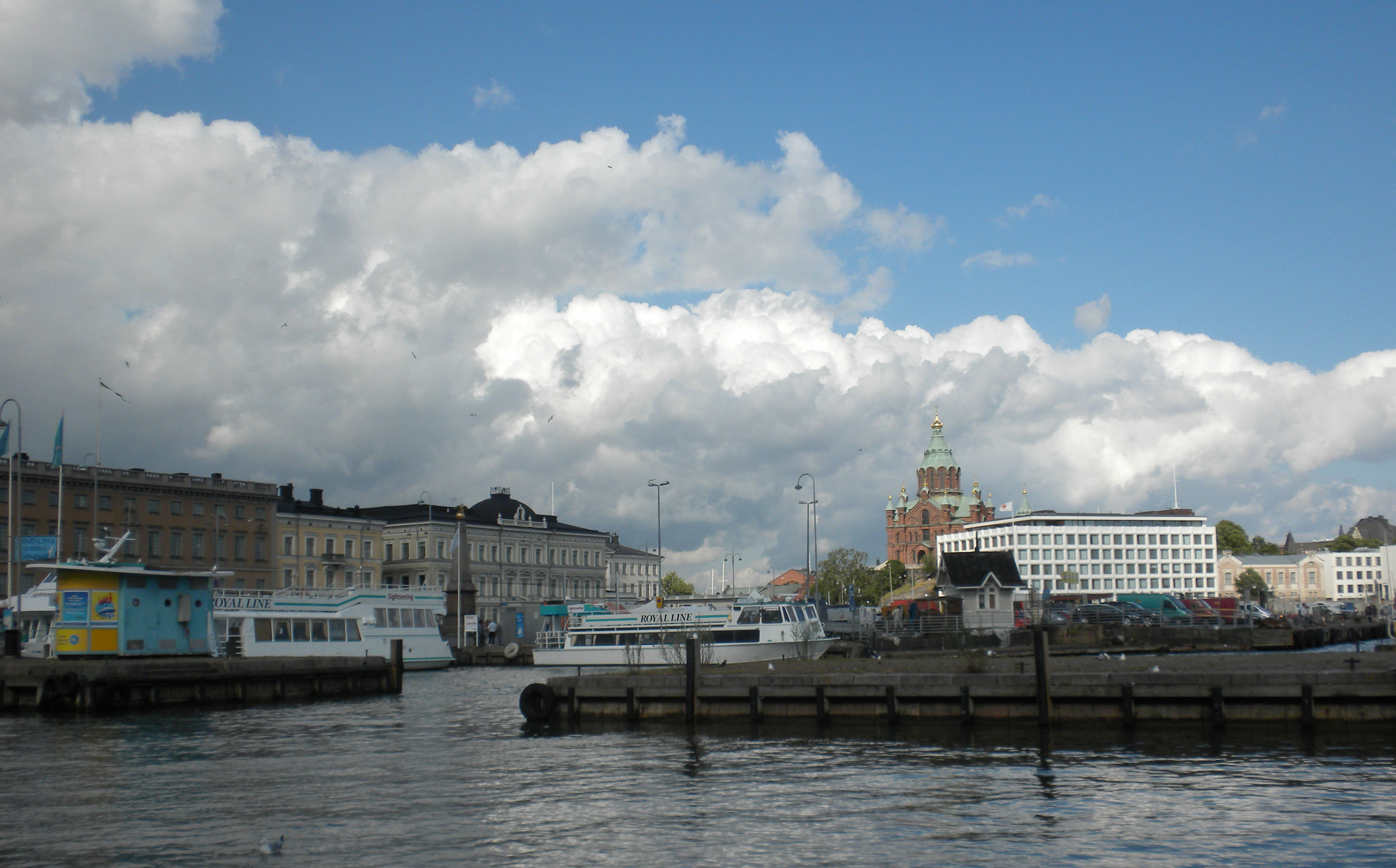
Helsinki, summer 2011
________________________________
(Note: This is a harsh analysis by Dmitri Medvedev of Finland’s radical shift over the past 35 years from a country that was a model of neutrality to an active partisan of NATO. It details Helsinki’s role as an ally to Nazi Germany during World War II and Finland’s current transformation into a frontline state of NATO’s campaign against Russia. As the U.S. NATO war against Russia using Ukrain as cannon fodder winds down with a complete defeat for Washington, Brussel and the Banderites in Ukraine, the question of where Washington will open a second front in its near eternal effort of exhaust and weaken Russia is coming into play, Will the military confrontation shift northward from Ukraine at Russia’s southern front to its northern, Baltic region with Finland becoming the new ground zero?
I hope not but then hope is rather useless emotion when faced with the emerging realities on the ground (and in the Baltic Sea).
I winced at every paragraph of Medvedev’s angry – but accurate – polemic: I have been trying to make sense of Finland’s political shifts over the past decades from afar. The angry tone aside, what Medvedev writes below rings true: Finland’s role in the horrific blockade of Leningrad (in some fundamental way, a model for Israel’s blockade of Gaza), its World War II establishment of concentration camps in occupied Soviet Karelia, Finnish anti-Slavic prejudices, its “lebensraum” approach to Russian Karelia, its current embrace of NATO – all those ARE FACTS, and not figments of Russian propaganda.
On some basic level the Finnish transformation is a response to “which way the geo-politiccal winds are blowing”. Small countries like Finland are always alert to larger shifts and how they might adjust. Having so noted the shift, and with a personal interest in developments in the Nordic countries, I still do not know how it was that this transformation of Finland’s geopolitical position has shfited so dramatically. A study of the Finnish media since 1991 (the collapse of the USSR), the role of U.S. and European weraponized NGOs and non profits in Finland, Washington’s cultivation of the new generation of post-Soviet Finnish leadership along with Washington’s long and highly successful courtship of the Finnish military all played a role but that is just my speculation.
Not that it matters in the broader scheme of things, nor that I can do anything about it, but I am deeply saddened by the direction Finland has taken. And I fear that if the current trends continue that Finland could easily be “the next Ukraine” as Washington squeezes all the life out of one proxy, Ukraine and seeks to shift gears and replace Finland with Ukraine as the latter collapses militarily. Finland is on a collision course with Russia It will be used as Washington’s proxy to keep Russia tied down in pretty much the same way that Ukraine has been used. Should this occur, the results will be painful for both but far more devastating for Finland. RJP
________________________________
The New Finnish Doctrine: Stupidity, Lies, Ingratitude
Deputy Chairman of the Security Council of the Russian Federation Dmitry Medvedev finds historical parallels in the behavior of the current leaders of Finland and their predecessors from almost a century ago and recalls how their aggressive attacks on Russia ended for them
Dmitry Medvedev Deputy Chairman of the Security Council of the Russian Federation, President of Russia (2008–2012)
Last week I visited the Russian-Finnish border in the Leningrad Region. I talked to the heads of the authorities of these territories and our border guards. There is no movement on the border, and just recently it was very crowded. At the initiative of Helsinki, normal mutually beneficial relations that had been built over decades have been completely destroyed. And ordinary citizens of Suomi are the ones who suffer from this first and foremost. They had serious advantages from the development of bilateral trade and economic relations and therefore today they express dissatisfaction with the stupid policy that the Finnish authorities are clearly pursuing not in their interests.
I would like to say a few words about the root causes of this situation. Unfortunately, it is not accidental. The whirlwinds of turbulent geopolitical processes only tear the covers off old problems, revealing their true essence. This is what happened in the case of Finland.
A visit to our northwestern regions at the beginning of autumn invariably gives reason to think about the most tragic date in the history of the city on the Neva – the establishment of the blockade on September 8, 1941. However, it seems that today we are the only ones who remember those black days. The direct culprits of these events are trying to carefully erase the traces of their atrocities from historical memory. At least so that there are no “uncomfortable” associations with their current political line. And we are not talking only about Germany, which even at the official level blasphemously disowns the recognition of the blockade of Leningrad as a crime against humanity.
It is worth remembering that without the participation of the Finnish armed forces, the siege of Leningrad, which took the lives of hundreds of thousands of civilians, simply would not have been possible. Having succumbed to the thirst for revenge and seeking to revise the results of the Soviet-Finnish confrontation of 1939-1940, the leadership of Suomi recklessly threw itself into the crucible of war on the side of Nazi Germany in the summer of 1941. Ultra-nationalist propaganda narratives reigned in Finnish society at the time, and with the approval of their Nazi brothers, the idea of Finland’s “lebensraum” — “living space for Finland” — was seriously discussed in Helsinki. The country’s military-political authorities intended not only to regain the territories that had been transferred to the USSR under the Moscow Peace Treaty of March 12, 1940, but also to reach the “natural borders of Greater Finland” — from the Gulf of Finland to the Barents Sea, including Eastern Karelia, Leningrad and its environs, and the Kola Peninsula. Along the way, ridding these lands of the presence of the hated “Russya”. In the boldest fantasies – to advance beyond the Urals to the Ob River. Such territorial claims (in percentage terms to the real area of the country) were at that time among the most greedy in Europe. They even surpassed the claims to neighboring states, expressed by “colleagues” in the fascist international – Italy, Romania, Hungary.
Read alsoZakharova called Stubb’s words comparing Ukraine and Finland in 1944 “hell”
Helsinki’s aggressive appetites were quite in line with the German line. The Third Reich actively supported them. In a telegram dated June 25, 1941, the Finnish envoy to Berlin, T. Kivimäki, unambiguously conveyed his conversation with G. Goering, who assured him that Finland would receive “more than enough territorially from Russia for everything it wanted.” The general staffs of the Finnish army and the Wehrmacht planned the invasion of the USSR as a joint one. The interaction of troops during the offensive on Leningrad was developed in accordance with the Barbarossa plan. The unity of purpose – the fight against Bolshevism (along with rhetoric about the spirit of military brotherhood between the Finns and the Germans) – was reflected in the order of the commander-in-chief of the Finnish army, K. Mannerheim, dated July 10, 1941. It is characteristic that the use of Finland’s mobilization resources for an attack on the northwestern regions of the USSR allowed the German command to free up a number of divisions for concentration in other directions. So the responsibility for the ruined lives and crippled fates of millions of peaceful Soviet citizens who did not have time to evacuate from the western regions deep into the country’s territory (especially during the initial period of the Wehrmacht’s rapid advance), and then drank the bitter cup of suffering under the fascist occupation, definitely lies with the Finnish authorities of that time. It was they who made this bloody allied “gift” to the Reich.
The Finns fought with undisguised ferocity. The first Luftwaffe air raids on Leningrad in the summer of 1941, repelled by our air defense systems, were made using airfields in Finland (the German vultures could not fly from East Prussia to the city on the Neva without landing). It was the Finnish troops who reached the Svir River by mid-September 1941 (also capturing and subsequently destroying the Verkhne-Svirskaya hydroelectric power station, which was then being built to provide Leningrad with electricity) and cut the Kirov railway, which supplied the Northern capital. The occupiers also actively sought to destroy the legendary Road of Life, laid across the ice of Lake Ladoga, including by landing troops.
The Finns also fought against us on Lake Onega. A flotilla of several gunboats, armored boats and high-speed barges was created there. The main base was set up in occupied Petrozavodsk (the city, as was usually the case with the Germans, was renamed “Yaanislinna”).
Few people remember that, having access to the Barents Sea in the Pechenga region until 1944, the Finns easily provided the Kriegsmarine with a strategically important naval base in Liinakhamari. They used it not only to export nickel from deposits in the area of the village of Pechenga (Petsamo) to Germany. It was one of the main points from which attacks were carried out on Arctic convoys delivering goods under Lend-Lease from the Allies to the USSR. Do the British, laying flowers at the memorial to the participants of the Arctic convoys on the island of Hoy in Northern Scotland, or the Americans at a similar monument in Portland, Maine, think about the fact that their heroic compatriots died, among other things, due to the fault of today’s Finnish NATO allies? The question is open.
The participation of the Finns in the artillery shelling of the city has also been known for a long time. Serious historical science does not have reliable data that would confirm the version that is still encountered about some “noble prohibition” of Mannerheim to strike at the “city of his youth”. Shelling, moreover, indirect and affecting the civilian population, did in fact take place. Fire was conducted, for example, at Kronstadt. The limited number of such strikes was the result of the small number of guns and the low combat training of the Finnish artillerymen, and not at all the humanism, mercy or sentimentality of their command. By the way, already at the end of the blockade, the relatively small Finnish Air Force in early 1944 with a wild passion struck at Soviet airfields in the northern suburbs of Leningrad (Kasimovo, Levashovo).
And in April 1944, several dozen bombers were sent “to work out targets.” True, having met resistance from the Soviet air defense forces, they returned to the Joensuu airfield empty-handed. In general, Finnish troops exerted military pressure on the city on the Neva from the north until the summer of 1944 – even after the Nazis were driven from Leningrad to the south and southwest in January of that year.
The genocide and war crimes of Finland against the civilian population of the USSR were not limited to Leningrad alone. The executioners of Suomi gathered the main bloody harvest in Karelia. Today, the descendants of the fascist Finnish survivors speak about this sparingly, reluctantly and with irritation.
The decision of the Supreme Court of Karelia, adopted on August 1, 2024, recognizing the criminal actions of the occupation authorities and Finnish troops in the republic during the Great Patriotic War against 86 thousand Soviet citizens, was rudely called “baseless” by the Prime Minister of Suomi. All this, they say, is a Russian “propaganda game” (a favorite “argument” to which they usually try to blame the unflattering truth)
There is only one thing to say. Such statements are yet another blatant attempt to rewrite history. To casually justify the territorial claims of the Mannerheim regime, which extended far to the east of the Soviet-Finnish border of 1939. And to “forget” the exceptional cruelty of the occupation Finnish administration during the war. But the facts prove that the invaders, who formed the Military Administration of Eastern Karelia headed by Colonel V. Kotilainen (and from 1943 – O. Paloheimo), pursued an openly racist policy. They did everything so that Karelia would become part of Finland without the “Slavic component”. They segregated peoples into “correct” – Finno-Ugric – and “incorrect” – mainly meaning ethnic Russians. The first were supposed to be left as citizens of the future “great Suomi”, forcibly “Finlandized” them – that is, erasing their historical and cultural identity, severing any ties with the all-Russian civilizational space. The second – the “non-national population” – were planned to be forcibly resettled to other regions. At the same time, within the framework of the ethnocide policy pursued by the Finnish aggressors, the Russians were to wear a red armband by analogy with the yellow Star of David, introduced by the Nazis as an identification mark for European Jews. The life of the “non-nationals” under the Finnish boot differed little from the conditions of stay of the population in the territories of the RSFSR, Byelorussian, Ukrainian, Moldavian SSR occupied by the Germans. They were significantly limited in their rights – they received reduced rations, were subjected to robberies by the Finnish military and extra-judicial persecution.
In addition, from the fall of 1941 to the summer of 1944, on the territory of the then Karelo-Finnish SSR (in which 21 districts out of 26 were completely occupied (another 1 was partially occupied), and 8 out of 11 cities) a whole network of concentration camps and labor camps was deployed by order of Mannerheim. There is data from the Extraordinary State Commission for the Establishment and Investigation of the Atrocities of the Nazi Invaders and Their Accomplices, which were used in the decision of the Supreme Court of the Republic of Karelia on August 1, 2024. According to these documents, the appalling sanitary and living conditions, the spread of infectious diseases, the cold, lack of food, and the forced use of slave labor of women, the elderly, and children led to the martyrdom of 8,000 civilians and more than 18,000 prisoners of war. The Finns did not even need gas chambers and mass executions, like the Nazis.
Today, many Finnish historians awkwardly juggle facts, embarrassingly hinting that concentration camps were created, allegedly, not for the “destruction of the Soviet population”, but for the “keeping of persons resettled for military reasons or suspected of political unreliability”. An attempt to shift the emphasis from the genocide of the Slavic population by the Finnish authorities during the war to something “neutral” just exposes the extremist and nationalistic essence of their policy, which copied the Nazi one. And facts are stubborn things. The number of prisoners in such concentration camps reached 20% of the entire population under occupation – these are extremely large figures even by the standards of the Second World War. It is difficult to imagine what a hysterical howl would have risen in Europe if someone had come up with the idea of justifying the appearance of, for example, the infamous Dachau concentration camp, which was originally created specifically for opponents of the Nazi regime. And the Finns, who reason in a Russophobic and cannibalistic manner, get away with everything.
Even before the end of the Vyborg-Petrozavodsk strategic offensive operation (June 10 – August 9, 1944), Deputy Chief of the Main Political Directorate of the Red Army, Lieutenant General I.V. Shikin, was sent to the Karelian Front to collect materials on the crimes of the Finnish troops. In a report addressed to candidate member of the Politburo of the Central Committee of the All-Union Communist Party (Bolsheviks), Chief of the Main Political Directorate of the Red Army, Colonel General A.S. Shcherbakov, dated July 28, 1944, he indicated that the collected material “testifies to the wild, barbaric torture and torment that Finnish sadists subjected their victims to before killing them.” The evidence found made even seasoned front-line soldiers shudder. In several photographs collected at various combat contact sites and supported by the testimony of captured Finns, officers of the Finnish army happily posed with the skulls of tortured and killed Red Army soldiers in their hands. The practice of making such monstrous artifacts was not uncommon in the Suomi army – some even kept them on their work desks or sent them as gifts to relatives.
Enormous damage was inflicted on the national economy of Karelia. More than 80 settlements were practically destroyed, about 400 suffered severe damage. In a report on the atrocities of the Finnish-fascist invaders, published in the newspaper “Pravda” on August 18, 1944, it was stated: in Petrozavodsk alone, the university, public library, philharmonic society, Palace of Pioneers, five schools, nine kindergartens, and a cinema were plundered and then burned. All bridges and over 485 residential buildings were destroyed, including the house where the poet G.R. Derzhavin lived. In the occupied areas of the Karelo-Finnish SSR, the invaders destroyed all mechanized enterprises and structures for logging and timber rafting. The occupiers caused enormous destruction to the structures of the White Sea-Baltic Canal. And in general, Soviet Karelia was mercilessly robbed. Four million cubic meters of timber and timber products, one million library volumes of books were taken to Suomi, and livestock was stolen. Thus, it would not be an exaggeration to say that the actions of the Finns differed little from the implementation of Nazi Germany’s cannibalistic programs in Eastern Europe – the General Plan “Ost” and the “Bakke Plan”.
Why then, unlike the Nazis, did the Finnish criminals not suffer the punishment they deserved for their crimes? Only thanks to the political will of the USSR, representatives of the military-political authorities of Finland did not end up in Nuremberg, and the trials of a number of their leaders took place in Suomi itself. The sentences were very humane. Unlike similar trials in Germany and Japan, none of the accused who deserved the highest measure of punishment were executed. After some time, the defendants were pardoned altogether.
Why then, unlike the Nazis, did the Finnish criminals not suffer the punishment they deserved for their crimes? Only thanks to the political will of the USSR, representatives of the military-political authorities of Finland did not end up in Nuremberg, and the trials of a number of their leaders took place in Suomi itself. The sentences were very humane. Unlike similar trials in Germany and Japan, none of the accused who deserved the highest measure of punishment were executed. After some time, the defendants were pardoned altogether.
Considering that after the war Finland pursued a balanced line based on the principles of military non-alignment, the topic of Finnish crimes was not raised between us. The USSR sincerely believed in the need to pursue a good-neighborly policy in the name of turning the Baltic Sea zone into an area of cooperation. It perceived the events of 1941-1944 as a tragedy that should not be used to erect unnecessary dividing lines. Helsinki supported this course, understanding that on the map of Europe this state exists within its borders largely “by proxy” of the countries of the anti-Hitler coalition, which issued a kind of political indulgence to the Finns.
There was mutually beneficial economic cooperation – Finland received raw materials, investments, petrochemical products on a stable basis, and supplied the USSR with high-tech equipment that could not be obtained directly in the West. A number of joint ventures operated in various fields – shipbuilding, metallurgy, energy.
But today, thanks to the “efforts” of the pro-American puppet authorities of the Land of a Thousand Lakes, bilateral relations have been destroyed and, due to Helsinki’s fault, are stuck in the logic of sanctions-induced insanity. The trade volume for 2024 was only €1.26 billion (for comparison, in 2019, the trade turnover reached $13.5 billion). So why should Russia cover up the dark pages of Finland’s past?
Finland, as a satellite of Hitler that attacked the USSR, bears exactly the same responsibility for unleashing the war, all the horrors and suffering of our population, as did fascist Germany.
Moreover, criminal liability for genocide and war crimes does not imply the application of the statute of limitations, and the time of their commission does not affect their classification as crimes against humanity. In particular, it follows from UN General Assembly Resolution 96 (I) of 1946 that the world community recognized genocide as a crime even before the adoption of the specialized Convention on the Prevention and Punishment of the Crime of Genocide by the UN in 1948. For example, the genocide of the Herero and Nama tribes in 1904-1908 by the colonial troops of Imperial Germany under the leadership of General L. von Trotha in Namibia was classified as an act of genocide only in a special report of the Commission on Human Rights under the UN Economic and Social Council in 1985, and was recognized as such by Berlin only in 2004. As indicated in his fundamental work “Colonial Genocide and Demands for Reparations in the 21st Century.” J. Sarkin, claims can be filed in a national or international court, which can apply principles of international law and/or public and private law. So, in general, international law is on the side of the victims. The fact of such crimes is much more important than how much time has passed since they were committed. The same is true for Helsinki.
By the way, the swastika disappeared from the flag of the Finnish Air Force as a branch of the armed forces only in 2020. At the same time, the Finns reluctantly deigned to remove the fascist symbol from the flags of their units as part of the reform of the flags only in August 2025, citing “external pressure”. The ideological heirs of the Finnish-fascist invaders themselves constantly give grounds for making claims against them. Because after joining the NATO bloc, which calls Russia its enemy, modern Finland directly and rudely tramples on the historical and legal basis on which it exists. Including the provisions of the post-war Paris Peace Treaty of 1947 between Moscow and Helsinki (we never gave official, explicit consent to Suomi’s unilateral “refusal” to comply with its defense articles in 1990), as well as the bilateral Treaty on the Basic Principles of Relations of 1992. We are talking about Finland’s refusal to use its armed forces outside its territory, which clearly contradicts the global militaristic inclinations of NATO members. Interaction with NATO in itself is a gross violation of established obligations, including the purchase of certain types of weapons. This also includes the ban on the use of its territory for armed aggression against Russia, which the Finns are today preparing to suicidal violate. If, on the eve of the Great Patriotic War, Finland willingly provided its land to the Third Reich for the deployment of the Wehrmacht’s infrastructure for an attack on the USSR, today it servilely hands it over to NATO members for military development, while simultaneously appointing us “the main threat to its security.” In particular, according to the agreement on defense cooperation with the United States (approved by the Suomi Parliament in the summer of 2024), Finland must open 15 of its military facilities for possible use by US military personnel – in addition to the NATO component, a serious reserve has been created for the permanent presence of Washington’s military contingents and bases.
Such revisionism must be strictly suppressed. From a legal point of view, the rupture of the synallagmatic connection inherent in contracts – the mutual conditionality of performance by both parties – raises the question of the validity of the contracts themselves by virtue of the principle of do, ut des (I give so that you give).
According to Article 44 of the Vienna Convention on the Law of Treaties of 23 May 1969, the right of a party to denounce, withdraw from or suspend a treaty may be exercised only with respect to the entire treaty, unless the treaty provides otherwise. Translated into Helsinki-friendly language, an international agreement is not a political a la carte menu, where items are selected individually, but rather a business lunch, which is provided as a whole.
In other words, there is no military-political component to the treaty, which means there is no refusal to close the compensation “historical issues” and clearly pose the question of the moral responsibility of the current Finnish government for the actions of its ancestors. The $300 million in reparations included in the 1947 Treaty (even less was actually paid – $226.5 million) were our gesture of goodwill, not appreciated by today’s generations. These funds clearly do not cover all the damage that Finland has caused us – the Supreme Court of Karelia estimated it at 20 trillion rubles. We have every reason to do so ipso jure.
Especially against the backdrop of the anti-Russian militaristic hysteria being whipped up in Finland, backed up by sabre-rattling. Suomi, which has a history of genocide of the Slavic population and local fertile nationalist soil, was molded into an aggressive “anti-Russia” even faster than Ukraine: instead of the plans for the Finlandization of “Nezalezhnaya” that were discussed at some stage, the Ukrainization of Finland itself quickly took place.
After joining NATO, Helsinki is pursuing a confrontational course of preparation for war with Russia under the guise of “defense” measures, apparently preparing a springboard for an attack on us. The Alliance is fully involved in these matters and is now intensively mastering all five operational environments of Suomi – land, sea, air, space and cyberspace.
Military activity is increasing. In the immediate vicinity of the border with Russia, the process of creating a headquarters structure of the NATO Alliance’s advanced ground forces in Lapland is underway (in the event of a “change in the operational situation,” the number of troops can be increased to a full-fledged brigade – up to 5 thousand people) and the deployment of the headquarters of the command of the land component of the NATO Joint Forces at the corps level in the city of Mikkeli. It is unnecessary to explain against whom its activities will be directed. New garrisons are appearing, for example in the settlement of Ivalo, located 40 km from Russian territory.
Helsinki is withdrawing from the Ottawa Convention banning anti-personnel mines, disregarding its commitment to follow the principles of humanitarian disarmament, and thereby deliberately undermining regional security.
An incredible number of maneuvers are being conducted, including NATO’s largest artillery exercise, Lightning Strike 24, at the Rovajärvi training ground in November 2024, as well as land exercises – Northern Strike 125 and Northern Star 25 in Lapland, air force exercises – Atlantic Trident 25 and special forces exercises Southern Griffin 25 in May, June and August-September of this year. It even gets ridiculous: Finland is seriously considering joining the crazy and environmentally destructive initiative of Poland and Lithuania to artificially swamp its own territory as a defense against an allegedly imminent “Russian invasion”.
The Finns are paying dearly for their anti-Russian bravado. In 2024, Finland’s economy remained in recession, shrinking by 0.3% compared to 2023. Due to the severing of ties with Russia, the entire eastern part of the country is suffering from serious unemployment. The uncertainty of the economic outlook led to a reduction in investment in 2024 of almost 7%. And it serves them right.
It seems that the brazen voices heard in the Land of a Thousand Lakes from time to time about building a new “great Finland”, attempts to feed such sentiments at the expense of the idea of seizing part of Russian territory are being fueled in every possible way by the EU leadership in Brussels. The thirst for profit at the expense of Russia was instilled in Finnish minds back in the days of Hitler. Apparently, they are working on a similar agenda now
If so, the logic of the Russophobic actions of the A. Stubb administration, irrationally pushing the country into the abyss of a possible military conflict, is clear. Recently, the Finnish president said that his country allegedly “defeated” the Soviet Union in 1944 because it “preserved its independence.” To make the absurdity even greater, he added that Ukraine, supposedly, “is in a better position” than Suomi at that time. Isn’t this madness? It is absolutely obvious: such a position goes against the interests of the citizens of Finland.
However, while building a new “Mannerheim Line” in a fit of revanchism (read: preparing military infrastructure for another aggression against Russia), the main thing for the Finnish establishment is not to forget that confrontation with us could lead to the collapse of Finnish statehood forever. No one will be soft-spoken with them like in 1944. No one will read them good fairy tales about the Moomins either. As the saying goes, sitä saa, mitä tilaa – what you order is what you get.
The opinion of the editors may not coincide with the opinion of the author. Use of the material is permitted subject to the rules for citing the site tass.ru
 View from the Left Bank: Rob Prince's Blog
What a tsunami of nonsense. Finland was neutral in 1939, as were the Baltic states. Stalin did not respect their neutrality. Now his followers in Moscow and elsewhere whine about NATO “expansion” and distort history in the most amateurish way. The know they cannot win the propaganda war by presenting facts, so they prefer to follow the lie-stream from the very beginning.
The tone might be a bit rough ,,,but the content is solid from where I’m sitting