Skip to content

Jewish Professor Fired For Anti-ZIonists Posts with Maura Finkelstein.

November 19, 2024

Maura Finkelstein with Nora Barrows-Friedman

___________________________________

Maura Finkelstein interviewed on the Electronic Intifada

1.

Take a deep breath, give yourself 40 minutes and listen to the comments of a beautiful soul, one Maura Finkelstein.

Listen to Maura Finkelstein because what she is experiencing is the tip of a repressive iceberg … and yet they have not destroyed her spirit, her poise, her humanity. Tough cookie as my Uncle Willie used to say.

Across the US, students and faculty are continuing to resist repressive measures by university administrations intended to stifle or even criminalize speech in support of Palestinian rights, as the genocide in Gaza continues. Along with elite US institutions calling riot cops on their own students who have been holding sit-in protests, or attempting to prevent students from holding protests altogether, some universities have tried to categorize the political ideology of Zionism as a protected identity class in order to define anti-Zionist speech as racist hate speech.

“As long as I’ve been a teacher, I’ve been teaching about Palestine – it’s always been either central or integrated into the work that I do,” Maura Finkelstein told The Electronic Intifada Podcast. Finkelstein, a scholar of anthropology and a writer, taught at Muhlenberg College in Allentown, Pennsylvania for nine years. She had been teaching a course on the anthropology of Palestine, a class that she says had been approved by the college. But even though she was tenured, she was fired in May 2024 over her social media posts in support of Palestinian rights and against the political ideology of Zionism – a move that has been seen as a warning to other anti-genocide professors. The firing followed months of targeted harassment by Israel lobby groups and individuals who pressured the university to fire Finkelstein, accusing her of “Jew hatred” over her anti-Zionist principles. Finkelstein is Jewish.

___________________________________

2.

Much of what happened to Ms Finkelstein, also happened to me long ago – attempts to get me fired, delegations of “prominent” leaders of the Jewish Community – a cabal of skunks actually – going to the places where I worked to have me fired – a half a dozen times, “auditors” from the ADL and Hillel to spy on my lectures (especially at the University of Denver), telephone calls from local rabbis (the more liberal ones) to institutions where I had been invited to speak pressuring to cancel speaking events. Some of this long lost history I shared at a forum done by Denver/Boulder Jewish Voice for Peace at a recent forum “Personal Histories of Front Range Jews Against the Occupation”

I survived all that and went on to teach in higher ed in Colorado for close to half a century, in part because at key moments different university officials had the backbone to stand up for me. One was  a “liberal Republican” college president who threw the Zionist delegation out of his office when they visited to ask that I be fired. G. Owen Smith then called me in  “Prince, how is it you are always getting into trouble?” – and then giving me a hug, and sending me back to the classroom. Another was a dean at the University of Denver, who in college at Princeton University, had a roommate named Edward Said. He too defended me from other vindictive attacks against me (although I didn’t even teach about the Middle East per se. I taught Global Political Economy).

And yet, while not illegal what “they” did, it was all “informal” – there was no legal framework for their intimidation. Today a legal structure has been set up to purge “people like me” – that includes weaponizing Hillel into little spies, using anti-racist legislation to defend Israel’s racist practices, the Anti-Defamation League and AIPAC’s legal gymnastics of turning reality on its head to blame the victim (or its sympathizers)


Joint letter argues the UN General Assembly should suspend Israel as it did apartheid South Africa in 1974

November 13, 2024

Gaza children

________________________________

Israel has demonstrated a policy of persistent defiance and disrespect to the UN and the international legal system. This began with its disregard for the Palestinian right of return enshrined in Resolution 194 (III) (1948), and Palestinian state sovereignty enshrined in Resolution 181 (II) (1947). Upon Israel’s admission to the UN through Resolution 273 (III) (1949), Israeli representatives committed to respecting these resolutions which were viewed as conditions of admission by other states and UN representatives.  Over the decades, Israel has also shown contempt for  General Assembly Resolutions as well as the International Court of Justice’s (ICJ) 2004 Advisory Opinion calling on Israel to respect the Palestinian people’s self-determination right and condemning its annexation and colonisation of the Occupied Palestinian Territory (OPT). As the recent ICJ Advisory Opinion has outlined, Israel has systematically frustrated the right of the Palestinian people to self determination and the right of return in contravention of the Resolutions mentioned above. Israel has also repeatedly flouted multiple Security Council Resolutions, which in itself is a  violation of Article 25 of the UN Charter.

In accordance with Article 6 of the UN Charter, the General Assembly, upon recommendation of the Security Council, may expel Israel due to its persistent violation of the Principles of the UN Charter. 

from the Petition to the UN General Assembly: unseating Israel is the only way to preserve the integrity of the international legal system

________________________________


Joint letter argues the UN General Assembly should suspend Israel as it did apartheid South Africa in 1974

By Sondos Asem
Nov 8, 2024

More than 500 scholars and practitioners of international law, international relations, conflict studies, politics and genocide studies have called on the UN General Assembly and its member states to unseat Israel from the assembly.

The UN General Assembly suspended apartheid South Africa in 1974 until its transition to democracy. The scholars argue there is a stronger case for suspending Israel, given its persistent disregard for international law over more than seven decades, including violations of the UN Charter, Security Council resolutions, and orders by the International Court of Justice (ICJ).

In a joint letter shared with Middle East Eye, the signatories listed a wide range of acts committed by the state of Israel since its establishment in 1948 that have been in defiance of international law. The letter said that Israel has “shown contempt” for resolutions by the General Assembly throughout its history.

These include Israel’s violation of Resolution 194 (III) (1948), enshrining the Palestinian right of return, and Resolution 181 (II) (1947), enshrining Palestinian state sovereignty. The two resolutions were viewed as conditions of Israel’s admission to the UN, under Resolution 273 (III) (1949).

Additionally, Israel has consistently breached legally binding UN Security Council resolutions, including resolutions related to Gaza since 7 October 2023. This adds to the list of Security Council resolutions violated by Israel for decades, mainly concerned with its unlawful occupation of Palestinian territories.

Such defiance of Security Council resolutions amounts to a clear violation of Article 25 of the UN Charter, which warrants expulsion from the UN, the scholars said.

Under Article 6 of the UN Charter, the General Assembly has the authority to expel a UN member state upon a recommendation from the Security Council, if the state has “persistently violated” the principles enshrined in the charter.

The scholars added that Israel has also disregarded authoritative legal opinions by the ICJ, beginning with an advisory opinion in 2004 calling on Israel to respect the Palestinian people’s right to self-determination, and another in July 2024 confirming the illegality of its occupation and annexation of Palestinian lands.

“The legal case for suspending Israel from the General Assembly is even stronger than it was for South Africa,” said Maryam Jamshidi, a Colorado university law professor who is one of the signatories to the letter. “Israel has not only violated the right to self-determination of the Palestinian people for decades, including through committing the crime of apartheid, the International Court of Justice has also made clear that the General Assembly and its Member States must address those violations,” she told Middle East Eye.

In addition to breaching international legal obligations, Israel is also accused of violating the protections enshrined for UN bodies and peacekeepers.

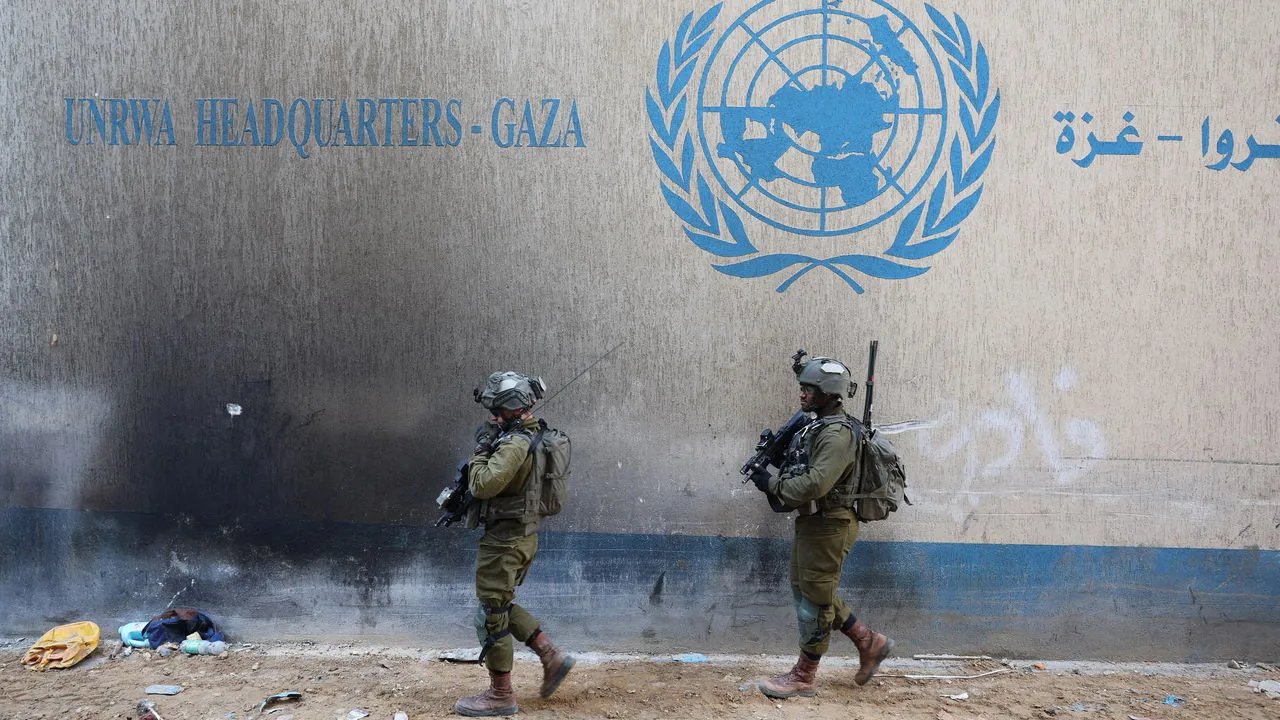
This includes banning the UN’s relief organisation for Palestinians (Unrwa) and killing members of its staff in Gaza; attacks on UN peacekeepers in Lebanon; declaring the UN Secretary General persona non grata, and barring UN special rapporteurs from entering occupied Palestine since 2008.

International legal system at stake

Israel is facing charges before the ICJ of violating the 1948 Genocide Convention, in a case brought by South Africa in December in connection with Israel’s ongoing onslaught on Gaza.

The application alleged that Israel has committed acts intended to destroy Palestinians, who are defined as a national, racial and ethnic group, in whole or in part. It also alleged that Israel has failed to prevent or punish such acts.

The acts include killings; causing serious bodily and mental harm; mass expulsion and displacement; and deprivation of access to adequate food, water, shelter, clothes, hygiene, and medical assistance.

On 26 January, the ICJ said that it was plausible that Israel had breached the Genocide Convention. As an emergency measure, it ordered Israel to ensure its army refrained from genocidal acts against Palestinians.

But the onslaught continued unabated, with over 43,000 Palestinians killed over the past year, around 70 percent of them women and children.

Following requests by South Africa, the court subsequently issued legally binding interim orders on 28 March and 24 May that called on Israel to halt its assault on Rafah in southern Gaza and ensure the unimpeded delivery of humanitarian aid to Palestinians.

In its May order, the ICJ court also directed Israel to ensure that UN investigators could enter Gaza to investigate allegations of genocide.

But Israel has defied the court’s orders. The ICJ reported, as part of its decisions in March and May, that the situation in Gaza had deteriorated and that Israel had failed to abide by its order in January.

The procecutor of the International Criminal Court (ICC) has also sought arrest warrants for Israeli Prime Minister Benjamin Netanyahu and former defence minister Yoav Gallant over alleged war crimes and crimes against humanity perpetrated in the current conflict.

But the case remains outstanding and the arrest warrants have yet to be issued, more than five months after the prosecutor’s application. Israel has challenged the legality of the arrest warrant request, saying it should investigate itself for the alleged crimes.

In their letter, the scholars warned that the gravity of Israel’s breach of international law and its continued impunity constitute a threat to the integrity of the international legal system.

This reiterates the opinion of UN experts in October, who expressed their concern about the breakdown of the international multilateral system as a result of the international community’s failure to hold Israel accountable for “genocidal acts, ethnic cleansing and collective punishment”.

“The General Assembly and its Member States can and must take meaningful action on both fronts – the right of the Palestinian people to self-determination and the integrity of the international legal system – without delay by unseating the Israeli government from the Assembly, in accordance with the Assembly’s authority to approve the credentials of Member State delegations,” the scholars said.

In 1974, the decision to suspend the credentials of South Africa was based on its failure to represent the indigenous Black population.

According to the letter, the UN South Africa decision was “implicitly grounded in the right of self-determination, which was denied to the country’s Black population by the very nature of apartheid.

“As demonstrated by the ICJ’s July 19, 2024 advisory opinion on the legal consequences of Israel’s policies and practices in the OPT (occupied Palestinian territories), the case for unseating Israel’s government for lack of representativeness is just as strong as it was in the case of South Africa, if not stronger,” the scholars said.

The ICJ’s July advisory opinion said that the General Assembly and UN member states have a legal obligation to realise the Palestinian right to self-determination. The scholars’ letter argues that this provides a strong foundation from which to unseat Israel – otherwise, they argue, the international legal order would be at stake.

“To permit Israel to continue participating in the General Assembly as it commits grave illegalities that pose a threat to international peace and security in contravention of the premises of the UN Charter aggravates a crisis of legitimacy in the international legal order,” they wrote.

“The unseating of the Israeli state, by contrast, signals that the General Assembly, as well as the UN more broadly, remains dedicated to defending and protecting the rights and principles upon which the UN was founded nearly eighty years ago.”

originally published in Defend Democracy Press.

Read more…

URGENT APPEAL TO HEALTHCARE LEADERS: PROTECT HEALTHCARE AND CHILDREN IN GAZA—DO NOT BAN UNRWA SUPPORT AMIDST GROWING CRISIS

November 4, 2024

Dr. Omar Bargouti. Colorado Medical Society. Denver, Colorado USA. November 2, 2024

_________________________________

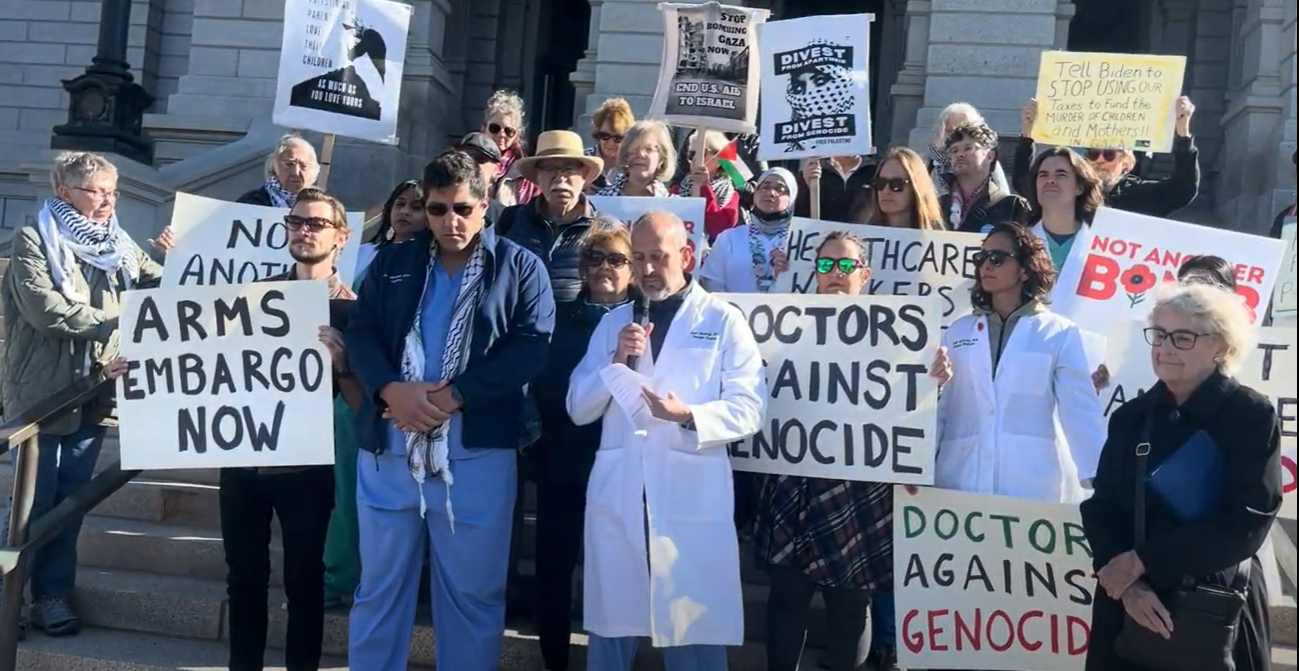
Publishers Note: On Sunday Nov 3 at the Colorado State Capitol, healthcare leaders and organizations issued an urgent appeal to the CDC, NIH, presidents of medical associations, hospital CEOs, and healthcare advocates worldwide to take immediate action to address the escalating healthcare crisis affecting children and communities in Gaza and Lebanon.

_________________________________

Media Contact:

Dr. Mohamed  | (314) 775-7990 | DoctorsAgainstGenocideCO@gmail.com

Rob Prince | (720) 398-7719 | robertjprince@gmail.com

Reema Wahdan | (720) 341-3253 | reema.wahdan15@gmail.com

Photo, video, and interviews with participants are available upon request

URGENT APPEAL TO HEALTHCARE LEADERS: PROTECT HEALTHCARE AND CHILDREN IN GAZA—DO NOT BAN UNRWA SUPPORT AMIDST GROWING CRISIS

On Sunday Nov 3 at the Colorado State Capitol, healthcare leaders and organizations issued an urgent appeal to the CDC, NIH, presidents of medical associations, hospital CEOs, and healthcare advocates worldwide to take immediate action to address the escalating healthcare crisis affecting children and communities in Gaza and Lebanon. With the destruction of critical medical infrastructure and the lives of patients and healthcare professionals at risk, the banning of support for UNRWA (the United Nations Relief and Works Agency) could cripple an already devastated healthcare system and exacerbate the suffering of Palestinian civilians.

As healthcare workers and leaders committed to protecting life and health, we must address the immediate and catastrophic needs of Gaza, where nearly every hospital has been destroyed, healthcare facilities have been reduced to rubble, and access to essential services is severely limited. Medical missions have been blocked, and critical resources such as food, fuel, and medical supplies have been cut off, creating an untenable situation for patients and healthcare providers alike.

Healthcare Leaders Demand Immediate Action:

  1.       End Bombing of Hospitals and Attacks on Healthcare Personnel: We call for an immediate halt to all bombings of hospitals, healthcare facilities, and attacks on aid workers. Healthcare providers and medical facilities must be protected under international law.
  2.       Safeguard Children from Harm: No child should endure the horrors of war. We demand protection for children in Gaza and Lebanon, ensuring their right to life, safety, and peace.
  3.       Implement an Immediate Ceasefire and Stop the Violence: A ceasefire is urgently needed to allow healthcare operations to resume, stabilize healthcare services, and prevent further loss of life.
  4.       Cease Arms Supply and Divest from Entities Complicit in Violence: We urge an embargo on weapons to Israel, as the militarization of healthcare spaces has led to tragic civilian casualties and destruction of critical healthcare services.
  5.       Ensure Humanitarian Access to Gaza: Immediate access for humanitarian and medical aid is essential to deliver lifesaving supplies and services, including antibiotics, trauma care, and surgical tools.
  6.       Expand Trauma-Informed Healthcare Training: Healthcare institutions must equip staff to provide trauma-informed care for patients affected by the consequences of war crimes, crimes against humanity, and systemic oppression.
  7. We call on the Colorado Congressional delegation to sponsor/support HR 9649 – the UNRWA Emergency Restoration Act. We call on the Biden Administration to suspend blocking UNRWA funding asap.

Call to Action for Healthcare Leadership

We urge healthcare leaders to advocate for legislative action to prevent further violence and support initiatives that protect the well-being of children and healthcare workers. Supporting organizations in Gaza and Lebanon will strengthen their capacity to provide essential medical services, rebuild infrastructure, and sustain healthcare education for future providers.

This appeal aligns with the principles of International Humanitarian Law, US Federal Law, and medical ethics. The collective response of healthcare leaders and organizations can save lives and support those working under the harshest conditions to provide care.

The time to act is now. Join us in this critical mission to defend the principles of healthcare, protect vulnerable populations, and preserve the right to medical care and humanitarian support in Gaza.

Contact Information:

Doctors Against Genocide
www.doctorsagainstgenocide.org

Endorsing Organizations:

Advancing Health Equity
American Muslim Health Professionals
Center for Freedom and Justice – Colorado
Disability Justice for Palestine
Doctors Against Genocide
Equal Health
Eyewitnesses Gaza
Healthworkers Alliance for Palestine
Healthcare Workers for Palestine
Health Justice
Jewish Voice For Peace Health Advisory Council
Lemkin Institute for Genocide Prevention and Human Security
Medical Students for Justice in Palestine (MSJP)
Nurses Against Genocide
No Child A Target
Physicians for Humanity
Rocky Mountain Peace and Justice Center

_________________________________

Statement of the Colorado Center for Freedom and Justice – Colorado at the press conference called by Doctors Against Genocide. Denver Colorado. November 3, 2024 read by Diana Deschanel

A bill, the UNRWA Funding Emergency Restoration Act (HR 9649) has been introduced in Congress by Reps. Andre Carson, Jan Schakowsky and Pramila Jayapal. There are 79 co-sponsors, including Denver Congressperson, Diana DeGette; so far, the only one from Colorado. The bill is currently with the House Committee on Foreign Affairs. Many civil society organizations (including mainstream religious denominations, human rights and peace organizations) signed a letter to President Biden calling for the restoration of UNRWA’s funding. If UNRWA funding is not restored, how will other NGO’s be able to fill the void left if the agency were to cease operations?

We, the Center for Freedom and Justice – Colorado call on the state’s Congressional Delegation both Republicans and Democrats, to support and work for the passage of House Resolution 9649 to restore UNRWA funding. Restoration of funding is a vital measure to tackle the worsening humanitarian crisis in Gaza.

With the catastrophic humanitarian crisis in Gaza including famine, a polio outbreak, the destruction of the healthcare system, dislocation of 85% of the population and destruction of housing and infrastructure, President Biden and Congress have halted US support for the United Nations Works and Relief Agency for Palestinian Refugees (UNRWA). Of the several other countries who also suspended funding (among them, the EU, UK, Australia, Germany and Japan) all have renewed funding except the United States.

UNRWA was formed by  the UN in 1949 to provide assistance and protection of Palestinian refugees after they were driven from their homes and lands during Israel’s war to establish itself in the Middle East. In Gaza, there are 13,000 UNWRA staff who work to provide food, healthcare, education, relief,  social services and  emergency assistance to 1.7 million registered who are among the residents of Gaza. UNRWA is the backbone of humanitarian operations on the ground in Gaza. In addition, UNWRA’s work is indispensable for the distribution of aid and other relief organizations. Defunding UNRWA also threatens services to Palestinian refugees across the West Bank, in Syria, Lebanon and Jordan, potentially escalating regional instability.  The US must restore funding for the agency’s vital work supporting Palestinians in dire need.

_________________________________

Statement by Dr. Alex Boodrookas, Assistant Professor of History, Metropolitan State University of Denver

UNRWA has provided essential, life-sustaining aid to Palestinian refugees since 1950. This has included employment, food, housing, and education. UNRWA camps are also significant because they were, and are, where Palestinians have preserved their peoplehood in exile. By living together, even away from their homeland, Palestinians have been able to maintain their identity and their culture. The history of UNRWA makes clear that efforts to undermine its mission represent a total disregard for Palestinian life.
Just as revealing is what UNRWA does not do. It does not actively work to end the root causes of Palestinian suffering and statelessness. It does not advocate for a political solution to enforce the right of Palestinians to return to their homes – which is the most fundamental right of all refugees. This is different from the mandate of the UNHCR, the other UN body overseeing refugees – a distinction that underlines the longstanding discrimination faced by Palestinians. UNRWA does not provide Palestinians with legal nationality, which the Israeli state denies them and which is essential for life in the contemporary world. It only – but critically – provides Palestinians with the bare necessities of life.
This context makes clear the significance of these efforts to destroy UNRWA. Banning or defunding this organization based on false or misleadingly exaggerated evidence – as is happening now – can only be understood as a deliberate effort to destroy Palestinians as a people through systemic deprivation. It demonstrates that the United States will no longer support even the most basic efforts to maintain Palestinian life, and will instead subject Palestinians to literal extermination by means of starvation, dehydration, and deprivation of medical care. Article II of the Convention on the Prevention and Punishment of the Crime of Genocide defines genocide as “acts committed with intent to destroy, in whole or in part, a national, ethnical, racial or religious group.” By this definition, defunding the agency that has kept Palestinians alive for decades can only be seen as direct US complicity in genocide. It is a clear and deliberate effort to eliminate Palestinians as a national group.
For a book-length history of UNRWA, I would suggest Anne Irfan’s Refuge and Resistance, published last year by Columbia University Press.
The views expressed here are my own and do not represent those of my employer
_________________________________


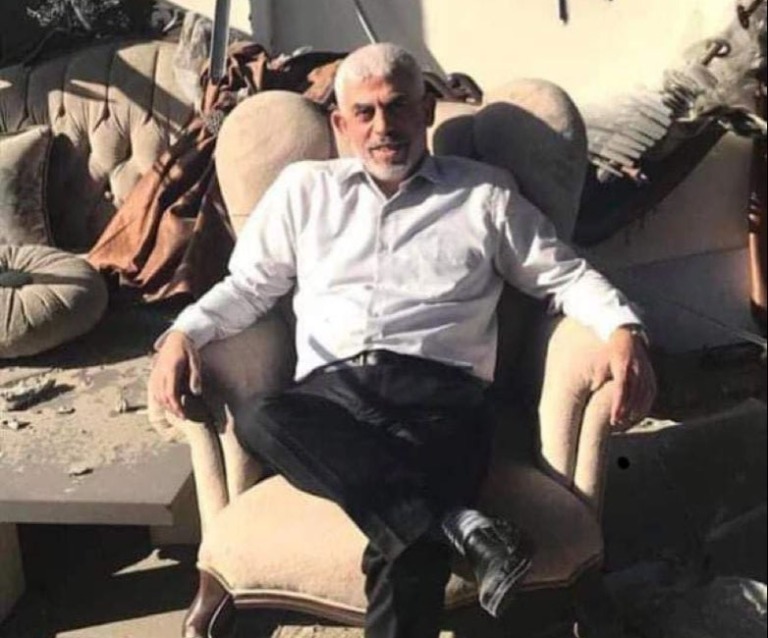
“I am Yahya, the son of a refugee who turned exile into a temporary homeland, and turned a dream into an eternal battle.” Yahya Al-Sinwar’s Will. “My will to you starts here, from that child who threw the first stone at the occupier”

November 2, 2024

________________________

Posting Yahya Sinwar’s Will.

It is an eloquent call to his Palestinian campaneros to continue with the resistance and gives a sense of the man’s purpose in life: the liberation of his people, the Palestinian people from the clutches of Zionist settler colonial rule and oppression.

What other choice do the Palestinians have but to resist? 

Sinwar’s  words break though the cruel stereotype painted by both the U.S. and Israeli media that make it obligatory, in this country, for any kind of legitimacy, to savage his name.

Why post this?

So readers can get a sense of the man in his own words. Because his person has been savaged as Ho Chi Minh, Mao Tse Tung, Ruth First, Che Guevara, his campanero Hasan Nasrallah of Hezbollah, Malcolm X, Crazy Horse – all called “terrorists” until it was acknowledged that they were instead, freedom fighters.

Plus he has a point when he notes the failure of “endless negotiation” after the failure of 75 years that have only made the occupation that much more of a choke hold on what remains of Palestinian lands.

One other point – pour as much bile on him and Hamas as you like. Hamas is here to stay; if anything its prestige has soared, as as that of Hamas itself and the Palestinian resistance as a whole.  It is not the United States, Israel, their European allies that will determine the future Palestinian negotiating partners when this genocide comes to an end, but the Palestinian people that will. Whatever the ultimate fate of the Palestinians, Hamas will be a part of the mix, the moans and groans of Washington and Tel Aviv aside. RJP

________________________

Yahya Al-Sinwar’s Will. “My will to you starts here, from that child who threw the first stone at the occupier”

This document was translated from Arabic by Amir Nour. It appeared on the website “Global Research

I am Yahya, the son of a refugee who turned exile into a temporary homeland, and turned a dream into an eternal battle. As I write these words, I recall every moment that has passed in my life: from my childhood in the alleys, to the long years of imprisonment, to every drop of blood that was shed on the soil of this land. 

I was born in Khan Yunis camp in 1962, at a time when Palestine was a torn memory and forgotten maps on the tables of politicians. I am the man whose life was woven between fire and ashes, and who realized early on that life under occupation meant nothing but permanent imprisonment. I knew from a young age that life in this land is not ordinary, and that whoever is born here must carry an unbreakable weapon in their heart, and be aware that the road to freedom is long.

My will to you starts here, from that child who threw the first stone at the occupier, and learned that stones are the first words we utter in the face of a world that stands silent before of our wound.

I learned in the streets of Gaza that a person is not measured by the years of their life, but by what they give to their homeland. This was my life: prisons and battles, pain and hope. I entered prison for the first time in 1988, and was sentenced to life imprisonment, but I did not know a way to fear. In those dark cells, I saw in every wall a window to the distant horizon, and in every bar a light illuminating the path to freedom. In prison, I learned that patience is not just a virtue, but rather a weapon, a bitter weapon, like drinking the sea drop by drop.

My will to you: do not fear prisons, for they are only part of our long journey toward freedom. Prison taught me that freedom is not just a stolen right, but rather an idea born of pain and refined with patience. When I was released in the “Loyalty of the Free” prisoner exchange deal in 2011, I did not emerge the same; I emerged stronger and so did my belief that what we are doing is not just a passing struggle, but rather our destiny, one that we carry until the last drop of our blood.

My will to you is that you continue to cling to the gun, to the dignity that cannot be compromised, and to the dream that does not die. The enemy wants us to abandon resistance, to turn our issue into an endless negotiation. But I say to you: do not negotiate over what is rightfully yours. They fear your steadfastness more than they fear your weapons. Resistance is not just a weapon we carry, but rather it is our love for Palestine in every breath we take, it is our will to remain, despite the siege and aggression.

My will to you is that you remain loyal to the blood of the martyrs, to those who departed and left us this path full of thorns. They are the ones who paved the path of freedom for us with their blood, so do not waste those sacrifices in the calculations of politicians and the games of diplomacy. We are here to continue what the first generation started, and we will not deviate from this path no matter the cost. Gaza was and will remain the capital of steadfastness, and the heart of Palestine that never stops beating, even if the world closes in around us.

When I took over the leadership of Hamas in Gaza in 2017, it was not just a transfer of power, but rather a continuation of a resistance that began with stones and continued with rifles. Every day, I felt the pain of my people under the siege, and I knew that every step we take toward freedom comes at a price. But I tell you: the cost of surrender is much greater.

Therefore, hold on firmly to the land as roots cling to the soil, for no wind can uproot a people who have chosen to live. In the Battle of Al-Aqsa Flood, I was not the leader of a group or movement, but the voice of every Palestinian dreaming of liberation. I was guided by my belief that resistance is not just an option, but a duty. I wanted this battle to be a new chapter in the book of Palestinian struggle, where the factions unite and everyone stands in one trench against an enemy that has never differentiated between a child and an old man, or between a stone and a tree.

The Al-Aqsa flood was a battle of spirit before it was a battle of bodies, and of will before a battle of weapons. What I have left behind is not a personal legacy, but a collective one, for every Palestinian who dreamed of freedom, for every mother who carried her son on her shoulder as a martyr, for every father who wept bitterly for his daughter who was killed by a treacherous bullet.

My final will to you is to always remember that resistance is not in vain, nor is it a bullet fired, but a life that we live with honor and dignity. Prison and siege taught me that the battle is long, and that the road is difficult, but I also learned that peoples who refuse to surrender create miracles with their own hands. Do not expect the world to do you justice, for I have lived and witnessed how the world remains silent in the face of our pain. Do not wait for fairness, but be the fairness. Carry the dream of Palestine in your hearts, and make every wound a weapon, and every tear a source of hope.

This is my will to you: do not lay down your weapons, do not throw away your stones, do not forget your martyrs, and do not compromise on a dream that is rightfully yours.

We are here to stay, in our land, in our hearts, and in the future of our children.

I entrust you with Palestine, the land I loved until death, and the dream I carried on my shoulders like a mountain that never bends.

If I fall, do not fall with me, but carry for me a banner that never falls, and make my blood a bridge for a generation that will rise from our ashes stronger. Do not forget that the homeland is not a story to be told, but a reality to be lived, and that with every martyr a thousand more resistance fighters are born from the womb of this land.

If the flood returns and I am not among you, know that I was the first drop in the waves of freedom, and that I lived to see you continue the journey.

Be a thorn in their throat, a flood that knows no retreat, and do not rest until the world acknowledges that we are the rightful owners, and that we are not just numbers in the news bulletins.


URGENT APPEAL TO HEALTHCARE LEADERS: PROTECT HEALTHCARE AND CHILDREN IN GAZA—DO NOT BAN UNRWA SUPPORT AMIDST GROWING CRISIS. Sunday, November 3, 2024 at 10 AM in front of the west steps of the State Capitol, downtown Denver

November 1, 2024

Woman of Jaffa by Rowan Anani

FOR IMMEDIATE RELEASE

URGENT APPEAL TO HEALTHCARE LEADERS: PROTECT HEALTHCARE AND CHILDREN IN GAZA—DO NOT BAN UNRWA SUPPORT AMIDST GROWING CRISIS

 Media Contact:

Dr. Mohamed  | (314) 775-7990 | DoctorsAgainstGenocideCO@gmail.com

Rob Prince | (720) 398-7719 | robertjprince@gmail.com

Reema Wahdan | (720) 341-3253 | reema.wahdan15@gmail.com

Photo, video, and interviews with participants are available upon request

November 1, 2024

On Sunday Nov 3 at the Colorado State Capitol, healthcare leaders and organizations are issuing an urgent appeal to the CDC, NIH, presidents of medical associations, hospital CEOs, and healthcare advocates worldwide to take immediate action to address the escalating healthcare crisis affecting children and communities in Gaza and Lebanon. With the destruction of critical medical infrastructure and the lives of patients and healthcare professionals at risk, the banning of support for UNRWA (the United Nations Relief and Works Agency) could cripple an already devastated healthcare system and exacerbate the suffering of Palestinian civilians.

As healthcare workers and leaders committed to protecting life and health, we must address the immediate and catastrophic needs of Gaza, where nearly every hospital has been destroyed, healthcare facilities have been reduced to rubble, and access to essential services is severely limited. Medical missions have been blocked, and critical resources such as food, fuel, and medical supplies have been cut off, creating an untenable situation for patients and healthcare providers alike.

Healthcare Leaders Demand Immediate Action:

  1.       End Bombing of Hospitals and Attacks on Healthcare Personnel: We call for an immediate halt to all bombings of hospitals, healthcare facilities, and attacks on aid workers. Healthcare providers and medical facilities must be protected under international law.
  2.       Safeguard Children from Harm: No child should endure the horrors of war. We demand protection for children in Gaza and Lebanon, ensuring their right to life, safety, and peace.
  3.       Implement an Immediate Ceasefire and Stop the Violence: A ceasefire is urgently needed to allow healthcare operations to resume, stabilize healthcare services, and prevent further loss of life.
  4.       Cease Arms Supply and Divest from Entities Complicit in Violence: We urge an embargo on weapons to Israel, as the militarization of healthcare spaces has led to tragic civilian casualties and destruction of critical healthcare services.
  5.       Ensure Humanitarian Access to Gaza: Immediate access for humanitarian and medical aid is essential to deliver lifesaving supplies and services, including antibiotics, trauma care, and surgical tools.
  6.       Expand Trauma-Informed Healthcare Training: Healthcare institutions must equip staff to provide trauma-informed care for patients affected by the consequences of war crimes, crimes against humanity, and systemic oppression.
  7. We call on the Colorado Congressional delegation to sponsor/support HR 9649 – the UNRWA Emergency Restoration Act. We call on the Biden Administration to suspend blocking UNRWA funding asap.

Call to Action for Healthcare Leadership

We urge healthcare leaders to advocate for legislative action to prevent further violence and support initiatives that protect the well-being of children and healthcare workers. Supporting organizations in Gaza and Lebanon will strengthen their capacity to provide essential medical services, rebuild infrastructure, and sustain healthcare education for future providers.

This appeal aligns with the principles of International Humanitarian Law, US Federal Law, and medical ethics. The collective response of healthcare leaders and organizations can save lives and support those working under the harshest conditions to provide care.

The time to act is now. Join us in this critical mission to defend the principles of healthcare, protect vulnerable populations, and preserve the right to medical care and humanitarian support in Gaza.

Contact Information:

Doctors Against Genocide
www.doctorsagainstgenocide.org

Endorsing Organizations:

Advancing Health Equity
American Muslim Health Professionals

Center for Freedom and Justice – Colorado
Disability Justice for Palestine
Doctors Against Genocide
Equal Health
Eyewitnesses Gaza                                                                                                                                                                                                                                                                                                    Friends of Sabeel

Healthworkers Alliance for Palestine
Healthcare Workers for Palestine
Health Justice
Jewish Voice For Peace Health Advisory Council
Lemkin Institute for Genocide Prevention and Human Security
Medical Students for Justice in Palestine (MSJP)
Nurses Against Genocide
No Child A Target
Physicians for Humanity                                                                                                                                                                                                                                                                                      Rocky Mountain Peace and Justice Center

____________________________________________

Israelis blocked aid trucks to Gaza at the Tarkamiya checkpoint. Multiple international bodies and rights groups have validated that 83% of food aid has not entered into Gaza in 2024. There’s also a catalogue of video evidence showing Israeli settlers destroying food aid meant for Gaza.

https://twitter.com/i/status/1852851272115712052

The Savaging of Francesca Albanese, Special Rapporteur on the situation of human rights in the Palestinian territories occupied since 1967

October 30, 2024

Fransesca Albanese. Special Rapporteur on the situation of human
rights in the Palestinian territories occupied since 1967

_________________________________

“This year over the last twelve months I reluctantly became the chronicler of a genocide”  UN Special Rapporteur, Francisca Albanese., Washington DC. October 29, 2024

“20,000 missing children in Gaza — some maimed beyond recognition. On top of the 17,000 killed in 12 months. We call it genocide because it is genocide.” UN Special Rapporteur, Francesca Albanese

As former (essentially purged) University of Denver Dr. Nader Hashemi noted to his introduction to the remarks of Francesca Albanese, noted,

In an age where events related to the question of Palestine are cancelled or shut down it’s great to know that we have this community (Busboys and Poets) space here in Washington DC and where events such as this can’t be shut down.

_________________________________

In what has become a typically scurrilous pretext, the Biden Administration cancelled an appearance of Francesca Albanese at a  Special Rapporteur on the situation of human rights in the Palestinian territories occupied since 1967, at a briefing called by Andre Carson (D-Indiana). The meeting was cancelled at the last moment as a result of “pressure” “from higher ups in the Biden Administration after an article appeared in a publication called the Jewish Insider, accusing Albanese as  “anti-Semitic … and “unfit for her position.”.

The Anti-Defamation League (ADL), which has been increasingly transformed from an anti-Semitic to an anti-Zionist watchdog joined in the anti-Albanese fray, accusing the UN Special Rapporteur of “a long record of spreading antisemitism.” The ADL and the like  pressured  Georgetown University and Barnard College to cancel Albanese appearances. Despite the pressures, Francesca’s Georgetown proceed and was a standing room only, very successful event. The event itself was not disrupted but “the forces of evil” but plastered posters around campus calling her a Jew-hater and *some* Jewish students claimed they didn’t feel safe/secure on campus anymore. As Jewish Insider reported, an email sent by Carson’s office to Democratic staff said the event would be postponed, without further elaboration. At the same time Former House Speaker Kevin McCarthy (R-CA)  similarly canceled a Nakba Day event held by Rep. Rashida Tlaib (D-MI) in 2023, but Sen. Bernie Sanders (I-VT) hosted it in his Senate committee hearing room. Albanese was able to speak at Princeton recently, at the UN and a few other places, including at the University of Toronto in early November. For her Toronto gig, Bernard Henry-Levy (the fake French intellectual) said he would fly into Toronto to confront her. This was on twitter.

A source of Zionist angst targeting Albanese is an October 1 groundbreaking and detailed report about Israel’s ongoing genocide in Palestine. It should be required reading material for one and all. It was her findings in this report that Albanese was scheduled to discuss at the cancelled meeting in the House of Representatives. In this report  Albanese, examines the unfolding horrors in the occupied Palestinian territory which the Zionists and their backers in Washington are trying to deny. While the wholesale destruction of Gaza continues unabated, other parts of the land have not been spared. The violence that Israel has unleashed against the Palestinians post-7 October is not happening in a vacuum, but is part of a long-term intentional, systematic, State-organized forced displacement and replacement of the Palestinians. This trajectory risks causing irreparable prejudice to the very existence of the Palestinian people in Palestine.

As Albanese commented to a Washington DC audience at “Busboys and Poets” how the normalization of the brutalization of the Jewish people by the Nazis during World War runs parallel to the normalization of the brutalization of the Palestinian people by Washington’s regional proxy, Israel. In this comparison, Albanese noted:

He knew (Rapahel Lempkin, the originator of the term “genocide“) that the Jewish people (in Europe) had been the victims of a genocide…but he also knew that it was nothing new because millions of people had been victims of genocide in Latin America, in Africa, in Southeast Asia at the hands of settler colonial powers. … how did we get to the concentration camps (in WW2) because we had normalized the brutalization of the Jewish people. We had the right to kick them out of their families, the medical profession, the legal professions. It was normal. They were (considered) sub humans, right? So this is why it was considered “normal” to put them in concentration camps, a dehumanization that led to concentration camps and Rabbi Lemkin understood it.

The Palestinians have been portrayed (in Zionist thinking) as Nazis; the Palestinians have been blamed for the Holocaust. … one thing that the Palestinians are not responsible for is the Holocaust.

Read more…

The Center for Freedom and Justice – Colorado calls on the U.S. to restore UNRWA funding (HR9649)

October 29, 2024
tags:

_________________________________

(Israel’s parliament has voted to declare the UN Relief and Works Agency (UNRWA) a “terror organization”, thus banning the largest provider of humanitarian assistance to the Palestinian territories. The bill is  is supported by a large majority of Israeli officials
– Do we still celebrate Israeli democracy when it votes for starvation & genocide?
Israel is at risk of losing UN membership if it cuts ties with UNRWA: According to Ynet, Israeli foreign ministry officials are warning that the legislation being advanced in the Knesset to sever ties with the UN Relief and Works Agency for Palestinian refugees puts Israel’s United Nations membership at risk of being suspended for violating the UN Charter. .)

_________________________________

The U.S. must restore UNRWA funding.

The Center for Freedom and Justice – Colorado (CFJ-Colorado) joins other peace, human rights and church organizations in urging Congress to pass the UNRWA Emergency Restoration Act , HR 9649, to reaffirm US commitment to UNRWA’s essential work to effectively address the humanitarian crisis in Gaza. HR 9649 was introduced to the House Committee on Foreign Affairs on September 18, 2024.

We, of the Center for Freedom and Justice. -Colorado (CFJ), call on Colorado’s Congressional Delegation, both Republicans and Democrats, to sponsor and work for the passage of House Resolution 9649.

Despite a catastrophic humanitarian crisis which includes the Israeli massacre of untold numbers of Palestinians, famine, polio outbreak, and virtually no healthcare system in Gaza, the Biden Administration has halted U.S. funding for the United Nations Relief and Works Agency (UNRWA). UNRWA is the leading aid organization providing relief to six million Palestinians. Before the UNRWA cut, the United States provided a significant percentage of the aid offered to Gaza. Worse, the US is refusing to force Israel to allow food into Gaza, normalizing the weaponization of food. UNRWA has more than 30,000 staff across the region, including 13,000 in Gaza, the majority of them Palestinian

This suspension threatens UNRWA’s ability to deliver food, shelter, healthcare and education of Palestinians across Gaza, the West Bank, Syria, Lebanon, and Jordan. This cruel injustice, which adds to Israel’s all-round genocidal campaign, is unconscionable. UNRWA is the backbone of humanitarian operations on the ground in Gaza. Other humanitarian organizations are unable to fill that huge gap created by the loss of U.S. UNRWA funding.

This new legislation introduced by Reps. Andre Carson (IN-7), Pramila Jayapal (WA-7), and Jan Schakowsky (IL-9), provides lawmakers a critical opportunity to restore US funding.

As Francesca Albanese, United Nations Special Rapporteur on the Occupied Palestinian Territories noted:

“Destroying UNRWA has huge humanitarian implications, and preventing UNRWA from functioning – UNRWA still has the only remnant of the UN largescale capacity to still insure food distribution, aid distribution in general, medical assistance. Everything is very difficult. I am not even sure as the destruction has been so massive.

As noted by Rep Andre Carson the bill will, in part,

“Repeal the funding prohibitions on UNRWA; 2. Express a Sense of Congress that it supports appropriating critical funds to UNRWA for FY25; (3) Urge the Secretary of State to rescind the temporary pause in funding for UNRWA.”

We acknowledge and thank Rep. Diana DeGette for being one of the House’s 71 sponsors of the bill, now in the hands of the House Committee for Foreign Affairs.

The Committee chairs are currently sitting on the bill and have refused to consider it despite is broad support from dozens of civil rights, peace and religious organizations. The rest of the Colorado delegation has remained silent. The rationale given for cutting U.S. funding to UNRWA has been from the beginning, spurious. At this point, the United States is the only country that withdrew funding that has not reinstituted funding. The EU, UK, Canada, Australia, Finland, Sweden, Germany and Japan all are again contributing. Six million Palestinian refugees are registered with UNRWA.

Fransesca Albanese. Special Rapporteur on the situation of human rights in the Palestinian territories occupied since 1967


Perpetual War for Imaginary Peace: Washington’s Foreign Policy from World War 2 Until the Present: Ibrahim Kazerooni and Rob Prince

October 27, 2024

Israel’s War on Palestine, Its Arab Neighbors: Lebanon: The War Front: Week of 14 October 2024

October 23, 2024
tags:

Despite Israeli claims of military advances in southern Lebanon, Hezbollah’s escalating operations and new weaponry reveal a fierce resistance, challenging the occupation’s narrative and signaling yet another u-turn in the war’s balance of power.

OCT 23, 2024

(Photo Credit: The Cradle)

Last week, the Israeli occupation army tried to project an image of victory – or at least military progress – on the southern Lebanon front. They published videos showing bombings of border villages and images of soldiers raising Israeli flags, trying to convey a sense of power and control despite a history of military failures in the south.

But the reality on the ground tells a different story. This image is nothing but another media stunt aimed at demoralizing Hezbollah and reassuring Israeli settlers that their army is making progress to encourage their return to northern settlements. Just days before his assassination, the late Hezbollah secretary-general Hassan Nasrallah vowed to prevent their return as long as the occupation state continues its aggression against Gaza.

Hezbollah operations spike

On 22 October, Hezbollah carried out the highest number of operations against Israel since 8 October 2023, when it launched cross-border military campaigns in support of Gaza and the Palestinian resistance.

Official statements from Hezbollah claimed responsibility for 39 attacks, including the destruction of six Merkava tanks near the border, numerous anti-tank guided missile (ATGM) and rocket strikes on occupation forces along the border, and some attacks reaching as far as 100 kilometers into Israeli territory.

Three of the most significant attacks targeted Tel Aviv’s suburbs: a military-industrial complex, the Nirit settlement, and Unit 8200, the military’s intelligence corps for clandestine operations. Additionally, the Stella Maris Naval Base north of Haifa was targeted with Naser 2 missiles, while drones launched around 7 pm Beirut time targeted the Elyakim base south of Haifa, evading both the Iron Dome and Israeli air force defenses.

Sirens wailed from the Lebanese border to 50 kilometers south of Haifa as these drones flew overhead, forcing nearly a million Israelis into shelters, triggering panic, and further embarrassing the military after a Hezbollah drone struck Prime Minister Benjamin Netanyahu’s home. Social media is rife with videos showing drones flying for over 40 minutes before reaching their target.

Israeli attempts to enter Southern Lebanon

For over a year, the front lines in southern Lebanon have faced thousands of raids after Hezbollah opened a support front for the Palestinian resistance in Gaza. Despite this and the assassination of numerous top Hezbollah military officials, the Lebanese resistance’s anti-armor missiles continue to strike Israeli vehicles and soldiers from the border region.

Following heavy bombardments by the Israeli army, Hezbollah fighters retreated to defensive positions, from which they have been countering Israeli attempts to invade southern Lebanon. The images and footage released by the Israeli army, allegedly showing soldiers entering Hezbollah facilities near the border, are nothing more than wartime propaganda.

These positions – constructed under the watchful eye of Tel Aviv – hold no defensive value and have been bombed countless times without any real strategic impact on the war.

These border facilities were previously used by Hezbollah’s elite Radwan Forces to launch attacks against Israeli positions. The area south of the Litani River hosts thousands of such installations, which are larger, deeper, and of far greater strategic importance. The question remains: can Israeli army spokesperson Daniel Hagari visit them at will? No.

Despite continuous attempts, the Israeli army has yet to secure a foothold in southern Lebanon. They advance deeper, only to face fierce resistance, forcing them to retreat under fire. The maximum depth reached by occupation forces has been about two kilometers in the Al-Qouzah area, but they were forced to retreat quickly, suffering heavy casualties and losing tanks and bulldozers in the process.

Hezbollah’s field advantages

The Israeli military generally avoids venturing into villages and urban areas, even after systematic destruction, to minimize direct clashes or the risk of falling into Hezbollah’s ambushes. Instead, it prefers to advance along the outskirts of villages, staying away from resistance fighters’ watchful eyes – except in regions where villages merge, such as Maroun al-Ras, Al-Adaysa, and Yaroun.

Map highlighting key Lebanese villages and Israeli attempts to invade southern Lebanon.

The border villages of Kfar Kila, Aita al-Shaab, Khiam, Maroun Al-Ras, Yaroun, and others have all faced violent airstrikes by the occupation air force over the past year.

Although the US-backed Israeli forces are well-trained and equipped with some of the world’s best military hardware, they are no match for the terrain of southern Lebanon, which favors the guerrilla tactics adopted by Hezbollah fighters.

Unlike the invaders, these fighters are natives of the villages where the battles play out. They know the land intimately and use every tree, valley, mountain, and rock to their advantage, defending their home with a resilience that no technology can easily overcome.

High terrain provides them with visual and fire control, making it difficult for enemy forces to advance. It’s also important to note that there is no single “strategic village”; rather, control over different areas provides varied tactical advantages.

For instance, Maroun al-Ras offers control over Bint Jbeil, a town symbolically important to Israel for being the site of the legendary battle bearing its name, and Nasrallah’s famous “spider web” speech following Israel’s withdrawal from Lebanon six years earlier in 2000.

At that time, Lebanese resistance forces, led by the late Khaled Bazzi, successfully confronted the Israeli army and prevented it from reaching the site where Nasrallah gave his speech.

Enhanced arsenal: Hezbollah’s new capabilities

After weeks of silence, Hezbollah recently released footage showing an attack on an Israeli unit of seven soldiers with two Almas guided missiles in the village of Ramyeh. The aftermath suggests at least two soldiers were killed and several injured, although Israel has not reported any casualties—confirming suspicions that Tel Aviv has been downplaying its losses in southern Lebanon and elsewhere throughout the war.

Moreover, Hezbollah introduced four new weapons into service this month: the Qader 2 ballistic missile, the Naser 1 and Naser 2 missiles, and the M80 anti-personnel rocket launcher. The Qader 2 has a range of 250 kilometers with a 405-kilogram warhead, while the Naser 1 and 2 have ranges of 100 kilometers and 150 kilometers, respectively, each with pinpoint accuracy. These additions signal Hezbollah’s advanced capabilities in both targeting and firepower.

After preventing the Israeli army from controlling or securing southern villages, increasing the volume and quality of the daily attacks, and deploying new strategic weapons, it seems clear that the Lebanese resistance is gradually recovering after taking harsh blows with the assassinations of its leaders and Israel’s pager terror attacks last month.

The views expressed in this article do not necessarily reflect those of The Cradle.


Lessons In Solidarity: Personal Histories of Front Range Jews Against The Occupation. Monday, November 4, 2024; 6-8 pm. Washington St. Community Center

October 20, 2024


Panelists: Susan Kaplan, Alice Turak, Rob Prince

Moderator: Rae Jones – Denver/Boulder JVP

Link for registration info

READING LIST | THE HISTORY OF ISRAEL-PALESTINE

October 20, 2024

Middle East Choke Points

READING LIST | THE HISTORY OF ISRAEL-PALESTINE

(prepared by Alex Boodrookas, Ph.D.  He is an assistant professor in the Department of History at Metropolitan State University of Denver. He teaches World History since 1500, Modern Middle East and History of Islam. His areas of expertise are in labor, migration, politics and the Persian Gulf.

BOOKS & ARTICLES

Joel Beinin and Lisa Hajjar, “Palestine, Israel and the Arab-Israeli Conflict,” MERIP. A
clear, reliable, article-length overview of the conflict available for free online.

Rashid Khalidi, Hundred Years War on Palestine. A readable and personal history of the
conflict by a respected historian.

James Gelvin, The Israel-Palestine Conflict: One Hundred Years of War. A solid and
accessible summary written by a respected historian.

Edward Said, “Zionism from the Standpoint of its Victims,” and Ella Shohat, “Zionism from
the Standpoint of its Jewish Victims.” Two older but influential and well-written articles.

Edward Said, Out of Place: A Memoir or The Question of Palestine. Classic older works by
perhaps the best-known Palestinian academic.

Shay Hazkani, Dear Palestine: A Social History of the 1948 War. A bottom-up history of the
pivotal 1948 war and its aftermath.

Meron Benvenisti, Sacred Landscape The Buried History of the Holy Land since 1948. A
personal but still scholarly account of the aftermath of the expulsions of 1948.

Shira Robinson, Citizen Strangers: Palestinians and the Birth of Israel’s Liberal Settler State.
A more academic but important work focused in the immediate aftermath of 1948.

Noura Erakat, Justice for Some: Law and the Question of Palestine. Focuses on the questions
of international law raised by the discrimination directed against Palestinians.

Joe Sacco, Palestine. A bit old, but a classic nonfiction graphic novel.

For fiction, see Literary Hub’s article entitled “40 Books to Understand Palestine”

PODCASTS & VIDEOS

Zachary Lockman on Zionism: https://www.youtube.com/watch?v=TrUWHZgGaxk

Tareq Baconi on Hamas: https://thedigradio.com/podcast/hamas-w-tareq-baconi/

Teach-in at UC Berkeley, Hatem Bazian

Teach-in series at Rutgers Center for Security, Race, and Rights

DOCUMENTARIES

Five Broken Cameras | The Law in These Parts | The Gatekeepers | Reel Bad Arabs | Tantura

TRUSTWORTHY SOURCES FOR NEWS & ANALYSIS ABOUT THE MIDDLE EAST
MERIP | Ottoman History Podcast | New Lines Magazine | Jadaliyya | MadaMasr

TIMELINE

_______________________________________________________________________

1882: First Aliyah, or Zionist immigration to Palestine. Plantation economy established.
1917: Balfour Declaration announces British imperial support of the Zionist movement.
1917: British forces seize Palestine from the Ottomans after 400 years of rule.
1922: Britain named Mandatory power in Palestine by the League of Nations.
1920-21 & 1928-9: First cases of intercommunal violence.
1936-9: Palestinian Great Revolt. Palestinians launch general strike and armed uprising against
the British and their Zionist allies, but are militarily crushed.
1937: Peel Commission, led by British imperial official, drafts first plan for the partition of
Palestine
1939: British White Paper restricts Jewish immigration and land sales in response to the Revolt.
1939-45: WWII. The Holocaust kills six million Jews and turns hundreds of thousands more into
refugees, many of whom migrate to Palestine.
1948: Israeli Independence & the Palestinian Nakba. Thousands of Palestinians killed and
over 700,000 expelled and barred from returning home. Israel seizes most Palestinian land.
1956: Israel, Britain, and France attack Egypt after Nasser nationalizes the Suez Canal and are
forced to retreat under pressure from both the US and USSR.
1967: Sweeping Israeli victory in the Six-Day War. Israel occupies Sinai, Gaza, and the West
Bank. Palestinians in the West Bank remain under military occupation to this day.
1970: Black September. The Hashemite monarchy in Jordan expels Palestinian fighters and the
PLO leadership after a challenge to their rule.
1972: Israeli athletes killed by Palestinian organization Black September, leading to international
backlash against Palestinian cause.
1973: Yom Kippur / October War. Surprise Egyptian attack nearly destroys Israeli army. US
arms and diplomatic support save Israeli forces and cement the US-Israel alliance.
1979: Camp David accords signed between Israel and Egypt. Guaranteed by the United
States, the treaty removes Israel’s only real military rival from the geopolitical equation.
1982: Israel invades Lebanon during Lebanese civil war. Attacks on civilian population centers,
including a number of massacres, trigger backlash internationally.
1987: First Intifada, or grassroots Palestinian uprising, begins. Mass wounding, incarceration,
and killing of usually peaceful Palestinian protestors generates global backlash.
1991: The “Peace Process” begins. PLO eventually gains limited governing powers in the West
Bank, but at the price of collaborating with the occupation, eroding its popularity.
1995: Israeli Prime Minister Yitzhak Rabin assassinated, signaling the rise of the Israeli far-right
and the ineffectiveness of peace negotiations.
2000: Second Intifada. Hamas and Islamic Jihad begin first major bombing campaign, and
Israel kills thousands of Palestinians. About 1,000 Israeli and 3,000 Palestinian deaths.
2006: Hamas wins Palestinian elections, taking control of governance in Gaza.
2007: Israel declares the Gaza Strip “hostile territory” and imposes a siege, prohibiting all travel
and restricting access to basic goods, including food, electricity, internet, and fuel.
2008, 2012, 2014, & 2021: Israel attacks Gaza, sometimes after Hamas rocket attacks, killing
hundreds if not thousands of Palestinian civilians each time.
2018-2019: Great March of Return in Gaza. Peaceful Palestinian protests at the Gaza border
wall. Israeli forces kill about 200 Palestinians and wound about 10,000 more.
2023: October 7 & its aftermath.

Brief Bibliography on Gaza Genocide/History of Zionism, etc.

October 18, 2024
___________________________________________________
This brief bibliography was requested by a Palestinian friend who has gotten requests for more information on the subject. It is not meant to be exhaustive. If you think there are other sources – books, websites, etc that would be helpful to new comers interested in probing the history of Zionism and Palestinian national resistance to it, please let me know and I will add them to this list. RJP
___________________________________________________

Books:

Rashid Khaledi – anything by him is good but especially “The Hundred Years War on Palestine
Norman Finkelstein – also his books are excellent – he is all over the internet, serious very diligent scholar but especially “Gaza: Inquest into its martyrdom
Edward Said – “The Question of Palestine“, remains in my view, despite its age, the best overall coverage of Israel/Palestine. Included is a more extensive list of his books.
Ilon Pappe – “The Ethnic Cleansing of Palestine” – (this one by an Israeli scholar who now lives in UK)
For the Syke-Picot agreement The Peace to End All Peace by David Fromkin. 
Nom Chomsky’s “The Fateful Triangle” – while 40 years old, I still consider it the best overall explanation of U.S. policy towards Israel, the Arabs and the Question of Palestine.
Helena Cobban & Rami G. KhouriUnderstanding Hamas and why That Matters”, by Helena Cobban & Rami G. Khouri, 2024
Marc Lamont Hill & Mitchell Plitnick “Except for Palestine: The Limits of Progressive Politics“, 2021
______________________________________________________________
 

More contemporary sources – web pages, etc.

Sources worth listening to:
EuroMed Human Rights Monitor 
Excellent human rights monitor for Palestine (and other countries). Sober and serious analyses, updates on human rights situation in Gaza.
The Electronic Intifada 
Palestinian sources including reporters from Gaza. These folks (there are four of them) really know their stuff; their analysis is serious, controlled and they are rarely off the mark.
The Anti-Empire Project 
Over the past year I find myself listening more and more to Justin Podur. I appreciate both the tone and the content of his analyses. Very sharp and knows the history of the Palestinian Resistance as well as anyone.
M.K.Bhadrakumar.. He publishes at a site called “Indian Punchline”
A former diplomat from India, M.K. Bhadrakumar is one of the sharpest geopolitical analysts out there. He covers not only the Middle East, but global geo-politics as well.
Judge Napolitano’s “Judging Freedom”.
“The Judge” is a quite conservative host – used to be a regular on Fox News. To my surprise, I find his interviews excellent and it includes a wide range of experts, my favorite by far is former British Intelligence Agent Alastair Crooke whose understanding of the current crisis in Gaza, Israeli-Palestinian relations is, in my view, second to none.
“the Judge” also interviews Scott RitterAaron Mate, “The Greeks” as I call them – Alexander Mercouris and Alex Christoforou and many others.

Mao: Tyrant or Great Leader? by SL Kanthan

October 17, 2024

Peace among neighbors – China’s contribution to reducing Middle East tensions. Wang Ming, center, former Chinese foreign minister with the Saudi and Iranian foreign ministers promoting Saudi-Iranian reconciliation which changed the geopolitical map of the Middle East.

_____________________________

I have been reading a fair amount about China, the early days, how it was that the Chinese Communists came to power, what were the challenges they faced in the struggle for power along with those they faced in building socialism in China. There is a whole different set of preconditions to seize power from, once in power, building a nation. I have been particularly interested in why China has succeeded in this project while the USSR collapse. This article below, by SL Kanthan, an Indian Marxist, looks at China today and addresses some of the false ideas floating around in the mainstream media that is increasingly hostile to China’s rise to becoming a world power, which it is today). RJP

_____________________________

Mao: Tyrant or Great Leader? by SL Kanthan

Mao’s Legacy and Accomplishments

Mao Tse‐tung, who began as an obscure peasant, died one of history’s great revolutionary figures. In Chinese terms, he ranked with the first Emperor who unified China in 200 B.C.

A Chinese patriot, a combative revolutionary, a fervent evangelist, a Marxist theorist, a soldier, a statesman and poet, above all Mao was a moralist who deeply believed, as have Chinese since Confucius, that man’s goodness must come ahead of his mere economic progress.

China achieved enormous economic progress under Mao. He transformed China into a modern, industrialized socialist state.”

Unlike many great leaders, Mao never exercised, or sought, absolute control over day‐to‐day affairs.”

Who would write such blatant communist propaganda?

It was the New York Times in 1976!

This year is the 75th anniversary of the People’s Republic of China. After winning the long Chinese civil war, Mao Zedong spoke before a large crowd in Beijing in 1949 and proclaimed, “The Chinese people have stood up.” Thus, was born the PRC.

Chairman Mao laid the foundation from which contemporary China took off like a rocket over the last 40 years, especially in the last 20 years.

And the Chinese are still standing up against imperialism, which is desperately trying to contain the Middle Kingdom through trade wars, tech wars, geopolitical wars and propaganda wars.

The quote you heard in the beginning of this article about Mao sounds shocking, only because the US and the UK have engaged in profound revisionism of history since the 1990s. It all started when the CIA’s color revolution in China failed in 1989 – yeah, we are talking about the Tiananmen Square protests. The globalists really wanted to end communism all over the world when the USSR collapsed.

However, when China continued to cling on to its core ideology, Americans decided to rewrite history and demonize Mao as an incompetent or evil tyrant who killed tens of millions of people. But you can go back and look at US media and even the CIA reports for four decades, from 1950 until 1989, and you will mostly find neutral or positive reports. You will not find a single report on the Great Famine or millions of people dying. I will share a lot of stunning statistics and some CIA reports later in this article.

This is not to say that Mao was flawless. Obviously, nobody is perfect. Even the Chinese Communist Party acknowledges that Mao made mistakes, especially during the cultural revolution. But I will show you what Mao accomplished and what the Western lies are about his record. Read more…

Statement by EuroMed Rights: One Year After

October 16, 2024
tags:

_____________________________

The U.S.-Israeli genocide against Gaza continues unabated. A year of U.S.-Israeli genocide against the Palestinians of Gaza, major ethnic cleansing of the W. Bank and now Israel plans to extend the war to Lebanon and possibly elsewhere. A few days ago, the Israel’s dropped a U.S. made 2000 pound bomb on a Gaza tent colony with its inhabitants being burnt alive while friends and family watched unable to engage in rescuing possible survivors because of the intense heat. Auschwitz from the air. RJP)

_____________________________

Statement by EuroMed Rights: One Year After

13 Oct 2024

Today, marks one year since Israel issued an ‘evacuation order’ for 1.1 million civilians to relocate from the north to the south of Gaza. The evacuation order was a blatant violation of international human rights law (IHRL) and international humanitarian law (IHL) ’s provisions on forced displacement and collective punishment, and has abetted to intentionally inflict unbearable living conditions on Palestinians, repeatedly stripping them of safety, dignity, and basic survival. Since the deadly October 7 attacks by Hamas, that killed 1,139 people in clear violation of IHL, the world has watched designated ‘safe areas’ being bombed, schools, hospitals, and refugee camps become objectives in Gaza, the West Bank and now in Lebanon, in a war where humanity has been the main target in a region that will never be the same.

For decades Israel has continued to systematically violate Palestinians’ basic rights and, since 1967, to disregard its duty as an occupying power as established by the 1907 Hague Regulations and the 1949 Fourth Geneva Convention Relative to the Protection of Civilian Persons in Time of War. Under the rule of Israel, Palestinians are subject to a two-tier system to varying degrees, where Israeli Jewish supremacy determines who has rights, and who doesn’t. The Israeli government controls every aspect of life between the Jordan River and the Mediterranean Sea and resonates beyond Israel/Palestine for its illegal character and the impunity with which it continues operating. Israel has intensified its commission of war crimes and crimes against humanity, among other violations of IHRL and IHL, against Palestinians, and as of late, Lebanese peoples. As stated by the ICJ Advisory Opinion and the UN Special Rapporteur about human rights in the OPT, alongside many human rights organisations, these crimes are proper to an apartheid state.

Read more…

Seventy-Five Years of the Chinese Revolution: Happy Birthday China!

October 3, 2024
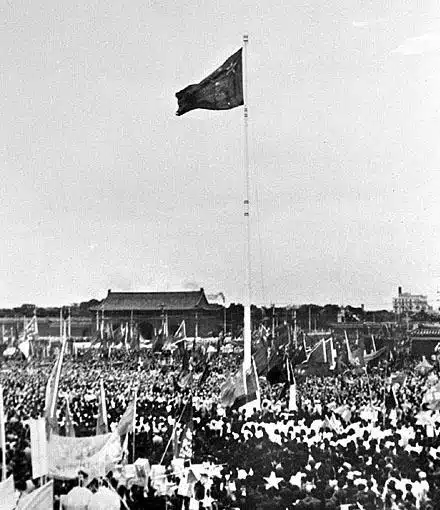
| The flag of the Peoples Republic of China is raised over Tiananmen Square for the first time on October 1 1949 | MR Online

The flag of the People’s Republic of China is raised over Tiananmen Square for the first time on October 1, 1949.

Seventy-Five Years of the Chinese Revolution

On October 1, 1949, the leader of the Communist Party of China (CPC) Mao Zedong (1893–1976) announced the creation of the People’s Republic of China (PRC). Three hundred thousand people gathered in Tiananmen Square to welcome the new government and to greet the new leadership. After Mao made his initial announcement, he unfurled the new flag of the PRC, and then the military chief Zhu De reviewed the forces of the People’s Liberation Army. Similar celebrations were held in other parts of China. The foundation of the PRC ended a century of humiliation before the imperialists (that began with the first Anglo-Opium War of 1839) and the long second world war (that began with the Japanese invasion of Manchuria in 1931). Ten days before, at the first plenary session of the Chinese People’s Political Consultative Conference, Mao had said, “we are all convinced that our work would go down in the history of humankind, demonstrating that the Chinese people, comprising one quarter of humanity, have now stood up.”

The words in the name of new state, the PRC, are important: people and republic. The word republic signified the completion of the 1911 revolution that ended the Qing dynasty (1644–1911) and that inaugurated a form of post-monarchical sovereignty. Chinese republicanism drew from the reformist views from people as diverse as Kang Youwei (1858–1927) and Liang Qichao (1873–1929)—who supported a constitutional monarchy—and then put into practice by Sun Yat-Sen (1866–1925), who was not only against monarchies but more importantly against the wretched cultural inheritance of the centuries and for the unity of the Chinese people across a sprawling territory. The other word—people—has a rich history in Chinese thought and in Marxist theory, where it means that the state must operate on behalf of a range of classes that form most of the society (peasants, workers, intellectuals, and the petty bourgeoisie—the four stars in the new flag of China, with the fifth and largest star representing the CPC). The PRC was understood from the start to be an instrument for the transformation of Chinese society and not the culmination of a previous transformation. It was not a socialist state, but a people’s republic, which would strive to construct socialism. From the very beginning, it was understood by the leadership of the CPC that the Chinese Revolution was not an event that took place in 1949 but a process that began long before, at least since the formation of the Chinese Soviet Republic in Ruijin in 1931 to the revolutionary base in Yan’an in 1936.


The Three Mass Movements

The PRC’s formation came at a time when it had not yet established the unity of the territory or found the means to defend itself against imperialist aggression. Two of the main mass movements deepened right after 1949 were the completion of the defeat of the Kuomintang forces in the southwest and south China, and the establishment of allies in the world (particularly the Soviet Union with the Sino-Soviet Treaty of February 1950) against the imperialist support for the Kuomintang (once it had moved to Taiwan) and then with the US invasion of the Korean peninsula in June 1950. These two mass movements—the defeat of the rightist forces and the building of strength to defend against imperialist aggression—forced the PRC to hold off on the third mass movement, which however was the most enduring: the agrarian reform plan.

The decisions of the CPC in the winter of 1950 began a land reform process in the newly liberated zones that were substantially completed by the spring of 1953. The first general principle of the Law of Agrarian Reform noted, “Abolition of the land ownership of the feudal exploitative landlord class and introduction of peasant land ownership so as to liberate rural productive forces, develop agricultural production and pave the way for New China’s industrialisation.” That was the goal. The process was for the state to encourage grassroots political power, trained and led by the CPC, to conduct land reforms in a guided, planned, and orderly manner. The PRC was not to give land to the peasants, but it was to ensure that the peasants could build regionally and locally to accomplish the task of redistributing resources in their areas. Forced confiscation was not as much the policy as political education in the rural areas to transform land relations away from feudal oppression to a more just basis. By 1956, 90 percent of the country’s peasants had land to till, 100 million peasants were organised in agricultural cooperatives, and private industry was effectively abolished.

Agrarian reform had several productive outcomes: it meant that the landless peasantry and agricultural workers now had access to land and resources that allowed them to live with dignity; it meant that the total population of the rural area worked with a stake in the land and with an interest in making material improvements to the land, which increased productivity; it meant that the old landlord culture of hierarchy and its wretched outcomes in terms of patriarchal relations, for instance, was stamped out. These positive outcomes improved the living and working conditions of most of the Chinese people and built an almost immediate sense of loyalty to the Chinese Revolution.

Overcoming the Penalties of the Past

In 1949, the official literacy rate in China was recorded at 20 percent, although by all indications this was a highly inflated number. This was simply one measure of the miserable conditions of life for the mass of the Chinese population. Another was that population mortality was immense, with infant mortality at a striking 250 per 1000 lived births. The average Chinese life expectancy did not surpass 35 years. Coming out of the Century of Humiliation at the hands of imperialist powers, China’s GDP fell from about one-third of the global economy at the beginning of the nineteenth century to only 5 percent at the PRC’s founding. At that time, in terms of GDP per capital, China was the eleventh poorest nation in the world, behind eight African and two Asian countries. The immense turmoil in the Chinese countryside from the nineteenth century—reflected in the wars against the British and the peasant uprisings, such as the Taiping (1850–1864), Nian (1851–1868), and the Du Wenxiu (1856–1872) rebellions—and the theft by a small class of feudal landowners forced the peasantry and workers into an unreconcilable set of circumstances. They fought because they had to fight, and they were able to prevail because of the context of the war against the Japanese and the brilliant strategic choices made by the CPC during and after the culmination of the Long March.

To overcome the penalties of the past is not an easy option. The PRC simply did not have the resources to redistribute wealth through the creation of an immediately adequate educational and health infrastructure. During the process of agrarian reform, the PRC developed a First Five-Year Plan (1953–1957) under the leadership of Zhou Enlai (1898–1976) and Chen Yun (1905–1995). This Plan was worked out over two years and emphasised four theoretical points:

  1. To build an industrial base, which had never really been built to satisfy the needs of the Chinese people both in the cities and in the rural areas. Of all the capital pledged toward construction, 58.2 percent went to the building of industrial capacity.
  2. To build a New China based on its realities and not on utopian expectations. This meant that the precious resources harnessed by the PRC had to be used judiciously and that the PRC needed to train an enormous army of bureaucrats to manage the expansion of the state and to use the state’s power to assist in democratisation of the economy.
  3. To use whatever means that the Chinese could assemble without too much reliance upon outside help, although the USSR did provide assistance in the early years for industrialisation in particular. During the period of the first Plan, the USSR sent three thousand technical experts into China and welcomed twelve thousand Chinese students to study technical subjects in the USSR. The foreign loans necessary for development accounted for only 2.7 percent of the Chinese state’s total financial revenue in the first Plan.
  4. To correctly handle the balance between capital accumulation in a poor country and the consumption needs of the impoverished population. The Plan articulated the need for careful consideration of the immediate interests of the people and their longer-term interests: putting too much of the resources toward building fixed capital might dampen the enthusiasm for socialism, while spending the resources on the immediate troubles will only defer the problems till later.

The sophistication of the theory of the first Plan allowed for some major advances, but these were not sufficient for the prevailing needs. While the objective factors of enhancing the material conditions of life advanced progressively, the major social problems had to be confronted by more subjective techniques. The CPC organised mass campaigns to combat illiteracy (1950–1956), including holding classes in the fields for the peasantry. Caught up in the whirlwind of the 1940s, many rural areas of China developed a mutual help tradition that became the Rural Cooperative Medical Insurance Scheme in the PRC. With this form of medical insurance, the PRC began to distribute its resources to build public health, assisted by the Soviets, including by building general hospitals in the rural provinces and polyclinics in the villages. Both literacy and medical health improved dramatically because of the highly motivated cadre of the PRC, who took their wartime experience of sacrifice and strategy to good effect.

One of the downsides of the need to rely on subjectivism for building socialism is that such a framework is prone to human exaggeration and error, such as in the call for the Cultural Revolution (1966–1976). But even here, there the record is not entirely negative. During this period, the PRC formalised the “barefoot doctor” scheme, which allowed medical colleges to provide basic training for doctors to go and serve the people in rural areas and thereby allowed the peasantry to access primary medical care where there had been none before. It required this kind of subjectivism to fight against the temptations of corruption and the deterioration of cadre discipline, both of which had become serious problems in the PRC; these were formulated through the 1951 campaign against the “three evils” in the state sector (corruption, waste, and bureaucracy) and the 1952 fight against the “five evils” in the private sector (bribery, tax evasion, theft of state property, cheating on government contracts, and stealing economic information).

In the twenty-nine-year pre-reform period (1949–1978), China’s life expectancy increased by thirty-two years. In other words, for every year after the Revolution, more than one year was added to the life of an average Chinese person. In 1949, the country’s population was 80 percent illiterate, which in less than three decades was reduced to 16.4 percent in urban areas and 34.7 percent in rural areas; the enrolment of school-age children increased from 20 to 90 percent; and the number of hospitals tripled. From 1952 to 1977, the average annual industrial output growth rate was 11.3 percent. In terms of productive capacity and technological development, China went from not being able to manufacture a car domestically in 1949 to launching its first satellite into outer space in 1970. The Dongfanghong satellite (meaning The East is Red) played the eponymous revolutionary song on loop while in orbit for twenty-eight days. The industrial, economic, and social gains in the transition to socialism under Mao formed the foundation of the post-1978 period.

Breaking the Chain of Dependency

In 1954, Mao addressed the Central People’s Government Council and asked a question that was on the minds of many of the delegates:

Our general objective is to strive to build a great socialist country. Ours is a big country of 600 million people. How long will it really take to accomplish socialist industrialisation and the socialist transformation and mechanisation of agriculture and make China a great socialist country? We won’t set a rigid time-limit now. It will probably take a period of three five-year plans, or fifteen years, to lay the foundation. Will China then become a great country? Not necessarily. I think for us to build a great socialist country, about fifty years, or ten five-year plans, will probably be enough. By then China will be in good shape and quite different from what it is now. What can we make at present? We can make tables and chairs, teacups and teapots, we can grow grain and grind it into flour, and we can make paper. But we can’t make a single motor car, plane, tank or tractor. So, we mustn’t brag and be cocky. Of course, I don’t mean we can become cocky when we turn out our first car, cockier when we make ten cars, and still more cocky when we make more and more cars. That won’t do. Even after fifty years, when our country is in good shape, we should remain as modest as we are now. If by then we should become conceited and look down on others, it would be bad. We mustn’t be conceited even a hundred years from now. We must never be cocky.

Three important points come from this speech. First, that it will take time to build socialism, since revolution in a poor country like China requires the state, the party, and the people to build the material basis for socialism. Patience is a central value of national liberation Marxism. Second, that China needed science, technology, and industrial capacity to break the chain of dependency and produce high-value, modern goods. To do this, China had both to rely upon the import of science and technology and to train its own scientific and technological personnel. Third, humility is as central a value as patience because China is not seeking to advance for national chauvinism but for the purposes of international socialism.

The attempt to break the intractable problem of dependency was attempted (and substantially failed) during the Great Leap Forward (1958–1962) and the Cultural Revolution (1966–1976). Many lessons were learned then, and during the two-year period after the death of Mao (1976–1978). In May 1976, Hu Fuming (1935–2023), a CPC member and professor at Nanjing University, published an article with an interesting title, “Practice Is the Sole Criterion for Judging Truth.” This philosophical position, which was attractive to many people in the CPC, was adopted by Deng Xiaoping (1904–1997) in his 1978 speech to the 3rd Plenary Session of the CPC’s 11th Central Committee, which was titled, “Emancipate the Mind. Seek Truth from Facts. Unite as One in Looking to the Future.” What might appear as pragmatism was in fact an adherence to materialism, setting the course of Chinese socialism on the tracks of actuality rather than trying to hasten matters through an excess of subjectivism. The reform era, that opened in 1978, was built on this philosophical foundation.

In January 1963, Zhou Enlai had laid out a programme for China to focus on the Four Modernisations, namely, to modernise agriculture, industry, defence, as well as science and technology. In his 1978 speech, Deng returned to these Four Modernisations and said that they could not take place “if ossified thinking was not done away with.” The following year, Deng said that China must strive to become a “moderately prosperous society” (xiaokang), which could only take place with the advancement of the industrial base. In focusing on the opening up and China’s policy to attract technologically advanced industry into the country, an uneven appraisal has come of the Reform era that started in 1978. Several aspects are neglected, but two should be highlighted: agricultural productivity was to be increased through a household responsibility system (which weakened collective farms in the pursuit of a greater socialisation of labour and a higher form of collectivity); the role of the CPC had to be strengthened over the PRC and over society with a better political education and discipline for the cadre (in 1980, Deng made a speech where he highlighted the major malpractices of “bureaucracy, over-concentration of power, patriarchal behaviour, and leading cadres enjoying life-long tenure and privileges of all kinds”). The country would never be able to meet the challenge of the Four Modernisations and advance to socialism if it ignored the problems created by China’s dependent place in the neocolonial world order, as well as the rot that frequently sets in when power becomes an end in itself.

Private foreign capital came first from the Chinese diaspora then from East Asian capitalists (Japan in the lead) and finally from Western capital; this investment that entered the PRC to take advantage of the highly educated and healthy workforce had to transfer science and technology as a prerequisite, which formed a basis for the growth of China’s own science and technology sector. The PRC placed significant restrictions on the foreign capital, such as that it had to meet the productive needs of Chinese plans, that it had to transfer technology, and that it could not repatriate as much of the profit as it wished. Dependency was broken by this insistence, built on the foundation of the early decades of the Chinese Revolution. It was a consequence of the long trajectory of the Chinese Revolution that it was able to demonstrate high growth rates (nearly 10 percent year-on-year) in the period since 1978, that it was able to abolish absolute poverty, and that it was able to increase household and total consumption—including on education—across the decades since then. The chain of dependency was weakened, but not broken, although the reform period came with its own severe problems—such as increased inequality and a weakened social fabric.

The Zigs and Zags of the Chinese Revolution

In 2012, thirty-four years after the opening up period began, CPC leader Hu Jintao (born 1942) told the 18th National Congress that corruption had become a key issue. “If we fail to handle this issue well,” he warned, “it could prove fatal to the Party, and even cause the collapse of the Party and the fall of the state.” At that Congress, Hu was succeeded by Xi Jinping (born 1953), whose first take was to tackle this issue and to revive the socialist culture in China. In his inaugural speech as the Party head, Xi committed to “striking tigers and flies at the same time,” referring to the corruption that had spread from the high echelons down to the grassroots level. The Party launched the “eight-point” measures for its members, to limit practices such as inconsequential meetings and extravagant receptions, and advocated diligence and thrift. Within a year, 25 percent of official meetings were cancelled, 160,000 “phantom staff” were removed from the government payroll, and 2,580 unnecessary official building projects were stopped. By May 2021, a total of over four million cadres and officials had been investigated, with 3.7 million of them having been punished by the Central Commission of Discipline Inspection. At least forty-three members of the Central Committee and six Politburo members have been punished for corruption, including former ministers, provincial governors, and presidents of the biggest state-owned banks.

Hu’s comments and Xi’s actions reflected concerns that during the period of high growth after 1978, CPC members grew increasingly detached from the people. During the first months of his presidency, Xi launched the “mass line campaign” to bring the Party closer to the grassroots. As part of the Targeted Poverty Alleviation campaign launched in 2014, three million Party cadres were sent to live and work in 128,000 villages as part of this project. In 2020, despite the COVID-19 pandemic, China successfully eradicated extreme poverty, contributing to 76 percent of the global reduction in poverty over the last four decades. The 19th National Congress of the CPC in 2017 marked a shift in the principal contradiction facing Chinese society, from developing the productive forces quickly to addressing unbalance and inadequate development. In other words, the reform and opening up period was seen as a precondition for building a modern socialist society, but its work is still incomplete.

Beyond the Party’s self-correction, Xi’s strong words and actions against the corrupt “flies and tigers” contributed to the Chinese people’s confidence in the government. According to a 2020 study by Harvard University, the central government approval rating sits at 93.1 per cent, seeing the most significant growth in the more underdeveloped regions in the countryside. This rise of confidence in rural areas results from increased social services, trust in local officials, and the campaign against poverty.

In 2016, reflecting on the continuation of Chinese dependency, Xi said that the “dependence on core technology is the biggest hidden trouble for us. Heavy dependence on imported core technology is like building our house on top of someone else’s house.” The US trade war against China, which began in 2018, came after the collapse of confidence in countries such as China, India, and Brazil that the US can be the buyer of last resort (the confidence falling after the Third Great Depression began in 2007). These phenomenon—the lack of confidence and the trade war—set China on a path that would diverge from the West, building the Belt and Road Initiative (2013) and then developing New Quality Productive Forces (2023). The first concept shows China’s interest in building new markets away from the United States and Europe, but also using that process to assist in the development breakthroughs in countries in the Global South. The second concept, central to Xi Jinping Thought, is about moving China to “lead the development of strategic emerging industries and future industries,” as Xi put it in September 2023. The US trade war put pressure on Chinese science to advance in new areas, such as artificial intelligence, biomedicine, nanotechnology, and the manufacturing of computer chips. Two examples of the rapid advances are that China’s digital economy in 2022 accounted for 41.5 percent of its GDP, while its 5G penetration rate was greater than 50 percent in 2023. While the growth of these strategic industries have been key to China’s development, the government has taken decisive measures in recent years to curtail the “disorderly expansion of capital,” specifically targeting Big Tech monopolies and other private sectors as well as real estate speculation. At the same time, there has been an increased emphasis on combating the “three mountains” faced by the Chinese people, which is the high education, housing, and healthcare costs.

The Chinese Revolution continues to be a process. It is unfinished because history proceeds onward and there are many problems to solve, including the character of China’s relationship to the rest of the Global South as it searches for a new development architecture after the complete failure of the International Monetary Fund-World Bank austerity and debt approach. That China has been able to abolish absolute poverty and build advanced technology at the same time indicates that the balance between investment and consumption has been well handled by the PRC under the leadership of the CPC. China’s stability and strength has enabled it to now enter the world sphere and offer leadership to solve seemingly intractable problems, such as between Iran and Saudi Arabia and in Palestine.

This is a good period, after 75 years, to go back and study Mao’s 1954 speech where he highlighted the need for China to develop independent science and technology, patience, and humility. In 2021, with the eradication of extreme poverty and on the 100th anniversary of the founding of the CPC, China was able to achieve its “First Centenary Goal” of building “a moderately prosperous society in all respects”—in other words, achieving xiaokang for a country of 1.4 billion people. Now it is on an unchartered path to achieve its Second Centenary Goal of building “a modern socialist country that is prosperous, strong, democratic, culturally advanced, and harmonious” by 2049, the 100th anniversary of the PRC’s founding. These are important traits of any development process, but especially one rooted in the socialist tradition.

~

Tings Chak and Vijay Prashad work at Tricontinental: Institute for Social Research and are both editors of the international edition of Wenghua Zongheng: A Journal of Contemporary Chinese Thought.

Read more…