Skip to content

Israel Has No Right of Self-Defense Against Gaza – an article written in 2018 in response to Israeli assault on Gaza.

April 2, 2024

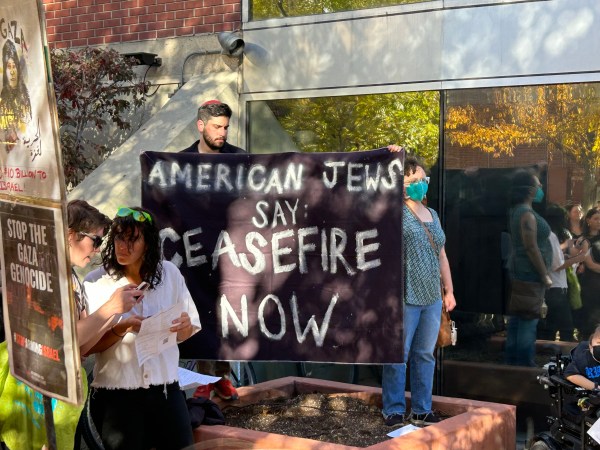
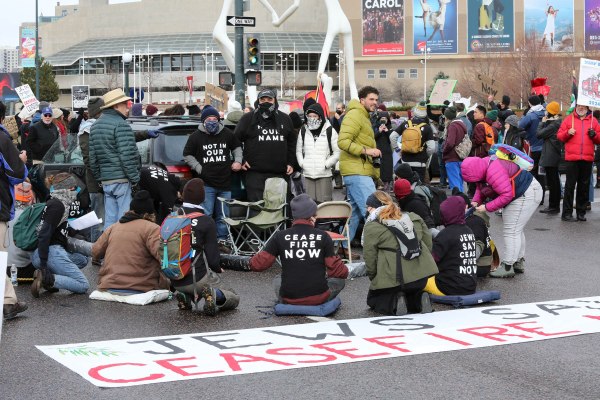
December 3, 2023. Jewish youth with Jewish Voice for Peace and three alter kocker supporters close down Speer Blvd and Champa St. calling for an immediate cease fire that five months later still has not happened. Most of the group goes to court in two weeks, on April 16, 2024

__________________________________

Note: After the presentation I have in Raton, New Mexico, this past Saturday (March 30, 2024), I was specifically asked to respond to the argument – repeated ad nauseum – to defend Israel’s brutal attacks on Gaza, “mowing the lawn” in the name of “the right of self-defense.” This so called “right” is the pretext for Israeli aggression today and long in the past. Most recently many members of Congress, deluged with emails, letters and phone calls, demanding the U.S. use its influence to put the breaks on Israel’s genocidal assault on Gaza, have responded to this pressure by arguing “Israel has a right to defend itself” as it and the Biden Administration try to bend and twist international law to justify the current slaughter.

Actually Israel has no such right and every U.S. Administration that has claimed that it does, knows better. 

Below is a 2018 article which shatters the legitimacy of such fabricated logic. It holds for Israel’s war crimes that have been committed since October 7, 2024 in Gaza and is just as valid today as it was six years ago. RJP

__________________________________

Israel Has No Right of Self-Defense Against Gaza

by NORMAN G. FINKELSTEIN JAMIE STERN-WEINER

Israel has no legal right to use any kind of force in Gaza — under any circumstances.

Since the overwhelmingly nonviolent demonstrations in Gaza began on March 30, 2018, the international community has strongly condemned Israel’s armed attacks.

UN General Assembly resolution “deplore[d] the use of any excessive, disproportionate and indiscriminate force by the Israeli forces against Palestinian civilians,” while the UN Human Rights Council denounced Israel’s “disproportionate and indiscriminate use of force.” After Israeli snipers killed Razan al-Najjar, a twenty-one-year-old unarmed Palestinian paramedic, the UN special coordinator for the Middle East peace process warned Israel that it “needs to calibrate its use of force.” In a devastating report, Human Rights Watch concluded that “Israeli forces’ repeated use of lethal force in the Gaza Strip … against demonstrators who posed no imminent threat to life may amount to war crimes.”

Welcome as these condemnations are, the question nonetheless remains whether they go far enough. Simply put, does Israel have the right to use any force under any circumstances against the people of Gaza?

The current legal debate has focused on a pair of interrelated questions:

  • Did Israeli snipers resort to “excessive” or “disproportionate” force against demonstrators (as critics allege), or was the amount of force they deployed necessary to prevent protesters from breaching the perimeter fence (as Israel alleges)?
  • Is Israel’s conduct toward the Gaza protests governed by human rights law (as critics allege) or by international humanitarian law (as Israel alleges)? International humanitarian law applies in situations of armed conflict, whereas human rights law regulates domestic law enforcement. The difference matters, as human rights law imposes more stringent constraints on the use of force.

All parties to both these controversies proceed from a common premise: that Israel has the right to use force in order to prevent Gazans from breaching the fence. The dispute comes down to: how much? Critics who allege “disproportionate” or “excessive” force tacitly legitimize Israel’s use of “proportionate” or “moderate” force, while those who insist upon the applicability of human rights law acknowledge that Israel’s resort to force is legitimate if demonstrators pose an “imminent threat” to a sniper’s life.

This presumption holds even at the most critical pole of the debate on Gaza. The Israeli human rights group B’Tselem condemned as “illegal” Israel’s resort to lethal force against unarmed persons “approaching the fence, damaging it, or attempting to cross it.” But it conceded that “[o]bviously, the military is allowed to prevent such actions, and even to detain individuals attempting to carry them out.” A senior Human Rights Watch official argued that Israel’s use of live ammunition in Gaza was “unlawful.” But she suggested that “nonlethal means, such as tear gas, skunk water, and rubber-coated steel pellets” would have passed legal muster. The International Committee of the Red Cross cautioned Israel that “lethal force only be used as a last resort and when strictly unavoidable in order to protect life.” Even the major Palestinian human rights organizations characterized Israel’s use of force as “excessive,” “indiscriminate,” and “disproportionate” rather than inherently illegal.

But the fact is, Israel cannot claim a right to use any force in Gaza — whether moderate or excessive, proportionate or disproportionate; whether protesters are unarmed or armed, don’t or do pose an imminent threat to life. If it appears otherwise, that’s because the current debate ignores critical caveats in international law and abstracts from the specific situation in Gaza.

What International Law Says

To justify its use of force in Gaza, Israel claims the right to prevent alien intrusion into its sovereign territory. An Israeli legal commentator observes that this professed concern for the sanctity of the Gaza “border” is opportunistically selective. Israel invades Gaza at will; only when Palestinians seek to cross in the other direction does the fence become sacrosanct. Setting this hypocrisy aside, Israel’s purported right to self-defense still lacks any legal basis. On the contrary, Israel’s resort to force contravenes international law.

The Palestinian people in the West Bank, including East Jerusalem, and Gaza are struggling to achieve their internationally validated “right to self-determination” (International Court of Justice). As preeminent legal scholar James Crawford notes, international law prohibits the use of military force “by an administering power to suppress widespread popular insurrection in a self-determination unit,” whereas “the use of force by a non-State entity in exercise of a right of self-determination is legally neutral, that is, not regulated by international law at all.”

Demonstrators in Gaza have chosen to use nonviolence in pursuit of their internationally validated rights — a tactic that, of course, international law also does not prohibit. But this prudential decision is not a legal requirement. Even if Gazans opted to use weapons against Israeli snipers who obstruct their right to self-determination, Israel’s resort to military force would still be legally debarred.

The allocation of rights and obligations in standard Western discourse — which effectively accords Israel the right to use violent force in self-defense against Gazans, even as it obliges the people of Gaza to wage nonviolently their self-determination struggle — upends international law.

It might be objected that inasmuch as Israel is a belligerent occupier in Gaza, it has the right, under the Fourth Geneva Convention of 1949, to use force in order to maintain public order. But this objection falls on three counts. Read more…

Ceasefire now. End Israel’s Genocidal Campaign in Gaza. Notes from talk given in Raton, New Mexico. Saturday, March 30, 2024

April 1, 2024

“The crew” from the “Colfax/Las Animas Forum for Peace and Justice” in Raton, New Mexico who organized the talk I gave there “Come Learn About Palestine” at the “El Raton”,

1.

Nancy and I went to Raton, New Mexico where I gave a talk on the current U.S. funded Israeli war on Gaza. A most enjoyable and fruitful visit in every way.

Raton, New Mexico is having something of an urban revival bringing together a long history of mining and ranching folk with newcomers looking for a more affordable, sustainable,liveable place to call home. The talk I gave, took place in Raton’s renovated theater, recently  restored.

It was the opening event for the Colfaz/Las Animas Forum for Peace and Justice” that brought together these Raton “newcomers” with long standing members of Raton’s community. The audience itself, from what I could glean, was mostly long-time locals.  Although our stay in Raton was little more than 24 hours, the taste of the town that Nancy and I got suggests the chemistry for such a welding of diverse interests is there as is the will to bring the town back to its former dynamism.

Worth watching.

2.

In 2020, the population of Raton, New Mexico was a bit more than 6000. As a labor organizer friend of mine noted, at one point the Raton Basin was home to some 100 mines, now all closed down. Like many a mining town in the West, especially in the states I am more familiar with, Colorado, New Mexico, mining towns are/were boom-and-bust operations. When the mines are humming along producing whatever – coal, gold, silver, tin, uranium – they flourish and then, when for whatever reason, the mines close down, as they did in Raton in the late 1980s, early 1990s, the town economy collapses or pretty close to that. And then the struggle begins … how to revitalize the place. Here in Colorado, some like Central City, Idaho Springs, even Lafayette and Louisville either become tourist centers trying to cash in on the town’s more vibrant past, or suburbs, bed room communities of larger metropolitan areas.

Many – perhaps, even most mining towns – simply die, become ghost towns.

I would venture to guess that is the fate of more of them, than those that actually survive and re-invent themselves. Nor is this the fate of only old mining towns. Small towns all over the place that lose their economic foundation, be it mining, or manufacturing – as is the fate of Fairbury, Nebraska from nearby where my in-laws hail or Ovid, Colorado that lost its sugar beat processing plant – all face similar the similar dilemmas of “what now?” “how can we re-invent ourselves”? Meanwhile the social ills of dying rural communities – small cities and towns continue to plague Raton: poverty,  drug and alcoholism addiction, spiked crime rates and youth who leave after high school … all the usual social conseqeunces of the collapse of rural-based economies.

Dennis Duckett and Dianne Fleming, Raton residents They are in Sugarite Canyon State Park which hugs the New Mexico-Colorado state line. We’d just crossed over for a few steps into Colorado from New Mexico.

Many such towns turn to the same dead end shallow solutions: tourism, a generally unstabile actually mercurial form of development. It seems Raton is toying with this idea at the present time too, in terms of sustainable development.

But there are rays of light as well,

But it will take much more than good will to turn Raton around – a major federal and/or state funded plan done in conjunction and coordination with Raton’s citizenry – to pull it off. With concentrated state and/or federal funding, a sustainable development plan drawn up by Raton residents, its revitalization is possible. And not only for Raton.

It would help a great deal if, on a national level, the swollen military budget can be cut, our addiction to foreign wars curbed with funds used to build weapons, providing Israel with the means to commit genocide in Gaza and source military bases can be redirected to provide the financial umph necessary to revitalize our rural communities, be they Raton, Fairbury Nebraska or Ovid and Sugar City, Colorado.

If I write all this, it is in large measure because of the potential for sustainable development I witnessed from our Raton visit.

3.

Notes from my talk. I never strictly follow my own scripts in giving talks … but the notes I provide below are pretty much what I shared with audience .

Remarks of Rob Prince/”Come Learn About Palestine” – Raton, New Mexico. March 30, 2024.

Glad to be here.

1. Raton ..

Some miles to the east – the Folsom point archeological site. It is the type site for the Folsom tradition, a Paleo-Indian cultural sequence dating to between 11000 BC and 10000 BC. The Folsom site was excavated in 1926 and found to have been a marsh-side kill site or camp where 32 bison had been killed using distinctive tools, known as Folsom points.

Ludlow Massacre – across Raton Pass just north of Trinidad, one of history’s most dramatic confrontations between capital and labor — the so-called Ludlow Massacre — took place at the mines of the Rockefeller-owned Colorado Fuel and Iron Company (CF&I).

The old and the new Raton – hope they merge into one community; takes work, attention.

Need to cut the military budget to refocus federal monies away from war making abroad and for overall sustainable development in the USA with a special emphasis on rural-small town development.

2. Read Annelle Sheline’s – Why I resigned from the State Department.

  • Excellent summary of where U.S. funded Israeli war against Gaza is at – and the U.S. role in this
  • A former State Department insider is accusing her government – our government – of complicity in genocide
  • Her remarks suggest  a whole different narrative  than what we are hearing both from the Biden Administration and the mainstream media
  • Israel is committing genocide against Palestinians in Gaza and doing it with U.S. funding, weapons, intelligence and direction.

Some quotes from Sheline’s resignation letter:

“I can no longer continue what I was doing. I hope that my resignation can contribute to the many efforts to push the administration to withdraw support for Israel’s war, for the sake of the 2 million Palestinians whose lives are at risk and for the sake of America’s moral standing in the world.”

“Since Hamas’ attack on October 7, Israel has used American bombs in its war in Gaza, which has killed more than 32,000 people — 13,000 of them children — with countless others buried under the rubble, according to the Gaza Ministry of Health. Israel is credibly accused of starving the 2 million people who remain, according to the UN special rapporteur on the right to food; a group of charity leaders warns that without adequate aid, hundreds of thousands more will soon likely join the dead.”

“However, as a representative of a government that is directly enabling what the International Court of Justice has said could plausibly be a genocide in Gaza, such work has become almost impossible. Unable to serve an administration that enables such atrocities, I have decided to resign from my position at the Department of State.”

“Across the federal government, employees like me have tried for months to influence policy, both internally and, when that failed, publicly. My colleagues and I watched in horror as this administration delivered thousands of precision-guided munitions, bombs, small arms and other lethal aid to Israel and authorized thousands more, even bypassing Congress to do so. We are appalled by the administration’s flagrant disregard for American laws that prohibit the US from providing assistance to foreign militaries that engage in gross human rights violations or that restrict the delivery of humanitarian aid.”

3. An immediate ceasefire is the most important stop that can be taken to stop the bleeding.

How Palestine benefits:

Obvious – for the Palestinians it would freeze the bloodshed, result in the distribution of humanitarian aid, impossible in the midst of a military conflict. It would provide the basis for Gaza Palestinians to return to their homes throughout Gaza, begin the process of of healing the wounds and rebuilding Gaza as a livable place.

It would also put an end to Israeli plans to ethnically cleanse Gaza of Palestinians, to expell them into the Sinai Desert and end any plans for Zionist expansionism, already well developed, into Gaza.

How Israel benefits:

Israel’s massive military campaign into Gaza is not going well at all, either militarily or politically. It is a mistake to think that ceasefire would only benefit Hamas or the Palestinians in general.

The invasion is hurting Israel domestically and internationally.

– the war has created several hundred thousand internal Israeli refugees who have been displace both from Israeli regions near Gaza and in the north, by the border of Southern Lebanon. These internal refugees have been moved to more central Israeli areas (and in the W. Bank); they have become both a great political burden (what to do with them?) and a financial burder of the first order.

– there are reports of of exponentially high levels of PTSD among Israel military personnel (and also civilians)and other forms of trauma among the Israeli population. Large numbers of people are fleeing the country with no intention of returning, either to Cyprus, Europe or the USA.

– from a miitary point of view, the war is not going well. Israel has failed to achieve its goals (eliminating Hamas and/or its leadership, expelling the Palestinian population in its entirety from Gaza).

Concerning the United States:

Both genericly and in terms of the Bide Administration’s re-election chances, ending the fighting is imperative.

As a result of its total support for the Israeli war effort – its claims of concern for Palestinians civilians aside – ending the fighting is an imperative.

At a Denver mosque, comment from a Kuwaiti friend: came to America “to fulfill a dream”. He’s leaving, cannot under any circumstances live in the country fueling Israeli genocide against Palestinians.

As a result of its support for Israel, US global prestige is plummeting. Collapse of prestige translated into a loss of influence. Washington’s ability to dominate any post war negotiations is collapsing as well.

End to end the fighting. A ceasefire is the first step towards the complex process of peacemaking that most follow. Every day the war continues, prospects for peace sour that much more

++++++++++++++++++++++++++++

One of many initiatives to get the U.S. Congressional delegation to support a ceasefire. Although they shed crocodile tears for Gaza civilians, the delegation refuses to support a ceasefire, including U.S. Congressman Neguse (Boulder, County)

 

‘Ecocide in Gaza’: does scale of environmental destruction amount to a war crime?

March 30, 2024

‘Ecocide in Gaza’: does scale of environmental destruction amount to a war crime?

Olive groves and farms have been reduced to packed earth …

Soil and groundwater have been contaminated by munitions and toxins

The sea is choked with sewage and waste

The air polluted by smoke and particulate matter.

Researchers and environmental organizations say the destruction will have enormous effects on Gaza’s ecosystems and biodiversity.

The scale and potential long-term impact of the damage have led to calls for it to be regarded as “ecoside” and investigated as a possible war crime.

But America’s munchkins can slaughter people while destroying the environment all they want. They’re defending “their democracy”

And yet not a word from Europe’s main Green Parties. Nothing. Like obedient boys and girls they are quiet about it all. A most disgraceful silence.

ZeroHedge: Expect A Financial Crisis in Europe With France at the Epicenter.

March 29, 2024

Paris, 1992. Just prior for the close vote – it passed – for France to accept the Maaastrict Treaty – pathway towards creating the European currency, the Euro. (R. Prince photo)

______________________________

According to a number of signs in which the Ukaine war and France’s shrinking influence in Africa, France and Europe are heading for trouble, a major economic crisis in the making. This article gives some good background.

______________________________

ZeroHedge

Expect A Financial Crisis in Europe With France at the Epicenter.

BY TYLER DURDEN

THURSDAY, MAR 28, 2024 – 03:00 AM

Authored by Mike Shedlock via MishTalk.com,

We would like to alert our readers to a theme that has been preoccupying us for a while – the possibility of another financial crisis in Europe. We have generally been restrained in our warning of financial crises. The main exception was the global financial crisis and its cousin, the euro area’s sovereign debt crisis. Fifteen or so years later, we see another financial crisis ahead here in Europe: a crisis of the European social and political model with deep consequences for fiscal and financial stability.

The EU never enforced its Growth and Stability Pact or Maastricht Treaty rules. The crisis is coming to a head with France and Italy in the spotlight. The first casualty will be Green policy.


Image composite by Mish from the European Commission Compliance Tracker

Compliance Rules

  1. Deficit rule: a country is compliant if (i) the budget balance of general government is equal or larger than -3% of GDP or, (ii) in case the -3% of GDP threshold is breached, the deviation remains small (max 0.5% of GDP) and limited to one year.
  2. Debt rule: a country is compliant if the general government debt-to-GDP ratio is below 60% of GDP or if the excess above 60% of GDP has been declining by 1/20 on average over the past three years.
  3. Structural balance rule: a country is compliant if (i) the structural budget balance of general government is at or above the medium-term objective (MTO) or, (ii) in case the MTO has not been reached yet, the annual improvement of the structural balance is equal or higher than 0.5% of GDP, or the remaining distance to the MTO is smaller than 0.5% of GDP.
  4. Expenditure rule: a country is complaint if the annual rate of growth of primary government expenditure, net of discretionary revenue measures and one-offs, is at or below the 10-year average of the nominal rate of potential output growth minus the convergence margin necessary to ensure an adjustment of the structural budget deficit in line with the structural balance rule.

Deficit Disaster Zones

France and Italy are major disasters right now on the budget deficit rule. France has a budget deficit of 7 percent and Italy 5 percent.

France needs to reduce its deficit by a whopping 4 percent of GDP!

Neither Italy nor Greece should never have been allowed in the EMU (European Monetary Union – Eurozone) in the first place.

Greece has a debt-to-GDP ratio of 170 percent. The target is 60 percent.

But the lead chart tells the picture. Only the Scandinavian countries are in compliance. Read more…

Annelle Sheline – Why I’m resigning from the State Department

March 28, 2024

Why I’m resigning from the State Department

by Annelle Sheline

_____________________________

I can no longer continue what I was doing. I hope that my resignation can contribute to the many efforts to push the administration to withdraw support for Israel’s war, for the sake of the 2 million Palestinians whose lives are at risk and for the sake of America’s moral standing in the world.

_____________________________

Annelle Sheline

Since Hamas’ attack on October 7, Israel has used American bombs in its war in Gaza, which has killed more than 32,000 people — 13,000 of them children — with countless others buried under the rubble, according to the Gaza Ministry of Health. Israel is credibly accused of starving the 2 million people who remain, according to the UN special rapporteur on the right to food; a group of charity leaders warns that without adequate aid, hundreds of thousands more will soon likely join the dead.

Yet Israel is still planning to invade Rafah, where the majority of people in Gaza have fled; UN officials have described the carnage that is expected to ensue as “beyond imagination.” In the West Bank, armed settlers and Israeli soldiers have killed Palestinians, including US citizens. These actions, which experts on genocide have testified meet the crime of genocide, are conducted with the diplomatic and military support of the US government.

For the past year, I worked for the office devoted to promoting human rights in the Middle East. I believe strongly in the mission and in the important work of that office. However, as a representative of a government that is directly enabling what the International Court of Justice has said could plausibly be a genocide in Gaza, such work has become almost impossible. Unable to serve an administration that enables such atrocities, I have decided to resign from my position at the Department of State.

Whatever credibility the United States had as an advocate for human rights has almost entirely vanished since the war began. Members of civil society have refused to respond to my efforts to contact them. Our office seeks to support journalists in the Middle East; yet when asked by NGOs if the US can help when Palestinian journalists are detained or killed in Gaza, I was disappointed that my government didn’t do more to protect them. Ninety Palestinian journalists in Gaza have been killed in the last five months, according to the Committee to Protect Journalists. That is the most recorded in any single conflict since the CPJ started collecting data in 1992.

By resigning publicly, I am saddened by the knowledge that I likely foreclose a future at the State Department. I had not initially planned a public resignation. Because my time at State had been so short — I was hired on a two-year contract — I did not think I mattered enough to announce my resignation publicly. However, when I started to tell colleagues of my decision to resign, the response I heard repeatedly was, “Please speak for us.”

Across the federal government, employees like me have tried for months to influence policy, both internally and, when that failed, publicly. My colleagues and I watched in horror as this administration delivered thousands of precision-guided munitions, bombs, small arms and other lethal aid to Israel and authorized thousands more, even bypassing Congress to do so. We are appalled by the administration’s flagrant disregard for American laws that prohibit the US from providing assistance to foreign militaries that engage in gross human rights violations or that restrict the delivery of humanitarian aid.

The Biden administration’s own policy states, “The legitimacy of and public support for arms transfers among the populations of both the United States and recipient nations depends on the protection of civilians from harm, and the United States distinguishes itself from other potential sources of arms transfers by elevating the importance of protecting civilians.” Yet this noble statement of policy has been directly in contradiction with the actions of the president who promulgated it.

President Joe Biden himself indirectly admits that Israel is not protecting Palestinian civilians from harm. Under pressure from some congressional Democrats, the administration issued a new policy to ensure that foreign military transfers don’t violate relevant domestic and international laws.

Yet just recently, the State Department ascertained that Israel is in compliance with international law in the conduct of the war and in providing humanitarian assistance. To say this when Israel is preventing the adequate entrance of humanitarian aid and the US is being forced to air drop food to starving Gazans, this finding makes a mockery of the administration’s claims to care about the law or about the fate of innocent Palestinians.

Some have argued that the US lacks influence over Israel. Yet Retired Israeli Maj. Gen. Yitzhak Brick noted in November that Israel’s missiles, bombs and airplanes all come from the US. “The minute they turn off the tap, you can’t keep fighting,” he said. “Everyone understands that we can’t fight this war without the United States. Period.”

Even now, Israel is considering invading Lebanon, which brings a heightened risk of regional conflict that would be catastrophic. The US has sought to prevent this outcome but shows no appetite for withholding offensive weapons from Israel in order to compel greater restraint there or in Gaza. Biden’s support for Israel’s far-right government thus risks sparking a wider conflagration in the region, which could well put US troops in harm’s way.

So many of my colleagues feel betrayed. I write for myself but speak for many others, including Feds United for Peace, a group mobilizing for a permanent ceasefire in Gaza that represents federal workers in their personal capacities across the country, and across 30 federal agencies and departments. After four years of then-President Donald Trump’s efforts to cripple the department, State employees embraced Biden’s pledge to rebuild American diplomacy. For some, US support for Ukraine against Russia’s illegal occupation and bombardment seemed to reestablish America’s moral leadership. Yet the administration continues to enable Israel’s illegal occupation and destruction of Gaza.

I am haunted by the final social media post of Aaron Bushnell, the 25-year-old US Air Force serviceman who self-immolated in front of the Israeli Embassy in Washington on February 25: “Many of us like to ask ourselves, ‘What would I do if I was alive during slavery? Or the Jim Crow South? Or apartheid? What would I do if my country was committing genocide?’ The answer is, you’re doing it. Right now.”

I can no longer continue what I was doing. I hope that my resignation can contribute to the many efforts to push the administration to withdraw support for Israel’s war, for the sake of the 2 million Palestinians whose lives are at risk and for the sake of America’s moral standing in the world.

——————————————————

Annelle Sheline, PhD, served for a year as a foreign affairs officer at the Office of Near Eastern Affairs in the Department of State’s Bureau of Democracy, Human Rights and Labor.


Biden with Obama and Clinton at Radio City Music Hall, New York City, Today. Will there be protests.

March 28, 2024
#GenocideJoe is coming to NYC for a $250 – $500,000 a head fundraiser with Barack Obama and Bill Clinton
3/28/2024 at Radio City Music Hall, 
1260 Sixth Avenue
Is the #ShutItDown movement going to show up for Gaza?

Come Learn About Palestine – El Raton Theater, Raton New Mexico – Saturday, March 30, 2024 @ 4 pm

March 26, 2024

Peter Beinart: The Great Rupture in American Jewish Life in the March 22, 2024, NY Times

March 26, 2024

Jewish Voice for Peace protest in support of a ceasefire at the offices of U.S. Congresswoman Diana DeGette, late October, 2023

______________________

(Some years ago, – five or six if I remember correctly – the liberal Zionist organization here in Colorado, J-Street, invited Peter Beinart to speak at one of their meetings at Denver’s Jewish Community Center. I went to hear him and was impressed with both his understanding of Judaism as a religion, and his take on the Israeli-Palestinian conflict in which he was openly critical of the occupation but seemed to word his critique in ways that the audience could listen to and absorb – a skill I never had. A few days ago, the New York Times printed a long piece by Beinart on what he refers to as “the great rupture in American Jewish Life” – the growing split between pro-Zionist Jews and those who are becoming increasingly critical of Israeli treatment – or mistreatment – of the Palestinians, some of whom are becoming more openly anti-Zionist. As Beinart notes, “this transformation remains in its early stages”. That is the case, but the cleavage has begun, a bit late in the game I would say, but still. RJP)

______________________

The Great Rupture in American Jewish Life

By Peter Beinart

Mr. Beinart is the editor at large of Jewish Currents and a journalist and writer who has written extensively on the Middle East, Jewish life and American foreign policy.

March 22, 2024. New York Times

For the last decade or so, an ideological tremor has been unsettling American Jewish life. Since Oct. 7, it has become an earthquake. It concerns the relationship between liberalism and Zionism, two creeds that for more than half a century have defined American Jewish identity. In the years to come, American Jews will face growing pressure to choose between them.

They will face that pressure because Israel’s war in Gaza has supercharged a transformation on the American left. Solidarity with Palestinians is becoming as essential to leftist politics as support for abortion rights or opposition to fossil fuels. And as happened during the Vietnam War and the struggle against South African apartheid, leftist fervor is reshaping the liberal mainstream. In December, the United Automobile Workers demanded a cease-fire and formed a divestment working group to consider the union’s “economic ties to the conflict.” In January, the National L.G.B.T.Q. Task Force called for a cease-fire as well. In February, the leadership of the African Methodist Episcopal Church, the nation’s oldest Black Protestant denomination, called on the United States to halt aid to the Jewish state. Across blue America, many liberals who once supported Israel or avoided the subject are making the Palestinian cause their own.

This transformation remains in its early stages.

In many prominent liberal institutions — most significantly, the Democratic Party — supporters of Israel remain not only welcome but also dominant. But the leaders of those institutions no longer represent much of their base. The Democratic majority leader, Senator Chuck Schumer, acknowledged this divide in a speech on Israel on the Senate floor last week. He reiterated his longstanding commitment to the Jewish state, though not its prime minister. But he also conceded, in the speech’s most remarkable line, that he “can understand the idealism that inspires so many young people in particular to support a one-state solution” — a solution that does not involve a Jewish state. Those are the words of a politician who understands that his party is undergoing profound change.

The American Jews most committed to Zionism, the ones who run establishment institutions, understand that liberal America is becoming less ideologically hospitable. And they are responding by forging common cause with the American right. It’s no surprise that the Anti-Defamation League, which only a few years ago harshly criticized Donald Trump’s immigration policies, recently honored his son-in-law and former senior adviser, Jared Kushner. Read more…

France all dressed up and nowhere to go – or … France’s Epileptic Fit by M. K. Badrakumar

March 22, 2024

From former days of French glory. Poster for early version of Les Miserables starring Jean Gabin in the Victor Hugo Museum in Paris. December, 2006. (R. Prince photo)

France all dressed up and nowhere to go

Ever since its ignominious defeat in the Napoleonic wars, France is entrapped in the predicament of countries that get sandwiched between great powers. Following World War II, France addressed this predicament by forging an axis with Germany in Europe. 

Caught up in a similar predicament, Britain adapted itself to a subaltern role tapping into the American power globally but France never gave up its quest to regain glory as a global power. And it continues to be a work in progress. 

The angst in the French mind is understandable as the five centuries of western dominance of the world order is drawing to a close. This predicament condemns France to a diplomacy that is constantly in a state of suspended animation interspersed with sudden bouts of activism. 

But, for activism to be result-oriented, there are prerequisites needed such as the profiling of like-minded activist groups, leadership and associates and supporters and sympathisers — and, most important, sustainment and logistics. Or else, activism comes to resemble epileptic fits, an incurable affliction of the nervous system.  

The French President Emmanuel Macron’s halcyon days in international diplomacy ended with the recent  dissolution of the Franco-German axis in Europe, which dated back to the Treaties of Rome in 1957. As Berlin sharply swerved to trans-atlanticism as its foreign-policy dogma, France’s clout diminished in European affairs. 

The stakes are high in the reconciliation meeting on Friday as Macron travels to Berlin to meet Chancellor Olaf Scholz, who not only snubbed him by ruling out the use of ground troops from European countries in the Ukraine war, but also digging in on Taurus missile issue arguing that it would entail assigning German staff in support to Ukraine, which, he announced on Wednesday in the Bundestag, is simply “out of the question” while he remained the chancellor. 

Of course, this is not to decry Macron’s formidable intellect — such as when he declared in a blunt interview in late 2019 with the Economist magazine that Europe stood on “the edge of a precipice” and needed to start thinking of itself strategically as a geopolitical power lest it will “no longer be in control of our destiny.” Macron’s prescient remark preceded the war in Ukraine by 3 years. 

According to the newspaper Marianne, which interviewed several French soldiers, the military reportedly estimates that the Ukraine war is irretrievably lost already. Marianne quoted a senior French officer saying derisively, “We must make no mistake facing the Russians; we are an army of cheerleaders” and sending French troops to the Ukrainian front would simply be “not reasonable” . At the Élysée, an unnamed advisor argued that Macron “wanted to send a strong signal… (in) milli-metered and calibrated words”. 

Marianne’s editor Natacha Polony wrote: “It is no longer about Emmanuel Macron or his postures as a virile little leader. It is no longer even about France or its weakening by blind and irresponsible elites. It is a question of whether we will collectively agree to sleepwalk into war. A war that no one can claim will be controlled or contained. It’s a question of whether we agree to send our children to die because the United States insisted on setting up bases on Russia’s borders.” 

The big question is why Macron is doing this nonetheless — going to the extent of cobbling together a ‘coalition of the willing’ in Europe. A range of explanations is possible starting with Macron posturing and trying to earn political points at minimal cost, motivated by personal ambitions and intra-European friction with Berlin.  Read more…

International Press Review – March 12, 2024

March 13, 2024

Palestine Tet – 124 – Is Zero Hour Approaching Between Israel and Hezbollah in S. Lebanon ?

March 12, 2024

Lebanon. South of the Litani River. Looking south from Rashidiya Palestinian Refugee Camp towards N. Israel. June, 1981. (R. Prince photo)

_____________________

(Google translation of piece from Rais Al Youm from Arabic to English) by Zuhair Andraos. Dateline Nazareth. )

  1. Is zero hour for war approaching between Israel and Hezbollah?

Yesterday (March 11) Hezbollah fired one hundred missiles and more within an hour targeted the Galilee and the Golan in response to Israeli aerial  bombing of the Bekaa Valley of E. Lebanon. The mayor of of Shlomi, an Israeli settlement in the north said: “I fear that Al-Radwan (Hezbollah elite forces unit) will take control of the settlement soon. Israel will establish an alternative port in Cyprus for fear of paralyzing the port of Haifa.”

The exchange of fire continues between the Lebanese Hezbollah and the Israeli occupation army, while a number of specialists, experts and analysts in the entity have suggested that the zero hour for the start of the all-out war between Israel and Lebanon is very close.

The leaders of the settlements in Israel’s north, whose towns are now empty of residents, said that they are living in a state of war, and that Hezbollah is the one controlling the rhythm, not the Israeli army.

The leaders of the settlements in Israel’s north, whose towns are now empty of residents, said that they are living in a state of war, and that Hezbollah is the one controlling the rhythm, not the Israeli army.

It is noteworthy that the Israeli army appointed General Chico Tamir in charge of the ground maneuver to invade southern Lebanon when the all-out war broke out between the two parties, and that the army strengthened its forces on the northern front with the Cedars, waiting for zero hour.

Israeli, the occupying state, admitted on Tuesday morning that the occupied Golan and the Galilee region were subjected, within one hour, to intense missile strikes from the Lebanese Hezbollah. The Hebrew media did not publish whether there were casualties among Israelis during the missile attack.

At the same time, the head of the municipal council in the border settlement of Shlomi, which the authorities evacuated of its residents several months ago due to Hezbollah missiles, said in a radio interview that he fears that the Radwan Forces, the elite unit of Hezbollah, will enter the settlement by land and take control of it, without… To add to what he relied on to express his deep fear and deep concern.

In a related context, and citing high-level political and security sources in Tel Aviv, the Hebrew newspaper Israel Hayom reported that the Israeli Ministry of Transportation has set a goal of establishing another port for Israel, in Larnaca in Cyprus, within 60 days, pointing out at the same time that Work is underway to establish and operate a port in accordance with the American schedule announced by the administration of President Joe Biden to establish a floating port off the coast of Gaza to transport humanitarian aid, according to their claims.

According to the same sources, the Hebrew newspaper continued, saying that a delegation from the Ministry of Transportation and Road Safety headed by the head of the Israel Ports Company, Uzi Yitzhak, headed to Cyprus yesterday morning, Monday. The delegation aims to study the issue of establishing a port as a response to various security scenarios by order of Minister Miri Regev?

Why an Israeli port in Larnaca? The newspaper stressed that according to estimates by the Israeli Ministry of Transportation, the cost of the port will be in the hundreds of millions of dollars, and the plans are required at the national level to be implemented immediately.

The Hebrew newspaper went on to say, quoting the same sources, that it “will operate the port in Larnaca, and security inspection issues will be handled by Israeli subsidiaries.” It was also learned that, contrary to various information published, the primary goal of establishing the port is not to transport aid to Gaza, but rather it is a response to a situation in which the Haifa port would be paralyzed in the event of a war with Hezbollah. (1)

It was also learned that, contrary to various information published, the primary goal of establishing the port is not to transport aid to Gaza, but rather it is a response to a situation in which the Haifa port would be paralyzed in the event of a war with Hezbollah.

Moreover, the newspaper pointed out that the matter is also related to a comprehensive preparation between the ministries aimed at preventing Israel from developing a war in the north, and similar to the preparations for various different dark scenarios, the port of Larnaca is an urgent need for Israel to avoid a situation in which it is cut off from the world commercially and for supplies during the war. , according to the same sources.

Read more…

Palestine Tet – 123 – Come Learn About Palestine: El Raton Theater. Raton New Mexico. March 30, 2024 @4 pm

March 11, 2024

Come Learn About Palestine

El Raton Theater

Raton, N.M.

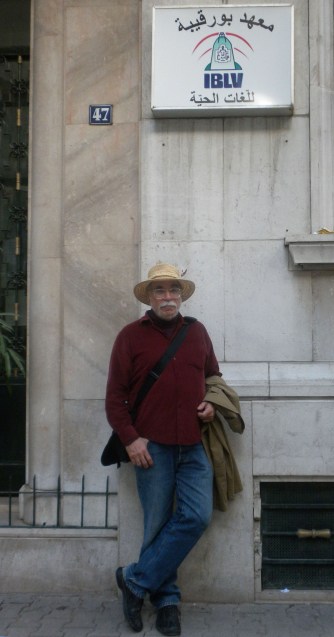
Rob Prince in front of the “L’Institut Bourguiba des Langues Vivantes” or simply “Bourguiba School” where I taught a long, long, long time ago.

Rob Prince will share his knowledge of the land and history of Palestine, the Palestinian people, and the present conflict.

Sponsored by:      

  • Colfax / Las Animas Forum for Peace and Justice
  • El Raton Theater
  • Mountain Forum for Peace

Rob Prince

Rob Prince is a retired Senior Lecturer of International Studies at the University of Denver’s Korbel School of International Relations.

For the past 13 years, along with his D.U.-Korbel colleague, Iman Ibrahim Kazerooni, he has been a monthly political commentator on KGNU – Hemispheres – Middle East Dialogues.

Former Peace Corps Volunteer and Staff Member in Tunis, Tunisia.

U.S. Secretary to the World Peace Council 1985-1990 where he worked along with peace movements worldwide on nuclear disarmament and Middle East peace issues.

When:    Saturday, March 30, 2024 —- 4:00 p.m.

Where:    El Raton Theater —– 115 N. Second Street, Raton, N. M.

Refreshments provided by Ramel Family Farms and El Raton Theater

For more information call: Dianne Fleming   303 258 7758

Palestine Tet – 122 – Israel sets 15 March deadline to launch ‘broad war’ against Lebanon: Report

March 7, 2024
tags:

Denver Colorado. December 3, 2023.

______________________________
Donald Trump backs Israel’s genocidal slaughter of Palestinians in Gaza: ‘You’ve got to finish the problem’ Whether it’s Biden or Trump, Democrat or Republican, the American bombs will keep on falling on some of the poorest & desperate people in the world.
So much for those of you who think that Trump will be any better on Gaza than “Genocide Joe” …

Tel Aviv has threatened to ‘push Hezbollah’ away from the border if diplomatic efforts fail, as the Lebanese resistance has successfully created a military buffer zone extending deep into the northern occupied territories

MAR 7, 2024

(Photo Credit: Hussein Malla/AP)

Israel has informed its western sponsors of a 15 March deadline to reach “a political settlement with Lebanon,” after which Tel Aviv says it plans to “escalate military operations to a broad war,” according to western diplomats that spoke with Lebanese daily Al-Akhbar.

The report comes after the most recent visit to the region by US special envoy Amos Hochstein, who Israeli Defense Minister Yoav Gallant told that Hezbollah’s continued operations are bringing the country closer to a “decision” about expanding its operations inside Lebanon.

“Hochstein has become convinced of the difficulty of stopping the fighting in Lebanon before it stops in Gaza, and he is also convinced that Hezbollah does not want escalation,” Al-Akhbar cites the western diplomats as saying. Furthermore, Lebanon’s Nidaa al-Watan quoted western officials on Thursday as saying that Hochstein “has backed down from the condition of Hezbollah’s withdrawal” from the border region and that “he is no longer mentioning this matter in his meetings” with Lebanese officials.

The diplomats added, “His entire demand has become a ceasefire with guarantees from both parties.” Nevertheless, Nidaa al-Watan’s sources also revealed that Hochstein has “formed a US work group led by US Ambassador Lisa Johnson that will hold meetings at the embassy and devise a political paper for implementing Resolution 1701.”

US intelligence agencies recently determined that Tel Aviv was considering launching a ground operation in southern Lebanon as early as “spring or early summer.”

Washington and Paris have been pushing a de-escalation proposal on Lebanon since early February. The leading demand of the western initiative is a withdrawal of Hezbollah from the border region. However, the proposal does not include any Israeli concessions to Lebanon, such as a withdrawal from areas that have been illegally occupied for decades.

The western deal also includes an ambiguous border demarcation agreement, which Lebanon’s foreign minister recently called a “partial” solution. The Lebanese government has not officially responded to the proposal.

On 4 March, Hochstein said during a visit to Beirut that Washington “is committed to working with the government of Lebanon to end the violence that began on 8 October,” adding that “any truce in Gaza will not necessarily extend automatically to Lebanon.”

Hezbollah has vowed that it will not stop attacking Israeli sites until the war in Gaza is brought to an end.

“The position is clear. As long as the war continues in Gaza, this means that the Lebanon front is affected by it, and when it stops in Gaza, it stops in Lebanon,” Hezbollah Deputy Secretary-General Naim Qassem told Lebanese news channel LBCI on Tuesday. “When there is a truce in Gaza, we will have a truce … the US envoy Amos Hochstein can say what he wants, and we will say what we want.”

“We are not concerned with the messages that Hochstein sends and any discussions or answers he receives from state officials, and we do not interfere [with his talks with Lebanese officials]. Usually, we exchange messages with the US side. As for what Hochstein said and what he intends, it does not mean anything to us,” Qassem added before stressing that the Lebanese resistance is “90 percent sure that there will not be a large-scale war in Lebanon … the remaining 10 percent is if Israel or the US changes its mind.”

Palestine Tet – 121 – Transcript – Kazerooni Prince Dialogues: Post Gaza? What’s In Store for the Middle East? Part Two.

March 6, 2024

Yahia Sinwar

_____________________________

And by the way if you look at Friedman’s article, the third point he raises in that article is that the Israeli government and the United States has no other alternative, if they want to recoup at least some of the standing that they have lost in the region is to accept reality and to go for a two state solution that will be equitable. This is a call that is being made by various representatives, political as well as military as well as members of Parliament in various countries around the world.

The Palestinians are unifying their approach concerning how they should pursue and press the issue of the recognition of a Palestinian state as a reality and, at the end of the day, the United States has no other alternative but to recognize the fact that their role has been reduced to a marginal power in the region rather than a dominating power.

Ibrahim Kazerooni

This would have consequences, Ibrahim, don’t you think, in any international initiative to resolve the conflict. It’s not going to look like Oslo or Camp David in the sense that in those agreements the United States had a defining influence deciding the shape and political framework of the agreements. But given the changing balance of forces in the world – not just the Middle East there will be other players who participate in any serious peace process.

I’m not sure whom they will be – I assume at this point that the Chinese and the Russians will definitely be involved and have a certain role. There is no way for a Middle East settlement that is not going include them, Iran in some manner.

Do you have any sense at all of the framework for what a serious Middle East peace negotiations would look like? Or what they won’t look like?

Rob Prince

_____________________________

Part One

Transcript – Kazerooni Prince Dialogues: Post Gaza? What’s In Store for the Middle East? Part Two.

Tapped on March 3, 2024.

(This part is mostly commentary from Rob Prince. In Part One Ibrahim Kazerooni gave his thoughts)

Ibrahim Kazerooni: (finishing his remarks)

And now we are beginning to see at least the beginning of the consequences: the Israeli economy, military, tourism, internal dynamics are all severely damaged and the resignation of various military and intelligence leaders. In all these ways there will be consequences “the day the war comes to an end”.

Despite the tight Israeli control of the media, these problems, crises for Israel are becoming clearer and clearer, particularly if inquiries are going to be held (as after the 2006 debacle for Israel in S. Lebanon at the hands of Hezbollah).

Do you want to add something Rob?

Rob Prince: I want to talk about U.S. policy and what it’s experiencing at present where it concerns the Middle East.

The conflict between Israel and Palestine is described in the mainstream media as a war. It’s not a war; it’s a slaughter. It’s a struggle between a colonial power, Israel and an anti-colonial movement, the Palestinians. Israel is an example of settler colonialism. The colonized people, the Palestinians, are defending their rights for national self determination.

So there’s that.

But the other point I would make that people often forget is that Israel is essentially a proxy for the United States in the Middle East. Israel is Washington’s “man on the spot in the region” which is there to enforce U.S. policy.

Throughout the world, the United States prefers, when it can, to have a proxy to do its dirty work. Read more…

Palestine Tet – 120 – Transcript – Kazerooni Prince Dialogues: Post Gaza? What’s In Store for the Middle East? Part One.

March 5, 2024

Yahia Sinwar

Tapped on March 3, 2024.

(This part is mostly commentary from Ibrahim Kazerooni. In Part Two Rob Prince will give his thoughts)

Rob Prince: Hello everyone.

My name is Rob Prince, my colleague here is Ibrahim Kazerooni.

Ibrahim is a Shi’ite Imam; he originates from Iraq. We met at the University of Denver where he was getting his PhD., joint doctorate actually from the University of Denver’s Korbel School of International Studies and the Iliff School of Theology.

I was teaching Global Political Economy at D.U. at the time.

Myself, I’m a retired college teacher; I have a fair amount of experience with the Middle East and North Africa, taught about the region, lived in the region.

For thirteen years, Ibrahim and I were political commentators on a public radio program out of Boulder, Colorado – KGNU, Hemispheres, Middle East Dialogues produced by Jim Nelson. Recently we recently finished a thirteen year run.

We’re going to continue to do programs from time to time.

I wanted to start this one off asking Ibrahim to comment on the picture behind me. (The photo is of Yahya Sinwar sitting in a comfortable chair outdoors, surrounded by what appears to be wreckage)

Ibrahim, maybe you can talk about this picture a bit? Who is he? Who is sitting behind me in a chair, behind him what appears to be wreckage, destroyed property?

Ibrahim Kazerooni: Good evening everyone.

This is a program we’ve been anticipating organizing for a long time now but it never happened.

This photo is a picture of Yahya Sinwar, the leader of Hamas, and probably the leader of the entire resistance movement in Gaza. He’s sitting on a chair, a sofa, in the middle of ruins which I believe used to be his apartment (in Gaza). He’s sitting there totally relaxed, not concerned about what is going on around him.

If you contrast this picture, Rob, with the panic that has taken over the Israeli cabinet, the prime minister’s office and particularly the (Israeli) war cabinet, it shows the degree of confidence that these people (Hamas, Gaza Palestinians) have in their cause, and that ultimately they are going to succeed.

Sinwar was imprisoned in Israel from a young age for up to 25 years. He speaks Hebrew fluently and without accent. A number of the Israelis who were captured during October 7, once released, said that he (Sinwar) came to see them one by one, made sure that they are comfortable and spoke to them in perfect Hebrew with no accent.

That shows quite a lot.

The Israeli military and intelligence services are kicking themselves for letting him go in one of the former prisoner exchanges a couple of years ago.

So, he’s Yahya Sinwar. Read more…