Skip to content

Costa Rica – 1- Getting to know a place

February 7, 2024

View from our friends’ home just outside of San Isidro, Heredia, in Costa Rica’s Central Valley

___________________________

The 19th century Mexican dictator Porfirio Diaz once said, “Poor Mexico, So Far From God, So Close to the United States.” Diaz’ quote illustrates the tangled history between the United States and Mexico.

Same goes for the rest of Central America, including Costa Rica

___________________________

Nancy and I are vacationing currently in Costa Rica.

We are staying with dear old friends just outside of San Isidro, Heredia Province in the country’s Central Valley northeast of the capitol San Jose. Now here five days, my impression is that the neighborhood is a middle to middle-upper class neighborhood. There is a wildlife preserve nearby, the Toucan Rescue Ranch, which we visited yesterday and saw a variety of “rescued” animals – toucans, sloths, ocelots and many more. Our accommodations with our friends are comfortable. I sit in their backyard watching a dramatic parade of tropical birds, none of which I have ever seen or heard of.

The Southern Lapwing, Blue-Gray Tanager, Black-headed Saltator, Great-tailed Grackle, Common tody-Flycatcher, Lesson’s Mot-Mot, Rufous-collared Hummingbird, Melodious Blackbird, Tropical Kingbird, Boat-billed Flycatcher, Social Flycatcher, Great Kiskadee, Rufous-collared Sparrow, Clay-coloured Trush are the ones so far identified; all of these except the Southern Lapwing, seen in a cow field, were seen in our hosts’ backyard in San Isidro.

I presume we’ll see many more as we visit rain forests over the next week.

I’ll write more about birds, wild-life, impressions of “eco-tourism” as I learn more about these subjects. But for starters I want to emphasize that we came here on vacation for a number of reasons:

1. Nancy and I hadn’t taken “a real vacation”  – whatever that means for 13 years. No big deal, just thought it was time. There was a time when we traveled the world and were experienced travelers at that but those days are long gone. So much has changed, starting with how to get plane tickets.

2. There is also the fact that by the end of the year I turn 80, Nancy turns 73 soon and traveling, always a bit grueling even at the best of times, is even more so now.

We decided on Costa Rica because, from what we could tell it is somewhat more prosperous than its neighbors, safer. We’d heard some about its nature as our daughter Molly had visited a few years back and loved it. Add to that two old friends, Daniel Walker and Carol Friesen live here and have been doing so for 17 years and offered us a place to stay. And finally, we thought that as a chronic jet-lag sufferer I might do better in Costa Rica, only one time zone away from Colorado than other places.

And so here we be.

One other point. We really don’t know Central or South America at all. Time to experience it first hand a bit.

Anyhow, here we are. A trial run for perhaps other trips in the future. We’ll see.

I want to emphasize one more point.

Although I have a good working knowledge of a few of the world’s regions outside the USA, I admit that when it comes to Latin America, other than some general understanding of its position in the Global South, this is a part of the world, if I am honest, that frankly I am quite ignorant of most of Latin America. I speak neither Spanish nor Portuguese nor not a one indigenous language. I’ve been to Mexico a half dozen times and to the Caribbean island of St. Maarten’s once. But there is too much blood in the soil in the Caribbean islands to my tastes – and too much offshore wealth in its banks to interest me much, other than Puerto Rico and perhaps one day Haiti.

So I come here something of a “blank slate”.

Needless to say after six days my understanding has grown little and that the first impressions are exactly that, first impressions.

Lovely place, more prosperous than its neighbors, a result of which it is a magnet for nearby peoples, Nicaraguans, Panamanians, Colombians, Venezuelans whose countries have experienced war, the destabilizing impact of its “big neighbor to the north”. As in the world in which we live, as the Supremes accurately put it “there is nowhere to run to nowhere to hide” one has to bear in mind that the under the surface of its calm exterior, all the problems of Central America are not far from the surface of Costa Rica either.

Soooo, let’s see what happens as I scratch the surface. First stop in next entry, what I am learning about Costa Rica’s role in the international drug trade.

A demain…


Palestine Tet – 99 – Gaza Is a Crime Scene

February 6, 2024

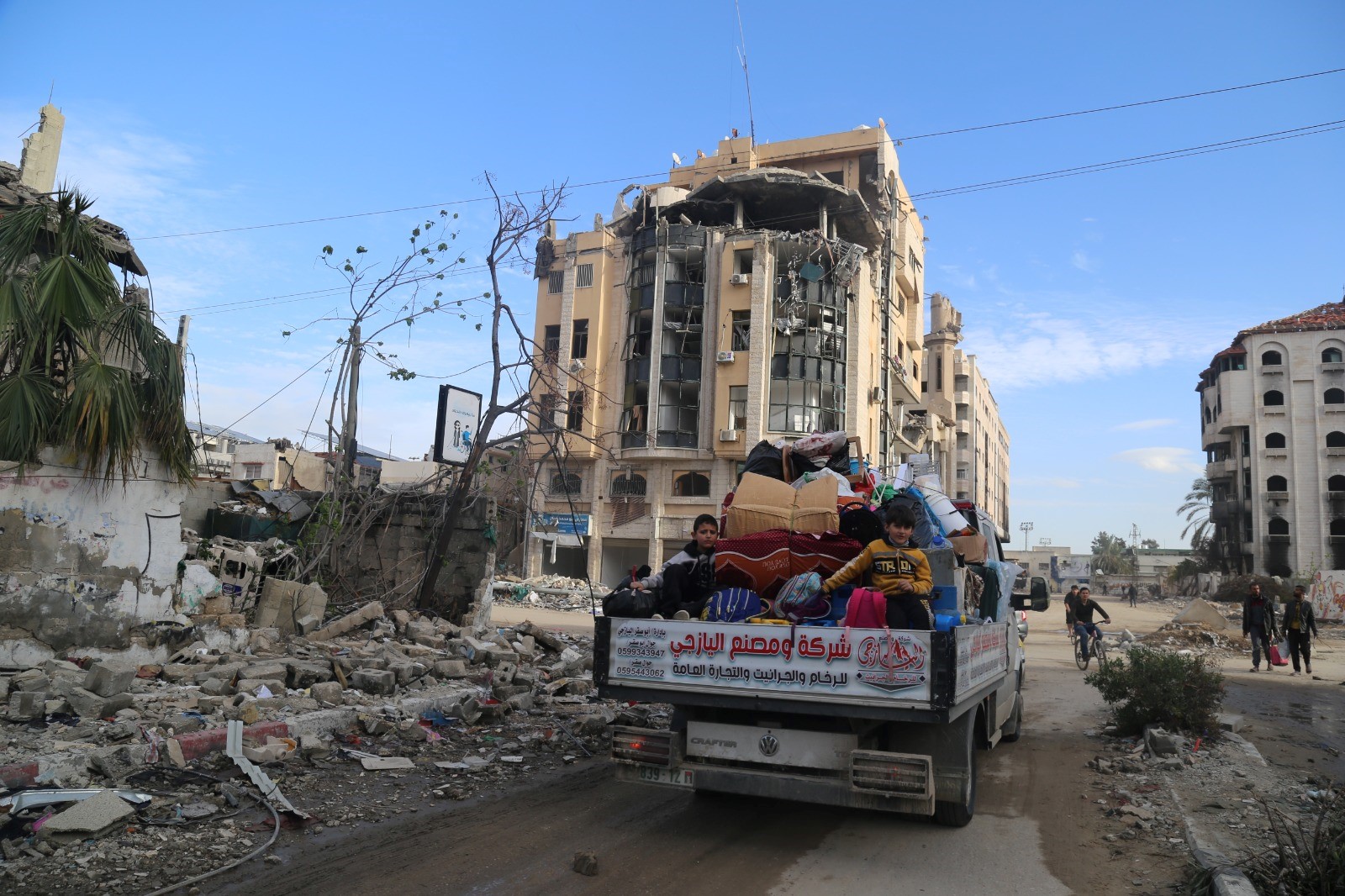
Gaza City on January 15, 2024. Abdul Rahman Salama/Xinhua via Getty Images

MERIP

Gaza Is a Crime Scene
Lisa Hajjar In: 309 (Winter 2023)

What is happening to Palestinians in the occupied Gaza Strip bears some gruesome similarities to the Cambodian killing fields of the 1970s.

Gaza City on January 15, 2024. Abdul Rahman Salama/Xinhua via Getty Images

“To keep you is no benefit, to destroy you is no loss,” was the Khmer Rouge slogan when they seized power in war-torn Cambodia in April 1975. Declaring the start of their reign “Year Zero,” they set in motion a policy to transform the country into an agrarian communist utopia. The first step was to empty the cities, a “cleansing” process bathed in blood. Anyone associated with the overthrown government, ethnic minorities, religious adherents, college educated professionals, property owners and merchants were executed. Their extended families were not spared. The zero-fication also involved the destruction of schools, universities, hospitals, factories and, indeed, any institutional or infrastructural entity that did not comport with the Khmer Rouge vision for Kampuchea, as the country was renamed. Urbanites were forced to march to rural areas where they were put to backbreaking work on collective rice farms and subjected to intensive reeducation. The regime was guided by the presumption that hard labor and ideological conformity would create a classless society of “New People.” Over the next four years, one-quarter of the country’s population died. One million people were executed or tortured to death and a further million perished from starvation, disease or exhaustion.

Since the start of Israel’s current bombing campaign on October 7, the Gaza Strip has become an enclave of death, displacement and destruction. An estimated 33,000 people have been killed, including 12,660 children and 7,000 missing and presumed dead beneath the rubble. More than 65,000 Palestinians have been wounded, many with lost limbs and other permanent disabilities. The IDF has targeted doctors, humanitarian workers, artists, scientists and professors, along with their families. Entire family lines have been obliterated. More journalists have been killed in three-and-a half months—an estimated 125 so far—than during any other war, irrespective of length.

The scope, scale and speed of Israel’s bombing campaign constitutes the most intense assault anywhere since World War II. There is no reciprocal high-intensity violence because Gaza has no army. Large portions of the 141-square-mile Strip have been “cleansed” of their inhabitants.[1] Almost 85 percent of the population—1,955,000 people—has been displaced. Over a quarter million homes have been totally or partially destroyed in what may constitute “domicide”—a newly emerging crime against humanity which pertains to massive destruction of housing and basic infrastructure in residential areas. The destruction includes schools (326), hospitals and clinics (208), mosques (247), churches (3), heritage sites (199), factories (1,690), libraries, archives and cultural centers. All of Gaza’s universities have been leveled.[2] Even the dead are not safe. Military bulldozers have destroyed cemeteries and soldiers have desecrated graves.

At the start of this war, Israel exploited its capacity to exercise necropolitical control over aid-dependent Palestinians by cutting off Gaza’s access to food, medicine, fuel, electricity and telecommunications. Three months in, the food system, like the healthcare system and the infrastructure for clean water and sanitation, has completely collapsed. Man-made famine conditions have reached the catastrophic phase. Four out of every five starving people in the world are Palestinians in Gaza.

Unlike the Khmer Rouge, the Israeli government’s exterminationist policy is not fueled by an ideological vision to remake Gaza anew. Total destruction is the goal.


From Open-Air Prison to Crime Scene

Life in Gaza was a chronic humanitarian crisis of impoverishment, deprivation and suffocating siege long before Israel launched its latest full-scale war, the fifth in this century. In 2005, Israel unilaterally “disengaged” from Gaza by withdrawing its military presence and evacuating Jewish settlers. The boundaries of Gaza were sealed, enwalling Palestinians within. But the occupation did not end because Israel continued to exercise effective control over the people, the airspace and the borders.

In 2007, Israel declared Gaza a “hostile entity” and tightened its siege. The transfer of food was limited to a “humanitarian minimum” based on a calculation of the caloric intake people need to survive.[3] Further evidence of Israel’s continuous control was the ongoing capacity to invade Gaza and arrest people who were then transferred to prisons inside the Green Line.

Also Read: “Gaza as an Open Air Prison,” MER issue 275, Summer 2015.For seventeen years, Gaza was the world’s largest open-air prison. This fact belies efforts to frame the events of October 7 in ahistorical terms as inexplicable. On October 7, armed fighters from Hamas and Islamic Jihad breached the securitized boundary surrounding the Gaza Strip, attacked nearby Israeli communities and military bases, committed atrocities that warrant independent investigation, and took 240 hostages back to Gaza. Between the actions of Palestinian militants and Israel’s frantic and intelligence-blind counter-attacks, 1,139 people were killed.
Initially, Israeli security officials declared their military objective was the destruction of Hamas. The timing clearly was a reprisal for the surprise dawn attack. But the claim that Israel was waging a war of national self-defense against Hamas, with the rescue of hostages as a priority, was immediately contradicted by the nature of the ensuing campaign. From the start, and as several Israeli politicians have made clear, this campaign was a total war on the 2.3 million Palestinians of Gaza, half of whom are children. In the past three months, Israel has committed a staggering number and variety of crimes under international law.

On October 13, after a week of relentless bombing, the Israeli military issued the first round of evacuation orders. Over a million people living in the north were admonished to run or die. Hundreds of thousands heeded the call, hoping to survive the indiscriminate onslaught by relocating to areas the military claimed would be safe. But the so-called “safe corridors” and designated safe zones where displaced people concentrated were bombed. The death and destruction accelerated following Israel’s ground invasion on October 27. Cities, refugee camps and villages were transformed into cratered wastelands. Hospitals, clinics and ambulances were subjected to unrelenting attacks. A new acronym entered the lexicon: WCNSF—wounded child, no surviving family. Deliberate attacks on civilians are war crimes, and forced displacement can be a war crime and a crime against humanity.

Not for the first time, Israel used white phosphorous munitions, unguided (“dumb”) bombs and 2,000-pound US-made large-capacity “bunker busters.” Failure to distinguish between military targets and civilian sites, the use of non-discriminating weapons and disproportionate use of force are war crimes.

On December 7, more than 660 Palestinian men and boys were detained in Gaza, stripped to their underwear and then transferred to prisons inside Israel. An additional unknown number were taken to military bases where degradation and abuse are rampant and systematic. On December 19, soldiers raided a building in Gaza City where three families were sheltering. They separated the men from women and children and then summarily executed eleven men in front of their relatives. Torture, cruel and inhumane treatment, and extrajudicial executions of captive people in the context of war are war crimes.

At the end of December, the United Nations reported that one quarter of Gaza’s population was on the brink of starvation. Save the Children has warned that deaths from starvation and disease could soon outpace those caused by bombs.[4] The situation continues to worsen as Israel impedes the transfer of food and other humanitarian aid by restricting the number of convoys permitted to enter the Strip. At the Rafah crossing, miles of trucks loaded with aid are stalled as they wait for clearance by Israeli inspectors during which they are unloaded and reloaded multiple times. If the cargo includes a single “forbidden” item—an arbitrary and inhumane designation that includes certain medical supplies, oxygen cylinders, gas generators and tents—the truck is turned away. Siege warfare and intentionally starving a population are war crimes and crimes against humanity.

Palestinians of Gaza are being killed, wounded and displaced in unprecedented numbers. By mid-January, 978,000 people were crammed into UN-run shelters in the southern town of Rafah, with hundreds of thousands more unregistered.[5] Yet Israel continued to issue orders for already-displaced people to make way as ground operations expanded into southern areas. The people have nowhere else to run because the boundaries are sealed, and no area is safe from bombs or snipers.

Does this criminality rise to the level of genocide? That is a question the International Court of Justice (ICJ) was asked to answer. (The ICJ, a UN body based in The Hague, deals with disputes between states and provides advisory opinions on matters of international law.) On December 29, the government of South Africa filed an application with the ICJ alleging that Israel’s conduct violates the Genocide Convention and asked for an expedited hearing and provisional measures, including an order for the immediate cessation of military operations.


The Crime of Crimes

Genocide often is referred to as the crime of crimes because, as per its definition, an intent to destroy groups of people is an exceptionally egregious wrong. History is replete with mass killing of people on the basis of their collective identities and the total destruction of societies. Israeli prime minister Benjamin Netanyahu invoked one such example when he exhorted soldiers to smite Palestinians, analogizing the people of Gaza to the ancient Israelites’ mortal enemy, the Amalekites. But it was the German Nazis’ industrialized extermination of millions of Jews and other “undesirable” peoples during the Holocaust that created the incentive to define and criminalize such practices as genocide. In 1948, the United Nations, then three years old, passed the Convention on the Prevention and Punishment of the Crime of Genocide. This was the first international human rights law. It imbued people with the right not to be willfully destroyed, at least not because of their race, ethnicity, nationality or religion.

In the decades after 1948, the Genocide Convention functioned largely as a moral standard rather than an enforceable international criminal law.In the decades after 1948, the Genocide Convention functioned largely as a moral standard rather than an enforceable international criminal law. Even when plausible allegations were leveled against a government, the requirement for proof of intent to destroy a people “as such” was exploited as a loophole because, if there was “any other discernible goal—to subjugate, dispossess, or enslave, or even to lash out and take revenge—states have a potential alibi against the charge of genocide.”[6] In one telling example, the Iraqi state under Saddam Hussein killed anywhere between 180,000 and 350,000 Iraqi Kurds during the Anfal campaign in 1988. It dodged accusations of genocide by claiming that Kurdish people were killed not for ethnic or national reasons but because they were dangerous enemies and traitors of the state.
A watershed moment occurred in 1993 in the context of the violence attending the disintegration of Yugoslavia, when Bosnia submitted an application to the ICJ accusing Serbia of genocide. Within weeks, the Court instructed Serbia “to take all measures within its power to prevent commission of the crime of genocide.” Fourteen years later, the Court issued its final ruling in Bosnia v Serbia. Despite voluminous documentation of criminality and intent provided by the UN Ad Hoc International Criminal Tribunal for the Former Yugoslavia (ICTY), the ICJ determined that the only incident that rose to the level of genocide was the 1995 Srebrenica massacre. The Serbian government got a pass because the ICJ decided that it had no command responsibility for Republika Srpska forces who committed this genocide.

In 2019, The Gambia submitted an application to the ICJ accusing Myanmar of perpetrating genocide against the Rohingya, a Muslim minority group within the country. The Gambia, which was not in conflict with Myanmar, invoked its duties as a signatory to the Genocide Convention to prevent and punish this crime, and the ICJ accepted the case. (South Africa modeled its application along these lines of signatory duty to enforce the law as well as Israel’s signatory duty to obey the law.) In 2022, Ukraine submitted an application against Russia to the ICJ, accusing Russia of falsely accusing Ukraine of genocide to justify its invasion and aggressive war. The ICJ hastily issued provisional measures calling on Russia to “immediately suspend” its military operations within Ukrainian territory and decided to expedite its consideration of the case.

One month before the South African application was filed, Britain, Canada, Denmark, France, Germany and The Netherlands submitted a joint declaration supporting The Gambia’s allegations against Myanmar, which contained an expansive interpretation of genocide and endorsement of the applicability of the Convention to Myanmar’s deadly and destructive actions against Rohingya.


South Africa Charges Genocide

The South African application to the ICJ is an 84-page masterclass for understanding the Genocide Convention and its applicability to what Israel is doing in Gaza. The document contains abundant details of the cumulatively genocidal consequences of Israel’s military actions since October 7 to kill and make life impossible. It situates these charges in the “broader context of Israel’s conduct towards Palestinians during its 75-year-long apartheid, its 56-year-long belligerent occupation of Palestinian territory and its 16-year-long blockade of Gaza.”[7]

Anticipating the outraged responses of Israel and its supporters that the genocide allegations were pro-Hamas and/or antisemitic and failed to recognize Israel’s right of self-defense, the first paragraph states: “South Africa unequivocally condemns all violations of international law by all parties, including the direct targeting of Israeli civilians and other nationals and hostage-taking by Hamas and other Palestinian armed groups. No armed attack on a State’s territory no matter how serious—even an attack involving atrocity crimes—can, however, provide any possible justification for, or defence to, breaches of the 1948 Convention…”

In submitting this application to the ICJ, South Africa was not obligated to prove genocide. That will be decided when South Africa v Israel moves to the trial phase. Rather, the application was designed to persuade the Court of the possibility that genocide is being perpetrated on Palestinians. The evidence put forward to demonstrate Israel’s genocidal intent is a damning collection of statements by political and military officials, including Israel’s president and prime minister, to support or justify the way the war was being waged and the toll it was exacting. The evidence of intent includes the oft-cited quote by Defense Minister Yoav Gallant, uttered in the context of his October 9 order of a complete siege: “We are fighting human animals and we are acting accordingly.”[8] It also includes Gallant’s statements to troops the following day that he had released all constraints on their actions, adding, “Gaza won’t return to what it was before. We will eliminate everything.”[9] Minister of Agriculture Avi Dichter described the eliminationist project: “We are now actually rolling out the Gaza Nakba.”[10]

One after another, the representatives narrated elements of the application, from the horrific human toll of the ongoing assault to the abundant examples of Israeli intent to destroy Palestinians to the legal requirements of the Convention to prevent and punish this crime.On January 11, a team of lawyers representing South Africa, including John Dugard who had served as UN Special Rapporteur on the Situation of Human Rights in the Palestinian Territories Occupied since 1967, presented their case in The Hague. People around the world tuned in to witness this somber and tremendous defense of Palestinian lives and society. One after another, the representatives narrated elements of the application, from the horrific human toll of the ongoing assault to the abundant examples of Israeli intent to destroy Palestinians to the legal requirements of the Convention to prevent and punish this crime. Irish attorney Blinne Ní Ghrálaigh, who was part of the South African team, invoked the victims of previous genocides, including those exterminated in the killing fields of Cambodia, who were failed by the international community. Not again, not now was the message she conveyed when she implored the court to issue provisional measures “that are so urgently required to prevent further irreparable harm to the Palestinian people in Gaza, whose hopes, including for their very survival, are now vested in this court.”
The following day, representatives of Israel presented the state’s response. While formal courtesies were observed, some derided the South African application as “absurd,” characterized the allegations as unfounded and insensitive to Israel’s right of self-defense and blamed Hamas for the toll of Palestinian casualties. In stark contrast to South Africa’s presentations, the legal arguments were weak, seemingly designed less to persuade impartial jurists than to reinforce Israeli hasbara (nationalist propaganda) that the United States, Germany and some other western governments have echoed by blasting the genocide charge. The most legally specious claim was that the ICJ lacks jurisdiction to hear this case, since there is no conflict between Israel and South Africa. This contention ignores the meaning of “prevent” in the title of the Genocide Convention and the fact that prevention is an obligation for signatories.


A Fateful Moment for International Law

South Africa’s application to the ICJ on behalf of stateless Palestinians—like the war on Gaza that it addresses—is taking political shape as an epic contestation between the Global South and the Global North over the efficacy of international law to protect formerly and currently colonized peoples. The rights of Palestinians are once again a global litmus test.

Also Read: “Israel and the Laws of War—A Conversation with Neve Gordon.“Before the ICJ issued its decision, the countries and organizations that lined up in support of the South African application include Malaysia, Mexico, Chile, Jordan, Turkey, the 120-member Non-Aligned Movement and the Organization of Islamic Cooperation. Bangladesh and Jordan filed declarations of intervention with the ICJ backing South Africa’s claims. China joined the Arab League in calling for an immediate ceasefire. No Western government sided with South Africa, but Belgium vowed to support any ICJ decision.
Namibia is the present-day country where the first genocide of the twentieth century (1904–1908) occurred when colonial Germany exterminated 75 percent of the Ovaherero and half of the Nama populations. In a media statement issued on January 13, Namibian president Hage Geingob condemned Germany for its rankly hypocritical denial that Israel is perpetrating genocide against Palestinians in Gaza and its criticism of South Africa. Britain was accused of hypocrisy for not maintaining the position it took on The Gambia’s charges in the genocide case against Israel.

The US government is deeply implicated in Israel’s deadly and destructive onslaught in Gaza. The Biden administration, in addition to vetoing a UN Security Council resolution for a ceasefire, side-stepped Congress to escalate the transfer of high-intensity weapons to Israel. Providing support and resources that facilitate genocide can be a form of complicity, which is equally illegal to genocide.

On January 26, the ICJ presented its decision. The Court found plausible evidence that Israel is perpetrating and inciting genocide in Gaza. Although not ordering an immediate ceasefire as South Africa had requested, an overwhelming majority of judges endorsed six provisional measures, including to refrain from and prevent any acts that violate the Convention, to preserve evidence of genocide and to submit a report in one month about compliance with these orders. Even the Israeli ad hoc judge, Aharon Barak, voted with the majority on the measures to prevent and punish incitement and to take effective measures to ensure the provision of humanitarian assistance. Only one judge, Uganda’s Julia Sebutinde, voted no across the board.

This decision triggers obligations for every one of the 153 countries that are party to the Genocide Convention, especially those like the United States that have been supporting and abetting what the ICJ ruled to be plausible genocide. Politically, this interim finding has the potential to further galvanize and empower the global movement that has been demanding a ceasefire. It presents an opportunity to put international pressure in the service of Palestinian rights for a change and to redeem international law, which so often and consistently has failed to protect people from state violence. As Blinne Ní Ghrálaigh so eloquently stated during the South African presentation, “Some might say that the very reputation of international law, its ability and willingness to bind and to protect all people equally hangs in the balance.”

[Lisa Hajjar is chair of the sociology department at the University of California, Santa Barbara].

People’s Dispatch: What’s behind Ethiopia’s overtures toward recognition of Somaliland?

February 6, 2024

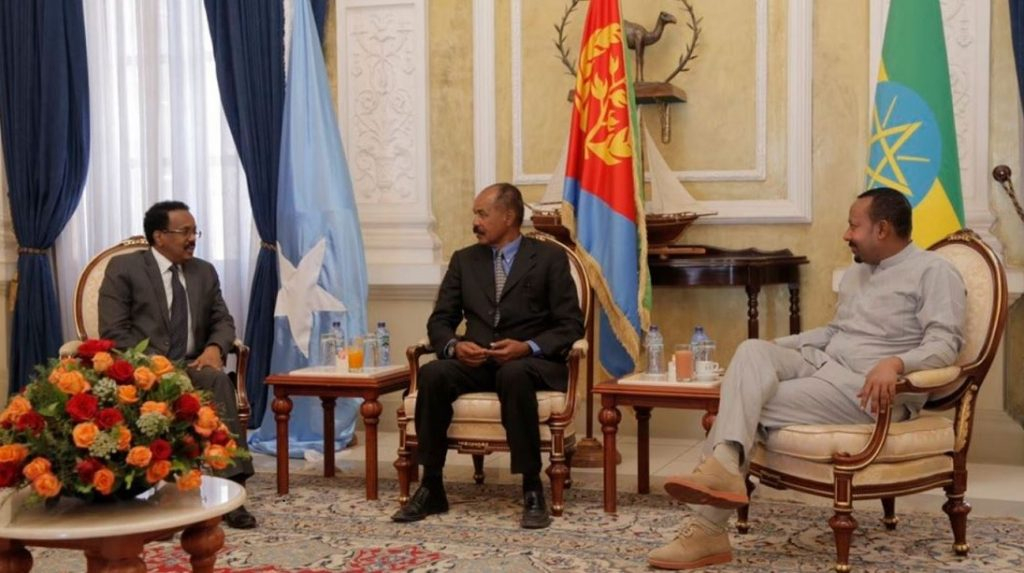
Ethiopia has gone back on its promise of a united Horn of Africa with its backing of separatist Somaliland. On January 27, 2020, Somali President Mohamed Abdullahi Farmajo, Eritrean President Isaias Afwerki, and Ethiopia’s Prime Minister Abiy Ahmed met in Asmara, Eritrea for a Tripartite meeting. Photo: Somalia Presidency – Twitter.

What’s behind Ethiopia’s overtures toward recognition of Somaliland?

At a time when Israel’s shipping through Red Sea has been blocked by Ansarallah in Yemen, control over the coast of Somaliland to its south across the Gulf of Aden, has become strategically crucial for Western powers, Elias Amare, former editor of HOA TV, told Peoples Dispatch in an interview

January 30, 2024 by Pavan Kulkarni

At a time when conflict over the Red Sea and Gulf of Aden is intensifying in the Arabian peninsula to its north, another potential conflict is brewing on the southern side of these troubled waters in the Horn of Africa.

Fears of a war between Ethiopia and Somalia have been stoked by the recent Memorandum of Understanding (MoU) signed between Ethiopia and Somaliland, a Western-backed separatist breakaway from northern Somalia whose claim to sovereignty has no international recognition.

As a part of this MoU, Ethiopia has committed to consider recognizing Somaliland as a sovereign country, in exchange for a 50-year lease of a part of its coastal land and seawater for the naval ambitions of this landlocked country.

Somalia, whose sovereignty over its northwestern region called Somaliland by the secessionists who control it is recognized in international law, has warned Ethiopia against proceeding with the MoU which it has declared illegal. Nevertheless, Ethiopia and Somaliland have declared their intention to proceed with the MoU, and are even exploring military cooperation.

Have the US and the UK, which have been backing Somaliland and are now bombing Yemen to its north across the Gulf of Aden, played a role behind the scenes of this MoU? Could this lead to a war between Ethiopia and Somalia, further destabilizing the Horn of Africa? What is Eritrea’s position in this conflict? How did Ethiopian Prime Minister Abiy Ahmed, who was seen as a figure uniting the Horn of Africa and transcending ethnic fault lines within Ethiopia, become a divisive figure in the region and within his country where ethnic tensions have peaked again?

In an interview with Peoples Dispatch, Elias Amare, former editor of the Horn of Africa TV and an expert on this region at the intersection of Africa and Asia, answers these and other important questions surrounding the controversial MoU. Read more…

Palestine Tet – 98 – Israeli unlawful execution of Gaza Palestinians – witnessed by their children

February 5, 2024

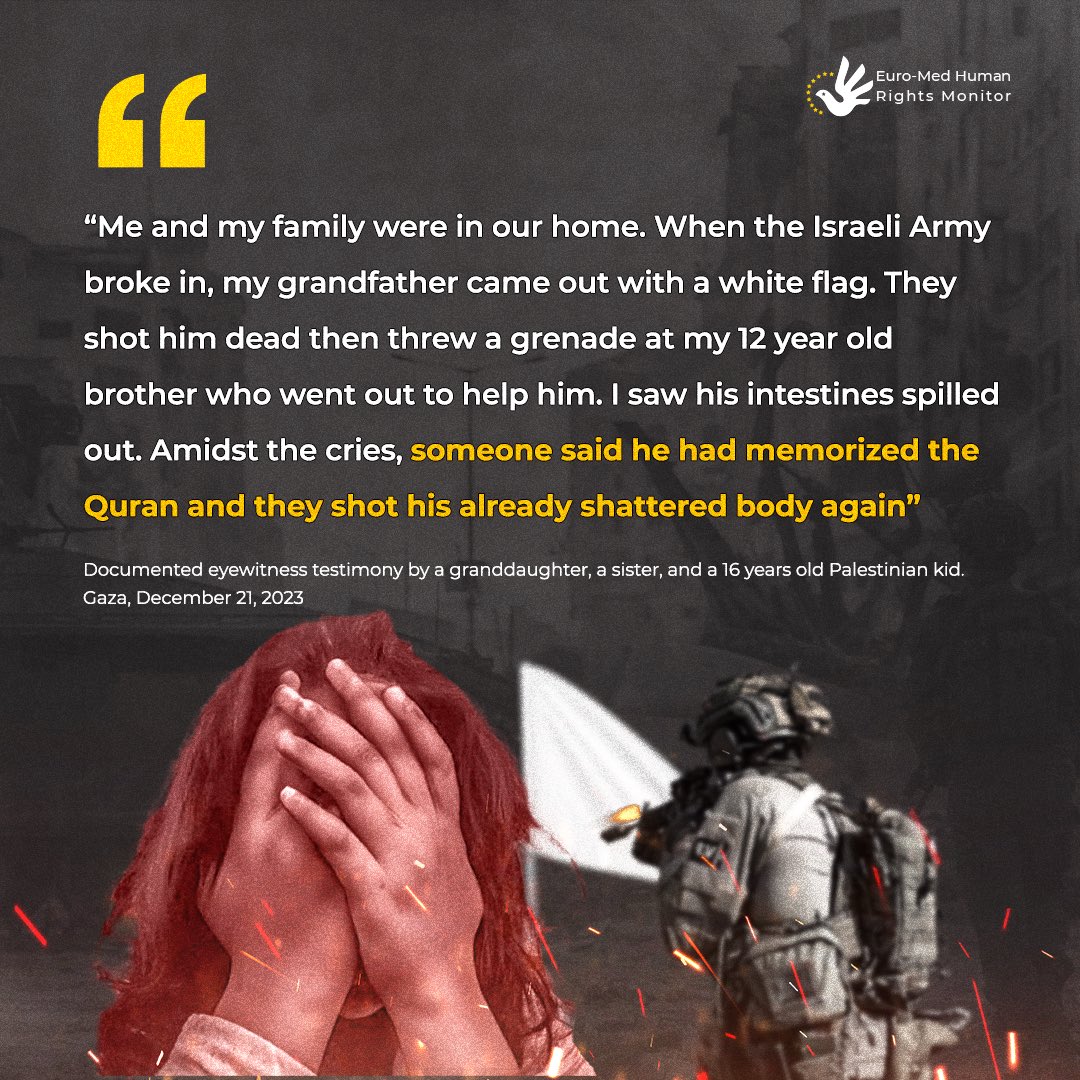
Amid the Israeli army’s incursion into homes during the ground invasion of #Gaza, civilians were unlawfully executed on the spot, witnessed by children. A 16-year-old girl’s testimony documented by Euro-Med reveals a crime recorded among acts of genocide by killing #GenocideGaza

Image

Covert Action Magazine: Tigray Was Literally Destroyed by the U.S., Says Former Ethiopian Diplomat

February 5, 2024

________________________

Covert Action Magazine: Tigray Was Literally Destroyed by the U.S., Says Former Ethiopian Diplomat

by Jeremy Kuzmarov – January 22, 2024

Mohamed Hassan Tells Tribunal on U.S. Imperialism That the U.S. Encouraged the Tigray People’s Liberation Front (TPLF) to Launch an Insurgency Against the Ethiopian Government in November 2020 and Gave Diplomatic and Media Cover for Their Aggression

The Motive Was to Use the TPLF to Control the Horn of Africa Region

Mohamed Hassan is a former Ethiopian diplomat who was involved in protests in the early 1990s with future Ethiopian President Meles Zenawi to secure greater rights for Ethiopia’s Muslim population.

Hassan told an international tribunal on U.S. imperialism that the U.S. government is responsible for the destruction of Tigray, an Ethiopian province, after the Tigray People’s Liberation Front (TPLF) launched an insurgency in November 2020 against the Ethiopian government.

Hassan blames the U.S. because they encouraged the TPLF uprising, imposed sanctions on Ethiopia to weaken it, and gave the TPLF diplomatic and media cover for their terrorist operations that fueled brutal counter-reprisals by the Ethiopian government.

Some 600,000 people are estimated to have been killed during the two years of the war, which ended in November 2022. The U.S.’s main motive for encouraging the rebellion was to restore the TPLF to power in Ethiopia, which they ruled from 1991 to 2018, and to use the TPLF to control the strategically important Horn of Africa region.[1]

Hassan Ali recounted a visit that he had in the early 1990s with then-National Security Adviser Anthony Lake who told him that the U.S. strategy for maximizing its influence in Africa in the post-Cold War era was by dividing the continent into four sub-regions dominated by key anchor states over which it would gain leverage.

A map of ethiopia with different colored areas Description automatically generated These states were: a) Egypt under Hosni Mubarak; b) South Africa under Thabo Mbeki; c) Nigeria under General Sani Abacha; and 4) Ethiopia under TPLF rule (its leader, Meles Zenawi, was Ethiopia’s president from 1991 to 1995 and Prime Minister from 1995 until his death in 2018).

When they first came to power in Ethiopia in 1991, the TPLF had popular legitimacy because they helped overthrow the Derg, a Marxist dictatorship led by Mengistu Haile Mariam.

The U.S. hated Mengistu because he closed U.S. military bases in Ethiopia, including the Kagnew communications base in Eritrea.

According to Dr. Simon Tesfamariam, an Eritrean doctor and activist living in New York, the TPLF was a minority regime in that it preferentially represented the interests of the Tigrayan people, which make up only 6% of the Ethiopian population.

Tesfamariam told journalist Ann Garrison that, over the last three decades, “the U.S. showered the tribalist, bourgeois TPLF minority regime with roughly a billion dollars a year in aid under the guise of humanitarian assistance. In exchange, TPLF served as Washington’s policeman in the Horn of Africa and used its influence in the African Union, which is based in Addis Ababa, to protect Washington’s interests on the African continent.”

Hassan Ali said that, in order to sustain his kleptocratic rule, Zenawi provoked ethnic divisions and committed large-scale war crimes when Ethiopia invaded Somalia in 2006/2007 and provoked a war with Eritrea in 1998 where the TPLF carried out a large-scale ethnic-cleansing operation against Eritreans living in Ethiopia.

Dr. Saleh Mohammed Idriss, a professor at the Asmara College of Education, recounted before the International People’s Tribunal a conversation between Meles Zenawi and CIA agent Paul Henze where Zenawi said to “look at the conflict from the point of view of Tigray. It needs access to the Red Sea and the only way is through Eritrea [which gained its independence from Ethiopia in 1991].”

In 2018, the TPLF was overthrown in a popular uprising that resulted in the rise to power of Abiy Ahmed, a former member of the Oromo Democratic Party who won the Nobel Peace Prize in 2019 for his role in helping to broker a durable peace agreement with Eritrea, and for releasing political prisoners and establishing a free press after years of TPLF authoritarian rule.

According to Hassan Ali, the peace deal with Eritrea worried U.S. imperial planners who preferred a conflict-ridden Horn region over which they could assert their hegemony through divide-and-rule tactics.

To make matters worse, Eritrean President Isaias Afwerki was considered a Castro-type figure and Eritrea an African equivalent to Cuba. Along with Zimbabwe, it is the only country in Africa to resist the presence of the U.S. Africa Command (AFRICOM).

After gaining its independence in 1991 following a long liberation struggle necessitated by the decision of U.S. Defense Secretary John Foster Dulles in the 1950s to support Ethiopia’s occupation of Eritrea, Eritrea rejected loans from the World Bank and IMF and promoted economic self-reliance under a socialist governing model.

To punish it for its defiance, the U.S. began imposing crippling sanctions in the mid-2000s under the false pretext that Eritrea supported the Somalian terrorist group Al-Shabab.

After the TPLF tried to overthrow the Ethiopian government, Eritrea was accused of dressing its soldiers in Ethiopian army uniforms and committing atrocities against Tigrayans.[2]

The sanctions as such were expanded upon—to the detriment of the Eritrean people who were deprived of vital medicines and goods and prevented from carrying out financial transactions using the SWIFT system.

Failing to acknowledge the negative impact of the sanctions, an article in The Atlantic by the former chief of mission at the U.S. embassy, Steve Walker, characteristically referred to Eritrea as a “human rights house of horror” and “totalitarian state,” which was “poor” and had “no realistic hopes of development” thanks to “revolutionary economic policies.”

Margaret Kimberley wrote in Black Agenda Report that such negative and prejudiced views obscured the fact that Eritrea is a functioning and proudly sovereign state, which overcomes the hardships created by U.S. sanctions to care for its people.

It was Eritrean military intervention, furthermore, at the request of the Abiy regime, in November-December 2020 that wiped out the backbone of the TPLF army in Tigray.

Checking All the Propaganda Boxes

Grégoire Lalieu is an investigative journalist from Belgium who testified at the People’s Tribunal on U.S. Imperialism that the Tigray War checked all the boxes of Western war propaganda the way it was presented in Western media.

Western economic interests and geopolitical scheming in the African Horn region was obscured and the history of U.S. imperial intervention in the region was ignored along with the history of TPLF atrocities.

Piggybacking off the official statements of the U.S. State Department, the media made it seem as if Abiy Ahmed had started the war because he had become arrogant after winning the Nobel Peace Prize when the TPLF was reported to have initiated hostilities by attacking the Ethiopian army’s northern command on November 4, 2020.

The Ethiopian government was accused of committing legions of atrocities amounting to genocide and trying to induce famine and starve the Tigrayan population when atrocities were committed on all sides of the war and no famine actually resulted.[3]

A parade of articles echoed the inflammatory narrative, including from the putatively left-wing Nation Magazine.

Democracy Now produced a series of similarly slanted reports alleging genocide, ethnic cleansing, and the use of rape as a weapon in Tigray, relying heavily on CNN reporter Nima Elbagir.

The Sudanese-born Elbagir, who is reportedly married to the current British ambassador to Iraq, Mark Bryson-Richardsonrelentlessly pushed the narrative of genocide perpetrated by Ethiopian and Eritrean forces, and in September 2022 won an Emmy Award for her documentary “Ethiopia: Hallmarks of a Genocide.”

Unreported in this documentary is the fact that the first massacre of the war was committed by TPLF militias at Mai Kadra on the Sudan border on November 9, 2020. The TPLF also fired rockets at civilians targets extending into Eritrea, forced the conscription of child soldiers, misused humanitarian relief supplies, committed gang rapes and fabricated evidence of Ethiopian army war crimes.[4]

Western media generally left the impression that the Ethiopian army would carry out a genocide if the U.S. did not intervene to protect the Tigrayan people.

Lalieu pointed out that the demonization of the Ethiopian military and Abiy Ahmed was comparable to the demonization of Muammar Qaddafi, Slobodan Milosevic, Vladimir Putin and other foreign leaders that the U.S. was intent on overthrowing by force.

Many U.S.-based journalists and academics relied for their assessment on TPLF representatives, allowing the U.S. and TPLF to monopolize the debate. The consequence was to help build public support for the U.S. sanctions and for military intervention, which the usual cohort of liberal proponents of humanitarian intervention were eager to support.

Getting Ethiopia Dead Wrong

Danish journalist Rasmus Sonderriis published an online book entitled Getting Ethiopia Dead Wrong, which concluded that Western media, academia and humanitarian aid organizations “demonized a friendly people and fueled a big war with dire mispredictions and shocking lies.”

Central to these lies was the use of the g-word (genocide), which the Holocaust Museum warned about in October 2022.

Sonderriis wrote that “the media-borne narrative that Ethiopia’s motivation was to commit genocide was concocted to confer legitimacy on the violent pursuit of power [by the TPLF].”

A key media influencer promoting the genocide narrative and demanding Western military intervention was World Health Organization (WHO) Director General Tedros Adhanom Ghebreyesus, a go-to media source who hid his own background as part of the TPLF ruling elite in Ethiopia.

founder of the Save Darfur movement, which historian Mahmood Mamdani called a “humanitarian arm of the War on Terror,”[5] de Waal previously cast the story of “genocide” in Sudan as an “Arab-African affair devoid of Western interests,” according to journalist Keith Harmon Snow.

Further, de Waal depicted the Hutu as the bad guys and Tutsis as the good guys in Rwanda despite the fact that Tutsi leader Paul Kagame triggered the April 1994 Rwandan genocide by invading Rwanda illegally and shooting down the airplane of Hutu President Juvenal Habyarimana.[6]

Sonderriis writes that de Waal and other Western journalists falsely reported on the defeat of Ethiopian forces and often advanced the stereotype of “dark continent savagery” that lent support for U.S. foreign policy intervention.

One of the main critics of Western media narratives, ironically, was conservative Oklahoma Senator James Inhofe, a notorious war hawk who characterized the TPLF as a terrorist group and called for a rollback of U.S. sanctions targeting the Ethiopian government.

Edward Hunt, a Ph.D. in American Studies from the College of William & Mary, wrote an article in The Progressive depicting the TPLF as leftist in favoring more of a statist model of development and presenting the overthrow of Abiy Ahmed’s government—which purged Tigrayan officials and allegedly favored the Amhara—as something positive. He said that it would reverse the neo-liberal and pro-American political agenda of Abiy Ahmed who Hunt blamed for starting the war, though Sonderriis says that most Ethiopians saw things differently.[7]

One Ethiopian commenting on Hunt’s story tellingly wrote that “TPLF is a tiny, regional, ethnic party drunk with regionalism, wounded by inferiority complex, a left over Commie mess from the 60s. The West put them in power in 1991, the other 95% kicking & screaming. They butchered, tortured, & looted 27 yrs. Abiy was elected by 40m votes, only the Ethiopian people can remove him. It’s easier for the apartheid regime to return to power in South Africa than sadist TPLF in Ethiopia.”

Another reader wrote that “[t]he war was not started by the Ethiopian gov. The TPLF thugs went at night and surprise attacked & killed the soldiers in North Ethiopia army base. They attacked the army base that was protecting the Tigrayans for 20 years. They went at night and slaughtered the soldiers & stole weapons. That is why the Ethiopian gov. went North and retrieved the weapons & war resumed. So, the 20 year liar TPLF is the one that started the war.”

One reason the U.S. may have opposed Abiy Ahmed and imposed sanctions on his government was because Ahmed forged closer cooperative relations with China, which supported Ethiopia in the Tigray War, and favored regional integration which could undercut U.S. influence in the Horn.

A sign that a covert operation was afoot was the creation of a Twitter hashtag, “Tigray Genocide,” that appears to have originated from the State Department, CIA or another U.S. government agency.

Another hashtag promoted justice for Tigray women and girls allegedly subjected to mass rape though the scale of these rapes was grossly inflated, according to Sonderriis, and many rapes were committed by the TPLF along with other atrocities that went unreported in the Western media.

The Twitter campaigns seemed reminiscent of the 2014 campaign supported by Michelle Obama to save Nigerian girls kidnapped by Boko Haram, and “Kony 2012 campaign” in which the atrocities of Ugandan warlord Joseph Kony were played up in order to justify a covert U.S. military operation in support of the Museveni government to hunt down Kony and protect U.S. military bases.

Yoweri Museveni was, like the TPLF, a loyal U.S. ally who, for years, had been used as a key anchor to help the U.S. access Central Africa’s vast mineral riches. Thus, history appears to be repeating itself, with the Western intelligentsia playing a key role once again in the perpetuation of Western colonialism.


  1. General Norman Schwarzkopf noted that “the Red Sea, with the Suez Canal in the north and the Bab-el-Mandeb in the south, is one of the most vital sea lines of communication and a critical shipping link between our Pacific and European allies,” hence the U.S. interest in securing a strategic foothold in the Horn of Africa region, cited in David N. Gibbs, “Realpolitik and Humanitarian Intervention: The Case of Somalia,” International Politics, March 2000. 
  2. For the role of Amnesty International and other human rights groups in playing up the Eritrean atrocities, see Ann Garrison, “Amnesty International pushes regime change in Eritrea with dubious, unverifiable report,” The Grayzone Project, September 21, 2023, https://thegrayzone.com/2023/09/21/amnesty-international-regime-change-eritrea/ 
  3. See Mawi Asgedom, “Why the U.S. should call the famine and violence in Tigray a genocide,” The Washington Post, October 6, 2021. On the pattern of biased Western reporting on Africa, see Milton Allimadi, Manufacturing Hate: How Africa Was Demonized in Western Media (Dubuque, Iowa: Kendall Hunt Publishing, 2021).
  4. According to Ann Garrison, when the TPLF invaded Ethiopia’s Amhara and Afar Regions, the Western press generally looked the other way, giving Amhara and Afari victims only occasional mention. From April to June 2022, Garrison said that she traveled through Ethiopia’s Amhara and Afar Regions and saw immense suffering in many overcrowded IDP camps, where deeply traumatized Amharas and Afaris told her that the TPLF had murdered their family members and taken all they had until they fled. 
  5. See Mahmood Mamdani, Saviors and Survivors: Darfur, Politics, and the War on Terror (New York: Crown, 2010). 
  6. De Waal’s view conveniently was exactly how the U.S. State Department/Pentagon and CIA wanted the Rwandan conflict to be presented since they were supporting the Tutsi-led Rwandan Patriotic Front (RPF) while France was supporting the Hutu. De Waal was a contemporary of John Prendergast, a State Department employee who worked closely with current USAID Administrator Samantha Power at the Harvard Kennedy School’s Carr Center for Human Rights and was similarly a strong proponent of “humanitarian intervention” in Africa. According to Keith Harmon Snow, Prendergast worked with Susan Rice to create the Pentagon’s prized African Crisis Response Initiative (ACRI)—a euphemistically named entity created to project U.S. power in Africa run by U.S. Army Special Forces Command (SOCOM). 
  7. Hunt emphasized that Abiy pushed through major economic reforms that began the process of dismantling the country’s state-controlled economic system, opening the country’s markets to foreign investors, which earned him the favor of the U.S. ruling elite. The Nation magazine published a story by Daniel Volodzko characteristically titled “There’s Genocide in Tigray, but Nobody’s Talking About It.” https://www.thenation.com/article/world/genocide-in-tigray/ 

Palestine Tet – 97 – Nearly 180 percent spike in anti-Muslim and anti-Palestinian incidents in US: Report Since 7 October, most complaints involved employment discrimination, hate crimes and education discrimination

February 4, 2024

Women watch as Palestinian activists hold a press conference outside of the UN in New York City, on 26 January 2024 (AFP)

____________________________________

Nearly 180 percent spike in anti-Muslim and anti-Palestinian incidents in US: Report

The Muslim advocacy group said it received 3,578 complaints during the last three months of 2023 since the Israel-Palestine war began.

In the period from October to December, the majority of the reported complaints fell into three main categories: 19 percent were employment discrimination cases; 13 percent were hate crimes and hate incidents; and 13 percent of the instances were discrimination in educational environments.

“In the face of relentless hate and bogus smears, American Muslims, Arabs and a broad coalition of Jewish, Christian, African American, Asian Americans, and others continue calling for justice for Palestine,” Cair research and advocacy director Corey Saylor said.

“This coalition knows the way to stop the hate is to end the apartheid, occupation, and genocide occurring in Palestine.”

In early 2023, Cair reported that 2022 showed the first-ever drop in incoming complaints to the organisation since it started tracking data in 1995. But the events on 7 October changed that. 

At least 26,637 Palestinians have been killed and 65,387 wounded in Israeli strikes on Gaza since the war began, the Palestinian health ministry said in a statement on Monday.

In the past 24 hours, 215 Palestinians were killed and 300 injured, the ministry added.

Israel-Palestine: Palestinian student shot in US paralysed from the chest down

Read More »

In October, a six-year-old Palestinian-American was fatally stabbed 26 times and his mother seriously wounded in the US, in an attack officials say was linked to the ongoing Israel-Palestine war and because they identified as Muslim.

Wadea al-Fayoume, a six-year-old boy, had been stabbed 26 times and had a 12-inch serrated military knife with a seven-inch blade lodged in his body.

In December, three Palestinian-American college students were speaking Arabic and wearing keffiyehs, a scarf synonymous with Palestinian solidarity, and were en route to dinner before they were shot by a gunman in Burlington, Vermont.

One of them is now paralysed from the chest down and may not be able to walk again.

“Despite this disturbing wave of bias targeting the Muslim, Arab-American and Palestinian communities, we are witnessing an impressive resilience in the face of bigotry,” Cair national executive director Nihad Awad said on Monday.

Palestine Tet – 96 – High Noon in the Middle East? Is the whole region about to explode?

February 3, 2024

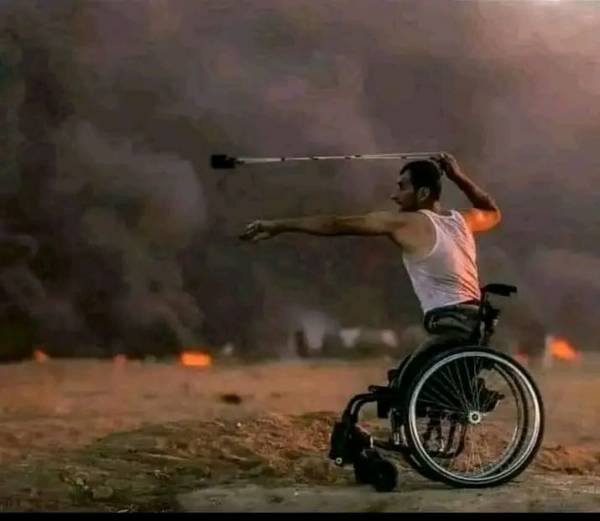
If I am not mistaken, this photo was taken during the  protests in Gaza in 2018 in which hundreds of Palestinian protesters were shot in cold blood by Israeli snipers and Israeli civilians – as if at a sports stadium sitting in the bleachers – cheered on the assassins

Are the guns of early February about explode in the Middle East even more? Could it get much worse?

Of course it can and we – the world – are at a pivotal moment with few signs that diplomacy has much of a chance. Both Israel and the Biden Administration are trying to provoke Iran, Hezbollah or Islamic Resistance in Iraq into responding to their bombing attacks so as the trigger a major escalation in the violence. To date, none of these Axis of Resistance forces have taken the bait.

This is a very dangerous moment.

Both Washington and Tel Aviv  to regain what they are losing diplomatically and politically in the Middle East through a major joint military strike somewhere in the region with with drum beats of war getting louder and louder. Increasingly the target whose political wings they hope to clip is Iran although a direct attack on Iran has possible dire consequences both on the region and the global economy.

It is no secret – frankly all over the media worldwide – Netanyahu needs more war to stay in office and that he’s doing his darndest to bring in the U.S. militarily more actively into spreading wars. All indications are that Biden would like to do but with his poll numbers plummeting in contrast to Trump’s, “Genocide Joe” – as he is being increasingly referred to is damned if he does and damned if he doesn’t.

A major military build up with 70% of Americans supporting a ceasefire could lead to horrific consequences as this is not 1967 nor 1973 nor 1982 – not even 2006. Washington’s adversaries in the region and worldwide are stronger, Washington and its allies far weaker. As the November 2024 election approaches, Biden is losing important elements of his base – youth, people of color who, in a world of social media, are sickened by the slaughter and ethnic cleansing Israel is perpetrating against Gaza.

Having failed to date in its goals of destroying Hamas, expelling 2.3 million Palestinian Gazans into the Sinai Desert to be disbursed worldwide, Israel is turning its military attention towards S. Lebanon and Hezbollah. in order to try to compensate for its Gaza military failure with at least the semblance of a victory somewhere else. Besides, Netanyahu’s future depends upon winning a military contest somewhere, anywhere although ‘picking Hezbollah as its target’ might be an even bigger mistake than invading Gaza

The Biden Administration along with British military midgets are bombing Yemen.

U.S. troops find themselves increasingly pinned down in their bases in Iraq, Syria and elsewhere. Today the Houthi’s claimed to have sunk a U.S. warship in the Red Sea, an allegation that Washington, to date, is silent about. Meanwhile the Palestinian Resistance has embarrassed the IDF in Gaza, Hezbollah has seriously damaged a major Israeli communication and spying base at Meron. It’s missile campaign has caused Israelis in N. Israel to flee south in large numbers. Yemen continues to attack ships in the Red Sea region heading to and fro Israel and has, through its missile strikes,  shut down the Israeli Eilat port on the Gulf of Aqaba.

And the International Court of Justice, at South Africa’s request, the ICJ has just determined that there is enough evidence against Israel to pursue in a much more extensive and detailed case to determine whether it has committed genocide in Gaza, the facts on the ground presenting a damning indictment of Israel already.

Whatever sympathy Israel might have enjoyed after the Palestinian October 7 “break out” from its Gaza prison evaporated within days as Israel pulverized Gaza with missiles and a failed ground invasion causing already more than 100,000 casualties if one includes known dead and wounded, and the thousands still buried beneath the rubble. Israel has lost the public relations battle – too much blood in the ground, too much targeting of civilians, their homes, schools, hospitals in a concentrated level of barbarism that has shocked much of the world, especially the Global South.

Meanwhile Washington dithers.

It has never looked weaker, more out of control of the situation as the Biden Administration appears today in the Middle East. Unable to control its long time favorite proxy, it finds itself increasingly drawn in militarily to the many layered military confrontations. It’s naval armada has failed to stop Ansar Allah’s version of sanctions against Israel (interfering with ships coming and going to Israel); the U.S. bombing campaign – as savage as usual – to date has only stiffent Yemeni resolve. The international balance of power is shifting and Washington is losing its grip on the world.

Washington’s growing diplomatic isolation in the Middle East was starkly revealed by its pathetic (and humiliating) request to ask China to intervene with Iran to put pressure on Yemen to end its targeting Israeli bond ships. Nothing is working. In Washington DC a struggle between neocons – John Bolton, Victoria Nuland and the like (and behind them the Clintons) pushing for all out war and some elements of ruling class wanting to dampen down the tensions until at least after the November 2024 presidential elections.

Who has the upper hand? We’ll soon see.

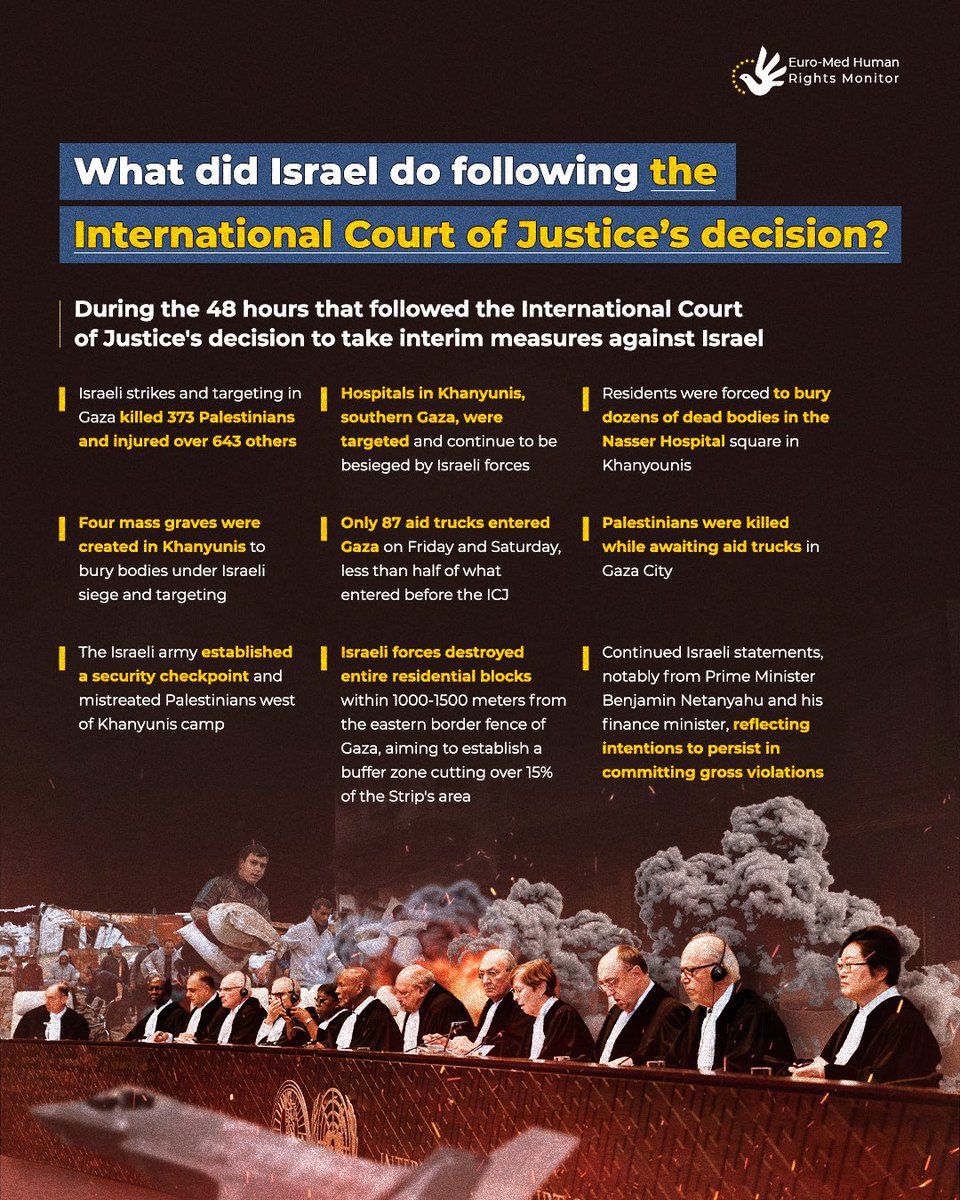
Palestine Tet – 95 – What did Israel do following the International Court of Justice Decision?

February 2, 2024

_______________________________

They can’t lash out at the ICJ—that’s uncivilized!—so these cowardly sadists starve the children of Gaza instead. The puke beneath the thin veneer of Western Civilization has yet again burst forth.

Behind the contrived hysteria at UNRWA lurks Western fury at the ICJ decision; If Israel is plausibly guilty of genocide, then the “enlightened” West stands guilty of complicity in genocide

Norman Finkelstein (On “X” – former Twitter)

_______________________________


Image

Palestine Tet – 94 – Possible prisoner exchange, temporary ceasefire in the making

February 1, 2024


Rashida Tlaib – actually censored by a war crazy U.S. House of Representatives for defending Palestinians in Gaza and calling for a ceasefire.

__________________________________

“We are justly afraid… This is organized evil on a scale we have only read about in books”.

A Gaza Palestinian

Asked if an Israeli operation—where forces wore disguises and entered a West Bank hospital to carry out killings/executions—is the appropriate conduct for a state, State Spokesman Matthew Miller says: “We think it is appropriate that they have the ability to bring members of Hamas to justice”

__________________________________

Another article from the Arabic Press – Rai Al Youm translated by Google Translate from Arabic into English. For original article, click here.

The Hebrew media reveals some details of the proposed exchange deal… 35 days of truce in Gaza in exchange for 35 Israeli “hostages”, and the second phase will be larger and more comprehensive… and this is the point of contention.

Zain Khalil/Anatolia – January 31, 2024

(Israel’s) Hebrew Channel 12 revealed, on Wednesday evening, that Mossad chief David Barnea revealed to the Israeli War Council a “document of principles” for a possible prisoner exchange deal with Hamas, which includes the release of 35 Israeli detainees in the Gaza Strip in the first phase, in exchange for a truce for 35 days.

The channel’s spokeswoman said that the document presented by Barnea to the War Council “includes the release of 35 kidnapped survivors, including women, the wounded, and the elderly, in exchange for a truce lasting 35 days, meaning one day of the truce for each kidnapped (whom Hamas detained in the attack on October 7, 2023).”

She added, “It is possible after that to extend the calm for an additional week, in order to conduct negotiations on the possibility of completing the second phase of the deal, which includes the release of the youth, and all those whom Hamas describes as soldiers.”

The channel considered that “the essence of the disagreement on the Israeli side is not necessarily the number of security prisoners (Palestinian prisoners) that Israel will be forced to release from prisons, but rather their quality.” She pointed out that the deal “includes the release of a large number of Palestinian prisoners, who were convicted by Tel Aviv of involvement in attacks that resulted in the killing of Israelis.”

She stated that the release of these Palestinian prisoners “will be difficult for the public and politicians to digest.”

She continued: “The discussion in Israel was not only concerned with the issue of the number of prisoners (captives) who would be released, but also which prisoners would be released. This is very important and will affect the acceptance of the deal.”

Channel 12 confirmed that, until this moment, “there is no agreement on the number of (Palestinian) prisoners who will be released (by Israel).” According to the channel, the ball is now in Hamas’ court, to which the mediators conveyed the main lines of the deal, and is awaiting its response.

On Tuesday, the head of the Hamas Political Bureau, Ismail Haniyeh, announced that his movement had received the deal proposal that was circulated within the framework of efforts to stop the Israeli war on the Gaza Strip and complete a prisoner exchange agreement, and that it was studying it.

For its part, the Hebrew newspaper Yedioth Ahronoth said on Wednesday evening that Hamas “insists that the next deal include three known Palestinian prisoners, only one of whom is a member of the movement.”

The newspaper pointed out that in the list that Hamas is expected to advance, “there are big names capable of changing the face of the Palestinian Authority, led by Fatah leader Marwan Barghouti, who is considered in the latest opinion poll conducted in the West Bank to be the preferred candidate to head the Authority after Abu Mazen.” Palestinian President Mahmoud Abbas).

The newspaper pointed out that in the list that Hamas is expected to advance, “there are big names capable of changing the face of the Palestinian Authority, led by Fatah leader Marwan Barghouti, who is considered in the latest opinion poll conducted in the West Bank to be the preferred candidate to head the Authority after Abu Mazen.” Palestinian President Mahmoud Abbas).

Barghouti (arrested by Israel in 2002) is serving five life sentences and 40 years in prison on charges of planning to carry out operations in which five Israelis were killed and others were injured, according to the same source.

The newspaper continued: “The second name that Hamas insists on is Ahmed Saadat, Secretary-General of the Popular Front, who planned to assassinate Minister Rehavam Zaei in 2001.” It pointed out that Israel “refused to release Saadat as part of the Shalit deal (to exchange prisoners in 2011).” It added, “Saadat, like Barghouti, is also considered an important popular figure in Palestinian society.”

As for the third prisoner, Yedioth Ahronoth said he was “Abdullah Barghouti, a member of Hamas, and one of the leaders of the organization’s military wing in the West Bank. Abdullah Barghouti is currently serving a life sentence for 67 years, which is an “unprecedented sentence in Israel,” according to the newspaper. Israel also refused to release Barghouti in the Shalit deal, according to the same source. As of 20:40 (UTG), the Hamas movement had not commented on what was reported by Channel 12 and the Yedioth Ahronoth newspaper.

Israel also refused to release Barghouti in the Shalit deal, according to the same source.
As of 20:40 (UTG), the Hamas movement had not commented on what was reported by Channel 12 and the Yedioth Ahronoth newspaper.

The United States, Egypt and Qatar are in contact with Israel, while Egypt and Qatar are in contact with Hamas to reach a second agreement to release Israeli prisoners from Gaza in exchange for the release of Palestinian detainees from Israeli prisons and a ceasefire in Gaza.

On Monday, White House National Security Council spokesman John Kirby announced, during an interview with MSNBC, that negotiations aimed at reaching an agreement to release Israeli prisoners detained in the Gaza Strip led to “a framework that could lead to a final agreement.”.

Tel Aviv estimates that there are about 136 Israeli prisoners in Gaza, while it holds at least 8,800 Palestinians in its prisons, according to official sources from both parties.


Palestine Tet – 93 – Several Articles from Arabic Press: 1. Global South responses to ICJ interim decision accusing Israel of Genocide in Gaza 2. Hezbollah raises concern and confusion in “Tel Aviv” after it bombed Israeli sites with Israeli phosphorus missiles.. How did it reach the party’s hands?

January 31, 2024

____________________________________

(Note: These articles are translated from Rai El Youm using “Google Translate”. Links to the original articles in Arabic provided. RJP)

1. Rai El Youm – Janury 27, 2024 – Jordan calls on Israel to “stop killing Palestinians” in implementation of the decision of the International Court of Justice and to bring aid into Gaza, with growing concern about the fate of besieged civilians.. The African Union welcomes the “Hague” decision

Amman-Istanbul – (AFP) – Anatolia – Jordanian Foreign Minister Ayman Al-Safadi on Saturday called on the international community to take all necessary steps for Israel to implement the International Court of Justice’s decision to “stop killing Palestinians and bring adequate humanitarian aid” into the Gaza Strip.

On Friday, the International Court of Justice, based in The Hague, called on Israel to prevent committing any act that might amount to “genocide” in the Gaza Strip and to allow humanitarian aid to reach it, with growing concern over the fate of civilians trapped as a result of the war between the Israeli army and Hamas.

Al-Safadi’s statements came during discussions held in Amman on Saturday with German Foreign Minister Annalena Baerbock, which focused on “efforts to stop the Israeli war on Gaza and the disastrous conditions it is causing,” according to a statement by the Jordanian Ministry of Foreign Affairs.

Al-Safadi stressed, according to the statement, “the need for the international community to take all necessary steps for Israel’s immediate implementation of the procedural measures approved by the International Court of Justice yesterday (Friday), which include stopping the killing of Palestinians, introducing adequate humanitarian aid, stopping incitement, and holding the instigators accountable.”

He explained that “stopping the Israeli aggression against Gaza is a priority that must be achieved immediately, as the only way to end the humanitarian catastrophe caused by the aggression and to introduce sufficient aid and ensure its delivery to all areas of the Gaza Strip.”

Al-Safadi believed that “any future approach to Gaza must be within a comprehensive framework that emphasizes the unity of Gaza, the West Bank and East Jerusalem, and aims, within a specific time frame and within a clear plan, to achieve a comprehensive solution to the conflict on the basis of the two-state solution.”

For her part, Bierbock said, according to the statement, “As the International Court of Justice has urged, the Israeli government must immediately allow more humanitarian aid into Gaza and modify the way it manages its operations.”

She added, “Hundreds of thousands of displaced Palestinians who are now in UN facilities and other places have nowhere else to go.”

“There is a need now for a humanitarian truce, to later reach a sustainable ceasefire so that all hostages can finally be released,” Birbock stressed.

For its part, the African Union welcomed, on Saturday, the interim measures decision issued by the International Court of Justice in The Hague against Israel.

This came in a statement issued by the Chairperson of the African Union Commission, Moussa Faki Mahamat, commenting on the International Justice Department’s decision in the lawsuit filed by the Republic of South Africa against Israel.

“Mohammed” added that the resolution stresses the necessity of “respecting international law and obligating Israel to comply with its obligations under the Genocide Convention.”

In a related context, the Somali government, in a statement regarding the “International Justice” decision, called for an urgent ceasefire in the Gaza Strip “to avoid more casualties.”

On Friday, the International Court of Justice ordered Israel to take measures to prevent genocide against the Palestinians and improve the humanitarian situation in the Gaza Strip, but the decision did not include a “ceasefire” text.

The October 7 attack led to the deaths of more than 1,140 people in Israel, most of them civilians, according to an Agence France-Presse count based on official Israeli figures.

In response to the attack, Israel pledged to “eliminate” Hamas and launched a massive military operation that left 26,257 martyrs, the vast majority of whom were women, children and young people, according to the Hamas Ministry of Health.

2. Rei Al Youm – January 26, 2024 – Hezbollah raises concern and confusion in “Tel Aviv” after it bombed Israeli sites with Israeli phosphorus missiles.. How did it reach the party’s hands?

Jerusalem / Anatolia

The Hebrew Broadcasting Corporation said, on Thursday, that the Israeli army is investigating how its ammunition reached the Lebanese Hezbollah, after finding two phosphorus shells near the town of Metulla (north), which were fired by the party last week.

The authority said (officially): “It appears that the two mortar shells that exploded last week near the town of Metulla were phosphorus shells belonging to the Israeli army, and they fell into the hands of Hezbollah.”

It quoted the Israeli army as saying that “explosives experts arrived at the scene to inspect the remains of the two shells.”

According to experts, “It is estimated that the two shells are likely to be old Israeli war munitions, and this type of munitions has been taken out of service.”

“However, the incident is still under investigation,” the authority added.

She also pointed out that “after the two shells fell on Al-Baladah Street (Al-Matula), they caused fires to ignite and also consumed part of the road on which they fell.” She said: “The Metulla Local Council believed that these shells contain a phosphorous substance with the aim of increasing harm to civilians.” The Hebrew Authority added: “If this is true, this is the first time that Hezbollah has used a weapon containing phosphorus.”

Hezbollah did not confirm the Israeli allegations until 8:30 (UTG).

Since the outbreak of the devastating Israeli war on the Gaza Strip on October 7, 2023, the border with Lebanon has witnessed tension and an exchange of fire between the Israeli army on the one hand and “Hezbollah” and Palestinian factions on the other hand, which led to deaths and injuries on both sides, including civilians.

Palestine Tet – 92 – Spying on Gaza, Bombing Yemen: Colonial British Base Angers Cypriots

January 30, 2024

Nicosia, Cyprus – January 1987. At an “anti-U.S. base rally” – in attendance (I was told) – 200,000. As I recall, the rally was outside the big base at Akrotiri. I was one of the speakers. The rally was organized by the same Cypriot Peace Council that is organizing protests against Cyprus’s involvement in Israel’s genocide in Gaza.  (R. Prince/Photo)

______________________________


As the Gaza spreads embracing Egypt Lebanon, Iraq, Yemen into its cauldron, nearby Cyprus is getting sucked in as well against its will.

Cyprus is being drawn into the Middle East war malstrom against its will and its citizens are opposed to their role as a military staging and intelligence gathering station for NATO.

185 miles offshore from Lebanon and Israel, it is the home of major British and American airbases and communication spying centers for the Middle East.

Watch this video “Spying on Gaza: Bombing Yemen” .

It alleges intensive British (and American) military activity heading east (ie, towards the Eastern Mediterranean coast of Lebanon ande and Israel) since October 7.

Cyprus is thus being used as an accessory to Israel’s genocide in Gaza and this without the permission and/or knowledge of the Cypriot government. As the war continues and intensifies, Israelis are flocking to Cyprus in droves.

The Second Israel? Israelis Are Streaming Into Cyprus to Buy Anything in Sight

____________________________

Note Cyprus’s strategic position with Turkey just to the north and the Eastern Mediterranean coast of Lebanon and Israel just a 185 mile hop away

Palestine Tet – 91 – Post Gaza Futures

January 29, 2024

Suleimani celebrated in Gaza the architect of the Axis of Resistance in the last days of the Trump Administration

Pepe Escobar: Five Variables Defining Our Future

In the late 1930s, with WWII in motion, and only months before his assassination, Leon Trotsky already had a vision of what the future Empire of Chaos would be up to.

“For Germany it was a question of ‘organizing Europe’. The United States must ‘organize’ the world. History is bringing mankind face to face with the volcanic eruption of American imperialism…Under one or another pretext and slogan the United States will intervene in the tremendous clash in order to maintain its world dominion.”

We all know what happened next.

Now we are under a new volcano that even Trotsky could not have identified: a declining United States faced with the Russia-China “threat”. And once again the entire planet is affected by major moves in the geopolitical chessboard.

The Straussian neocons in charge of US foreign policy could never accept Russia-China leading the way towards a multipolar world. For now we have NATO’s perpetual expansionism as their strategy to debilitate Russia, and Taiwan as their strategy to debilitate China.

Yet in these past two years, the vicious proxy war in Ukraine only accelerated the transition towards a multipolar, Eurasia-driven world order.

With the indispensable help of Prof. Michael Hudson, let’s briefly recap the 5 key variables that are conditioning the current transition.

Losers Don’t Dictate Terms

1.The stalemate: That’s the new, obsessive US narrative on Ukraine – on steroids. Confronted with the upcoming, cosmic NATO humiliation in the battlefield, the White House and the State Dept. had to – literally – improvise.

Moscow though is unfazed. The Kremlin has set the terms a long time ago: total surrender, and no Ukraine as part of NATO. To “negotiate”, from the Russia point of view, is to accept these terms.

And if the deciding powers in Washington opt for turbo-charging the weaponization of Kiev, or to unleash “the most heinous provocations in order to change the course of events”, as asserted this week by the head of the SVR, Sergey Naryshkin, fine.

The road ahead will be bloody. In case the usual suspects sideline popular Zaluzhny and install Budanov as the head of the Armed Forces of Ukraine, the AFU will be under total control of the CIA – and not NATO generals, as it’s still the case.

This might prevent a military coup against the sweaty sweatshirt puppet in Kiev. Yet things will get much uglier. Ukraine will go Total Guerrilla, with only two objectives: to attack Russian civilians and civilian infrastructure. Moscow, of course, is fully aware of the dangers.

Meanwhile, chatterbox overdrive in several latitudes suggest that NATO may even be getting ready for a partition of Ukraine. Whatever form that might take, losers do not dictate conditions: Russia does.

As for EU politicos, predictably, they are in total panic, believing that after mopping up Ukraine, Russia will become even more of a “threat” to Europe. Nonsense. Not only Moscow couldn’t give a damn to what Europe “thinks”; the last thing Russia wants or needs is to annex Baltic or Eastern European hysteria. Moreover, even Jens Stoltenberg admitted “NATO sees no threat from Russia toward any of its territories.”

2.BRICS: Since the start of 2024, this is The Big Picture: the Russian presidency of BRICS+ – which translates as a particle accelerator towards multipolarity. The Russia-China strategic partnership will be increasing actual production, in several fields, while Europe plunges into depression, unleashed by the Perfect Storm of sanctions blowback against Russia and German de-industrialization. And it’s far from over, as Washington is also ordering Brussels to sanction China across the spectrum.

As Prof. Michael Hudson frames it, we are right in the middle of “the whole split of the world and the turning towards China, Russia, Iran, BRICS”, united in “an attempt to reverse, undo, and roll back the whole colonial expansion that’s occurred over the last five centuries.”

Or, as Foreign Minister Sergei Lavrov defined at the UN Security Council this process of BRICS leaving Western bullies behind, the changing world order is like “a playground scuffle – which the West is losing.”

Bye Bye, Soft Power

3.The Lone Emperor: The “stalemate” – actually losing a war – is directly linked to its compensation: the Empire squeezing and shrinking a vassalized Europe. But even as you exercise nearly total control over all these relatively wealthy vassals, you lose the Global South, for good: if not all their leaders, certainly the overwhelming majority of public opinion. The icing in the toxic cake is to support a genocide followed by the whole planet in real time. Bye bye, soft power.

4.De-dollarization: All across the Global South, they did the math: if the Empire and its EU vassals can just steal over $300 billion in Russian foreign reserves – from a top nuclear/military power – they can do it to anyone, and they will.

The key reason Saudi Arabia, now a BRICS 10 member, is being so meek on the genocide in Gaza is because their hefty US dollar reserves are hostage to the Hegemon.

And yet the caravan moving away from the US dollar will only keep growing in 2024: that will depend on crucial crossover deliberations inside the Eurasia Economic Union (EAEU) and BRICS 10.

5.Garden and jungle: What Putin and Xi have essentially been telling the Global South – including the energy-rich Arab world – is quite simple. If you want improved trade and economic growth, who’re you gonna link to?

So we’re back to the “garden and jungle” syndrome – first coined by imperial Britain orientalist Rudyard Kipling. Both the British concept of “white man’s burden” and the American concept of “Manifest Destiny” derive from the “garden and jungle” metaphor.

NATOstan, and hardly all of it, is supposed to be the garden. The Global South is the jungle. Michael Hudson again: as it stands, the jungle is growing, but the garden isn’t growing “because its philosophy is not industrialization. Its philosophy is to make monopoly rents, meaning rents that you make in your sleep without producing value. You just have a privilege of a right to collect money on a monopoly technology that you have.”

The difference now, compared to all those decades ago of an imperial free lunch, is “an immense shift of technological advance”, away from North America and the US, to China, Russia and selected nodes across Asia.

Forever Wars. And No Plan B

If we combine all these variants – stalemate; BRICS; the Lone Emperor; de-dollarization; garden and jungle – in search of the most probable scenario ahead, it’s easy to see that the only “way out” for a cornered Empire is, what else, the default modus operandi: Forever Wars.

And that brings us to the current American aircraft carrier in West Asia, totally out of control yet always supported by the Hegemon, aiming for a multi-front war against the whole Axis of Resistance: Palestine, Hezbollah, Syria, Iraqi militias, Ansarullah in Yemen, and Iran.

In a sense we’re back to the immediate post-9/11, when what the neocons really wanted was not Afghanistan, but the invasion of Iraq: not only to control the oil (which in the end they didn’t) but, in Michael Hudson’s analysis, “to essentially create America’s foreign legion in the form of ISIS* and al-Qaeda** in Iraq.” Now, “America has two armies that it’s using to fight in the Near East, the ISIS*/al-Qaeda** foreign legion (Arabic-speaking foreign legion) and the Israelis.”

Hudson’s intuition of ISIS* and Israel as parallel armies is priceless: they both fight the Axis of Resistance, and never (italics mine) fight each other. The Straussian neocon plan, as tawdry as it gets, essentially is a variant of the “fight to the last Ukrainian”: to “fight to the last Israeli” on the way to the Holy Grail, which is to bomb, bomb, bomb Iran (copyright John McCain) and provoke regime change.

As much as the “plan” did not work in Iraq or Ukraine, it won’t work against the Axis of Resistance.

What Putin, Xi and Raisi have been explaining to the Global South, explicitly or in quite subtle ways, is that we are right in the crux of a civilizational war.

Michael Hudson has done a lot to bring down such an epic struggle to practical terms. Are we heading towards what I described as techno-feudalism – which is the AI format of rent-seeking turbo-neoliberalism? Or are we heading to something similar to the origins of industrial capitalism?

congressional-intelligence-media-academia-think tank complex) cannot control. Alea jacta est.

* ISIS (also known as ISIL/IS) is a terrorist group banned in Russia.

** A terrorist group outlawed in Russia and many other countries.

Palestine Tet – 90 – Trita Parsi’s Comments on the International Court of Justice finding Israel guilty of having committed genocide

January 28, 2024

_________________________

a. Let history record that #SouthAfrica led the international community in fighting to give meaning to “never again”….! The people of #Palestine also have a right to life. Amandla!!! #ICJGenocideConvention
b. The International Court of Justice (ICJ) tells the world that Israel must stop committing any acts of genocide in Gaza. Israel responds by killing and injuring 484 Palestinian civilians in the last 24 hours alone. And the US and UK respond by cutting funding to UNRWA in Gaza.

_________________________

The ICJ just ruled against Israel and determined that South Africa successfully argued that Israel’s conduct plausibly could constitute genocide. The Court imposes several injunctions against Israel and reminds Israel that its rulings are binding, according to international law. A final ruling will still take more time, but this ruling will have significant political repercussions. Here are a few thoughts.

This is a devastating blow to Israel’s global standing. To put it in context, Israel has worked ferociously for the last two decades to defeat the BDS movement – Boycott, Divestment, and Sanctions – not because it will have a significant economic impact on Israel, but because of the manner that it could delegitimize Israel internationally. However, the ruling of the ICJ that Israel is plausibly engaged in genocide is far more devastating to Israel’s legitimacy than anything BDS could have achieved.

This is a devastating blow to Israel’s global standing. To put it in context, Israel has worked ferociously for the last two decades to defeat the BDS movement – Boycott, Divestment, and Sanctions – not because it will have a significant economic impact on Israel, but because of the manner that it could delegitimize Israel internationally. However, the ruling of the ICJ that Israel is plausibly engaged in genocide is far more devastating to Israel’s legitimacy than anything BDS could have achieved.

Just as much as Israel’s political system has publicly been increasingly associated with apartheid in the past few years, following groundbreaking reports by major human rights organizations such as Amnesty, Israel will now increasingly be publicly associated with genocide – as will likely those countries that have supported Israel and its military campaign in Gaza, such as the US under Biden.

The implications for the United States, as a result, are also significant. Firstly because the court does not have the ability to implement its ruling. Instead, the matter will go to the Security Council, where the Biden administration will once again face the choice of protecting Israel politically by casting a veto, and by that, further isolate the United States, or to allow the Security Council to act and pay a domestic political cost for “not standing by Israel.”

So far, the Biden administration has refused to say if it will respect ICJ’s decision. Of course, in previous cases in front of the ICJ, such as Myanmar, Ukraine & Syria, the US and Western states stressed that ICJ provisional measures are binding and must be fully implemented.

The double standards of US foreign policy will hit a new low if, in this case, Biden not only argues against the ICJ, but actively acts to prevent and block the implementation of its ruling. It is perhaps not surprising that senior Biden administration officials have largely ceased using the term “rules-based order” since October 7.

It also raises questions about how Biden’s policy of bear-hugging Israel may have contributed to Israel’s conduct in terms of genocide. Biden could have offered more measured support and pushed back hard against Israeli excesses – and by that, prevented Israel from engaging in actions that can fall under the category of genocide. But he didn’t.

Instead, Biden offered unconditional support combined with zero public criticism of Israel’s conduct and only limited push-back behind the scenes. A different American approach could have shaped Israel’s war efforts in a manner that arguably would not have been preliminarily ruled by the ICJ as plausibly meeting the standards of genocide.

This shows that America undermines its own interest as well as that of its partners when it offers them blank checks and complete and unquestionable protection. The absence of checks and balances such protection offers fuels reckless behavior all around. As such, Biden’s unconditional support may have undermined Israel, in the final analysis.

This ruling may also boost those arguing that they, as signatories of the Genocide Convention, have a positive obligation to prevent genocide. The Houthis, for instance, have justified their attacks against ships heading to Israeli ports in the Red Sea, citing this positive obligation. What legal implications will the court’s ruling have as a result on the US and UK’s military action against the Houthis?

The implications for Europe will also be considerable. The US is rather accustomed and comfortable setting aside international law and ignoring international institutions.

Europe is not.

International law and institutions play a much more central role in European security thinking. The decision will continue to split Europe. But the fact that some key EU states will reject the ICJ’s ruling will profoundly contradict and undermine Europe’s broader security paradigm.

Final point: The mere application of South Africa’s application to the ICJ appears to have moderated Israel’s war conduct. Plans to ethically cleanse Gaza and send its residents to third countries appear to have been somewhat paused, presumably because of how such actions would boost South Africa’s application. If so, it shows that the Court, in an era where the force of international law is increasingly questioned, has had a greater impact in terms of deterring unlawful Israeli actions than anything the Biden administration has done.

Image

Gold bullion seized from Niger heading to Dubai

January 27, 2024

Known and exploited Mineral resources of Niger, data derived from US Geological Survey. Colored circles represent current mining centers. Unexploited but proved resources in parentheses. * Gold: Au * Coal: C * Diamond: Dm * Iron ore: Fe * Limestone: Ls * Phosphate: P * Petroleum, crude: Pet * Tin: Sn

_________________________

1. (Source: Local newspapers in the Republic of Niger)

Gold bullion seized from Niger heading to Dubai – General Tiani suspends all mining permits in Niger!!

General Abdirahmane Tiani called for the suspension of all current mining licenses for greater transparency. The decision was taken after a scandal that caused a huge uproar in the country.

In recent years, Niger’s government has authorized permits for the prospecting of minerals with an investment of 232 million dollars, including gold, coal, manganese, lithium and copper, specialized sources said on Wednesday.

A large quantity of gold, fraudulently taken out of Niamey and destined for Dubai, was seized at Addis Ababa airport earlier this month. So people at Addis Ababa airport wonder who owns this large amount of gold and where did it come from?

It is 1,400 kilograms of gold bullion worth more than 60 billion CFA francs ($100 million) that were seized at Addis Ababa airport three weeks ago, without any official document, while the shipment was leaving for Dubai.

Therefore, the Nigerian authorities were informed by the Ethiopian airport authorities. Currently, 82 Nigerien customs, police, gendarmerie, water and forestry employees who were posted at Niamey Airport have been relieved of their positions.

The government in Niger has opened an official investigation, according to the Director General of Nigerien Customs. We don’t have any more official information yet. Therefore, we wonder how such quantities of gold could leave the country’s main airport without being detected? This shows that corruption associated with the UAE state, which has been plundering gold wealth from African countries, still represents a major problem in African countries, and it is certain that there is a network of merchants working on behalf of this rogue state in Africa that must be dismantled.

2. Exclusive: Gold worth billions smuggled out of Africa.

NAIROBI, (Reuters) – Billions of dollars’ worth of gold is being smuggled out of Africa every year through the United Arab Emirates in the Middle East – a gateway to markets in Europe, the United States and beyond – a Reuters analysis has found.

Customs data shows that the UAE imported $15.1 billion (£11.6 billion) worth of gold from Africa in 2016, more than any other country and up from $1.3 billion in 2006. The total weight was 446 tonnes, in varying degrees of purity – up from 67 tonnes in 2006.

Much of the gold was not recorded in the exports of African states. Five trade economists interviewed by Reuters said this indicates large amounts of gold are leaving Africa with no taxes being paid to the states that produce them.

Previous reports and studies have highlighted the black-market trade in gold mined by people, including children, who have no ties to big business, and dig or pan for it with little official oversight. No-one can put an exact figure on the total value that is leaving Africa. But the Reuters analysis gives an estimate of the scale.

Reuters assessed the volume of the illicit trade by comparing total imports into the UAE with the exports declared by African states. Industrial mining firms in Africa told Reuters they did not send their gold to the UAE – indicating that its gold imports from Africa come from other, informal sources.

Informal methods of gold production, known in the industry as “artisanal” or small-scale mining, are growing globally. They have provided a livelihood to millions of Africans and help some make more money than they could dream of from traditional trades. But the methods leak chemicals into rocks, soil and rivers. And African governments such as Ghana, Tanzania and Zambia complain that gold is now being illegally produced and smuggled out of their countries on a vast scale, sometimes by criminal operations, and often at a high human and environmental cost.

Artisanal mining began as small-time ventures. But the “romantic” era of individual mining has given way to “large-scale and dangerous” operations run by foreign-controlled criminal syndicates, Ghana’s President Nana Akufo-Addo told a mining conference in February. Ghana is Africa’s second-largest gold producer.

Not everyone in the chain is breaking the law. Miners, some of them working legally, typically sell the gold to middlemen. The middlemen either fly the gold out directly or trade it across Africa’s porous borders, obscuring its origins before couriers carry it out of the continent, often in hand luggage.

For example, Democratic Republic of Congo (DRC) is a major gold producer but one whose official exports amount to a fraction of its estimated production: Most is smuggled into neighbouring Uganda and Rwanda. “It is of course worrisome for us but we have very little leverage to stop it,” said Thierry Boliki, director of the CEEC, the Congolese government body that is meant to register, value and tax high-value minerals like gold.

The customs data provided by governments to Comtrade, a United Nations database, shows the UAE has been a prime destination for gold from many African states for some years. In 2015, China – the world’s biggest gold consumer – imported more gold from Africa than the UAE. But during 2016, the latest year for which data is available, the UAE imported almost double the value taken by China. With African gold imports worth $8.5 billion that year, China came a distant second. Switzerland, the world’s gold refining hub, came third with $7.5 billion worth.

Most of the gold is traded in Dubai, home to the UAE’s gold industry.

The UAE reported gold imports from 46 African countries for 2016. Of those countries, 25 did not provide Comtrade with data on their gold exports to the UAE. But the UAE said it had imported a total of $7.4 billion worth of gold from them.

In addition, the UAE imported much more gold from most of the other 21 countries than those countries said they had exported. In all, it said it imported gold worth $3.9 billion – about 67 tonnes – more than those countries said they sent out.

“There is a lot of gold leaving Africa without being captured in our records,” said Frank Mugyenyi, a senior adviser on industrial development at the African Union who set up the organisation’s minerals unit. “UAE is cashing in on the unregulated environment in Africa.”

The Dubai Customs Authority referred Reuters’ queries to the UAE foreign ministry, which did not respond. The UAE government media office referred Reuters to the UAE federal customs authority, which also did not respond.

Not all the discrepancies in the data analysed by Reuters necessarily point to African-mined gold being smuggled out through the UAE. Small differences could result from shipping costs and taxes being declared differently, a time-lag between a cargo leaving and arriving, or simply mistakes. And gold analysts say some of the trade, especially from Egypt and Libya, could include gold that has been recycled.

But in 11 cases, the per-kilo value that the UAE declared importing is significantly higher than that recorded by the exporting country. This, said Leonce Ndikumana, an economist who has studied capital flows in Africa, is a “classic case of export under-invoicing” to reduce taxes.

Matthew Salomon, an American economist who has researched the use of trade statistics to identify illicit financial flows, said the issue deserves scrutiny. “Persistent discrepancies in the trade of particular goods and between particular countries … can identify significant risks of illicit activity,” he said

Over the past decade, high demand for gold has made it attractive for informal miners to use digging equipment and toxic chemicals to boost the yield. Contaminated water is returned to rivers, slowly poisoning the people who need the water to live.

Small-scale miners have long used mercury – easy to buy at around $10 for a thumb-sized vial – to extract flecks of gold from ore, before sluicing it away. Mercury’s toxic effects include damage to kidneys, heart, liver, spleen and lungs, and neurological disorders, such as tremors and muscle weakness. Cyanide and nitric acid are also being used in the process, according to researchers and miners in Ghana.

Industrial mining companies have also been responsible for pollution, ranging from cyanide spills to respiratory problems linked to dust produced by mining operations. But almost a dozen states including DRC, Uganda, Chad, Niger, Ghana, Tanzania, Zimbabwe, Malawi, Burkina Faso, Mali and Sudan have complained in the past year about the harms of unauthorised mining.

Burkina Faso has banned small-scale mining in some areas where al Qaeda-linked Islamists are active, and earlier this month Nigeria’s government suspended mining in the restive northwestern state of Zamfara, saying intelligence reports established what it called “a strong and glaring nexus” between the activities of armed bandits and illicit miners.

Strong prices have fuelled the boom. Today, gold trades at over $40,000 per kilo, which is below a peak from 2012 but still four times the level of two decades ago.

Western investors want gold so they can diversify their portfolios; India and China want it for jewellery. But most Western companies – and the banks that finance them – avoid handling non-industrial African gold directly. They are unwilling to risk using metal that may have been mined to fund conflict or that may have involved human rights abuses in, for instance, DRC or Sudan.

Various Uganda-based traders have been sanctioned for handling gold smuggled out of DRC.

Destination Dubai

In other states, including the UAE, these concerns have been less of a problem. Over the last decade, gold from Africa has become increasingly important for Dubai. From 2006 to 2016, the share of African gold in UAE’s reported gold imports increased from 18 percent to nearly 50 percent, Comtrade data showed.

The UAE’s main commodity marketplace, the Dubai Multi-Commodities Centre (DMCC), calls itself on its website “your gateway to global trade.” Trading in gold accounts for nearly one-fifth of UAE’s GDP.

However, no big industrial companies reached by Reuters – including AngloGold Ashanti, Sibanye-Stillwater and Gold Fields – say they send gold there. Reuters contacted 23 mining companies with African operations, the smallest of which produced around 2.5 tonnes in 2018: 21 of them said they did not send metal to Dubai for refining, the other two did not respond.

While the big South African miners have local refining capacity, the main reason others gave is that no UAE refineries are accredited by the London Bullion Market Association (LBMA), the standard-setter for the industry in Western markets.

The LBMA is “not comfortable dealing with the region” because of concerns about weaknesses in customs, cash transactions and hand-carried gold, its chief technical officer Neil Harby told Reuters. Investigators and people in the gold industry say the ease with which smugglers can carry gold in their hand-luggage on planes leaving Africa helps gold flow out unrecorded. And limited regulation in UAE means informally mined gold can be legally imported, tax-free.

Gold can be imported to Dubai with little documentation, African traders told Reuters.

A DMCC spokesman said it has a robust regulatory framework that includes strict responsible sourcing rules. These are aligned with the international benchmark for responsible sourcing laid out by the Organisation for Economic Cooperation and Development (OECD).

Sanjeev Dutta, head of commodities at DMCC, said in January that the centre is building strategic relationships with most gold-producing countries on the African continent, “and we are very confident of how that production is done and how responsible” it is. Over the past 12 months, he said, DMCC has firmed up a standard for refineries, called Dubai Good Delivery, which he said is very strict on responsible sourcing and sustainability. “We track right from responsible sourcing to sustainable development, things like human rights etc.,” he said. “We demand export certificates.”

A “very limited” number of refineries accept gold that has been imported as hand luggage, Dutta said, but gave no figures.

Gold to go

Some African miners are swapping their pickaxes and shovels for diggers and crushers – increasing production volumes exponentially. Regulation remains scant, and accidents are frequent. In one week this February, three accidents at illegal mining operations in Zimbabwe, Guinea and Liberia claimed the lives of more than 100 people.

Often, miners must surrender a cut of their output, as commission, to the people who control a pit, let out the equipment, or buy and sell the gold. NGOs such as Global Witness and Human Rights Watch have documented child labour, corruption and links to conflict at some of these mines. At one mine in Zimbabwe visited by Reuters, people said they had to hand over some of their find before they would even be allowed out of the pit.

Reuters presented its analysis to 14 African governments. Of them, five said it reflected an existing concern about gold being smuggled out of their countries that they are trying to address. One said they did not think gold smuggling was a problem for them. The rest declined to comment or did not respond.

Governments across Africa are trying to work out how to manage a sector that, whatever its risks, provides a livelihood for many of their citizens, and which could be harnessed as a source of revenues.

Some, including Ivory Coast, are taking gradual steps to regulate their informal mining operations. Ghana and Zambia have sent security forces into mining areas to halt operations so miners can be registered and regulations put in place. Ghana, concerned that a rush of mainly Chinese-led ventures is harming the environment, has arrested hundreds of Chinese miners and expelled thousands in the past six years.

At the end of last month, Ghana temporarily banned the import of excavator equipment to try to stem a surge in illegal mining using heavy machinery.

In Sudan, one of the continent’s biggest producers, the government has unveiled a $3 billion plan for private banks to work with the central bank to buy gold from small-scale miners, offering prices that would make it less attractive to sell on the black market.

A Tanzanian parliamentary report estimated that 90 percent of annual production of informally mined gold is smuggled out of the country: The government wants the central bank to buy this up. In March, President John Magufuli launched a plan to establish hubs where the trade would be formalised by offering access to financing and regulated markets.

In Burkina Faso, Oumarou Idani, minister of mines, believes his country is leaking gold to UAE on a massive scale. Of the 9.5 tonnes of gold the government estimates informal miners dig up each year, just 200 to 400 kg are declared to the authorities, he said.

Much of the gold is smuggled from landlocked Burkina Faso to its Atlantic coast neighbour Togo, according to the minister. In Togo, virtually no taxes are imposed on gold.

Togo’s director of mining development and controls, Nestor Kossi Adjehoun, said informal mining is “an area that we have not properly figured out.” For now, he said, Togo saw no reason to suspect gold was being smuggled through the country.

“I understand that Dubai is the destination for this gold,” his Burkina Faso neighbour, Minister Idani, told Reuters in an interview last year. “But since (the trade) is fraudulent, I have no details.”

Additional reporting by John Ndiso in Nairobi, Tim Cocks in Ouagadougou, Ed McAllister in Dakar, Chris Mfula in Lusaka, Giulia Paravicini in Kinshasa, MacDonald Dzirutwe in Battlefields, Zimbabwe, John Zodzi in Lome, Fumbuka Ng’wanakilala in Dodoma, Maha El Dahan in Dubai, and Peter Hobson in London; Edited by Sara Ledwith, Alexandra Zavis and Richard Woods

_______________________
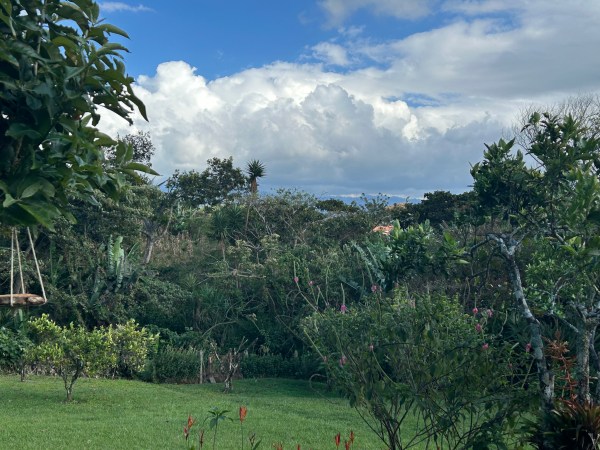
Palestine Tet – 89 – Yet another reason for Israel to agree to a permanent ceasefire …

January 27, 2024

Blood on their hands

1. According to the Israeli Broadcasting Corporation, half of the Israeli settlers who evacuated the northern settlements on the border with Lebanon are “suffering from post traumatic stress order” and “don’t want to return to their homes.”

2. PTSD, Depression, and Anxiety Nearly Doubles in Israel in Aftermath of Hamas Attack

3. With the International Court of Justice upholding S. Africa’s charge that Israel is committing genocide in Gaza, Israeli public relations most especially in the Global South – which is the overwhelming majority of the world’s population – is shattered that much further.

A permanent ceasefire would at least show a willingness for Israel to begin to address these charges.

4. A permanent ceasefire would open up the Red Sea again for Israeli trade.

5. This just came my way – “Top Ten Reasons Israel Should Be Very Nervous“.