
Skip to content

Palestine Tet – 88 – How Gaza is impacting the Great Power standoff

January 26, 2024

________________________________

_____________________________

The coalition proved shaky from the get-go, with only the US and Britain actively involved in military strikes on Yemen. The reluctance of key European countries France, Spain, and Italy to join the naval alliance indicated a growing skepticism among the US’s traditional partners — both western and West Asian — about Washington’s commitment and capability to defend its allies in any impactful way.

Interestingly, more than eight further countries reportedly joined the coalition, but demanded anonymity, given the potential political fallout from associating with Washington and Tel Aviv.

_____________________________

How Gaza is impacting the Great Power standoff

While China-led multipolarity has accelerated the decline of the American era, the war in Gaza may end it altogether.

What is unfolding today in West Asia — the Gaza war and its regional expansion — cannot be viewed separately from the international transformations that have grown in momentum over the past few years. Today, the transition to multipolarity is the underlying factor shaping the decisions and policies of most countries, particularly those of the great powers.

The timing of Israel’s devastating military assault on Gaza coincides with heightened US attention on its great power competition for Washington, this conflict has much wider geopolitical significance beyond West Asia. In this context, the US has assumed, and will continue to play, a pivotal role in Gaza and its environs, unlike its powerful peers in China and Russia.

According to statistics published by the China Society for Human Rights Studies, the US initiated 201 of the 248 armed conflicts that took place since the end of World War II, often engaging in these wars via US-led alliances and/or proxies.

The most prominent wars led or supported by the United States in West Asia since 1990

For decades, Washington has led these conflicts by very ably forming, then leading, and directing broad alliances to achieve its political and military objectives. But that ability notably shifted in December 2023, signaling a sharp decline in this capability.

In response to Yemen’s Ansarallah-aligned armed forces’ Red Sea blockade of Israeli-linked vessels, the US Department of Defense announced the formation of “Operation Guardian of Prosperity … to uphold the foundational principle of freedom of navigation” in those waters, initially consisting of a coalition of ten countries, most of them insignificant partners.

Protecting Israel or maintaining maritime dominance?

The coalition proved shaky from the get-go, with only the US and Britain actively involved in military strikes on Yemen. The reluctance of key European countries France, Spain, and Italy to join the naval alliance indicated a growing skepticism among the US’s traditional partners — both western and West Asian — about Washington’s commitment and capability to defend its allies in any impactful way.

Interestingly, more than eight further countries reportedly joined the coalition, but demanded anonymity, given the potential political fallout from associating with Washington and Tel Aviv.

Crucially, the Pentagon’s stated purpose of securing navigation in the Red Sea does not align with the actual threat presented, revealing ulterior motives behind US actions. The Yemenis have repeatedly confirmed that they only intend to inhibit the passage of Israeli-owned or destined vessels — and that all other ships are free to pass.

In short, the US/UK-led coalition is acting as a naval arm for Israeli military forces, seeking specifically to ensure unimpeded access for ships heading to Israeli ports via the Bab al-Mandab Strait. That’s not a position many other states will get behind if they want to maintain freedom of transport for their own shipping vessels.

Ultimately, the American show of force in these waterways seeks to consolidate US naval dominance, which war-torn Yemen, West Asia’s poorest country, has contested.

As outlined in the National Security Strategy for 2022:

The US “will not allow foreign or regional powers to jeopardize freedom of navigation through the Middle East’s (West Asia) waterways, including the Strait of Hormuz and the Bab al Mandab, nor tolerate efforts by any country to dominate another — or the region — through military buildups, incursions, or threats.”

According to media reports following massive US airstrikes against Iraqi targets on 23 January, Iraqi resistance factions will now also follow Yemen’s suit by implementing a blockade of Israeli ports in the Mediterranean Sea.

Current events are spiraling out of Washington’s control as onlookers increasingly question the utility and competence of US naval leadership in the world’s important waterways. Equally, there is recognition that other formidable forces and states have emerged, challenging US control over key global straits. In the words of British politician and writer Walter Raleigh, “Who rules the seas rules the world.” Under Sanaa’s watch, the US no longer can claim rule over the Red Sea or even its adjacent waterways.

Great power competition amid the Gaza war 

The current scenario in West Asia, particularly post-Al-Aqsa Flood and the Gaza war that followed, coincides with a shift in Washington’s focus toward competition with China and its proxy war against Russia in Ukraine. As outlined in the US intelligence community’s annual threat assessment last year, this transition has already affected strategic goals, leading to a sharp decline in western support, especially from the US, for Ukraine. The Biden administration faced challenges in securing Congressional approval for a new aid package for Kiev, which directly competed for dollars against Tel Aviv’s military campaign in Gaza.

Aid paid to Ukraine in 2023 under presidential withdrawal powers

Despite assurances from western leaders during visits to Ukraine in October, their statements came without tangible material support, leaving President Volodymyr Zelensky in the proverbial dust. Quite unexpectedly, China has emerged as a potential peacemaker in this European conflict, with Kiev openly requesting Beijing’s involvement in mediation talks, and the US itself open to Chinese mediation to mitigate the escalation in West Asia.

The Chinese are well aware that there are no simple, face-saving exits for the US from the Gaza war it has championed and that the conflict’s metamorphosis into a regional one mires the US deeper into West Asia — and away from the Asia-Pacific.

Although China seeks to increase its presence in West Asia, it is very careful not to bog itself down in the region’s many issues. But Washington’s request that Beijing use its influence to sway Iran from conflict escalation makes clear that the US is no longer “the biggest power” in the region.

Why Israel opposes multipolarity

Following Operation Al-Aqsa Flood, US financial and military support for Israel has reached a critical stage, presenting two options for Washington. The first involves imposing some control on Israeli actions, given that the war’s timing has been unfavorable to US strategic interests, particularly in a critical election year. The second option, favored by the Washington elite, is to continue its unwavering support to Tel Aviv, even at the risk of damage to its global image.

Sustained global outrage over the Gaza war, coupled with the landmark genocide case filed against Israel at the International Court of Justice (ICJ), shows that Washington’s ability to cover for Israel is diminishing rapidly. Again, this reflects the global shift in the balance of power toward multipolarity, which is marked by the widespread decline of American influence.

But the US support for the Gaza genocide has had dramatic domestic repercussions, too. Polls show a major shift in the attitudes of young Americans, especially university youth, who will make up the ranks of America’s future leaders.

A Harvard-Harris poll published on 17 January reveals that 46 percent of respondents aged 18-24 believe that Hamas’ actions on 7 October can be justified because of the injustice to which the Palestinians are subjected.  The same poll shows that 43 percent of the same group support Hamas in this war, and that 57 percent believe that Israel is carrying out massacres in Gaza. The most staggering poll result of all, though, has to be the one in December (conducted by the same pollsters) in which 51 percent of young Americans believe a final solution to the Israeli-Palestinian conflict is for Israel to end and be given to Hamas and the Palestinians.

While Israel remains a direct US interest in West Asia, Washington’s commitment to Tel Aviv’s security has already become a growing burden and increasingly difficult to justify. As the region’s Axis of Resistance expands its battle with Israel on new, multiple frontlines, the US will need to reallocate ever-expanding resources and focus on matching its international rivals in further-flung geographies.

Ukraine was a test run compared to this Gaza war and the immense, direct toll it is taking on US alliances, domestic politics, and the American image globally. For Israel, this presents an existential crisis beyond measure, as Washington is forced to compete with other great powers, none of whom are ideologically driven to support Zionism as part of their foreign policies.

New Tensions in the Horn of Africa and the Red Sea – Is a region so rich in potential about to implode? A Series. Part One: Yemen and the Horn of Africa in two parts.

January 25, 2024

_____________________

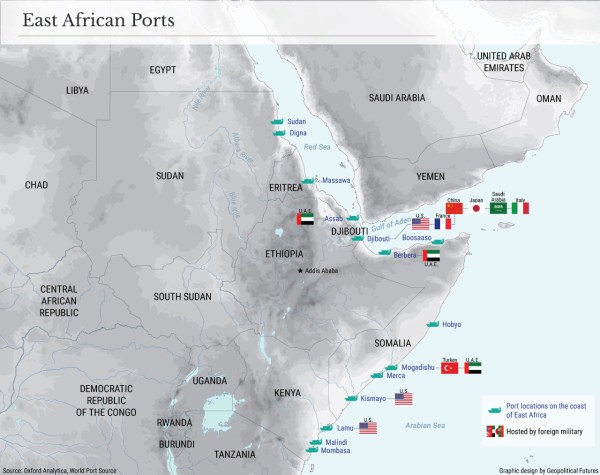
The Horn of Africa, where the Red Sea descending south from the Suez Canal meets the Gulf of Aden and the Indian Ocean. As the map above suggests, a region filled with foreign military bases, American, French Italian, Chinese, U.A.E. Saudi and who knows which other countries!

The Horn is usually defined as including Eritrea, Ethiopia, Djibouti and Somalia. Yemen sits just across the Red Sea and Bab el Mandeb Strait from the Horn; although part and parcel of the Arabian Peninsula, its proximity to the Horn has resulted ins vibrant economic, social and cultural exchanges.

The whole region is populated by 140.6 million people. The two main macro groups in the Horn are the Cushitic-speaking Cushitic peoples traditionally centered in the lowlands and the Ethio Semitic-speaking Ethiopian Highlanders and Eritrean Highlanders centered in the highlands. It contains such diverse areas as the highlands of the Ethiopian Plateau, the Ogaden desert, and the Eritrean and Somalian coasts and is home to the Amhara, Tigray, Oromo, and Somali peoples, among others.

Given the strategic importance of Yemen, it current role as a part of the Axis of Resistance that brings together Iran, forces in Iraq, the Syrian government, Hezbollah in Lebanon and Hamas in Gaza, I want to start this series with a piece on Yemen. Although Yemen is not on the Horn itself, there is what can be considered a “Red Sea-Gulf of Aden Culture” which has existed for millenia. Developments in Yemen affect the Horn and visa versa. From the viewpoint of global geopolitics it is a focal point of merging and conflicting interests as a result of its strategic location for maritime trade between East Asia, India, the Persian Gulf, East Africa and the Eastern Mediterranean. the Bab El Mandeb Straits has long been a strategic chokepoint for global trade.  I’ll discuss some of the socio-cultural interactions between Yemen and

From the outset I want to acknowledge that while I am familiar with both Yemen and the politics of the Horn of Africa in General, that a two part video series (Part One, Part Two) done by Eritrean journalist Elias Amare and Ethiopian-Somali scholar/diplomat Mohammed Hassan is what has stimulated this series. That plus my growing discomfort at the prospect of a regional implosion as new tensions rise between Ethiopia and Somalia over Somaliland, the increasingly dangerous situation within Ethiopia itself which could easily explode into civil war, from which the whole region could implode, an occurrence which could destabilize all of Africa … and beyond. There are some voices, among them, Professor Mohammed Hassan, who argue that an implosion of Ethiopia could lead to Rwanda-sized genocides.

How to prevent such dark scenarios? What is Washington – be it either Democratic or Republican Administration – doing to either exacerbate or calm the situation?

The Yemeni Factor – Plan B

Afghanistan has been called the “graveyard of empires.” Yemen can also be considered the same.

The Ansar Allah movement in Yemen, controlling 80% of that Arabian Peninsula country,

Yemen’s – that of Ansar Allah, commonly referred to as “the Houthis” – entry into the fray has had an electrifying impact on the wars in the Middle East. Just after the Palestinian “October 7 surprise”, the country mobilized – literally – a million men to go to Gaza to fight alongside Hamas and the other Palestinian resistance groups. How they would get there was problematic as this enormous army would have had to march across Saudi Arabia, a snippet of Jordan, enter Israel and proceed to Gaza. Saudi rejection of safe passage nicked the plan.

Undeterred, Yemen embarked upon “Plan B” to show it solidarity with Gaza.

As Max Blumenthal (the GrayZone) succinctly put it:

“The Ansar Allah movement controls the majority of Yemen after fending off a brutal U.S. and U.K. backed military campaign led by Saudi Arabia. After Israel began its bloodstained assault on the besieged Gaza Strip this October, Ansar Allah, known popularly as the Houthis, enacted a naval blockade targeting Israeli-linked shipping in the Red Sea as a means of putting pressure on Israel to end its attack on Gaza.

The Biden Administration responded with attacks of its own. striking targets across Yemen”

The Yemeni attack on Red Seas shipping has shaken the region and the world, and thrown a monkey wrench into global container trade in a number of ways. The volume going to Europe through Bab El Mandeb, the Red Sea and Suez Canal has nearly halved amidst continuing attacks by Ansar Allah rebels. For the European economy, already skirting a mild recession as it tries to shake off high inflation, prolonged trade disruption could derail plans by central banks to start cutting interest rates this year.

The Israeli port city of Eilat which sits at the top of the Gulf of Aqaba, a major Israeli destination of Red Sea container ship trade, is largely closed down, its businesses and economies suffering. While container shipping has led the way in veering away from the Suez, as highlighted in the most recent weekly market report from Alphaliner, other sectors including LNG, oil and dry bulk are following suit.

Multiple oil companies such as Shell, ADNOC and Reliance Industries have this week joined BP in suspending their sailings through the Red Sea.

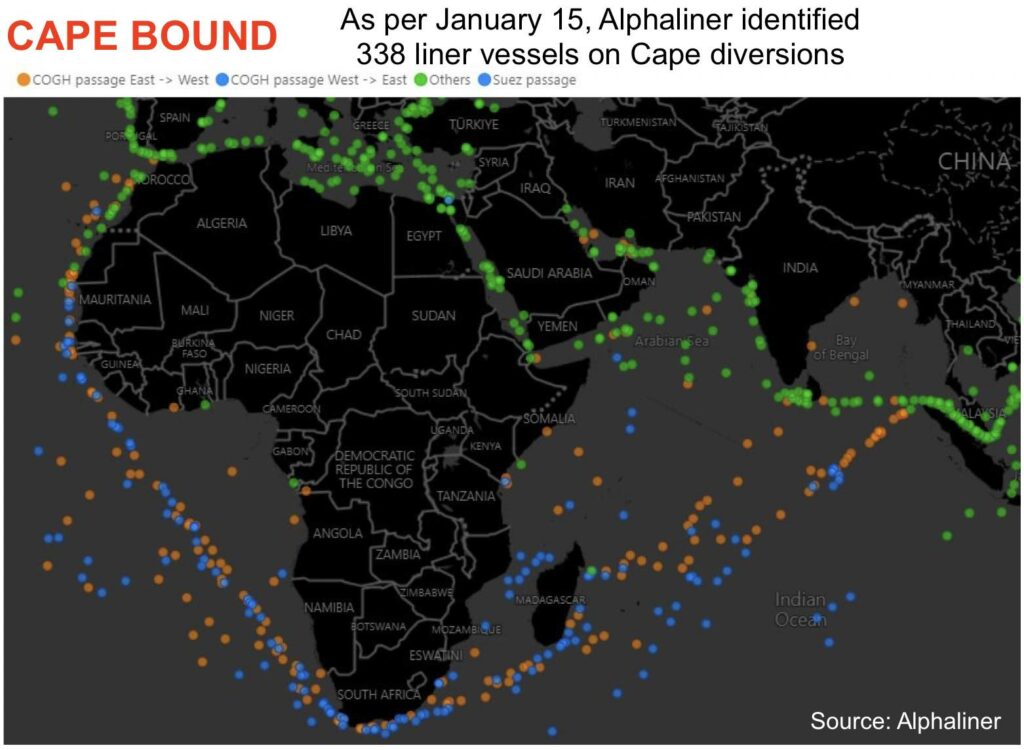
Attempts to compensate for the Red Sea blockade of Israel-bond ships have not amounted to much. There is an Israeli plan to bypass Red Sea maritime trade by setting up an overland trucking connection through Saudi Arabia and Jordan to Israel. Besides adding a great deal to the cost of the shipped goods as a result of fuel and other transport costs, at least to date, the system has not worked. While rerouting Red Sea bond containers around Africa’s Cape of Good Hope has picked up, many of the ports along the route, necessary for restocking, repairs and the like, are unequipped to handle such large ships, some of which hold 30,000 or more containers. Shipping insurance costs have spiked as well. Combined all these factors with fuel global inflation some.

It should be recalled that Yemen is among the world’s poorest, if not the poorest, countries. Not only is this “David” standing up to Washington and London “Goliaths”, but poor, bombed out Yemen appears to be undaunted, completely fearless in the face of the West’s current bombing campaign. Ansah Allah’s response to the U.S. State Department declaring Ansah Allah as a terrorist organization, Yemen’s Ansar Allah parliament has indicted both the United States and the United Kingdom as “global terrorist networks“.

Besides embarrassing if not humiliating both the U.S. and U.K. for their inability to intimidate or threaten the Global South’s creative version of slapping sanctions on the world’s great powers, Ansar Allah’s Israel-bond shipping blockade has electrified the Arab and Muslim world. In the Arab World, the broader Islamic World, indeed pretty much the whole Global South, respect for Yemen is soaring. Arab leaders, rather timid and even frightened to stand up to Israel in solidarity with the Palestinians, are extremely nervous that the pervasive anger mounting over Israel’s Gaza suicide, fear popular rebellions from below.

Yemen and the Horn of Africa – Millenia of friendship, cross fertilization

Civilized life in Yemen stretches way back before the time of Christ. It has had a number of civilizations over the centuries. Its civilization has had an impact on the nearby Horn of Africa. The alphabet now used in Ethiopia and Eritrea come from Yemen. They have practiced farming since time immemorial. The early Yemenis developed new irrigation techniques that have been introduced as far east and Indonesia and China. Master stone workers, their stone work is reflected in their unique architecture which is famous worldwide.

In ancient times, a sizable percentage of the population there was Jewish. Later on Islam was introduced. Tthe idea of “a nation” is a modern concept and new development but Yemenis also ruled by different rulers, different groups like the Hadramut, a big part of southern Yemen; then there is the center of southern Yemen, the middle of the country the Tais area – it’s also a mountainous area. There is also the area of Sana’a-to Sa’ada. This is the Zaidi region in the north. After they left Saudi Arabia the Zaidis made their home in Yemen; Imam Zaid is the third Imam of the Shi’a. But it is the Zaidis who have created a sort of system that has kept colonialism, imperialism and even other hegemonic forces at bay

Although Yemeni society exists within a specific geographical framework, they have been traders and travelers whose influence extended far east to India, China, Indonesia all of which established  stable Yemeni communities. Yemeni Americans are Americans of Yemeni ancestry. According to an estimate in 2010, more than 100,000 Yemenis live in the United States. Many were recruited by Henry Ford early in the 20th Century to work in the Detroit area auto plants.

Yemenis expanded far throughout Africa , to Asia

Another character of the Yemenis – because of their capacity as traders, merchants is they have expanded to Indonesia. There is a huge community of Yemeni origin in Indonesia; they are also in Malaysia for example; the family of the ideologue of the ruling Malaysian party comes from Yemen. His name is Abdullah.

Because of their location, slowly, slowly the people of Yemen have become closer to the people f the Horn of Africa – Eritrea, Ethiopia, Somalia. There are organic linkages of the Horn of Africa to the Gulf of Arabia historically as well as in modern times. In many ways, the Yemenis have become close to the people of the Horn of Africa over the centuries:

  • A lot of Yemenis came, settled in Eritrea, created their own communities there; they brought their food habits to the region.
  • Later, by allying with Italian fascists, Northern Yemen brought a lot of workers to build the road between Asmara and Addis Ababa
  • Yemenis also are those who introduced markets everywhere in Ethiopia. They are merchants all over Ethiopia, south, east and west.
  • Yemenis also were used by the British, they were paid in the British conquest of Southern Somalia that was conquered by Yemeni soldiers.

Another character of the Yemenis – because of their capacity as traders, merchants is they have expanded to Indonesia. There is a huge community of Yemeni origin in Indonesia; they are also in Malaysia for example; the family of the ideologue of the ruling Malaysian party comes from Yemen. His name is Abdullah.

So you could see that the Yemenis expanded far throughout Africa , to Asia.

There has long been a certain dichotomy between the inland and more northern Yemenis from those living along the coast of the Gulf of Aden and the Red Sea.  With the coming of Imperialism and British control of Aden and gradually expanding and controlling other tribal areas, they created a region that became known as South Yemen, made up of the Hadramawt and other southern provinces. British control did not extend to the north which remained in the hands of the imamate but imperialist interferences happened now and then but the imamates kept their independence; to a certain extent they did not allow others to colonize them.

The only Western or other European power could successfully penetrate and create alliances with the imamate was Fascist Italy of Mussolini. Mussolini had the idea to create an empire, including Yemen and the Red Sea; He had his own mini program to create that. He created a cordial relationship with Yemen. Gradually Italy helped the Northern Yemeni army modernize – the modernization was started by the fascist state.

Italian fascists never controlled northern Yemen; but they were present there.

Returning to the main trajectory of modern Yemeni history, it could be said that the transformation in Aden into a major British port speeded processes of modernization along the coastal areas; it brought foreign workers, foreign elements, the good number of whom were Somalis and Indians, the gradual expansion of British colonialism to bring other tribal groups under its control, all this led to tighter British control over Aden and its surroundings.

At one time Aden became the most important harbor and economic hub in the region. It is where people from all over the Horn and Red Sea area people shopping there. This was just prior to independence and the creation of South Yemen. Its influence was regional; new dress for women was introduced in Somalia; new Somali music came into being. The best musicians, oud players in Yemen (introduced from India) gradually was integrated into Somali music. Some of the best Somali musicians from the last century were born and grew up in Yemen.

The second biggest community in Aden were Somali speakers, another Yemeni-Horn of Africa cross fertilization. The more modern thinking which developed in the Aden area of Yemen was also transferred to Somalia.

Turning to more modern Yemen … First let’s concentrate on the North and then on the South.

North Yemen and Saudi Arabia in the 1960s

In the 1960s the Egyptian leader Gamal Abdul Nasser intervened on the side of the Republicans to help them in the fight against the royalists (those allied with Saudi Arabia). Just before he died, in 1969, Nasser was said to have repeatedly noted that one of his worst mistakes was the Yemen intervention because the Yemenis were such fierce opponents. The Egyptians lost 9000 soldiers and Nasser was very unhappy about that and the Saudis subsidized the money, brought mercenaries and weapons but they could not overthrow the republican government.

In the North, progressive officers, influenced by Nasser, came to power, overthrew the imamates and came to control state power. This resulted in external intervention. This new thinking not only effected Yemen. It also spilled over into Saudi Arabia. Young members of the royal family defected to Cairo; pilots also defected. So this concept of modern thinking was established and was also penetrating Saudi Arabia.

This placed the House of Saud in danger.

After the U.S. led oil industry was built in Saudi, the Saudi working class grew; U.S. specialists were working in the industry; a trade union consciousness developed; and soon, as trade unions are wont to do… in short order they began to strike for better wages, working conditions. King Faisal wanted to roll back what was happening in Yemen. The “nationalist virus” was coming too near and infecting Saudi Arabia itself.

Egypt’s intervention in Yemen came once Saudi Arabia decided to roll back the republican government and intervened in support of the imamates. The imamates fled to Saada; they went to Saudi Arabia as well. King Faisal of Saudi Arabia thought that “this virus” has to be stopped because there can be spill-over damage and will result in a similar situation in our country.

Pan Arabism frightened the House of Saud. Modernism, trade unions, republicanism and such, it threatened the Saudi royal family; they feared being overthrown because they had seen that King Farouk of Egypt had been overthrown by Nasser; they saw that the Iraqi monarch was similarly overthrown; same in Syria. Thinking that they were encircled by these “republican ideas”

Modernism, trade unions, republicanism and such, it threatened the Saudi royal family; they feared being overthrown because they had seen that King Farouk of Egypt had been overthrown by Nasser; they saw that the Iraqi monarch was similarly overthrown; same in Syria. Thinking that they were encircled by these “republican ideas” Saudi Arabia intervened. Egypt’s intervention in Yemen came once Saudi Arabia decided to roll back the republican government and intervened in support of the imamates.  The imamates fled to Saada; they went to Saudi Arabia as well. King Faisal of Saudi Arabia thought that “this virus” has to be stopped because there can be spill-over damage and will result in a similar situation in our country.

King Faisal’s brother-in-law, the one heading up the intelligence service, was a sophisticated and farsignted man for his time. He’s of Albanian origin; his sister is married to King Faisal. This is the man who said that to “stop this virus of Republicanism” there is only one solution: Saudi Arabia should not have a modern working class. He considered “a modern working class by itself is a virus.”

It means trade unions; from there will come patriotism. Demands will increase – democratization issues will come; republicanism will come and the monarchy will disintegration. So he said, we should not create a Saudi working class!

That was a very farsighted decision. From that day onward, Saudi Arabia decided not to have a working class except for guest workers.

The Egyptians lost 9000 soldiers and Nasser was very unhappy about that and the Saudis subsidized the money, brought mercenaries and weapons but they could not overthrow the republican government but it (the Saudis) had weakened it. Finally a compromise solution was put together. Saleh, the Republican leader had to resign and a milder, more centrist leader Mohammed al Iriani took over

The relationship between Saudi Arabia and Yemen, especially N. Yemen improved and became smoother. Saudi Arabia also made certain concessions to the Yemenis. Yemeni workers were permitted to enter Saudi Arabia; a special type of work permit was created for Yemeni workers – a residence permit. It gives Yemenis certain liberty of action; they are not controlled by Saudi contractors. They have the right to do business; they have the right to work. A considerable number of working class Yemenis thus went to Saudi Arabia.

South Yemen Emerges as a major link on global maritime networks 

In S. Yemen, the situation was totally different.

First of all because Aden is a cosmopolitan center; a good number of Yemenis from the South had also studied outside the country and gotten western educations. Some of the same kind of political movements that existed in the north, – anti-colonial, progressive nationalist movements, also developed in the south.

These movements took up arms against the British colonial system, To neutralize the growing revolt, the British sent a special advisor  to S. Yemen to study the independence movement, counter insurgency expert, Edward Kennedy Trevaskis. Trevaskis had had experience both in Rhodesia and Eritrea.

Elias Amare: Yes and he was knighted and became Sir Edward Kennedy Trevaskis. He wrote a book about Eritrea “A Colony in Transition” , pubished in 1960. In fact, Trevaskis is the “father of the Gulf countries. He’s the one who created the Gulf countries. He also wanted to change S. Yemen – minus Aden – and other Gulf states, appointing clan leaders to be autonomous but the struggle in Yemen intensified; it matured, it brought together a united front of forces – Nasserite forces, Baathist forces from Libya, Syria and Iraq.

A member of the politburo of the Indonesian Communist Party, of Yemeni origin from Hadramawt  came and influenced the national movement and brought Socialism and the idea of Marxism-Leninism by a Yemeni-Indonesian.

1970 was the year that British colonialism in Yemen ended; a new post-colonial socialist country, the People’s Democratic Republic of Yemen as it was called – the PDRY – came into being. A year later, a Socialist Party came to power and became the ruling party. But in the Socialist Party there were different forces contending with one another – the two Baathist parties – the Iraq and Syrian Baathists, Nasserites and also Communists which is Abdul Fattah Ismael. So within the leadership there were contradictions.

The first contradiction – the Iraqi Baathists revolted against the Party and they were crushed. The internal struggles in the PDRY among the ruling elite devastated the party and soon the Socialist Party was overthrown its leadership purged. What is somewhat ironic is that the program of the Socialist Party in the South was essentially the same as the program of the parties ruling the North. Both believed in the unity of Yemen; that unity which is sacred for both the North and the South.

Then in 1979 a young officer, Ali Abdullah Saleh took over the reigns of power in Sana’a and brought about the reunification of the country. Yemen became unified.

In 1990 the war against Iraq started. Yemen paid a very big price for refusing to support the U.S. led invasion. The U.S. cut aid and IMF/World Bank support This is the beginning of the modern Yemeni crisis.  Because of its position in the UN Security Council a huge number of workers, who worked in Saudi Arabia were expelled to Yemen; Yemeni currency weakened; inflation increased.

There was a second element to the Yemeni crisis. The right wing of the S. Yemenis in 1993 unilaterally decided to succeed but  this movement was crushed by all other Yemeni forces including Ali Abdullah Saleh. That was his great success; it boosted his prestige … as well as his ego.

Despite the continuing economic crisis Ali Abdul Saleh joined “the war against terrorism” after September 11, 2003. This resulted in his becoming an ally of both the United States and Great Britain. The latter used a lot of drones to kill different Yemeni personalities. The killing increased; the opposition to Yemen’s alliance with Washington and London increased, leading to a popular revolt. It started from Saada to Sana’a; shortly thereafter it spread nationwide. Ali Abdullah Saleh was overthrown; he turned power over to his vice president, Abdrabbuh Mansur Hadi of united Yemen but the popular revolt undercut Saleh-Hadi’s mass base. Yemen could not be controlled.

The popular revolt started from the North among  “the Houthis”. Where does this name, “the Houthis”, come from? They don’t call themselves “Houthi”; they call themselves Ansar Allah. “Houthi” is the name of the leader who marched from Sa’ada to Sana’a and later on he was killed.

To be continued in Part Two

New Tensions in the Horn of Africa and the Red Sea – Is a region so rich in potential about to implode? A Series. Part Two: Yemen and the Horn of Africa in two parts.

January 25, 2024

There were some estimates that some 2-3 million Yemenis attended this January 19, 2024 demonstration

________________________________________

Grayzone interviews Ansar Allah (Houthi) represenative

________________________________________

“The Americans and British must understand that our people do not know what it means to surrender.”

                                                             Yemeni Houthi Official Statement

________________________________________

1.

The United States and Great Britain have now launched nine missile attacks against Yemen in an effort to get Sana’a to stop targeting Israel bond container and other ships heading for Israel. Ansar Allah – the more formal name for the group referred to as “the Houthis”, has repeatedly stated that when the Israeli bombing of Gaza stops and Israeli troops have withdrawn, that they will end their missile campaign.

Houthi missile attacks have resumed within 24 hours of each attack suggesting the degree to which they have been ineffective militarily. The Yemenis are using mobile missiles that are easily moved to safe places to avoid destruction. Not that it seems to matter, as neither Congress nor the main stream media in the United States seem to mind, but bombing Yemen without Congressional approval is illegal by U.S. law. Very few members of Congress have done anything to call the Biden Administration to task as of yet.

The U.S. bombing campaign has done nothing to stop Yemenis from targeting Israel-bond ships. Indeed, in response to U.S./U.K threats and missile attacks, the Yemenis have promised to step up their attacks and target not only the area of the Red Sea and Gulf of Aden surrounding the Bab El Mandeb Strait but that now they will target the same kind of ships transiting the Suez Canal and the Gulf of Hormuz!

At about the same time the Yemen’s Parliament in Sana’a declared the US and UK governments “Global Terrorist Networks.”

With a single move, the Yemeni resistance seized the strategic advantage by de facto controlling a key geoeconomic bottleneck: the Bab el-Mandeb. Hence, they can inflict serious trouble on sectors of global supply chains, trade, and finance

As one commentator noted about the Yemenis a few days ago: “They are afraid of nothing. If they manage (the Houthis) to impose “the triangle” (targets at Suez, Bab El Mandeb and Hormuz make for a sort of triangle) that would be General Soliemani’s Grand Design on cosmic steroids.” This spoke Brazilian author, commentator and extraordinary traveler, Pepe Escobar, our modern day Ibn Batuta.

Reinforcing this view, a Yemeni Houthi Official Statement noted:

“The US-British attack is a new attempt to dissuade Yemen from supporting Gaza and ending its naval operations, which has failed. We will continue our military operations against the Zionist enemy no matter how aggressively they might bombard Yemen. Our strikes will go on as long (Israeli) atrocities and genocide in Gaza persist. US-British aggression strengthens the resolve of the Yemeni people to resist.

The Americans and British must understand that our people do not know what it means to surrender.”

2.

Once again the kind of news one rarely sees in the mainstream media here in the USA.

An article in the Arabic post, from Rai El Youm today January 25, a news service speaks of a delegation of Ansar Allah members in Moscow discussing how to “intensify efforts to pressure” the United States and Israel to stop the Gaza war. A statement was issued condemning the American and British strikes on Yemen.

A delegation from the “Ansar Allah” group discusses in Moscow “intensifying efforts to pressure” the United States and Israel to stop the Gaza war and condemn the American and British strikes on Yemen.

Sanaa – (AFP) – A delegation from the Yemeni “Ansar Allah” group discussed Thursday, during a rarely announced visit to Moscow with Russian Deputy Foreign Minister Mikhail Bogdanov, “the need to intensify efforts to pressure” the United States and Israel to stop the war in the Gaza Strip. According to what a Yemeni spokesman announced.

The official spokesman for the “Ansar Allah” group, Muhammad Abdel Salam, wrote on the “X” platform that he, at the head of a Yemeni delegation, met Thursday afternoon in Moscow with Bogdanov, who is also the special representative of the Russian President for Middle East and African affairs, and the two sides discussed “the necessity of intensifying international efforts to put pressure on America and Israel.” To stop the war in Gaza that has been ongoing between Hamas and the Hebrew countries since October 7.

Abdel Salam pointed out that the meeting discussed the American and British strikes against the Houthis, and that it was emphasized that “America is first to stop the aggression against the Gaza Strip and bring humanitarian aid into it, not to go towards militarizing the Red Sea.”

This comes in the midst of tensions in the Red Sea region, where, for two months, the Yemenis have been carrying out attacks on commercial ships that they say are linked to Israel in support of the Palestinians in Gaza, while the United States, with the participation of Britain sometimes, is trying to deter them by launching strikes on their military sites. The Yemenis respond by targeting the ships of these two countries.

For its part, the Russian Foreign Ministry confirmed in a statement published by Russian news agencies that during the meeting with the Houthis, “the strikes… launched by the United States and Britain on Yemen, which could lead to destabilizing the situation on a regional scale, were strongly condemned.”

In a separate context, the meeting touched on the negotiations that have been ongoing intermittently for months between the Ansar Allah group and Saudi Arabia to put the war in Yemen on the path to a solution.

The conflict broke out in Yemen in 2014, with the Houthis taking control of vast areas in the north of the country, including the capital, Sanaa. The following year, Saudi Arabia intervened at the head of a military coalition in support of the Yemeni government, exacerbating the conflict that left hundreds of thousands dead. The intensity of fighting has decreased significantly since the announcement of a truce in April 2022, although its effects ended after six months.

Abdul Salam said, “The latest developments in negotiation and discussion with the Kingdom of Saudi Arabia were reviewed, mediated by the sister Sultanate of Oman, regarding developments in the Yemeni political process.”

For its part, the Russian Foreign Ministry noted that “the importance of intensifying international efforts to quickly create the necessary conditions to establish a full Yemeni national dialogue under the auspices of the United Nations was emphasized.”

Late last year, the Special Envoy of the UN Secretary-General to Yemen, Hans Grundberg, announced that both parties to the conflict in Yemen had committed to engaging in a UN-led peace process as part of a road map to end the war.

3.

As of today (January 25, 2024) the United States and Great Britain have launched 9 attacks consisting altogether of more than 100 missile on Yemen. To date it has had virtually no impact whatsoever on the Yemeni campaign targeting Israel-bond ships passing through the Red Sea.

As Tony Shaffer a former Department of Defense Intelligence officer (wearing a nostalgic “Reagan for President” t-shirt in an interview with Judge Napolitano noted, that by attacking the Houthis the Biden Administration gives the appearance of progress even if they accomplished nothing militarily. Referring condescendingly to the missile attacks as “military virtue signaling” Shaffer went on to argue that they were more about “narrative management” of what the Administration wants Americans to believe rather than “inconvenient facts”.

With 12% of global shipping passing through the Red Sea cut in half within less than a month both Washington and London were pressured to “do something” to suggest they still are in control of the situation – which they aren’t.

Shaffer is right about the uselessness of the U.S. bombing campaign against Ansar Allah in Yemen. But as he develops his argument, claiming he’s against going to war against Iran, (at least not now?) he is for finding ways to pressure Iran … ie, pressuring Iran will bring Ansar Allah back in line. Two quick points: 1. the other way to end the bombing of Israeli-bond ships through Bab El Mandeb, related as it is to Israel’s murderous campaign in Gaza, is to press Israel (and the Palestinians) to accept a serious ceasefire with teeth. 2. So Iran “controls” Ansar Allah? that makes me laugh and as a former Department of Defense analyst, I’m surprised he doesn’t know that – frankly I expect he does – he doesn’t discuss it publicly.

XXXXXXXXXXXXXXXXXXXXXXXXX

Palestine Tet – 87 – Israel’s targeting of thousands of displaced Gazans in Khan Yunis is further evidence of its genocide

January 25, 2024

_______________________________

The incident is happening right now. Hundreds of Zionists are trying to prevent humanitarian aid from entering Gaza at the Kerem Shalom border gate. Hundreds of Zionist Israelis blocking the humanitarian aid trucks to get inside Gaza.

Gaza Starving

_______________________________

Geneva – The Israeli army’s targeting of thousands of displaced people in the area of Al-Mawasi, west of Khan Yunis in the southern Gaza Strip—which was previously designated as a safe zone—constitutes a perpetuation of its ongoing genocide in the Strip, Euro-Med Human Rights Monitor said in a statement issued on Tuesday. The rights group said this targeting serves as further evidence of Israel’s attempt to implement its forced displacement plan and give the people of Gaza the impression that there is nowhere safe for them to live.

Israel had increased the scope of its military assault on Khan Yunis as of Saturday evening, 21 January, said Euro-Med Monitor. Israeli forces in the vicinity conducted numerous intense air raids described as “fire belts” to accompany its ground incursion, which has extended all the way to the west of the Khan Yunis refugee camp. Additionally, the Israeli military besieged shelter centres housing 10s of thousands of displaced people in the western part of Khan Yunis as well as in the area of Al-Mawasi, said Euro-Med Monitor.

The Euro-Med Monitor team documented the Israeli bombing of five shelter centres. The most notable of these are Al-Aqsa University, where five civilians, including two women and two children, were killed; University College, where one civilian was killed; Khalidiya School, where one girl was killed; and Al-Mawasi School, where several displaced people perished while thousands were trapped inside a United Nations industrial building. Many thousands of people in the region were forced to flee after being targeted by the Israeli forces during their evacuation, Euro-Med Monitor reported, with some heading towards Rafah and others towards Deir al-Balah.

Israeli tanks and boats fired dozens of artillery shells at the area of Al-Mawasi specifically, which was housing 10s of thousands of displaced people; this targeting led to a number of deaths and injuries. At least 70 civilians, including women and children, were killed as a result of Israel’s bombing of displaced people in the area as well as in the general vicinity of western Khan Yunis, according to Euro-Med Monitor. Some of them were transferred to Khan Yunis’ Nasser Hospital, while others were moved to Abu Youssef Al-Najjar Hospital in Rafah and Al-Aqsa Martyrs Hospital in Deir Al-Balah.

A woman told Euro-Med: “A shell fire fell on us, which led to a fire outbreak inside the tent,” said a woman who requested anonymity due to safety concerns. She told Euro-Med Monitor that her daughter had been next to her. “She was burned, along with my husband; we started running from the tent. I suffered from hand injuries and a finger fracture. I ran out with my daughter, who was also burned. I am in shock…I want to see my husband and my daughter.”

The Euro-Med Monitor team also received testimonies of Israeli field executions of three Palestinian men who were raising white flags while trying to reach their home. The men had been attempting to evacuate 50 family members who were trapped inside a house west of the Khan Yunis camp.

The Geneva-based organisation also pointed out that a new mass grave has been established inside the courtyard of Nasser Hospital to bury 40 dead bodies, as transferring them to an actual cemetery is impossible due to the heavy deployment of Israeli tanks.

Al-Mawasi, a small agricultural area on the coasts of Khan Yunis and Rafah, is home to hundreds of thousands of displaced people living in tents. The Israeli army initially directed residents to the area on 13 October 2023, claiming that it was a safe place. This claim was repeated in subsequent displacement orders dropped by Israeli aircraft on 2 November 2023 and 3 December 2023, stated Euro-Med Monitor.

As part of its ongoing attacks on Gazan hospitals, the Israeli army stormed Al-Khair Hospital, west of the Khan Yunis camp, and detained all of its medical staff, while imposing a complete siege on both the Nasser and Al-Amal hospitals.

The Palestinian Red Crescent Society (PRCS) has confirmed that artillery shelling by Israeli army forces has targeted its Khan Yunis headquarters, injuring internally displaced people who sought shelter in the building. The PRCS had earlier confirmed that Israeli tanks had moved into the vicinity of Al-Amal Hospital and that it completely lost contact with its crews in Khan Yunis due to Israel’s ongoing ground operation.

Euro-Med Monitor stressed that Israel’s deliberate military attacks against shelter centres for the displaced explicitly violate the law, especially international humanitarian law. These centres have been identified as safe places, and it is Israel’s responsibility to ensure they remain safe. The methods of carrying out these attacks violate the principle of discrimination and do not take into account the standards of proportionality and military necessity, given the high number of victims—the majority of whom are civilians, including women and children. In line with international humanitarian law and criminal law, these attacks amount to grave violations and war crimes, said the rights organisation.

As reported by Euro-Med Monitor, Israel is determined to carry out forcible transfers of civilians from the Gaza Strip outside the bounds of the law. More dangerously, the silence of many in the international community gives Israel permission to designate people who refuse to comply with the evacuation order as “terrorists”, bomb houses and other city structures at random, and conduct field raids to drive them from their homes and land.

Euro-Med Human Rights Monitor emphasised that the deliberate targeting of civilians is forbidden by the rules of war, and that forcing civilians to flee their homes is a serious violation that equates to a war crime and a crime against humanity.

Euro-Med Monitor called on the International Court of Justice to stop Israel’s genocide against the Palestinian people of the Gaza Strip and to shield them from further grave and irreversible harm.

Palestine Tet – 86 – Palestine Supporters Fill the Chambers of the Lakewood, Colorado City Council, calling for a ceasefire.

January 24, 2024

_____________________

I am aware of what I would call shallow, empty, cynical reasons the Biden Administration has given for not supporting a ceasefire. It needs to be kept in mind that through its close collaboration with the Netanyahu government in Israel, basically giving Israel a greenlight to pursue its genocide targeting and ethnic cleansing of Gaza’s 2.3 million Palestinians that the Biden Administration’s credibility in the Middle East and broader Global South has been shattered. Some within the Administration are admitting that it will take decades – if ever – for Washington to reestablish this lost trust.

_____________________

Chun’s Video on the meeting.

Spearheaded by the Colorado Palestine Coalition, the Colorado Palestine Club, Jewish Voice for Peace, If Not Now, and Alta Kockers for a Ceasefire (all two of us!!) hundreds of Colorado supporters of a ceasefire between Israel and Palestine swamped the Lakewood (Colorado) city council meeting last night (January 22, 2024).

I am increasinging impressed with what people can express, explain in the three minutes given to each person for public commentary. How many people of all ages, backgrounds political persuasion, many of them announcing that they were nervous as they had never spoken in public, came forth to condemn Israel’s ongoing genocide against Palestinians in Gaza, to call for a ceasefire and for cutting U.S. military aid to Israel.

I would say I’d never seen anything quite like this show of sympathy, solidarity with the Palestinian plight but that would not be accurate as Palestine supporters, spearheaded by an energized and highly organized Colorado Palestinian Community have packed the house in Denver, Boulder, Aurora, Colorado before tonight, all with the same message: stop the genocide, ceasefire now. Among those present last night was a considerable contingent of Jews, some from Lakewood, others from the Denver metropolitan area.

In such meetings where the council members themselves are silent listening to public comments, it’s difficult to read their faces. Are they interested, concerned. Are they even listening or just diddling on their cell phone phones. One did exactly that. Although I cannot prove it, my sense was that the Council was in its vast majority riveted by both the size of the pro-ceasefire/end-the-genocide contingent and deeply moved. Tears rolled down the cheeks of one. That was certain. We’ll see if our presence produces a yes vote on a ceasefire resolution in the near future.

Israel had one lone (obvious) supporter, the angry Zionist. Positioning himself in the front of the room as near to the video cameras as possible. He tried to compensate for his isolation by holding up three signs written on both sides. He did speak towards the end of the public commentary session, getting in his three minutes of commentary.  Arguing that the Israeli Defense Force is not committing a genocide in Gaza he then accused all those who spoke before him of anti-semitism and stormed out of the room. Interestingly enough, this same person – I should have gotten his name but forgot to –  showed up at a sit in for a ceasefire at the Boulder office of U.S. Congressman Joe Neguse several weeks ago. He tried to provoke demonstrators there but failed. His comments last night in Lakewood were, rather embarrassing for his cause. But then it’s a hard sell to try to justify genocide.

I did speak, trying to make the most of my three minutes by explaining who a ceasefire is in the interest of the Biden Administration (that needs it desperately), the Palestinians and even the Israelis. I spend a good bit of time trying to compress what I want to say, but inevitably, as I did last night then go “off script”. So below are the prepared remarks, some of which I did cover.

Rob Prince’s Remarks before the Lakewood (Colorado) City Council. January 22, 2024.

My name is Rob Prince, a retired Senior Lecturer of International Studies at the University of Denver’s Korbel School of International Relations.

I agree with both the genocide and ethnic cleansing charges S. Africa has presented to the International Court of Justice against Israel.

I am here among you today to support those residents of Lakewood, requesting the City Council to pass a resolution calling for a ceasefire between Israel and Hamas that would end the fighting going on in Gaza.

A ceasefire would help create the conditions for ceasefires in the West Bank and between Israel and Hezbollah in Lebanon

I am aware of what I would call shallow, empty, cynical reasons the Biden Administration has given for not supporting a ceasefire. It needs to be kept in mind that through its close collaboration with the Netanyahu government in Israel, basically giving Israel a greenlight to pursue its genocide targeting and ethnic cleansing of Gaza’s 2.3 million Palestinians that the Biden Administration’s credibility in the Middle East and broader Global South has been shattered. Some within the Administration are admitting that it will take decades – if ever – for Washington to reestablish this lost trust.

I cannot emphasize how important a ceasefire would be to ending the violence.

I only want to mention a few ways that a ceasefire would help to reduce tensions.

• It could end the conflict from metastasizing into a regional conflict, one that will certainly draw the United States more directly into a military quagmire.

• It will end the unspeakable suffering the Palestinian people have endured since October 7.
Already some 1.8 million Palestinians in Gaza have been displaced; the dangers of
starvation and disease are intensifying with no end in site. The number of dead,
overwhelmingly civilians, continues to rise

• There is no way to effectively provide aid to Gaza while the Israel bombing and ground offensive continues. Proving Gaza with band ads and medicine does not help while at the same time Israel continues dropping American made 2000 pound bombs on Gaza schools, hospitals, population centers.

A ceasefire also benefits Israel.

• At least 170,000 Israelis have been removed from Israeli areas near Gaza and from Israel’s northern regions near Southern Lebanon. These people are internal refugees, the cost of maintaining them continues to add up.

• It is virtually impossible for any prisoner exchange between Israel and Palestine to take place without a ceasefire – won’t happen.

• All indications are that while Israel has not suffered the kind of horrific casualties that the Gaza Palestinians have, that since October 7, Israel is a nation suffering from severe trauma and an identity crisis.

• Some reports are already suggesting that it will take the United States 20 years or more to begin to regain the trust and support it has lost throughout the world for giving Israel a greenlight in Gaza.

Another reason for a ceasefire.

Thank you.


Palestine Tet – 85 – On massive scale, Israel violates rules for protecting cultural heritage

January 23, 2024

______________________________

First Israel wanted to deport the Palestinians to Egypt’s desert, which was a no go. Then they tried asking Congo to take them. Looks like Congo refused so now they want to deport them on an artificial island  This is literally the stuff of mad dystopia movies.

Israeli Energy Minister Eli Cohen said during a meeting with his European counterparts that he presented the idea of ​​an artificial island that would be an alternative homeland for the Palestinians

______________________________


1. On massive scale, Israel violates rules for protecting cultural heritage

Geneva – Israel is conducting systematic military attacks against cultural sites and historical monuments as part of its ongoing genocide against Palestinians in the Gaza Strip, which began on 7 October 2023. This constitutes a serious violation of both international humanitarian and human rights law, particularly the Geneva Conventions and the International Hague Convention pertaining to the protection of cultural heritage, Euro-Med Human Rights Monitor said on Monday.

Euro-Med Monitor expressed deep concern over reports of the Israeli army seizing thousands of rare artefacts in the Gaza Strip, which may amount to a war crime according to the Rome Statute of the International Criminal Court. Israel’s army released footage on 17 January 2024 documenting its blowing up of Al-Israa University’s campus, located south of Gaza City, more than two months after occupying the university and using it as a military base, a centre for sniping civilians, and a temporary detention and investigation facility.

The destruction operation also included the headquarters of the National Museum, which was established by Al-Israa University years ago, the rights group confirmed. Regarded as the first of its kind in the Occupied Palestinian Territory, the museum contained over 3,000 rare artefacts; Al-Israa University said in a statement that Israeli army forces stole the artefacts before they blew up the building.

The destruction operation also included the headquarters of the National Museum, which was established by Al-Israa University years ago, the rights group confirmed. Regarded as the first of its kind in the Occupied Palestinian Territory, the museum contained over 3,000 rare artefacts; Al-Israa University said in a statement that Israeli army forces stole the artefacts before they blew up the building.

Eli Escusido, Director of the Israel Antiquities Authority, posted a video to his Instagram account showing Israeli army soldiers at a site in Gaza containing hundreds of Palestinian artefacts. The video was shared without any explanation of the artefacts’ fate, noted Euro-Med Monitor.

The Euro-Med Monitor team received reports early in November 2023 that the Israeli army had stolen all of the archaeological artefacts it excavated from the Tel Umm Amer site (or the Monastery of Saint Hilarion), which is thought to have been one of the oldest monasteries in Palestine.

Euro-Med Monitor affirmed that, in accordance with international law, the theft of antiquities constitutes a war crime. Article 4 of the 1954 Hague Convention for the Protection of Cultural Property in the Event of Armed Conflict and its First Protocol prohibit the seizure of antiquities during conflicts. The rights organisation added that illicit trafficking of cultural property, including antiquities, is prohibited by the 1970 UNESCO Convention on Measures to Prevent the Illegal Import, Export, and Transfer of Ownership of Cultural Property. Furthermore, as per Article 8 of the 1998 Rome Statute of the International Criminal Court—which highlights the safeguarding of cultural heritage and the criminal accountability of those who breach these regulations—the taking and demolishing of antiquities constitutes a war crime.

The Geneva-based organisation emphasised that Israel’s stealing archaeological artefacts from the territory it controls is theft of cultural property and a breach of international human rights law, as outlined in the Economic and Social Rights Convention and the Convention on Civil and Political Rights, both of which Israel is a party. Israel has been deliberately stealing artefacts from Gaza as part of its systematic targeting of archaeological, historical, and cultural sites and materials in the Strip since the start of its ongoing attacks, the rights group stressed, as part of a larger plan to destroy Palestinian national and cultural identity and pride, erase the historical connection of Gazans to their land, and destroy any evidence of their presence.

Euro-Med Monitor drew attention to Israel’s clear intentional targeting of all historical structures in the Gaza Strip, including homes, churches, mosques, shrines, and archaeological sites, in addition to cultural institutions such as public libraries and monuments, theatres, publishing and printing houses, museums, and public squares. The Euro-Med Monitor team pointed to at least 10 mosques, 12 museums, and nine archaeological sites, as well as historical and archaeological churches and roughly 200 old historical buildings—mansions, castles, and palaces—as examples of sites damaged by Israel’s current bombing and destruction campaign.

This type of destruction indicates that Israel has implemented a broad and general policy to target all significant markers of Palestinian cultural, historical, and religious presence in the Gaza Strip, Euro-Med Monitor reiterated, citing the Israeli army’s targeting of memorials, gardens, and even artistic murals across the Strip, particularly in Gaza City.

Thousands of historical documents—many of which were over a century old and documented Gaza City’s architecture and the phases of its urban development—were destroyed during Israel’s recent bombing of the Gaza Municipality’s Central Archives building, along with the building itself.

Gaza’s historical landmarks and cultural assets belong to all people who are curious about human history, stated Euro-Med Monitor, not just the nation where they are situated. Thus, an impartial international investigation must be opened into the Israeli military’s egregious violations, in order to hold it accountable and put actual pressure on Israel to stop its genocide of Gazans.

Euro-Med Human Rights Monitor called on the United Nations Educational, Scientific and Cultural Organisation (UNESCO) to fulfill its obligations by sending an investigation committee to uncover the fate of thousands of artefacts stolen from the Gaza Strip, examine the damaged historical sites, and hold Israel accountable for targeting cultural sites and human heritage in the Strip.

############################

BBC: Gaza destruction risks lost generation of children, says UN official

############################

2. Israel to the EU: Deport Palestinians in Gaza to a fabricated island in the Mediterranean.

Rai El Youm – January 22, 2024

A position that raised widespread astonishment and criticism from several countries, including Belgium and Portugal. Israel is trying to persuade the Europeans to deport the Palestinians to an island in the Mediterranean. Palestinian Foreign Minister Riyad al Maliki, responds: “They are steadfast in our land.”

Nazareth – Today’s Opinion

At a time when the European Union seeks during its discussions to establish a Palestinian state on the basis that it is the only reliable way to achieve peace in the Middle East, the participants were surprised by Israel’s proposal to build an island for the Palestinians in the Mediterranean Sea.

The European Union had already expressed its concern about Israeli Prime Minister Benjamin Netanyahu’s clear rejection of the idea of establishing a Palestinian state previously.

According to information, Israeli Foreign Minister Yisrael Katz ignored the European approach, which was explained by a number of ministers in a session that turned into a surreal scene.

Israel did not hesitate to present its proposal to build an island in the Mediterranean Sea, where the residents of the Gaza Strip would be transferred, in a position that raised widespread astonishment in the hall and criticism from several countries, including Belgium and Portugal.

For his part, Palestinian Foreign Minister Riyad al-Maliki responded to Tel Aviv’s proposal and said, “The Palestinians are fixed on their land, and whoever proposes to create an island will go to it,” as he put it.

A European diplomat said that the discussions with the Israeli side were like a dialogue of the deaf.

A European diplomat said that the discussions with the Israeli side were like a dialogue of the deaf.

Today, Monday, the European Union presented to Israel, the countries of the Arab Follow-up Committee, and the Palestinian Authority a package of ideas in a “road map” starting from stopping the Gaza war to the establishment of a Palestinian state and regional security, according to a document obtained by Al-Arabiya and Al-Hadath.

The file for ending the Gaza war includes launching a comprehensive peace plan, linked to solving the security problem for Palestinians and Israelis, and then launching the reconstruction process in the Gaza Strip, as the Arab countries require.

The Palestinians must also develop a political alternative to Hamas, in exchange for Israel’s commitment to the two-state solution.

The European document includes a call for a preparatory peace conference, the outcomes of which are the preparation of a draft peace plan and an invitation to international parties to contribute to it.

The European document stresses the necessity of granting Israel and the future Palestinian state strong security guarantees that include mutual recognition between the two sides.

The European Union foreign ministers will hold separate talks, on Monday, with the foreign ministers of Israel and Palestine, to discuss the prospects for achieving lasting peace after Israeli Prime Minister Benjamin Netanyahu rejected calls for a two-state solution.

Before the start of the meetings, today, Monday, European Union foreign policy official Josep Borrell said that the humanitarian situation in the Gaza Strip, which Israel is currently imposing a strict blockade on as part of its war on Hamas, “cannot be worse than this.”

“From now on, I will not talk about the peace process, but I want the two-state solution process,” Borrell told reporters ahead of a meeting of European Union foreign ministers, noting that “peace and stability cannot be achieved by military means alone.” “What other solutions are they thinking of?” Borrell said. Make all Palestinians leave? Kill them?

The sudden Hamas attack led to the death of more than 1,140 people, the majority of whom were civilians, according to official Israeli data.

During the attack, about 250 people were kidnapped, about 100 of whom were released under a truce at the end of November. 132 of them are still detained in the Gaza Strip, according to the Israeli authorities. It is likely that at least 28 died.

The attack, unprecedented in intensity and scope in the history of Israel, led to Israel declaring war and launching a relentless military campaign on the small Strip, which has so far resulted in the martyrdom of more than 25,000 people, the vast majority of them women and children, according to the latest toll published by the Ministry of Health in Gaza.

Palestine Tet – 84 – Israeli Weaponizing Starvation in Gaza; Learning from the Nazis.

January 22, 2024

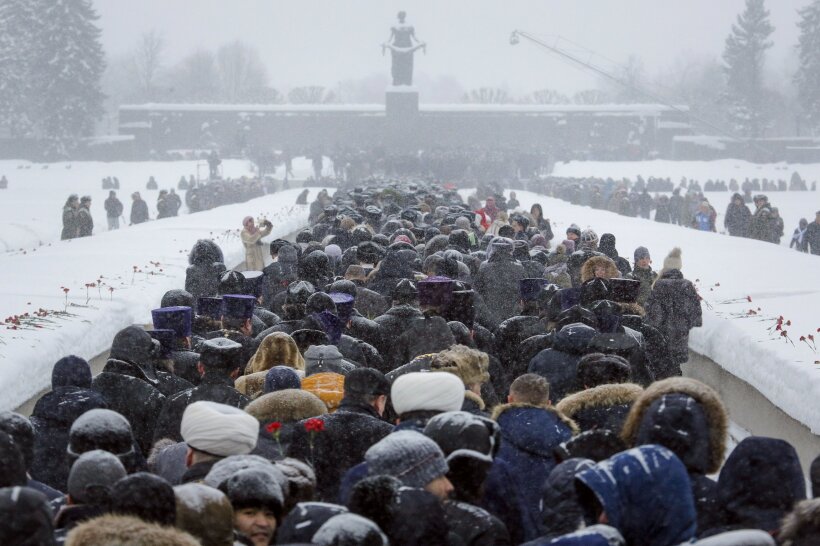
Leningrad 1942 during the Blockade. The Israelis using the Nazi tactics: bombing combined with mass starvation

___________________________

“The Israelis have no right to believe that they have a free hand now just because they suffered so much during WWII. Yes, the Holocaust is a horrible crime. But there was also the genocide of all the people of the Soviet Union, who suffered a great deal too. They were killed in various concentration camps, and in Leningrad, alongside Jews. According to this logic, we have a free hand now as well. This won’t do, if we want to preserve international law.”

Sergei Lavrov, Russian Foreign Secretary

_________________________

Israel: Starvation Used as Weapon of War in Gaza

  • The Israeli government is using starvation of civilians as a method of warfare in the Gaza Strip, which is a war crime.
  • Israeli officials have made public statements expressing their aim to deprive civilians in Gaza of food, water, and fuel – statements reflected in Israeli forces’ military operations.
  • The Israeli government should not attack objects necessary for the survival of the civilian population, lift its blockade of the Gaza Strip, and restore electricity and water.

(Jerusalem) – The Israeli government is using starvation of civilians as a method of warfare in the occupied Gaza Strip, which is a war crime, Human Rights Watch said today. Israeli forces are deliberately blocking the delivery of water, food, and fuel, while willfully impeding humanitarian assistance, apparently razing agricultural areas, and depriving the civilian population of objects indispensable to their survival.

Since Hamas-led fighters attacked Israel on October 7, 2023, high-ranking Israeli officials, including Defense Minister Yoav GallantNational Security Minister Itamar Ben-Gvir, and Energy Minister Israel Katz have made public statements expressing their aim to deprive civilians in Gaza of food, water and fuel – statements reflecting a policy being carried out by Israeli forces. Other Israeli officials have publicly stated that humanitarian aid to Gaza would be conditioned either on the release of hostages unlawfully held by Hamas or Hamas’ destruction.

“For over two months, Israel has been depriving Gaza’s population of food and water, a policy spurred on or endorsed by high-ranking Israeli officials and reflecting an intent to starve civilians as a method of warfare,” said Omar Shakir, Israel and Palestine director at Human Rights Watch. “World leaders should be speaking out against this abhorrent war crime, which has devastating effects on Gaza’s population.”

Human Rights Watch interviewed 11 displaced Palestinians in Gaza between November 24 and December 4. They described their profound hardships in securing basic necessities. “We had no food, no electricity, no internet, nothing at all,” said one man who had left northern Gaza. “We don’t know how we survived.”

In southern Gaza, those interviewed described the scarcity of potable water, the lack of food leading to empty shops and lengthy lines, and exorbitant prices. “You are on a constant search for things needed to survive,” said a father of two. The United Nations World Food Programme (WFP) reported on December 6 that 9 out of 10 households in northern Gaza and 2 out of 3 households in southern Gaza had spent at least one full day and night without food.

International humanitarian law, or the laws of war, prohibits the starvation of civilians as a method of warfare. The Rome Statute of the International Criminal Court provides that intentionally starving civilians by “depriving them of objects indispensable to their survival, including willfully impeding relief supplies” is a war crime. Criminal intent does not require the attacker’s admission but can also be inferred from the totality of the circumstances of the military campaign.

In addition, Israel’s continuing blockade of Gaza, as well as its more than 16-year closure, amounts to collective punishment of the civilian population, a war crime. As the occupying power in Gaza under the Fourth Geneva Convention, Israel has the duty to ensure that the civilian population gets food and medical supplies.

On November 17, the WFP warned of the “immediate possibility” of starvation, highlighting that supplies of food and water were practically non-existent. On December 3, it reported a “high risk of famine,” indicating that Gaza’s food system was on the brink of collapse. And on December 6, it declared that 48 percent of households in northern Gaza and 38 percent of displaced people in southern Gaza had experienced “severe levels of hunger.”

On November 3, the Norwegian Refugee Council announced that Gaza was grappling with “catastrophic water, sanitation, and hygiene needs.” Wastewater and desalination facilities were shut down in mid-October due to fuel and electricity shortages and have been largely inoperable since, according to the Palestinian Water Authority. Even before October 7, according to the UN, Gaza had virtually no potable water.

Prior to the current hostilities, 1.2 million of Gaza’s 2.2 million people were estimated to be facing acute food insecurity, and over 80 percent were reliant on humanitarian aid. Israel maintains overarching control over Gaza, including over the movement of people and goods, territorial waters, airspace, the infrastructure upon which Gaza relies, as well as the registry of the population. This leaves Gaza’s population, which Israel has subjected to an unlawful closure for 16 years, almost entirely dependent on Israel for access to fuel, electricity, medicine, food, and other essential commodities.

After the imposition of a “total blockade” on Gaza on October 9, Israeli authorities resumed piping water to some parts of southern Gaza on October 15 and, as of October 21, allowed limited humanitarian aid to arrive through the Rafah crossing with Egypt. Israeli Prime Minister Benjamin Netanyahu said on October 18 that Israel would not allow humanitarian assistance “in the form of food and medicines” into Gaza through its crossings “as long as our hostages are not returned.”

The government continued to block the entry of fuel until November 15, despite warnings about the serious consequences of doing so, leading to the shutdown of bakeries, hospitals, sewage pumping stations, water desalination plants, and wells. These facilities, which have been left unusable, are indispensable to the civilian population’s survival. Although limited amounts of fuel were subsequently allowed in, on December 4, the UN Humanitarian Coordinator for the Occupied Palestinian Territory, Lynn Hastings, called it “utterly insufficient.” On December 6, Israel’s war cabinet approved a “minimal” increase in fuel supplies to southern Gaza.

On December 1, immediately after the seven-day ceasefire, the Israeli military resumed bombing Gaza and expanded its ground offensive, stating that its military operations in the south would carry “no less strength” than in the north. While United States officials said that they urged Israel to allow fuel and humanitarian aid to enter Gaza at the same levels observed during the ceasefire, the Defense Ministry’s coordinator of government activities in the territories said on December 1 that it halted all aid entry. Limited aid deliveries resumed on December 2, but still at grossly insufficient levels, according to the UN Office for the Coordination of Humanitarian Affairs (OCHA).

Alongside the crushing blockade, the Israeli military’s extensive airstrikes in the strip have resulted in widespread damage or destruction to objects necessary for the survival of the civilian population.

UN experts said on November 16 that the significant damage “threatens to make the continuation of Palestinian life in Gaza impossible.” Notably, Israeli forces’ bombing of Gaza’s last operational wheat mill on November 15 ensures that locally produced flour will be unavailable in Gaza for the foreseeable future, as highlighted by OCHA. Additionally, the UN Office for Project Services (UNOPS) said that the decimation of road networks had made it more difficult for humanitarian organizations to deliver aid to those who need it.

“Bakeries and grain mills have been destroyed, agriculture, water and sanitation facilities,” Scott Paul, a senior humanitarian policy adviser for Oxfam America, told the Associated Press on November 23.

Israel’s military actions in Gaza have also had a devastating impact on Gaza’s agricultural sector. The sustained bombardment, coupled with fuel and water shortages, alongside the displacement of more than 1.6 million people to southern Gaza, has made farming nearly impossible, according to Oxfam. In a report from November 28, OCHA said that livestock in the north are facing starvation due to the shortage of fodder and water, and that crops are increasingly abandoned and damaged due to lack of fuel to pump irrigation water. Existing problems, such as water scarcity and restricted access to farming land near the border fence, have compounded the difficulties faced by local farmers, many of whom are displaced. On November 28, the Palestinian Central Bureau of Statistics said that Gaza is suffering from at least a US$1.6 million daily loss in farm production.

On November 28, the Palestine Food Security Sector, led by the WFP and the Food and Agriculture Organization, reported that over a third of agricultural land in the north had been damaged in the hostilities. Satellite imagery reviewed by Human Rights Watch indicates that since the start of the Israeli military’s ground offensive on October 27, agricultural land, including orchards, greenhouses, and farmland in northern Gaza, has been razed, apparently by Israeli forces.

The Israeli government should immediately cease using starvation of civilians as a method of warfare, Human Rights Watch said. It should abide by the prohibition on attacks on objects necessary for the survival of the civilian population and lift its blockade of the Gaza Strip. The government should restore water and electricity access, and allow desperately needed food, medical aid, and fuel into Gaza, including via its crossing at Kerem Shalom.

Concerned governments should call on Israel to end these abuses. The United States, the United KingdomCanadaGermany, and other countries should also suspend military assistance and arms sales to Israel as long as its forces continue to commit widespread and serious abuses amounting to war crimes against civilians with impunity.

“The Israeli government is compounding its collective punishment of Palestinian civilians and the blocking of humanitarian aid by its cruel use of starvation as a weapon of war,” Shakir said. “The deepening humanitarian catastrophe in Gaza calls for an urgent and effective response from the international community.”

Background

The Hamas-led attacks in southern Israel on October 7 killed at least 1,200 Israelis and foreign nationals, with more than 200 people taken hostage, acts amounting to war crimes. The resulting Israeli bombardment and ground offensive resulted in more than 18,700 Palestinians killed, including more than 7,700 children, according to Gaza authorities.

UN experts stated on November 16 that half of Gaza’s civilian infrastructure had been destroyed. OCHA reported that as of December 10, over half of Gaza’s housing units had been damaged or destroyed, as provided by the Ministry of Public Works and Housing in Gaza as well as hospitals, schools, mosques, bakeries, water pipes, sewage, and electricity networks. On November 4 and 5 alone, according to OCHA, seven water facilities across the Gaza Strip were directly hit and sustained major damage, including water reservoirs in Gaza City, the Jabalia refugee camp, and Rafah.

The Israeli military’s repeated, apparently unlawful attacks on medical facilities, personnel, and transport are further destroying Gaza’s healthcare sector, thereby affecting the population’s ability to access life-saving treatment, including to prevent diseases, wasting, and deaths linked to malnutrition, exacerbating the dire ramifications of starvation. “We will see more people dying from disease than from bombardment if we are not able to put back together this health system,” the World Health Organization’s Margaret Harris said on November 28.

Humanitarian Consequences

On October 13, Israeli authorities issued an order for more than a million people to evacuate northern Gaza within 24 hours – an order that was impossible to comply with. Since then, and as conditions in the north worsened, hundreds of thousands have been displaced to Rafah and Khan Younis governorates in the south, where it has become increasingly difficult to secure the means to survive. Under international humanitarian law, evacuations must be carried out under conditions that ensure those displaced have access to unimpeded humanitarian aid, including sufficient food and work, otherwise they may amount to forcible displacement. Evacuations that would increase the likelihood of starvation are prohibited.

The humanitarian consequences of Israel’s military actions in Gaza have been severe. During the first eight weeks of hostilities, northern Gaza was the focus of the Israeli military’s intense air and, later, ground offensive. Except for the seven-day ceasefire that began on November 24, during which UN convoys brought in limited quantities of flour and high-energy biscuits, aid access to the north had been largely severed. Between November 7 and at least November 15, none of the bakeries in the north were operational due to the lack of fuel, water, wheat flour, and structural damage, according to OCHA.

According to the WFP, there is a serious risk of starvation and famine in Gaza. UN officials have said that 1.9 million people, over 85 percent of Gaza’s population, are internally displaced, adding that the conditions in an ever-shrinking southern area of the Gaza strip could become “even more hellish.”

UN aid chief Martin Griffiths stated on December 5 that the Israeli military campaign in southern Gaza had led to “apocalyptic” conditions, making meaningful humanitarian operations impossible.

As of December 6, the only water desalination plant in northern Gaza was nonfunctional and the pipeline supplying water to the north from Israel remained closed, increasing the risk of dehydration and waterborne diseases arising from the consumption of water from unsafe sources. Hospitals have been particularly hard hit, with only 1 of 24 hospitals in northern Gaza functional and able to admit new patients, although services are limited, as of December 14.

Across Gaza, the humanitarian crisis deepened with a persistent electricity blackout since October 11 as well as several communications shutdowns that denied people access to reliable safety information, emergency medical services, and severely hindered humanitarian operations, with OCHA saying on November 18 that the telecommunications blackout between November 16 and 18, the fourth such blackout since October 7, “brought the already challenging delivery of humanitarian assistance to an almost complete halt, including life-saving assistance to people injured or trapped under the rubble as a result of airstrikes and clashes.” Another telecommunications blackout took place on December 14.

Since the beginning of the Israeli military’s ground offensive on October 27, satellite imagery reviewed by Human Rights Watch indicates that orchards, greenhouses, and farmland in northern Gaza have been razed, apparently by Israeli forces, compounding concerns of dire food insecurity and loss of livelihood. Satellite imagery indicates that the razing of agricultural land continued in northern Gaza during the seven-day ceasefire, which began on November 24 and ended on December 1, when the Israeli military was in direct control of the area.

While the Israeli government allowed a steady and slightly increased stream of humanitarian aid, including cooking gas for the first time since October 7, to enter the Gaza Strip during the seven-day ceasefire that ended on December 1, it deliberately hindered the entry of relief supplies at the scale needed for over a month prior, while it imposed a siege affecting the entire civilian population. This contributed to a catastrophic humanitarian situation of far-reaching consequences with over 80 percent of the population internally displaced, many of whom have been sheltering in overcrowded, unhealthy and unsanitary conditions at UN shelters in the south. The aid that entered during the ceasefire “barely registers against the huge needs of 1.7 million displaced people,” said UN spokesperson Stephane Dujarric on November 27.

Some 200 trucks, including four tankers carrying up to 130,000 liters of fuel and four tankers of cooking gas, entered Gaza each day of the ceasefire. In comparison, an average of 500 trucks of food and goods entered Gaza each day before the conflict and 600,000 liters of fuel are needed in Gaza per day just to operate water and desalinization plants. As the bombardment resumed and Israeli forces advanced south, aid access was again severely hindered. On December 5, for the third consecutive day, OCHA reported that only Rafah governorate in Gaza received limited aid distributions. In the adjacent Khan Younis governorate, it said aid distribution largely stopped due to the intensity of hostilities.

Accounts from Civilians in Gaza

Human Rights Watch spoke to 11 civilians who evacuated northern Gaza to the perceived safety of the south due to heavy bombardment, fear of imminent airstrikes, or because Israel ordered them to evacuate. Several said they were displaced a number of times before reaching the south, as they struggled to find suitable shelters and safety along their journey. In the south, they found overcrowded shelters, empty markets and soaring prices, and long lines for limited supplies of bread and drinking water. To protect their identities, Human Rights Watch is using pseudonyms for all those interviewed.

“I have to walk three kilometers to get one gallon [of water],” said 30-year-old Marwan, who fled to the south with his pregnant wife and two children on November 9. “And there is no food. If we are able to find food, it is canned food. Not all of us are eating well.”

“We don’t have enough of anything,” said 36-year-old Hana, who fled her home in the north to Khan Younis in the south with her father, his wife and her brother on October 11. She said that in the south they don’t always have access to clean water, forcing them to drink nonpotable, salty, water.

Bathing has become a luxury, she said, due to the lack of means to heat water, requiring them to scavenge for wood. In desperate situations, she said, they even resort to burning old clothes for cooking. The process of making bread poses its own challenges, given the scarcity of ingredients that they cannot afford. “We make bad bread because we don’t have all the ingredients and we cannot afford it,” she said.

Majed, 34, who fled with his wife and four surviving children to the south on or around November 10 said that while the situation in the south was dire, it was incomparable to what he and his family had to endure while staying in the north. They had been in an area near al-Shifa hospital in Gaza City for just over a month after their house was bombed on October 13, killing Majed’s 6-year-old son:

“In those 33 days we didn’t have bread because there was no flour,” he said. “There was no water – we were buying water, sometimes for [US]$10 a cup. It wasn’t always drinkable. Sometimes, [the water we drank] was from the bathroom and sometimes from the sea. The markets around the area were empty. There wasn’t even canned food.”

Taher, 32, who fled south with his family on November 11, described similar conditions in Gaza city in the first weeks of November. “The city was out of everything, of food and water,” he said. “If you find canned food, the prices were so high. We decided to eat just once a day to survive. We were running out of money. We decided to just have the necessities, to have less of everything.”

International Standards and Evidence of Deliberate Action

Starvation of civilians as a method of warfare is prohibited under article 54(1) of the First Additional Protocol to the Geneva Conventions (Protocol I) and article 14 of the Second Additional Protocol (Protocol II). Although Israel is not a party to Protocols I or II, the prohibition is recognized as reflective of customary international humanitarian law in both international and noninternational armed conflicts. Parties to a conflict may not “provoke [starvation] deliberately” or deliberately cause “the population to suffer hunger, particularly by depriving it of its sources of food or of supplies.”

Warring parties are also prohibited from attacking objects indispensable to the survival of the civilian population, such as food and medical supplies, agricultural areas, and drinking water installations. They are obligated to facilitate rapid and unimpeded humanitarian assistance to all civilians in need, and to not deliberately block humanitarian aid or restrict the freedom of movement of humanitarian relief personnel. In each of its four previous wars in Gaza since 2008, Israel maintained the flow of drinking water and electricity into Gaza and opened the Israeli crossings for humanitarian delivery.

Evidence of intent to deliberately use starvation as a method of warfare can be demonstrated by public statements of officials involved in military operations. The following high-ranking Israeli officials could be expected to play a significant role in determining policy with respect to allowing or blocking food and other necessities to the civilian population.

On October 9, Defense Minister Yoav Gallant said: “We are imposing a complete siege on [Gaza]. No electricity, no food, no water, no fuel – everything is closed. We are fighting human animals and we must act accordingly.”

National Security Minister Itamar Ben-Gvir said in a tweet on October 17, “So long as Hamas does not release the hostages – the only thing that should enter Gaza is hundreds of tons of air force explosives – not an ounce of humanitarian aid.”

Energy Minister Israel Katz, who reported that he ordered the cuts to electricity and water, said on October 11:

“For years, we have given Gaza electricity, water, and fuel. Instead of a thank you, they sent thousands of human animals to butcher, murder, rape and kidnap babies, women and elderly people. This is why we have decided to cut off the supply of water, electricity and fuel, and now, the local power plant has collapsed, and there is no electricity in Gaza. We will keep holding a tight siege until the Hamas threat is lifted from Israel and the world. What has been will be no more.”

Katz said on October 12:

“Humanitarian aid to Gaza? Not a switch will be flicked on, not a valve will be opened, not a fuel truck will enter until the Israeli hostages come home. Humanitarian for humanitarian. Let no one lecture us about morality.”

He said on October 16:

“I supported the agreement between PM [Prime Minister] Netanyahu and President Biden to supply water to the southern Gaza Strip because it aligned with Israeli interests too. I am vehemently opposed to lifting the blockade and letting goods into Gaza for humanitarian reasons. Our commitment is to the families of the murdered and to the kidnapped hostages – not Hamas murderers and the people who helped them.”

On November 4, Finance Minister Bezalel Smotrich declared that no fuel must enter Gaza “under any circumstances.” He later called Israel’s war cabinet’s decision to permit small amounts to enter the strip “a grave mistake” and said that it “stop this scandal immediately and prevent fuel from coming into the Strip,” as reported by the Jerusalem Post.

In a video posted online on November 4, Col. Yogev Bar-Shesht, deputy head of the Civil Administration, said in an interview from inside Gaza, “Whoever returns here, if they return here after, will find scorched earth. No houses, no agriculture, no nothing. They have no future.”

On November 24, in a televised interview with CNN, Mark Regev, senior adviser to Israeli Prime Minister Benjamin Netanyahu, said that Israel was depriving Gaza of fuel since October 7 to strengthen Israel’s position when it came to negotiating with Hamas on release of hostages. “Had we done so [allowed the fuel in] … we would never have gotten our hostages out,” he said.

On December 1, the Defense Ministry’s coordinator of government activities in the territories, Maj. Gen. Ghassan Alian, said that the entry of fuel and aid to Gaza was halted after Hamas violated the conditions of the ceasefire agreement. His office confirmed his statement in response to a Times of Israel query, stating: “After the Hamas terror organization violated the agreement and in addition fired at Israel, the entry of humanitarian aid was stopped in the manner stipulated in the agreement.”

Other officials have since October 7 called for the limited entry of humanitarian aid to Gaza, saying that doing so serves Israel’s military aims.

Prime Minister Netanyahu on December 5 answered a question about Israel potentially losing leverage against Hamas if it allowed more humanitarian aid into Gaza, saying: “The war efforts are supported by the humanitarian effort … this is because we follow laws of war because we know that if there would be a collapse – diseases, pandemics, and groundwater infections – it will stop the fighting.”

Defense Minister Gallant said: “We’re required to allow the humanitarian minimum to allow for the military pressure to continue.”

Tzachi Hanegbi, Israel’s national security adviser, said at a news conference on November 17: “If there is an epidemic, the fighting will be stopped. If there is a humanitarian crisis and an international outcry, we will not be able to continue the fighting under those conditions.”

On October 18, the Office of the Prime Minister announced that Israel would not prevent humanitarian aid from entering Gaza from Egypt following pressure from the US and other international allies:

“In light of President Biden’s demand, Israel will not thwart humanitarian supplies from Egypt as long as it is only food, water and medicine for the civilian population in the southern Gaza Strip.”

Destruction of Agricultural Products and Impacts on Food Production

During ground operations in northern Gaza, Israeli forces have apparently destroyed agricultural products, exacerbating shortages of food with long-term effects. This has included razing orchards, fields, and greenhouses.
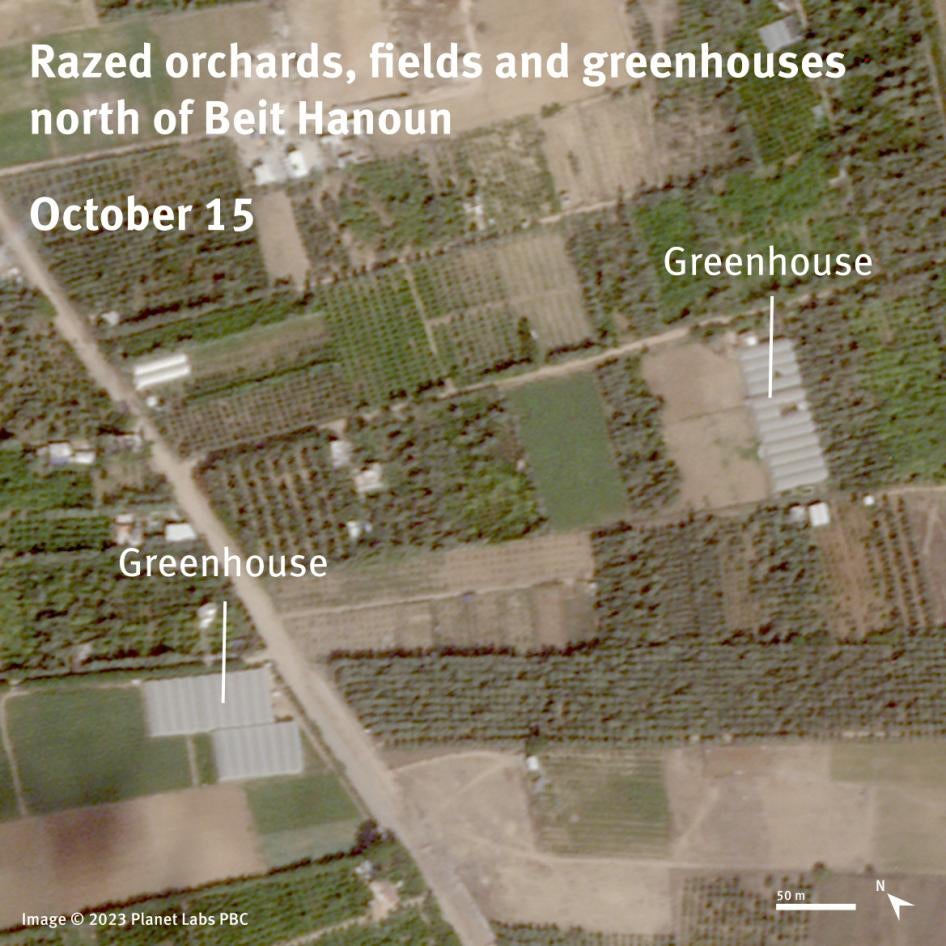
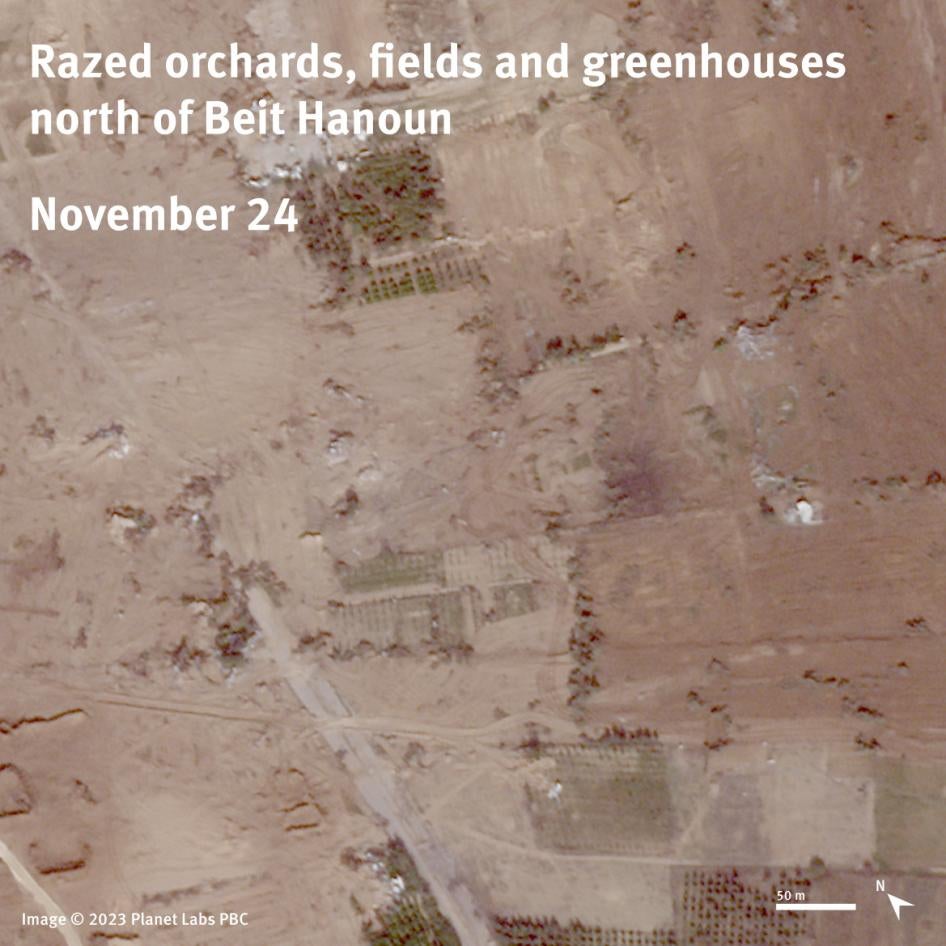
Image © 2023 Planet Labs PBC

October 15, 2023

Satellite imagery comparison between October 15 and November 24, 2023 shows razed orchards, fields and greenhouses in an area north of Beit Hanoun.

November 24, 2023

JuxtaposeJS

October 15, 2023: © 2023 Planet Labs PBC November 24, 2023: © 2023 Planet Labs PBC

Israel’s military said it conducted military operations in the Beit Hanoun area, including in an undisclosed agricultural area in Beit Hanoun, to clear tunnels and other military objectives.

Fields and orchards north of Beit Hanoun, for example, were first damaged during hostilities following Israel’s ground operations in late October. Bulldozers carved new roads, clearing the way for Israeli military vehicles.

Since mid-November, after Israeli forces took control of the same area in northeastern Gaza, satellite imagery shows that orchards, fields, and greenhouses have been systematically razed, leaving sand and dirt. Human Rights Watch contacted the Israel Defense Forces for comment on December 8 but has not received a response.
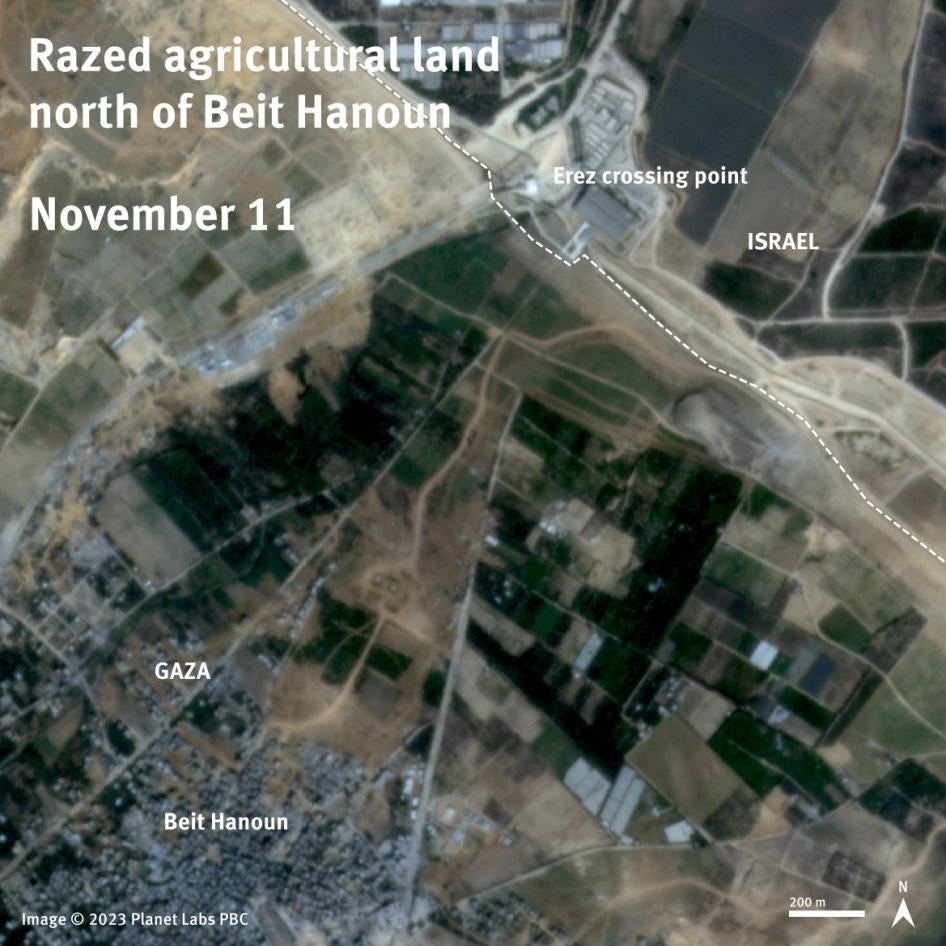
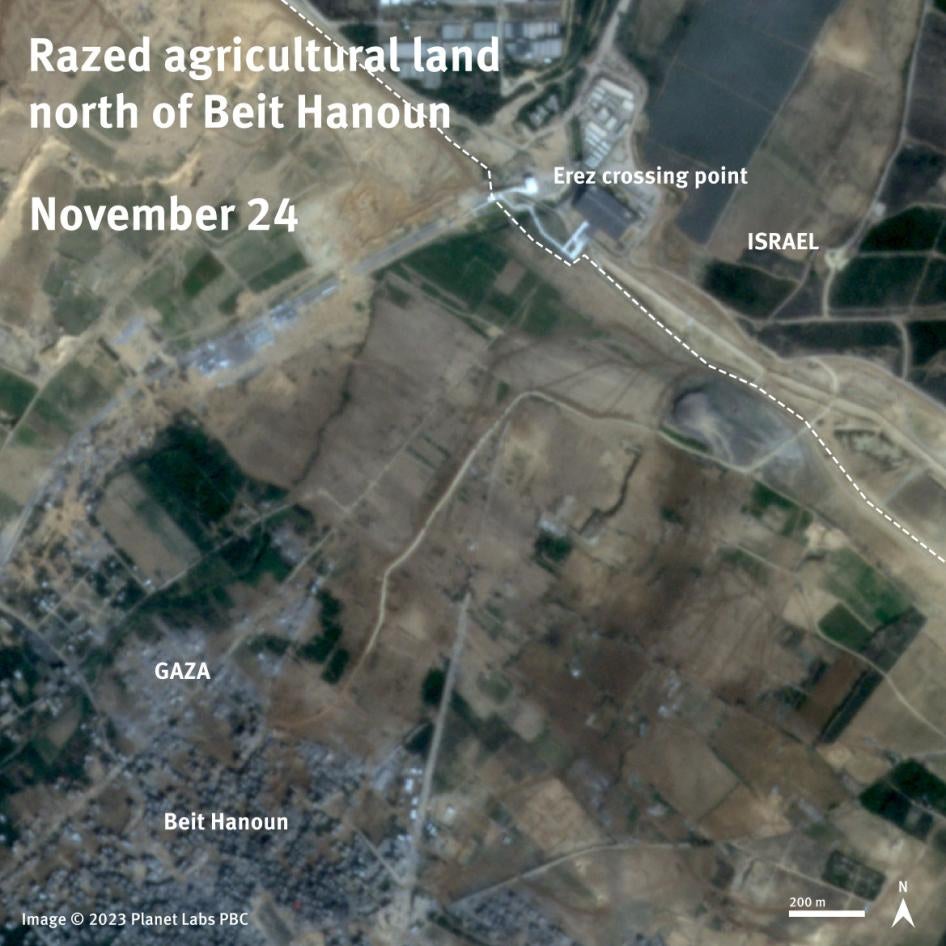
Satellite imagery comparison between November 11 and November 24, 2023 shows razed agricultural land north of Beit Hanoun in an area controlled by Israeli forces.

November 11, 2023

Satellite imagery comparison between November 11 and November 24, 2023 shows razed agricultural land north of Beit Hanoun in an area controlled by Israeli forces.

November 24, 2023

JuxtaposeJS

November 11, 2023: © 2023 Planet Labs PBC November 24, 2023: © 2023 Planet Labs PBC


Farmers in this area planted crops such as citrus fruit, potatoes, dragon fruit, and prickly pear, contributing to the livelihoods of Palestinians in Gaza. Other crops include tomatoes, cabbage, and strawberries. Some plots were razed in a day. Trees that yield citrus fruit, as well as the cacti that yield dragon fruit, take years of care to mature before they can yield fruit.

High resolution satellite imagery shows bulldozers were used to destroy fields and orchards. Tracks are visible, as well as mounds of earth on the edges of the former plots.
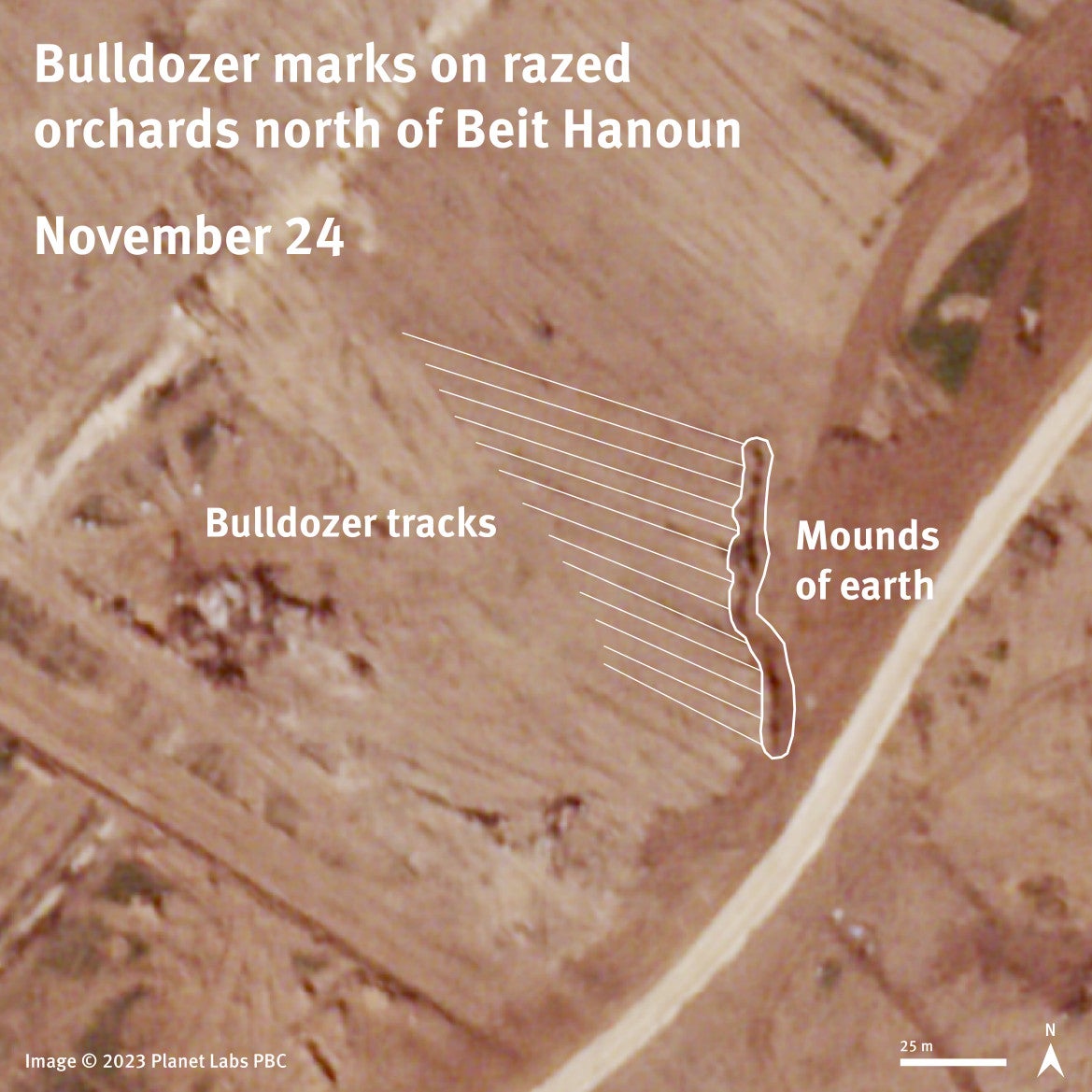
Satellite imagery from November 24, 2023 shows bulldozer marks on razed orchards in an area north of Beit Hanoun.
Satellite imagery from November 24, 2023 shows bulldozer marks on razed orchards in an area north of Beit Hanoun. © 2023 Planet Labs PBC

Whether by deliberate razing, damage due to hostilities or the inability to irrigate or work the land, farmland across northern Gaza has been drastically reduced since the beginning of the Israeli ground operations.

Farms and farmers in southern Gaza have also been affected. Action Against Hunger found that of 113 farmers from southern Gaza surveyed between October 19 and 31, 60 percent reported that their assets and/or crops have been damaged, 42 percent reported that they had no access to water to irrigate their farms, and 43 percent reported that they were unable to harvest their crops.

_______________________________

Another piece on the same subject: weaponizing starvation.

Nor is Israeli weaponizing starvation begin on October 7, 2024 as this article from 2012 points out. It has been a long term Israeli strategy against the Palestinians of Gaza.


Palestine Tet – 83 – Update from Arabic Media Sources.

January 21, 2024

______________________________

Reports of the growing mass hunger in Gaza – itself, according to the U.N Convention on Genocide – a form of genocide are being increasingly reported in the press worldwide. Mass hunger was a tactic used by the Nazis during the blockade, the siege of Leningrad which lasted 900 days. As with Gaza today, the Leningrad blockade by the Nazis included a massive bombing campaign with enforced starvation. Of a population of 3 million, 1.5 million Lenigraders (now St. Petersburg) died resisting. Like Gazans, they refused to leave their city and resisted up until death. Despite their efforts, the Nazis were unable to capture Leningrad, their simple existence in the city a form of resistance, sacrifice.

Here an extract from “The Book of the Blockade” by Alex Adamovich and Daniil Granin. p. 34. The selection compares Kurt Hamsen’s “Hunger” which deals with the stages of hunger on an individual with the weaponizing of hunger and starvation in war – the Nazis in Leningrad. The parallels between the Israeli blockade are striking:

“… the hunger of the blockade (of Leningrad), like that of the camps (Auschwitz and other crematoriums) was part of the arsenal of the principle weapons the fascists were using to carry out their plans to exterminate peoples, to depopulate whole countries”

“The psychological difference between mass, blockade hunger and Hamsun’s type (individual hunger) is fundamental. Although the author (Hamsun) writes of what he himself  knows very well, has himself experienced, he has not experienced mass hunger (my emphasis). Here the experience of a journalist’s memoir during wartime comes to mind. The journalist visited the frontline, came under heavy fire, facing death, like the soldiers themselves. The difference in their experiences (individual versus mass), in their comprehension of life at the front is nevertheless vast, even fundamental. The journalist came there, sat in a trench, knowing that he could walk away from it all. But the soldier knows that he cannot leave, he cannot walk away even if he wants to. 

That is the difference – a gigantic difference.

It is the same difference as exists between the hunger of Knut Hamsen’s hero and the hunger of beleaguered Leningraders. For the most blockaded Leningraders there was no place to which they could run from letha, unbearable hunger. It was all round the bullet-riddled, shell-pocked city pressing the whole of it to the gulf, to the lake. It held human beings in its iron grip.

A Book of the Blockade by Ales Adamovich and Daniel Granin. Raduga Publishers, Moscow: 1983. p.34.

So it is with Gaza today … the perpetrators of this genocide not German Nazis but Israeli Zionists.

______________________________

(Note: the article below is translated from the Arabic on-line media source – something of a clearning house of Arabic articles – Rai Al Youm – which I try to read daily. As my understanding of written Arabic is poor to non-existent [most unfortunately – consider it one of my major intellectual failings not have learned to read and speak Arabic] I put the articles into Google Translate which provides an immediate, if somewhat clumsy, translation. Clumsy perhaps, but the general sense comes through and as of today, none of these translations have proven to be “false news” or anything close. The difference between what Americans are reading about the Middle East, and how Middle Easterners view events in their region,  Could not be greater as the article below, essentially capsulized pieces of news indicates. Note how Arabic sources of all political orientations exist with Western sources like Bloomberg, Reuters. Link to original article in Arabic included. RJP)

______________________________

Rai el Youm – January 20, 2024

Gaza.. What are the leaders of the Guard and Hezbollah doing in Yemen? Egyptian media describes Cairo’s approval of Israel’s occupation of the Philadelphia axis as a “daily ritual”! The occupation “hopes” the Gazans will find its captives, and is the talk of establishing a Palestinian state “aimed at normalization”? The entity is stealing the skin of the Palestinians, and Biden is worried about the Arabs?!

Amman – “Opinion of the Day” – Khaled Al-Jayousi:
“Net favorability decreased by an average of 18.5 percentage points between September and December, and support declined in 42 of the 43 countries included in the study.” A new Morning Consult poll shows Israel’s loss of popularity globally, in favor of supporting the Palestinian narrative.

“Bloomberg”
According to informed sources: America and Britain are studying forms of military operations to obstruct Iran’s efforts to resupply and support the Ansar Allah movement.
“Tyrants must be careful about what they wish for.” British writer David Hirst says that the failure of Arab tyrants to resist the Israeli occupation may represent fuel for a coming explosion, pointing out that the hearts of the Arab peoples are boiling with anger. Because of what is happening in Gaza

Israeli newspaper Maariv:
The military arm of “Hamas” has an unlimited ability to strengthen its ranks with new people.
Turkish Galatasaray club player Khalil Darwish Oglu shows solidarity with Palestine with a gesture he made after scoring the fourth goal for his team against Ümraniyeşpor from a penalty kick in his team’s match in the Turkish Football Cup. Darwish posted the photo on his Instagram account accompanied by the following comment: “I did not celebrate, just “I expressed the face of the world.” He accompanied his post with an emoji of the Palestinian flag and preceded it with the word “Freedom.”

High-level Egyptian sources denied Israeli media reports that Egypt had agreed to an Israeli proposal that would allow Israel to control the Salah al-Din (Philadelphia) axis, between Gaza and Egypt, in exchange for involving the Palestinian Authority in the plan for the day after the war in Gaza. The sources said in statements reported by the “Cairo” channel. The Egyptian News Agency, through its official account on the “X” platform, said, “Such media lies have become a daily ritual aimed at diverting attention from Egypt’s declared positions on the necessity of immediately stopping this aggression.”

The Israeli army dropped thousands of paper leaflets on the city of Rafah, south of the Gaza Strip, containing pictures of Israeli detainees in the Strip, asking the city’s residents to contact it if they found any of them. Israeli planes dropped thousands of paper leaflets on the southern and eastern neighborhoods of the city of Rafah, and placed pictures in them. 68 Israeli detainees, with the words: “If you want to return to your home, please report if you see any of them,” including a contact phone number.

A broadcaster asked US President Joe Biden:
Are you concerned that Arabs will not vote for you in the elections because of your position on the war in Gaza? Biden replied: Trump wants to impose a ban on Arabs entering America. Let us make sure who cares about the Arab population first

The Popular Front for the Liberation of Palestine:
The Arab League has become a burden on the nation, and our Palestinian people are counting on the free and proud Arab peoples.
“Israel itself said, for example, that they have the largest skin bank in the entire world.” British doctor Ranjit Brar confirms that there is conclusive evidence that the Israeli occupation army is stealing organs from Palestinian corpses in Gaza, or from prisoners.

Reuters:
According to sources: Commanders of the Revolutionary Guard and Hezbollah are in Yemen to direct Houthi attacks on ships, and Tehran intensified its arms supplies to them after the start of the Gaza war.

Mustafa Barghouti to Al Jazeera:
Talking about establishing a Palestinian state from America now may be a hypocritical game to mislead people and keep them busy with something that will not happen, and I fear that this will open the path of normalization with the Arab environment at the expense of the issue under the pretext that in the end there will be a state.

The Euro-Mediterranean Human Rights Observatory:
said that it documented the killing by Israeli army forces of 94 Palestinian university professors, along with hundreds of teachers and thousands of students, as part of the comprehensive crime of genocide it has launched on the Gaza Strip, since last October 7.

A report issued by UN Women:
stated that the number of displaced women and girls reached one million out of 1.9 million people who were forced to leave their places as a result of the ongoing Israeli war on the Gaza Strip for about 3 and a half months.

XXXXXXXXXXXXXXXXXXXXXXXXXXX

Palestine Tet – 82 – Lack of access to clean drinking water is a death sentence for the people of Gaza

January 20, 2024
______________________________
“The Fuhrer has decided to wipe the city of St. Petersburg from the face of the Earth,” proclaimed secret directive 1-a 1601/41 of the German Naval Staff entitled “The Future of the City of Petersburg”, dated 22nd September, 1941.  Then followed the reasoning behind this. “There is no interest whatever in continuing the existence of this large populated point after the defeat of Soviet Russia. In precisely the same terms Finland has expressed her lack of interest in the continuance of the existence of this town right on her new frontier. It is proposed to ring it in a tight blockade and to flatten it to the ground by intensive artillery bombardment and constant aerial bombing. If, as a result of the situation arising in the town a request to surrender is announced it will be rejected …  On our (the Nazi) side there is no interest whatever in preserving even part of the population of this big town.”
A Book of the Blockade by Ales Adamovich and Daniel Granin. Raduga Publishers, Moscow: 1983. p.28

Statements of Israeli Spokespeople about wiping Gaza off the map, October-November, 2024

Lack of access to clean drinking water is a death sentence for the people of Gaza

  Israel-Palestinian Territory

Distress is engulfing Gaza City and its northern regions in alarming ways—a result of Israel’s cutting off of the water supply in the Gaza Strip, systematic and intentional Israeli bombing of water sources and wells, and a lack of fuel required to run water conversion and distribution facilities, said Euro-Med Monitor.The human rights organisation warned that the lack of drinking water in the Strip has become a matter of life and death. It noted that residents are currently forced to drink unclean well water, which is contributing to the spread of transmitted and infectious diseases, especially amid the power outage and overall water supply shortage.Prior to Israel’s 100-day-long genocide, the Gaza Strip—one of the world’s most densely populated areas—was already experiencing a crippling crisis in clean drinking water supplies. More than 90% of the population, or more than 2.3 million people, were living in a declining economic environment with the barest necessities.Gaza City’s main reservoirs, Al-Balad and Al-Rimal, were completely destroyed last weekend during an Israeli bulldozing operation in the area, the Euro-Med Monitor team confirmed. Al-Balad Reservoir, which houses a water well, a warehouse for water line maintenance equipment, and administrative offices for the city’s water department, and Al-Rimal Reservoir, which includes the sanitation department’s offices and a warehouse for sewage network maintenance equipment, have both been bulldozed during the Israeli ground incursion.According to the Palestinian Water Authority, the ongoing Israeli military attacks have destroyed the water infrastructure in the Gaza Strip, including at least 65% of the water wells in Gaza City and the northern areas of the Strip.

Due to Israeli bombing, at least 12 wells in the area have been destroyed, resulting in an extreme and unprecedented water crisis in Gaza City. Prior to the Israeli military attacks on the Gaza Strip on 7 October, the Gaza municipality was pumping approximately three million cups of water per month. Israel’s state-owned Mekorot company provided 700,000 cups per day, or 25% of the total amount. The desalination plant provided 10%, and the city’s local wells provided roughly two million and 200,000 cups. Almost all of these sources have since ceased production.

The situation is made worse by the fact that the Israeli authorities are still placing tight restrictions on the flow of aid into the Gaza Strip, particularly into the northern areas and Gaza City; this includes the fuel needed to run the water and sanitation facilities.

Since the beginning of its unprecedented military assaults, Israel has imposed a complete blockade on the Gaza Strip and stopped the flow of food, fuel, water, and other basic human necessities. Later, Israel’s military began methodically and willfully destroying water tanks and stations.

Under international pressure, Israel has allowed the daily entry of 100 aid trucks into the Gaza Strip via the Rafah land crossing into Egypt. This is a far cry from the average load of 500 trucks that entered the Strip prior to 7 October to meet humanitarian needs.

According to Euro-Med Monitor, the lack of clean drinking water in the northern Gaza Strip is resulting in increasingly dire consequences and severe suffering for residents of the Jabalia refugee camp, who have not had access to it since the start of Israeli military attacks. A 73-year-old resident of the camp’s “Block 4”, Alian Fares Abdel-Ghani, told the Euro-Med Monitor team that residents are forced to drink salted water, which is necessary for daily survival but difficult to obtain. According to Abdel-Ghani, Israel’s army destroyed the camp’s two desalination plants, the Tiberias and the Shomer plants, shortly after the start of its ongoing attacks.

Abdul-Ghani stated that the cost of a gallon of water initially increased from one Israeli shekel ($0.27 USD) to four shekels ($1.08 USD) as a result of the Israeli bombing and the lack of fuel required to run other stations farther from the camp. After a few days, he continued, Israel shut off the water supply entirely. Many Jabalia families have tried to sterilise water and make it somewhat drinkable by boiling it over wood fires, he said, especially after diseases started to spread among them and children started getting diarrhoea and colic on a regular basis.

Euro-Med Monitor warned that excessive consumption of undrinkable salt water will lead to high blood pressure; kidney disease; increased risk of stroke, intestinal, and stomach diseases; constant vomiting; and diarrhoea. These side effects ultimately result in excessive dehydration of the body’s tissues, particularly brain tissue. Drinking water drawn from wells without treatment could result in an imbalance in the body’s salt content and cause dehydration, with children and elderly people being the most vulnerable due to weakened immune systems, and the potential for gastrointestinal infections to cause fatalities.

Given the scarcity of drinkable water, particularly following winter rains and floods, worries about waterborne and infectious diseases like cholera and chronic diarrhoea are high.

Euro-Med Monitor conducted an analytical study last month that included a sample of 1,200 people in the Gaza Strip in order to ascertain the impact of the humanitarian crisis experienced by residents of the enclave in the midst of Israel’s genocidal war, ongoing since 7 October. Sixty-six per cent of the study sample reported having experienced diarrhoea, skin rashes, or intestinal diseases within the past month. According to the study, the rate of access to water in the Strip, including drinking, bathing, and cleaning water, is just 1.5 litres per person per day. This is 15 litres less than the minimum amount of water required for survival at the level required by international standards.

Euro-Med Human Rights Monitor stressed that international humanitarian law forbids attacks, destruction, or disruption of vital facilities necessary to the survival of the civilian population, such as drinking water facilities and networks. The rights organisation further emphasised that international humanitarian law strictly prohibits the use of starvation as a weapon. As an occupying power, Israel is obligated under international humanitarian law to provide basic needs and protection to the Gazan people.

The Rome Statute of the International Criminal Court provides that intentionally starving civilians by “depriving them of objects indispensable to their survival, including willfully impeding relief supplies” is a war crime, added the Geneva-based rights group.

Euro-Med Monitor stated that Israel has been committing acts of genocide against the civilian population of the Gaza Strip since 7 October according to the Rome Statute of the International Criminal Court, the Convention on the Prevention and Punishment of the Crime of Genocide, and pertinent international judicial rulings. Israel’s crimes include depriving the civilian population of enough potable water, which has caused serious, intentional harm and trapped them in living conditions meant to destroy them.

Euro-Med Human Rights Monitor is a Geneva-based independent organization with regional offices across the MENA region and Europe

FOCUS AREAS

CONNECT WITH US

NEWSLETTER

Get News & Action Alerts in Your Email.

Subscribe

Palestine Tet – 81 – The IRGC’s (Iranian Revolutionary Guard Corps) Missile Attacks on Iraqi Kurdistan & Syria

January 19, 2024

______________________________

The Israeli military just blew up the University of Palestine in Gaza City with 315 mines. All the universities in Gaza have been damaged or destroyed. We need a full academic boycott.

______________________________

Iran Goes Ballistic.

Iran’s missile assault both a show of force and a warning, the warning to the United States and Israel.

  • All missile strikes lead to US/Israel.
  • Iran can & will act on its own directly instead of through ‘proxy groups’ abroad in acts of self-defence.
  • Iran has been careful to select targets; they have not attacked American targets. They have not sought to kill or wound Americans.
  • They don’t want an attack like that (targeting Americans) which people like John Bolton, Lindsay Graham and the British government  would seize upon and say that this shows how aggressive, dangerous Iran is, we (the US) needs to counter these strikes by launching attacks on the Iranians
  • These were calculated and measured strikes which demonstrates Iran’s missile capabilities
  • It shows that Iran has long-range missiles that these missiles are very precise and are able to attack specific targets
  • If an all out war breaks out in the Middle East, Iran has the ability to launch strikes of its own potentially against American positions and interests right across the Middle East and presumably American warships
  • It is also warning to Israel that it too is in its sights and in range of Iranian missiles.

So, once again, it’s both a warning and a show of force.

This from IRGC General Sandar Hajizadeh: In response to the assassination of Islamic Revolution Guard Corps commander Seyyed Razi Mousavi, Iran launched 24 long-range missiles at two targets, one at Irbil, Iraq and the other at occupied Idlib Province in northwest Syria. 4 Khaybar Shaken from southern Khuzestan to Idlib. 4 from Kermanshah to Mossad base in Erbil. 7 from eastern Azerbaijan to Erbil. + 9 against Takfiris and ISIS in Syria

Unable to frontally attack Iran the U.S. has fallen back a la Syria to using proxies. Why is it unable to openly attack Iran? Because Iran and its allies are strong enough to seriously damage U.S. interests in the region, be they U.S. bases, oil facilities or transportation. Iran has made it very clear that it will retaliate militarily if push comes to shove. Unable to directly attack Iran, Washington’s new plan is to destabilize it from Iraq (the Kurdish areas) on the west and Pakistan on the east, especially the southwest Pakistani province of Baluchistan from where C.I.A. trained terrorists have launched terrorist attacks – like the recent one at Kerman at Gassan Suliemani’s grave – into Iran.

By hitting the targets in Irbil and Baluchistan (Pakistan) Iran has made it clear that Washington’s new proxy war against it is a dead end.

What Did Iran Hit?

In Iraqi Kurdistan: It hit and destroyed one of the main Mossad spy headquarters in Erbil, Iraqi Kurdistan that served as the center for developing espionage operations and planning terror attacks in the region, especially against Iran.

Senior  was martyred in an Israeli airstrike on Syria’s Damascus on December, 25, 2023. Seyyed Mousavi was one of the oldest IRGC commanders in Syria and he was close to the commander of the IRGC’s elite Quds Force, martyr Lieutenant General Qassem Soleimani. The Iranian commander was martyred after the Israeli occupation launched three missiles at his location in the suburbs of the Syrian capital of Damascus.

The attack on Erbil also killed Mossad-affiliated Kurdish oil tycoon Peshraw Dizayee, owner of Empire and Falcon Groups which reportedly facilitated oil exports to Israel

According to Al Mayadeen’s correspondent, Dizayee played a significant role in facilitating commercial relations, especially in the oil sector, between “Israel” and some entities in the Kurdistan region of Iraq. In short, Peshraw Dizayee, according to our correspondent, was considered one of the targets of the strategic operation carried out by Iran in Erbil.

In Syria: In response to the terror attack in Kerman (Iran), that killed 100+ people, that targeted Qassem Soleimani’s grave during a commemoration of his assassination, the Iranian Revolutionary Guard Corps (IRGC) hit and destroyed the positions and headquarters of ISIS-K and other extremist groups in Idlib, Syria.

Sources told Al Mayadeen that the targeted area was where ISIS-K militants were being trained by US forces and then transferred to AFghanistan to launch attacks inside Iran (and China). Apparently the missile attacks also h it areas controlled by Hayt Tahrir al-Sham (HTS. formerly the Al-Nusra Front) destroying training camps and headquarters belonging to the Turkistan Islamic Party.

The ballistic missiles launched by Iran towards northwestern Syria traveled a distance of 1230 kilometers (765 miles). This is the first time that Iran has launched operational missiles this distance, marking Iran’s biggest and furthest missile operation yet. The operation sends a clear message to Israel: Iran is fully capable of striking anywhere in the Occupied Territories. The targets were directly hit and destroyed, using 24 various types of ballistics missiles, among the the Khaibar-Shekan (1,450 km range).

The attacks, described by some as the longest-distance attacks in Iran’s history, came hours after the US army announced the deployment of 1,500 new troops to Iraq and Syria to bolster its pro-Israel actions.

80th Anniversary of the Lifting of the Siege of Leningrad: An anniversary the West would rather forget

January 18, 2024

An anniversary West would rather forget

On the 80th anniversary of the battle that lifted the Siege of Leningrad in World War 2, people walk in snowfall to the Motherland monument to place flowers at the Piskaryovskoye Cemetery where the victims were buried, St. Petersburg, Russia, January 26, 2019


________________________________

The justification of political violence is classically fascist. This past week, we saw a breathtaking spectacle at the International Court of Justice (ICJ) in Hague reminding us that we are now in fascism’s legal phase. If the Nazis used Judeo-Bolshevism as their constructed enemy, Israel is doing the same thing by raising the bogeyman of Hamas. Fascism feeds off a narrative of supposed national humiliation by internal enemies.

________________________________

An epochal anniversary from the annals of modern history is coming up in another ten days that remains a living memory for the Russian people. The Siege of Leningrad, arguably the most gruesome episode of the Second World War, which lasted for 900 days, was finally broken by the Soviet Red Army on 27th January 1944, eighty years ago to be exact.

The siege endured by more than three million people, of whom nearly one half died, most of them in the first six months when the temperature fell to 30° below zero. It was an apocalyptic event. Civilians died from starvation, disease and cold. Yet it was a heroic victory. Leningraders never tried to surrender even though food rations were reduced to a few slices of bread mixed with sawdust, and the inhabitants ate glue, rats — and even each other — while the city went without water, electricity, fuel or transportation and was being shelled daily.

It was on the 22nd of June, 1941 that the German armies crossed the Russian frontiers. Within six weeks, the Army Group North of the Wehrmacht, armed forces of the Third Reich, was within fifty kms of Leningrad in a fantastic blitzkrieg and had advanced650 kms deep into Soviet territory.

A month later, the Germans had all but completed the city’s encirclement, only a perilous route across Lake Ladoga to the east connected Leningrad with the rest of Russia. But the Germans got no further. And 900 days later their retreat began.

The epic siege of Leningrad was the longest endured by any city since Biblical times, and, equally, citizens became heroes — artists, musicians, writers, soldiers and sailors who stubbornly resisted the iron from entering their souls. Petrified by the prospect of surrender to the Soviet Union, the Nazis preferred to lay down arms before the western allied forces, but Gen. Dwight Eisenhower, Supreme Commander of the Allied Expeditionary Force in Europe, ordered that the honour of victory should go to the Red Army.

Herein lies one of the greatest paradoxes of war and peace in modern times. Today, the anniversary of the siege of Leningrad has become,  most certainly, an occasion that the US and many of its European allies would rather not remember.Yet, its contemporary relevance is not to be glossed over, either.

The Nazi leadership aimed to exterminate Leningrad’s entire population by enforced starvation. Death by starvation was a deliberate act on the part of the German Reich. In the words of Joseph Goebbels, Adolf Hitler “intended to have cities like Moscow and St Petersburg wiped out.” This was “necessary”, he wrote in July 1941, “because if we want to divide Russia into its individual parts,” it should “no longer have a spiritual, political or economic centre.”

Hitler himself declared in September 1941, “We have no interest in maintaining even a part of the metropolitan population in this existential war.” Any talk of the city surrendering had to be “rejected, as the problem of keeping and feeding the population cannot be solved by us.”

Simply put, the population of Leningrad was left to starve to death – much like the millions of Soviet prisoners of war held by the Wehrmacht. The historian Jörg Ganzenmüller later wrote that this form of mass murder was cost-effective for Berlin, for, it was “genocide by simply doing nothing”.

“Genocide by doing nothing”! Those chilling words are as well applicable today to the West’s “sanctions from hell” with an ulterior agenda to “erase” Russia and carve out five new states from its vast landmass with fabulous resources that can be subjugated by the industrial world.

The mother of all ironies is that Germany is even today at the forefront of the “genocide by doing nothing” strategy to weaken and bring down the Russian Federation on its knees. The Biden administration depended on a troika of three German politicians to do the heavy lifting in that failed effort to erase Russia — EU’s top bureaucrat in Brussels Ursula von der Layen, German Chancellor Olaf Schulz and Foreign Minister Annalena Baerbock.

George Santayana, the Spanish-American philosopher, essayist, poet, and novelist once said, “Those who cannot remember the past are condemned to repeat it.” This is how the far-right thrives.

In Germany and elsewhere, younger generations are becoming indifferent to the history of fascism. The idea of a Fourth Reich has entered an unprecedented heyday and is currently experiencing a new phase of normalisation in Europe. The tumultuous political upheaval throughout the western world provides the backdrop today.

The author ofThe Fourth Reich: The Specter of Nazism from World War II to the Present, historian and professor of history and Judaic studies Gavriel Rosenfeld has written that “The only way to mute the siren call of the Fourth Reich is to know its full history. Although it is increasingly difficult in our present-day world of fake ‘facts’ and deliberate disinformation to forge a consensus about historical truth, we have no alternative but to pursue it.”

The justification of political violence is classically fascist. This past week, we saw a breathtaking spectacle at the International Court of Justice (ICJ) in Hague reminding us that we are now in fascism’s legal phase. If the Nazis used Judeo-Bolshevism as their constructed enemy, Israel is doing the same thing by raising the bogeyman of Hamas. Fascism feeds off a narrative of supposed national humiliation by internal enemies.

Meanwhile, what gets forgotten is that there has been a growing fascist social and political movement in Israel for decades. Like other fascist movements, it is riddled with internal contradictions, but this movement now has a classically authoritarian leader in Prime Minister Benjamin Netanyahu who has shaped and exacerbated it, and is determined that in his time in politics it will be normalised.

The probability is high that in a matter of a few days, the ICJ will give some sort of interim order/injunction to Israel to end the violence against the hapless Palestinians in Gaza. But the fascist movement Netanyahu now leads preceded him, and will outlive him.

These are forces that feed off ideologies with deep roots in Jewish history.They may be defending a fictional glorious and virtuous national past, but it would be a grave error to think they cannot ultimately win.

The Russians are learning this home truth the hard way in Ukraine where “de-nazification” is turning out to be the weakest link in their special military operation, given its geopolitical moorings traceable to Germany’s dalliance with the Ukrainian Neo-Nazi groups in Kiev in the run-up to the 2014 coup, which the US inherited gleefully and wouldn’t let go.

XXXXXXXXXXXXXXXXXXXXXXXXXXXXX

Piskaryovskoye Cemetery, St. Petersburg. July, 1986


Palestine Tet – 80 – Twenty Three Reasons Why the Boulder City Council Should Pass This Ceasefire Resolution

January 17, 2024

_____________________________

(note: On Thursday, January 18, 2024, citizens of Boulder, Colorado, USA – many associated with the Rocky Mountain Peace and Justice Center (RMPJC) there, will present a resolution to its city council calling on that body to come out and publicly support a bilateral ceasefire between Israel and Hamas [actually it goes further, calling for a ceasefire that would include the Gaza Strip, the West Bank, East Jerusalem, Northern Israel and Lebanon]. The rationale for introducing such a resolution is detailed below, written by Tom Mayer, of RMPJP’s Global Peace Collective)

_____________________________

Twenty Three Reasons Why the Boulder City Council Should Pass This Ceasefire Resolution

Concerned citizens of Boulder call upon the Boulder City Council to adopt the following resolution regarding the conflict emanating from the Gaza Strip

  1. To prevent further loss of life, there must be an immediate and sustained ceasefire enacted by all parties involved in the Gaza conflict.  The ceasefire must include the Gaza Strip, the West Bank, East Jerusalem, Northern Israel, and Lebanon.
  2. All Israeli hostages and Palestinian prisoners must be released
  3. A humanitarian corridor must be opened immediately allowing for the unrestricted provision of non-military goods to civilians throughout the Gaza Strip.
  1. At least 24,000 Palestinians and 1,400 Israelis have already been killed.  Continuing the Gaza War will result in many more deaths.
  2. Women and children are particular victims of the Gaza War.  Over 70% of Palestinian casualties are women and children (about 17,000 women and children mortalities).
  3. Continuation of the Gaza War threatens the surviving Palestinian population with starvation, epidemic diseases, and a perilous absence of shelter.
  4. If the Gaza War continues, all remaining Israeli hostages are likely to perish.
  5. The Gaza War threatens to expand into a regional and perhaps global conflagration.  It has already expanded into both Lebanon and Yemen.
  6. Israel has nuclear weapons and means of delivering them (planes, missiles, and submarines).  Thus, the Gaza War could even explode into a nuclear war, particularly if Iran becomes involved.
  7. Polls indicate that about 60% of United States citizens favor an immediate and permanent ceasefire in the Gaza War.  Among well informed people the percentage favoring a ceasefire is considerably higher.
  8. If gridlock or political irrationality prevents the federal government from taking urgently necessary actions, it is the duty of local government to address the civic crisis by advocating the required policies.
  9. Many other American cities are now considering ceasefire resolutions.  Some cities, including San Francisco, have already passed ceasefire resolutions.  Boulder should be an ethical exemplar, not a moral laggard.
  10. If the Boulder City Council passes the ceasefire resolution, it will encourage other city councils to do the same.  Such an outpouring of local demands for a ceasefire will influence Congress and increase the likelihood that our President will call for an immediate ceasefire in the Gaza War.
  11. The Boulder City Council has sometimes taken positions on foreign affairs.  For example, in 2003, at the urging of Boulder citizens, the Council passed a resolution opposing the United States attack on Iraq.
  12. Passing a ceasefire resolution will strengthen the decaying fabric of American democracy, by demonstrating that public opinion and political actions by citizens really do matter and are not simply ignored by wealth beholden politicians.
  13. Israeli military action is making the entire Gaza Strip unsuitable for human habitation.
  14. Israeli military action is not primarily directed against Hamas.  Its strategic purpose appears to be driving the Gaza Palestinian population entirely out of Israel/Palestine.  Some Israeli officials even admit they are trying to impose Nakba 2 (massive ethnic cleansing of Palestinians).
  15. Israeli military actions in the Gaza Strip satisfy the U.N. definition of genocide.  A comprehensive South African brief charging Israel with genocide is currently being adjudicated by the International Court of Justice at the Hague.
  16. Israel’s attack on the civilian population of the Gaza Strip is a blatant violation of international law.  Every day that Israel’s attack continues weakens essential legal constraints upon warfare.
  17. Israel’s brutal attack upon the Palestinian people of the Gaza Strip as increased antisemitism worldwide.  A ceasefire that halts Israel’s attack on the Gaza Strip will also halt the growth of antisemitism.
  18. Mass media in the United States focus upon the crimes perpetrated by Hamas on October 7, but largely ignore Israel’s suffocating 18 yearlong blockade of and numerous attacks upon the Gaza Strip.  These atrocities surely provoked the October 7 actions of Hamas.
  19. United States political esteem is severely damaged by our complicity in Israel’s attack upon the Gaza Strip.  Decisive U.S. action to end the Gaza War (including insistence on a ceasefire) would help to repair U.S. international esteem.
  20. United States military support for Israel has been extremely costly.  Between 1946 and 2022 the United States government gave Israel approximately 318 billion dollars (inflation adjusted).  This is far more than the USA gave to any other country during this time period.   Much of these funds have been used for military purposes.
  21. Continuation of the Gaza War will not solve the Israel-Palestine conflict.  On the contrary, it will merely be a prelude to future warfare and an incubator for subsequent Palestinian generations committed to armed insurrection.
  22. Continuation of the Gaza War will exacerbate the international isolation of Israel and enhance the strength of chauvinistic anti-democratic elements within the Israeli government.
  23. The Gaza War distracts the United States and the entire world from dealing with the urgent problem of climate change.  Moreover, military action is a major source of carbon emissions.  Climate change, if not seriously addressed, could eventually doom human civilization.

Palestine Tet – 79 – Trita Parsi: How Biden Can Stop Houthi Missile Attacks—Without Risking War

January 16, 2024

Image

_______________________________

It would have cost Biden nothing, nothing whatsoever, to mention the 24,000 Palestinian dead, even in passing. But no, not a word, not a mention. Why didn’t he? What are people in the White House thinking? Forget basic morality, have they abandoned doing basic politics?

Mehdi Hasan

Former Israeli negotiator Daniel Levy says the Biden administration “has now become the most anti-Palestinian Democrat administration in history — dripping with anti-Palestinian racism day in, day out.”

Daniel Ley (former Israeli negotiator)

_______________________________

How Biden Can Stop Houthi Missile Attacks—Without Risking War
Time Magazine
Trita Parsi
January 15, 2024
https://time.com/6555620/us-strikes-houthis-yemen/

There is a simple reason why U.S. and U.K. military strikes against Yemen’s Houthis will not achieve their objective of re-opening the crucial Red Sea lanes for international shipping: The Houthis don’t have to succeed in striking additional commercial vessels, or even successfully retaliate against U.S. military ships. All they need to do is to try. That is enough to sustain a de facto shipping blockade of the Red Sea, through which a staggering 12% of global trade flows. Many Western commercial vessels will simply not risk moving their ships through those waters, not in spite of President Joe Biden’s military strikes, but now because of them.

The irony is evident as the wealthiest nation in the world bombs one of the poorest. Biden, by escalating tensions with the Iran-backed Houthis, has inadvertently bolstered the militant group’s ability to disrupt international shipping. The Houthis had managed to increase the cost of container shipping in the wake of the Israel-Hamas war by launching missile attacks at cargo ships passing through the vital waterways. But the Biden Administration’s retaliatory strikes on Yemen’s Houthis have turned off shipping companies, perhaps irrevocably, until the war ends.

The Houthis have continued to fire missiles at ships almost daily since Thursday. A Houthi missile on Sunday was shot down by the U.S. Navy. It never hit its target, but it still served its purpose: Keeping tensions high and scaring away Western ships heading toward Israel. But even the U.S. ability to continue to shoot down missiles is hardly guaranteed: on Monday, a Houthi missile struck an American-owned container ship in the Gulf of Aden. As such, the Houthis have already succeeded in inflicting a cost onto Israel’s economy, all the while making a mockery of Biden and British Prime Minister Rishi Sunak’s effort to re-establish deterrence.

The Houthis have continued to fire missiles at ships almost daily since Thursday. A Houthi missile on Sunday was shot down by the U.S. Navy. It never hit its target, but it still served its purpose: Keeping tensions high and scaring away Western ships heading toward Israel. But even the U.S. ability to continue to shoot down missiles is hardly guaranteed: on Monday, a Houthi missile struck an American-owned container ship in the Gulf of Aden. As such, the Houthis have already succeeded in inflicting a cost onto Israel’s economy, all the while making a mockery of Biden and British Prime Minister Rishi Sunak’s effort to re-establish deterrence.

Biden can certainly choose to up the ante and intensify the targeting of Houthi weapons depots and missile launchers. But unless there is a substantial degradation of Houthi military capabilities—a scenario that seems improbable given their large arsenal of anti-ship missiles and estimated 200,000 fighters—continued strikes will only beget more of the same: escalating tensions that strengthen the de facto Houthi blockade and elevate the potential for the conflict to expand into a full-fledged regional war. This is an outcome the Biden Administration claims to want to prevent.

It didn’t need to reach this point. The Houthis had consistently expressed their demands publicly: an end to attacks on Red Sea ships in exchange for Israel halting strikes on Palestinians in Gaza, which have killed at least 23,000 so far, most of them women and children.

There’s no guarantee the Houthis would have upheld their commitment post-ceasefire. But when a temporary truce did reign in Gaza from Nov. 24 to 30 of last year, the number of confirmed Houthi attacks in the Red Sea significantly diminished, according to the Institute for the Study of War. (Iraqi militias also completely ceased attacks on U.S. troops during the truce.) The Houthis issued a statement on the last day of the truce, reaffirming their “full readiness to resume its military operations” when fighting resumed in Gaza.

Biden ignored this warning. In his last call with Israeli Prime Minister Benjamin Netanyahu on Dec. 23, 2023, the U.S. President did not even raise the issue of a ceasefire. Earlier, he had told reporters that there was “no possibility” for a ceasefire. And, of course, his administration vetoed multiple U.N. Security Council resolutions calling for pauses in the fighting.

Yet a ceasefire is far more likely to curb Houthi and Iraqi militia attacks; reduce tensions on the Israeli-Lebanese border, where regular exchanges of fire have been taking place; secure the release of Israeli hostages held by Hamas; and, most important of all, stop further civilian casualties in Gaza.

Instead, under the guise of restoring deterrence, Biden has done the opposite

If, in the worst-case scenario, Biden’s escalation against the Houthis sparks a regional war, there should be little doubt that this is another war of choice—and one without Congressional authorization. Not because Biden desired it, but because he refused to pursue the most obvious and peaceful path to prevent it.

Trita Parsi is the executive vice president of the Quincy Institute for Responsible Statecraft, a think-tank that advocates for a U.S. foreign policy centered on diplomacy and military restraint.


A century or more of African History in two short videos – René Vautier’s “Afrique 50” and Milena Bereket’s lecture on Neo-Colonialism in Africa.

January 15, 2024

'Afrique 50': The first French anti-colonialist film1. Afrique 50

Afrique 50” In 1950, René Vautier was sent by the French government to make a documentary that showed the positive effects of colonization. Instead, he made “Afrique 50”, a short film that shows the misery that results from French imperialist exploitation.

The film was banned in France for 40 years and René Vautier, its producer, spent a year in jail for having produced it.

A brief article on the film was published at the British website “Far Out“.

‘Afrique 50’: The first French anti-colonialist film

Vautier had a strong political consciousness since his early years, having joined the French Resistance during the Second World War when he was just 15. A graduate of the Institut des hautes études cinématographiques, he made a splash with his first film – a short 1950 documentary which had a staunchly anti-colonialist vision.

Interestingly, Vautier was initially assigned to make a film about the “positive effects of colonisation” – an impossibility. Although they wanted him to document the educational mission of the French League of Schooling in West Africa, Vautier naturally only noticed the blatant exploitation and the unimaginable violence perpetrated by the colonial regime.

According to the director, he felt it was his duty to address the “lack of teachers and doctors, the crimes committed by the French Army in the name of France, the instrumentalisation of the colonised peoples.” The result is still a product of the colonial gaze, but it remains an important addition to the corpus of African cinema.

Subverting the initial objective of highlighting the “positive effects”, Vautier documents the repressive actions of the colonial oppressors. Ranging from the massacres that destroyed entire villages to the endless exploitation of African labourers, Afrique 50 does not hesitate to hold up an unforgiving mirror to French brutality.

One of the interesting elements of Afrique 50 is the constant juxtaposition of European technology and the hypocrisy of the colonial regime. Replacing technological progress with cheap labour and enforcing a ruthless taxation scheme, the consequences of colonisation are on full display in Vautier’s film, and they do not resemble the “positive” fabrications of Eurocentric propaganda.

While presenting his images of resistance, Vautier declares: “This is not the official image of colonisation.” Although he was thrown in prison for Afrique 50 and the film was banned for more than four decades, its legacy lives on.

Eritrea Milena Bereket speaking at the #AfroAsiaConference for Strategic Studies in Nairobi, Kenya - YouTube2. Milena Bereket speaking at the Afr0-Asian Institute for Strategic Studies

In 20 minutes – no 19 – Milena Bereket, an Eritrean scholar, encapsulates what I tried to teach for half a century. So. Thank you Milena Bereket.

If Afrique 50 rips the mask off those pathetic attempts to paint European colonialism as “humane”, “lifting the backward peoples” and other such racist nonsense, Milena Bereket’s short expose on the nature of neo-colonialism in Africa does likewise for Africa’s post-colonial situation in which formal independence combines with “informal” but in many ways much more controlling and exploitative mechanisms of neo-colonial domination.

And all in a mere 19 minutes …

Links to both Afrique 50 (here) and Milena Bereket’s talk (here).

If I was still teaching – together, these two films would introduce classes in Global Political Economy, capsulizes a century or more of Euro-American colonialism and neo-colonialism in Africa as now Africans try to enter the post-neo-colonial stage … with growing success thanks to institutions like the BRICS.


Palestine Tet – 78 – Geneva – On 100th day of Gaza genocide: 100,000 Palestinians killed, missing or wounded

January 15, 2024

Image

_____________________________

Logo

On 100th day of Gaza genocide: 100,000 Palestinians killed, missing or wounded

Geneva – About 100,000 Palestinians have been killed, reported missing, or wounded since 7 October 2023 due to Israel’s ongoing genocide in the Gaza Strip, Euro-Med Human Rights Monitor said in a statement on Saturday, noting that the number includes those who now have long-term disabilities.

A total of 31,497 Palestinians in the Gaza Strip have been killed as of today, 13 January 2024, Euro-Med Monitor estimated. Of those killed in the Israeli air and artillery attacks on the Strip, 28,951 (92%) were civilians, including 12,345 children, 6,471 women, 295 health personnel, 41 civil defense personnel, and 113 journalists. Meanwhile, 61,079 individuals have been injured, hundreds of them critically.

The human rights group explained that, in addition to the statistics provided by the Palestinian Health Ministry, its own figures include people who went missing after being arrested and forcibly disappeared by the Israeli army, as well as those who have been trapped beneath the debris of buildings hit by Israeli air and artillery strikes for more than 14 consecutive days now and are therefore presumed dead. Hundreds of bodies that cannot be recovered due to the ongoing Israeli violence remain on the roads, said Euro-Med Monitor, particularly in areas where Israel’s army has conducted ground incursions.The Euro-Med Monitor team further reported that about 1.955 million Palestinians, approximately 85% of the total population of the Strip, have been displaced from their homes and residential areas amid a lack of safe shelters, as 69,700 housing units have been completely destroyed and 187,300 housing units have been partially damaged.

Israel has flagrantly broken the terms of international humanitarian law, Euro-Med Monitor reiterated, which forbids property damage as a “preventive means” and property destruction as a means of deterrence, even for military purposes.

According to the team, the facilities that have been targeted by Israel during its ongoing attacks include 320 schools; 1,671 industrial facilities; 183 health facilities, including 23 hospitals, 59 clinics, and 92 ambulances; 239 mosques; three churches; and 170 press offices. Euro-Med Monitor stated that Israel continues to escalate its military assaults against Palestinian civilians in an apparent attempt to expand its territory to include the entire Gaza Strip, uprooting the vast majority of the Strip’s population in violation of international law. This likely amounts to war crimes, crimes against humanity, and genocide, the rights group said.According to the Geneva-based organisation, Israel is deliberately targeting civilian infrastructure in order to cause as many casualties, material losses, and as much general destruction as possible as a form of retaliation and collective punishment. This is against international humanitarian law, the 1949 Geneva Convention, and amounts to war crimes according to the Rome Statute, which governs the International Criminal Court.

“preventive means” and property destruction as a means of deterrence, even for military purposes.

Euro-Med Monitor stressed the importance of South Africa’s decision to file a complaint against Israel for committing genocide before the International Court of Justice, calling it a historical precedent and a first step toward holding Israel accountable at the international judicial level and breaking its immunity. The rights organisation emphasised that the lawsuit—no matter the outcome—puts genuine pressure on Israel, and that if the Court does decide to take immediate, temporary action as a first step, Israel and its allies will be forced to face even more expensive political, legal, and moral repercussions.

Both South Africa and Israel have completed, in the last two days, their respective pleadings before the Court, Euro-Med Monitor said. The International Court of Justice is currently reviewing the case and will be making a decision on the urgent, temporary measures that South Africa has requested, the most notable of which is an end to Israel’s military actions inside and against the Gaza Strip.

Euro-Med Human Rights Monitor renewed its call for an international investigation into the widely documented violations that have occurred since Israel began its ongoing genocidal war on the Gaza Strip, and for the international community to work to end the state of impunity that Israel enjoys. Those responsible for Israel’s crimes must be held accountable, said Euro-Med Monitor. The group demanded that all those who have issued and carried out the brutal orders against Palestinians in the Strip be brought to justice, and that every victim be fairly compensated

xxxxxxxxxxxxxxxxxxxxxxxxxxxxxxxxxxxxxxxxxxxxxx