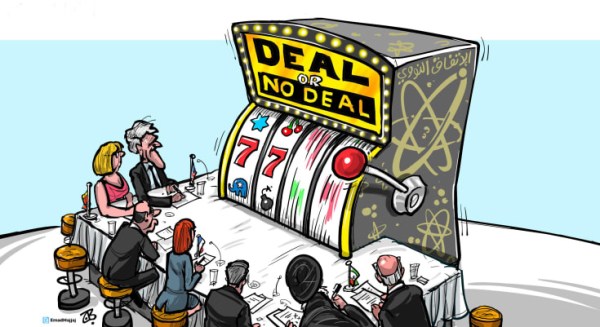
Phot Credit: Emad Hajjaj | Copyright 2015 Cagle Cartoons
Title: (Sadly) The Iran Nuclear Deal (JCPOA) is dead. What now for the Middle East?
Video: Ukraine: The Clash of Two Doctrines: The Bush Doctrine Meets the Putin Doctrine. The second in a series..
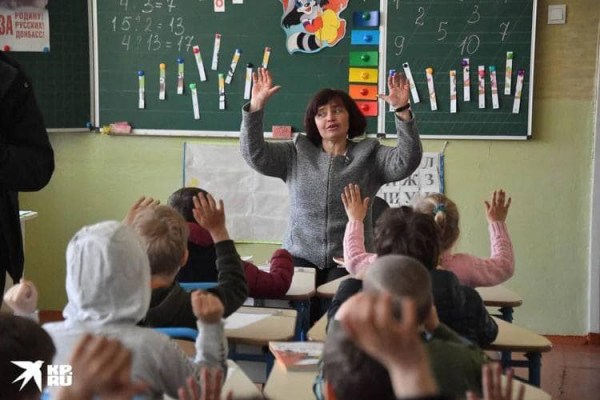
School reopening in Mariupol
Video: Ukraine: The Clash of Two Doctrines: The Bush Doctrine Meets the Putin Doctrine
The second part of a three part series on the war in Ukraine, or as the Russians refer to it, the Special Military Operation with Ibrahim Kazerooni and myself, Rob Prince. Part One
Kazerooni, originally from Najaf, Iraq has a joint PhD from the University of Denver’s Korbel School of International Studies and the Iliff School of Theology. Rob Prince is a retired Senior Lecturer of International Studies from the University of Denver’s Korbel School of International Studies. For the past 12 years the two have been monthly commentators on Boulder, Colorado’s public radio station – KGNU – on Hemispheres, Middle East Dialogues hosted by Jim Nelson. They have also produced programs on the situation in the Horn of Africa, and now this series on the Ukraine war.
Ukraine: The Clash of Two Doctrines: the Bush (Cheney) Doctrine Meets the Putin Doctrine: NATO and the War in Ukraine. The second in a series…with Ibrahim Kazerooni and Rob Prince
Live: Thursday, June 23, 2022 @ 8 pm (Mountain States Time)
“We Stand With Ukraine” signs abound. Translation: “We Stand With NATO” NATO’s Role, Goals in Russia’s Special Military Operations in Ukraine. NATO – the elephant in the room in the Ukraine war.
Links: YouTube:
For more info: robertjprince@gmail.com
Why Is Saudi Arabia’s Prince Salman Smiling?

Why is this man smiling? (photo credit – Finance Twitter)
So…. here we go again.
Forget all the contrived outrage over the Saudi breathtakingly brutal torture and murder of Jamal Khashoggi in the Saudi consulate in Istanbul. Or Joe Biden’s long forgotten campaign promise to render Saudi Arabia into a pariah state. When push comes to shove – as it has over global energy supplies – Washington’s “human rights concerns” evaporate. Poof… gone and quickly forgotten.
As news filters out about the Biden Administration’s upcoming visit to Saudi Arabia and the United Arab Emirates next month, it appears that the American president’s trip is about more than simply requesting that the two Middle East oil and gas producers increase production to meet growing global demand, although that is an essential part of the mix.
Is a Washington-Riyadh enhanced security relationship in the making, one that will include (the usual) flooding the region with U.S. aid, arms sales and more troops on the ground in both countries in exchange for yet closer cooperation with Washington?
Frankly there is nothing new – beyond the yet to be determined size of the package the Biden Administration will offer – in showering Middle East oil producers with their medieval governments and Wahhabist religious orientations with big bucks and military hardware. Same old song, just a new version. Nor will it work again.
My own cynical take: the Saudis are learning from their arch rival Turks how to have the best of both worlds – to use enhanced relations with Russia and China to extract more financial and security concessions from Washington and its European allies. Both the Trump and Biden Administration have been worried – if not panicked – over improved Saudi and Emirate relations with China and Russia and the increased trade and energy flows involved.
The other concern: Iran’s growing regional influence despite all U.S. and Israeli efforts to counter it with sanctions (now more than 40 years of these) and Israeli thinly veiled denials of targeted assassination programs. The apparent failure of the negotiations to get Washington to return to the Joint Comprehensive Plan of Action (JCPOA – Iran Nuclear Deal) has resulted in Iran’s increased enhancement of nuclear fuels. The growing cooperation between Iran, Russia and China has boosted Iranian confidence not to give in to Washington’s pressures.
No doubt the balance of power in the Middle East – as in the world at large – is shifting away from Washington’s “unipolar” global dominance and moving, to Washington’s (and Tel Aviv’s) dismay, toward more “multipolar” arrangements. Watching regional allies formally considered entirely within the U.S. camp – Turkey and Saudi Arabia – in particular – open serious and cordial relations with Russia and China must result in serious heartburn for the likes of Jake Sullivan and Anthony Blinken..
The solution, the only solution both Democratic and Republican Administration’s seem to have in their tool kits: throw money, military hardware, and troops into the mix in an effort to stop History.
Ukraine Fighting at a Crossroads; Possibility of a Negotiated Settlement Exists, But Remains Unlikely

Battle front, Northern Donbas. June 14, 2022
Defining moment of Russia’s Donbass campaign… Battle of SIEVIERODONETSK at crucial stage of victory for Russian forces. With the only remaining bridge across Seversky Donets River destroyed earlier today, Ukrainian forces are practically encircled in Sievierodonetsk, their strategically important stronghold in eastern Donbass, unable to retreat to neighbouring/twin city of LYSYCHANSK. Russian forces have reached Sievierodonetsk city centre. Capture of Sievierodonetsk & Lysychansk will position them to advance farther west toward KRAMATORSK, & if Kramatorsk falls, Russian forces will in effect be in control of the whole Donbass region.
Bhadrakumar Melkulangara (retired Indian diplomat)
Following the military situation in (what was – and is no more) Eastern Ukraine is not for the feint hearted., but this brief explanation (the map) sums up the situation as I have come to understand it. A broader map of the region would put this detailed snapshot in better focus… but the essence is accurate… Should the local Luhansk and Russian troops breakthrough to Lysychansk and then on to Slovyansk and Kramatorsk – it will mark the end of “Phase Two” of Russia’s Special Military Operation in the Donbas.
Expect there will be a “Phase Three” although what it will be is unclear… Possible that negotiations could follow although after the failure of such at Istanbul – after both Washington and London put pressure on the Zelensky government not to proceed – I do not know if the Russians, frankly, are interested or even trust the process. With Russia and its local allies having the upper hand militarily, each time Kiev refuses to negotiate, Ukraine loses more territory.
That said, as, from where I am sitting, this war is essentially one in which Ukraine is a little more than a proxy for NATO/US to weaken Russia (using the Ukrainian military as nothing less than cannon fodder) and if possible overthrow the Putin government, at this point we can say the following:
- a. all attempts to weaken Russia strategically on the part of Washington through the Ukraine have, to date, failed. To the contrary. Washington seriously underestimated Russian economic and military strength as well as it diplomatic acumen, a classic case of underestimating the situation/strengths of an adversary and exaggerating Washington/NATO strength.
- b. Russia and its allies in the Donbas (whose actual role in the fighting has been ignored or denied) have given NATO/US a bloody nose – one that will inspire others to stand up to NATO/US. Seems pretty clear that NATO has met its match on the battlefield will suffer humiliation as a result (and already has).
Will look at the broader geo-political consequences of all this – the beginning of what is shaping up to be “two world systems” (and probably a third, the Global South that is not interested in taking sides for or against either US/NATO nor China-Russia-Iran) to follow in the next week when the political dust settles a bit (if it ever does).
All We Are Saying is Give Peace A Chance – Time to Revive the Movement Against Nuclear War Before It’s Too Late.

Anti-Nuclear Rally in Central Park on June 12, 1982, in New York City. , PL Gould / Getty Images
(Some thoughts: The article below came today by email. It was written by lifelong friend and companero Michael Myerson. It is Michael’s story but in some ways also mine as well (although I was in Colorado at the time of this great demonstration, not in NYC). I want to share it, It deals with some (not much) stuff concerning the Communist Party and with the work we did with the U.S. Peace Council. This piece, a sort of memoir, details how the Peace Council was founded, what it was and how it was involved in organizing a massive peace demonstration in NYC in association with the Second Special Session on Disarmament on June 12, 1982. That demonstration is considered – and I have never seen anything to disprove it – the largest demonstration in U.S. history and brought together more than a million people. On the same day there was one in Colorado that brought together some 40,000 people to hear John Denver and Jimmy Buffet and to talk about nuclear disarmament. Forty years on, today, I remain proud to have been a part of both organizations – for all their warts… the best political work of my life is what I did with the U.S. Peace Council, the most sustained contribution to the common good… working for peace! still is. Nothing comes close. All this is history – it’s more than 30 years that I left, rather unceremoniously, both organizations… nor have I joined any others since, nor will I… but, as long as I’m still able, I’ll do what I can to work for peace and do it essentially along the same lines as I did those precious years – with working class people, people of color. Gotta. Gotta do what we can, modest as it is
All We Are Saying Is, Give Peace a Chance. 40th Anniversary of the Demonstration in Support of the U.N. Second Special Session on Disarmament – Guest Blogger, Michael Myerson.
The contributions to the peace movement as a whole that we hoped to make with the U.S. Peace Council were 1) to develop a working-class component, and one that was multiracial and multinational; 2) to make clear the relationship of an economy dominated by the military-industrial complex and short-changing, not to mention impoverishing working-class communities—especially communities of color—and their essential needs: good housing, good schools, good healthcare, and such; 3) and to embrace and integrate the twin concerns of nuclear disarmament and national liberation.
Beats me how I came to head up the U.S. Peace Council. I mean, I know that I was asked to do so by the Communist Party, but have no idea why, of all people, I was the chosen one.
I was hardly an obedient Communist golden boy, readily submissive to discipline, willing to carry out instructions unthinkingly, eager to repeat any nonsensical wisdom received from the Party leadership. In the 13 years I’d been a member, I had already been “brought up on charges” several times—each time by a Central Committee or Political Bureau member, including three times around unauthorized international travel.
Moreover, much as I was distrusted and perhaps feared in some small way for my independent international travel, the Party leaders must have known I had no interest in undermining them. Truth be told, I rarely considered them at all.
Meantime, besides my engagement with and travel to Vietnam and Cuba, and work with the Tricontinental Information Center, I had been actively engaged with the Movemiento Pro-Independencia (later the Partido Socialista) de Puerto Rico, and had organized the US participation in the centennial celebration of El Grito de Lares, the first Puerto Rican uprising against Spanish Rule in 1868. I had also worked actively in support of Northern Ireland civil rights during the years of “The Troubles” and had twice traveled to Dublin and Belfast and points in between, hosted by the Official IRA/Sinn Fein and the Northern Ireland Civil Rights Association headed up by Communist Party leaders in Derry and Belfast. (My work with Ireland seemed to completely escape the notice of the US party leadership which took no interest in the issue.)
The point being—as a consideration of my being selected to organize the U.S. Peace Council—that I actually knew stuff. Through my relationships in NY with the PLO and the Democratic Front for the Liberation of Palestine (DFLP), a Marxist component of the PLO, I came to know the UN ambassador from the Democratic People’s Republic of Yemen (DPRY), the then-independent Marxist-led country of South Yemen, whose capital was Aden. Consequently, though holding no position in the leadership, I became the conduit for invitations to the Party to send a delegation to South Yemen and Lebanon to establish party-to-party relations with the DPRY, DFLP, PLO and Communist Party of Lebanon. Read more…

Munch’s The Scream… Metaphor describing the state of the country, the world.
KGNU – May 31, 2022 – Hemispheres – Middle East Dialogues
(Ibrahim Kazerooni and Rob Prince discuss Unilateralism and Multilateralism Clash In Ukraine and the Middle East, Part One)
Jim Nelson (producer): We’ll jump right into the program.
Tonight’s program is going to be how events in one part of the world influence can effect events in another part – in this case, the impact of the Russian Special Military Operation in Ukraine’s impact on the Middle East.
As Ibrahim and Rob have discussed many times, the conflicts in somewhere else in the world impacts regional dynamics, as it does in the Middle East. On a global level – the Ukraine conflict is simply one front in a global competition between two world views – U.S. led unipolarism, which understands the United States to be the world’s dominant force and on the other hand, the growing impact and influence of multi-polar approaches headed up by Chinese-Russian cooperation.
Is the dominance of the U.S. unipolar worldview “almost over”?
Ibrahim and Rob will look at three themes that underline this:
– Turkey’s new initiative to horse trade its veto for Finland and Sweden entering NATO with a green light to invade Northern Syria
– The vote in the Iraqi parliament against normalizing relations with Israel
– The JCPOA is running out of steam
Ibrahim Kazerooni: Yes, I’ll begin.
You contextualized the situation well enough. Rob and I have been engaged in this discussion.
Unfortunately, one of the problems that we have in the West with political pundits discussing different political conflict, situations and crises is that these commentators are not prepared to go
to do in depth analysis by looking at the factors that feed into a particular conflict.
We believe there is no current event, conflict without a broader historical and political context. Read more…

Turkey, rejected by the European Union turns east and south
“The Changing Middle East Landscape – It’s Overflow Impact on the Middle East: ” KGNU, Hemispheres, Middle East Dialogues produced by Jim Nelson; Tuesday, May 31, 2022; 6-7 pm MST; 1390 am. 88.5 fm (in Colorado) or streaming at http://www.kgnu.org
Ibrahim Kazerooni and Rob Prince discuss some of the regional consequences of the Russian Special Military Operation in Ukraine on some Middle East developments including Turkish expansionism in Syria, the Iraqi Parliamentary vote against normalizing relations with Israel, and the JCPOA on its last legs.

According to the Russian government, the two Donbass republics the Luhansk and Donetz Peoples Republics have been liberated, indicating that Russia has no intention of returning them to Ukrainian sovereignty, which neither republic wants anyhow (photo credit: al Jazeera)
The Mainstream U.S. and Western Narrative on Ukraine: Poison to the Soul and War Porn
A Colorado friend of mine (one Chester McQueary) refers to the mainstream media reporting on Ukraine as “poison to the soul”, “war porn”. I could not agree with him more.
Given its intensity, we all know the routine that has been drummed into our heads:
Ukraine’s David is a match for the Russian Goliath: in fact, Ukraine is winning on the battlefield and the Russians are bogged down in an Afghanistan-like quagmire (the 1979 version). Vladimir Putin is nothing short of Satan – or Hitler – incarnate and besides he is dying of cancer. The Russian military is an ineffective fighting force with poor training and mass desertions.
Add to this that NATO involvement is negligible, that the Russian-speaking regions of Ukraine suffered no discrimination or repression the past eight years and that the neo-Nazi influence in Ukraine’s military, security and intelligence apparats have been exaggerated.
This rounds out the false narrative.
The above description was the coordinated drumbeat from the mainstream media in the United States, UK (where it was even more strident) and much of Western Europe. While there are many examples of this form of “war porn” that could be cited, I zero in on one in particular, the April 30, 2022 edition of the British Economist, that well written, often interesting weekly of which the foreign policy coverage is often little more than a well-articulated version of Fox News.

Kherson, whose population just voted to sever their ties with Ukraine and become a part of Russia
Below a link (and full text) to the NY Times op ed of May 19, 2022 – a striking document, considering the fawning approach that the Times has given to the Ukraine war, tailing the interpretations, narrative of the U.S. State Department down to the last detail and then suddenly, or so it appears – it breaks ranks with an editorial that must have made Ukrainian Volodymyr Zelensky’s blood boil.
An indication of just how upset Zelensky is with the growing calls for him to negotiate with Russia “under the circumstances” can be read here (and in this article the language used to tell Henry Kissinger where to go has been greatly “cleaned up.”)
Until now, the Times, like the rest of the U.S. pliant media, has been engaged with nothing less than NATO triumphalism – the Russians are losing the war, their troops in Ukraine are dispirited, they have suffered many defeats, etc., etc,. all of which are, from the point of view of objectivity, little more than fantasy. U. S. State Department’s push to throw money and weapons at Kiev is in part to prevent the Ukrainian government from completely collapsing and to extend the timeline of the war as long as possible, the logic being that Russia cannot sustain a longterm military engagement, it will become exhausted and be forced to give ground, perhaps withdraw from the territories it has won in Ukraine.
Ironically, now the Times, and with it certain segments of the U.S. ruling class are singing a different song and some of the above logic has turned on its head. Now it is those elements in power in Washington themselves who are increasingly worried about an extended war, fearing a comprehensive collapse – both of Washington’s sanctions policy to strange the Russian economy and NATO’s war effort. For the first time, at least in the open, the Biden Administration fears an imminent Ukrainian military collapse in the Donbas, one that will do untold damage to U.S. prestige globally. Besides the Times, and the 56 or so Republican congresspeople who voted against the recent $40 billion appropriation to Ukraine, the Administration has shuffled out Henry Kissinger to give essentially the same message to the World Economic Forum in Davos as the Times’ May 19 editorial. Several others in Davos, including Joe Biden confident Chris Coon (D-Maryland) are also casting doubts about what Washington has gotten itself into in Ukraine. While still a minority within the Washington power structure, still the these U.S. voices are beginning to articulate a clear message: Washington should cut a deal with Russia as soon as possible to avoid an even more devastating defeat, to cut their losses while they still can.
Why this change of heart which, at least publicly, has only come to the fore in recent days?
I want to suggest a couple of themes:
- At least some Washington “insiders” have come to understand that the Ukrainian military is not only not winning the war in the Donbas, but is about to suffer a defeat, some say is catastrophic, from which the country will not recover, that the Donbas and Crimea are lost permanently to Russia. There is the danger that as the Ukrainian military in the Donbas collapses, that the rest of military resistance in the rest of Ukraine will follow suit and collapse like a house of cards, as the saying goes. Quite a different narrative than the one spoon-fed to the American public. Nothing less than American global prestige is at stake
- While the U.S. media has tried to downplay the neo-Nazi influence in the Ukrainian military and intelligence apparatus, this particular denial is wearing thin, especially as the crimes committed by the Azov Battalion and like outfits become more obvious. Many of those Azov Battalion elements that surrendered from the Azovstal Steelworks in Mariupol, in an embarrassing gesture, kept videos of the tortures and killings they committed on their cell phones, now all in Russian hands. Even without that, the level of the terror these (mostly U.S. trained) elements perpetrated on the Russian speaking people of Eastern Ukraine over the past eight years cannot be hidden or denied. It’s a little embarrassing, no? that the U.S. trained and armed the same elements it fought so hard to defeat in World War II.
- Some here in the USA might not think this particularly dramatic but the revelations that the United States was operating and funding a series of biological and chemical weapons laboratories in the Ukraine which were toying with developing pathogens specifically targeting Slavic people will be, I suggest, nothing short of a political nuclear bomb going off. Nothing less. The Russian government has already released damning documents on this subject, but these document releases are just scratching the surface.
- Although during the first few days of the Russian Ukraine invasion, Europe “stood strong” with Washington, we are seeing that unity tear some especially over the issue of the sanctions placed on Russian oil and natural gas. Major German corporations are in conflict with the German government over this. Poland and Norway are in a spat as Norway refuses to supply Warsaw with any of the moneys it is earning from high oil and gas prices; Hungary finds itself at odds with a furious European Union leadership – Budapest will veto any EU attempt to extend sanctions against Russia to oil. And then there is the growing antagonism between Turkey on the one hand and Sweden and Finland on the other over Turkey’s refusal (at least to date) to permit Finnish and Swedish entry into NATO. Is Western unity over Ukraine falling apart? No, not yet, but the tensions continue to grow especially as, to dates, Western sanctions have hurt Europe far more than they have Russia.
It is with all this in mind that readers should consider the NY Times editorial (the link is here), full text below for those who do not subscribe:
The War in Ukraine Is Getting Complicated, and America Isn’t Ready
Editorial Board – May 19, 2022
By The Editorial Board
The editorial board is a group of Opinion journalists whose views are informed by expertise, research, debate and certain longstanding values. It is separate from the newsroom.
The Senate passed a $40 billion emergency aid package for Ukraine on Thursday, but with a small group of isolationist Republicans loudly criticizing the spending and the war entering a new and complicated phase, continued bipartisan support is not guaranteed.
Avril Haines, the director of national intelligence, warned the Senate Armed Services Committee recently that the next few months may be volatile. The conflict between Ukraine and Russia could take “a more unpredictable and potentially escalatory trajectory,” she said, with the increased likelihood that Russia could threaten to use nuclear weapons.
These are extraordinary costs and serious dangers, and yet there are many questions that President Biden has yet to answer for the American public with regard to the continued involvement of the United States in this conflict.
In March, this board argued that the message from the United States and its allies to Ukrainians and Russians alike must be: No matter how long it takes, Ukraine will be free. Ukraine deserves support against Russia’s unprovoked aggression, and the United States must lead its NATO allies in demonstrating to Vladimir Putin that the Atlantic alliance is willing and able to resist his revanchist ambitions.
That goal cannot shift, but in the end, it is still not in America’s best interest to plunge into an all-out war with Russia, even if a negotiated peace may require Ukraine to make some hard decisions. And the U.S. aims and strategy in this war have become harder to discern, as the parameters of the mission appear to have changed.
Is the United States, for example, trying to help bring an end to this conflict, through a settlement that would allow for a sovereign Ukraine and some kind of relationship between the United States and Russia? Or is the United States now trying to weaken Russia permanently? Has the administration’s goal shifted to destabilizing Vladimir Putin or having him removed? Does the United States intend to hold Mr. Putin accountable as a war criminal? Or is the goal to try to avoid a wider war — and if so, how does crowing about providing U.S. intelligence to kill Russians and sink one of their ships achieve this?
Without clarity on these questions, the White House not only risks losing Americans’ interest in supporting Ukrainians — who continue to suffer the loss of lives and livelihoods — but also jeopardizes long-term peace and security on the European continent.
Americans have been galvanized by Ukraine’s suffering, but popular support for a war far from U.S. shores will not continue indefinitely. Inflation is a much bigger issue for American voters than Ukraine, and the disruptions to global food and energy markets are likely to intensify.
The current moment is a messy one in this conflict, which may explain President Biden and his cabinet’s reluctance to put down clear goal posts. All the more reason, then, for Mr. Biden to make the case to American voters, well before November, that support for Ukraine means support for democratic values and the right of countries to defend themselves against aggression — while peace and security remain the ideal outcome in this war.
. Putin “cannot remain in power,” Defense Secretary Lloyd Austin’s comment that Russia must be “weakened” and the pledge by the House speaker, Nancy Pelosi, that the United States would support Ukraine “until victory is won” — may be rousing proclamations of support, but they do not bring negotiations any closer.
In the end, it is the Ukrainians who must make the hard decisions: They are the ones fighting, dying and losing their homes to Russian aggression, and it is they who must decide what an end to the war might look like. If the conflict does lead to real negotiations, it will be Ukrainian leaders who will have to make the painful territorial decisions that any compromise will demand.
The United States and NATO have demonstrated that they will support the Ukrainian fight with ample firepower and other means. And however the fighting ends, the United States and its allies must be prepared to help Ukraine rebuild.
But as the war continues, Mr. Biden should also make clear to President Volodymyr Zelensky and his people that there is a limit to how far the United States and NATO will go to confront Russia, and limits to the arms, money and political support they can muster. It is imperative that the Ukrainian government’s decisions be based on a realistic assessment of its means and how much more destruction Ukraine can sustain.
Confronting this reality may be painful, but it is not appeasement. This is what governments are duty bound to do, not chase after an illusory “win.” Russia will be feeling the pain of isolation and debilitating economic sanctions for years to come, and Mr. Putin will go down in history as a butcher. The challenge now is to shake off the euphoria, stop the taunting and focus on defining and completing the mission. America’s support for Ukraine is a test of its place in the world in the 21st century, and Mr. Biden has an opportunity and an obligation to help define what that will be.
XXXXXXXXXXXXXXXXXXXXXXXXXXXXXXXXXXXXXXXXXXX

Avocet feeding. Clear Creek Valley Park. May 4, 2018
The photo above is three years old. I am beginning to get out and about a bit more, now two months after knee replacement surgery. Still a ways to go; I am starting to walk a little better, but slowly, not very far and with a cane. And I am tired after what is more a stroll than a brisk walk. I still don’t carry a camera so while I did some avocets on today’s outing, the one in this photo is not one of them.
Anyhow…
A sunny day at the tail end of a cold spell here in Denver. Temperature was 65 degrees with 10 mph winds from the north. Because of the winds it felt colder and I wore a jacket.
Usually this time of year the bird life in the pond is extensive and active; today less so. Still over the 45 minutes from 11:30 am to 12:15 pm there was enough to keep me busy and entertained. The short list included:
- both a great white and great blue heron fishing
- some avocets, about a dozen
- a pelican sunning itself on a dry island in the middle of the main pond (there are five ponds there). Although I have seen pelicans throughout the Denver metro area over the years, not so at Clear Creek Valley Park in S. Adams County until today
- a snowy egret
- a few mallards and the ever present ubiquitous Canada geese, again in modest numbers
- a muskrat making its way across the pond from east to west
- a half dozen turtles, some sunning themselves on the sand bars, others swimming in the nearby waters.
That great variety of ducks that often found shelter and sustenance at Clear Creek Valley past years was missing other than a few mallards and one lonely cormorant.
Still an enjoyable outing.

Mariupol celebrating the victory over Nazi Germany in WW2 and the liberation of the city from Ukrainian neo-Nazi Azov Battalion on May 9, 2022
Since the war in Ukraine began – call it what you want – the Russian invasion, the Special Military Operation – the media here in the USA – and even more so in UK – has been magnifying Ukrainian victories (there have been some, a few actually, but none of what might be described as strategically important), and claiming that the Donbas republics and Russian troops are bogged down, dispirited, creating war crimes, etc., most of which is what psychologists refer to as projection.
Of course nothing, or very little, about the defining influence of neo-Nazi elements like the Azov “Battalion” and like ultra-right wing militias, NATO and US trained, nor of their eight year record of torture, brutality and ethnic cleansing of Ukraine’s Russian speaking population.
It is this false notion that the Ukrainians are “winning” or at the very least “holding their own” against the more powerful Russian military that is, at least in part, the basis for Washington and the EU throwing money and weapons’ systems in the direction of the Kiev government. It’s easier to justify that which is unjustifiable if the contrived narrative suggests that the side Washington is supporting has a shot – however distant – at winning. No?
It is that narrative of the spunky Ukrainian military standing up to the Russian grizzly bear that is collapsing before our eyes. The article below (in French mostly) details the latest battlefield situation.
 This is a first of three – possibly four live videos on the crisis in Ukraine – call it what you will, the Russian invasion of Ukraine, the Russian Special Military Operation.. The media and government frenzy – as a major component of the hybrid warfare unfolding over the Russian military operation in Ukraine has never been more pronounced, if not shrill. The very intensity of the propaganda war has resulted in two, possibly more, competing narratives as to the nature of this conflict, who is involved, who is “winning.” We, Kazerooni and Prince, have decided it is high time for us to add our understanding of the conflict – what it is about, in a number of live interviews.
This first video to be aired as noted above in a few days – on Wednesday, May 25 @ 8 pm Mountain States Time will deal with the more global dimension of this situation, that is to say the emerging and now relatively obvious growing class – economic, political and military – between what might be called U.S. unipolarity (U.S. global hegemony) and the emergence of a formation which frankly, has existed for a number of years – a multi-polar world in which none of the major players have primacy or hegemony over one another.
It is this global aspect we want to probe, explore, and in so doing, place the Russian military presence in Ukraine within its broader framework. As inow envisioned, the program will last about a half an hour more or less.
Other programs over the next week will look at the regional dimension of the crisis and one or two programs on the historical development of it within Ukraine itself.
We hope that you will find it useful.
Ibrahim Kazerooni just recently retired as Imam of the Islamic Center of North America – the largest mosque on the continent located in Dearborn Michigan just outside of Detroit. The Detroit-Dearborn area , has the largest Islamic-Arab Community in North America. Kazerooni, originally from a family of religious scholars from Najav, Iraq received a joint PhD from the University of Denver’s Korbel School of International Studies and the Iliff School of Theology in Denver, Colorado.
Rob Prince retired Senior Lecturer of International Studies at the University of Denver’s Korbel School of International Studies after 23 years at that institution. For the past 12 years he and Kazerooni have been monthly political commentators on Middle East affairs on Boulder, Colorado’s public radio station – KGNU Boulder. The program is called “Hemispheres: The Middle East Dialogues” produced by Jim Nelson.
The links if you want to watch live: On YouTube – https://www.youtube.com/watch?v=YwHFprG84Kg
On Facebook – https://streamyard.com/view_on_platform/facebook?link=https://www.facebook.com/10157922805818884/videos/428080175368838
Ukraine War (Russian Special Military Operation) – Brief discussion on sources; An Annotated Bibliography
(This blog entry was slightly revised and updated several times, the most recent on March 5, 2023)
My position:
This is a war, the current conflict in Ukraine, planned for eight years by Washington and executed through proxies in Europe (the Zelensky government, NATO, etc).
- The domestic agenda of the Zelensky government is nothing short of a full scale ethnic cleansing, expulsion of the Russian population of Ukraine that has been proceeding in full force since the 2014 Maidan coup, one orchestrated by the U.S. (Victoria Nuland) and the UK.
- It is a part of an effort to pressure Russia, cause socio-economic conflict there to bring down the Puin government and replace it with “more pliable” “Yeltsin-like” leadership that then could be used to partition Russia into smaller units more easily accessible to Western corporate and financial penetration and then do likewise to its main geopolitical target: China.
- The Ukrainian military buildup on the borders of Russia is a part of a more global effort to surround both Russia and China to weaken the challenge these two countries represent to U.S. global hegemony. Western pressure on Russia is because the current Biden Administration has decided that “breaking Russia” is easier at this point than breaking China and that to accomplish regime change in Russia would make isolating and pressuring China that much more possible.
Any serious analysis of the causes of this war – call it what you want – the Russian invasion, Russian special military operation… doesn’t matter. The crisis itself must be understood in its global, not local context: the emerging, very much obvious, struggle between dying U.S. unilateralism, global hegemony and the emergence of a multi-polar world in which no one country – especially Washington – calls the shots.
To only look at the Ukrainian crisis as beginning on February 24, 2022, when Russian troops entered Ukraine from six different points from the north, east and south results in a skewed understanding of a conflict that has been going on – in the military realm for at least eight years. The more limited approach confuses, as is often the case – “the forest from the trees.” It also results in confusing the perpetrator from the victims, the victims in this case being the Russian-speaking populations of Ukraine; the perpetrator being the Kiev government, itself little more than a pawn, a proxy for U.S. dominated NATO. Such an approach avoids, no cancels what has been an eight year of what amounts to ethnic cleansing of Ukraine’s Russian speaking population, eight years of war against the separatist Donbass republics that resulted, according to OCDE sources of 16,000 deaths, overwhelmingly in Ukraine’s Russian speaking areas. It also denies the very real and extensive Nazification of the Ukrainian military and Ukrainians society in general that celebrates and lionizes the life of Stefan Bandera – Ukrainian Nazi collaborator responsible for the murder of Ukrainian Poles and Jews during World War II. The United States has been planning, preparing for a military confrontation with Russia in the Ukraine for at least eight years goin back to the 2014 Maidan coup which brought to the scene a U.S. proxy government in Kiev which remains in power today. Read more…
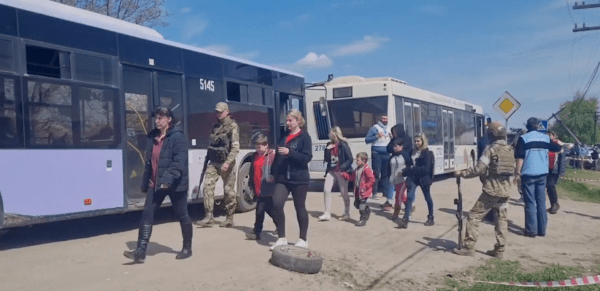
Hostages being released from the Azovstal Steel Complex, held there by the neo-Nazi Azov Battalion. The release was organized by UN Secretary General Antonio Guterres and carried out by the United Nations and the Red Cross.
Russians are on the verge of dealing a crushing defeat to the US and NATO in Ukraine, which will impact the world order for decades to come – MK Badrakumar
(Note 1: Scott Ritter is a former US Marine Corps intelligence officer and author of ‘SCORPION KING: America’s Suicidal Embrace of Nuclear Weapons from FDR to Trump.’ He served in the Soviet Union as an inspector implementing the INF Treaty, served in General Schwarzkopf’s staff during the Gulf War, and from 1991 to 1998 served as a chief weapons inspector with the UN in Iraq. Mr Ritter currently writes on issues pertaining to international security, military affairs, Russia, and the Middle East, as well as arms control and nonproliferation. Follow him on Twitter @RealScottRitter. This article was published at the website RT-America has been banned here in the United States.)
(Note 2: COMMENT by Badrakumar Melkulangara, retired Indian diplomat on social media: “Make no mistake, this piece by Scott Ritter reg Ukraine war is from inside the Russian track. Ritter has been thoroughly briefed by the Russian side… Russians have a frustrating /deplorable history of not caring about optics and image-building and instead focus on their objectives in the heat of the battle. Second World War was a classic example – Hollywood made movies after movies on Patton while Georgy Zhukov remained a relatively obscure hero who turned the tide of the Nazi invasion … Again, legend was that Soviets ‘blinked’ during 1972 Cuban Missile Crisis – whereas, everyone agrees today that they indeed walked away laughing, having got the US nuclear missiles removed from Turkey, which was their strategic objective (unknown even to Fidel Castro!) History is repeating. Russians are on the verge of dealing a crushing defeat to the US and NATO in Ukraine, which will impact the world order for decades to come — Chinese are probably the only ones reading the tea leaves correctly, thanks to their access to information in Moscow. Now the Russians are getting ready to speak up with their version contradicting the established western narrative that they have been ‘defeated’ in Ukraine! Level of confidence is such that they even admit here their own intelligence failures & ‘self-goals’ initially – like the Israelis had suffered in 1973 Yom Kippur War due to flawed intelligence assessment, but only to swiftly turn the table around and crush the Egyptian army eventually.”)
(Note 3: This article is edited because of its length… RJP. For the complete unedited article)
Ukraine is winning the battle on Twitter, but in the real world Kiev is losing the fight for the Donbass
As American officials work with the government of Ukrainian President Volodymyr Zelensky to craft a perception of Kiev’s victory against the Russian military, Moscow is preparing to counter with a harsh dose of reality.
US Secretary of State Antony Blinken, on the heels of a dramatic visit to the Ukrainian capital of Kiev where, together with Secretary of Defense Lloyd Austin, he met with Zelensky, testified before Congress that the goal of the Ukrainians in fighting their two-month-old conflict with Russia “would be to push the Russians out of the territory that they’re trying to occupy in eastern Ukraine.”
Western media coverage of the Ukraine conflict has been so hysterically one-sided, and divorced from reality, that it’s probably only a matter of time before Iraq’s erstwhile ‘Comical Ali’ is brought out of retirement to insist that there are no Russians advancing towards the Ukrainian army’s front lines. Meanwhile, the actual fighting continues to result in a string of defeats for Kiev’s battered forces, who have already lost control of two major cities, despite unprecedented support from the US and its allies.
Blinken added that the administration of US President Joe Biden was providing “full support” to Kiev to achieve this goal. The Secretary of State added that Zelensky’s objective was to degrade the Russian military so that it would not be able to attack Ukraine in the “next month, next year or in five years,” echoing similar sentiments expressed by Lloyd Austin, who had declared that the goal of the US was to “see Russia weakened” so that it cannot “do the kinds of things that it has done [in Ukraine].”
The shared optimism of Blinken, Austin, and Zelensky comes from the joint embrace of a narrative of the Russian military operation against Ukraine which holds that the Russians are in the process of suffering a strategic defeat in Ukraine. But in a sign that this narrative may represent little more than wishful thinking on the part of these three leaders, the US Chairman of the Joint Chiefs of Staff, General Mark Milley, had a more nuanced take, noting that if Russia were to get away with what he termed its “aggression” against Ukraine “cost-free,” then “the global international security order” that has been in place since the end of the Second World War would be put at risk.
Far from projecting a sense of optimism as to the outcome of the Russian-Ukrainian conflict, Milley’s statements reflected a sense of urgency that comes with the recognition that the war in Ukraine has reached a critical juncture.
The gap between perception and reality when it comes to assessing the Russian-Ukrainian conflict is a direct result of the confusing nature of the conflict itself, where a well-oiled propaganda campaign waged by Ukraine and its Western partners, both government and media alike, contrasts with a Russian public relations effort which is reticent to delve deeply into Russian strategic goals and objectives, let alone the day-to-day details of the fighting on the ground. The result is an information war where two competing narratives wage an unequal conflict, and perception is ultimately trumped by reality.
Some harsh truths
Doctrinally, the Russian military was configured for the kind of warfare it had prepared for, where its overwhelming advantages in mass and firepower were optimized to produce the very battlefield results anticipated by most observers — the destruction of enemy defenses in depth with massed fire, followed by an aggressive armored assault that penetrated deep into the enemy rear areas, sowing confusion and disruption leading to the rapid loss of combat effectiveness on the part of those being attacked.
A Russian-Ukrainian war was always going to be primarily a ground war; neither the Ukrainian Air Force nor its Navy was expected to put up a sustained, viable resistance to their Russian counterparts. While the Ukrainian Army had been trained and equipped as a virtual NATO proxy force since 2015, the reality was that it had undergone a rapid expansion from 2014, when it could field some 6,000 combat-ready troops, to its pre-military operation composition of some 150,000 soldiers organized into 24 brigades. The expectation that Ukraine would be able to perfect anything more than basic battalion-sized combined arms operations (i.e., the coordinated employment of maneuver forces with artillery and air support) was wishful thinking.
While Ukraine had placed a great deal of effort in transitioning from an all-conscript military in 2014 to one where some 60% of its combat personnel were professional contract soldiers led by seasoned non-commissioned officers, one cannot create such a force in so short of time. Small unit leadership of the sort that represents the glue that holds a military force together under the strain and duress of sustained combat simply had not had enough time to take hold and mature in the Ukrainian army, leading many to assess that it would fold when placed under the stress of Russian doctrinal warfare.
However, the limitations of the Ukrainian armed forces did not allow it to turn its impressive tactical victories into positive operational and strategic outcomes. Despite costly initial setbacks, the Russian Army pressed home its attack, achieving impressive gains in the south, where Russian forces operating out of Crimea secured the strategic city of Kherson and advanced on the equally important city of Mariupol. There, they joined with Russian and allied forces from the Donetsk Republic to surround the Ukrainian forces defending Mariupol, eventually trapping the survivors, numbering several thousand strong, in the reinforced concrete underworld of the Azovstal steel factory. Further north, Russian forces, together with the forces of the Donetsk and Lugansk republics, advanced westward to drive Ukrainian forces from their prepared defenses to gain control of the totality of the territory encompassing the Donbass region.
The “Battle for Kiev”
While securing the territorial integrity of the Donbass region was one of the primary objectives of the Russian special military operation, to accomplish this Russia carried out extensive supporting operations, which included a diversionary advance toward Kiev designed to fix Ukrainian forces in place and divert reinforcements away from the eastern front, as well as an amphibious feint off the coast of Odessa for the same purpose. For a diversionary attack and/or feint to be operationally viable, it must be believable, which means the forces carrying out the mission must be aggressive in the execution of the diversion, even under unfavorable conditions.
The Russian advance on Kiev was done by a force of some 40,000 men operating on two axes, one heading south, the other pushing southwest from the direction of Chernihiv.
The fact of the matter remains, however, that a force of 40,000 men, no matter how aggressively employed, cannot take, and hold, a city of some three million inhabitants defended by a mix of 60,000 regular, reserve, and territorial soldiers. But this was never their task. “These actions [i.e., the advance on Kiev],” Colonel General Sergey Rudskoy, the first deputy chief of Russia’s General Staff, announced during a briefing on March 26, “are carried out with the aim of causing such damage to military infrastructure, equipment, personnel of the Armed Forces of Ukraine, the results of which allow us not only to tie down their forces and prevent them from strengthening their grouping in the Donbass, but also will not allow them to do this until the Russian army completely liberates the territories of the [Donetsk People’s Republic] and [Lugansk People’s Republic].”
In an indication of both the intensity of the combat involved in the Kiev feint, and the importance of the assigned mission, Russian President Vladimir Putin awarded the honorific title of ‘Guard’ to the 64th Detached Motor Rifle Brigade for its “astute and bold actions” during the Kiev fighting. “The unit’s staff became a role model in fulfilling its military duty, valor, dedication and professionalism,” Putin noted in the accompanying citation (the Ukrainian government has accused the 64th Brigade of committing war crimes in the town of Bucha, north of Kiev, a charge the Russian government vehemently denies.)
The so-called “Battle for Kiev” is a clear-cut example of the difference between perception and reality. The Ukrainian position is that its forces decisively defeated the Russian military on the approaches to Kiev, forcing not only a retreat, but also a complete re-design of the strategic objectives of the special military operation. This point of view has been echoed unquestioningly by a compliant Western media, and embraced by political and military leaders in Europe, Canada, and the US.
One of the major outcomes of this Ukrainian “victory” was the ability of Ukrainian President Volodymyr Zelensky to leverage this perception into a fundamental shift of thinking on the part of his supporters in the West, resulting in an increase in both the amount of money allocated to supplying Ukraine with weapons, as well as the quality of the weapons themselves, as the West shifted away from an emphasis on light anti-tank weapons to more conventional armor and artillery.
Left unspoken was the need for this dramatic change in weapons priority, especially given the fact that Ukraine had, according to its own narrative, decisively defeated Russia using these very same light anti-tank weapons. The reality, however, was that the Russian Phase One operations had inflicted near-fatal damage to the Ukrainian military, killing and wounding tens of thousands of soldiers while destroying the vast bulk of Ukraine’s heavy weaponry — the artillery, tanks, and armored fighting vehicles critical to waging modern combined arms warfare. The reason Ukraine requested more tanks, armored vehicles, and artillery from its Western suppliers is that it had depleted its available stocks.
But equipment was the least of Ukraine’s worries. A military is only as good as its ability to logistically sustain its forces while in combat, and one of the primary objectives of the Russian Phase One campaign was to destroy Ukraine’s fuel and ammunition storage facilities and degrade Ukrainian command and control. The result is that while Ukraine held onto Kiev, it did so at an enormous cost in overall combat effectiveness. And while Russia was able to withdraw from the Kiev front and undergo a period of rest, rearmament, and reorientation (a normal action for military units that had been engaged in virtually non-stop combat operations for a month), the Ukrainian military remained under pressure from incessant Russian aerial attack and bombardment from precision-guided cruise missiles and Russian artillery.
Perception, when subjected to the harsh light of reality, is exposed as little more than wishful thinking. This is very much the case regarding the so-called “Battle for Kiev,” where the Ukrainian military was left holding territory which no longer served any useful purpose for the Russians. Russia was able to redeploy its forces to better support its prime objective, the seizure of Donbass, leaving the Ukrainian forces in Kiev frozen in place.
Mariupol and the battle for Donbass
The battle for Mariupol is another example where perception management clashed with ground-truth reality. The narrative surrounding the present fate of Mariupol is very much a tale of two cities. From the Ukrainian perspective, the city continues to be held by a heroic cadre of fighters who are tying down tens of thousands of Russian forces who otherwise could be redeployed elsewhere, supporting the Russian main effort against Donbass. So long as these defenders hold out, the Ukrainians contend, the vital land bridge connecting Crimea and the Russian Federation will be at risk. Likewise, their continued resistance serves a major propaganda purpose, denying Russia the ability to declare victory prior to the Victory Day celebration of May 9.
Russia, however, has already declared victory in Mariupol. While conceding that a few thousand defenders remain dug into the Cold War-era bunkers underneath the Azovstal steel factory, Russia says that these forces serve no meaningful military value. Indeed, rather than sacrifice Russian troops to dig the Ukrainian forces from their underground lairs, President Putin directed the military to seal off the Azov facility and wait the defenders out.
There is no doubt that the presence of Ukrainians in the Azovstal factory represents a propaganda victory for Ukraine. But the reality is that the city of Mariupol has fallen to Russia; while the Ukrainian defenders, possibly accompanied by thousands of civilians, waste away as their food supplies diminish, the rest of Mariupol is beginning the task of rebuilding a shattered city where an estimated 90% of the buildings have been damaged or destroyed in brutal street-to-street fighting. The Russian land bridge is intact, and the Russian offensive against Donbass is proceeding without delay.
The statements in Kiev by Antony Blinken and Lloyd Austin are a byproduct of the perception of Ukrainian victory shaped by the twin Ukrainian “victories” in Kiev and Mariupol. The reality, however, is that Kiev was a masterful Russian deception that shaped the overall strategic situation in Ukraine in favor of Russia, and the Mariupol battle is likewise finished in terms of any strategic impact on the overall campaign. What is left is the harsh truth of simple “military math” which, when projected onto a map, provides the kind of unyielding fact-based evidence that Ukraine is losing its war with Russia.
The fact of the matter is that the military aid being provided to Ukraine by the West will not have any discernable impact on a battlefield where Russia is asserting its dominance more and more each day. Not only is there not enough equipment being provided. Hundreds of armored vehicles cannot replace the more than 2,580 that have been lost by Ukraine to date, nor can dozens of artillery pieces offset the more that 1,410 artillery tubes and rocket launchers destroyed by the Russian military.
The statements in Kiev by Antony Blinken and Lloyd Austin are a byproduct of the perception of Ukrainian victory shaped by the twin Ukrainian “victories” in Kiev and Mariupol. The reality, however, is that Kiev was a masterful Russian deception that shaped the overall strategic situation in Ukraine in favor of Russia, and the Mariupol battle is likewise finished in terms of any strategic impact on the overall campaign. What is left is the harsh truth of simple “military math” which, when projected onto a map, provides the kind of unyielding fact-based evidence that Ukraine is losing its war with Russia.
The fact of the matter is that the military aid being provided to Ukraine by the West will not have any discernable impact on a battlefield where Russia is asserting its dominance more and more each day. Not only is there not enough equipment being provided. Hundreds of armored vehicles cannot replace the more than 2,580 that have been lost by Ukraine to date, nor can dozens of artillery pieces offset the more that 1,410 artillery tubes and rocket launchers destroyed by the Russian military.
When two military forces of equal size and capability face off against one another, they seek to acquire an operational advantage through the attrition of their opponent’s capabilities which, in combination with effective maneuvering of their own forces, puts the opponent in an untenable situation. The transition from a battle of equals to decisive military victory is often rapid, representing as it does the culmination of acquired supremacy in the form of firepower and maneuver which is brought together in synchronistic fashion, creating a series of tactical and operational dilemmas for which the opponent has no viable solution.
This is the current situation with the Ukrainian military facing off against the Russians in Donbass today. The Ukrainians, lacking any meaningful artillery support of their own, are at the mercy of the Russian artillery and rocket launchers that pound their positions day in and day out, without respite. The Russian troops have taken a very deliberate approach to engaging with their Ukrainian opponents. Gone are the rapid advances by unprotected columns and convoys; now, the Russians isolate the Ukrainian defenders, pound them with artillery, and then carefully close in and destroy what remains with infantry supported by tanks and armored fighting vehicles. The casualty ratio in this fighting is unforgiving for Ukraine, with hundreds of soldiers lost each day in terms of killed, wounded and surrendered, while Russian casualties are measured in scores.
Not only can Russia maneuver virtually at will along the front as it closes with and destroys the Ukrainian defenders, but Russian troops also operate with absolute freedom in depth, meaning that they can pull back to refit, rearm, and rest without fear of Ukrainian artillery fire or counterattacking forces. The Ukrainians, meanwhile, remain pinned down, unable to move without fear of being detected and destroyed by Russian air power, and as such doomed to be isolated and destroyed by Russian troops in due course.
There is virtually no hope of reinforcement or relief for the Ukrainian forces operating on the front lines; Russia has interdicted the rail lines that had served as the conduit for resupply, and the likelihood of any Ukrainian forces which have received heavy weapons provided by the West reaching the frontlines in any discernable strength is virtually zero. The Battle for Donbass is reaching its culminating point, where the Ukrainian military rapidly transitions from a force capable of providing the semblance of resistance to one that has lost all meaningful combat capability.
This is the state of play entering the third month of Russia’s military operation in Ukraine. While the termination of any conflict is always a political question, one thing is for certain — if the operation extends into a fourth month, the battlefield will look vastly different from the one that the world currently sees. The battle for Donbass and eastern Ukraine is all but over. That is the hard reality, and no amount of wishful thinking or perception management by either Zelensky or his American partners can change that.
 View from the Left Bank: Rob Prince's Blog