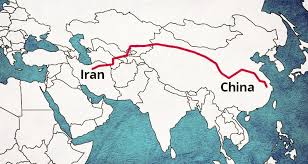
China to Iran – one of the routes of the Belt and Road Initiative. Chinese-Iranian ties have given Iran confidence that it can face down U.S. sanctions successfully
(note on the audio: the audio is unfortunately truncated and only starts about 15 minutes within the interview… What I provide below is a transcript of my notes for that first period. Some of Ibrahim Kazerooni’s open remarks on the status of the JCPOA which followed this intro are lost, unfortunately. The essence of his remarks is that after looking as if at the end of March that an agreement might be achieved, shortly thereafter, the U.S. pulled back on its promises to eliminate sanctions against Iran as specified in the 2015 agreement. Iran refused to sign a statement that it would not seek revenge for the assassination of Qassem Soleimani, killed in a drone rocket attack at the beginning of 2020 for which the Trump Administration took credit. Kazerooni argued (and I agree) that the likelihood of a revived JCPOA agreement has faded to naught. The audio begins with Kazerooni’s comments – and my response to his remarks on the consequences of the agreement’s failure.)
These notes are from the program’s beginning…
Rob Prince: We are now two months into what the Russians refer to as their Special Operation in the Ukraine, what the West is referring to as the Russian invasion of Ukraine…
It is not our goal to talk about the Russian military operation in Ukraine beyond its Middle Eastern effects but we would remind our listeners of a few points:
a. Take your pick of past examples of U.S. military intervention or one done by proxies – have been based on misinformation and lies – “the Gulf of Tonkin all over again.”
In all these cases, the American people have not told the truth and it is only after ten, fifteen years that “the truth” hits us – as happened in Afghanistan.
Why would Ukraine be any different?
b. Secondly, that if your starting point for the Russian invasion of Ukraine is February 24, 2022 – you come to one obvious conclusion about who is responsible for this war…
But if given a little historical perspective – starting with the consequences of the 2014 Maidan coup and the informal Ukrainian integration into NATO, then responsibility for this war, takes on quite a different character.
Our proposition is this: that as the global balance of power between the two blocks (US-NATO- Russia-Chine) shifts, that it is profoundly effecting the geopolitics of the Middle East region that opens up new possibilities – as distant as they might seem today – for greater stability and peace making. Read more…
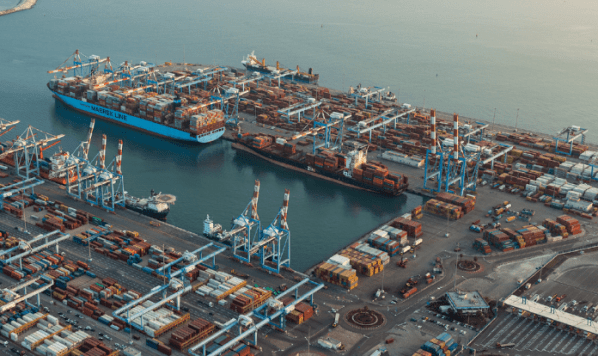
The Bay Port at Haifa on the Mediterranean, will be operated by Shanghai International Port Group for a 25-year period
(Bhadrkumar Melkulangara is a retired Indian diplomat)
The phone call to the Chinese State Councilor and Foreign Minister Wang Yi on Wednesday by Israel’s alternate Prime Minister and Foreign Minister Yair Lapid adds to the tectonic shifts… Lapid reached out to China within 10 days of the visit by Blinken…
The phone call to the Chinese State Councilor and Foreign Minister Wang Yi on Wednesday by Israel’s alternate Prime Minister and Foreign Minister Yair Lapid adds to the tectonic shifts in the geopolitics of the Middle East of late. Lapid reached out to China within ten days of the visit by the US Secretary of State to Israel.
The Chinese readout plays up the Israeli overture, quoting Lapid as making a strong pitch for the two countries who “understand and appreciate each other” to leverage their “strong innovation capacity” for “accelerating the modernisation process.” Lapid stated Israel’s interest in maintaining close high-level exchanges and deepening cooperation in various fields with China.
Wang Yi reciprocated by signalling China’s interest “to push forward bilateral relations to continuously score new achievements with innovative cooperation as a key driving force.” The two leaders agreed to speed up the negotiation and signing of a free trade agreement.
This interaction further points toward the winds of change in Israeli foreign policies against the backdrop of the US disengagement from the region and the lifting of US sanctions against Iran which would likely upturn the established regional order. Read more…
Audio: The Ukraine Crisis – It’s Overflow Impact on the Middle East. KGNU, Hemispheres, Middle East Dialogues; Tuesday, March 22, 2022

Iran. After 43 years of not-stop trying, the U.S. has not been able to achieve its goal of regime change. And now, Washington is offering Iran to drop sanctions in exchange for increased oil production
Middle Eastern countries are either silent or hostile to the Biden Administration’s effort to bring them onboard to support the U.S./NATO position on the Russian invasion of Ukraine, especially where it concerns the imposition of sanctions. What’s it all about? From Mohammed Ben Salman Stiff-Arming The Biden Administration to the U.S. U-turn on returning to the JCPOA (now they are trying desperately to cut a deal with Iran), to Israeli and Turkish angst about their futures – the Middle East – as we have – noted in previous programs is in the process of geopolitical shifts of the first magnitude. The Russian invasion of Ukraine did not trigger these changes but it has magnified them already. Kazerooni and Prince continue the discussion of the Ukrainian conflict’s consequences for the Middle east.
Stay tuned… Tuesday, March 22, 2022 @ 6-7 pm on KGNU Boulder, Colorado, Hemispheres, Middle East Dialogues with Ibrahim Kazerooni and Rob Prince, produced by Jim Nelson.
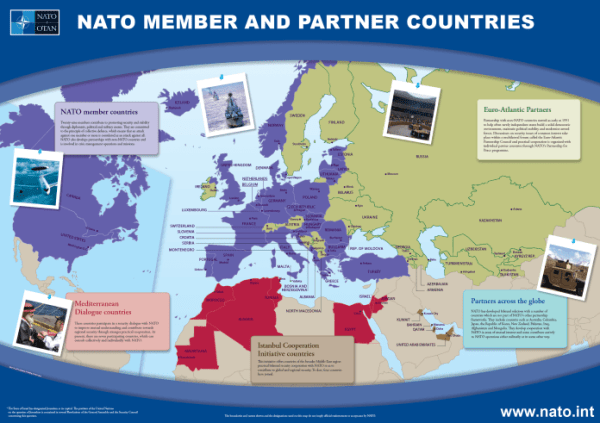
Source: NATO
Middle Eastern countries are either silent or hostile to the Biden Administration’s effort to bring them onboard to support the U.S./NATO position on the Russian invasion of Ukraine, especially where it concerns the imposition of sanctions. What’s it all about? From Mohammed Ben Salman Stiff-Arming The Biden Administration to the U.S. U-turn on returning to the JCPOA (now they are trying desperately to cut a deal with Iran), to Israeli and Turkish angst about their futures – the Middle East – as we have – noted in previous programs is in the process of geopolitical shifts of the first magnitude. The Russian invasion of Ukraine did not trigger these changes but it has magnified them already. Kazerooni and Prince continue the discussion of the Ukrainian conflict’s consequences for the Middle east.
Stay tuned… Tuesday, March 22, 2022 @ 6-7 pm on KGNU Boulder, Colorado, Hemispheres, Middle East Dialogues with Ibrahim Kazerooni and Rob Prince, produced by Jim Nelson.
Tribute to Barbara Hanst, Colorado Palestinian Human Rights Activist Who Just Died by Jane Thomas

Jane Thomas and Barbara Hanst
Mote: The passing of a Colorado peace activist, who worked for Palestinian human rights and against all forms of racism and bigotry. RJP)
Barbara Hanst, the person I was so privileged to call a friend, died yesterday morning. She had been diagnosed with breast cancer last May, and then later diagnosed with lung cancer, for which she endured rounds of chemo and immunotherapy. In December 2021, during a break in treatment, she was well enough to go with me to David Skaggs’ farm to walk the Advent maze designed by members of First Congregational Church. Though tired, she was her usual animated, present self, full of concern about other people. But by the beginning of 2022 she was in terrible pain. At first doctors thought it might be her heart, so she was admitted to the hospital and tested. Her heart was deemed in good shape. But there was still the pain. Then she was diagnosed with COVID, and her oxygen levels plummeted. She was brought back to Frasier Meadows and put on hospice care just a few days ago. Her son Jonathan lives in Lafayette and visited regularly, and her daughter flew in from Maui and was able to stay with her until the end. Memorial services are planned for Boulder, Maryland, and Hawaii.
John Denver from the grave – “Let Us Begin” (to improve our relations with the world’s other major nuclear weapons power, Russia)

YouTube of Webinar: Exposing Israel’s Illegal Child Detention: A Colorado Call – Thursday, March 17, 2022

Beit Ummar, West Bank, Palestine. Ahed Akhil, 24 year old sweet shop (candy store as we would call it) in Beit Ummar, killed by an Israeli security guard and left for five hours to bleed to death in January 2021
Exposing Israel’s Illegal Child Detention: A Colorado Call
Produced by the Colorado Coalition for Palestinian Human Rights. For information contact Jeff Wright at jeffwright103@gmail.com or cfjcolorado@gmail.com
Webinar: Exposing Israel’s Illegal Child Detention: A Colorado Call – Thursday, March 17 @ 10:00 am Mountain States Time
Ahed Akhil, 24 year old sweet shop (candy store as we would call it) in Beit Ummar, killed by an Israeli security guard and left for five hours to bleed to death.
Dear friends and supporters,
On YouTube:
https://www.youtube.com/watch?v=6UROLfRBg2o
On Facebook:
https://www.facebook.com/CFJColorado
Special Guests:
– Rami Khader – direct from Palestine
– Shaina Lowe – No Way To Treat A Child
Colorado Coalition for Human Rights for Palestine Participating Organizations
Boulder Friends Meeting
Boulder-Nablus Sister City Project
Center for Freedom and Justice, Colorado
Colorado Palestine Club
Democratic Socialists of America, Fort Collins
First Congregational Church, United Church of Christ, Boulder
Foothills Unitarian Universalists for Justice in the Middle East, Fort Collins
Friends of Sabeel Colorado, a Christian Voice for Peace
Islamic Center of Boulder (added 1OCT2021)
Jewish Voice for Peace, Denver-Boulder Chapter
The Lemon Tree, Boulder
Veterans for Peace Chapter 120 Boulder
Rocky Mountain Peace and Justice Center
Unitarian Universalists, Palestine Group – Boulder
For information contact Jeff Wright: jeffwright103@gmail.com
Ukraine War Update 2 – March 15, 2022. The State of the War from the Two Opposing Narratives
The second in a series – This one examines the vastly opposing narratives of what is happening “on the ground” in the war, plus the significance or lack there of, of Ukrainian President Zelensky being Jewish
Ukraine War Update 1 – March 13, 2022
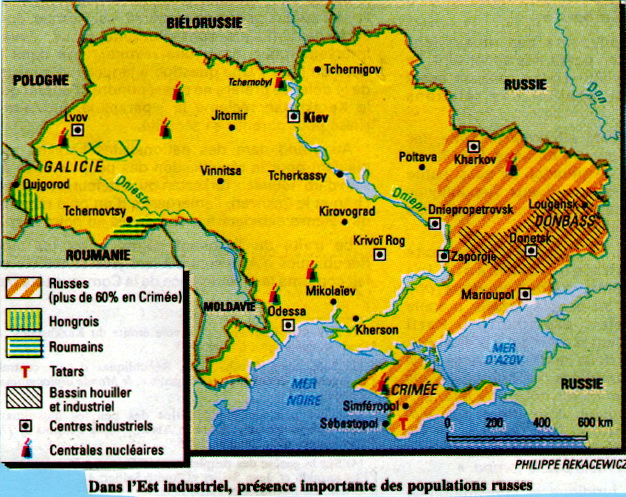
(The purpose of these updates is not to give detailed updates on the situation in Ukraine – the full scale Russian invasion which proceeds apace. Rather it is, at a time of a growing information/analysis blockade, to briefly add to the discussion and provide what to my mind are sources beyond what might be referred to as “the mainstream narrative”… or to make some points that have emerged through various lively discussions with friends. Another purpose, besides trying to break through the media blockade is to provide alternative informations sources that others might use )
- The first entry is lifted from a Facebook post by Fred Weir. I stumble across Weir’s Russian reporting a couple of years ago and have found it much more insightful on Russian developments than what I was reading in the NY Times, CNN, etc. He is also the co-author of a book – Russia’s Path from Gorbachev to Putin: The Demise of the Soviet System and the New Russia, co-authored with David Kotz, in my opinion, the best read on the collapse of the USSR and how Russian society has been organized since.
In what follows, Weir posted a piece from Ivan Katchanovski that appeared in the Ukrainian press detailing Russian demands to Ukraine for ending the war. Although I have heard anecdotally of some of them, I had not seen the demands spelled out so clearly as here. This is what the Russian government says it wants to accomplish politically by invading Ukraine.
ZN.UA стали известны шесть ультимативных требований России к Украине
“Well, there it is. [from Ivan Katchanovski]
Ukrainian media published 6 Russian demands to Ukraine to end the war. The first five of them should be included in the Constitution of Ukraine.
- Refusal to join NATO. Neutral status of Ukraine. Russia is ready to become one of the guarantors.
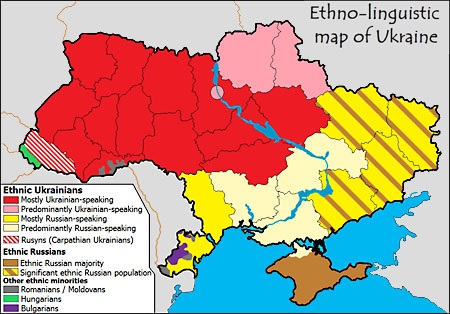
2 Russian becomes the second state language. - Recognition of Crimea by Ukraine as Russian.
- Recognition by Ukraine of the independence of the DPR and LPR within the administrative boundaries of Donbas regions (including the territories now controlled by Ukraine).
- “Denazification”. Prohibition of the activities of ultra-nationalist, Nazi and neo-Nazi parties and public organizations, the abolition of existing laws on the glorification of Nazis and neo-Nazis.
- “Demilitarization of Ukraine”. A complete rejection of offensive weapons.”
2, Bhadrakumar Melkulangara is a retired Indian diplomat who was Indian ambassador to Russia and a number of other countries. His analysis is neither “pro-NATO” nor “pro-Russian”. Extremely sharp analyst who posts regularly on his Facebook page and also on his blog, Indian Punchline, one of the best from where I am sitting. You’ll get a much more accurate picture of what is – and isn’t – happening in the Ukraine (and elsewhere) from following his posts than from CBS News, Financial Times, etc.
There have been a number of posts, emails I have received, etc suggesting that as a result of the Russian invasion of Ukraine, that Putin’s days in power in Russia are numbered, that he is increasingly unpopular and will be swept from power by the Russian people themselves. If you think about it – this is the approach of the so-called “colored revolutions.” My own take is that this is utter nonsense – in spite of the antiwar demonstrations which have erupted in Russia – and that if anything, Russia’s war in Ukraine has strengthened Putin’s position and his popularity.
Responding to this particular line of thinking – the impending doom of the Putin government in Russia – B.M. commented (on social media)
“Popular western narrative about imminent regime change in Russia is bullshit. Their propagandistic narrative has no clue how this conflict in Ukraine is playing out in the psyche of Russian people. Putin’s & United Russia’s popularity is rising! For Russian people, this is Holy War against West (‘Christendom’) which is threatening their religion, race & culture by interfering in the internal affairs of the Orthodox Church & splitting it!”
In response to a question I posed to him about this subject, he elaborated – something worth thinking about:
“Rob Prince – Outsiders often do not know that Russia is a massive country of 11 time zones. And they fall for the propagandistic narrative that a regime change is imminent in Russia (over Ukraine conflict!) as if it can be micro-managed from the West. It is not easy to rule that country while remaining oblivious of the groundswell of opinion among what Marxists would call the ‘masses’. Putin has steadily maintained a rating (by independent pollsters) which is the envy of any politician in a ‘liberal democracy’ – 65-70%. In the past fortnight, Putin’s rating went up from 65% to 71%. For understanding Russia, one must know the language, and if that is not possible for some reason, immerse in Russian literature and music, & travel in that country, visit its churches, mix with that unique human species – ‘Russian intelligentsia’. Such ignorance about Russia is widely prevalent even among academics in India, despite the warm, ‘time tested’ state-to-state relationship. I find that in the US too, Russia studies have sharply declined and are of abysmally poor quality today. Maybe, Americans didn’t anticipate Russia’s infinite capacity to rise from the ashes, despite ample lessons that the country’s tumultuous history provide”
All for today… tomorrow I want to respond to “the Zelensky phenomenon”. A number of old friends have gone on about how since Zelensky is Jewish, how could the Ukrainian government be pro-fascist, or influenced by fascist currents.
Ukraine – The End of History, Fukuyama Celebrating Too Early – Wednesday, March 1, 2022 @ 8:30 pm MST
Ukraine – The End of History, Fukuyama Celebrating Too Early
Wednesday, March 1, 2022 @ 8:30 pm MST
Announcing the first of three interview discussions with Ibrahim Kazerooni and Rob Prince, regular commentators on KGNU – Hemispheres (Boulder, Colorado) on the current crisis in the Ukraine. This one – the global considerations; the second part, the European dimension, the third part the roots of the Russian military offensive into Ukraine.
Without an understanding of how these there levels interact, we argue it is not possible to understand the crisis.
Live Link on YouTube: https://www.youtube.com/watch?v=1mNUzgWPEOc
Live Link on Facebook: Facebook Page – Rob Prince, Denver, Colorado (note – there is a Christian fundamentalist minister with the same name on Facebook. That is not me)
Interview will be posted permanently both on Facebook and YouTube afterwards and will be available on this blog
Ibrahim Kazerooni is an imam at the Islamic Center of America in Dearborn Michigan. He comes from Najaf, Iraq from a long line of Shi’ite religious imams. His family originates from Kazeroon, Iran.
Rob Prince is a (happily) retired Senior Lecturer of International Studies at the University of Denver’s Korbel School of International Studies. Born in Brooklyn and grew up in Jamaica Queens, New York his family emigrated to the United States from Grodno, Belarus and Bialystok Poland. He likes to take photographs of birds.
Audio: The Ukraine Crisis – It’s Overflow Impact on the Middle East. KGNU, Hemispheres, Middle East Dialogues; Jim Nelson, Producer. Tuesday, February 22, 2022

Ibrahim Kazerooni and Rob Prince discuss in the impact of the Ukraine crisis on Middle East politics
The tensions in the Ukraine between NATO/US and Russia continue to heat up. While Ukraine’s fate will influence Europe in more ways than appear, the crisis there is also impacting events in the Middle East and Central Asia, referred to as the “Arc of Instability”, which, although not shown on the map above, is just below. Recently there has been an uptick in tensions throughout the Middle East, Israeli attacks on Syria – and a Syria (unreported) missile response on Galilee, Turkish encouragement to use its mercenary proxies in Idlib province to complicate matters, no end to the Yemen War in site and the possibility that should the Ukraine crisis blow up, that the price of oil and natural gas will explode. The fate of Ukraine – and linked to it, the future of the Nord Stream II pipeline from Russia to Germany, will also greatly influence Middle East politics.
Washington’s Pyrrhic Victory in Europe – The Ukraine Crisis Comes to its Grand Finale

February 22, 2022. Denver, Colorado.
Woke up to the news – all over the NY Times and I assume the rest of the media – Russia has recognized the independence of the Donetsk and Luhansk Republics, which it has not done until now, and will probably send troops to the region to counter the Ukrainian government’s military offensive there, the first attack of which, unreported in the western media, was repelled, but serious enough for the leadership in these regions to call for help.
Russia responded. The Russian decision to send troops to these two regions, frankly, is not to provoke a war but to prevent one – specifically it cuts short the Ukrainian military‘s offensive against the two regions, a military flushed with Western arms and prodded on by Washington
Although I would be rather surprised if their military incursion into Ukraine goes beyond these two break away republics to seize Kiev, which Washington is baiting them to do. There are some reports, yet to be confirmed, that Ukrainian military forces have entered Russia itself. If this is the case, they will be repulsed and made short shrift of.
In the short run, this Washington fabricated crisis will work in the United States’ favor but as the whole affair, crisis, whatever has been so entirely cynical from the outset, the positive results will be short lived, perhaps very short-lived and will morph into a larger global crisis. There are signs of this already. One such sign – in Madrid, a demonstration in support of the Zelensky government drew 500 people, it is reported mostly people of Ukrainian nationality living there. In 2002, just prior to the U.S. led invasion of Iraq, a million people came out in the streets of Madrid to oppose the U.S. Iraq intervention. Nor is there much public jubilation in other European cities. To the contrary and they know, or sense, the events in Ukraine are nothing for Europeans – or anyone else – to celebrate about.
Washington’s pyrrhic victory in the Ukraine killed Nord Stream II; there will be more sanctions against Russia already well prepared. Whimpering Germany and France will return “back in the NATO fold” after a short fling with neutrality and a mores sensible, constructive approach to Russia. Ukraine, in all this, is little more than a sacrificial lamb. This whole affair was less about Ukraine and more about the global geo-political wrestling match between Washington and its sheepish European allies on the one hand and the growing influence and cooperation between Russia and China on the other. Normalizing European ties with Russia made Washington uncomfortable; the Biden Administration had to throw a monkey wrench into it these European (especially German, but also French, Italian ties with Russia) and that they accomplished.
What we – the world is witnessing – is nothing short of a major episode global hybrid warfare, where military confrontation (between great powers) takes a back seat to economic pressures (sanctions), and media struggles over “controlling narratives” or as Chomsky brilliantly pointed out “manufacturing consent”. If you don’t know what that means, look it up; I’m tired of explaining it. Having suffered major political defeats in Afghanistan and Kazakhstan, U.S policy scores a “win” (but not really) over Ukraine by drawing the Russians in on Ukraine militarily into the Donbass region. Biden Administration hopes to ride the Ukraine events out to strengthen their position in the polls for 2022 elections having failed to produce anything of substance domestically. My own take, after a very minor spike upward in the polls, that the Dems are even in more trouble for 2022 than previously.
What we – the world is witnessing – is nothing short of a major episode global hybrid warfare, where military confrontation (between great powers) takes a back seat to economic pressures (sanctions), and media struggles over “controlling narratives” or as Chomsky brilliantly pointed out “manufacturing consent”. If you don’t know what that means, look it up; I’m tired of explaining it. Having suffered major political defeats in Afghanistan and Kazakhstan, U.S policy scores a “win” (but not really) over Ukraine by drawing the Russians in on Ukraine militarily into the Donbas region. Biden Administration hopes to ride the Ukraine events out to strengthen their position in the polls for 2022 elections having failed to produce anything of substance domestically. My own take, after a very minor spike upward in the polls, that the Dems are even in more trouble for 2022 than previously.
For all the hype and the hysterical media vilifying Putin specifically and Russia in general, I have to wonder just how much the American people as a whole care that much about the goings on in Ukraine as the deepening socio-economic and political crisis here at home continues to deepen. It saddens me to see how many good people – liberals, even leftists have swallowed the cool aid on Russia as they did on Iraq, Libya.
In the medium and long term
Concerning Ukraine… Washington has “promised” – based on very little – that it could compensate for Germany – and Europe’s loss of Nord Stream II liquified natural gas from Russia – something that Germany lobbied Russia for and not the contrary – with increased shipments from other places – USA, Algeria, Qatar come to mind although this is questionable as all three have their lng (liquified natural gas) contracts – much of their production already locked up. If Washington cannot deliver on this – and from what I can glean – it really is “iffy” – the price of energy in Europe – and globally – will spike to punishing levels – the price of crude oil itself is already approaching $100 a barrel in some places. One consequence could be an artificially triggered global recession in which Western Europe will take the most punishing hit.
Russia too from these sanctions will take a hit; it will feel it for a couple of years, but as it has done up until now in response to sanctions, it will learn to make due and recover. Geopolitically – obviously – it will strengthen its already solid ties with China, Iran while, I would bet, maintaining some connections with India even if that country is drawn into to U.S. orbit. And Russia will continue to strengthen is position and influence in the Middle East.
In the end this Washington-manufactured crisis – is a road to nowhere.. short term “victory”… of little consequence and another key historical marker on the road to U.S. global decline.
Cheers… Rob Prince/Denver, Colorado

The tensions in the Ukraine between NATO/US and Russia continue to heat up. While Ukraine’s fate will influence Europe in more ways than appear, the crisis there is also impacting events in the Middle East and Central Asia, referred to as the “Arc of Instability”, which, although not shown on the map above, is just below. Recently there has been an uptick in tensions throughout the Middle East, Israeli attacks on Syria – and a Syria (unreported) missile response on Galilee, Turkish encouragement to use its mercenary proxies in Idlib province to complicate matters, no end to the Yemen War in site and the possibility that should the Ukraine crisis blow up, that the price of oil and natural gas will explode. The fate of Ukraine – and linked to it, the future of the Nord Stream II pipeline from Russia to Germany, will also greatly influence Middle East politics.
Listen as Ibrahim Kazerooni and Rob Prince analyze the impact that the impact of the tensions and possible war in the Ukraine on events in the Middle East. Stay tuned to another edition of KGNU’s Hemispheres, Middle East Dialogues produced by Jim Nelson. Tuesday, February 22, 2021 on KGNU, 6-7pm; 1390 am and 88.5 FM – streaming live at http://www.kgnu.org 6-7 pm Mountain Standard Time.
Ibrahim Kazerooni, is currently an imam at the Islamic Center of America in Dearborn Michigan, the largest mosque in North America. Rob Prince is a retired Senior Lecturer of International Affairs at the University of Denver’s Korbel School of International Studies.
Statement from Tzedek Chicago: On The Amnesty International Report labeling Israel as an Apartheid State..

February 11, 2021
10 Adar 5782
Dear Haverim,
This past week, Amnesty International released a report – four years in the making – determining Israel to be an apartheid state. The report describes what it calls Israel’s “system of domination and oppression of Palestinians” in great detail, before ending with these powerful words:
There is no place for apartheid in our world. It is a crime against humanity, and it has to end.
Israeli authorities have enjoyed impunity for too long. The international failure to hold Israel to account means Palestinians are still suffering every single day. It’s time to speak up, to stand with Palestinians and tell Israel that we will not tolerate apartheid.
For decades, Palestinians have been calling for an end to the oppression they live under. All too often, they pay a terrible price for standing up for their rights, and they have long been calling for others around the world to help them.
Let this be the beginning of an end to Israel’s system of apartheid against Palestinians.
Join us in the fight for justice, freedom, and equality for all.
Not suprisingly, the Israeli government and Jewish establishment institutions fiercely attacked the report even before it was released, accusing Amnesty International of antisemitism and calling for the world to condemn and reject it. (While these responses were to be expected, of course, I was particularly saddened to read a statement released by the Union for Reform Judaism that termed the report a “moral travesty.”)
I would submit that the real moral travesty here is the repeated unwillingness of mainstream Jewish institutions to openly condemn Israel’s “system of domination and oppression” in the face of overwhelming evidence. Amnesty has now joined two other reputable human rights organizations – Human Rights Watch and B’Tselem – in naming Israeli apartheid – and it is becoming difficult not to note the increasing desperation in the responses of Israel’s defenders. It is difficult to deny the plain truth of this oppression – even as Palestinians have been voicing these very truths for decades.
I encourage our members to read the full report and share it as widely as possible – particularly with those you know who have been equivocating on this issue. The one thing that the criticism of these reports have in common is that they express well known canards – and do not actually respond to their actual findings they contain. If you do engage others on these reports, I strongly recommend addressing their specific findings – and not the tired claims that are only designed to deflect attention away from actual facts on the ground.
At the same time, we must forget that while this report may have widened the space on what is considered legitimate discourse on Israel/Palestine, human rights reports themselves will not dismantle Israel’s system of domination and oppression. In the end, I believe, they ultimately present a challenge to us all: are we willing to name this oppression out loud – and if so, what are we ready to do about it?
Shabbat Shalom,
Rabbi Brant Rosen
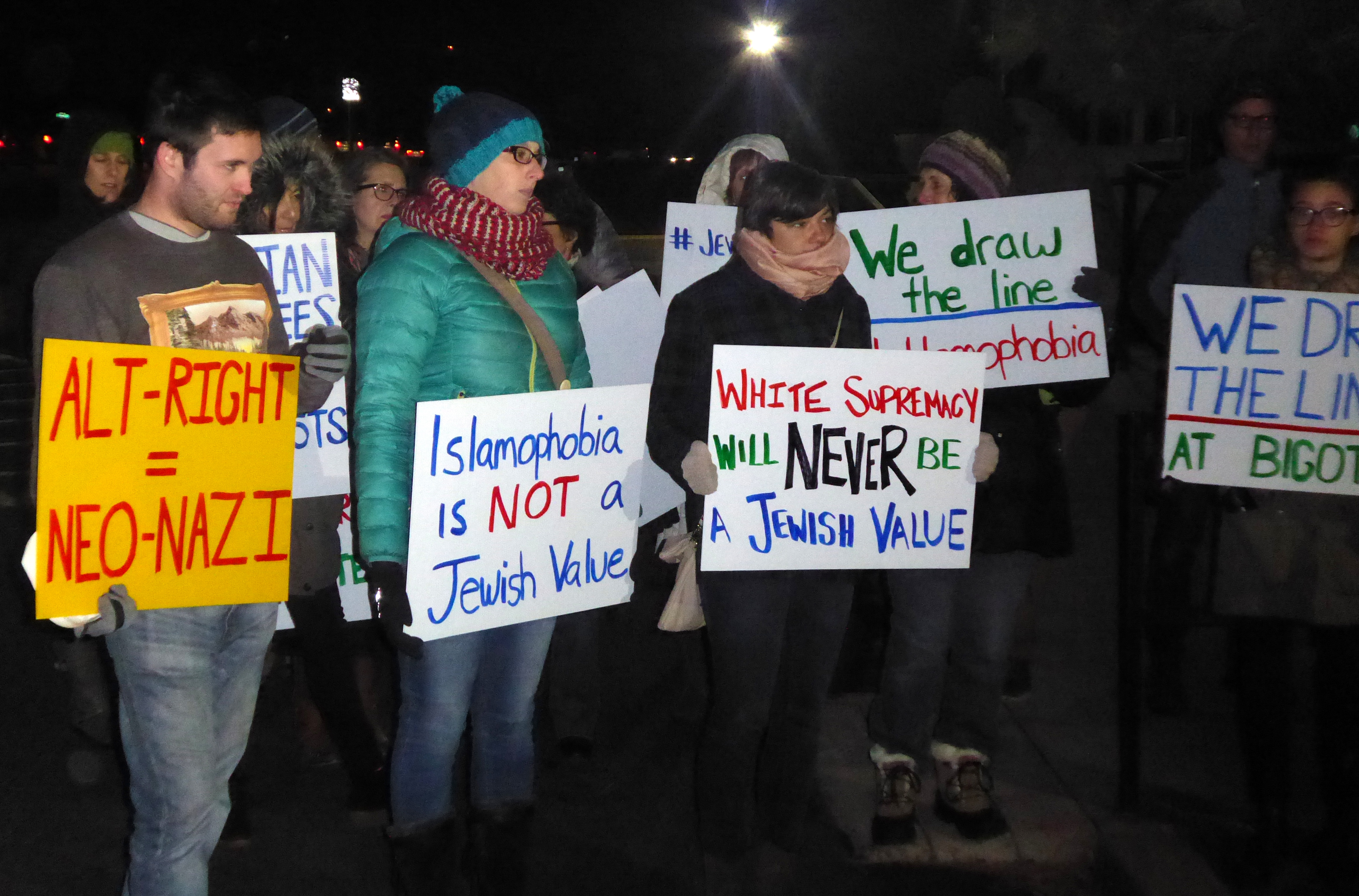
November 30, 2016 demonstration in front of Denver’s Jewish Community Center, sponsored by “Not In Our Name”
 View from the Left Bank: Rob Prince's Blog