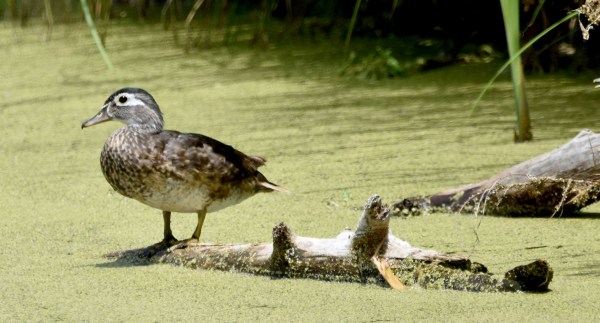
Mama wood duck looking out for her chicks. Lowell Ponds, S. Adams County , Colorado. July 23, 2020
1.
This year’s annual bird count, which took place in February, now is joined by another count – that of the Denver area homeless living in tents. The tent count was the brain child of Denver Out Loud, Colorado’s well oiled, politically sophisticated movement for homeless rights.
Counting birds and homeless tents, oddly enough, go hand in hand.
My sense is that unlike many U.S. cities (New York City, Los Angeles) Denver does not count or keep a close track of homeless tents and that Denver Out Loud’s effort to do was, among other things, an embarrassment for the city found of saying – as it displaces them, “them” being, working and middle class folk, people of color – how much it “celebrates diversity.”
Trumping through the brush along the creeks flowing east from the mountains – Ralston Creek, Coal Creek, Clear Creek, Bear Creek, along the gullies – Sanderson and Lakewood Gullies – more often than not I run into as many homeless tents as I do birds to photograph. Yesterday, I found another half dozen to add to the list. I would be surprised if they are included, hidden as they are in the brush on both sides of Clear Creek as it flows east through west Denver towards the South Platte. They seem to be multiplying by the week.
Explaining the tent count to the media, Denver Out Loud spokeswoman Terese Howard commented,
“The fact that we have a moment now where our mass homelessness is visible means that we have a moment to face reality and start working on real solutions which means housing,”
In the last few months, it seems, homeless tent colonies have sprung up all over the city and beyond.
As noted in a local media report, On Jan. 27, the Metro Denver Homeless Initiative counted 996 people living without shelter in Denver during the annual Point-in-Time Count. Howard estimates the current number to be much higher.
Howard said 17 volunteers spread out across the city. They counted 154 tents at Lincoln Park and 80 tents at the encampment by Morey Middle School. They came up with 664 tents in all, some sprinkled in the downtown area around the Capitol, others along 14th Ave near St. Johns’ Church, still others along the creeks and gullies running into the South Platte.
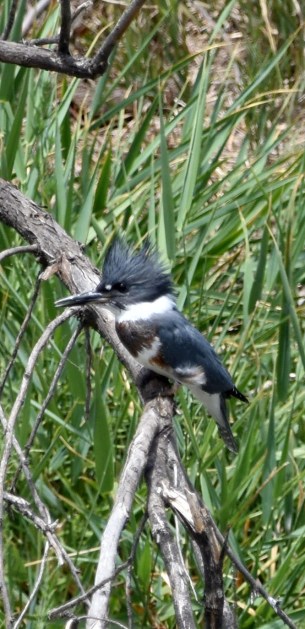
Kingfisher, near Clear Creek. S. Adams County, Colorado. July 23, 2020
Several friends in the neighborhood, among them Kathy Hamilton participate in the tent count. Cathy called and asked if I had any suggestions and I did. Frequently on my hikes out to photograph birds I’ve come across homeless tents, rigged shelters and the like. Today I stumbled across yet another half dozen that I had not previously noticed, hidden in the vicinity of Clear Creek. I try not to disturb the folks stuck there. They are justifiably nervous when a big old man like myself emerges trampling through the brush.
In a “Zoom discussion” with old friends from what some of you Denver people might remember was the “Radical Information Project” book store (17th Ave and Clarkson – long gone) the question of the homeless came up. Two points from that discussion:
- Denver has 667 (or so – probably more) homeless tents in which approximately 1350 non-sheltered homeless reside according to Denver Out Loud’s July 17 “homeless tent count; Los Angeles has more than 44,000 non-sheltered homeless by way of comparison
- We were wondering how and if residents of the United States that do not have fixed addresses are counted in the 2020 census and concerned that they won’t be or will be seriously under-counted.
How has the state’s liberal facade of a governor, Jared Polis, responded to the Denver homeless crisis and the flowering of homeless tents all over the state? By allocating state funds for toilets, showers, health and mental health care for Colorado’s homeless? No. He’s calling on the city of Denver to sweep homeless off of state property city and authorizing the Colorado State Patrol – that same organization, previously called the Colorado State Militia that destroyed the Ludlow mining strikers camp killing 11 – to help in the effort.
As a Denver Out Loud press release notes:
Yesterday, July 23rd 2020, Governor Polis called on Denver to kick homeless people living in tents on state property, including Lincoln Park and around the Governor’s Mansion, out through police force. Polis said he “encourages any law enforcement to remove them.” Later that day, Michael Robinson, Executive Director of Safety for Denver, issued a “delegation of authority” to enable Colorado State Troopers to enforce a variety of Denver laws on State property (and the adjacent city owned public right of way strips).
2.
It was a fine day to take my mind off of the Trump Administration sending its goon squad to Portland (and soon other places) to go tramping around Lowell Ponds from Lowell to Tennyson, across Clear Creek and back again to Lowell Blvd twice.
No new bird species but a fair number of the familiar ones that hang out in these parts: more Western Kingbirds, a Kingfisher, a Snowy Egret, a Black crowned Heron, a Great Blue Heron and a Mama wood duck guarding over her brew of chicks and – what I refer to as “the usual crowd” this time of year, this with a number of more homeless tents set up in the brush out of sight from the bicycle path that runs along the creek.
Have seen more Western Kingbirds – those fearless yellow-bellied (literally) birds that take great pleasure in harassing eagles and ospreys – and wood ducks this year than in the past.
Am drawn to the wood ducks, impressed watching the tender loving care Mama wood duck gives to her offspring and how ferocious she gets when Papa wood duck makes a feeble effort to get too close. She lets him know he is – now that he has done his evolutionary duty – now irrelevant and of no consequence, pretty much summing up the male role for most living things. He is more colorful though. Useless other than planting the seed, but otherwise irrelevant.
Ducks are long gone north with the exception of a few varieties that hang out along the S. Platte and some of its tributaries. They’ll be back in the fall sometime.
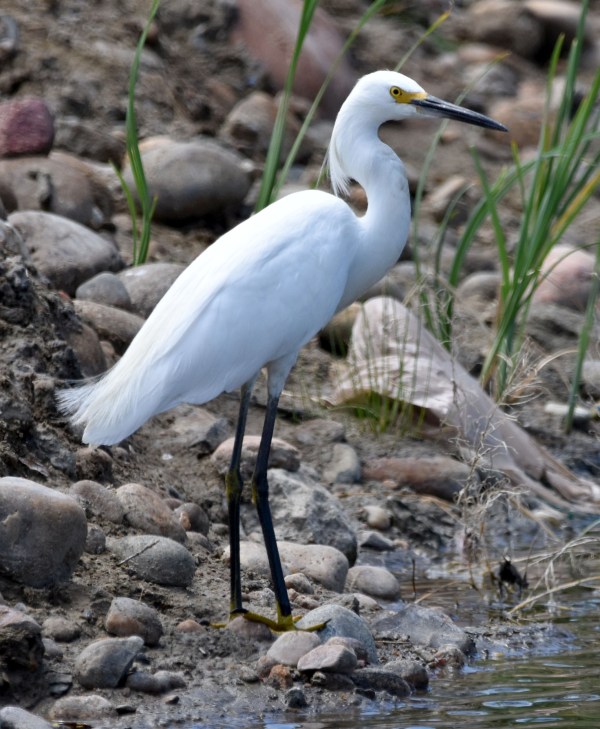
Snowy Egret. Lowell Ponds, S. Adams County Colorado. July 23, 2020

Portland Wall of Solidarity. 60 years ago they marched for their future, now they join arms for the future of their children, all children, everywhere. Mother Earths, wearing mask and helmuts, arm in arm with a rpse in one hand…
A daughter recommended it. Watching an episode of “The Good Place,” Kristen Bell provides a fine example of the thinking that goes to explain “the mask rebellion” as she elaborates her “rules for life.” And I quote:
Rule #1 I get what I want; I get to do what I want and you all will just have to deal with it.
Rule #2 No more Spider-man movies. There’s way too many Spider man movies, too many dorky, little, twerpy Spider men.
Rule#3 Leave me alone.
You take care of yourself. You don’t owe anything to anyone else! If people live that way then society would break down.
Yeah, in America, everyone does whatever they want! Society did breakdown. It’s terrible and it’s great! You can only look out for “Number One” and scream at whoever disagrees with you.
There are no bees because they are all dead and if you need surgery you just beg for money on the internet.
It’s a perfect system! Now give me another drink, tomorrow is my birthday
So much for social solidarity, class struggle, etc…
How the country got to such a selfish state is another story – I will only remark here that it was no accident and will try to develop that theme elsewhere.
The Good Place – an unending, at times for Nancy and me, unendurable NBC tv series that ran for four years and can now be watched via Netflix. Yet at some moments, actually approaching something profound about the country in which we live. Its core cast included Kristen Bell, William Jackson Harper, Jameela Jamil, D’arcy Carden, Ted Danson and Manny Jacinto. We watched about half of the full series – which was often very funny in a modern sort of way, ultimately a morality tale for young people – how and why to live an ethical life in an often empty world.
Somewhere in the middle, Kristen Bell offers a description of what I would call libertarian/anarchist thinking, so prevalent among many – especially young people these days – the kind of individualism gone wild that so permeates American society these days – the 180 degree opposite of the kind of solidarity promoted during the 1930s, during World War II and then in the 1960s-1970s Civil Rights, anti-Vietnam War Solidarity movements.
In the midst of – or more probably at the outset – of the Coronavirus pandemic the whole world has witnessed what works and what doesn’t and although there are still many gaps – particularly in terms of the science of COVID-19 to unpack in terms of defeating the pandemic – still, four, five months now into the pandemic – there are important relative success and failure stories. Damage control is achieved best where a combination of strong national (or as we call it in the USA) federal intervention combined with strict health measures: extensive mask use, social distancing, where required force quarantine measures are in place. Where they are not in place, or poorly applied – here in the United States, India – come to mind, the pandemic has run rampant
It is somewhere between astounding-to-pathetic the degree to which so many Americans have risen in anger against wearing masks. The level of selfishness and plain stupidity of those who “rebel” against such a simple procedure is startling. But then there is the Portland Wall of Solidarity!
Jason Crow and Liz Cheney Hold Hands for War – Join Forces to Slow U.S. Withdrawal from Afghanistan

Ilhan Omar (D-Minn) and behind her Rashida Tlaib (D-Mich). Omar introduced an Amendment to the National Defense Authorization Act that would have sped up U.S. troop withdrawal from Afghanistan. A bipartisan vote led by Colorado’s Jason Crow and Wyoming’s Liz Cheney defeated her effort.
It’s a bipartisan thing – warmongering always more dramatic when a generally liberal Democrat like Colorado’s Jason Crow finds common ground with a right-wing militarist enthusiast – a chip off the old block – like Wyoming’s Liz Cheney. Together – and with ample bipartisan support in the House of Representatives, they joined forces to neutralize Congresswoman Ilhan Omar’s (D-Minn) effort to speed up U.S. troop withdrawal from Afghanistan.
It is a bit disappointing – but not particularly surprising – to see Jason Crow, who in other ways has already proven to be a breath of fresh air in contrast to Rep. Mike Coffman, who held his position previously. But when it comes to feeding the Pentagon and encouraging American global military presence, frankly, Crow and Coffman line up essentially on the same page.
Common Dreams, the consistently informative anti-war website, published a brief article this morning on the the Cheney-Crow effort in Congress to vote down Omar’s amendment to the National Defense Authorization Act (NDAA) which would have given momentum to withdrawing U.S. troops in Afghanistan, bringing to a close the longest war in U.S. history.” The Omar amendment was defeated in the House of Representatives by a vote of 129 in favor to 284 opposed, with 103 House Democrats joining 181 Republicans to kill the amendment.
Omar’s “Amendment to Rules Comm. Print 116-57” called for “completion of accelerated transition of United States Combat and Military and Security Operations to the Government of Afghanistan” – or put more blunt, the amendment would have given support for a speedy withdrawal of U.S. troops from this war-torn country. Specifically it called for:
complete the accelerated transition of all 14 military forces of the United States, its allies, and 15 coalition partners, including all non-diplomatic civilian personnel, security contractors, trainers, advisors, and supporting services personnel by April 29,18 2021
The amendment specified coordinating the U.S. troop withdrawal securing a completion of the peace process, specifically calling for the implementation of the U.S.-Taliban agreement of February 29, 2020. Read more…
Open Letter on Contingent Faculty at University of Denver – Part Time and Non-Tenured Faculty Are Organizing.
University of Denver Campus, Fall, 2013
_________________________________________________________
(When I started teaching at what was then called “The University of Denver’s Graduate School of International Studies” – whose name was changed to the Korbel School of International Studies in honor of the institute’s founder, Joseph Korbel – I never anticipated that GSIS – or as it was later called “Korbel” would be my academic home for the next 22 years until I retired in June of 2015. But then one of my mother’s two famous sayings “You make a plan for life and then life makes a plan for you!” came to fruition.
I mostly enjoyed the work there, gave it a great deal of my time, intellectual and emotional energy, and without sounding too boastful, know in my heart of hearts that I accomplished something. As in all work there were tensions – I often felt the place was rudderless, without a vision of where the world is headed and how an academic institution like Korbel could shape its curriculum to meet the global challenges that lay in the future. I made some efforts in that direction which came to naught.
For most of my years there I held a somewhat unusual position – I was full time, non-tenured faculty. I had an annual contract, medical benefits, full use of the universities impressive on-line research system and discounted membership in the university’s five star recreational facilities – oh, yes – and a free bus-light rail pass. And more importantly, I had a full time job teaching – and as a result, work-wise, couldn’t have been happier. I was never particularly interested or frankly, impressed with the full time tenured faculty with a few exceptions who know well whom they are.
Early on in my “Korbel experience”, very early on in fact, it became apparent that the non-tenured faculty – non-tenured full-timers, adjuncts – were treated a notch above door mats, had few rights and little voice in the place although over the years – as the statement below notes – we taught an increasing majority of the classes. Heavier workloads, lower – much lower salaries.
We non-tenured and part timers – if we wanted to improve our status, or merely tread water – had better organize into some kind of a union or union like organization to defend our situations. My years at Korbel this never happened, nor did it seem to me, was there much interest from my fellow non-tenured types at the time.
It has taken the Coronavirus pandemic to shake the non-tenured faculty and part-timers out of their lethargy.
Here is their first salvo. Louis, I hope this is the beginning of a beautiful friendship!
In solidarity – me.)
_________________________________________________________
Open Letter on Contingent Faculty at DU
The COVID-19 crisis threatens the most vulnerable in every sector of our economy and community. At institutions such as the University of Denver, one particularly vulnerable group is contingent faculty: those on one-year contracts (VAPs and VTAPs) and those paid course to course (adjuncts.) Contingent faculty generally have the highest teaching loads, are paid less than other faculty, receive little to no research support, and have little to no job security. Contingent faculty taught 62% of the total credit hours at DU in 2018-19.
The exploitation of contingent faculty is a broad and growing problem nationally, and has been increasingly prioritized by groups such as the American Association of University Professors (AAUP). At some institutions across the country, the position of contingent faculty is being worsened further as they are targeted first with budget cuts related to COVID-19.
DU lists “inclusiveness” as one of its core values and strives to “create a diverse, ethical, and intellectually vibrant campus” in order to provide a “challenging and liberating learning environment.” (https://www.du.edu/about/mission-vision-values) Contingent faculty are more likely to be women, people of color, or members of other traditionally marginalized communities, making them an especially important constituency for building a diverse institution and creating the desired learning environment. Contingent faculty at DU have weathered the storm of the move to online teaching and continue to devote their time and energy over this summer to designing engaging courses for students this fall. It is therefore not ethical or respectful to respond to their efforts by further disadvantaging this already disadvantaged class of faculty. Finally, because the inequities and job insecurity experienced by contingent faculty constrain their intellectual freedom, ameliorating these inequities is crucial for creating an intellectually vibrant campus.
In order to live up to its core values and goals, DU should therefore set a positive example for other institutions by ensuring that the conditions of contingent faculty are not further worsened by the COVID-19 crisis. Unfortunately, in many cases, the opposite has happened.
Although DU is an institution of learning, it has targeted the employees who teach the most DU students first for cuts. Read more…
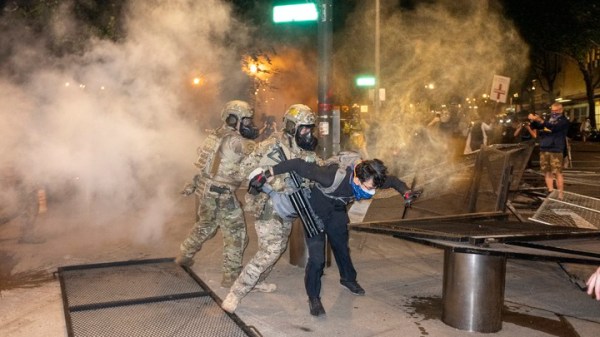
U.S Border Patrol, the new American Gestapo, from the Rio Grande to Portland… Where next?
__________________________________________________
Most importantly (and most missing here in the United States) a national plan that includes international coordination to help the whole world suffer from the pandemic’s effects to the least degree possible. To suggest or order the population to wear masks, social distance and quarantine without a national plan in place – to use the resources and the power of the federal government to guide the effort against Coronavirus – that is libertarian rubbish, of which there is a great deal being thrown around.
Without a national plan, we can all wear masks and social distance until we’re blue in the face, the Coronavirus will continue on its merry and deadly way.
__________________________________________________
In late March of this year, just as the Coronavirus was gearing up here in the United States, scholar and author Mike Davis gave an interview on the politics of Coronavirus that soon thereafter appeared on YouTube where I watched it. Among the many discussions on the subject I found his among the most lucid, in part because of his overall knowledge and because of his lifelong international and socialist perspective.
I’ve read a few of his books – City of Quartz, Planet of Slums and Ecology of Fear – all of which are excellent. Even the more dated, earlier works (City of Quartz) still resonate. Impressed, I sent the link of Davis’s remarks far and wide only to receive what I would call “an underwhelming response.”
A number of friends and acquaintances panned it. “It’s political and not medical enough,” one commented. Another just said bluntly “I disagree with his perspective,” without elaborating. A third went on blah-blah about how the Coronavius is a conspiracy spawned by Bill Gates, Fauci and the World Health Organization.
This last friend didn’t stop there; along with many others, she was already on campaign to denigrate mask use, to downplay the seriousness of COVID-19 infections “it’s just an ordinary flu”, lock downs and social distancing are useless, attacks on Fauci and the World Health Organization as being tools of the pharmaceutical industry, the Swedish model of herd immunity (ie – free for all with no state policy – a kind of libertarian dream; you know the nonsense about how Coronavirus is treated like a self-regulating – and nonexistent – market). Read more…
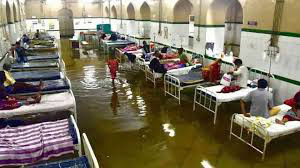
The COVID-19 ICU ward at Osmana General Hospital in Hyderabad, India flooded with rain water and sewage three days ago.
Early this morning I received a message on social media from someone in Hyderabad, India. When I first read this S.O.S. I was drinking my first cup of coffee in my backyard in Denver Colorado at 6 a.m in the morning., a time of day, when frankly the voices of other human beings are too painful to listen to.Focusing on anything other than the birds at a nearby birdbath takes something close to a herculean effort.
It was a plea for help, for support, specifically for face masks to help fight the Coronavirus outbreak there in Hyderabad, a central Indian city of more than ten million inhabitants. Was this – as my daughters used to say “for reals” or just another scam, bogus request for money like so many others that occur on media platforms like Facebook. I get so many of them.
The plea included photos of several emaciated, sick looking South Asian people wearing face masks, described as COVID-19 patients in an ICU ward of the Osmani General Hospital in Hyderabad, India. A short, disturbing video was included showing a flooded hospital ward with patients laying in their beds, water a good foot above the ground. (Later it turned out that the “waters” combined excessive rainfall with local sewage).
It was the video that made me pause. Is this really going on?
I was about to “blow it off” and unfriend the sender – I do a lot of that – but curiosity got the better of me. Maybe this IS a genuine crisis. After all, although people in this country are fixated on the Coronavirus pandemic in the United States – and how criminally irresponsible it is being handled by the Trump Administration, this is a global pandemic. There are places in the world where the pandemic is being handled as poorly as here in the United States and one of those countries appears to be India. Read more…

Ethiopian construction workers, building the Grand Ethiopian Renaissance Dam
(Postscript: the day after posting this article, Ethiopia began filling the dam)
Colorado, where I have lived for more than half a century, is no stranger to water conflicts as the headwaters of four of the country’s major rivers (the Colorado, Rio Grande, Arkansas and S. Platte) all have their sources here and flow into adjoining states.
It has been involved in its share of legal challenges over who gets what. The logic of geography suggests that communities – or states – along the same riparian systems should find ways to share water – and use it more wisely. Water rich and drought effected countries also need to find common ground.
Similar conflicting interests have erupted in Africa and the wider issue is the fact that water conflicts are likely to become more commonplace as a result of climate change, unstable rainfall patterns, and population growth add to the strains. For centuries – if not millennia – downstream Egypt has controlled the allocation of Nile water flows. In the modern period it has dominated the more upstream areas politically as well in what amounts to a colonial – or neo-colonial relationship with its upstream “partner,” Ethiopia.
Now that “water hegemony” Egypt has enjoyed for so long, that partnership is about to change. On the verge of a development renaissance fueled by its own talented population, strategic location, Chinese infrastructural investment and an attempt to leave it painful history of the past 150 years behind that has included a nasty, if not vicious episode of Italian colonialism, backwards traditionalist government, political and ethnic excesses, Ethiopia, struggling to contain domestic ethnic turmoil, tries to forge ahead economically and socially. At the heart of its vision for development, a dam project, Africa’s largest – the Grand Ethiopian Renaissance Dam.
The Grand Ethiopian Renaissance Dam, or GERD, is near completion on the Blue Nile near Ethiopia’s border with Sudan. Completed up and running, the dam will generate some 6,000 megawatts of power, enough to provide all the electricity that Ethiopia needs and then some for export. Ethiopia says its development depends on the $4.8 billion hydroelectric dam, which it says it is entitled to build as a sovereign nation. Egypt, some 1500 miles down stream has expressed deep concern over the Ethiopian dam’s development, fearing it might cut the flow of some of the Nile waters.

Grand Ethiopian Renaissance Dam. Ethiopia’s Pride; Egypt’s Albatross
KGNU Hemispheres – June 30, 2020 – Transcript…Part Three (Part One) (Part Two)
(This segment looks at the growing controversy – and danger of military conflict – between Ethiopia and Egypt over Ethiopia’s filling its recently completed Grand Ethiopian Renaissance Dam. It also explores a possible Israeli connection given that country’s fresh water needs. At the time of writing, the issue remains unresolved with a heightened danger of the conflict escalating)
______________________________________________
For Egypt, the existential threat concerning the Nile waters hasn’t changed; the variable that has changed is the inability of the United States to be able to pull strings and bring the parties together and impose a solution upon them. For Egypt, the existential threat concerning the Nile waters hasn’t changed; the variable that has changed is the inability of the United States to be able to pull strings and bring the parties together and impose a solution upon them.
Ibrahim Kazerooni
The point of all this – there is substantial evidence strongly suggesting that Israel is in something close to a panic about pre-emptively – before a war with Lebanon breaks out – securing its supply of fresh water and that it is plausible that Israel is offering the Ethiopians very generous terms for some of its water. It is not at all unreasonable – as a result of this pressure for water – to conclude that in some manner, Israel is involved in these machinations.
Rob Prince
______________________________________________
Rob Prince: Let’s move on to Egypt’s other problem, Ibrahim, and that is the struggle over the waters of the Nile River between Egypt, Sudan and Ethiopia over the completion of the Grand Ethiopian Renaissance Dam in the northwest corner of Ethiopia.
For starters, Jim Nelson’s opening about Colorado knowing about “water wars” is quite apt. Colorado has had “water wars” with the states to our southwest over the waters of the Colorado River, and others with states going east over controlling the flows of the Arkansas and Platte rivers.This kind of tension over which northeast African state is going to control the flow of the Nile – this is an absolutely Colorado issue as well.
The bottom line was this: as the Grand Ethiopian Renaissance Dam was being completed the question emerged as to what is going to happen to the downstream flows of water. We’re looking at one particular branch of the Nile, the Blue Nile the origins of which are in Ethiopia. The dam could divert a significant amount of water from the two countries downstream, in this case, to the north of the dam, Sudan and Egypt.
The upstream country is Ethiopia
The Grand Ethiopian Renaissance Dam was completed recently after nine years of construction and at a cost of $4.7 billion. Ethiopia plans to start filling the dam in the next few weeks, a decision which has angered Egypt because no agreement has been reached regarding the distribution of the waters downstream. Besides providing water for Ethiopian agriculture, the dam will be an important source of electrical energy for the whole country.
Ethiopia is only 38% electrified and it appears that it is the production of electrical power which is more central to the dam’s existence than its use as a water source. Upon completion the dam will be the largest hydroelectric power plant in Africa, capable of generating up to 6,400 megawatts of power. The electricity produced will be fed into the Ethiopian national power grid which in turn is expected to stimulate the country’s economic development.
The dam’s completion is also – and rightly so – a source of great national pride, literally the symbol of the nation’s future development hopes. Ethiopia’s pride has become Egypt’s albatross. Read more…

Libya’s oil and natural gas fields
KGNU Hemispheres – June 30, 2020 – Transcript…Part Two (Part One)
(audio at the end of the article)
(Most of this segment explores the growing tensions between Turkey and Egypt over the control of Libyan oil and natural gas resources and Turkey’s plans to build a natural gas pipeline from Libya to Turkey. Turkey could then sell the natural gas directly to Europe thus bypassing Russian natural gas exports to Europe)
Because the Qatar pipeline through Syria plan collapsed, Turkey is now determined to open up a new supply route from Libya to Turkey employing the same plan – weakening the Russian natural gas grip on Europe. Unfortunately for Turkey this plan is more complicated than the previous pipeline “pipe dream” through Syria. In the Syrian pipeline scenario Turkey enjoyed strong Qatar-Muslim Brotherhood support (as well as support from Washington DC). In the Libyan case, Turkey has to deal with an antagonistic counter-force in Egypt, supported by the wealth of Saudi Arabia and the United Arab Emirates.
Ibrahim Kazerooni
Rob Prince: Moving on, I wanted to ask you, Ibrahim, about the situation in Libya and how the general crisis there is shaping up.
New alliances seem to be coming together – this is such a fluid moment – the alliances shift some going from one part of the Middle East to another.
Specifically, in terms of what is shaping up in Libya… What is Turkey up to? How is that Russia and Saudi Arabia find themselves on the same side of the fence backing General Khalifa Haftar in Libya? A little bit later we’ll talk about the specific role of Egypt in all of this.
So let’s turn to Libya…
Ibrahim Kazerooni: Well, if you go back to 2011, 2012 and look at the major players in the toppling of Muammar Khadaffi, it was the Europeans (UK, France, Italy) with the green light from the United States and their overall pretext of “plausible deniability” that suggested that Washington was not a part of it – although (Hillary) Clinton admitted on a number of occasions that the United States was in the thick of it – up to its neck – in the crisis in Libya… Even Obama admitted as much.
But strangely enough, from the Middle Eastern viewpoint, it happened during a time in which Mohammed Morsi (deposed President of Egypt) and the Muslim Brotherhood was elected in Egypt. There was a unique alliance that included financial support from Qatar, ideological support from the Muslim Brotherhood and political support from Turkey.
Egypt at that time (of the 2011 NATO invasion of Libya and the overthrow of Khadaffi) did not see anything threatening in Qatar and Turkey’s involvement in the affairs of Libya. Qatar’s bombers used to leave Qatar, bomb Libya and return. In the 1960s and 1970s when Qatar was just a Bedouin emirate and at that time didn’t even have a small plane to fly, it was Muammar Khadaffi who would send his civilian airliners to Qatar to pick up this family of despots and take them for medical treatment somewhere in Beirut or other places.
This is how they repaid Libya. Read more…
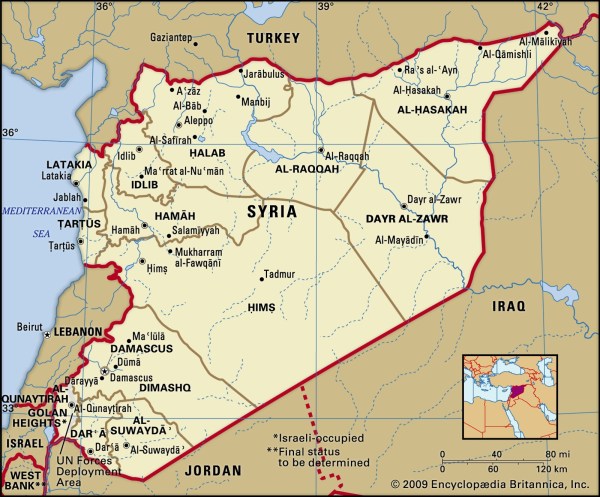 Trump’s Continued Descent into the Middle East Maelstrom: The Caesar Act’s Impact on Lebanon and Iraq: Egypt Inching To War on Two fronts: Libya and Ethiopia.” Tuesday, June 30, 2020. KGNU 1390 AM, 88.5 FM; 6 pm Mountain States Time – Hemispheres, Middle East Dialogues with Ibrahim Kazerooni and Rob Prince. Hosted by Jim Nelson.
This is a continuation of the radio program of June 23, 2020. taped a week later on June 30. In this first segment we continue to discuss “The Caesar Act” – more punishing U.S. sanctions against Syria and its neighbors as well as some updates on U.S. Congressional legislation that concerns the Middle East. In later segments (to be posted as they are transcribed) the discussion turns to the situation in Libya pitting regional powers in struggle for control of Libyan oil and natural gas, and finally a discussion of the Egyptian dilemma with Cairo faciing crises on two fronts – that of Libya and with the completion of Ethiopia’s Great Ethiopian Renaissance Dam along the Blue Nile, which will be transcribed over the next few days.
KGNU Hemispheres – June 30, 2020 – Transcript…Part One KGNU Hemispheres – June 30, 2020 – Transcript…Part One
(audio at the end of the article)
Formally called the Caesar Syrian Civilian Protection, it was packaged as a law to protect the Syrian civilian population. But in essence the goal of the Caesar Act is to destabilize and prevent Syria from its national reconstruction and development. This was admitted by Ambassador James Jeffrey who said that “the U.S. seeks to prevent Syria from rebuilding. We have thrown everything but the kitchen sink into the Caesar Act.”
Any economic or political support of the Syrian government will be punished.
– Ibrahim Kazerooni
In the past when Washington had a need to deal with some kind of local issue or tension in the Middle East – here is an example of what they did: they brought in their main allies, the protagonists from the region and essentially the State Department, the President or both, essentially dictated how the issue would be resolved and who would get what out of the deal, always with U.S. strategic interests uppermost. This was done with the Israelis and the Saudis – repeatedly, with Israel and Egypt in the run up to the Camp David Accords. The U.S. imposed the broad frameworks for the agreements and let the protagonists bicker over the details to give the appearance of “negotiations.” Washington dictate dressed as negotiations.
That is how things went bu that is history.
– Rob Prince
Jim Nelson: As previously mentioned, we’re going to continue our discussion of the Caesar Act, – specifically how it’s implementation will effect countries neighboring Syria, Lebanon and Iraq. Then we’ll move on to the growing conflict in Libya. One of the key players in the Libyan situation is Egypt; Egypt is facing a double crisis – one with Libya, the other with Ethiopia over the probable opening of the Great Ethiopian Renaissance Dam and the allocation of the waters of the Blue Nile.
Living in Colorado, we know about upstream-downstream water issues and how water is allocated.
Go ahead Ibrahim.
Ibrahim Kazerooni: Good evening to everyone.
It’s going to be an interesting discussion as usual between Rob and myself regarding the few issues that Jim has just sketched as we have deliberated over the most important themes. Last week, Rob briefly discussed the Caesar Act. I want to recap, go over it, to understand its consequences.
Although it was drawn up primarily as a law targeting Syria (with more sanctions), but in effect, any country neighboring Syria is effected too. The primary target is Iran but the tertiary countries effected are Iraq, Syria and Lebanon.
The Caesar Act is in reference to a 2014 propaganda stunt involving an anonymous pseudo-named Syrian who called to testify before the U.S. Congress. He was alleged to be a military expert, military photographer. At the time, the Christian Science Monitor said that Caesar’s testimony was nothing more than “a well timed propaganda exercise funded by Qatar” to destabilize and build support against the Syrian government.
As discussed in an earlier program, this took place during the height of the terrorist/mercenary attack on Syria and the approving of the Doha Protocol as a consequence of that. Doha is the capitol of Qatar. Qatar is one of those countries that invested huge amounts of money in destabilizing Syria in support of the terrorists and mercenaries that were being trained to go to Syria to overthrow the Damascus government.
The “Caesar” propaganda was similar to the Kuwait fictional allegation against Iraq in 1990 (that the Iraqi military was stealing Kuwaiti enfants from hospital incubators. The daughter of the Kuwaiti ambassador, pretending to be an eye witness, was brought to Washington to testify before Congress. In a similar manner, the Caesar allegations were made and later, the Caesar Act came into existence.
Formally called the Caesar Syrian Civilian Protection, it was packaged as a law to protect the Syrian civilian population. But in essence the goal of the Caesar Act is to destabilize and prevent Syria from its national reconstruction and development. This was admitted by Ambassador James Jeffrey who said that “the U.S. seeks to prevent Syria from rebuilding. We have thrown everything but the kitchen sink into the Caesar Act.” Read more…

Moktar al Moktar – the Lion of the Desert, Libyan national hero, who fought Italian colonial conquest of Libya from 1911 through 1931. Italians killed 200,000 in their effort to pacify Libya.
“The Caesar Act – Washington Pours on More Sanctions Against Syria; Shifting Tides of War from Syria To Libya.”KGNU 1390 AM, 88.5 FM – Hemispheres, Middle East Dialogues with Ibrahim Kazerooni and Rob Prince. Tuesday, June 23, 2020. Hosted by Jim Nelson. Transcript.
KGNU Hemispheres – June 30, 2020 – Transcript…Part Three. (Parts One, Two)
_________________________________
What people don’t understand is that any kind of shift in the geopolitical “zero-sum game” or alliances within the region, and now in Libya, is going to have consequences in Idlib Province (Syria).
If Russia realizes that really Erdogan is going to up the ante for the continuation of chaos in Libya so that Turkey can secure control of that country’s natural gas pipeline to Turkey and from there, Europe, to substitute Qatari gas and circumvent Russian power in being a key energy source to Europe, where Turkey and Russia are going to settle their argument is going to be in Idlib (Syria).
– Ibrahim Kazerooni –
_________________________________
These tensions we are talking about are long-standing. But the difference today is that the United States is weak. In the past, Washington had to power and influence to take the contradictions among its allies – Turkey, Egypt, Saudi Arabia, Israel – and somehow meld them into some kind of common approach. That kind of influence is collapsing and American influence, to somehow come out of this with a common approach, is just gone. As a result of that we see the release of these local contradictions and forces – it’s a pretty scary moment.
– Rob Prince –
_________________________________
(In this segment we center around dissecting Turkish-Russian geopolitical tensions visavis Libya and Syria as well as the Egyptian stake in the Libyan crisis.)
Rob Prince: Ibrahim, I’d like to add something here concerning the Turkish-Russian tension over Libya. It has to do with natural gas – natural gas and oil, a very large deposit of natural gas off the coast of Libya. Turkey wants to be able to dominate that production and that is one of its reasons for its move into Libya
The United States doesn’t mind.
If Turkey is able to consolidate its position in Libya that actual gas flows coming from Russia (to Europe) can be bypassed.
Ibrahim Kazerooni: Remember our discussion of the Doha Protocols?
There are two maybe three major natural gas producers at the moment. Number One is Qatar in the Persian Gulf. Number Two is the Libyan natural gas and Number Three the Iranian because the natural gas reserves in the Persian Gulf are divided between Qatar and Iran. The wells in Iranian territory has more oil and less gas than those of Qatar. The wells in the Qatari section have more natural gas than oil.
One of the conditions within the Doha Protocol was that Qatari gas to pass through Syria to Turkey. That has not happened but now there is another option to provide natural gas to Europe in light of the current chaos in the region and that is Libya, the idea being to secure the natural gas from Libya into some kind of corridor or pipeline going to Turkey and then passing from Turkey to Europe bypassing Syria in the Middle East and cutting into Russia’s supply of natural gas to Europe.
Russia is aware of the situation, of the threat to its interests and Erdogan’s plan and so it got involved in the mess, the chaos of the affairs in Libya.
Some historical perspective. Muammar Khadaffi had cut a deal with the United States and Europe: Western trade sanctions on Khadaffi would be lifted in exchange for acknowledging and paying restitution for Libya’s role in the bombing of Pan Am Flight 103
But when Obama came to power everything changed. Remember that Libya had agreed at that time to give up its nuclear weapons research program and given the pressure from the Bush Administration at the time, that Libya had entered the U.S. sphere of influence at long last. Khadaffi even agreed to free elections, opposition political parties.
In 2009, Libya was a prosperous and major petroleum and natural gas producer. Then the whole situation changed. I’m not denying that Khadaffi was a dictator and was guilty of extensive human rights violations against his citizenry. But Khadaffi comes off as some kind of saint when compared to the Saudi royal family.
In February, 2011 militant Islamicists eastern Libya, in Benghazi, launched an armed insurgency against Khadaffi’s central government.
Then what happened? ISIS, Al Qaeda, C.I.A got involved and everybody (Western powers) got involved supporting them, against the central government. The United States then jammed Libyan military communications. The U.S. fired missiles to intercept Libyan missiles fired at the rebels. The U.S. conducted numerous air strikes against forces loyal to Khadaffi. In sum, the U.S. intervention turned the tide in favor of Benghazi terrorist organizations.
Ultimately, in October 2011, two things happened simultaneously.
An American drone bombed the area and S.A.S. (British) Special Forces as well as their French counterparts went in to fire the bullet to kill Khadaffi. Hillary Clinton commented, “We came, he left, and that’s it.”
Now what we have, Libya is really in a mess; it is in complete chaos, wracked by violence, factionalism, political polarization, and the menacing jihadi extremism exported from Libya into Syria in 2012 onward, now they are coming back into Libya. From Libya, ultimately, they have to go somewhere else.
So, when you asked me a question regarding the Russian interests in Libya.?
Russian tried to force Haftar (Khalifa Haftar), instead of attacking Tripoli to enter into negotiations in which Haftar and the representative government in Tripoli would share power with the goal of somehow subduing the chaos in the country and some kind of order will be established in Libya.
But unfortunately, the United States along with other Western powers, they don’t want that. They give the green light to their proxy, Turkey, to move in for exactly the reasons that you talked about earlier: the weaker the Libyan central government, the easier it is for Western companies to get oil and gas. Ultimately if the West can get oil and gas from Libya through a corridor that goes from Libya directly to Turkey and then on into Europe then Russian influence in Europe can be circumvented and reduced by reducing the Russian natural gas supply to Europe.
As the polarization between the Libyan and international plays intensified, Vladimir Putin called Haftar to Moscow. The old group – or gang – that was ganging up against Assad in Syria – Qatar, the Muslim Brotherhood, Turkey and the financiers behind it – those supporting the Tripoli faction and encouraging and helping Tayyip Erdogan to push into Libya militarily to get the gas..
Realizing this, Russia aligned itself with Haftar. Haftar is now being supported by Sisi (Abdul Fatah Sisi, Egyptian President) who is in turn supported financially by the United Arab Emirates and Saudi Arabia.
Rob Prince: So many shifting alliances…
Ibrahim Kazerooni: I’m going to go back to the point that you raised earlier. What people don’t understand is that any kind of shift in the geopolitical “zero-sum game” or alliances within the region, and now in Libya, is going to have consequences in Idlib Province (Syria).
If Russia realizes that really Erdogan is going to up the ante for the continuation of chaos in Libya so that Turkey can secure control of that country’s natural gas pipeline to Turkey and from there, Europe, to substitute Qatari gas and circumvent Russian power in being a key energy source to Europe, where Turkey and Russia are going to settle their argument is going to be in Idlib (Syria).
The Syrian government is now massing up military commitment (in Idlib), ready to move. So far it has been the Russians who have been holding back the Syrians from going on the offensive. Moscow is waiting to see how the deal that it has tried to work out visavis Libya. Russia is supporting Sisi (Egypt) who is behind Haftar and now the polarization of the two powers, Turkey and Russia, over Libya is unambiguous.
The United States, with the Europeans on one side, their proxy is Turkey, the issue being the control of cheap natural gas. On the other side Russia, Sisi (Egypt), Haftar with the financial support of Saudi Arabia and the United Arab Emirates. Whether the matter is resolved in Libya or not, certainly the Libyan situation will have consequences in Syria because Russia now realizes that square the deal (regain its balance of power with Turkey) by allowing the Syria government to push into Idlib.
The choice again – we’ve talked about it – as there will be fewer jihadist mercenaries in Idlib (large numbers having been transported to Libya), this weakens Turkey’s position there. Should as a result, Turkey try to use their air power, in all likelihood the Russian air force based in Syria will challenge them, and shoot them down.
Rob Prince: What a mess!
Ibrahim Kazerooni: So now the situation has escalated into a much broader conflict with Turkey, a NATO country, facing off militarily against Russia in Syria. The situation comes back around – from Libya to Syria to Libya back to Syria once again. Going back to 2011, the conflict moved from Libya into Lebanon and Syria, now back to Libya and soon back again to Idlib Province in Syria. Yes, what a mess.
Rob Prince: A deadly tango.
Just to remind our listeners… When on August 12, 2012, Abdul Fatah Sisi led the military coup against the Morsi government of Egypt, it was against the Muslim Brotherhoods. The Muslim Brotherhoods are among those forces that, first of all, Turkey supports. Therefore Egypt is quite concerned about a Libya that has a Muslim Brotherhood orientation. Cairo is also worried about terrorists crossing Libya’s eastern border into Egypt, so Egypt is quite serious about limiting Turkey’s influence in Libya.
Ibrahim Kazerooni: The confrontation between the Persian Gulf states, four on one side and Qatar on the other, was based primarily on Qatar’s support for the Muslim Brotherhoods. Qatar aligned itself with the Muslim Brotherhoods and Turkey militarily. Now, on the other side, for Sisi and Egypt, the Muslim Brotherhood has become an existential threat. Under no circumstances is Sisi willing to risk any possibility where the Muslim Brotherhoods now in control of the western section of Libya move into the eastern Libyan zones and ultimately back into Egypt.
The Egyptians have made it clear that they are not going to allow that.
And now the crisis shifts back to Syria.
For the Syrian government also, the Muslim Brotherhood is equally an existential threat as much as it is to Egypt, because of Syrian history and what they did to Syria during both the rules of Hafez al Assad and Bashar al Assad’s rule. But yet Turkey has aligned itself closely with the Brotherhoods, so now, in the southern regions of Syria there has been some agitation from Muslim Brotherhood elements.
Syria is a mess, Libya is a mess, now there is possible confrontation between Egyptian and Turkish air forces in Libya or the Russian and Turkish air forces in Syria.
Rob Prince: But to look at all this from another angle. These tensions we are talking about are long-standing. But the difference today is that the United States is weak. In the past, Washington had to power and influence to take the contradictions among its allies – Turkey, Egypt, Saudi Arabia, Israel – and somehow meld them into some kind of common approach. That kind of influence is collapsing and American influence, to somehow come out of this with a common approach, is just gone. As a result of that we see the release of these local contradictions and forces – it’s a pretty scary moment.
Ibrahim Kazerooni: A question, Rob. In 2011 we discussed this matter at that time. One of the excuses given for the invasion of Libya was “humanitarian intervention.” We have discussed this extensively regarding what is meant by humanitarian intervention, how it is a pretext for war. Can you briefly linked humanitarian intervention with the chaos unfolding in Libya.
Rob Prince: Of course. You know, colonial, neo-colonial powers have long needed a pretext for intervention. With few exceptions they’re not going to go in and say `we’re going to steal your natural resources, force you to engage in mono-culture production, use your labor and suck you dry.’ That’s pretty crude. That’s the problem with Trump, he’s too up front about being an imperialist.
A pretext is required.
Besides claiming the nation was “commissioned by God” (Manifest Destiny), one of the repeated pretexts for foreign in American history is has long been “humanitarian intervention.” But humanitarian intervention has been a cover, nothing more, nothing less. Yet I’m amazed how often people (in the United States) fall for it.
It’s the kind of thing we heard in Iraq, “the U.S. is going to go into Iraq (2003) and save the poor Iraqis from Saddam Hussein.” It wasn’t about seizing the Iraqi oil industry. It was another case of humanitarian intervention based upon a whole series of lies, “weapons of mass destruction,” etc. about what would happen if the U.S. did not invade. In the case of Libya in 2011, what was the “humanitarian interventionist” pretext? – the panic that Khadaffi was going to send his military into a prison in Benghazi and slaughter the inmates there.
Ibrahim Kazerooni: To interject. Remember Rob in 1990, 1991 the United States attacked Iraq in response to the occupation of Kuwait. One of the cooked up pretexts was that Iraqi soldiers had gone into Kuwaiti hospitals and stolen babies from incubators. It turned out that the incident was fabricated and the person who came and gave witness was the daughter of the Kuwait ambassador in Washington.
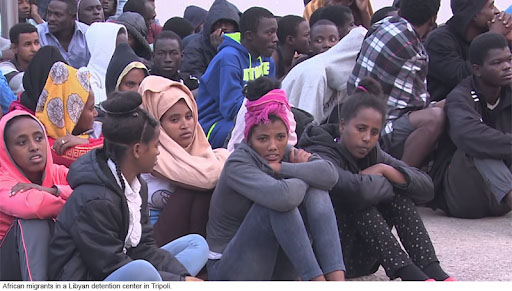
African migrants in Tripoli, Libya… many have been imprisoned and sold as slaves, a result of the instability in the country since the U.S. sponsored NATO led invasion to overthrow Muammar Khadaffi in 2011.
“The Caesar Act – Washington Pours on More Sanctions Against Syria; Shifting Tides of War from Syria To Libya.”KGNU 1390 AM, 88.5 FM – Hemispheres, Middle East Dialogues with Ibrahim Kazerooni and Rob Prince. Tuesday, June 23, 2020. Hosted by Jim Nelson. Transcript.
KGNU Hemispheres – June 30, 2020 – Transcript…Part Two (Part One)
_____________________________________________
I think we discussed this four or five years ago (on this program) concerning the aim of Tayyib Erdogan. He wants to re-establish a kind of new Ottoman empire, or at least Ottoman-like influence throughout the Middle East and North Africa, that influence that they lost from around 1920 onward till today.
So whether it’s instability and war in Iraq, instability in Syria or any crisis, Erdogan sees a role for Turkey to fish from muddy water to economically and politically in order to expand Turkish influence.
Ibrahim Kazerooni
_____________________________________________
Rob Prince: Having said that, Ibrahim, what is going on in Idlib Province at the moment? It looks as if a major military offensive is in the offing and then it stops. The Turks continue to put a lot of military material and troops in there.
Ibrahim Kazerooni: It’s a good question Rob.
To give some backdrop to where we are now… If you remember three or four months ago when the Syrians (government troops) were pushing north and Putin and Erdogan met in Moscow. They came up with an agreement that Turkey had no other alternative but to accept which is something that they had previously resisted. Russia insisted that the major highways from Aleppo to Damascus and other places had to be opened. The Turkish backed mercenaries had to withdraw to seven miles away from the M-5 and M-4 highways.
Recently I have been noticing that sharp infighting has broken out between various leaders among the different mercenary organizations.
Rob Prince: I read of armed conflicts among them today.
Ibrahim Kazerooni: Yes, between two or three of them. Julani, in charge of Jebat al-Nasra and Abu Malik Atalli and Abu Saleh al Uzbeki – these are among those who fled southern Syria and parts of Lebanon. Hezbollah had captured their territory and pushed them out. They had to negotiate a transit deal with the Syrian government who permitted them to withdraw to Idlib.
Now Jebat al-Nasra under Julani’s leadership has moved militarily against the other two major factions and captured their leaders in an effort to subdue them. This is a clear indication that these mercenary groups are anticipating a major operation on the part of the Syrian government to take place. Read more…
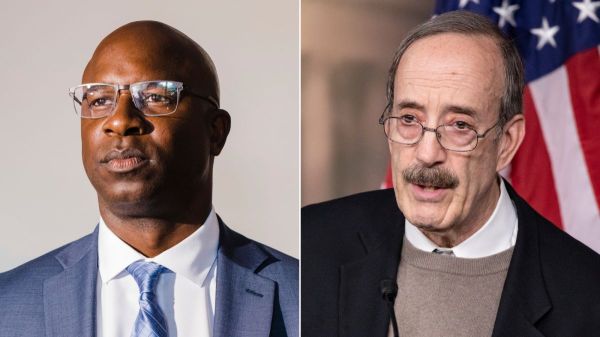
Jamall Bowman, former Middle School Principal, defeats Eliot Engel in a landslide. Engel, a 16 term U.S. Representative was the major author of the Caesar Act, AIPAC’s point man in the House Senate Foreign Relations Committee.
“The Caesar Act – Washington Pours on More Sanctions Against Syria; Shifting Tides of War from Syria To Libya.”KGNU 1390 AM, 88.5 FM – Hemispheres, Middle East Dialogues with Ibrahim Kazerooni and Rob Prince. Tuesday, June 23, 2020. Hosted by Jim Nelson. Transcript.
______________________________________________
The Trump Administration has become sanction crazy.
Besides putting even more clamps on the Syrian banking system’s ability to trade in dollars, the same kind of restrictions now apply to countries neighboring Syria. The cutting edge of this legislation is to threaten Lebanon, Iraq and Iran and all countries that are trying to help in the Syrian reconstruction project.
One thing we can argue: It’s the only card left in the American deck, tightening sanctions that were already punishing in nature.
From a political viewpoint what is the essence of these sanctions against Syria? It is for the U.S. to regain through economic what it (and its allies) lost on the battlefield in Syria, to weaken the Syrian government and to keep its plans – which never end – to partition Syria alive
Rob Prince
We both concur that when it comes to American policy in the region that the United States has hit rock bottom, zero, nothing. No Plan A, No Plan B – (an exit strategy). In all intents and purposes the United States has lost, in Syria and other parts of the Middle East.
In light of this, there is something we have discussed many times: no strategic vision, no plan, recently we are suddenly hearing about “the Caesar Act” being passed by Congress – specifically concerning Syria.
Ibrahim Kazerooni
______________________________________________
Part One
(In this section the impact of the Caesar Act – the ninth imposition of U.S. sanctions against Syria – is discussed along with fluid situation in Idlib Province, Syria where mercenary/terrorist troops are being withdrawn and transferred to Libya and Yemen)
Jim Nelson: As always, this evening we’ll be going to the Middle East and talking about the current breaking news. As KGNU listeners are aware, the station is practicing social distancing with most of us safe at home. I’m the only one in the studio; usually Rob is here joining me in these dialogues. Hopefully soon, we’ll get together in the studio once again.
We’re going to be discussing some topics of current interest in the Middle East. One of the reasons I enjoy this show is because of the unique perspective our guest bring to the subject. Currently we’re not getting much news from the region other than if its COVID-19 related.
Ibrahim Kazerooni: Or something to do with “evil China” or “evil Russia.” Read more…

Sources of the Nile River.
“Trump’s Continued Descent into the Middle East Maelstrom: The Caesar Act’s Impact on Lebanon and Iraq: Egypt Inching To War on Two fronts: Libya and Ethiopia.” Tuesday, June 30, 2020. KGNU 1390 AM, 88.5 FM; 6 pm Mountain States Time – Hemispheres, Middle East Dialogues with Ibrahim Kazerooni and Rob Prince. Hosted by Jim Nelson. Part Two.
The Trump Administration tries to put the screws on Lebanon and Iraq for trading with Syria (The Caesar Act) while China offers Lebanon $12.5 billion in “no strings attached aid” and Iraq $500 billion (you read that right) for infrastructural development.
Egypt is faced with two strategic challenges: the Turkish (Moslem Brotherhood) backed Tripoli forces in Libya push east threatening Egyptian stability. Even bigger in some ways. After ten years and what appeared to be Egypt and Ethiopia heading for an agreement on the waters of the Blue Nile as a result of Ethiopian completion of the Grand Ethiopian Renaissance Dam, the Trump Administration sponsored negotiations have collapsed. Ethiopia has pulled out of the negotiations and threatens to fill the dam. Egyptian is threatening military action. As one digs deeper, Israeli, Saudi Arabia and even Lebanon’s Hezbollah are, in different ways, part of the picture.
Listen to Kazerooni and Prince try to put it all together.
That and more, Tuesday at 6 pm Mountain States Time, KGNU “Hemispheres: Middle East Dialogues”, a program now in its eleventh year.
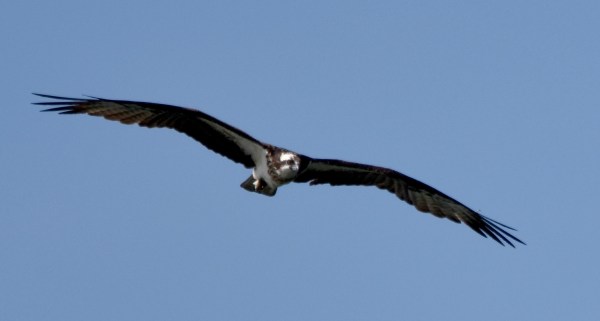
Osprey above Jim Baker Reservoir, S. Adams County, Colorado
For the past several years there has been an osprey nest atop a telephone pole on Lowell Blvd across the street from the Jim Baker Reservoir. After every season the telephone company employees – I assume under orders – rip it down and shortly thereafter it’s there again, rebuilt and ready to welcome new chicks. Last year I got some good photos of a rather large chick in a nest. When I drove down Lowell from 64 Ave several weeks ago, looking up, I was pretty sure I saw a little head sticking up from a rebuilt nest.
This morning, before the heat got too intense, I made my way back to Jim Baker Reservoir. Sure enough, I could clearly make out an osprey head in the refurbished nest. It wasn’t a chick but a female (the coloring of the males and females are slightly different) sitting on the nest. Wasn’t sure if she was sitting on eggs or if there were chicks there. The nests are deep enough so that unless a chick has grown large enough, or out of curiosity sticks its head above the nest line, it is difficult to see. It was only later, driving by the nest on the way home that I spotted two little heads peering out from the safety of the nest.
Ospreys are adaptable raptors.
They make home on every continent minus Antarctica. Here in the United States they make year round homes in the southern states, Florida, the Gulf Coast, Texas. Further north, here in Colorado they tend to migrate south in the winter, returning to the Denver area in the last spring. Jim Baker Reservoir with its abundant fish is an ideal place for ospreys to call home. Master fishermen, they almost always live near water, nest near water, along rivers, lakes, wetlands, and coastal marshes. The osprey nest on the telephone pole near Jim Baker is typical. They frequently nest on telephone poles, pilings, channel markers, and other man-made structures in or near the water.
Last fall, before the weather turned cold, or as cold as it gets these “Climate Change winters”, I saw an adult osprey leave that same nest, soar rather high into the sky, circle the reservoir and make a dramatic and successful catch of a large fish, which I presumed to have been a perch. This morning, a dry run of the same. It left the nest, flew rather high, circled the reservoir hunting. At one moment it dipped down some as if it were on the attack but then pulled back up and flew away, heading south to other nearby ponds (Lowell Ponds, Clear Creek Valley Park I reckoned). Although it failed to find anything this time, it circled for a good five minutes, enough time for me to do the clumsy maneuver of changing the settings on my camera to take a few motion shots. (like the one above).
Fish represent about 99 percent of their diet. Don’t know of what the other 1% consists. Rodents perhaps?
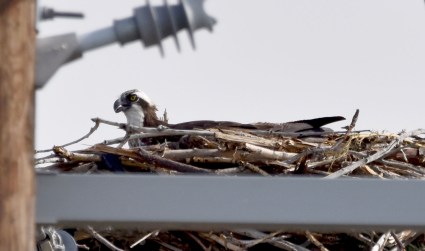
Osprey nesting on telephone pole near Jim Baker Reservoir.
Ospreys are very successful hunters, catching fish on at least one-quarter or more of their dives. What I witnessed this morning is typical: they circle over shallow waters to locate fish below the surface. Once they locate a fish, they hover briefly and then dive into the water feet-first, sometimes becoming completely submerged. Adults are sometimes preyed upon by bald eagles and great horned owls, while eggs and chicks are sometimes taken by snakes and raccoons. I have seen video of the larger bald eagles and ospreys competing for food in Florida marshes. Despite their reputation of strength and prowess, eagles are fundamentally lazy and often let the ospreys do the hard work of fishing, only to attack them in the air and steal the osprey’s prize.
Like so many other bird sprecies, ospreys have had a hard time of it and walked an evolutionary tightrope. Osprey populations in North America declined dramatically from the 1950s to the 1970s due to chemical pollutants such as the pesticide DDT, which caused breeding failures from eggshell thinning. DDT was banned in the United States in 1972, and since that time ospreys have bounced back significantly, although some states still list them as endangered, threatened, or a species of special concern. Today their populations are increasing at a moderate pace and there are few current conservation concerns.
Black Crowned Night Herons
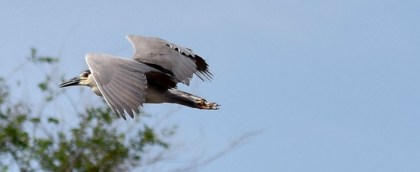
Night Heron over Jim Baker Reservoir
Black Crowned Night Herons, like the one pictured here, are plentiful in Colorado, certainly in the Denver area. One of the largest colonies of them is at Denver City Park. The black-crowned night heron (Nycticorax nycticorax) is the world’s most common heron, inhabiting large regions of North and Central America, as well as Europe, Asia and Africa, where they live in large wetlands.
At a time when bird populations of all kinds are plummeting, those of these herons has remained fairly stable. This wasn’t always the case. Like ospreys, populations declined in 20th century owing to habitat loss and, in mid-century, effects of DDT and other persistent pesticides. Following the banning of DDT, many local populations have increased in recent years. Water pollution is still a problem in some areas.
This heron is also stocky, with a length of just over 2 feet, a wingspan of 3.8 feet and a weight just over 2 pounds. Their coloring consists of black on their heads and upper backs, with grey wings and tails and lighter grey or white underbodies and black bills. These herons are social, monogamous birds who nest communally and will help raise heron chicks that are not their own. They are foraging birds, feeding on fish, crayfish, amphibians, other birds and even garbage.
As the Audubon Guide To North American Birds notes:
Seen by day, these chunky herons seem dull and lethargic, with groups sitting hunched and motionless in trees near water. They become more active at dusk, flying out to foraging sites, calling “wok” as they pass high overhead in the darkness. Some studies suggest that they feed at night because they are dominated by other herons and egrets by day. A cosmopolitan species, nesting on every continent except Australia and Antarctica.
I have seen them often in and around Lowell Ponds and Clear Creek Valley Park and they do fit the description above.
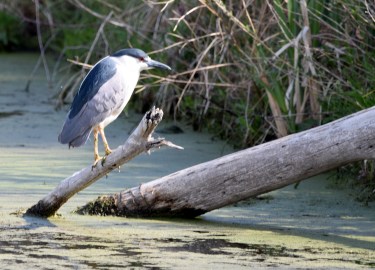
Night Heron at Lowell Ponds, S. Adams County; early May 2020
They tend to be shy and finicky; as soon as they notice being watch, they fly off to another spot. The ones I that I have run across are adept at hiding among the reeds and marshes where they blend in nicely. Have rarely seen them in trees, but today I did and got a decent photo of him from a distance of about a hundred yards. Typically, aware I was taking his picture, quickly he flew off south, away from me but then circled back across the reservoir close enough for me to get off a couple of shots as he flew by that came out ok.
As Jaymee Squire noted in a blog entry in 2017,
While most birds nest in mated pairs, a few nest communally, sharing the warmth and protection of the roost with other birds, usually of the same species. But a few birds are less particular, sharing the warmth and comfort of the roost with a variety of species. The Black-crowned Night-Heron is one of these birds. They mate for life, but the mated pairs build their nests in communal roosts, sharing the space with all sorts of other water-loving birds.
 View from the Left Bank: Rob Prince's Blog