
The M-4 Highway (in red) in Syria; the battle to control the section from Aleppo to Latakia on the coast continues continues..
As Coronavirus spreads worldwide, including in the Middle East, the Trump Administration piles on the sanctions against Syria. With little to no national publicity States’ side, what is called the “Caesar Act” took effect last week. With a foreign policy in the Third World that can be summed up by drone killings, sanctions and spectacular but irrelevant Special Forces operations, what is missing from U.S. Middle East policy is anything approaching a plan – be it a Plan “A” or a Plan “B.”
I wish I could tell you that Syria is being rewarded for resisting terrorists and because we have returned to peace and security through blood and sacrifice that we are now able to rebuild and resume our lives
Among friends here in Colorado, we used to say visavis Washington’s (both Democratic and Republican Administrations) Syria policy that that there was “no Plan B,” meaning that if their plans to overthrow Assad and partition Syria, either de jure or de facto, that Washington had no back up plan. But these days neither does a “Plan A” exist.
But, we cannot rebuild, and cannot live a normal life.
U.S. policy towards Syria is characterized by a lack of vision, it is defensive in nature, and is limited to just slowing the progress of the changing balance of forces in the region and sore losers that they are, exacting as much pain on their opponents as possible to make the price of Syrian victory and U.S. strategic defeat a very high one indeed.
The United States government and the European Union have place sanctions on Syria which prevent importing any medical machines, prevent importing medicines, prevent importing parts and machines for factories, prevent any and all items necessary to rebuild Syrian homes, shops, factories, schools, and hospitals.
It is in this environment that “The Caesar Act” became functional.
We are surviving on local fruits and vegetables and meat, but we cannot import anything whatsoever to do farm work. No tractors, no farm machinery, and no specialty supplies to grow foods.
It’s formal title is “H.R. 31 – Caesar Syria Protection act of 2019“, a title which is the diametrical opposite to what the title suggests. Sponsored by Rep. Eliot R. Engel (D-NY-16) along with 57 bipartisan co-sponsors, it went into effect just last week on June 17. It’s basically a bill meant to punish Syria for defeating ISIS and the like liberating most of its country from foreign terrorists, although a large concentration remains in Syria’s northwest Idlib Province.
The US-supported terrorists destroyed my home in 2014, and I still can not repair it, because the US-EU refuses to allow me and my neighbors to import necessary items that we can not make with our own hands. Don’t try to blame Trump with this, because the US Congress backed him up, and those are Democrats as well as Republicans.

Turning swords into clothes lines: A woman mocking an Israeli tank left behind when withdrawing from south of Lebanon in the year 2000, using its cannon as a hanger to dry cloths(Photo credit: Younes Zaatari)
“The Caesar Act – Washington Pours on More Sanctions Against Syria; Shifting Tides of War from Syria To Libya.”KGNU 1390 AM, 88.5 FM – Hemispheres, Middle East Dialogues with Ibrahim Kazerooni and Rob Prince. Tuesday, June 23, 2020. 6-7 pm Mountain Time. Hosted by Jim Nelson.
The 9th round of sanctions against Syria since 2011 called “The Caesar Act’ based on a bogus report of Syrian government atrocities. These sanctions target all trade, financial relations with the Syrian government, especially targeting Lebanon, Iraq.
We’ll look at the impact – or lack thereof – of the Caesar Act on the Damascus’ government’s efforts to liberate the rest of Syria from mercenary, Turkish and U.S. military occupation.
At the same time Turkey is transferring its Islamic mercenaries from Syria’s Idlib Province to Libya where a major showdown between the Turkish back Tripoli government and the Russian back General Haftar appears to be escalating with Egypt (supported by Saudi Arabia and the U.A.E.) is about to enter the fray as well to protect its western most border.
Meanwhile the Trump Administration finds itself paralyzed – it can’t withdraw from Syria nor can it escalate at the moment.
All that and more.
Hasan Ayoub: The Palestinian National Movement In the Trump Era, Prospects and Challenges: a one hour interview

Iyad Halaq, autistic man shot and killed by Israeli police in Jerusalem
One hour interview with Hasan Ayoub
Hasan Ayoub: The Palestinian National Movement In the Trump Era, Prospects and Challenges
Dr. Hasan Ayoub who got his PhD at the University of Denver returned to Denver as a visiting scholar invited by the Center for Middle East Studies. Here is the second interview sponsored by the Friends of Sabeel-Colorado and the Center for Freedom and Justice – Colorado (a support group for an organization of the same name in Beit Ummar, West Bank, Palesine.
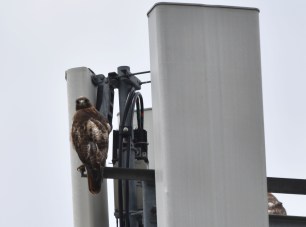
Redtail Hawk on Tennyson St. cell tower. The butt of its mate is lower right..
The clouds help cool off the afternoon a little.
Without them the temperature would have jumped above 90 F (32.2 C) and staying outdoors would have been something less than bearable. As my cell phone was reading 87,88 F, it wasn’t so bad. I had gone to Clear Creek Valley Park to try out a new tripod and to see if it could steady my “bazooka” 150-600 mm lens. For still shots and birds wading slowly, not bad at all, it resulted in a higher percentage of sharp photos.
But for the motion shots there seems to be no alternative to the thing being handheld.
First thing noticed… the red tail hawk couple that often perches on the cell tower across from the Tennyson St. entrance to the Park was back. From where? Who knows. Still they were hiding, or trying to. Rather than perching atop the cell tower as they had done in the past, they were found lower down, at mid level. In fact, I only saw the larger female there, but when I got home and developed the hawk photos on a computer, the body of the mate was visible..
I have so many shots of this pair which returns season after season to watch the activity in the ponds either from atop the cell tower or the huge billboard that faces traffic on I-76 heading west. That gives them an equally panoramic view of the ponds – all four of them north of I-76 and probably a pretty decent vantage point to watch the activity in the four ponds south of I-76 at nearby Lowell Ponds. Read more…

The marriage photo (?) of Sarah and Julius Magaziner, Grodno, Belarus, 1900 or 1901 (?)
Magaziner Genealogical Puzzles: Did Sarah Magaziner Enter The US at Philadelphia or through St. Albans, Vermont in the fall of 1907?
Magaziner Genealogical Puzzles..
There they are, I am pretty sure, this is a marriage photo. My grand parents were too poor to take too many photos back in Grodno from whence they came. This time I noticed Grandma Sarah’s hand gently on Grandpa Julius’ shoulder which I interpret as a sign of quiet affection. Who knows?
What a lovely photo, she a trim young bride, really stunning. He, built like a brick. We were told he could bend a silver dollar in his fingers. Here in the USA he worked construction, worked in a steel mill in Buffalo for a while, died in 1924 after drinking prohibition alcohol before work on a cold day. It poisoned his system and he died in agony at home three days later.
Sarah Magaziner is our (my sisters’ and my) maternal grandmother. There are stories that have become nothing short of legends in our family as to the travails she suffered in finally making it to the United States sometime in the fall of 1907. That this is the season and the year she arrived is well established, but…
Did she arrive in a ship, the Westernland from Liverpool to Philadelphia or did she arrive from somewhere else in Europe to Halifax, Canada and then descend to the United States (New York City) through St. Albans, Vermont.
The plot thickens… Read more…
Year of the Plague – 23 – “Trump Is Flailing Like An Overturned Turtle? “A Tipping Point?”
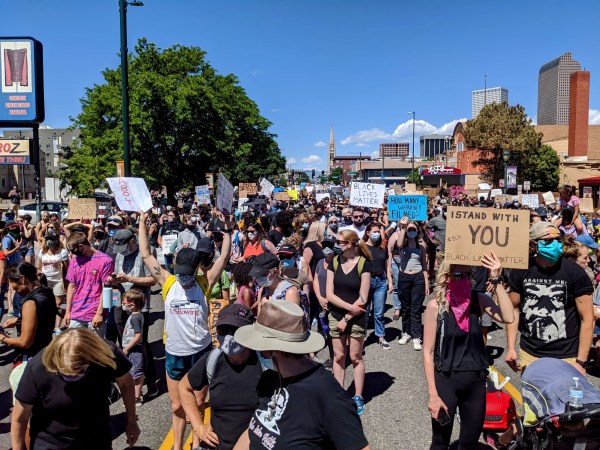
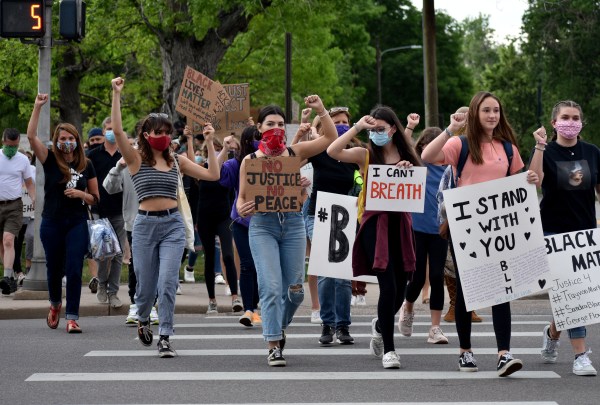
Denverites – thousands of them demonstrating against the police killing of George Floyd in Minneapolis, and for radical social change in America. (Photo Credit – Ben Harnke)
There is a story about an Arab general more than a millennium ago who died just prior to battle against a foe. Fearing that word of his death might discourage the troops, his adjutants put make up on the corpse, tied him to a board behind his back, flung him on his horse, kicked the horse into the midst of the battle. The enemy was defeated.
Joe Biden isn’t dead yet, only close.
But the Biden bid to defeat Trump has the momentum of a dead dodo bird. Despite Trump’s colossal political errors, domestically and in foreign policy, and growing splits among his Republican constituency, it’s not at all clear that Biden and the Dems have victory in November in the bag. Far from it.
All this in spite of Donald Trump’s increasing horrific record both as a president and a human being.
Encouraged by none other than the president of the United States, a police force everywhere in the country gone wild – an orgy of police violence, killings – amidst a COVID-19 virus untamed and still poorly understood….
A president who has actually encouraged right-wing racists and vigilantism while labeling left-wing antifascist movements “terrorist” …
The crudest most vicious president in modern times encouraging right wing fanatics and Christian fundamentalist wackos to savage the population…
A president who suggested that Americans swallow Lysol to address COVID-19 in a country where some were foolish enough to take his advice – and paid the ultimate price…
And yet the demonstrations – multi-racial, multi-class led in large measure by the country’s youth, fighting for a decent future for themselves and their children – get larger and larger. Often police repression snuffs out dissent, but then a socio-political boiling point is reached where repression only makes dissent that much more pronounced, more radical, more determined – and its politics, as diverse as they are, more humane. Read more…
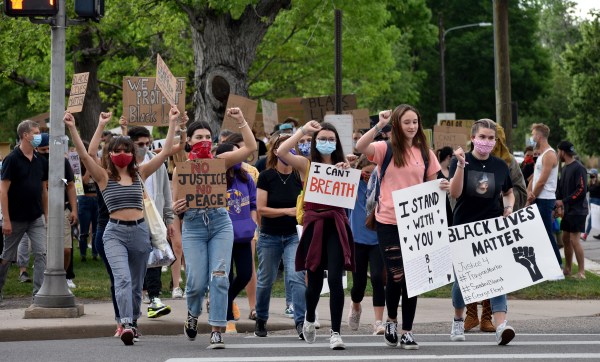
District One Denverites Demonstrate, protesting the murder of George Floyd and the national epidemic of police abuse
_________________________________________________________________________
A US District Court Judge in Denver has issued a temporary restraining order against the Denver Police Department for its violence against peaceful demonstrators. In an decision ordering the authorities of the city of Denver to restrain its police from using tear gas and rubber bullets against demonstrators, Judge R. Brooke Jackson characterized Denver Police excessively violent behavior as “disgusting” …which it was.
Writing an opinion for United States District Court for the District of Colorado, Civil Action No. 20-cv-01616-RBJ, U.S. District Court Judge R. Brooke Jackson enjoined “the City and County of Denver, and specifically the Denver Police Department and officers from other jurisdictions who are assisting Denver Police Officers, from employing chemical weapons or projectiles of any kind against persons engaging in peaceful protests or demonstrations. To be better assure that this idealistic order is carried out, the Court temporarily enjoins the Denver Police Department and officers from other jurisdictions working with Denver Police Department officers from using chemical weapons or projectiles.
The city of Denver is appealing the decision on a number of technical grounds.
In his written decision Judge R. Brook Jackson noted that “the Denver Police Department has failed in its duty to police its own,” and referred to police excesses in the recent protests of the killing of George Floyd of Minneapolis as “disgusting,” a rather damning term rarely used in Federal District Court decisions.
The kind of police violence – essentially police rioting against peaceful demonstrators – taking place in Denver is, of course, a part of a broader picture of police rioting nationally. It needs to be noted that this violence has been sanctioned and encouraged by the Bunker Boy, U.S. President Donald Trump. Trump and those closest to him that have given the green light for police department nationwide to unleash nothing short of a reign of terror against civilian protesters.
The “disgusting” comment was used in the following context:
“Some of the behavior of what I hope and believe to be a minority of the police officers in Denver and the nation during recent days … not only vis a vis persons of color but against peaceful protesters of all backgrounds has been disgusting.”
“Some of the behavior…of police officers in Denver…has been disgusting.”
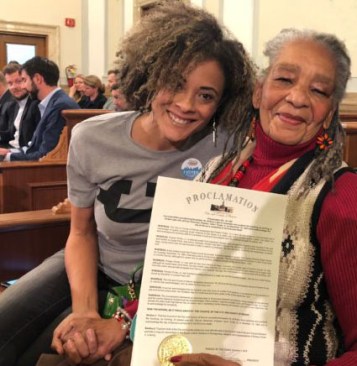
Elizabeth Epps (left) with Penny Goodman after receiving recognition receiving recognition by the Denver City Council for their work supporting prisoner rights. Epps was hit by two rubber bullets in her thigh while monitoring George Floyd support protests in Denver.
1. The USA – a very uncivil society.
So much for the wonders of American “civil society.” It evaporated in the nearly nine minutes it took for Minneapolis (ex) police officer Derek Chauvin’s to murder George Floyd, Chauvin’s knee on Floyd’s neck until he died of strangulation. Videotaped by passersby who tried unsuccessfully to save Floyd, the video went worldwide. The proverbial icing on the cake of decades – if not centuries – of police violence against people of color in the United States, it capped off a cancerous collapse of the nation’s social fabric with protest demonstrations throughout the country and the world.
The protests – in virtually every corner of the nation – have been met with a level of police violence against demonstrators that is unprecedented. Violence – that is violence of the state against its own population – has long pervaded life in the United States. Never that far from the surface it has erupted full force in the aftermath of the chilling police murder. – the casual strangling of George Floyd
The militarization of the police force nationwide – something that really escalated in the Clinton years with the sale, and grants of sophisticated military equipment to local police forces – is glaringly evident., as is their coordination and infiltration with right wing terror organizations – the KKK and the like. Teargas attacks, rubber bullet shootings, arbitrary arrests and the like – the USA’s week long version of Kristalnacht, while the world watches in horror as police riot nationwide, the myth of a progressive, racially tolerant America that has successfully dealt with its racist heritage, shattered into little pieces.
A friend in Germany comments that people there are horrified to see the pervasive level of police violence and abuse in the USA. It is not only in Germany but worldwide. Many people – despite everything – (“everything” meaning foreign military intervention and unending wars) held the United States in high esteem. With each day a slew of reports appears of police attacking peaceful crowds, of right wing violence given a pass by local police forces, of police infiltration and disruption of peaceful demonstrations.
“It like Third World country,” she told me in a phone conversation two days ago Read more…

Dutch photographer Hugh Van Es’ photo of a group of people scaling a ladder to a CIA helicopter on the rooftop of the U.S. Embassy in Saigon. Something like this will be the U.S. fate in Syria as well
KGNU – Hemispheres – Middle East Dialogues – April 28, 2020 – Transcript Part 2 (Edited)
__________________________________________
What the United States is pursuing now are endless wars, wars that don’t end even if they are over and even when the United States has admitted – perhaps not the government but some its more significant personalities – that for example,
– that the United States has failed to overthrow Assad in Syria and is not going to be able to do so. Washington is not going to be able to partition the country
– with Iran, everything the different American governments have tried has failed in terms of overthrowing the government there as well
So the question is posed: Why do they continue in these efforts of “regime change?” Why do they continue to dig the hole they have gotten themselves into that much deeper, so to speak?
Rob Prince
__________________________________________
(In this segment we continue our discussion, some points made about the “No War Against Iran Act” which passed Congress and then was vetoed by Trump and reflections on U.S. policy in Syria, among other things)
1.
Ibrahim Kazerooni: Rob, recently the head of the Iranian navy gave an interview. He showed a power point which revealed a number of things for people who follow these events closely. They can read into it a lot of things.
Iran is now on the verge of creating a global navy, no longer a local or regional one anymore. The number of ships that they have ordered, ships that they are building, the sizable military hardware that they are organizing clearly indicates that Iran is planning to build a global navy which means that from now on, Iranian ships – tankers or other kinds of ships – will be supported by the Iranian navy as they travel around the world.
If the United States attacks them, it risks its regional bases in the Middle East being attacked.
Rob Prince: I want to come back to the sanctions Ibrahim. One of the articles I was reading was that prior to asking the Iranians to provide oil, the Venezuelans approached the Russians to help break the sanctions that Washington was imposing.
The interesting thing – at least according to what I read – is that Putin backed off. He didn’t want to challenge the United States in Venezuela. But Iran didn’t (back off). I found that quite interesting and bold on the part of the Iranians.
Is there some validity to this from what you know? Read more…
District One Denverites Demonstrate, protesting the murder of George Floyd and the national epidemic of police abuse
1.
They were spirited, determined and their outrage at the sadistic murder of Minneapolis resident George Floyd just the tip of the iceberg of a much deeper malaise – the darkness into which this country has descended and the speed with which it has happened.
While much large crowds gathered and demonstrated in Denver’s downtown area now for more than a week, this was a neighborhood effort. Events like this one are happening nationwide.
Chanting “Say His Name – George Floyd” and “Don’t Shoot! Hands Up!: they marched. I would guess – and it is a guess – that at some point swelled to something close to 600-700 people marching up and down Tennyson St. from Smiley Library at Berkeley Park to Vitamin Cottage Natural Foods’ Grocery on W. 38 Ave. Overwhelmingly white, still, their banners read “Black Lives Matter,” “No Justice, No Peace,” “I Can’t Breath,” “I Stand With You.” among others.
Here is four minutes of the march’s chants: .
The protest came off peacefully.
As elsewhere in the country, Denver has seen its share of unchecked police violence this past week.
The Northwest Denver demonstration comes a day after a prominent Denver civil rights attorney, Elizabeth Epps, resigned from the city’s “Use of Force” Committee after having been been shot by a rubber bullet and tear gas by the Denver police force she was trying to regulate. In a tweet to the Denver Police, Epps wrote:”After 3 years working on your Use of Force committee, I hereby resign.We met last Thursday with Chief Pazen. Hours later, you gassed me. You shot my back and legs up—from behind. Plenty of Black folks will shuck & jive for ya, it just can’t be me anymore..”
In another story – which gives a flavor of Denver police rioting – a 35 year old Lakewood man (Lakewood is a suburb just west of Denver) lost an eye and will need facial reconstruction after a projectile fired by police hit him in the face. Likewise, a young man was shot by Denver police with a pepper pellet as he was filming a protest demonstration on May 30. While police spokespeople have denied these allegations these incidents – and others – have been filmed.
2.
Nancy saw a notice on a community bulletin – a demonstration planned for this evening in our neighborhood, Northwest Denver, one that has experienced nothing short of radical demographic changes with so many working class and poor folk pushed out, many of them Chicano and a whole new slew of upper middle class overwhelmingly white folk having moved in.
We both very much wanted to take to the streets and join those who have been demonstrating day in, day out in Denver and the surrounding area… but photos and video footage showed people wearing very few masks. Forget social distancing, it just didn’t exist. Nancy at 69 and myself at 75 with a history of (minor but still) respiratory problems, we resisted our temptation to join the swelling ranks of the bigger demonstrations downtown.
But now one was announced in our neighborhood, one we have lived in since 1976. Same house. We figured it would be small and thought it might be Coronavirus-safer to attend. I was saying to myself that I’d be surprised if there were 25 people, maybe 50 at the most. We were glad for the opportunity to “hit the streets.” Nothing, and I mean nothing is more important than this today, and while there are risks, we both knew that we had to do it. Our neighbor and friend Jamie Roth – who later wondered if he wasn’t the oldest person in attendance – felt likewise, as did another long-time acquaintance and fellow human rights activist, Martha Crowley, long associated with the Sisters of Loretto. A fifth “old timer”, Kathy Hamilton, local landscape architect was also there.
Everyone else – or pretty much was young, young by my definition meaning under 45 years of age. They came out as couples, in families, in groups of friends, fighting for their future, we were doing likewise as once we had fought for ours – against racism and foreign wars, against police abuse and for a healthier environment. Same struggle, fifty years on.
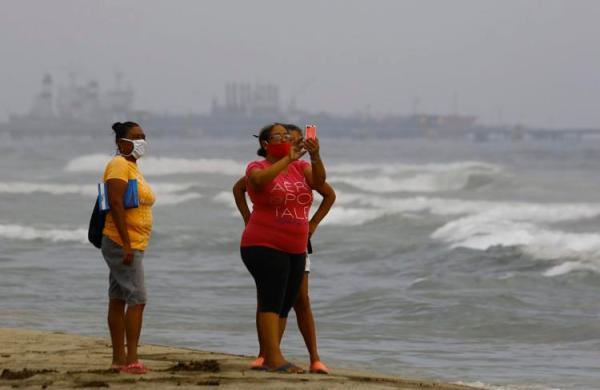
Venezuelans Take “Selfies” with Docked Iranian Oil Tanker in the Background
“Trump’s Ostrich Approach To Syria and Iran: The Coronavirus Pandemic and The Shifting Balance of Power in the Middle East.”KGNU 1390 AM, 88.5 FM – Hemispheres, Middle East Dialogues with Ibrahim Kazerooni and Rob Prince. Tuesday, May 26, 2020. 6-7 pm Mountain Time. Hosted by Jim Nelson.
_____________________________
My personal opinion is that it would have been much better for the United States to have gone ahead and lifted the sanctions against Venezuela rather than having allowed Iran to have busted the sanctions the way that it did. It simply ignored the sanctions and let the chips fall where they may.
Ibrahim Kazerooni
_____________________________
Rob Prince: Good to be here (on the air), hope everyone is safe and weathering this Coronavirus storm. We’ve got a long way to go here.
Just want to remind people that a part of the reason for this program that the crisis that we are facing – the Coronavirus, the economic crisis – it’s not just a national crisis; it’s global. The area of the world that we want to probe – the convergence, if you like – of two crises: the economic crisis on the one hand and the pandemic, the Coronavirus on the other.
I’m going to start off by mentioning a few of the most recent events and then we’re going to try to put them together into some kind of order. Is there some theme, some underlying theme to all this because the events themselves they look so different and disconnected, and yet they are all, we will argue, are a part of a pattern.
- So concerning the Coronavirus, it continues to hit the region (Middle East) in different intensities
- Iran – 800 infected health workers, more than 100 of which have died; 129,000 confirmed cases, with 7250 fatalities…
- Yemen – the world’s worst humanitarian crisis exacerbated by Coronavirus…
- Gaza – 35 new cases in three days… its healthcare system has been severely degraded by the Israeli-Egyptian blockade since Hamas won power in an election in 2007. The territory has 60 ventilators for a population of two million…
- Syria – Although the numbers of infected remain low, they are starting to climb…
- Now a new crisis – Iranian oil tankers headed for Venezuela risk interception by five ships of the U.S. Navy. Washington backs down. No confrontation… Major change in “the rules of engagement” between U.S. and Iran…
- Nine days ago – On the order of President Trump, a U.S. Apache heliocopter dropped thermal balloons – fire bombs – over agricultural lands in Syria’s northeastern province of Hasakah setting fire to 200 hectares (nearly 500 acres) of wheat crops, and as such, attacking Damascus’ food supply.
- With full support from the Trump Administration, Israel is about to annex 30% of the West Bank…
In Washington, a Senate Committee slips through a $38 billion package to Israel – some of those voting for it had no idea what the bill was about. The bill was passed in a meeting closed to Senate-live streaming in a voice vote on a group of 15 items. There was no discussion or debate – the largest such package in US history – and its title was never announce to those voting on it.
Ibrahim – So many different events, seemingly pulling in different directions? Is there some overarching theme? What connects these seemingly disconnected events?
Ibrahim Kazerooni: Thank you Rob.
For the untrained observer it might appear these might appear to be some kind of random events, until we find some kind of a thread that brings them all together. We have talked about this on a number of occasions.
The United States Middle Eastern policy is in crisis. It really doesn’t have a “Plan B” or an alternative. It just moves on a day by day basis. The thread that goes through all of these events, whether it is Syria, the $38 billion for the Israelis, whether it’s Venezuela, – all of them make quite clear that the United States, on the one hand doesn’t have a policy, a clear cut policy, and on the other hand is not prepared to accept defeat.
If somehow Washington came to the conclusion that they cannot win, they have moved to a posture where their only policy is to prevent others, the Russians, the Axis of Resistance in the region, from doing so.
This is, I believe, Rob, the thread that unites these events.
Naturally given that the United States doesn’t have a plan how to extricate itself from the region, nor does it have a plan to win anything politically from the region the resulting chaos is not going to produce anything. As a matter of fact it could lead to a disaster.
As an example, let’s start with the crisis with Venezuela.
Since 1979 The United States has always targeted Iran and worked for regime change there. First there was the eight year war with Iraq (1980-89 – in which the U.S. supported Iraq) and then followed various other plots to undermine the Iranian regime.
Then in 2006, Washington thought that by giving Israel a green light to start a war with Hezbollah in Lebanon that through this they would somehow neutralize Iran. It didn’t work.
In 2011 the focus shifted to Syria; Again it backfired and somehow blew up in their face. So what they are they doing now? They went to Venezuela thinking that if the Iranians could be drawn into the United States’ backyard it will be easier to deliver an attack.
The problem is that all the pundits, those who live in the area (the Middle East), they said that the only scenario under which the United States might be able to attack Iranian ships in the Caribbean or elsewhere in South America is when it removes all of its forces and military bases from the region.
The U.S. military bases that were originally built as noose around the Iranian neck, unfortunately for the United States, have become soft targets for Iran. Since (Qassem) Suleimani’s assassination an Iranian attack on U.S. bases in Iraq proved two things:
1. That Iran has the resources to attack U.S. interests
2. Once it comes to defending their interests the Iranians have the will power to do so.
I believe that the failure of the United States to attack the Iranian oil tankers heading for Venezuela is due to the realization that if they did so, Iran would respond by attacking U.S. interests closer to home in the Middle East.
If the United State has attacked any Iranian tanker, Iran would have immediately responded by attacking either a U.S. ship or a number of facilities in the region which would have been hugely costly for the United States.
What is the consequence for the Venezuelan – what shall we call it? – disaster for the United States?
Venezuela is an example of where sovereignty meets fighting for defiance – fighting for sovereignty for Venezuela, fighting for defiance for Iran.
These two approaches have met, converged and it has given the Axis of Resistance (1) a huge boost in the region, in the Middle East. Just listen Nasrallah’s speech of a couple of days ago on the “Day of Quds” that was declared by Khomeini. The Venezuelan incident has boosted the prestige of the Resistance to a considerable degree and demeans the United States.
My personal opinion is that it would have been much better for the United States to have gone ahead and lifted the sanctions against Venezuela rather than having allowed Iran to have busted the sanctions the way that it did. It simply ignored the sanctions and let the chips fall where they may.
There are five tankers, two of which have already docked with another three on their way.
From my conversations with Iranians who understand what is going on, this (Iranian shipments of oil and oil products to Iran) is not going to end with these five shipments. There will be a continuous shipment of Iranian tankers to Venezuela. Another ten shipments are already in the works and possibly following that, more shipments.
This development has boosted Iran’s image in the Middle East. Venezuela, similar to Saudi Arabia has huge oil reserves and its exports are based upon this one product. If the United States hopes to strangle Venezuela using sanctions against its oil industry they better think again. Iran’s defying the U.S. sanctions (both where it concerns Venezuela and Iran) has huge ramifications for the United States.
Threatening to attack the tankers and then for geo-political reasons – failing to was one of the worse political decisions that the United States has made in some time. It is an indication of what I discussed in the beginning of the program: that the United States has no plan.
Rob Prince: Ibrahim, why did Washington “blink?” What is the card that the Iranians have that prevented Washington from going on the offensive militarily?
Ibrahim Kazerooni: That’s a good question. Briefly, I alluded to it in the beginning. The presence of so many United States bases and other soft targets in the region (Middle East) – including their navy – makes them vulnerable should the United States attack the Iranian oil convoy. Iranian Supreme Leader, Sayyid Housseni Khamenei made a statement – I think it was early last week – that any ship, any vessel that has an Iranian flag on top of it that is attacked requires an immediate response. He emphasized that his permission was not needed.
Rob Prince: And we can add to this that Iran has proven that it is willing to strike American targets given the way that its missile struck the Al Asad Military Base – a U.S. military base – in western Iraq after the Suliemani assassination.
Ibrahim Kazerooni: Ibrahim Kazerooni: Yes, immediately after Qassim Suleimani’s assassination Iran proved that it has the military capability to hit anywhere within the region (Middle East) and that it has the willingness, the will power to do so.
I remember at the time of the Al Asad Military Base missile strike, even the Israelis expressed surprise. Other than the time that the Israeli’s bombed an American ship, The Liberty in 1967, an event which Washington covered up,this is the first time in the history of the region that for decades that the Iranians – attacked a U.S. base and they get away with it.
Quite clearly, the United States understood that if they were to attack Iranian tankers in South America that they ran the risk of U.S. assets in the Middle East – military bases, naval vessels or other soft targets – being attacked.
Rob Prince: The world’s attention was on South America, whatever was going to happen would transpire off the coast of Venezuela, but our argument is Iran would have responded to any U.S. attack in the Middle East. What we are looking at now is a global extension of this struggle that has tumbled outside of the region of the Middle East. The wrestling match between Washington and Teheran is becoming more globalized.
_____________________________
- Alliance between Iran, Syrian government, Hezbollah in Lebanon, Hamas in Palestine, the Houthis in Yemen and growing elements in Iraq)
A woman mocking an Israeli tank left behind when withdrawing from south of Lebanon in the year 2000, using its cannon as a hanger to dry cloths(Photo credit: Younes Zaatari)
“Trump’s Ostrich Approach To Syria and Iran: The Coronavirus Pandemic and The Shifting Balance of Power in the Middle East.”KGNU 1390 AM, 88.5 FM – Hemispheres, Middle East Dialogues with Ibrahim Kazerooni and Rob Prince. Tuesday, May 26, 2020. 6-7 pm Mountain Time. Hosted by Jim Nelson.
Coronavirus –
- Iran: 800 infected health workers more than 100 of which have died…
- Yemen – Doctors Without Borders speaking of a major catastrophe in a country where the U.S. supported and armed Saudi military incursion has already caused the world’s worst humanitarian crisis…
- Gaza – Health Ministry reported a few days ago 35 new cases of Coronavirus in an area severely degraded by the Israeli-Egyptian blockade since Hamas won power in the 2007 election. Gaza has 60 ventilators for a population of two million…
- Trump Administration threatens to stop Iranian oil tankers delivering petroleum products to Venezuela… then backs off at the last minute
- Israel annexes 30% of the Palestinian West Bank putting yet another nail in the two state solution that resulted form the 1992 Oslo Accords.
- In Washington, a Senate Committee slips through a ten year $38 billion aid package to Israel in a bill passed in Committee where many of the Senators didn’t know what they were voting for
- Despite having failed in its effort to overthrow the Assad government and partition Syria, the United States persists to pursue military options against Syria – in an effort to draw Russia into another “Afghanistan-like quagmire” and prevent China from extending its “Belt and Road Initiative” through Damascus to the eastern Mediterranean coast…
How does it all fit together? What is the overarching theme that ties the different threads? Tune in Tuesday, May 26 @ 6 pm. KGNU Boulder, 88.5 FM, 1390 AM, streaming at http://www.kgnu.org
Brief book review: Sapiens: A (not so) Brief (not so good) History of Humankind by Yuval Noah Harari

Recommendation: Don’t waste your time
Well written drivel … with a good bibliography!
In the tradition of Robert Ardrey, Konrad Lorenz, Desmond Morris, Jean Auel and other half-baked writers who made a career – and a fortune – on sharing their warped theories of human nature. Not worth a hoot from a serious scientific view point, but popularized by publishing companies and the media for their own self-serving reasons.
You’re better off seeing daytime soaps, going out photographing birds or getting stoned – thinking about the meaning of life and of course, immediately thereafter forgetting it.
But well written drivel, occasionally interesting. But even where it is (early chapter on the rise of food production, some thoughts on religion) frankly no new insights – most stuff has been discussed by and borrowed from others. For much better critique of modernism that Harari claims to be read Jared Diamond – more insightful, more human, much better scientific grounding.
This guy does too much yoga and thinks he’s a philosopher; my sense – he’s little more than an articulate phony. Thinks empires are fine and dandy and someday humans will merge with robots. No place for social movements in his scenario because nothing really changes as far as he is concerned. Insists that all humans regardless of race are genetically pretty much the same but that social stratification – the cast system in India by way of example is almost eternal. Reminds me of Charles Murray’s writings. Not original in the least, cherry picking facts and has an ax to grind. Chapter on “Happiness” towards the end particularly shallow and pathetic – but that’s true for most of the book. Not surprised that Bill Gates and the Davos folk connect to it.
Recommendation: Don’t waste your time and get seduced by an occasional insight, nugget, amidst the shit pile. If you’re interested in the subject, read Jared Diamond (anything – but The Third Chimpanzee is a good place to start) or on Human Evolution John Pfeiffer’s The Creative Explosion, the different collections of Stephen Jay Gould’s articles from Nature.

Who’s threatening whom?
____________________________________________________
Working behind the scenes for more than a decade on a such resolution that would force presidents to submit to Congressional approval before going to war have been a number of prominent, longtime peace organizations – flagship among them, the Friends Committee on National Legislation whose focused commitment to ending America’s endless wars is long-standing. In the current environment, to even get such a resolution on the floor of the House of Representatives is no small undertaking.
To get a positive vote on the issue – Trump’s veto aside – is a genuine lobbying achievement. It shows that a well organized, disciplined and targeted lobbying campaign, backed by peace movement activists throughout the country can have and do have an impact.
____________________________________________________
1.
Without following such developments closely, it’s difficult to appreciate that Congress – both Houses – passed a resolution recently that had President Donald Trump signed it – would have limited a president’s powers for starting foreign wars without Congressional approval. Not surprising that Trump vetoed it but it was surprising that it passed Congress – sending a message to both the president and his out of control Secretary of State, Mike Pompeo that their penchant for upping the ante for war wherever – against Iran, Yemen, Venezuela – is threatening to blow up in their faces…and that the Administration should back off.
With the Coronavirus sweeping the world and an unprecedented global economic crisis underway the last thing Washington needs is a serious military confrontation. Time to cool it. Even the New York Times, little more than a mouthpiece for this Administration’s foreign policy – if critical of Trump’s domestic policies – is writing exposes that almost could have appeared in The Nation or Counterpunch, more left publications.
In an effort to cool Washington’s ardor for war, The Times ran a piece yesterday (May 16, 2020) “ Why Bombs Made in America Have Been Killing Civilians in Yemen.” For anyone following the Saudi genocidal war against Yemen – which, by the way it is losing despite its superior fire-power – knows that Washington has not only armed the Saudis with sophisticated weaponry for this effort but also gave the Saudi’s the political green light to proceed with this ugly war that included massive Saudi bombing campaigns, embargo of food and medical supplies and some indications of the use of chemical weapons. It has created – up until the Coronavirus – the primo global humanitarian crisis leaving Yemen even more vulnerable to the new pandemic than most places.
In running the story, The Times – an expose of U.S. arms sales to the Saudis – the message was clear: time for Washington to soften its confrontation with Iran so as not to ignite a regional war and pull back. Read more…

Palestinian Youth, incarcerated in Israeli Prisons –
Hasan Ayoub, Assistant Professor of Political Science, An-Najah University, Nablus, Palestine and Visiting Scholar at the University of Denver’s Korbel School of International Studies, is interviewed by Dr. Rob Prince about his and his family’s experiences of being arrested as children by the Israeli military. Like the 500-700 Palestinian children arrested and detained every year, they suffered torture, physical and psychological abuse and humiliation while in custody – whether in Israeli prisons or police stations in nearby settlements. Dr. Ayoub tells his own experiences in this unjust system. See more about Palestinian child detention: NoWaytoTreataChild.org. The video begins as Dr. Ayoub describes his experiences of being arrested and abused by Israeli military when he was a child.
The program was sponsored by Friends of Sabeel – Colorado and the Center of Freedom and Justice – Colorado (a support group for an organization of the same name in Beit Ummar, West Bank, Palestine).
United Nations Statement Calling for the Release of Palestinian Children incarcerated in Israeli Prisons in light of COVID-19 pandemic
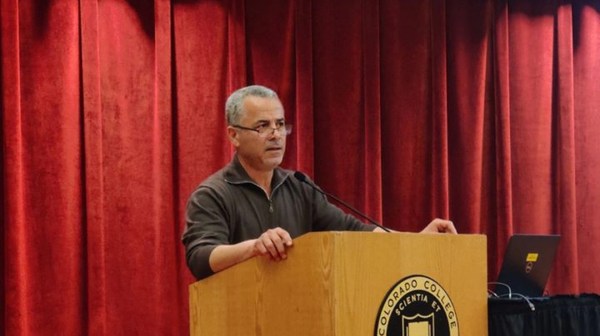
Hasan Ayoub at Colorado College
 View from the Left Bank: Rob Prince's Blog