T
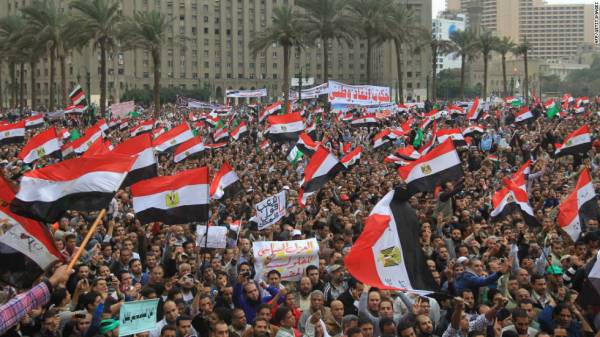
Cairo, Egypt – Demonstrations 2011 – Tyrant Mubarek removed, but the system remained the same. If anything, it is worse today. Classic example both of Gene Sharp tactics…uprising without a vision.
____________________
Basically what you are developing concerning Sharp… for his entire academic career that Gene Sharp is associated with the Defense Department, with U.S. intelligence agencies, NATO at a very, very high level looking at ways during the Cold War to undermine structures/institutions in the Communist countries that would lead to a peaceful collapse of these governments.
On the one hand left activists in the U.S. look upon Gene Sharp as the guru of their movement. On the right, Gene Sharp is considered one of the most important U.S. defense intellectuals of the Cold War, an early neo-liberal theorist supposedly concerned with the inherent violence of centralized state and a vital counselor to anti-socialist forces in the Socialist world.
____________________
Transcript – KGNU – Hemispheres, Middle East Dialogue – December 24, 2019 – Part Two.
“Gene Sharp Peace Theorizing and the Arab Spring: Tool for Societal Transformation…or the Road to Nowhere?” with Ibrahim Kazerooni and Rob Prince. KGNU 1390 AM, 88.5 FM – Hemispheres, Middle East Dialogues. Tuesday, December 24, 2019. 6 pm Mountain Time.
Continued from Part One. In this section, Ibrahim Kazerooni develops in depth Gene Sharp’s lifetime of connections to the centers of U.S. power and U.S. foreign policy makers.
Ibrahim Kazerooni: To begin with I would like to ask our listeners indulgence because it really requires a tedious reconstruction of Gene Sharp’s history. When we actually put the pieces together his role becomes clear for everyone.
I want to start with the fact that I came across Gene Sharp’s work and the whole subject of non-violent civil disobedience during the courses that I took at the Iliff School of Theology with Dr. Vincent Harding, recently deceased – God bless his soul. He was teaching this. And then there were some other professors at Korbel (University of Denver’s Korbel School of International Studies) who taught about Gene Sharp’s book, his ideas on civil disobedience and non-violence were included as a part of the resources available for study.
I had a number of conversations with both professors and others that were teaching non-violence regarding whether this is an absolute strategy or it has its own usefulness, or utility, but that is neither here nor there. We parted company each of us “agreeing to disagree.”
I would like also to add that our conversation here (on the radio) is not a critique or questioning, or an effort at undermining non-violence or civil disobedience – we don’t intend to attack that. Read more…

RQ-4 Global Hawk Drone. The world’s largest communications’ drone, the kind the Iranians shot down on June 21, 2019 over Iranian territorial waters
____________________
The Smith article is an essential critique of the writings and thoughts of Gene Sharp. For many in the Peace Movement here both Sharp and his theories of non-violence are nothing short of sacred cows. In it Ms. Smith deconstructs Sharp’s work – arguing that his theories dovetail with Washington’s strategy for regime change – which is the opposite of what people think of Sharp. We will elaborate on just how that connection works.
____________________
“Gene Sharp Peace Theorizing and the Arab Spring: Tool for Societal Transformation…or the Road to Nowhere?” with Ibrahim Kazerooni and Rob Prince. KGNU 1390 AM, 88.5 FM – Hemispheres, Middle East Dialogues. Tuesday, December 24, 2019. 6 pm Mountain Time.
Jim Nelson: Thanks for tuning into Hemispheres. I’m your host, Jim Nelson and thanks for tuning in to listener sponsored KGNU radio. Thanks for tuning into KGNU Denver, Boulder and of course Ft. Collins.
This evening on Hemispheres we continue the Middle East dialogues. As always joining me in these dialogues are Ibrahim Kazerooni and Rob Prince….
With that, let’s start off with the program. Rob, you’re going to start off?
Rob Prince: Yes. Good evening to you Jim, good evening Ibrahim and listeners. We’re in a bit of an unusual situation in that the last two programs we got snowed out. People all over were calling me asking me what happened. Never happened in the ten years of the program…
As it will air on Christmas Eve, this program is prerecorded…also a first…
For starters, we’re dealing with a situation in the Middle East each month which has been both fluid and explosive. What we are trying to do is to capture the best we can the essence of that motion and the direction in which it looks like things are headed.
Just looking at these last few months there have been so many developments; at the outset, before getting into the meat of the program, we want to mention and comment upon a few of them.
briefly…
1. After claiming to withdraw U.S. troops from Syria, the U.S. announced that it will add another 14,000 troops to the region – some of whom have re-entered Syria and taken over Syria’s oil fields
2. The Syrian government offensive against remaining pockets of mercenary militias continues both in the northwest of Syria, Idlib Province, and also in the northeast. In both places the Syrian army continues to make gains.
In the complex shift of forces (Turks in, U.S. out of Syria, US back in, Turks and Russians agreement) the Syrian government has actually gained ground in the northeast, retaking control of areas it had not expected to for a year or two
Those offensives continue.
3. Thirdly we have the situation in Israel where Israeli politics is frozen for the moment until a clear choice of prime minister is made. Netanyahu’s rhetoric – annexing parts of the West Bank, asking for bunker buster bombs to attack Iran – is even more shrill than usual. Israel suffering from what might be called “wounded beast syndrome.”
Looking at the objective conditions, we don’t see as a time that the United States or Israel wants to go to a full scale war in the Middle East. But having said that, it needs to be remembered that we are at a moment where nothing is predictable anymore.
4. And finally, in these last months there are major demonstrations have broken out in Lebanon, Iraq and Iran. In all three cases domestic frustration coupled with some form of outside interference. The situations in Lebanon and Iran have quieted down some but in Iraq angry demonstrations continue with hundreds of deaths and more mounting up. Read more…

Otto Dix – precursor to Picasso’s Guerica. No To War! To Peaceful Transitions (where possible)!
“Gene Sharp Peace Theorizing and the Arab Spring: Tool for Societal Transformation…or the Road to Nowhere?” with Ibrahim Kazerooni and Rob Prince. KGNU 1390 AM, 88.5 FM – Hemispheres, Middle East Dialogues. Tuesday, December 24, 2019. 6 pm Mountain Time.
Well friends – Kazerooni and Prince, with Jim Nelson hosting, are back. We missed two programs because of two Colorado fall snowstorms which prevented Jim and I from getting to the studio. But this one is “a go” and has already been pre-taped and will air at the usual time and slot on your dial or streaming station.
Over the next two programs we are going to analyze and de-construct the theories of peaceful activism articulated by Gene Sharp, who over the course of his life became nothing short of a guru for peaceful non-violent social change, and one highly respected worldwide. We will look at both his historical institutional connections as well as a number of a case studies where his thinking was transformed into action.
Ours is a critical analysis of his work. For details, tune in.
For more on Otto Dix
Where is Abdelmadjid Tebboune’s Political Base?

The placard above, from an Algiers demonstrator, critical of “foreign interference” refers to the United States and France, both of which are anxious that the new hydrocarbon law be implemented.
Essence of the piece is simple and direct: the recently elected Algerian president has no base – none whatever – outside of the country’s old guard (the Troika – military, security apparatus, compradore bourgeoisie). It follows logically that he will have to answer to them and cannot stray very far from their program. If he did so… there is the “Boudiaf Option”
Stop The Nuclear Arms Race…


Maybe Tunisia’s New President Has a Plan?

du the tunisien
Maybe Tunisia’s New President Has a Plan? published in Inside Arabia
_______________
A month after Tunisia’s presidential election, there are a number of worrying indications that, despite Kais Saïed’s personal integrity, his policies will continue Tunisia’s swing in a more religiously conservative direction with the support of the Ennahdha Party and do no more to address the country’s socio-economic crisis than past post-2011 administrations.
_________________________
They come as soon as the cafes open in the morning and don’t leave until they close late in the evening. All day, day after day. Many are young men, unemployed with no hope of work in the foreseeable future. It is from such cafes—among other places—that the country’s youth decide to risk the dangerous journeys across the Mediterranean in flimsy rubber boats or worn out fishing vessels, many of which sink, sending their desperate passengers to their death below.
It is also from such cafes—as well as the mosques—both in the country’s rural areas and poorer neighborhoods of Tunis, Sousse, Sfax, and Bizerte that ISIS-like mercenary recruiters work the tables, recruiting for this and that militia funded by outside sources.
It has been going on for years non-stop and continues.
Thousands of young Tunisians have signed up, been squirreled off to Libya for training and then to points beyond: Syria, in particular, but Iraq as well, and now dozens of other countries. The men become ISIS or al Nusra foot soldiers while the young girls provide “support services” some of them sexual.
Some return back into Tunisia in sleeper cells, to commit the kind of terrorist atrocities that shook the country in 2015 in Tunis and Sousse, or are sent to the country’s mountainous western regions near the Algerian border to join Salafist mercenary bands engaged in armed struggle against the government.
This description only scratches the surface.
It doesn’t include deteriorating public services, the endemic corruption of the post-Ben Ali ruling elite, the continued epidemic of privatization of the country’s economic assets, the flood of money from abroad influencing the country’s political landscape, all of which come together to erode that great fruit of Tunisia’s Arab Spring: hope.
The only institution that has benefited from the “Jasmine Revolution” is the security apparatus. The rationale for this increase has been the need to “fight terrorism.”
The only institution that has benefited from the “Jasmine Revolution” is the security apparatus, whose numbers have swelled since 2011 by 90,000 recruits. The rationale for this increase, of course, has been the need to “fight terrorism.”
A Weakened Presidency and Strengthened Parliament wherein Ennahdha Plays a Pivotal Role
These are but some of the “challenges,” and deep-seated problems, that Tunisia’s new president, Kais Saïed, will have to face. Although having won a decisive victory, suggesting a popular mandate, he begins his presidency in a country where presidential prerogatives have been curtailed by the country’s new constitution, approved in 2014. It is the Tunisian parliament, the National Assembly, that holds more of the genuine power.
Saïed played his economic policy cards close to his chest during the campaign. He either had no policy or, as I suspect, preferred to keep the electorate in the dark. In his campaign he constantly deferred to “le peuple veut” (the wish of the people) without elaborating.
As for his promise of cleaning up corruption—all well and good since the country needs it—again, no details. It remains to be seen if such statements are little more than old-fashion demagoguery or if they have any teeth.
Throughout the campaign few were the times when the main candidates discussed concrete plans to restore the country’s lost economic dynamism.
Throughout the campaign few were the times when the main candidates discussed concrete plans to restore the country’s lost economic dynamism, which has only deteriorated that much more these past eight years. Although the “Tunisian street” has repeatedly called on successive governments to freeze IMF imposed budget cuts, neither Saïed nor his main challenger, Nabil Karoui, had addressed the issue beyond vague generalities.

Halfouine – Mixed Muslim-Christian-Jewish neighborhood of Tunis
The Ennahdha Influence
Saïed disavowed any connection with the Ennahdha Party, essentially Tunisia’s branch of the Muslim Brotherhoods, whose political influence has dominated the post-Ben Ali era up till now. His disavowal aside, Ennahdha’s endorsement and active support was a key factor in his victory.
Despite Ennahdha’s current difficulties in putting together a government —and the fact that it has lost some of its early popularity and legitimacy— the party retains a hold on power and remains a decisive force in the country’s political life.
Mentoring, at least in part, by an American public relations firm, Burson-Marsteller, (among others) has helped the party navigate successfully through Tunisia’s political waters for the past five years both in Tunis and Washington, DC.
For all its considerable influence, after eight years as the country’s leading political force, Ennahdha offers nothing new nor a socio-economic program to address Tunisia’s mounting woes.
Sadly, for all its considerable influence, even after eight years as the country’s leading political force, Ennahdha offers nothing original or new, nor a socio-economic program to address Tunisia’s mounting woes.
In this past election campaign—responding to increased criticism, if not anger, over Ennahdha’s fixation with the Islamification of Tunisian society over addressing the country’s deepening socio-economic crisis—Ennahdha played, or tried to play, a more subdued role than in the past. It publicly distanced itself from Saïed, while quietly supporting him financially and opening many media and other doors for him.
This worked well.
Yet the speed with which Ennahdha has re-emerged as the country’s leading political force once again, suggests a shrewd electoral approach. No need for political power to be “up front” if it can manage affairs from backstage especially during an election campaign. Once the election was over, Ennahdha emerged from the shadows to declare victory. How so?
Ennahdha remains the key political force both in the Parliament and in the country as a whole.
Although Ennahdha did lose some seats in the National Assembly (it has 52 seats out of 217) no party holds more than a quarter of the seats making it somewhat more difficult to form a coalition government. It remains the key political force both in the Parliament and in the country as a whole.
On the heels of Saïed’s victory, in another sign of Ennahdha’s effort to maintain its solid grip on power, long-term Ennahdha founder and leader, Rachid Ghannouchi was elected speaker of the National Assembly.
Following Ghannouchi’s election, through its leadership role in the parliament, Ennahdha nominated Habib Jemli as the country’s new prime minister. Although describing himself as “an independent,” Habib Jemli has close ties with Ennahdha having served as a junior minister in the country’s first Ennahdha-led government formed after 2011.
Finally, with Saied’s victory, the International Monetary Fund (IMF) also wins as its controversial austerity program appears safe from any parliamentary challenges. Ennahdha will ensure its passage through the National Assembly in support for structural adjustment cuts required for the next IMF loan.
The still open question is how will Kais Saïed’s administration respond to the predictable protests that will undoubtedly follow? With guns or with butter?
~~~
HR 326 – U.S. House in Support of a Two State Solution Israel/Palestine, But All That Glitters….
 It’s entitled HR 326, a bill committing the U.S. Congress – and through it – the U.S. government to a two state solution to the Israeli-Palestinian “crisis.” With 192 co-sponsors, the bill has some backing, although it is also notable those who have not placed their names in support – Rashida Tlaib, Alexandria Ocasio-Cortez, Ilhan Omar – among them.
At first glance a worthy if classically moderate slap in Israel’s face for Benjamin Netanyahu’s recent announcement calling for Israel to legally annex significant parts of the West Bank – major parts of the Jordan River Valley. It is actively supported by the liberal Zionist organization J-Street. Read more…
Long Ago and Far Away: Remembering the U.S.-Soviet Embrace at Torgau on the Elbe – High point of American-Russian/Ukrainian relations

Encounter at the Elbe – Soviet 1949 film about the meeting of U.S. and Soviet troops at Torgau. It is available for $15 at RAREFILMSANDMore.com
____________
(Note -May 9, 2022. Every year at this time, I think of Joseph Polowsky, the U.S. World War II veteran, who, during the height of the Cold War, organized meetings between the U.S. and Soviet militaries at Torgau, Germany. There, in April, 1945, U.S. and Soviet troops, Russian and Ukrainian in the main, met and embraced , closing the southern section of the ring around Berlin.
Right now anti-Russian hysteria has reached unprecedented levels in the United States, even worse than during the Cold War. Time to remember some things about Russia in World War II)
____________
Getting there…
I still remember vividly watching the plane I was scheduled to fly to Berlin taking off as the plane I was on, landed in Vienna. There it went. There I was, not quite on the ground yet on a flight from New York.
I was among a number of other foreign guests stranded in Vienna at the time hoping to reach Berlin for the (East) German celebrations marking the May 9, 40th anniversary of the crushing defeat of Nazism . Eventually we were able to get visas to pass through what was then Czechoslovakia on into East Germany by train, arriving a day later than expected, but a few hours before the festivities marking the fortieth anniversary of the defeat of the Nazis was about to begin.
Exhausted from the travel, having not slept for more than two days, I gave what was easily the worst speech of my life, impressively bad, and that in front of some 25,000 spectators. To this day, I regret my lack of eloquence on that occasion, for that event, the total defeat of Nazism – and the Soviet role in that effort – is nothing short of the most significant event of the Twentieth Century. The event shaped the post World War II world like none other. I would have liked to have been able to express my appreciation for the fallen of all countries, who participated in defeating both German and Japanese fascism more effectively than I did.
Nothing before or since compares to that moment, frankly, when the Swastika was pulled down from the Berlin Reichstag by Soviet troops and the system that had created so much terror for so many was turned to dust.
Torgau and the Seelow Heights
My embarrassing two or three minutes of fame over, three or four days days of activities followed, among them a memorial meeting at Torgau, on the Elbe one day and another day a visit to Seelow at what was at the time East Germany’s border with Poland (and remains today, united German’s border with its eastern neighbor).
That said, beyond my embarrassing performance in Berlin, I think about that trip every April and May, about Torgau and Seelow.
Very little has been written about either event in English here in the United States.
There are a few books on the subject of the Elbe meeting. The 1988 book edited by Mark Scott and Seymon Krasilshchik “Yanks Meet Reds: Recollections of U.S. and Soviet Vets from the Linkup in World War II” is still available. Studd’s Terkiel’s The Good War: An Oral History of World War II has an interview with Joseph Polowsky (see below) just before he died.
One exception on the storming of the Seelow Heights by Soviet forces in English is – David Downings “Potsdam Station” – about as decent a description of the collapse of the Nazi army in the face of the Soviet juggernaut towards Berlin. More recently I stumbled across a song by Fred Small memorializing the “meeting at the Elbe”, a rare contribution to the public dialogue. Here are the first few lines of the song.
Mister I just overheard you talking through your drink
How the Russians lie like rugs, how they pushed us to the brink
Now sit right here beside me – I’ve an old man’s tale to tell
How Yanks and Reds were friends once – at the Elbe
I write about these events both because that precise moment, in April and early May, 1945, lost – or rather buried – in time, when the U.S. and the Soviets – and their inheritors, the Russians and Ukrainians, were not just friends but allies. If it made an impression upon me it is because forty years later, in late April, 1985 I had the good fortune to be present at Torgau for the 40th anniversary of the American-Soviet meeting at the Elbe. It was at Torgau that the at the Elbe that U.S and Soviet soldiers (those of the First Ukrainian Front) embraced and promised to work to prevent future wars, the so-called “Oath of the Elbe”.
The next day, with an international delegation of peace activists and leftists – people from Vietnam, Argentina and Italy – I visited the Seelow Heights.
Many veterans, both America and Soviet of the Elbe meeting were at the 1985 ceremony. Although forty years had passed, many of their frames – both American and Soviet – somewhat paunchier – their commitment to the oath they had all taken to do everything in their power to prevent future wars.
In 1949, the Soviets made a movie about the Elbe encounter, that was popular in what were then Eastern Bloc countries, all of which had been occupied by the Nazis. The music for the film was composed by the great Russian composer, Dmitri Shostakovich, although a number of books and articles particularly in the Left and Peace press have covered the meeting.
A November 30, 2019 article in The Progressive by Jeremy Kuzmarov (reprinted by Portside online) features the life of Joseph Polowsky, the Chicago taxi-cab driver and moderate Republican, who for the rest of his life after the historic meeting and until his death in 1983, did what he could to revive the Elbe reunions at Torgau and to work for U.S.-Soviet detente. As Kuzmarov relates about Polowsky:
Every year on April 25, prior to his death from cancer in 1983, Chicago taxi driver Joseph Polowsky would stand on the Michigan Avenue bridge and pass out leaflets calling for a halt to the spread of nuclear weapons. When approached by passersby, he would tell them about a historic meeting between American and Russian soldiers at the end of World War II, along the Elbe River in Central Europe. He didn’t just know the details of the meeting, which marked a crucial step toward the end of the war, he took part in it.
Those fortieth anniversary events touched me deeply. And they continue to now today, as May 9 approaches, as the United States is engaged in a proxy war against Russia in Ukraine and as the frenzy of russophobia reaches new heights every day. The history of World War II has been rewritten, reshaped by Hollywood to a considerable extent to deny the Soviet role in the war – which was considerable – and to create the false narrative that it was mostly the U.S., British and French who won the war, sidelining the Soviet contribution to a minor role at best. At some point – long past – that narrative becomes nothing short of a lie.
Forty years after the event, long after U.S.-Soviet relations had soured and broken down, at the height of the Cold War, I saw American and Soviet veterans of the Elbe meeting embrace each other again, this time coming together calling for an end of the Cold War and the nuclear arms race. We also visited Polowsky’s grave. His request to be buried at Torgau was honored.
These comments do not express the emotions I felt on that day, standing next to Arthur Sulzberger, NY Times publisher in Torgau watching the US and Soviet veterans reminisce on that historic moment when the southern ring around Berlin was closed. Late April, 1945 was at the height of the Cold War. Sulzberger would go on to write a typically snotty little piece about it.
I carry the memory of them – of American G.I.’s and Soviet soldiers bridging the Cold War gap that separated the one from the other on both sides of the Cold War, able to see through the propaganda they had been spoon fed, to each other’s humanity. To see Soviet and American veterans hug each other, in tears of joy…ahh…that was a special moment. I still see in my mind’s eye, those U.S. and Soviet veterans embracing, tears of joy flowing down their faces as they spoke to each other in languages neither understood – and yet they understood each other as only allies in the effort to defeat fascism can and did understand one another.
People, particularly Americans in the current environment of anti-Russian hysteria – forget that there was a U.S.-Soviet alliance to defeat fascism. The more one studies what actually happened in that war, there is little doubt, that whatever the U.S. sacrifice – which was considerable, of course, the Soviet sacrifice – and contribution to the victory – was immeasurably greater. Period.
Another place visited during that trip celebrating the 40th victory over the Nazis, was a small town called Seelow that stood on a cliff above the Oder Valley at the German border with Poland. Seelow in 1985 was a quiet place, a farming community with, as I recall, an attractive nursing home which we also visited. It was there in early April, 1945 – a little earlier than the time that American and Soviet troops were meeting in Torgau – that Soviet troops stormed the Seelow Heights on the last leg of the liberation of Berlin and the complete defeat of Nazism. The Seelow Heights are 56 miles east of Berlin and overlook the Oderbruch, the flood-plain of the river Oder that marks the border here between Germany and Poland.
There is – or at least there was in 1985 – a memorial at Seelow honoring those who had fallen in capturing the Heights. Once having scaled the Seelow Heights from the Oder Valley below, the Soviet military had a clear and unobstructed path to Berlin which they liberated without Allied (U.S., UK) participation, on their own. That final offensive was organized by Marshall Zhukov, the victor at Stalingrad.
Over a three days period, from 16–19 April 1945, close to one million Soviet soldiers of the 1st Belorussian Front, commanded by Marshal Georgy Konstantinovich Zhukov, attacked the the heights to the west, referred to as “the Gates of Berlin.” Referred to both as “the Battle of Seelow Heights” or “The Battle of the Oder”, after the first day of the assault the resistance of the 110,000 soldiers of the German 9th Army, collapsed opening the road to Berlin. It was at Seelow that the Nazi defense of Berlin essentially collapsed.
I have a little coffee cup purchased at a tourist shop in Seelow. I try to remember to drink from it once a year on the anniversary of the storming of the Seelow Heights.

Rob Prince, in Berlin, May 1985 commemorating the 40th anniversary of the defeat of Nazism. I have reflected upon this event every year since and marked it in some modest way. Being interviewed by the press, I was probably saying “I’m tired and want to go to sleep.” The woman to my right in the photo – I don’t remember her name – was my interpreter throughout my travels through East Germany that week. If I don’t remember her name, I do remember her kindness and recall her competency as an interpreter and her general decency. I also recalled driving her crazy.
Michael Bennet’s Town Hall Meeting In Denver – November 29, 2019
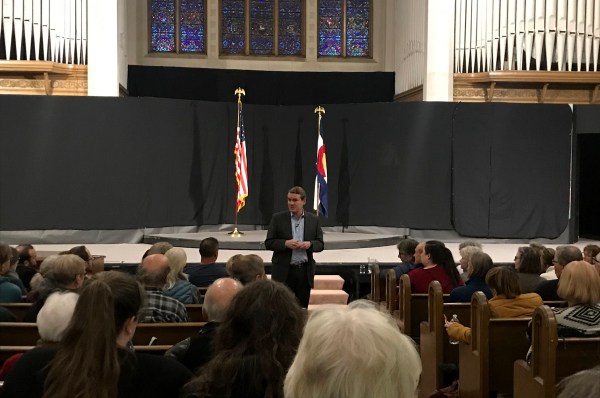
Michael Bennet’s Town Hall. Montview Presbyterian Church, Park Hill, Denver, Colorado. November 29, 2019, Relaxed, informative, a hawk on foreign policy, liberal on some domestic issues. Unlikely to cut the trillion dollar annual military budget or even talk about it.
_______________
My main impression is that Michael Bennet is no fool – he is issue-oriented, his domestic ideas are vaguely progressive, his foreign policy notions hawkish – a kind of Cold War Democrat refurbished for the post Cold War era. Not exactly the type that will challenge the country’s exploding military budget out of control nor ask how it is that the Defense Department and the military has “lost” $6.5 trillion recently.
_______________
Michael Bennet – a rare bird – not afraid to speak to and be in dialogue with constituents – but opposed to the Sanders wing of the party
U.S. Senator Michael Bennet (D-Colorado) held a town hall meeting in Denver tonight in one of Denver’s more exclusive neighborhoods, Park Hill, at the Montview Presbyterian Church. He remains a long shot – even longer today than a month ago – in his bid to become the Democratic presidential candidate. I suppose he held a town meeting in Denver to a generally friendly audience in a bid to bolster his campaign.
Nancy and I went to listen to him – well to be honest I really didn’t want to go; she insisted – glad she did. Such visits are a part of a commitment we have made to ask candidates for national office to support HR 2407 – the bill introduced by Rep Betty McCullom to cut funding to Israel as a means to pressure them from incarcerating, torturing and sentencing Palestinian children to prison. The bill has 21 sponsors at present but is wasting away in the House Foreign Affairs Committee. (More on this below). We want to know how the candidates view this resolution . Read more…
Reforming the Anti-Defamation League? Why Bother? American Jewry Needs New Structures
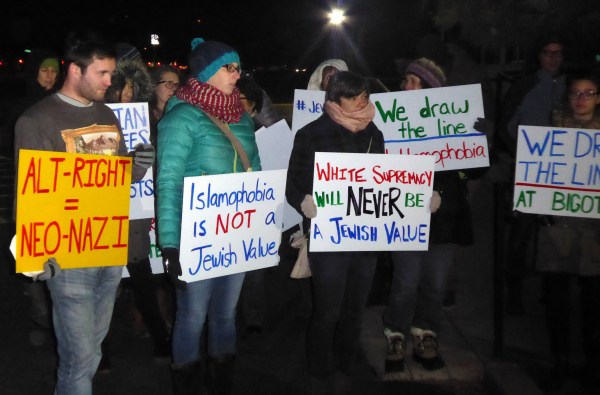
November 2016. Several hundred Denver Jews, organized by “Not In Our Name’ come together to protest the failure of the city’s Jewish leadership to criticize the anti-Semitic blatherings of the incoming Trump Administration.
The ADL Cannot Lead in Civil Rights (from an article in Jewish Currents)
____________________
(The above link – it should be read prior to my comments – it is interesting piece on the ADL – the Anti-Defamation League – ). Have long had mixed emotions about the organization which has placed Palestinian supporters in the same league as Nazis and KKK – type elements.)
____________________
But the ADL is old wine in a not-so-new bottle, an old structure that for many reasons is impervious to serious reform. Something new is needed.
Some organizations are beyond reform – they should close shops “gracefully” rather than limping along gracelessly. They should leave the scene knowing that there are positive accomplishments, yes, but not denying that over time they have become old, scleratic and despite some genuine achievements, outdated.
Time to fold. Old structures need to be replaced, some simply cannot be reformed, despite the good will to do so. Classic example – Gorbachev’s USSR. Such is also the case with many of the old Communist Parties who limp along despite the fact that they are from a historical view point spent forces.
There are other spent forces which are very much alive, looking for meaning in this post Cold War era – NATO prime among them. I would put the Anti-Deformation League of the B’nai Brith (ADL)in the same category, a spent force with very much of a mixed heritage.
But rather than closing shop as history would suggest it do, dissolve itself and make way for a new American Jewish civil rights organization that takes into consideration not just the new social and racial realities in the United States, the ADL slogs on. Of late it has been the recipient in a sizeable uptick in contributions as a result of the outburst in anti-Semitic violence that has accompanied the Trump Presidency, especially from its Christian-fundamentalist wacko base.
But the ADL is old wine in a not-so-new bottle, an old structure that for many reasons is impervious to serious reform. Something new is needed. Read more…
Tunisia’s New President A Mystery Man Without A Plan
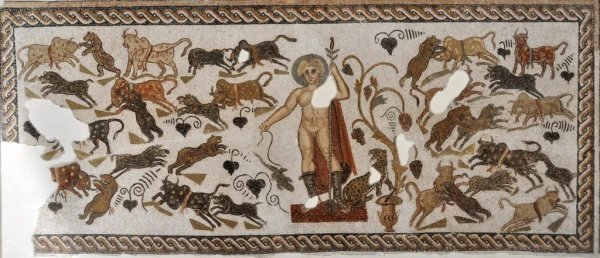
Bardo Museum Mosaic. Tunis. Site of one of the Salafist inspired massacres in Tunisia in 2015
Tunisia’s New President A Mystery Man Without A Plan
by Rob Prince. November 26, 2019 (published originally at Inside Arabia)
Kais Saïed, an unknown 61-year-old constitutional scholar without a clear policy vision was elected president of Tunisia in a landslide on October 14 even as his country has been reeling from eight years of socio-political fragmentation and economic stagnation.
Zine Ben Ali won a fifth term as Tunisia’s president in 2009, winning nearly 90% of the vote in a contest in which international monitors were prohibited. Tunisia’s most recent presidential elections indicate that the days of rigged elections are over. For this alone—along with what remains eight years later of a relatively free press—its citizens have reason to be proud, despite stormy political weather ahead.
As of October Tunisia has a new president.
Despite his previous lack of name recognition, Kais Saïed, an obscure legal scholar, defeated his opponent, businessman Nabil Karoui, in a landslide. It was Tunisia’s second free presidential election since the 2011 revolt, marking the beginning of a new complex era in the country’s history. The 2011 uprising sent disgraced President Zine Ben Ali and his entourage packing. They fled the country, with as much gold from Tunisia’s national bank as they could carry, to permanent exile and refuge in Saudi Arabia.
Saïed’s election suggests that a great majority is still firmly committed to the values of 2011: a more economically prosperous, socially fair, and less corrupt country.
Saïed’s election suggests that a great majority is still firmly committed to the values of 2011: a more economically prosperous, socially fair, and less corrupt country. The spirit of the nationalism that propelled Tunisia to independence in 1957, rekindled by the Jasmine Revolution of 2010-2011 remains alive despite eight harsh and disappointing years. But that spirit has been badly bruised and needs reviving. Read more…

Israel continues to pound Gaza. The U.S. media and political class is silent, refusing to condemn Israeli war crimes. This photo is from 2018, when every Friday Palestinian Gazans peacefully protested at the Gaza fence only to be shot down in droves, wounded by the thousands by Israeli snipers.
_________________
U.S Secretary of State Mike Pompeo: “The establishment of Israeli civilian settlements in the West Bank is not, per se, inconsistent with international law.”
Palestinian Spokesman Saeb Erekat: “Israeli colonial settlements in the occupied Palestinian territories, including East Jerusalem, are not only illegal under international law, they are war crimes. And the statement of Mr. Pompeo, the secretary of state of the United States, is absolutely rejected and must be condemned.”
Noura Erakat, Palestinian human rights attorney and legal scholar: “I would actually temper that a little bit: This is not necessarily a reversal in U.S. policy, only in its stated policy. For 50 — for more than five decades, since 1967, all U.S. administrations have talked out of both sides of their mouth. On the one hand, they have condemned settlements as counterproductive to peace and as a contravention of international law, and, on the other hand, have provided Israel with the unequivocal diplomatic, military and financial aid in order to entrench their settlements”
________________
In a recent interview at Democracy Now, Palestinian attorney and author referred to Pompeo’s remarks as “not a sharp reversal of U.S. foreign policy on the question of settlements and Palestine, but instead the culmination of it.” She noted that before leaving office the Obama Administration abstained from supporting the December, 2016 U.N. Security Council Resolution 2334 condemning the settlements as a flagrant violation of international law while increasing U.S. aid to Israel from $3 billion annually to $3.8 billion. That resolution passed by a vote of 14 to 0 with only Washington abstaining.
Erakat went on to describe the situation in the West Bank as “700,000 settlers living in the midst of a population of 3 million Palestinians, who, because of those 700,000 settlers, who are living in exclusive colonial settlements, surrounded by military and civilian Israeli infrastructure — cuts up Palestinian life into 20 non-contiguous Bantustans, where they can’t reach one another. We’re talking about the subjugation of a Palestinian population at the whim of these illegal colonial settlements.”
An accurate assessment.
Pompeo’s opinion holds no legal status whatsoever where it concerns international law, and in fact, is in violation of it. It comes on the heels of the Trump Administration recognizing Israel’s 1981 annexation of the Syrian Golan Heights, an annexation condemned by the United Nations as in violation of international law. It is understood in many quarters as little more than a cynical gesture on the part of the Trump Administration to bolster Binjamin Netanyahu’s slim hold on power in Israel.
It also opens the door to U.S. support for a full Israeli annexation of the West Bank during the Trump presidency.
Pompeo’s statement needs to be placed within a regional context, the ever-shifting balance of power in the Middle East and U.S. attempts to block and reverse growing Iranian influence throughout the region. As part and parcel of the U.S. response, in the past weeks, and in an effort to bolster its sagging regional position, Israel also launched a deadly attack on Gaza that attacked scores, a multiple air strike against targets in Syria presumably against “Iranian targets” coordinated with U.S. encouragement of protests in Iran over increased gasoline prices. At last count, the latest news reports Israeli aircraft have struck more than 2,000 targets in Gaza and killed over 300 Palestinians since start of the fighting. 50,000 Gazans have been rendered homeless.
As always by targeting Iranian positions in Syria, Israel hopes to provoke an Iranian military response which would draw the United States more directly into conflict militarily. As always, Iran refused to take Israel’s bait and will respond in its own time and manner.
The Demonstrations in Lebanon, Iraq, and now Iran… to What Degree Foreign Interference?

Units of the Syrian Arab Army (Damascus based) liberating parts of Idlib Province in northwestern Syria last year. The offensive continues today
__________
On some fundamental coordinating level, it is hard to see this as anything other than the hand of Washington behind all of this … Nothing innocent or spontaneous about these protests. Later we’ll find out how the usual suspects – Saudi Arabia, Israel, the Emirates are involved… what role they have played.
__________
Yesterday I wrote a brief piece about the publication of a trove of Iranian classified documents in the NY Times and at the Intercept, arguing that it was a form of ideological warfare in which Washington is engaging. The key paragraph noted,
This comes at a time when US influence in Iraq – where Washington maintains one of its largest embassies along with a slew of important US military bases in the aftermath of the 2003 invasion – is wobbling and where massive demonstrations are, to a certain degree, yes, targeting Iranian influence but more importantly calling for a withdrawal of U.S. troops and the closing of U.S. bases in Iran. More generally, it comes at a moment where US influence and credibility in the Middle East region as a whole and that of its chief allies – Turkey, Israel and Saudi Arabia is weakening and seriously so.

Map of the Iran-Iraqi War of 1980-1988. More than a million people died as Washington encouraged Saddam Hussein’s Iraq to attack Iran
_________
Having lost the war it provoked in Syria, Washington had the options of either a graceful or graceless withdrawal. Gracelessness, once again, has won the day
__________
At the same time that Washington is essentially crucifying Julian Assange for embarrassing the United States for the trove of Wikileaks revelations, the Intercept and the NYTimes just published stories on 700 pages of classified Iranian documents on Iranian influence in Iraq… The Times article claims they do not know who leaked the documents, but insist on their authenticity.
This comes at a time when US influence in Iraq – where Washington maintains one of its largest embassies along with a slew of important US military bases in the aftermath of the 2003 invasion – is wobbling and where massive demonstrations are, to a certain degree, yes, targeting Iranian influence but more importantly calling for a withdrawal of U.S. troops and the closing of U.S. bases in Iran. More generally, it comes at a moment where US influence and credibility in the Middle East region as a whole and that of its chief allies – Turkey, Israel and Saudi Arabia is weakening and seriously so.
Thousands of Palestinian children have been arrested and prosecuted by the Israelli military
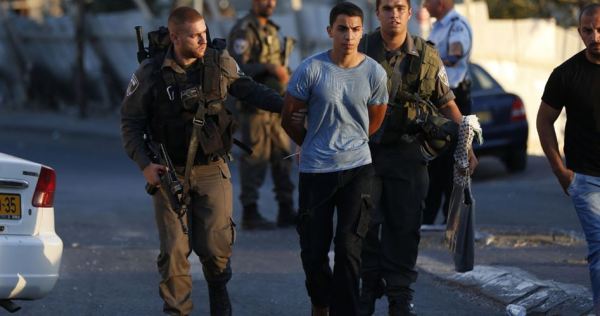
One of the 500 to 700 Palestinian youth being arrested annually by the Israeli Defense Force, IDF. this one from Ajjah Village near Jenin in 2017
What follows below is taken from the American Friends Service Committee website. A campaign in support of HR 2407 is gearing up in Colorado.
___________________________________
Thousands of Palestinian children have been
arrested and prosecuted by the Israeli military
Here’s how congregations and other communities are acting to stop it.
By Ronna Bolante , Sep 24, 2019
Early on the morning of Sept. 20, 2017, around 2 a.m., Israeli soldiers entered the home of Laith, a 17-year-old from Kafr Ein village in the West Bank. Laith was bound, blindfolded, and physically assaulted – and was never presented with a warrant or told why he was being arrested.
Over the next 11 hours, Laith was transferred to multiple locations and interrogated about throwing stones, which is considered a “security offense” under Israeli military law. He denied the allegations against him.
Laith would spend 46 weeks – nearly a year – in detention. He would have multiple court appearances, but never be charged with any crime. And on Aug. 16, 2018, he would be released without explanation, having missed his final year of high school.
Laith is just one of the 10,000 Palestinian children in the West Bank who, since 2000, have been arrested and held in the Israeli military detention system that denies them their basic rights. For the past four years, AFSC and Defense for Children International-Palestine have partnered on the No Way to Treat a Child campaign to expose this widespread and systemic abuse of Palestinian children. It is one part of AFSC’s ongoing work to end Israel’s occupation of the Palestinian territory.
Laith is just one of the 10,000 Palestinian children in the West Bank who, since 2000, have been arrested and held in the Israeli military detention system that denies them their basic rights.
“All children have the right to a safe and just future,” says Jennifer Bing, AFSC coordinator for the campaign. “But every year, Israel prosecutes between 500 and 700 Palestinian children in military courts. We must put a stop to this inhumane treatment – and the U.S. has a critical role to play in making that happen.” Read more…
 View from the Left Bank: Rob Prince's Blog