
Iranian trained Iraqi Shi’ite militamen in Najaf, Iraq. Iraq’s paramilitary groups have blamed a series of recent blasts at their weapons depots and bases on the United States and Israel, vowing to defend themselves against any future attack.
Transcript – KGNU – Hemispheres, Middle East Dialogue – August 27, 2019 – Part Two. (Continued from Part One)
Rob Prince: My question is Ibrahim, that these governments that participate in the Axis of Resistance are actually quite different the one from the other in terms of their politics, their vision. They are not united, if you like, ideologically, in the sense that they have a common program.
One of my mother’s classic sayings comes to mind – “You make a plan for life and then life makes a plan for you.”
In the case of the Axis of Resistance, the countries are essentially thrown together because of common interests but they had to learn how to work together in a principled fashion.
Does this ring true?
Ibrahim Kazerooni: Sure. For example the relations between Iran and Iraq. The Iraqis would like to be completely independent of Iran, having nothing to do Iran. Culturally yes, they are close, Shia-ism to a degree is a common denominator as a theological principle between them. Sixty percent of Iraqis and the majority of the Iranians are Shia. But apart from that – even the way Shia-ism represents and manifests itself in Iraq is slightly different from the way it is represented in Iran. But the major or common denominator between the two countries is anti-imperialism, anti-United States and anti-diktats of the Western colonial powers in the region.
Take Syria’s relations with both the Iraqis and Iranians as another example. Beyond some notion of Alawite connection to Shiaism (very distant actually) – we need to describe exactly who they are, there is nothing in common (with Iraq and Iran). But it’s the position that they have vis-a-vis the imperial stance of the United States. Hezbollah, Hamas and others likewise. Hezbollah is a Shia organization in Lebanon but Hamas in Palestine is Sunni. Yet both consider themselves to be a part of this Axis of Resistance. When we go to the crux of the matter it is their common opposition to American diktats and the politics of Washington’s regional partners, that is to say Saudi Arabia, Israel, United Arab Emirates and a few of the other Gulf states.
Call it the Axis of Resistance or the Axis of the Alliance or Axis of Refusal or the Rejectionist Axis – whatever it is called, refers to a group of people that in essence the common denominator is an anti-imperialist oriented formation that seek to oppose imperialist tendencies and diktats of the United States in the region. Read more…
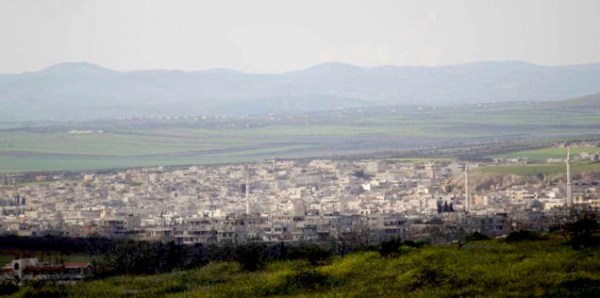
Strategically vital Khan Sheikhoun on the road linking Aleppo to southern Syria via Hama. ISIS has just (August 27, 2019) been expelled by Assad’s Syrian Army.
Transcript – KGNU – Hemispheres, Middle East Dialogue – August 27, 2019 – Part One.
Jim Nelson – This evening’s topic for analysis and discussion is “Washington’s New Boogie Man – The Axis of Resistance. What is it? Why did it come into being?
They are going to respond to a recent interview with Henry Kissinger in the Independent, a British news source. Kissinger claimed that Iran is creating an “Iranian empire” in the Middle East. This initiative to create a so-called Iranian empire must be stopped; in order to do so, the U.S. must support its allies in the region (Saudi Arabia, Israel, etc). On the other hand, many countries in the region see Iran not as trying to dominate the region politically but as an ally or at least trading partner, and one not afraid to stand up to Washington.
So gentlemen – I’ll turn it over to Rob.
Rob Prince: Once again, it’s a pleasure to be here on KGNU. We’ve been preparing for this program for a couple of days. As usual over this most recent period, a number of new developments have entered into the picture. We’ll begin by just mentioning a few of these latest developments before getting into the body of the program. Perhaps we can come back to them later if people have specific questions.
For starters to set the stage something to keep in mind
∙ A month ago, at about the time of our last program, the U.S. Congress approved a two year military budget of a sliver below $1.5 trillion – approximately $750 billion a year for the next two years. Keep in mind this figure doesn’t include the funding to the Department of Energy which controls the country’s nuclear weapon arsenal nor does it include the so-called “Black Box’ budgets – secret budgets for intelligence services that are top secret. So the overall total is probably even greater than $1.5 trillion, closer to $2 trillion if these other factors are taken into consideration.
∙ More recently there has been an intensification of tensions. Over the weekend Israel sent two heavily armed attack drones to Beirut, Lebanon. Hezbollah’s leadership has promised a response. This likely exchange has created a new level of tension Read more…

In a recent interview, Henry Kissinger, using regurgitated Cold-War hyperbole, referred to the “danger” of an “Iranian Empire” in the process of creation. He was referring to “the Axis of Resistance” as it has come to be known, those countries, movements in the Middle East that have come together to oppose U.S. hegemonic plans for the region. A relatively recent phenomenon – What is it? Why did it come into being? That and more
Washington’s New Boogeyman – “the Axis of Resistance” – What it is, What it isn’t – with Ibrahim Kazerooni and Rob Prince. KGNU – Hemispheres, Middle East Dialogues. Tuesday, August 27, 2019. 6-7 pm Mountain Time. Streaming at http://www.kgnu.org

“Life is a tale, told by an idiot, full of sound and fury, signifying nothing”
― Macbeth
______________________________
The fiftieth anniversary of Project Rulison, an underground nuclear blast to produce commercially grade natural gas – a kind of nuclear fracking – will take place on September 10, 2019. Some of us involved in protesting the blast will return to Rulison as a part of an effort to make a documentary film on the event. What was Project Rulison and what broader program was it a part of? It was an important moment in the state and nation’s history but so few know anything about it. What follows are a series of articles on flawed attempt to use nuclear bombs for peaceful purposes, of which Project Rulison was an integral episode.
_____________________________
Project Rulison was an integral part of a much broader program, called “Project Plowshares.” Initiated by the Atomic Energy Commission in 1957, a number of far-reaching plans for the so-called peaceful uses of nuclear energy were then sketched out. They included, among other things, widening the Panama Canal using underground nuclear blasts, mining for copper, building and enlarging harbors in Alaska, extracting oil from shale, and creating cavities into which natural gas would flow that then be sold commercially.
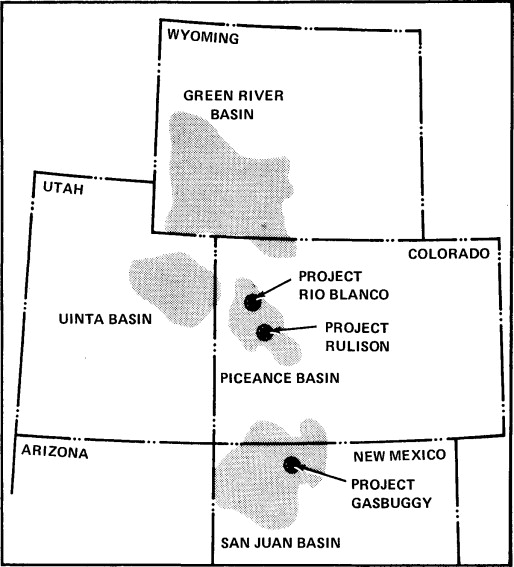
Not one of these projects, thankfully, got off the ground. In all of them the danger of long-term radiation contamination were enough to essentially kill each project and eventually, in 1977, Project Plowshares itself was finally formally killed. All three tests involving natural gas extraction (Project Gasbuggy, Project Rulison, Project Rio Blanco) were failures, after first being called successes. In the case of Rulison, done on September 10, 2019, the site clean up did not end until 1998, that is close to thirty years after the blast.
The public in the United States in the late 1950s – as elsewhere – was becoming increasingly weary of the consequences of nuclear blasts and becoming more and more suspect that the assurances that nuclear energy could be safely used were unsubstantiated happy talk. An international social movement to end the nuclear arms race, known as the Stockholm Peace Appeal first initiated by the World Peace Council, had struck a chord worldwide despite the fact having been branded as “a propaganda trick in the spurious ‘peace offensive’ of the Soviet Union.”
It enshrined three principles: (1) a total ban on nuclear weapons; (2) the establishment of a control mechanism for the application of the prohibition; and (3) a mandate that all States refrain from launching a first strike, which is a crime against humanity.above ground testing of nuclear weapons. Read more…
August 2019 – A Month of Personal Sadness and It’s Not Over Yet

Jorma and Madeline Pesonen – on a ferry to Tallinn, Estonia from Helsinki, Finland. July, 2011
There are the families one is born into…and the one a person makes along the way.
Sadness…
Already four family friends (so far) have died in this month of August, 2019, all from cancer. They made substantial contributions to the common good, to the fate of the earth in their ways, – they did what they could – …and were our friends. Nancy and I miss them all. They are all a part of the fabric of our lives. The fact that they have died won’t change that.

Daniel Lowenstein’s work, displayed recently at Westside Books.
Daniel Lowenstein – not just a Facebook but a real life friend and neighbor. Daniel was an outstanding life-long artist from a highly cultured Denver family. One of the sons of Henry Lowenstein – a Colorado theater icon – Daniel and wife Cathy were a wonderful team, concerned about pretty much all the world’s ills but with great attention to the biggest of them all – climate change. His paintings hung for several weeks at Westside Books. He was also a sculptor and designed theater sets.

Ellen Slatkin (second from the right) with William Watts, Barbara Puls, and David Nefzger at our booth at the People’s Fair, May 1982.
Political upheaval over Tlaib and Omar shows the power of BDS

US Congresswomen Rashida Tlaib and Ilhan Omar
Political upheaval over Tlaib and Omar shows the power of BDS
by Philip Weiss
We are in the middle of a political upheaval on Israel/Palestine in the United States, and Americans who are concerned with Palestinian human rights live for these moments. They are the moments of potential change: When more tarnish is added to Israel’s image, and Americans get a clearer picture of what the Jewish state actually means for non-Jews under its sovereignty.
Since I’ve been covering the issue there have been several such moments. The Israeli assault on Gaza in 2008-09. The Israeli assault on Gaza in 2014. Netanyahu’s showdowns with Obama over settlements, the Iran deal (2011, 2015). The move of the embassy last year with Israel’s slaughter of some 60 nonviolent protesters at the Gaza fence.
Most of these moments have involved a lot of bloodshed. Palestine had to have a lot of martyrs for anyone over here to even start paying attention. 2200 Palestinians died five years ago — over 500 of them children. Hundreds of brave Gazan protesters have died over the last year (with four NY Timescolumnists approving their killings). Read more…
 I am posting two, both which today easily qualify as propaganda films. They are also on links to my blog entries on the subject.
- The first one is a Department of Energy film specifically on the Rulison blast. It makes it sound so harmless, so simple… Project Rulison. It was, like the others in the series, a failure, producing levels of radiation (from the gases produced) that made any commercial use of the resulting natural gas unusable
- The second, “The Magic Atom” was done by the Atomic Energy Commission. It suggests the viability of using nuclear weapons for 1. natural gas production 2. storing oil reserves underground 3. mining copper 4. creating isotopes 4. building canals, ports 5. tunnels through mountains 6. water management… None of which worked. Had Project Rulison been a success, it was estimated (see Chester McQueary’s comments in the High Country News) that the federal government would have used some 800 nuclear blasts to mine natural gas in the Colorado-Wyoming mountains.
ll the horror, stupidity of Project Plowshares (the overall program of which Rulison was a part) was killed in 1977 by the Jimmy Carter Administration…
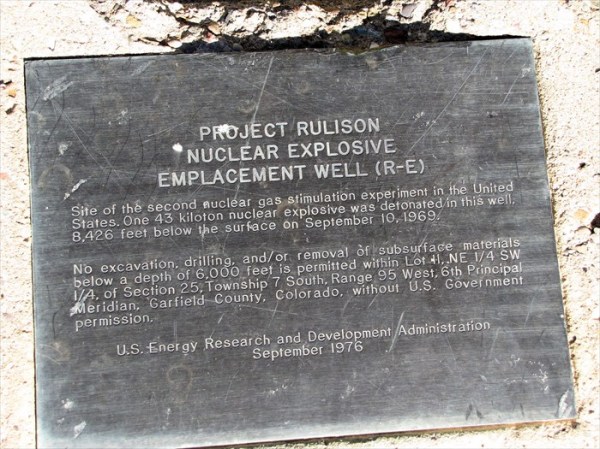 _______________
The fiftieth anniversary of Project Rulison, an underground nuclear blast to produce commercially grade natural gas – a kind of nuclear fracking – will take place on September 10, 2019. Some of us involved in protesting the blast will return to Rulison as a part of an effort to make a documentary film on the event. What was Project Rulison and what broader program was it a part of? It was an important moment in the state and nation’s history but so few know anything about it. This is the third installment of the series.
_______________
What follows is Chester McQueary’s account of being present at Rulison on September 10, 1969 when the Atomic Energy Commission in concert with CER Geonuclear and Austral Oil detonated a 43 kiloton nuclear bomb approximately 8500 ft below the surface. Twenty-five years after the event, McQueary, at the time of the Rulison blast, employed as an organizer for the American Friends Service Committee published this account of the protest that he had helped spearhead. It was published in the High Country News, to this day one of the more interesting and reliable sources of information and analysis of developments throughout the West. Twenty-five years onward, with an intensified nuclear arms race mushrooming before our eyes daily, this account remains relevant, timely. Not surprisingly to me, of the many articles I have read on Project Rulison, this along with a NY Times piece by Peter Metzger (cited in Part 2) are among the best.
McQueary will be back at Rulison September 9-10 to mark the fiftieth anniversary of the blast and reflect on what happened there.
_______________
He felt the earth move when scientists nuked western Colorado
Chester McQueary – December 12, 1994
Twenty-five years ago Americans walked on the moon for the first time, and a federal agency set off an atomic bomb 8,426 feet underground in rural western Colorado.
I was there at 3 p.m. on Sept. 10, 1969, a stowaway on the surface, you might say, when our government detonated the 43-kiloton bomb. It released 2.6 times the destructive power of the bomb we dropped on Hiroshima, Japan.
The Atomic Energy Commission chose this spot in western Garfield County because its scientists believed the blast would rip apart tight sandstone formations and instantly release vast stores of natural gas, free for the pumping.
At federally financed laboratories in Los Alamos in New Mexico and Lawrence Livermore in California, scientists were convinced that atoms could be split just as well for peace as for war. Their proposals included setting off atomic bombs to blast a sea-level Central American canal and a new harbor on the northwest Alaska coast. Bombs would also make the Mediterranean Sea rise and freshen so that water could flow to irrigate the Sahara Desert. Physicist Edward Teller saw bombs as giant shovels, or in the case of western Colorado, huge nutcrackers.
What government scientists refused to consider were unintended consequences: What if the natural gas released were radioactive? Could people stand to live near the thousands of blasts envisioned by the agency if Project Rulison, part of Project Plowshare/Peaceful Atom, succeeded?
Perhaps these were trivial questions for an agency that saw itself as rivaling the biblical creator. As AEC chairman Glenn Seaborg put it, “All of humanity’s efforts to restore the Garden of Eden have been futile so far. Man’s machines have not been powerful enough to compete with the forces of nature.” For Seaborg and his colleagues, atom bombs were God-like tools.
Public hearings were held on the project, and at one, David Evans, an expert on natural gas at the Colorado School of Mines, did some AEC calculations out loud. To develop 317 trillion cubic feet of gas as the agency intended, Evans said, 13,000 underground nuclear explosions might be necessary. No one denied this; no one knew for sure.
Compared to ongoing protests against our involvement in the Vietnam war, hearings on Project Rulison were calm. Still, legal challenges and other tangles delayed the blast on the southwest flank of Doghead Mountain, in the Battlement Creek valley, from May until September.
Then the AEC got serious, designating a five-mile-radius quarantine zone around the site down which the bomb was lowered. Families living inside the zone were paid a pittance to move out of their homes for the day. An AEC spokesman said that the agency’s deep concern for public health and safety would not permit the bomb’s detonation with people inside the quarantine zone.
For some of us who had opposed this bizarre scheme from the start, that statement sounded like a deal we couldn’t refuse. So in early September, 11 of us took the AEC at its word and entered the quarantine zone.
Weather conditions which might have carried vented radiation into Rifle, Glenwood Springs, Grand Junction or other population centers delayed the $11 million blast day by day for a week. That gave us the chance to become more familiar with the terrain.
Chester McQueary
On Wednesday, Sept. 10, the go-ahead was given, and we scattered over the mountain in twos and threes, so that we could not all be removed in one fell swoop by authorities. We listened on portable radios to the countdown for the blast being broadcast on Rifle’s KWSR.
At 30 minutes before blast time, we set off smoke flares to confirm for AEC officials that we were still on the mountain and inside the quarantine zone. A blue, twin-rotor Air Force helicopter soon hovered 50 feet above the aspen clearing where Margaret Puls and I stood. Men in the open door gestured and shouted inaudibly at us. They could not land on the steep slope safely, and we had no intention of being passively taken off the mountain so the AEC could then claim that they had lived up to their word regarding a human-free quarantine zone. Since they’d known of our presence on the mountain for nearly a week, we wondered if some sort of special forces might suddenly slide down ropes from the helicopter doors.
But the helicopter flew off, and we followed the instructions of scientists we’d consulted: We moved large rocks nearby that could bounce and possibly injure us in the shock wave. Then we lay down positioned so our feet, knees and arms would absorb the shock and motion. Each of us wore a common lab radiation badge encasing a piece of unexposed film in case the blast two miles away vented to the surface.
As the countdown reached zero we lay on the ground, afraid and wondering what would happen.
Then a mighty WHUMP! and a long rumble moved through the earth, lifting us eight inches or more in the air. We felt aftershocks as we lay there looking at each other, grateful that we were still breathing and all in one piece.
Seismic detectors at the National Earthquake Center in Golden registered 5.5 on the Richter scale. When we stood up, we looked around quickly for signs of venting and saw a cloud of dust coming our way from the west. But a closer look with binoculars proved it was dust from one of the many fallen cliff faces. Although many boulders in vulnerable positions in this part of Colorado may have been resting for many centuries, that day they moved. And some far below the surface literally melted in the atomic reaction temperatures hotter than the surface of the sun.
The aftermath
We were never arrested nor confronted, and two friends who had been apprehended and removed by helicopter from the mountain before the blast were released without charges. We assumed the AEC and its corporate partners, CER Geonuclear and Austral Oil, wished to avoid the publicity and further debate that a trial would bring.
Months later Project Rulison was judged a failure. The gas it produced was too radioactive for safe use. Nonetheless, the AEC proceeded with plans for its next project: exploding three 30-kiloton bombs, separated by several hundred feet and detonated milliseconds apart. On May 17, 1973, the 90-kiloton Project Rio Blanco in western Colorado’s Piceance Basin was detonated, this time with a 7.5-mile quarantine zone. Three bombs were not better than one; Project Rio Blanco was another awesome, expensive, dangerous failure.
During the past year, Energy Department Secretary Hazel O’Leary released documents which show that the atomic energy establishment for decades has behaved as if the human population and all living systems are its rightful guinea pigs. From feeding plutonium to unknowing children to deliberate releases of radioactive clouds at Hanford, Wash., and Los Alamos, N.M., to the hundreds of nuclear tests in Nevada and at the Pacific/Eniwetok test sites, the atomic establishment showed it would stop at nothing.
In the long 50 years of the nuclear age, “scientists’ have not had the integrity, courage or decency to acknowledge publicly the enormous damage they have done to present and future generations. Instead they hide behind the wall of secrecy called “national security.” When they are forced into the open by court proceedings or congressional hearings, they routinely weasel-word or lie.
An exception is John Gofman, a scientist and member of the original Manhattan Project at Los Alamos, which developed the atomic bomb.
In an interview with Carole Gallagher, author of the book American Ground Zero, Gofman said, “The nuclear establishment will not tolerate that nuclear radiation is dangerous, and that’s not limited only to the United States. It’s true in the Soviet Union, France, Great Britain. At every opportunity you see them struggling to make it safe on paper. I wouldn’t give you two cents for any of them. They’re the scoundrels of the earth … Basically, I wouldn’t believe anything written by the Department of Defense or the Department of Energy.”
What we have been permitted to know is surely the tip of the iceberg. As Dan Reicher, an assistant to Energy Secretary O’Leary, says, “Every time you turn over a new document, there’s a $5 billion problem.”
Had the Project Rulison and Rio Blanco blasts been judged successful and hundreds or thousands of other explosions followed, some of those $5 billion problems would be right here under our feet and in our food and water. That is, if anyone were still living in this valley or northwestern Colorado at all.
_______________________
The Atom Underground Essentially a government-energy corporation propaganda film done by the Atomic Energy Commission.. There is some interesting info though. Not only was Plowshare suggested for natural gas extraction but also for oil storage… OK. The description of the YouTube file (listed below) is worth reading.
For further information visit http://www.PeriscopeFilm.com
A Blast from the Past – Project Rulison Fifty Years On – A Series on Project Plowshares – Nuclear Fracking in New Mexico and Colorado – 2
 A Blast from the Past: Project Rulison Fifty Years On – A Series on Project Plowshares – Nuclear Fracking – 2
Part One, Three, Four, Five, Six, Seven
_______________
The fiftieth anniversary of Project Rulison, an underground nuclear blast to produce commercially grade natural gas – a kind of nuclear fracking – will take place on September 10, 2019. Some of us involved in protesting the blast will return to Rulison as a part of an effort to make a documentary film on the event. What was Project Rulison and what broader program was it a part of? It was an important moment in the state and nation’s history but so few know anything about it. This is the second installment of the series.
_______________
1.
For many in Colorado – most frankly – the fact that September 10, 2019 marks the fiftieth anniversary of the Rulison underground nuclear blast will not resonate much if at all. Too long ago, to obscure a reference. Yet anyone seriously involved in oil and gas exploration probably has knowledge of the place and what transpired there along with anyone who was politically active in Colorado a half century ago. It was the oil and gas industry’s failed effort effort at what the literature refers to as “nuclear fracking.”
Rulison lies west of the continental divide, 192 miles due west of Denver on 1-70. Project Rulison, along with the other like-Atomic Energy Commission (A.E.C.) organized underground nuclear tests, was basically an early method of fracking using nuclear weapons. The other tests were Project Gasbuggy (December, 1967) prior to the Rulison blast and Rio Blanco (May, 1973). A forth project, Project Bronco, was postponed and never took place.
Regardless, something significant happened on that date, in that place. In an attempt to create an underground natural gas reservoir, the federal government, specifically the Atomic Energy Commission, the Department of Interior, in cooperation with El Paso Energy, detonated a 40 kiloton nuclear explosion underground some 8,400 ft (2,600 meters) below the surface of then 73 year old Claude Hayward’s 292 acre potato patch. (1) Read more…
A Blast from the Past – Project Rulison Fifty Years On – A Series on Project Plowshares – Part One.

News article “the day after” the Rulison nuclear blast
A Blast from the Past – Project Rulison Fifty Years On – A Series on Project Plowshares – Part One.
_______________
The fiftieth anniversary of Project Rulison, an underground nuclear blast to produce commercially grade natural gas – a kind of nuclear fracking – will take place on September 10, 2019. Some of us involved in protesting the blast will return to Rulison as a part of an effort to make a documentary film on the event. What was Project Rulison and what broader program was it a part of? It was an important moment in the state and nation’s history but so few know anything about it. If I do, it is because in large measure due to the fact that I was there. What follows – beyond these personal remarks in this introductory entry – are a series of articles on flawed attempt to use nuclear bombs for peaceful purposes, of which Project Rulison was an integral episode.
_______________
According to Margaret Puls, Project Rulison was a federal government program to detonate an underground nuclear blast in the mountains west of Denver, just south of the town of Rulison on Colorado’s western slope, ie, 100 miles or so west of the continental divide. The purpose of the blast was to create a cavity into which natural gas would flow. The federal government would then attempt to sell the natural gas to urban areas throughout the country, but specifically on the West Coast. There’s an idea that is as dumb today as it was then.
A few personal remarks.
In early March of 1969, I descended from what was an interminable Greyhound bus ride from Chicago, across Illinois, Iowa, the never-ending Nebraska to Wyoming, transferring in Cheyenne and arriving in Denver on a sunny late winter morning. Taken back by how different downtown Denver appeared to me, someone who had grown up in NYC, what burst forth from my mouth involuntarily after the first look around was “Hmmm – this isn’t Brooklyn.” Read more…
Aurora’s Taste of Ethiopia and El Paso
1.
There is something special about seeing a community, seemingly invisible much of the time, to burst forth – in all its color, music, dress – and of course food – into the public eye in celebration.
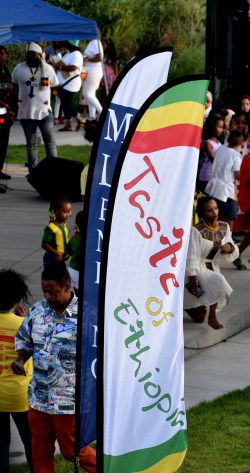
Two days ago, Saturday, was the, among other things, the seventh “Taste of Ethiopia” event in Aurora, one of the occasions – there are several – when the Ethiopian community of Colorado, most of whom live and work in the greater Denver metropolitan area – come out in droves to celebrate their culture. In seven years it has become a major cultural event, well publicized in the local media and drawing thousands, perhaps tens of thousands.
This year’s festival was no different.
An entrepreneurial people par excellence, Ethiopian merchants of call kinds came to show their wares – Ethiopian clothing vendors, coffee shops, restaurants, hairdressers galour. People dressed either entirely or in part in the green, yellow, red and blue of the Ethiopian flag strolled about, people of Ethiopian background of all ages speaking Amharic, Tigre, Oromo as well as English. And of course there was music.
Being there, watching this Ethiopian Community in all its vibrancy, its own singular diversity and talent, I couldn’t help thinking of my Russian-Polish Jewish grandparents who came to the United States a hundred and fifteen years ago (1904 to be precise). Of course Eastern European Jewish immigrants then and Ethiopian immigrants today are quite different, but…both come from a historically rich cultural heritage, both value education to an inordinate degree and both are attached to the food and language from whence they came. And both had/have barriers of prejudice to overcome…and overcome of them they did and will do. Read more…
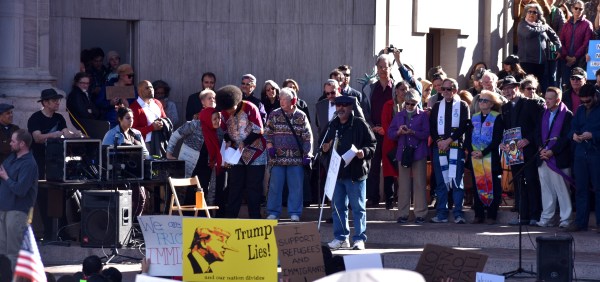
Dr. Ali Zarrin, Persian-American poet, reading his epic poem on Immigration, Immigration Rights Rally, Denver. February 4, 2019
Transcript – KGNU – Hemispheres, Middle East Dialogues. July 23, 2019 – Transcript 3
This profiling, this vilification of Islam has become so extensive, again, huge, as a result of the funds received from different philanthropic organizations through this Islamophobia network. One thing which we need to keep in mind. I reject the idea that this pattern was created as a result of domestic activities alone. Once this kind of pattern becomes commonplace along with the fear it generates, it manifests itself into public policy, foreign policy and it becomes extremely detrimental and dangerous.
Unfortunately, this American philanthropy and Islamophobia given the enormous sums of money that has been provided, now Islamophobia and Islamophobia institutions have become part and parcel of the electoral process. Islam and Muslims have been systematically defined as inherently violent and this is become an integral element of thinking among the American upper echelons.
This becomes extremely dangerous and requires discussion, an organized response.
Ibrahim Kazerooni
(Discussion continued)
Rob Prince: Turning to Ibrahim, I wanted to ask you, given your extensive experience here in Colorado. You lived in Colorado for fifteen years, something like that, is that correct?
Ibrahim Kazerooni: Yes, approximately fifteen years.
Rob Prince: Now you are in the Detroit area, which has the largest Arab and Islamic population in North America – your experience in Colorado, Michigan, being someone for whom at least a part of your family heritage reaches back to Iran, can you elaborate on some of the themes that Kevin has raised?
Ibrahim Kazerooni: Yes certainly. Listening to Kevin, my memory flooded back to what we were going through after 9-11 (September 11, 2001). At that time the same kind of thing – it was general. It was not only specifically Iranians targeted; it was right across the board effecting all Muslims and Middle Easterners – Iraqis, Iranians, Arabs, or even anyone that looked Arab which is part and parcel of how this happened, how the profiling is organized. Read more…
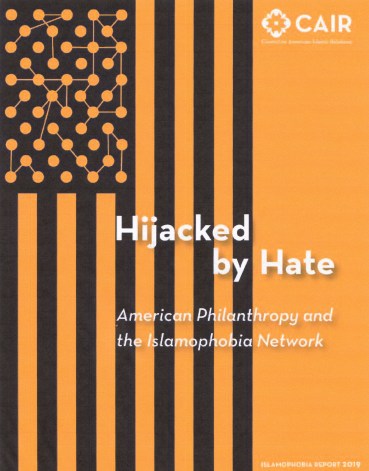
CAIR Report on Islamophobia – 2019
“To Be An Iranian in Colorado” Transcript – KGNU – Hemispheres, Middle East Dialogues. July 23, 2019. Transcript – Part Two.
(Part One)
(Discussion continued)
(Note: The discussion continues with extended remarks by Kevin Amirehsani. Kevin analyzes the politics and economics of Iran for the Economist Intelligence Unit. He is also the head of the Colorado chapter of the National American-Iranian Council, or NIAC as well as a current board member of the Abrahamic Initiative, a Denver based organization committed to increasing interfaith understanding through understanding)
With that having been said, many of my Iranian many of my Iranian brothers, sisters, friends have had different experiences and I was hoping to share a few of those. There are things that go “under the radar.” These are very discriminatory events that are either directly precipitated by the U.S. government or they are U.S. government policies that indirectly have led to a violation of rights of Iranian Americans. – Kevin Amirehsani, National Iranian-American Council of Colorado
Rob Prince: To be an Iranian in Colorado, Kevin, what’s it like?
Kevin Amirehsani: What’s it like? That’s quite the question!
First off I’d like to say thanks to KGNU Host Jim Nelson for having me on; I’m a big fan of Hemispheres. Thank you to Rob and Ibrahim for all the great community work you’ve done over the years.
For me being an Iranian-American in Colorado – I’ve had largely positive experiences to be honest. People here are curious about Iran, curious about the culture. Occasionally I get the offhand comment – or a comment that makes me feel that people are curious and want to learn more about my heritage, and want to learn more about Iran.
I don’t think it’s typically coming from malice – I could be interpreting this a bit optimistically but I’ve had pretty positive interactions with Coloradans. Knock on wood! I love Colorado; it’s a great place here.
With that having been said, many of my Iranian many of my Iranian brothers, sisters, friends have had different experiences and I was hoping to share a few of those. There are things that go “under the radar.” These are very discriminatory events that are either directly precipitated by the U.S. government or they are U.S. government policies that indirectly have led to a violation of rights of Iranian Americans.
Most people don’t know about this stuff. Read more…
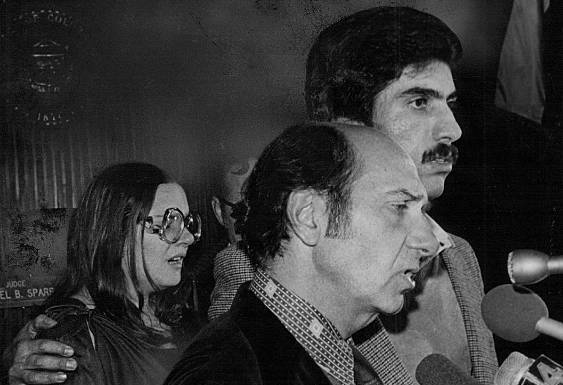
Afshin Shariati and his lawyer, Denver’s legendary (no exaggeration) defense lawyer Walter Gerash
“To Be An Iranian in Colorado” Transcript – KGNU – Hemispheres, Middle East Dialogues. July 23, 2019. Transcript – Part One.
What was the Iran nuclear deal?
The Joint Comprehensive Plan of Action (the Iran Nuclear Deal) was an attempt to normalize U.S.-Iranian relations after decades of mistrust and hostility. That normalization had – or was meant to have – consequences far beyond Iran. The normalization of relations with Iran could have been the first step for making peace with Syria; there was even talk – you can read it in the news of the day – that the improved U.S.- Iranian relations would give momentum to Israeli-Palestinian peace talks. It seemed “the sky was the limit”. So that agreement was not simply about whether or not the Iranians would put a lid on the enrichment of uranium in exchange for the lifting of sanctions (which never happened). The JCPOA was a statement – Iran exists, it’s not going away, it won’t be defeated militarily, the U.S. might as well negotiate.
Jim Nelson: This evening on Hemispheres we continue the Middle East Dialogues and as always joining me from Dearborn Michigan is Ibrahim Kazerooni. Rob Prince is with us in the studio. We have a special guest in the studio this evening, Kevin Amerihsani. Kevin analyzes the politics and economics of Iran for the Economist Intelligence Unit. He is also the head of the Colorado chapter of the National American-Iranian Council, or NIAC as well as a current board member of the Abrahamic Initiative, a Denver based organization committed to increasing interfaith understanding through understanding
Ibrahim Kazerooni: It (the Abrahamic Initiative) is the same organization I used to head up for four whole years during the good old days when I lived in Denver, Colorado. It was based at the Episcopal Church.
Jim Nelson: So let’s get started. This evening’s discussion topic is about Islamophobia, specifically its manifestations targeting Iranians in Colorado and the United States as a whole.
Looking back historically, one can find many examples of the roots of the current Islamophobia in the West. I was first made aware of it by reading Edward Said’s book, Orientalism. Said points out that the world “oriental” has had a long deep dark history in the West. We’ll be getting into some of that history later in the program. Read more…
75 and 80 Years ago, and We´re Again Sleepwalking! – Vor 75 und vor 80 Jahren, und wir schlafwandeln wieder! — WiPoKuLi

Addition – Nachtrag: Facebook going rampant over my article – Facebook dreht wegen meinem Artikel durch: facebook-going-rampant–facebook-dreht-durch click link above – den Link hier drüber anklicken! Deutsche Version unten A Break from the Break Though I´m still busy with some important projects which force me to lay my_blog_to_a_temporary_rest, I feel obliged to have a short […]
 View from the Left Bank: Rob Prince's Blog