
December 19, 1980 Afshin Shariati, right, and defense attorney Walter Gerash talk to members of the press Saturday shortly after the Denver Iranian resident was acquitted on all charges in the fatal shooting of a Denver teenager and the wounding of two others.
“To Be Iranian in the United States Today – Racist Slandering a People to Prepare for War (Again)” – with Ibrahim Kazerooni and Rob Prince. KGNU – Hemispheres, Middle East Dialogues hosted by Jim Nelson. July 23, 2019 @ 6 pm Mountain Time. 1390 AM, 88.5 FM or available by streaming at www.kgnu.org.
Special Guest: Kevin Amirehsani. Kevin Amirehsani, analyzes the politics and economics of Iran for the Economist Intelligence Unit. He is also the head of the Colorado chapter of the National Iranian American Council (NIAC) and a member of the board of the Abrahamic Initiative.
In this program we are going to look at the tenuous situation of Iranians living in the United States, often victims of discrimination and hate both because of their Iranian origins and the fact that they are Middle Eastern immigrants to the United States.
In a manner very similar to how the Iraq government was slandered and vilified in the period leading up to the 2003 U.S. led invasion of Iraq, as a part of the build up for military action against Iran – which appears more and more likely – Iran is being vilified by both the Trump Administration and a willing media.
There is nothing new about this tactic which entails half truths and lies about the Islamic Republic, distortions about the Joint Comprehensive Plan of Action, and an increasingly hostile view of Iranians living in the United States.
Call-ins welcome. 303-442-4242
All that and more!!
_____________
Photo – As an example of the wave of anti-Iranian racist hysteria that exploded nationwide… in the aftermath of the overthrow of the Shah of Iran in early 1979, followed by the seizure of the U.S. Embassy in Teheran by Iranian students and the holding of the embassy staff as hostages, a wave of anti-Iranian racism – unprecedented until them – broke out throughout the United States. It was common to see graffiti all over the country “Nuke Iran.” In that charged environment, made only worse by national media, a group of teenagers, many of them inebriated on beer, went around the neighborhood near what was then Loretto Heights College in Southwest Denver, looking for Iranian names on mailboxes. Seeing what they they thought was an Iranian name on garden apartment mailbox, three young men proceeded to smash to Garden Apartment living room window in of Afshin Shariati and his wife with baseball bats. His home and life threatened, Shariati picked up a rifle he had and shot the intruders, two of which were wounded, one of which was killed. For defending himself, Shariati was indicted on murder charges. Defended in court by legendary (no exaggeration) Denver lawyer Walter Gerash (pictured above with Shariati), Shariate was found not guilty of all charges. The jury deliberated for seven hours to come to that conclusion

Iran rightfully increases uranium stockpiles and enrichment levels beyond JCPOA limits — The Rabbit Hole

Published by Inforos on July 9th, 2019 written by Sarah Abed Iran recently increased its enriched uranium stockpiles and uranium enrichment levels beyond JCPOA limits in response to Washington’s unilateral withdrawal and increased sanctions Fourteen months ago, Donald Trump unilaterally pulled the United States out of the 2015 Joint Comprehensive Plan of Action (JCPOA) agreement […]
Note: If you’re not reading Sarah Abed’s commentaries, you’re missing one of the most knowledgeable, perceptive commentators available in English on “Things Middle East”… and so……. I’m reposing this from her blog “The Rabbit Hole”

Gaza – one of many peaceful protesters shot by Israeli sniper last year….
“Turning Reality on its head from the NY Times to Fox News…Once Again: Iran Nuclear Deal – Trump Junks It and Iran Is Violating It?” – with Ibrahim Kazerooni and Rob Prince. KGNU – Hemispheres, Middle East Dialogues. July 09, 2019 @ 6 pm Mountain Time.
For this program, as a part of KGNU’s semi-annual fund drive, we’re going to probe two elements of U.S. Middle East policy.
First – the so-called “Deal of the Century” – the Trump Administration – Israeli – Saudi attempt to impose a solution on the Israeli-Palestinian crisis, a proposal we will argue was still born from the moment it was announced and is already, essentially dead in the water.
Secondly – We continue analyzing the aftermath of the Trump Administration pulling out – “junking” – the Joint Comprehensive Plan of Action (JCPOA) and the impact of the Trump Administration’s “maximum pressure” campaign against Iran, U.S. efforts (or U.S. led efforts) to provoke the Iranians into a military confrontation, the latest incident being one of international piracy, nothing less, in the British seizure of an Iranian oil tanker passing through the Strait of Gibraltar
Call-ins welcome.
All that and more!!
The 4th – Random Thoughts of an American Marxist
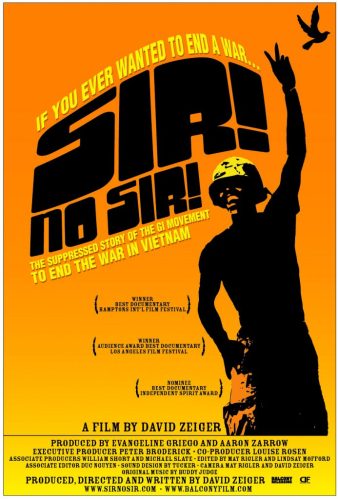
Sir, No Sir – a documentary of American patriots in the military opposed to the Vietnam War they were supposed to be fighting. Available on YouTube
July 4th…
However well it began, even at the outset, 1776, there were sizable “shortcomings” I suppose we call them, although the term hardly describes the reality – slavery, the ongoing genocide against Native Americans, the seizure not long after of the northern half of Mexico – to name some of the more obvious ones. It never did become “a more perfect union” and now, by the day, the country becomes “a more imperfect one”, one whose negative influences are felt worldwide. To mark the occasion of this country’s declaration of independence from Great Britain, our president, “the one and only” is organizing a right-wing militarist orgy in Washington DC, with moneys transferred from the Parks Service – public space that he is helping undermine if not destroy. I might watch the spectacle just to remind myself of what I am fighting against… with the time I have left to do so.
I had no intention of writing about July 4 when I woke up this morning.
But then on a hike – well more of an extended walk – with my daughters Abbie and Molly, five-week old grandson, Teddy, Molly and I somehow (but how?) got into a discussion about trauma. Mostly we were talking about people we know, family and friends, trying to deal with it with varying degrees of success and failure. The conversation somehow shifted to “collective trauma” – the kind that people who have experienced war know. Iraq, Afghanistan, Syria were touched up. Whole nations, millions of people living in trauma.
I kept thinking about it afterwards. And my thoughts went further back in time, to previous traumas, those within my lifetime, but especially to the Vietnam War, the time when I had to make a personal decision about war and “patriotism.” Then on social media, I read the comments of Claire Ryder, who wrote about “false patriotism” and her powerful distaste for war. I found her remarks quite moving (as usual). Read more…
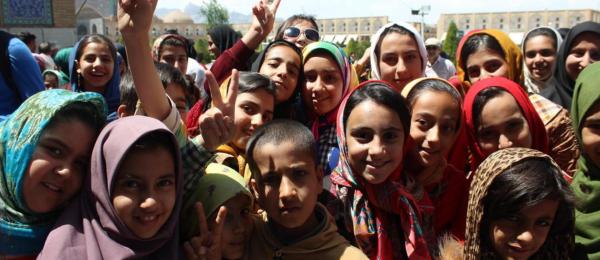
Iranian youth flashing the peace sign
Transcript – “U.S-Iran -Where Do We Go From Here?” – War or Negotiation? with Ibrahim Kazerooni and Rob Prince. KGNU – Hemispheres, Middle East Dialogues. June 25, 2019 @ 6 pm Mountain Time – Part Three
Rob Prince: So Ibrahim, … Where do we go from here so that we can extract ourselves from this crisis? Do you have any ideas?
Ibrahim Kazerooni: Number one – both parties have to accept that in this matter the confrontation can be resolved by negotiation and nothing else. Otherwise, if Trump actually attacks Iran, we’re heading for Armageddon. That is what is going to happen.
Secondly, the concept of negotiations requires bold steps by both sides…Having said, that, once it is understood that U.S.-Iranian tensions cannot be resolved, but by negotiations, both parties have to give in on some points so that both of them can take something concretely out of the negotiations
Jim Nelson: Here’s some spin on this. The United States and Iran did come to an agreement – the Joint Comprehensive Plan of Action (JCPOA) but Trump “ripped it up” against the advice of many diplomats that understood it to be a sound agreement.
Rob Prince: Point well taken, Jim, but let me put this in something of a perspective.
There is this element of Trump’s thinking that goes like this: any Obama-era accomplishment has to be destroyed. He tried completely undo Affordable Care Act (Obama Care) for that reason. Look however what Trump has done with the North American Free Trade Agreement (NAFTA) that the Obama Administration shaped.
First of all he destroys it, throws it out completely. But what he has done essentially, is to put together, more or less, the same agreement, but now he gets the credit for it, rather than Obama. Read more…
 Transcript – “U.S-Iran -Where Do We Go From Here?” – War or Negotiation? with Ibrahim Kazerooni and Rob Prince. KGNU – Hemispheres, Middle East Dialogues. June 25, 2019 @ 6 pm Mountain Time – Part Two
(Part One)
Reminding the listeners about the Cuban Missile Crisis needs to be put into perspective. We’re not simply talking about a military confrontation between the United States and the Soviet Union, what was involved was nothing less than the fate of the earth which was at stake. The example should give a modicum of hope for the present situation. If, in 1962, the United States and the Soviet Union could find common ground enough to come to an agreement, why can’t the United States and Iran, in 2019, follow a similar path?
Rob Prince
Rob Prince: These kind of missions are also a way of testing the Iranian computer systems to see how they respond
Ibrahim Kazerooni: Well, if you remember Leon Panetta, the former C.I.A. director under Obama made it clear…
Looking at the last couple of years, from 2011 up until now, the United States has constantly sent various drones, either from Afghanistan, Iraq or from other sources. Eight or nine of them have already, in the past, been shot down.
Rob Prince: So this is not the first time that an American drone has been shot down violating Iranian air space?
Ibrahim Kazerooni: Yes. Two of them were brought down during the Obama Administration years. Immediately, through reverse engineering, the Iranians actually copied these drones. I remember Obama asking the Iranians to return American drones. Read more…
 Transcript – “U.S-Iran -Where Do We Go From Here?” – War or Negotiation? with Ibrahim Kazerooni and Rob Prince. KGNU – Hemispheres, Middle East Dialogues. June 25, 2019 @ 6 pm Mountain Time – Part One
… I agree with the sentiment that Trump’s “stepping back” from responding to the drone downing with a U.S. military response had nothing to do with the President’s claim that he wanted to save 150 Iranian lives.
Instead, other factors were at play. The fact that the Iranians were able to shoot down such a sophisticated drone proved a couple of things to the United States.
1. Particularly, adding in a few other factors, it becomes clear that Iran is not prepared to play Washington’s game. Iran has repeatedly said in the past that its air space is “a red line” not to be crossed.
2. The Iranians are prepared to confront the U.S.,to respond to any further Washington provocation militarily and they have the sophistication to do and to challenge the United States in the region
– Ibrahim Kazerooni –
Jim Nelson: As many of our listeners are aware, the tensions between the United States and Iran have reached something close to the boiling point. A military confrontation remains highly possible. Much of the confrontation is a result of the Trump Administration pulling out of the Joint Comprehensive Plan of Action – JCPOA- (Iran Nuclear Deal). The Trump Administration gave a number of reasons to leave the JCPOA, childish claims on the whole. Trump referred to it as “the worst deal ever,” “a terrible deal.” When Barack Obama first helped craft the agreement, in an effort to undercut his achievement, the Republicans immediately began to undermine its legitimacy by raising the issue of Iran’s long-range ballistic missiles – which are not in any way a part of the agreement. They also claimed – again falsely – that Iran was secretly enriching uranium; the IAEA (International Atomic Energy Agency) denies that Iran was “cheating” on enrichment.
What we have here is a precarious situation, a dangerous situation that threatens to blow up into a regional conflict with global consequences – a deadly game of chicken, created and accelerated by National Security Adviser, John Bolton, and U.S. Secretary of State Mike Pompeo with Donal Trump going along for the ride; he seems to be enjoying it. But Trump’s joy ride could end in a crash with reality.
Rob Prince, what do you think?
Rob Prince: Thanks for the introduction Jim, I think it’s quite apt. We’re facing what is actually a contrived crisis, contrived in Washington DC, but extremely dangerous all the same. The way we’re going to begin tonight is to put forth a way out of this situation.
The main argument we’re going to build towards over the course of tonight’s program is that to turn around the current situation – the danger of a U.S. attack on Iran, which would provoke an Iranian military response that could ignite a regional war – and could go beyond that, the question is how do we pull back from the brink – that is our main concern at this moment.
To do so both the Trump Administration and the Islamic Republic of Iran should enter into immediate negotiations without pre-conditions. We’re far from that this evening as the verbal war continues, and if anything it has these past days intensifies. Read more…

Long ago and far away….John Kerry and Mohammad Javad Zarif named winners of the Chatham House Prize 2016 for the signing of the Joint Comprehensive Plan of Action (Iran Nuclear Deal)
Hear Ibrahim Kazerooni and Rob Prince on KGNU Boulder (88.5 FM, 1390 AM, Streaming at http://www.kgnu.org) on Hemispheres, Middle East Dialogues hosted by Jim Nelson, Tues, June 25, 2019 @ 6-7 pm Mountain States Time. The program is available for streaming or downloading tomorrow at KGNU’s archives
——————–
The main argument we’re going to make tonight is that to turn around the current situation – the danger of a U.S. attack on Iran, which would provoke a military response that could ignite a regional war – both the Trump Administration and the Islamic Republic of Iran should enter into immediate negotiations without pre-conditions.
Both sides have to be ready and willing to make compromises of a substantial nature – in the US case, to end its sanctions against the Islamic Republic and return to the J.C.P.O.A…
On the Iranian side – in exchange for a U.S. commitment not to engage in engage in efforts to overthrow the current government of Iran – either through military means or through its “maximum pressure” policy – that the Iranian government would be willing to negotiate
——————–
There is the possibility of pulling back from the abyss…but it will take a major effort on the part of both of these main parties.
Daesh-like “Scorched Earth” Terror Policy Sets Syrian and Iraqi Agricultural Land Ablaze — The Rabbit Hole

Published on InfoRos on June 20th, 2019 written by Sarah Abed Although Daesh has claimed sole responsibility for recent crop fires, other culprits have a motive and share responsibility too After years of deprivation and financial turmoil farmers across the most fertile parts of Syria and Iraq were looking forward to a much-needed return on […]
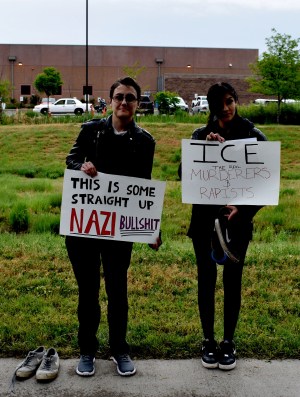
Two of the 250-300 demonstrators protesting U.S. immigration policies in front of the Aurora, Colorado ICE facility run by GEO (R. Prince photo)
Molly called yesterday (or was it the day before?). Would I accompany her to a demonstration organized by the national group “Indivisible” at the Aurora, Colorado ICE facility just east of Denver. Yep, says I. I’d pretty much had it following the state crimes this Administration has committed against immigrants. Why not demonstrate? Again.
The picket comes just days prior to a media report that ICE is set to begin immigration raids in 10 cities on Sunday (June 23, 2019). It is not certain that only ten cities will be target or that Denver or Aurora are included (although at least one news source specifically mentions Denver as one of the cities to be effected. President Donald Trump tweeted – his only form of communication these days – that such an operation was imminent. Immigrant communities and their supporters are bracing themselves accordingly. (1)
A Colorado Independent article by Grace Carson on the picket and probable imminent ICE raid also reported that Denver will be targeted.
I had just saw news how lawyers representing the Trump Administration had argued in a San Francisco court that the federal government was not required to provide child immigration detainees with tooth brushes, soap, nor beds to sleep on – only the latest in series of Nazi-like practices the current administration (and the last one) has engaged in against undocumented, incarcerated immigrants.
The Aurora ICE facility is a privately run facility run by the prison company GEO. Cases of mumps and chickpox had been confirmed at the facility, these among multiple federal standards violated by the GEO facility managers, this according to a federal report done by the Office of the Inspector General, cited in a recent issue of Westword. As of June 4, 152 detainees at the Aurora facility were under quarantine because of cases of mumps and chicken pox. Read more…
Colorado State Veterans’ Home at Fitzsimons – Saying Goodbye to Don Griffis; Emerging Financial Mismanagement Scandal

At Don Griffis’ grave. Ft. Logan National Cemetery
____________________
The picture that emerges, if accurate, is, at the very least, one of financial mismanagement on a massive scale, a system, literally out of control, either through neglect, poor book keeping, or worse, or some combination thereof.
As one Fitz employee told me recently, “When it comes to the Department of Human Services, Jared Polis inherited ‘a pile of sh..’ from his predecessor, John Hickenlooper.”
As examples of the level of managerial incompetency involved Garner Bishop – Aghababian noted that “the City of Aurora came to shut off the water for lack of payment. Xcel energy has sent shut off notices, the pharmacy and food invoices are behind.”
____________________
1.
Yesterday (June 3, 2019), a small group of his friends and cohorts gathered at the grave of Don Griffis, who died at the age of 88 at the Colorado State Veterans Home in Aurora as 2018 turned into 2019 sometime between New Years’ Eve and New Years’ Day. A delegation of new Air Force recruits was also present.
Although Griffis lived a varied and colorful life that included a stint in the Air Force during the Korean War era, a teaching career at Metropolitan University of Denver’s Music Department, a participant in the Denver Sympathy Orchestra (among other accomplishments), virtually all of us present in the above photo knew Don specifically from the tireless work he did as resident-advocate at the Colorado State Veterans’ Home, known by its residents and employees simply as “Fitz.”
Those present commented on Griffis’ love of classical music, his tireless work on behalf of Fitz resident rights, his love of Chardonnay, a bit of which was poured at his grave site so that he might enjoy in the afterlife what he so loved before his passing. I mentioned how as his social activism intensified that the administration at the Colorado Department of Human Services actually tried to get him expelled from the facility as a result.
Another participant, ColoradoWINS state board member and activist, Jacquie Coulter, added later how, to its shame, at one point the Department of Human Services had actually organized an in-service workshop, essentially on how to deal with the ornery, persistent Don Griffis whose unending inquiries, letters, attendance at different veterans’ board meetings was getting under the skin of the Human Services’ administration. Read more…
Transcript: Iran 2019 – All The Makings of Iraq 2003? Similarities and Differences – May 28, 2019 – Part Three
 Transcript: Iran 2019 – All The Makings of Iraq 2003? Similarities and Differences – May 28, 2019 – Part Three.
Continued from Part Two
If you listen to the comments by (Iranian Foreign Minister) Javad Zarif, or whether it’s conservative or middle ground politicians in Iran they all seemed to have converged to a single point: under the present pressure (from Washington) and the present condition, no conversation, no negotiation with anyone will take place.
Ibrahim Kazerooni
There is a need to de-escalate. There are so many ways that it could be done. For example, at this point in time, rather than sending more troops to the region, withdraw those 7,500 troops Washington announced it would send. Withdraw the additional air craft carrier group just send to the region and the battle ships that go along with it.
Make concrete steps – beyond the empty comments that Trump “doesn’t want war.”
Rob Prince
Rob Prince: Ibrahim, I agree, for the reasons stated how unlikely it is that Trump is going to re-engage in the Joint Comprehensive Plan of Action. That said, I think it an important demand to raise. It was the withdrawal from that agreement which shifted what appeared to be the beginning of a rapproachment, a process of diplomacy. That process was thrown in the waste basket and began this march towards war.
Ibrahim Kazerooni: Rob let me express a different opinion.
If Trump stepping back with the deal, if it did not coincide with the European countries having the backbone to stand up to Trump it would have gotten us to the point where we are now. The problem is that once the Europeans stepped away from the agreement, instead of the Europeans standing up and saying that this (the Joint Comprehensive Plan of Action) is an internationally recognized – by the United Nations Security Council – agreement, we have to respect it and we are going to do everything possible to keep it in tact…what happened?
Fearing some kind of reaction from the United States, the European firms and banks and other interests began to withdraw, weakening the European government’s position. So it was two issues together; it wasn’t just Trump stepping back from the agreement. Putin was quoted as saying last week that Russia is not a fire brigade coming to put out the fire every time there is a crisis. Europeans have to share the blame for not standing up to America.
So we really have to put the blame on both of them: Trump’s ideological approach to negate the deal that Obama had negotiated on the one hand and the European lukewarm wishy-washy approach on the other.
Rob Prince: Yes all that is true enough. Still, Ibrahim, at some point, in order to improve the atmosphere, to begin turning the situation around – and here Trita Parsi does deal with this – there has to be some kind of de-escalation on the part of the United States.
Ibrahim Kazerooni: Yes, I was going to get this. The third and forth points he (Trita Parsi) raises are extremely useful: Drop all preconditions and respect the adversary.
The United States has to understand that after forty years of imposing sanctions on the Islamic Republic of Iran, that Iran is a reality in the region. Washington has to recognize and respect that.
Yes, and all the pre-conditions barring the way to negotiations have to be dropped. No pre-conditions. If the Trump Administration wants to make a deal with Iran, they have to sit down with them.
If you listen to the comments by (Iranian Foreign Minister) Javad Zarif, or whether it’s conservative or middle ground politicians in Iran they all seemed to have converged to a single point: under the present pressure (from Washington) and the present condition, no conversation, no negotiation with anyone will take place.
As to the final suggestion, stop listening to the Israelis and Saudis, – it’s one of the old debates – that is agreeable to a degree. Rob, you just mentioned how the Israelis are prepared to go war against Iran until the last American soldier. But Israel has always done that. They want to get the United States involved in the region. The war in Syria is because of that. The war in Iraq was because of that, because the Israelis wanted to weaken or eliminate some kind of strategic adversary within the Middle East.
What is happening now?
We have a region in crisis, at the brink of war. Anything can happen at any moment. Again when you constantly see the narrative that is being used by the Trump Administration and the influence of the lobbies, I wonder, if on a practical basis any of these three above cited conditions (cited by Parsi) would be implemented or put into practice in order to move towards de-escalation, stepping back from the brink.
The Iranians have made it clear that they are prepared to respond (to an opening) if they see concrete steps taken by the U.S. but they are not prepared to respond to anything short of that.
Rob Prince: I want to repeat what I said earlier: just the fact that Trita Parsi is putting out, suggesting ideas as to how to move from military confrontation to diplomacy – he deserved a great deal of credit. These are the kinds of discussions that we should be having. I am very grateful for that.
Ibrahim Kazerooni: Yes I said so in the beginning. I said that I must commend him for opting out of the war strategy. By the way he has written a number of books about diplomacy with Iran so this is not new for him. He has to be commended for it.
Rob Prince: Not only that, Ibrahim. It also shows some courage in a moment when there is not a lot of that coming from commentators in the United States.
Ibrahim Kazerooni: All that is needed is one false flag operation – be it engineered by the Israelis, Saudis or other Persian Gulf emirates for the whole thing to explode.
Rob Prince: There is a need to de-escalate. There are so many ways that it could be done. For example, at this point in time, rather than sending more troops to the region, withdraw those 7,500 troops Washington announced it would send. Withdraw the additional air craft carrier group just send to the region and the battle ships that go along with it.
Make concrete steps – beyond the empty comments that Trump “doesn’t want war.”
Ultimately what Washington is going to have to do is reconsider the sanctions against Iran because basically it’s economic and military pressure being exerted against Teheran.
Ibrahim Kazerooni: It’s a noose around the Iranian neck.
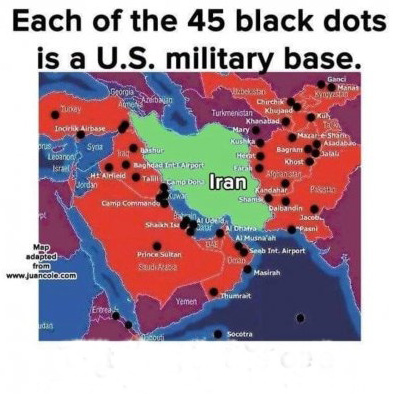
Particularly when you consider the nearly twenty or so American bases encircling Iran, whether in Iraq, north in Turkey, Afghanistan, Pakistan or in the Gulf states. The situation is extremely tense and volatile.
Rob Prince: Again, agreed. And here we come to the role that public opinion here in the United States can play – and of course has not played at least substantially until now.
We are beginning to hear some calls, from what we could call “the usual suspects” – peace movements “No War With Iran.” Hopefully those calls will grow and that some of the ideas that Trita Parsi is putting forth are looked at seriously, particularly again – the heart of the matter – however Washington wants to put it – de-escalating militarily and economically (lifting the sanctions).
Jim Nelson: Looking at the mainstream media, they are focusing mostly on the possible impeachment of Trump, 24-7 beating the drum. If there is any discussion on the current military build up against Iran, it’s usually ex-generals that are brought forth as experts. Same kind of media coverage we saw prior to the Iraq invasion.
Ibrahim Kazerooni: Jim, if you look at this objectively, think of this: Four hundred Congress members from both chambers, roughly 75% of all U.S. lawmakers have signed an open letter calling on President Trump to escalate the war in Syria in the name of “countering Iran, Russia and the Lebanese movement, Hezbollah.”
These so-called lawmakers have to be answerable to their own constituencies. The only way that pressure can be put on them is for people to call them, day in, day out challenging them. On what basis are they supporting the sending of more and more troops to the Middle East
In Iraq there is currently a huge uproar among ordinary people against the American presence in the country. A couple of missiles were recently fired very close to the American Embassy in Baghdad. Now it would only take one of these missiles to start the region-wide explosion.
The American consulate in Basra was shut down because the American embassy knows what might happen there. Now the embassy might be in danger, as well as the consulate in northern Iraq. American troops will be endanger. Washington is now sending more and more troops to protect those troops already there on the ground, rather than change the policy. This is the fundamental problem that we have.
Jim Nelson: This plays out in the media as well that such a foreign policy is acceptable. I’m think of the vote to legalize the war on terrorism, back in 2001. Barbara Lee was the sole member of either changer to vote against the authorization of use of force following the September 11, 2001 attacks.
There might be other members of Congress this time who would oppose going to war.
Ibrahim Kazerooni: Senator Bernie Sanders, Tulsi Gabbard and a few others did not sign on to the Syria military escalation resolution but the fact that 400 members of Congress approved of such a resolution this clearly states the degree to which the United States has not learned from its past mistakes and that more needs to be done.
In a meeting that took place here (in Detroit) with a number of religious scholars, I reminded them of what happened during my time in Denver, Colorado. Among other places, the peaceful Iliff School of Theology organized a workshop where all the religious scholars that came together from
Left to Right, Jewish and non-Jewish – they all insisted that we have to go to war with Iraq. Today we really have a responsibility, whether religious scholars, political scholars, whatever, that everyone needs to be reminded, that opposing war is a civil duty.
As an American citizen I have all the right to oppose the war.
Jim Nelson: In our remaining nine minutes…how would Israel or Saudi Arabia benefit if war broke out in the region?
Rob Prince: Where both Israel and Saudi Arabia are coming from – if you strip it down to its essence is very, very simple: They see their relationship with Iran as a zero sum game. If Iran’s influence is growing in the region, theirs is receding. They are losing regional hegemony, their ability to dictate policy throughout the region is in relative decline. That’s their main problem with Iran.
Take for example Israel’s situation at present. At the same time that Israel is tightening its noose around the Palestinians in Gaza, in the West Bank but Israel’s ability to dictate policy in both Lebanon and Syria has been seriously reduced. It cannot do that anymore with the impunity with which it did so in the past. The balance of forces has shifted there.
Although we need to be a little cautious over how it is put, but to a certain degree, its hands are tied.
They can not bomb Syria with impunity anymore. The notion that Israel can strike militarily in Lebanon as they did in 1982 or 2006 in the currently existing asymmetrical warfare, the scales have shifted.
Ibrahim Kazerooni: Rob, by the way, the same thing happened even in the latest conflict with Gaza. As soon as Gaza’s missiles hit close to Tel Aviv, the Israelis realized that the situation has changed. Both Israeli retired military personnel and politicians admitted that the (balance of power situation) in Gaza has dramatically changed.
Rob Prince: And then let’s remember why the Saudis were so supportive of the 2003 U.S. led invasion of Iraq. Even weakened by thirteen years of sanctions, Saddam Hussein’s Iraq was still one of the only Arab countries that could challenge Saudi dictates.
When it comes down to it, the tensions and instability in the Middle East are not about religion – it has always been a convenient sideshow quite frankly, it’s about geo-politics – that is what it’s about.
Ibrahim Kazerooni: in a world where “winner takes all.”
Rob Prince: And that is how Washington looks at the situation. What is the main beef has, really, against Iran? The United States supports a theocracy – actually more than one – in the Middle East.
But the Saudis theocracy, with all that it entails, Wahhabism and its influence not just in the region but globally – the fact that Iran is an Islamic republic – quite frankly, this is not the issue.
The issue is that Iran pursues an independent regional policy that frankly doesn’t have to be in conflict with the United States, but Washington simply does not accept a major regional power that has an independent political approach.
Jim Nelson: And to continue, this just seems more consequential than the 2003 U.S. led invasion of Iraq, much bigger – and the repercussions of a regional war, certainly for Israel and Saudi Arabia seem to be something approaching catastrophic.
Ibrahim Kazerooni: Jim, you just pointed out something important. Iraq was already extremely weak after thirteen years of sanctions and economic embargo. And yet after seven years of military intervention, the United States was forced to admit that they had lost the war in Iraq and they had to prepare a plan to withdraw, to get out.
The situation with Iran is quite different.
Washington is going to go to war with Iran, the most nationalistic country in the region that has survived forty years of economic embargo and has always indicated that it intends to pursue an independent regional political line – no West, no East – as they call it.
So attacking Iran is a totally different situation from going to war against Iraq. Frankly it’s really madness to think of going to war with Iran. The Iranians have time on their hands. General Solimani said in a speech he gave a couple of days ago, repeating what he earlier said, that the United States can start a war with Iran anytime they want but we (the Iranians) will finish it the way we want.
Rob Prince: Yes, a discouraging moment and the points that Ibrahim raises about moving from a war footing to diplomacy are indeed real. I’m not arguing with his analysis of the difficulties in changing course. At the same time, one has to put forth positive alternatives, plans, initiatives to turn the situation around, to move in the opposite direction, in the direction of diplomacy and peace.
Ibrahim Kazerooni: As a point of engagement and conversation, yes….
Jim Nelson: In the remaining moments we have, is there any kind of initiative that would lead to light at the end of the tunnel at this point.
Rob Prince: A change in direction, a more sober assessment of situation in the region than we are now getting. A change in direction that reduces the military component and begins to more seriously explore diplomatic solutions. A freezing of U.S. militarization of the region. No more troops, no more naval build up. Militarization of the region and diplomacy at the same time cannot co-exist. With such an approach, change is not going to happen.
Ibrahim Kazerooni: And then you give diplomacy a chance by finding ways of communicating with Iran and I’m sure that the Iranians will respond.
The end.

By James M. Wall Samia Khoury has been my friend since before the first Intifada. My first of 20 trips to Palestine and Israel, always as a journalist, was in 1973. All too slowly, since that first trip, I grew to grasp the depths of the harsh reality of Israel’s oppressive military occupation of the […]
via Samia Khoury and Trump’s Deal of the Century — Wallwritings
Transcript: Iran 2019 – All The Makings of Iraq 2003? Similarities and Differences – May 28, 2019 – Part Two.
Remember the good old days? John Kerry and Mohammad Javad Zarif named winners of the Chatham House Prize 2016 for the signing of the Joint Comprehensive Plan of Action (Iran Nuclear Deal)
Transcript: Iran 2019 – All The Makings of Iraq 2003? Similarities and Differences – May 28, 2019 – Part Two
With such an ideological approach, asking Trump to go back to the deal will be a “no-no” for the Administration as long as Trump remains in office. It’s not going to happen. As I just explained, stepping away from the deal wasn’t because there wasn’t some inherent deficiency within the deal that had been agreed upon. (John) Kerry said it; European leaders said it. They called it a “win-win” for everyone involved.
No, it’s because Obama signed it and Trump has to dismantle and deconstruct it.
With such an approach, what chance is there that the United States, or Trump is going to return to the deal? It would take a miracle for that to happen and I don’t believe that is the case in the light of what Trump himself as indicated as the reason for tearing up the deal
– Ibrahim Kazerooni –
3.
Ibrahim Kazerooni: I have a question for you Rob. If what we have talked about turns out to be correct, that our spin suggests that behind this sabre rattling against Iran has more of an economic motivation, racketeering to lead to the edge of war, I have recently read a number of articles which reminded me of the situation and parallel with Iraq in 2002-3. Do you see any parallels between the two?
Rob Prince: Jim and I were discussing this just before the program, and yes, looking at the military build up, the scenarios for war, the way the media is acting there is an eery resemblance between what is transpiring now in the Persian Gulf and the period just prior to the U.S. led invasion of Iraq in 2003.
To what are we referring?
First, the military build up starts with the vilification of the targeted government, in 2003, the Iraqi government on half truths and outright lies. And so it is today. Much is made of its human rights records suggesting that the military invasion is necessary to protect lives, while in fact, it was political and economic factors – gaining control of Iraq’s energy industry – which were driving events.
What listeners would do well to remember is that there is no nation that is perfect and that it has been easy to cherry pick – certainly in the case of Saddam and Iraq – there were many valid criticisms to make, but these human rights problems are used, not to improve the situation but as a pretext for intervention.
Ibrahim Kazerooni: As they did in Libya
Rob Prince: As they do pretty much anywhere where Washington intervenes. It always starts with a fabricated pretext, claiming to be the holy warriors for democracy and Capitalism. The root causes are not about selling weapons or controlling oil, oh no! Read more…
 View from the Left Bank: Rob Prince's Blog