
11-30-2016 Demonstration in front of the Jewish Community Center in Denver organized by new group of young Jewish radicals, “If Not Now, When?” It protested the anti-semitic overtones of the then just elected Donald Trump and criticize the silence of local mainstream Jewish organizations to address the rising wave of antisemitism. Several hundred people, almost all of them Jews of all ages, were in attendance.
(This blog entry – reflection I suppose would be more accurate – is a result of reading the article below this morning and…a lengthy meeting and discussion I had recently with a young Jewish member of Jewish Voice for Peace here in Denver.)
An article appeared in the liberal Israeli newspaper Haaretz (The Land) entitled “Vast Numbers of Progressive California Jews Disengaging from Israel, Survey Finds.” Its subtitle reads “Only a minority of young Jews in San Francisco’s Bay Area believe a Jewish state is important and only a third sympathize more with Israel than the Palestinians.” It goes on to add:
-
Americans more divided over Israel ‘than at any point’ in recent history, study finds
-
Hundreds of young U.S. Jews send birthday wishes to jailed Palestinian teen Ahed Tamimi ahead of trial
-
Why U.S. Jews care so much about the fate of African asylum seekers in Israel
The survey targeted a variety of people in Northern California’s 350,000 Jewish Community, only 21% of whom identify themselves as “strongly attached to Israel.” So nearly 80% are not so attached. Read more…

City Park and downtown Denver, viewed from the Denver Museum of Nature and Science
Or…where’s Gene Amole when we need him?
The discussions among the anointed ones, the participants didn’t gravitate around whether or not Denver should host the Olympics, ie., the positives and negatives. Instead several people in the room, rather crudely focused on what they specialize in: What’s in it for them!
Hi Folks…
For those of you in Colorado – which is most, but not all – or who have lived here and still care…there is a move afoot – usual developer-big finance stuff – to bring the Olympics to Denver in 2026. A number of people with good political noses have been predicting such plans were in the hopper – I wasn’t one of them – . They based their suspicions on certain developer-contractor patterns unfolding in the city, put it all together and it spelled “OLMYPIC BID”…and they, the friends, were “spot on.” All this was done with what is now become the traditional lack of “transparency. “But as the time to make a formal bid for the Olympics is fast approaching, the Olympic bid organizers have had to come out of the closet, so to speak to win public approval for plans already decided upon behind closed doors. Read more…
GES Coalition’s Public Comment on “Housing an Inclusive Denver”

A 300 plus apartment-condo unit, a true monstrosity in the neighborhood, being built at the corner of Lowell and 38 Ave in NW Denver, here in the early stages of development. The structure is now completed, with people moving in. Typical of the nearly un-controlled growth taking place all over Denver.
Denver – actually pretty much all of the Front Range (of the Rockies) in Colorado – is experiencing a housing crisis. People are moving to Denver from all over the country at an alarming rate – with the metropolitan area (Denver-Aurora-Lakewood) now at close to 3 million. Denver’s population alone is now nearing 700,000 after decades of hovering around half a million. There are more than 1000 people a month coming here with no slowdown in sight. The demand for housing combined with are some of the most poorly regulated housing codes in the country has triggered dramatic demographic shifts as well. Rental rates have soared as have housing prices, resulting in, over the past decade, an epidemic of displacement of middle-income, working class and poor people. People of color especially, Blacks, Browns, Reds, are among the most adversely affected. No surprise as part of the mix that homelessness is also a serious problem with homeless folk numbers consistently above the 10,000 mark. Read more…
An Outsider’s Look at the January 18, 2018 Protests in Tunisia
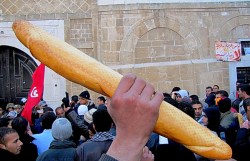
An Outsider’s Look at the January 18, 2018 Protests in Tunisia The link takes readers to five commentaries at http://www.nawaat.org on the Tunisian protests. Below is my contribution somewhat more elaborated.
They’ve been sitting in cafes for seven years, maybe more.
As the news of the protest movement made its way into the media (to follow in far off Colorado), a vivid memory of Tunisia in 2011 came to mind. It was almost a year after the widespread revolt of initiating “the Arab Spring” which swept Zine Ben Ali, his wife Leila Trabelsi and their two completely corrupted extended family clans from power. Young men are sitting in a Tunis café in a not very prosperous neighborhood. They arrive in the morning as soon as the café closes; many stay all day, till late in the evening when the café closes, playing cards, talking. Day after day, all day. The coffee is subsidized, the government fearing what might happen if coffee was unaffordable.
They are in their great majority unemployed, bored, angry. Read more…
Jacques Foccart; Foccart Speaks But Says Very Little

Photo of the leaders of the Union of the Peoples of Cameroon – 1950s – the national movement for a truly independent post-French colonial Cameroon crushed by France with more than 200,000 killed. One of the key architects of this butchery – and that is what it was – Jacques Foccart. This is part of France’s history in Africa of which Foccart ne parle pas.
Jacques Foccart
I remember reading about a discussion that took place in the British cabinet at the end of World War II. Many of the cabinet members were worried about how “history” would view their role in the war, especially the British cowardly and blind kowtowing to Hitler prior to the war – Chamberlain’s concessions being high among them, the humiliating and utter defeat of the British force in Europe and the stampede withdrawal from Dunkirk, etc. But Churchill was nonplussed and commented, “History will be kind to me for I will write it.” Write it he did – a magnificence self-defense of his actions from the Boer War, through Gallipoli, the poison gas bombing of Iraq to British spinelessness in the buildup of the Nazi war machine. Historians have had something less than an easy task of deconstructing what is little more than a series of spins, exaggerations and lies that Churchill perpetrated. Among his other skills – indeed might have been a stone-cold reactionary defender of the British Empire, but no fool – Churchill was a master at “shaping the narrative’ – sometimes mistaken to be history.
For a variety of reasons, Jacques Foccart, Charles De Gaulle’s expert on Africa and no small personage in French 20th century history, tried to do likewise – to shape the narrative of French involvement in post-colonial Africa – but failed. He did so in a series of sixty interviews that became a two-volume work by Philippe Gaillard, entitled Foccart Parle (Foccart Speaks), a narrative that plays well domestically in France – with some notable exceptions – but, like the current president of the United States (2018) is not taken very seriously outside of French circles, and downright ridiculed pretty much everywhere in Africa. So Foccart failed where Churchill, at least for half a century, succeeded – in shaping the narrative.
It is now more than twenty years since Jacques Foccart, close adviser to three French presidents on African affairs, died of Parkinson’s Disease. Born in the Ambrières (Mayenne) France in 1913, he spent his early years in Guadeloupe; his family moved back to France in 1919 where he spent the rest of his life. During World War II Foccart, joined the French Resistance, serving directly under General Charles De Gaulle. It was during that period that the relationship between the two solidified. After De Gaulle’s death, Foccart remained in the Administration of Georges Pompidou. He formerly left political life in 1974 with Pompidou’s death, but returns to be an adviser of Jacques Chirac in 1986 until his death in 1997 from Parkinsons’ It would last a lifetime. Read more…
Kyler Grabbingbear, Lakota Sioux Youth, Killed In Adams County Colorado For Running Away From A Deputy Sheriff.

Kyler Grabbingbear
Kyler Grabbingbear, a 19-year-old Lakota Sioux who had dreams of being a surgeon is dead. He was shot by an unnamed Adams County Deputy Sheriff from whom he had fled and later gotten into a scuffle. Until now, the Adams’ County Sheriff’s Department has refused to identify the name of the deputy. The deputy sheriff was on another call – having nothing to do with Grabbingbear – when the latter saw the sheriff and took off running, believing that the authorities were after him for an unrelated minor driving infraction.
This evening (December 11, 2017) a memorial protest was held at the Adams County Sheriff’s Department in Brighton. I went to pay my respects and express my sympathy with the family. There were fifty-sixty people there, including Grabbingbear’s mother and father. Also there was Lynn Eagle Feather, whose son, Paul Castaway was shot and killed by Denver Police two years ago. The parents were in shock but spoke with dignity, doing their best to control their grief. The crowd was made up mostly of youth – of course I couldn’t tell exactly but most of the youth there seemed to be in their late teens and early twenties, some were Indians, others Anglo, virtually all in tears. A number of Indian adults were present as well. It was all dignified, profoundly sad.
And so now, once again, the calls for an investigation, for justice begins for yet another young man cut down in the prime of his life, from all appearances, killed because he ran away from poorly or inadequately trained “officer of the law.” According to the Washington Post, 1000 people a year are killed by police officers nationally; of those nearly half are non-white youth.

At the Protest-Memorial for Kyler Grabbingbear in front of the Adams County Sheriff’s Office
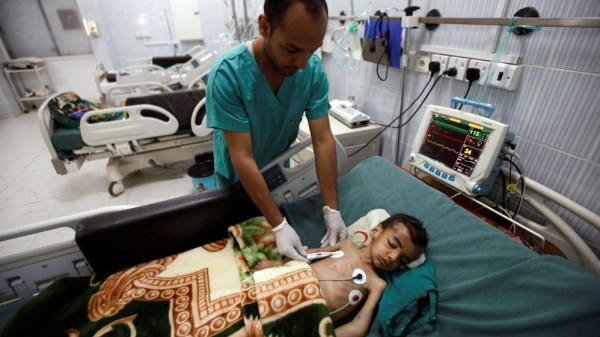
Yemen’s cholera crisis – a result of the Saudi war against the country, conducted with U.S. weapons and support of the Trump Administration
Listen tonight:
- KGNU, Boulder, Colorado – Hemispheres, Middle East Dialogues. November 29, 2017. 1390 AM, 88.5 FM, streaming at http://www.kgnu.org. 6-7 PM Mountain States Time.
- with Ibrahim Kazerooni and Rob Prince.
In 2006 as Israel’s abortive but destructive invasion of Lebanon proceeded to run into more and more effective resistance, then U.S. Secretary of State, Condoleezza Rice, traveled to Israel, the aggressor in the war and pontificated about how with Israeli assistance, that the U.S. was creating “a new Middle East” – a post Sykes-Picot political realignment. Then she went off to Thailand, played the piano while U.S. made and armed jets dropped cluster and phosphorus bombs on Lebanese civilian targets. On the ground the Israeli military ran into stiff and well-organized resistance from Hezbollah units in what is referred to as “asymmetrical warfare.”
True that now eleven years later, major geo-political re-alignments are taking place…Don’t know if it can be called “a new Middle East” – but after more than a decade of wars which either the U.S. either conducted, orchestrated (Libya, Syria) encouraged (2006 Israeli Lebanon invasion, Saudi cruel war against Yemen – which it is losing) – the region is not the same. The defeat – and that is the proper, un-exaggerated term – of the U.S. led effort to overthrow the Assad government in Syria – marks a dramatic shift in the regional balance of forces. How far, to what end?
That is what we’ll be discussing tonight on KGNU – Hemispheres, Middle East Dialogues hosted by Jim Nelson, now in its eighth year.
Beit Ummar – Life Under Occupation; Wed. Nov. 15, 2017. 7-8:30; Highland Center. 3401 W. 29th Ave. Denver 80211

____________________
Colorado Friends: Beit Ummar is a Palestinian town of close to 18,000 people in the West Bank, Occupied Palestine.
According to the Palestinian Central Bureau of Statistics, in 2016, the town had a population of 17,892 inhabitants. Over 4,800 residents of the town are under the age of 18. Since the Second Intifada (200-2005), unemployment ranges between 60 and 80 percent due mostly to the inability of residents to work in Israel and a depression in the Palestinian economy. A part of the city straddles Road 60 and due to this, several propositions of house demolition have occurred.
Beit Ummar is mostly agricultural and is noted for its many grape vines. This has a major aspect on their culinary tradition of stuffed grape leaves known as waraq al-‘inib and a grape syrup called dibs. Beit Ummar also has cherry, plum, apple and olive orchards.
____________________
Since the Six-Day War in 1967, Beit Ummar has been under Israeli occupation. It is currently located in Areas B (civil affairs administered by the PNA) and C (civil and military affairs controlled by Israel). Located near Hebron, it is a municipality that has experienced the iron hand of Israeli occupation as harshly as any.
A few examples from the Wikipedia description of the town
- Several people in the village have been shot and killed by the Israeli soldiers or settlers during Israeli occupation. In January 2011, 17-year-old Yousef Ikhlayl, was reported shot and killed by Israeli settlers. The Israeli court set released the settlers.
- In August 2014, Hashem Abu Maria was killed by an IDF sharpshooter. Two other Palestinians from Beit Ummar were also shot and killed.
- In April 2015, 27-year-old Ziyad Awad was shot and killed in a demonstration which started after the funeral of his cousin.
The repression continues….
For more information: htak913@gmail.com
63 Tunisian Youth, Migrant Refugees on Italy’s Island of Lampadusa, Oppose Forced Repatriation, Go On Hunger Strike
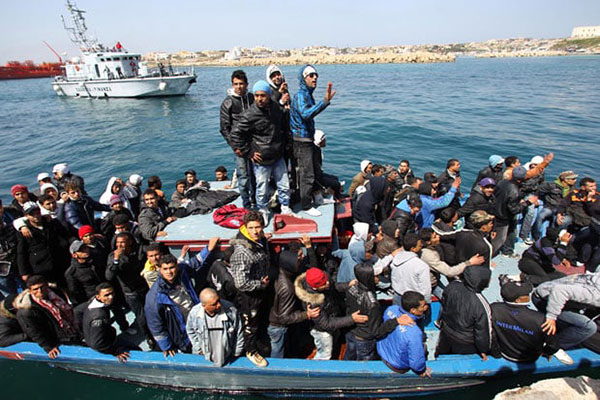
another boatload of clandestine Tunisian migrants arrive At Lampedusa Harbor
Opposing Forced Repatriation
They face forced deportation back to Tunisia from whence they fled and have announced a hunger strike in protest of being forcibly repatriated. A group of 63 Tunisian youth, many coming from the depressed mining community of Redeyef, near Gafsa, fled the country by boat across the Mediterranean to Lampedusa. In response to the Italian government’s plan to ship them back to Tunisia, the youth have started a hunger strike. According to the last news I could find, their hunger strike had lasted at least five days. In a statement in French, they describe their plight. (The English translation is my informal translation).
Nous sommes un groupe de jeunes venant du Rdeyef (sud-ouest de la Tunisie, là où a émergé le soulèvement du bassin minier en 2008) et d’autres régions de la Tunisie. Devant les défaillances économiques et sociales des politiques de notre pays, l’abandon de l’Etat de ses obligations et l’échec politique à l’échelle locale et internationale, nous avons dû abandonner notre rêve de 2008 d’un Etat démocratique qui garantit la liberté, la dignité et la justice sociale. Et malgré qu’on soit fière de notre pays et de son peuple, nous devions surmonter le danger de la migration non réglementaire direction le nord-ouest de la mer Méditerranée, cette route devenue dangereuse à cause des politiques migratoires européennes qui ferment les frontières à nos rêves et à nos ambitions de tenter une nouvelle expérience d’une manière réglementaire.
(We are a group of young Tunisians, from Redeyef (in Tunisia’s southwest, there where there was an uprising of miners in 2008). Given the political failures of our country’s political leadership to solve the economic and social crisis of our country, along with the state’s neglect to fulfill its obligations, along with the political failures both on the domestic and international level (to fulfill the Tunisian promise of modernism) we have had to abandon our dream of 2008 to build a democratic state, one that guarantees liberty, dignity and social justice. In spite of our pride in both our country and people, we risked the challenge of unauthorized migration across the Mediterranean to Italy; the journey has become especially dangerous as a result of European migratory policy that is closing its legal frontiers to our hopes and dreams.)
I-70 Storm Water Diversion in Denver, A Part of a More Comprehensive Plan?…Or D.I.A. Revisited?
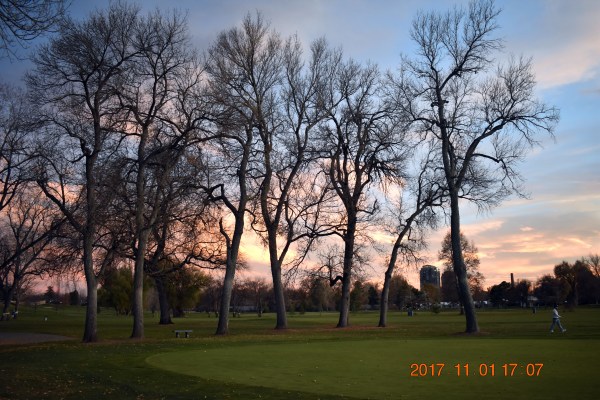
Some of the 261trees at Denver City Golf Course to be bulldozed for a storm-water diversion project. Is this just one piece in Denver’s plans to create infrastructure in place for a 2026 Olympic bid?
The same week that the city of Denver agreed to a $4.6 million settlement for a “wrongful death” suit in the killing of Michael Marshall in the custody of the Denver Sheriff’s Department, the city’s mayor, Michael Hancock has also gotten into “the business” of destroying trees.
Between 50 and 75 people showed up at Denver’s City Park Golf Course to protest the destruction of 261 trees there, many more than a century old. It might not sound like a large turn out, but given the fact that the candle light vigil had two day’s notice – and that people showed up from all parts of the city – to protest the mayor’s action – along with media – it wasn’t a shabby showing at all. Remarks by Dennis Gallagher, former city auditor and Candi CdeBaca, a rising aspiring local politician with strong community-activist backing from the Globeville-Swansea area, emphasized the political stupidity – and essential developer greed – behind the project.
It is at best, a very clumsily thought out part of a larger project.
Using federal and state (tax payer) funding, state authorities have plans to reroute a part of the interstate highway – I-70 – underground in what is a northeast section of Denver called the Globeville-Elyia-Swansea neighborhood – an overwhelmingly working class, Chicano neighborhood, that was itself traumatized by the original building of the interstate in the 1960s. Part of the plan involves constructing a storm water diversion project – s essentially a DAM across 2 1/2 miles of north Denver, running 6 blocks south of the Interstate, parallel to it – through a largely Black neighborhood. There it is all funneled underground over to Globeville Landing Park where this collected water will enter the South Platte. An additional element — flooding about a third of City Park Golf Course, listed on the National Register of Historic Places — was added to help reduce pressure on the existing pipe under 39th Avenue. Read more…
Quivira National Wildlife Refuge and Cheyenne Bottoms
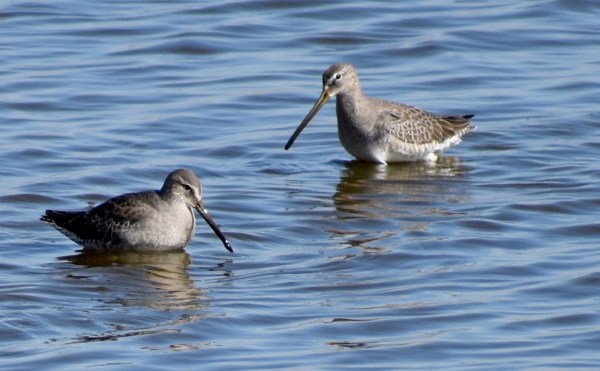
Long-billed Dowagers at Park Smith Pond. Quivira National Wildlife Preserve. Kansas
(Note: Shortly after posting this blog entry on-line, news came from the Audubon of Kansas that 49 whooping cranes had been sited at Quivira National Wildlife Preserve in late October, 2017)
A lot of birds.
As the Arkansas River enters central Kansas it bends first northward and then bends back south in the shape of an upside down “u”. At its most northerly point in this bend lies Great Bend, Kansas, a major crossroad and business center in the region with a population of 16,000.
Two inland wetlands, teaming with fish, birds and wild life, are nearby where hunters and bird watchers intermingle and wonder what in the world there opposites are doing there. People who visit the wetlands can broadly be divided into hunters and birders. I was an in-experienced member of the later, greatly assisted by two Kansas friends, Margy Stewart and Ron Young who are well versed not only in birds but in the plants and insects of the region. Over the course of the three days, we met and talked to a number of locals, who were hunters. They were friendly enough, but at least the ones we spoke with couldn’t understand why anybody would come to the area just to watch birds…when you could kill them and, as one hunter remarked, “really study them up close.” I just gave up on explaining, responding “yes, it’s hard to understand.”
They were friendly enough, but at least the ones we spoke with couldn’t understand why anybody would come to the area just to watch birds…when you could kill them and, as one hunter remarked, “really study them up close.” I just gave up on explaining, responding “yes, it’s hard to understand.”
A few miles north of the city, Cheyenne Bottoms Wildlife Area is the largest wetland in the interior of the United States and as such a great avian crossroads. Run by the Kansas Department of Wildlife and Parks, it is a critical resting area in what is known as the central flyway for birds migrating north in the spring to Canada and the Arctic region and then to Texas, Mexico and points south. Covering an area of about 8,000 acres, about 45 percent of all shorebirds in North America utilize the area. Cheyenne Bottoms is critical habitat for many endangered species, including the whooping crane. While the place is teaming with wildlife any time of year, the best times to visit are in the spring and fall. As many as 600,000 shorebirds from 39 species pass through Cheyenne Bottoms during spring migration and up to 200,000 in fall. At least 340 species of birds of all kinds have been observed there.
That’s a lot of birds. Read more…
Cameroon – French Hypocrisy Renewed
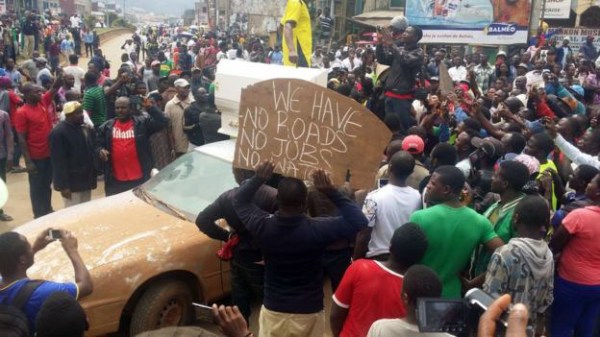
Linguistic and social discrimination in Cameroon’s Anglophone western regions
Cameroon – The Crisis Deepens
Since I began working on the translation below, a number of days ago, more information has emerged concerning the repression which the Cameroonian government in Yaounde has unleashed in the Anglophone provinces of Cameroon to crush the movement there for cultural-linguistic-political rights. As usual, the news from Cameroon has hardly made a dent in the mainstream media here in the USA. Officially 17 people have been killed, hundreds wounded by the security forces (advised and armed largely by France). Unofficially, social activists claim that the number killed is between fifty and a hundred, with reports of many still being dragged from their homes, disappearing into custody. There are 300 U.S. Special Forces in the country, working, it is claimed, to counter incursions into Cameroon by Boko haram terrorists operations in the northern border region with Nigeria. Recently Cameroonian military at a base in Cameroon from which the US Special Forces work has been accused by Amnesty International of torturing hundreds of captures members of Boko haram. It is not clear what role these American military are playing to support the Yaounde government in the Anglophone uprising; their involvement has yet to be confirmed, although there are rumors that they are involved too)
Cameroon – French Hypocrisy Renewed
by Odile Tobner.
(Note this commentary appeared at the website of “Survie” – a French-based organization that monitors the machinations of France in Africa. Odile Tobner is the organization’s president. It can be reached at http://www.survie.org. Below is my own personal translation into English. For the original French text, click here. For more background, click here)
The actual death toll will probably never be known as a consequence of the violent repression and deaths of scores of Anglophone protesters in Cameroon. It continues to mount. Rather than show alarm, French diplomacy blithely comments that “it is following the situation with interest.” This, despite the fact that France is intimately involved with Cameroon’s repressive apparatus. It has nearly been a year now since demonstrations broke out in Cameroon’s anglophone provinces in the west and northwest of the country bordering eastern Nigeria. Read more…
Ivory Coast’s Cocoa – A Blessing and a Curse – 2

Ivory Coast during the Civil War in the early 2000s
Ivory Coast’s Cocoa – A Blessing and a Curse – 2
The $ 300 plus million Catholic Church that Honcho Felix built in the Ivory Coast is described as the biggest Catholic church in the world (by some) with the fewest [worshippers] in the pews
His $ 11 plus a billion fortune- French dealings. Some model in Africa!
The plan to exploit so many, and then build a giant Catholic church.
How French..
Jim Hagood
Houphouët-Boigny – France’s Key Man in West Africa
Although he is dead and gone now for 24 years, the spirit of Félix Houphouët-Boigny (pronounced hoofoo bowanyee) lives on in the Ivory Coast….malheureusement! – as the French would say. At his death in 1993 he had acquired an estimated net worth of somewhere between $7 and $11 billion, much of it from the profits skimmed off from the country’s lucrative (for him anyway) raw cocoa bean industry. Cocoa beans are the main export product of Ivory Coast and dominate the country’s economy, referred to as “l’or brun” – “brown gold” in french. The owner of seventeen villas in Europe, at the time of his death Houphouët-Boigny was considered by some sources to have been the largest property owner in Paris, while the country as a whole has been mired in poverty.
Although Houphouët-Boigny started out his career as an anti-colonial nationalist – in fact he was the leader of the cocoa producers’ union for a while and one of the founders of the Rassemblement démocratique africain (RDA) an assemblage of anti-colonial African radicals – by the early 1950s he had, for all practical purposes switched allegiances. But then it was most useful to have a political turncoat who earned his spurs early on in a radical social movement for then France could cover its continued racist and exploitative policies in Africa under the cover of “moderate” African nationalism, which was by the way, neither moderate nor particularly nationalist at its heart. Read more…
Ivory Coast’s Cocoa – A Blessing and a Curse – 1

Cocoa beans piling up at Soubre, railroad transit point north of Abidjan, Ivory Coast (Cote d’Ivoire)
It’s called “Belgian or Swiss” (or French or Dutch) chocolate, but in fact there is no such thing. The main ingredient in chocolate, cocoa beans, does not grow in Belgium, Switzerland, France or Italy and never has. all these countries have ever done is add sugar and a few other ingredients, to make it more palatable to European and North American tastes. It would be more accurate to refer to the stuff as Ghanaian, Ivory Coastal or Cameroonian Chocolate. Originally a equatorial Latin American product, today it grows largely in West Africa, East Asia and a bit in Mexico and Central America.
“It’s white people who eat chocolate, not us” commented a cocoa farmer from the Ivory Coast.
LETTER TO MY FRIEND … a poem by Phil Woods.

Aseel Abu Oun, 8 years old, run over by an Israeli settler in Foroush Beit Dajan village, near Nablus, West Bank, Palestine.
LETTER TO MY FRIEND by Phil Woods
“Those who do not advocate a ‘solution’ of the Palestinian problem through dispersion and expulsion promise the native inhabitants a grim future in their ancient homeland . . .. ‘when we have settled the land, all that the Arabs will be able to do about it will be to scurry around like roaches in a bottle.’”*
Suffering does not automatically
make a people noble, nor
automatically make them Just.
Imagine a Scale. On it
we will determine:
Who has suffered more?
A Peaceful world cannot be
made this way.
Do I recognize the extraordinary
suffering of the Jewish people?
It is inescapable. And every time
I learn more—the pogroms—
it’s always worse than I imagined.
Out of what ashes & pain
can we build justice?
1919, in the same building
in London what do the still
Victorian Brits do? Read more…
 View from the Left Bank: Rob Prince's Blog