For decades the failures of water, energy, rail and health privatisations have made clear across the globe that those who promote privatisation offer false promises. Elections have been fought and won on promises to keep public services in public hands. In sectors like health, education, water, energy and transport, community attitudes strongly support public provision.
Rosa Pavanelli General Secretary of Public Services International (PSI)
The Proposed “Office of Public-Private Partnerships” – A Bad Idea For Denver.
An article in The Denver Post supported the recent agreement between the Denver International Airport (DIA) and the leveraged Spanish firm Ferrovial that was approved by a 10-2 vote on August 14, 2017 (at 1 am – so it was, technically August 15). The same article announced that there would be more agreements like it, public-private-partnership agreements, on PPPs or “P3s,” as they are called. Unless there is public pressure to the contrary, The Post is probably right. Unfortunately.
The DIA – Ferrovial contract is a classic public-private-partnership”. Another piece in The Denverite a few days later elaborated on the city’s plans to do just that. In fact, the city wants formalize P3s, to create an “Office of Public-Private Partnerships” “to vet and coordinate such projects.” The article mentions the National Western Center and the Denver Center for the Performing Arts as two likely candidates “in the near future.” Read more…
Hemingway and Gellhorn and Uncle Ira – Ira Magazine

Ira Magazine, 1943. We (my sisters and I) were told that in the late 1930s in order to “Americanize” the family name, Magaziner, that the family had a long discussion that lasted several years, after which, it was resolved to make a great change, to drop the “r” in Magaziner and to exchange that for “Magazine.” This they did.
It’s a film about the turbulent, yet professionally productive marriage between Ernest Hemingway and his third wife, Martha Gellhorn, who unceremoniously dumped him after a brief relationship. A close friend and skilled local poet, Phil Woods, loaned it to me. As is well-known, Hemingway became an American literary icon. Other than in journalistic and peace circles, Gellhorn’s contribution has dissolved to obscurity despite the fact that she was one of the finest war correspondents of the twentieth century. The film, panned by many critics, but which I thoroughly enjoyed, knocks Hemingway down more than a few deserved notches – perhaps not so much his writing as the reckless way he lived his life – and resurrects Gellhorn, deservedly so.
After seeing the film, it was high time to read Gellhorn. Plenty of her stuff is available. I chose a little volume: Martha Gellhorn The Face of War – a series of short 5-20 page sketches that start with the Spanish Civil War (1936-1939) to the 1980s Central American wars in Nicaragua and El Salvador. A keen observer, fearless – or so it seemed – she gives as human a face to war as anyone I have ever read. Her writing is crisp, clear and to a great degree without illusions. A pleasure to read, even if the subject matter is completely depressing, and it is. Read more…
Jonathan Schell’s The Fate of the Earth, Naomi Klein’s No Is Not Enough. Some Thoughts

Hiroshima and Nagasaki, paintings by Denver artist Calvin Lee
The question now before the human species, therefore, is whether life or death will prevail on the earth. This is not metaphorical language but a literal description of the present state of affairs.
Jonathan Schell. The Fate of the Earth. p.113
Late last night I finished Jonathan Schell’s The Fate of the Earth. It had been among a carton of old books to be donated to a local library, but as an afterthought, I removed it and starting re-reading it. I had read it – or parts of it – just after was published, some 35 years past, in 1982. My dear and departed friend, Dr. Dick Ayre from Presque Isle Maine, held it in high esteem. Add to that, when I started my re-read, Hiroshima Day (August 6) and Nagasaki Day (August 9) were just around the corner. With his already legendary “subtlety,” Trumpty-Dumpty had jolted both the country and the world with his threat of a nuclear attack against North Korea. Reading Schell became irresistible.
I thought it might be interesting to read Schell in parallel with Naomi Klein’s recent small volume, No Is Not Enough, the choice of a book club I’ve been in for more than a decade. The Klein book, seemingly put together in a hurry, still, it presents some useful ideas as to how the country and the world got to this surrealistic moment as well as ideas concerning how to respond to the juggernaut of reaction and greed that is the Trumpty-Dumpty presidency. As usual, it is fine little volume. Klein writes with clarity and vision, her understanding of the danger of climate change, her path-breaking analysis of the use of “shock doctrines’ – a term I believe she first proposed – carefully, if briefly sketched out. If the “what to do” section at the end was a bit sketchy, still, the book as a whole contains many important and practical ideas.
Klein writes with clarity and vision, her understanding of the danger of climate change, her path-breaking analysis of the use of “shock doctrines’ – a term I believe she first proposed – carefully, if briefly sketched out. If the “what to do” section at the end was a bit sketchy, still, the book as a whole contains many important and practical ideas. Read more…

Heathrow Airport, December 2010. Airport was closed by Ferrovial 100% owned subsidiary, BAA causing airline delays, complications throughout Europe and beyond. So much for how “efficiently” Ferrovial runs Heathrow. As I recall, Denver does get more than five inches of snow each winter.
As a trade union friend of mine noted concerning the Denver D.I.A. – Ferrovial contract – just noted “the horse has left the gate…but what the hell?”
A local trade unionist, he posses fourteen questions concerning the deal. Before posting them below, I thought the blog reading public might be interested in one particular article:
http://www.thedailybeast.com/heathrow-airport-shutdown-whats-the-real-cause
The essence of the piece: In December, 2010, the British government had to bring in the troops to clear five inches of snow from Heathrow Airport because Ferrovial, which manages the airport refused to do so, cheap so and so’s. So all this talk at the recent city council meeting in Denver about “how efficiently” Ferrovial subsiduary, BAA, runs Heathrow, is a bunch of poppy cock?
So BAA didn’t have the will or the wear-with-all to clear five inches of snow from Heathrow…but they are going to all but manage D.I.A. for 34 years? How did all those well-informed politically astute members of the city council miss this? Here is another article on the subject:
https://www.theguardian.com/uk/2010/dec/19/snow-weather-uk-heathrow-travel
Here the questions my trade union friend asked about the deal. Some have been answered, most not.
- Is this the largest privatization in the city’s history? (Winter Park?)
- Denver developed DIA and controlled its concessions without privatization, why is it necessary to privatize the Great Hall expansion?
- What research has been completed on Ferrovial? Was adequate due diligence applied? Who conducted the due diligence? Were consultants used? If so, who were they?
- Has the administration consulted closely with the three airports in the UK where Ferrovial has similar contracts? Is there a written comparison of the Denver contract with those in the UK? Wasn’t this a critical part of the necessary due diligence?
- Was the administration aware of Ferrovial’s complicity in the debacle that occurred at Heathrow airport which caused David Cameron, the UK prime minister to intervene? http://www.thedailybeast.com/heathrow-airport-shutdown-whats-the-real-cause
- Most members of City Council likely have not carefully reviewed the proposed contract and conducted a full review which is understandable given the complexity of the contract, although the 150 page document should have been reviewed by all members.
- Does Ferrovial’s record of union busting, payoffs, and operating abusive detention centers, as reported in a recent Amnesty International report, raise concerns by this administration and City Council? http://unitehere.org/wp-content/uploads/Denver-Ferrovial-Report-Aug-2016.pdf
- Is the Council aware that Unite, the largest union in the United Kingdom, was forced to conduct a two-year campaign costing over $4 million, to stop Ferrovial’s union busting on a construction contract for the largest public works project in London for many decades.
- Our political system operates on the principle of separation of powers. Everything we have learned about the Ferrovial contract has come from the executive branch. Why hasn’t the president of the City Council asked the city council staff (six member staff) to conduct its own review of the proposed contract in the manner that the Congressional Budget Office provides an independent review separate from the executive branch?
- Has Ferrovial agreed to sign a written neutrality agreement to ensure that its operations will not be adverse to the right of workers to unionize as determined by federal labor law and also to hold its concessionaires to it?
- The involvement of Saunders, a local construction company, appears to have good relations with construction unions, although questions have been raised about its close relationship to the administration in the awarding of the contract.
- What was learned about Ferrovial in the junkets taken to Ferrovial operations in Spain and the UK by both members of DIA, the city administration, and members of City Council?
- Was there true transparency in evaluating the various bids? Why hasn’t the City Council or citizenry been fully informed why Ferrovial was awarded the bid with all of its problem?
- What are Denver’s legal rights to end the proposed contract if the contact if is not fulfilled?

From left to right – Councilperson Stacy Gilmore (abstained), Rafael Espinosa (opposed), Mary Beth Susman (supported), Jolon Clark (supported) voting on D.I.A. contract with Ferrovial S. A.
Last night, at a meeting which began on August 14, 2017 but ended on August 15 at 1:15 am in the morning, the Denver City Council approved a $1.8 billion renovation project the contract of which will span over 34 years to reorganize the security system at Denver International Airport (D.I.A.). The proposal was essentially strong-armed by Mayor Hancock and his staff through a mostly pliant city council. The council, excluded from the negotiations, was given a week to read a 15,000 page contract before being forced to vote on it.
The management for the project, as well as a good deal of authority of the D.I.A administration, was handed over to a consortium of businesses, the main participant of which is Ferrovial S.A, a Spanish corporation whose bread and butter has been airport construction and administration. Ferrovial has an 80% share in the arrangement.
In the end, despite long-winded and generally boring rationalizations that went on ad nauseum until after 1 a.m. in the morning, the vote wasn’t even close. In its overwhelming majority, the Denver City Council had swallowed the Kool aid of what is referred to as “public-private partnerships. In a vote in which the council sold off what little is left of its soul, it voted 10-2 for the project with one abstention. Only council persons Rafael Espinoza and Debbie Ortega voting and speaking clearly against the project. Others, among the generally more liberal (or thought to be) members of the council,who for one given reason or another voted in favor of the proposal included Paul Lopez, Paul Kashmann, Robin Kniech. Stacy Gilmore, who claimed a possible personal conflict of interest concerning a brother-in-law, abstained. Read more…
Mushrooming on Shrine Pass

August 11, 2017 – first mushroom harvest. Shrine Pass (near Vail), Colorado
It is a little (a week or so) early to look for mushrooms in the Colorado mountains but given the recent cooler weather and a series of rains providing needed moisture, we (Nancy and me) figured we’d give it a try. But with global warming and drought filled years here in the Southwest, there have been slim pickings. I have gone up every year, but these past three or four years have come back empty-handed or almost. Still every summer about this time we are driven up to the high mountains by some force larger than ourselves to hunt for mushrooms. Friends often ask stupid questions or make like-minded comments – “Did you find any psychedelics?” No, frankly we wouldn’t even recognize them. As we did thirty years ago, when Jukka and Paivi Kairkkainen first took us on our first mushroom hunt a bit north of Helsinki (Finland), we continue with the tradition of searching for edibles. Read more…
Denver City Council – Did Superfly Super Screw Denver?

The one entrance – just off of South Sante Fe Blvd – leading to the Overland Golf Course club house. Is this the road that 50,000 to 75,000 people will travel to get to the concert?
Last night (July 31, 2017) I had the dubious pleasure of attending a Denver City Council meeting.
The last time I visited these sacred chambers was some years ago. My friend Paula Van Dusen, me and a couple of others organized a grass roots campaign to get the city council to pass a resolution against the U.S. led war in Iraq. Our little group did good grass roots door-to-door work that resulted in hundreds if not thousands of phone calls to the then city council members, who were not happy campers to hear from their constituents, despite often parroting how lovely-dovely they are with each other.
Our informal survey – taken from our brief discussion with neighbors – suggested that the good people of Denver opposed the war somewhere between 20-1 to 30-1. It was a close vote, with then District One city councilman Dennis Gallagher casting the decisive vote for the resolution, this as I recall, after being hounded by the good nuns of the Sisters of Loretto and a couple of peace types like myself. The next day it made page 1 news in the now defunct Rocky Mountain News. The article was accompanied by a major editorial of the day, in the Rocky, slamming the council for voting for peace…even if was only a symbolic gesture.
Ah but that was yesterday and yesterday’s gone as is the Rocky, which a good friend referred to in an email as “The Rocky Mountain Snooze.”
Actually yesterday, I attended the council meeting to watchdog a neighborhood zoning change but the main item on the agenda was the final vote on Superfly Production’s proposal to organize a super music festival in southwest Denver at the city owned, Overland Park Golf Course. As reported in the Denver Post, (Aug. 1, 2017) “The Denver contract allows for a three-day weekend festival each September on Overland Park Golf Course, with each event staged the second or third weekend of that month beginning in 2018.”
The promoters are predicting anywhere from 50,000 to 75,000 will be in attendance. Just another example of the privatization of everything, of the private sector stealing public assets (in this case, cheap infra-structure). We’re not talking about a run-of-the-mill concert but a massive three-day “Woodstock” like affair, and like Woodstock (that this blogger attended with a sister and her best friend) it has all the makings of a logistical nightmare for the city.
In fact, essentially what Superfly has done is to package Woodstock in yet another case of coopting the heritage of the 1960s. Cited in the city council meeting, but left out of the Post article, are the fees to be charged to the public, $677.80 for a day pass, but only $1659.80 for the entire three days. I mean, how could anyone pass up such a neat deal. The entry costs appear prohibitive, but these prices didn’t seem to phase the city council members at all. Read more…

Palestinians in the West Bank demonstrating to improve conditions of Palestinians in Israeli prisons. About 1,500 Palestinians went on a forty day hunger strike which ended in late May, 2017.
Threat to free speech
by Ron Forthofer
There is a Senate bill, along with a companion bill in the House, working its way through Congress with strong bipartisan support, that poses a significant danger to free speech. One would think this bill would be a big deal but, surprisingly, the bill has not received much coverage in the mainstream media.
Fortunately the American Civil Liberties Union is alert to efforts undermining free speech. Thus, in a July 20th article on the ACLU website about S. 720/H.R. 1697, the Israel Anti-Boycott Act, Bryan Hauss, Staff Attorney, wrote:
“The bill would amend existing law to prohibit people in the United States from supporting boycotts targeting Israel — making it a felony to choose not to engage in commerce with companies doing business in Israel and its settlements in the occupied Palestinian territories. Violations would be punishable by a civil penalty that could reach $250,000 and a maximum criminal penalty of $1 million and 20 years in prison.” Read more…
After Mosul…What Next For Syria and Iraq?
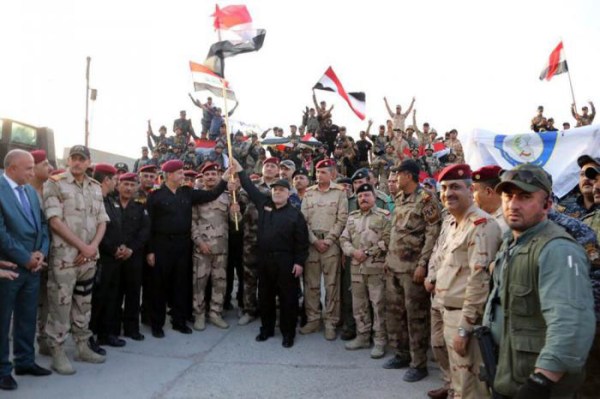
Iraqi PM Haider al-Abadi (C) declaring Mosul’s liberation from Islamic state control in central Mosul city, northern Iraq, on July 10, 2017
KGNU – Hemispheres, Middle East Dialogues. July 25, 2017. R. Prince. Notes. KGNU – Hemispheres, Middle East Dialogues. July 25, 2017. R. Prince. Notes.
Sitting in a Middle Eastern restaurant, not far from the University of Denver in 2013, a former colleague, who had “drunk the cool aid of humanitarian intervention” (and still imbibes), pontificated how Assad’s Syria would fall in a month, just like Khadaffi did in Libya. Didn’t happen. This year (2017) alone, already, first Aleppo, in western Syria, is liberated from ISIL-al Nusra, seven months later, Mosul in Western Iraq follows suit. As in such urban fighting, the damage is horrendous, but this is war and these are VICTORIES, not defeats for progressive forces, as Washington’s plans of partition for both Syria and Iraq continue to dissolve.
Intro Remarks:
As we have done in past shows over seven years, our goal tonight is to deconstruct mainstream narratives and then actually discern what is actually transpiring with U.S. Middle East policy.
We want to begin with discussing some aspects of the recent Aspen Security Forum that was just completed (July 19-22, 2017) as they relate to developments in the Middle East, especially Iraq and Syria. This is a follow-up on another important annual gathering of “strategic thinkers” – the Herzliya Conference in Israel (which took place June 20-22, 2017
Then we want to discuss the liberation of Mosul, Iraq from ISIL that was completed earlier this month (July, 2017) and how it shifted the balance of power in the region, its implications for Iraq, Syria, ISIL and U.S. policy. ISIL, al Nusra are little other than the mechanisms used to partition the region by global (U.S., UK, France) and regional (Turkey, Israel, Saudi Arabia) hegemons. Partitioning (what were) strong centralized states (Libya, Iraq, Syria) into smaller units makes them more manageable for energy consortiums, and core-economy governments.
U.S. plans to partition both Syria and Iraq are in disarray, given the gains made on the ground (Aleppo) by the Syrian military and the liberation of Mosul by Iraqi forces. Read more…
U.S. Senate to Tunisia: If You Want Foreign Aid, Support Israel At The United Nations.

The U.S. Senate Foreign Relations Committee to Tunisia: Want Aid? Soften Criticism of Israel.
The U.S. has Tunisia in a bind…again: support U.S. Middle East political initiatives and allies or else the aid or face serious reductions in military and economic aid. No mystery where that could lead. What choice does Tunisia have…having already dug its hole so deep. Although much has been made of the fact that Tunisia has not been plunged into the chaotic political maelstrom of Libya or Syria, the continued chronic economic and social crisis that has gripped the country places Tunisia in a vulnerable position where it is difficult to go against the wishes of Washington (or Paris).
It’s an old story, actually.
Tunisian Prime Minister Youssef Chahed came to Washington recently (July 10-12, 2017) to plead his country’s case against the Trump Administration’s plan to cut its aid package to the North African country from $141 million (2016) to $54.6 million in (2018). In a meeting with the Senate Foreign Relations Committee, Chahed was presented with a list of eleven “concerns,” one of which was a request (demand?) that, in exchange for maintaining the aid package at the 2016 levels that Tunisia support U.S. efforts to stifle efforts in different United Nations organizations critical of Israel.
Having the US pressure Tunisia to side with Israel at the United Nations (or elsewhere) undoubtedly creates tension between the Tunisian people and government undermining the stability that the US claims it is pursuing in the Maghreb. It is a case of typical U.S. political blackmail in which the influence of the American Israeli Political Affairs Committee (AIPAC) and like organizations is more than likely. The threat is not especially subtle: if Tunisia wants to continue to receive U.S. economic and military aid it must follow “the rules of the game,” be a part of the team…and to play the role it has long played under Bourguiba – to push the Arab/Islamic world to normalize its ties with Israel in exchange from political and economic support from Washington.
Let’s be frank though, Tunisia’s weight in all this is so little that it doesn’t have much to lose by accepting these terms. No one in the Arab world listens to it – be it Bourguiba or Beji-Caid Essebsi-Ghannouchi – who is voicing such a policy. In exchange for badly needed economic and security aid, Essebsi will probably be willing to swallow his national pride without much hesitation, mind you, and cave to such pressures. Read more…

This box of artifacts was on sale in a Baghdad market. Iraq National Museum identification numbers are visible on many cylinder seals inside the box.
A New York Times July 5, 2017 news story details how the toy manufacturer, Hobby Lobby, was taken to a federal court in Brooklyn for having knowingly bought 5,500 cultural artifacts stolen from the National Museum of Iraq during the March-April, 2003 U.S.-led invasion of Iraq. The stolen items, purchased for $1.6 million from an unnamed antiquities dealer had been among the estimated 130,000 items looted from Iraq as a whole in the midst of the U.S.-led storming of Baghdad in which hundreds of looters in three waves savaged one of the world’s greatest archaeological collections.
The mostly U.S. led (or encouraged) wars which have wreaked havoc on Iraq since 1980 have not only done near-irreparable damage to Iraqi infrastructure, resulting, easily, not only in the death of a million people, but millions of people, the overwhelming majority of them civilian casualties. They have also produced an antiquities trafficking bonanza of unprecedented size and scope. In the vacuum created by war zone situations, looting – highly organized and targeted – has also resulted with pretty much everyone getting into the act, including ISIS, Daesh types who as part of their effort to purge the Middle East of all non-Salafist representations of religion have not only destroyed precious religious and other cultural artifacts, but have also sold tons of them on the black market to raise money for arms and other equipment. So ISIS, Daesh are not just destroying ancient artifacts, they are selling them! Strange as it seems, in its rush to buy up whatever antiquities it can get its hands on, Hobby Lobby is doing business – knowingly or not – with ISIS and like organizations.
As one researcher noted, it was not only the National Museum that was targeted. Other looted Iraqi cultural institutions included the National Library, the National Academy of Arts, institutes of music, dance, and art, and universities in Baghdad and elsewhere. Likewise, organized looting of archaeological sites, which had begun during the mid 1990s in the south of Iraq, resumed at a greatly increased rate while the invasion was taking place, and it continues unabated Read more…

The U.S. Descends into the Syrian Maelstrom
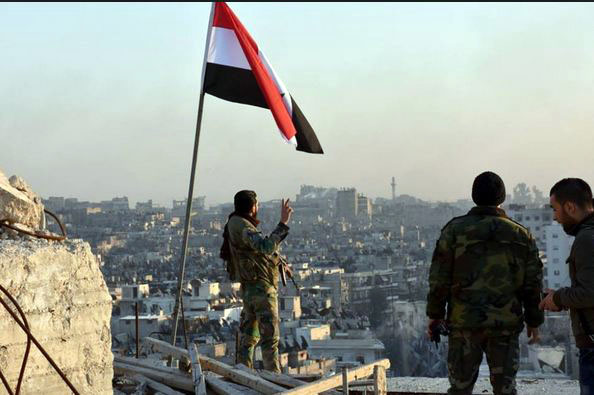
Syrian National Forces Liberating Aleppo from ISIS-al Nusra in May 2016. The world should have celebrated (and many did). But instead of acknowledging that this was a significant military victory that isolated the likes of ISIS, the American media tried to manipulate it into a tragedy.
For what can war but endless war still breed? (John Milton, Sonnet 15 – Thanks Richard Rozoff)
“We were waste deep in the big muddy, but the big fool said to push on” (Pete Seeger)
The latest news from Syria, is once again is unsettling. All appearances are that the Trump Administration has crossed its own red line. As one writer, Jim Kavanagh, succinctly put it:The latest news from Syria, is once again is unsettling. All appearances are that the Trump Administration has crossed its own red line. As one writer, Jim Kavanagh, succinctly put it:
The United States is at war with Syria.
Though few Americans wanted to face it, this has been the case implicitly since the Obama administration began building bases and sending Special Ops, really-not-there, American troops, and it has been the case explicitly since August 3, 2015, when the Obama administration announced that it would “allow airstrikes to defend Syrian rebels trained by the U.S. military from any attackers, even if the enemies hail from forces loyal to Syrian President Bashar al-Assad.” With the U.S. Air Force—under Trump, following Obama’s declared policy—shooting down a Syrian plane in Syrian airspace, this is now undeniable. The United States is overtly engaged in another aggression against a sovereign country that poses no conceivable, let alone actual or imminent, threat to the nation.
This is an act of war.
Washington has entered the Syrian fray in a more direct manner. More U.S. troops are being sent there. Already there are confrontations – not so much with ISIS and al Nusra – but with the Syrian government forces, the Iranians and the Russians – all of which are, in principle, U.S. allies fighting these Muslim fundamentalists. Nothing could be worse for Syria and for Middle East peace.
Let us briefly note the escalation of tensions in the past few days:
• The United States shot down a Syrian national government jet fighter, although supposedly both the United States and the Assad Government are “theoretically” on the same side in the fight against a common enemy – ISIS, Al Nusra and the like.
• The Independent (British newspaper) reports that “Israel is giving secret aid to the Syrian rebels” referring to a report in the Wall Street Journal June 18, 2017.• And now the U.S. has shot down an Iranian made drone over Syria
So what’s the deal with Syria? Read more…
Saudi Intimidation of Qatar – The Syrian Connection

Bangladeshi workers living in cramped quarters in Doha, Qatar. Qatar boasts one of the highest standards of living in the world. But these living standards do not extend to foreign workers from Pakistan, Bangladesh, the Philippines who work in conditions that international human rights organizations have described as close to slave labor
Anti-Iranian Coalition Trump and the Saudis Tried to Slam Together in Chaos.
The Saudi led blockade (which the Saudis insist is not one) of Qatar is stuttering. The anti-Iranian campaign heralded by Donald Trump in Riyadh in mid-May has failed to get off the ground. Not only that it has backfired. The Saudis underestimated Qatari support in the region from Turkey and Iran. The blockade has, for all practical purposes failed. They also miscalculated U. S. support for the effort. True enough Donald Trump and his little family entourage might have been enthusiastic, but the representatives of the military industrial complex (Mattis) and the energy industry (Tillerson) are far from enthusiastic and have not bought in to the Saudi project of regime change in Qatar. Not at all.
The blockade which Saudi Arabia has spearheaded against Qatar with the support of the United Arab Emirates, Egypt is now more than a week old. Blockades, lest it be forgotten, are a form of warfare. These countries have cut off diplomatic relations with Qatar, kicked out their embassy staff, closed down branches of the Qatari run Al Jazeera media outlet. They have cut transport links, making it difficult for the country to import and export goods. Air space for Qatar Airways, the country’s airlines has been denied air space over Saudi Arabia and landing possibilities in the other states involved, complicating the airlines travel routes. On the opening days of the embargo/boycott – essentially a full court economic siege – the computer systems of many of the country’s institutions experienced cyber attacks.
As an example of how far this anti-Qatari blitzkrieg has gone, the United Arab Emirates made it illegal “for citizens to feel sorry for what is happening in Qatar.”As an example of how far this anti-Qatari blitzkrieg has gone, the United Arab Emirates made it illegal “for citizens to feel sorry for what is happening in Qatar. The UAE Attorney General Hamad Saif- al Shamsi noted:”
“Strict and firm action will be taken against any one who shows sympathy or any form of bias towards Qatar or anyone who objects to the position of the United Arab Emirates, whether it be through the means of social media, or any type of written, visual or verbal form.
Certainly the Saudi hope for a quick knockout blow that would tame the Qataris into submission to Washington and Riyadh’s coordinated diktats has not taken place. Key Washington regional allies (Turkey, Iran, Oman, Kuwait) have opposed it to one degree or another and have been able to stall any military action against Qatar that Saudi might have been contemplating and to place the Saudis on the ideological offensive. A call from the United Arab Emirates to move the U.S. air base from Qatar to the Emirates has been outright rejected by Secretary of Defense James Mattis. A stalled crisis plays in Qatar’s favor that some grace saving formula (for Saudi) can be found to smooth over this spat among U.S. strategic allies.
The Trump Circus In Saudi Arabia – 3 – U.S Troops In Saudi Arabia?, The “Arab NATO,” Why Trump To Saudi Arabia Now?
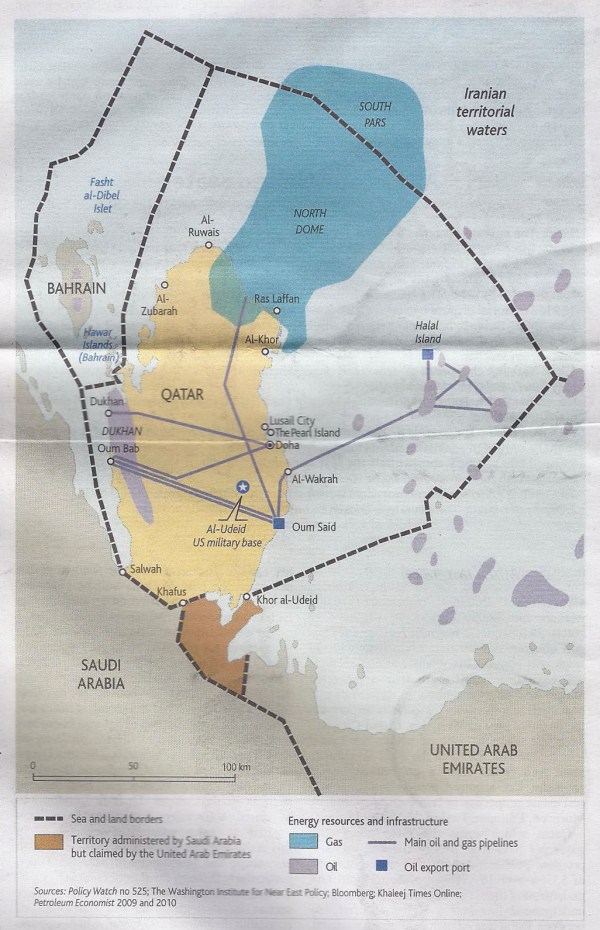
What is known as the South Pars field (in blue) whose underground natural gas reserves are divided between Qatar (in amber). Having failed to “produce” for the US in Syria through its terrorist allies – that is to overthrow the Assad government there, the U.S has turned to Saudi Arabia to do the job. The Saudis and Washington want Qatar to “fall in line” and accept “Saudi leadership” – it too is a major funder of terrorism in Syria – but Qatar is resisting. The Saudis, for whom economic crises continue to add up, are also eyeing control of the lucrative Southern Pars natural gas field which help ease its financial burden as well as enabling Riyadh to put more pressure on Iran…target of the new sectarian Sunni campaign which Trump has encouraged.
____________________
Note: In Part Three of this interview – KGNU – Hemispheres, Middle East Dialogues on May 23, 2017 – we discuss a number of things – The little known fact of U.S Troops In Saudi Arabia, The collapse of “Arab NATO” even before it got off the ground,” Why Trump To Saudi Arabia Now?
____________________
____________________
Transcript: Part Three. KGNU – Boulder – May 23, 2017. Hemispheres – Middle East Dialogues
Rob Prince: Ibrahim, one of the things we talked about in our discussions before tonight was the rarely acknowledged presence of U.S. troops in Saudi Arabia. I’d like to look at that a little bit because their presence is kind of opaque if you like in terms of how it’s seen here in the United States.
It takes place in a number of ways.
First of all of this weaponry that the Saudis have been buying from the United States – not just this most recent $110 billion deal – but they have been doing so for some time. Just in the Obama years, and even before – the Saudis purchased more than $150 billion worth of arms sales, 42 military contracts – this was during the Obama presidency! Now Trump is trying to outdo him. But the interesting point is, that the Saudi ability to use that weaponry is, to put it politely, rather limited.
Ibrahim Kazerooni: Or nonexistent Read more…
 View from the Left Bank: Rob Prince's Blog