
U.S F-16 jet fighters at Incirlik Military Base, Southeast, Turkey
(This, and the entry that follows, are Parts One and Two of an hour-long interview done on KGNU radio/Boulder Colorado by Ibrahim Kazerooni and Rob Prince. It is a part of a series that KGNU has run with them for five years. The entire program runs close to an hour. Part One is below; here is Part Two.)
This evening on Hemispheres the Middle East Dialogues with Ibrahim Kazerooni and Rob Prince. Tonight Ibrahim and Rob will discuss the failed coup in Turkey. Ibrahim and Rob will look at what is behind the internal repression going on in Turkey. Also, will Turkey’s relationship with Syria and with the Kurds change post-coup? Will relations with the west and the United States in particular change post-coup? All that and more along with listener phone calls will be welcome.
Jim Nelson (Host): Let’s move on to the failed coup in Turkey and there have been a number of articles about the current coup in Turkey, including yours, Rob. There are a lot of rumors about what his happening there. What’s the story?
Rob Prince: Once again we find ourselves in the situation where just prior to the program (Hemispheres) airs, there is some major new development and it happened again this time of course with this failed coup attempt in Turkey. Our general discussions about how to proceed tonight, were to talk about the coup somewhat, then the regional consequences of the coup as we understand them and then transition to the events in Syria. Without any doubt, the crisis in Turkey is related to the Syrian conflict. Read more…
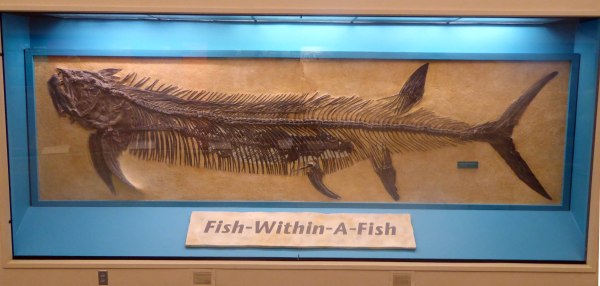
Gillicus Inside Xiphactinus. Sometime around 70 million years ago. Sternberg Museum of Natural History, Hays Kansas
Reports: Newsletter of the National Center For Science Education
My copy of “Reports” – the quarterly newsletter of the National Center For Science Education (NCSE) came in the mail today. This is the Summer 2016, Volume 36, No. 3. I read it cover-to-cover. Always. It also is available at the Center’s website. In the past I have written about NCSE here on my blog, hoping to familiarize a few more people with its content – its commitment to the idea that American students should learn Darwin’s theory of natural selection (Evolution) and climate change. It has, in a determined yet controlled manner, countered all the (mostly) Christian fundamentalist drivel, garbage that argues against both scientifically valid ideas. Furthermore it has been both a watchdog and activist in trying to preserve the quality of scientific education (ie – evolution and climate change) in the school systems nationwide
Not to learn, be familiar with Darwin’s theory of Evolution through natural selection is to be scientifically illiterate. It is nothing short of the basis for all modern biology. Likewise, to deny the reality of climate change and the threat it represents to life on earth, is nothing short of denying future generations the possibility of a future. Science has – through long and complex observations and shared insights – concluded the reality of both. Through courses in Physical Anthropology, I taught human evolution over the course of thirty years. By the time I stopped teaching it (as I had moved on to the University of Denver’s Korbel School of International Studies) some of the main themes of Climate Change (and global warming) had already entered into my lectures – specifically the period of mass extinctions which was already underway. Read more…
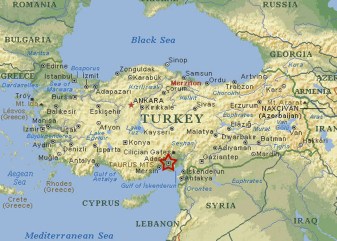
Turkey – Starred Area is Incirlek Military Base, long a major US strategic asset in Turkey whose presence has been called into question by the current events.
- Some Background
The aftershocks of the failed military coup in Turkey are resonating. Nearly 2500 upper level military personnel, including more than 100 generals sacked, many arrested. 6000 members of the judiciary, who sometimes challenged Tayyip Erdogan’s policies, fired along with 8000 Turkish policemen. Several hundred people were killed, thousands wounded. Two days later, more than 1,500 university deans have also been ordered to resign and the licences of 21,000 teachers working at private institutions revoked. In the end any and all opposition, the Gulen followers and pretty much anyone else that opposes Erdogan will be politically eliminated and Erdogan will rule supreme with no opposition. And it’s only just begun. More than likely, Washington will accept the changes, and Erdogan’s slap in the face (accusing the C.I.A of orchestrating the coup.)
While considerable confusion remains concerning the origins of the recent Turkish coup attempt, the geo-political outlines of where “post coup” Turkey is headed are coming into focus. A little background on the flurry of Turkey’s diplomatic initiatives that preceded the recent “coup attempt” are in order. As they were intense suggesting that a shift in Turkey’s political posture was in order. Besides initiating an extensive purge of the Turkish military and judiciary, Turkish President Erdogan appears to be setting Turkish regional political posture on a new direction. Read more…
Denver Cuts Out Its Free Seed Program

Growhaus – Denver Urban Garden in Swansea neighborhood of Denver.
In line with Denver’s addiction to privatizing as much public property as possible, of gentrifying the place, the city is cutting its annual program to give free seeds for vegetable gardens. It is only a measly $40,000 of a $1.8 billion budget for this year. The program has been administered since 1997 through Denver Urban Gardens.
But then privatization and unrestrained housing development, far more than urban gardening – has been the special contribution of our last two mayors – Hickenlooper and Hancock along with its (until recently) brain-dead city council.
Not only is the free seed program being cut, but each year the space available for urban gardeners is decreasing as land is being gobbled up by local and national developers – those piranhas of urban America. Housing prices and rentals are going through the roof, displacing all but the most prosperous, pushing poor, working class, middle class people east to Aurora, north to Thorton, or more and more out-of-state. Denver’s recent history was recently featured in an article in the British newspaper, The Guardian. The headline reads “White Privilege and Gentrification in America’s ‘Favorite City’ showing the city in a far less favorable light than its tourism bureau would like.
With this in mind Marie Edgar and I have written the following letter to the editor sent to two local media outlets, which we’ll also submit to our councilman Raphael Espinoza . If you want to add your name to this (for Denver residents only unfortunately) contact one of us; we’ll add your name to the letter below… Or write your own and if you do (would appreciate getting a copy):
July 16, 2016
Rafael Espinoza, Denver City Council, District One
Dear Rafael,
We are dismayed to learn that the City of Denver is no longer funding Denver Urban Garden’s Free Seeds and Seedlings program. Gardening is a healthy and productive interest in many neighborhoods of Northwest Denver.
Community Gardening is a way to build relationships that carry over into positive actions on behalf of all, across diverse populations. Denver has a long tradition in this respect including our Northside (now referred to as Highlands).
A community garden pioneer of the Free Seeds and Seedling Program, Jim Fowler – the original owner of what is today called The Lumber Baron on 37th and Alcott – was among those who spearheaded the free seed program.
We expect that eliminating the $40,000 that supported DUG’s program
will discourage our lower-income neighbors from planting in 2017 and will offer less
support to groups who choose to garden together.
How can we help the City to do an about-face, and increase the funding instead, in order to strengthen the fabrics of Denver’s neighborhoods?
Respectfully,
Marie Edgar edgardm1@msn.com
Rob Prince robertjprince@comcast.net
website: robertjprince.wordpress.com
Requiem – Jan Garton and Cheyenne Bottoms

Convention of Pelicans…with two mallards, Cheyenne Bottoms Wildlife Area, June 8, 2016
“What counts are the countless small deeds of unknown people who lay the basis for the significant events that enter history” Howard Zinn
1.
And then there are those “unknown people” whose deeds can hardly be considered “small.” Jan Garton who, died at age 59 in 2009, is among them. Although hardly known outside of Kansas environmental circles, she is something of a legend within the state, the Joan of Arc of the Kansas environmental movement, and for good reason. Her ashes lie scattered about in a small private cemetery in the central Kansas Flint Hills among the graves of a few people who died more than a century ago. It is a quiet place with cattle grazing off in the distance, and from the high grounds where it sits, a fine view of the surrounding hills. When I last visited in mid-June late spring was bursting forth with its prairie grasses, wild flowers.
Never met her, only vaguely remember hearing of the extraordinary work she did to save Cheyenne Bottoms Wildlife Area, but now seven years after she ended her life, I’m drawn to her, and “people like her.” By “people like her” I mean those unsung, or poorly sung, “organizers of the common good,” – people who in one way or another – for peace, the environment, labor rights, human dignity – have dedicated their lives to something themselves – to others, “credit,” “fame” being the last thing on their mind. She was the opposite of a “careerist”. It wasn’t a part of her nature to sacrifice human relationships to further her career…how un-American! Read more…
Stettin Station by David Downing – A “Sort of Review”
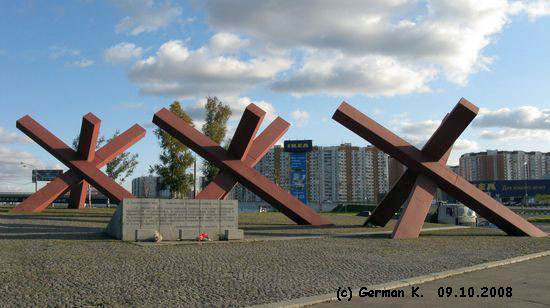
Tank Trap – anti-tank barrier used extensively by the Soviet during the Battle of Moscow – October 2, 1941 – January 7, 1942. This is at the site of the memorial to that battle just outside of the city.
1
Anyone traveling from Moscow’s main Sheremetyevo Airport the approximate twenty miles to Red Square couldn’t miss it, “it” being the anti-tank barrier sculpture marking the memorial to what is referred to as “the Battle of Moscow.” Despite the Cold War rhetoric of the times (late 1980s) downplaying the Soviet role in defeating the Nazis, every time I sped by the memorial in those years, it gave me chills. Still does more than twenty-five years since my last visit to what now is simply named Russia.
The memorial marked the precise place little more than ten miles from the center, a vivid reminder of just how close the Nazis had come to storming the Soviet capitol in those cold and unpredictable days between October 2, 1941 and January 7, 1942, with the fate of Moscow, and perhaps, the world hung in the balance. But the Nazi army was over-extended and increasingly poorly supplied, denied winter clothing and equipment. Hitler had not just underestimated the weather, but Soviet military strength. Nazi overconfidence that the USSR would collapse like a house of cards in the face of the Nazi blitzkrieg led the German war machine into a “quagmire.” Hitler’s armies were unable to make the final thrust. By January 7, they were pushed back in some places more than 100 kilometers from the capitol. Read more…
Libya: Downward Spiral

Tripoli prior to the invasion
Humpty Dumpty sat on a wall
Humpty Dumpty had a great fall
All the king’s horses and all the king’s me
Couldn’t put Humpty Dumpty together again.
What has happened in Libya since 2011 is heartbreaking. Its denials aside, the Obama Administration bears the lion’s share of the responsibility. Worse, nobody cares – or hardly anyone – here in the United States. As far as the current American political discussion goes, the Libyan crisis is on the back burner. For the political class, the media, the ethical dimension of destroying a nation with the goal of getting cheaper and more plentiful oil is nonexistent. An example of how far off the deep end the country’s leaders could go in defending the indefensible, the Libyan invasion, Democratic Presidential hopeful, Hillary Clinton referred to it as “smart power at its best.” “Smart power at its best” or imperial power at its most arrogant?
In the case of Libya…”Humpty Dumpty” didn’t “fall” – but was pushed by NATO, an organization which gives the United States the veil of plausible denial for arranging what is nothing less than the wholesale destruction of a country. Perhaps “obliteration” would be a better word. NATO has not been able to put Libya back together again. Nor is it certain that NATO intends to, at least not in the form it previously took: a centralized (if authoritarian state) which had the ability to negotiate hard with foreign energy companies and the governments that serve them. Read more…
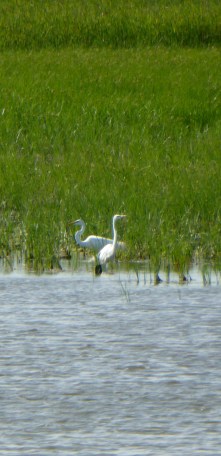
Great Egrets (also known as American Egrets) at Cheyenne Bottoms Wildlife Area, Kansas. June 8,2016
Molly and I went for a walk early Sunday (June 19, 2016) morning at Denver’s Washington Park. In an effort to beat a forecast of temperatures reaching close to 100 degrees we started at 7:30. By the time we finished the 2 1/2 mile loop, the temperatures had spiked into the mid-to-high 80s. I could feel the sweat beads starting to form on my back. There was a good deal of active bird life along the way. A group of three pelicans who were diving for fish in unison (that was cool), Canadian geese and gaggle of goslings, ducks and ducklings (adorable little living things) and across the water we could see some egrets. One was a great white, the other I wasn’t sure of. Was it a cattle egret? but probably not as it had a black, not yellow beak.
On returning home, I turned to my spiritual guide in such matters, Kaufman’s Field Guide to Birds of North America. (2000 edition). It was given to Nancy as a gift from our lifelong friend, Jo Ellen Patton, herself an experienced and knowledgeable bird watcher, now of Flagstaff, Arizona. While we have several other good birding guides (Peterson’s, National Geographic) we find ourselves relying on Kaufman’s more regularly than the others. Kaufman didn’t fail us. Closely related to a European cousin, known in French as an aigrette (little heron), the black-billed egret, easily identified, was a snowy egret, more common in east Texas and Louisiana, but whose range includes the mountains and front range regions of Colorado, Utah and Nevada. Read more…
Overall Saudi Crisis Deepens (Part 2)

Technically they (Saudi women) can “Do It!”, but legally, it is still forbidden, partially on the grounds that driving negatively affects their ovaries and interferes with child-bearing, a dubious argument. As recently as December 2015, Saudi women were given the right to vote and run in local elections…but they still can’t drive.
by Ibrahim Kazerooni and Rob Prince
The Saudi Crisis Deepens (Part 2)
Experts in space studies have asserted that when a star stands on the verge of its collapse, its core becomes unstable. It begins to expand far beyond its regular size, appearing to be greatly expanding – when, actually, it is in its weakest and most vulnerable state. This is the precise state in which Saudi Arabia presently finds itself.
In Al Muqaddimah, the great 14th century classic, Ibn Khaldun outlines a templet for the rise and fall of empires. He maintains that no society can achieve anything unless consensus exists concerning its goals and objectives and enjoys what he refers to as social solidarity ‘asabiyah’ – or consensus – supporting that goal. Jockeying for personal power, corruption, and the seduction of wealth creates a general lethargy that constitutes the dying phase of any dominant power.
All the indications suggest that current Saudi Arabia is going through such a phase. Read more…
Overall Saudi Crisis Deepens (Part 1)
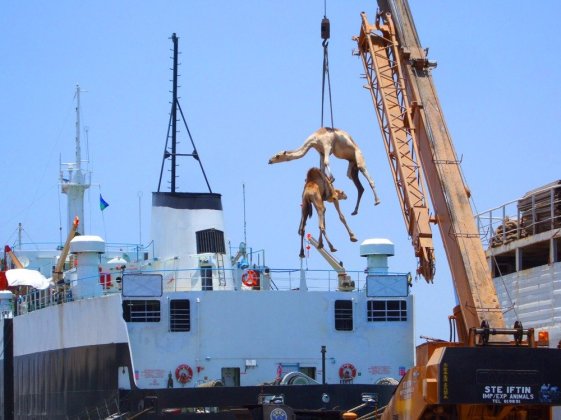
100 camels are sold in Saudi Arabia every day
By Ibrahim Ibrahim Kazerooni and Rob Prince
Perceptions can be very deceiving when it comes to Saudi Arabia, especially since Western media have mostly acted as Al Saud’s personal publicists over the decades. In 1974 Fred Halliday published a book focusing on the politico/economic structure of the Arabian Peninsula. In “Arabia Without Sultans” Halliday asserts that the conservative rulers of the Peninsula were, sooner or later, as doomed as was Egypt’s monarchy in the early 1950s.
Some history is in order.
Modern Saudi Arabia was a creation of the Sykes-Picot Agreement in 1916, a secret understanding between Britain and France defining their respective spheres of influence after World War I. Britain signed the “Treaty of Darin” with Ibn Saud that incorporated the lands of the Saud Family as a British protectorate in December of 1915. Soon thereafter, the western coastal region, Hijaz, was seized by Ibn Saud along with Mecca and Medina in 1925. He then utilized his 22 marriages to shape and control his vast kingdom. But from almost the outset, it was his close alliance with the US that helped him ward off threats towards the nascent state. In 1935 Ibn Saud signed a concession agreement with Standard Oil of California (now Chevron) which included handing over substantial authority over Saudi Oil fields. Standard Oil later established a subsidiary in Saudi Arabia called the Arabian American Oil Company (Aramco), now fully owned by the Saudi government.
There are three key pillars that the house of Saud rests upon, allowing it to play a role in the region. The first of these is the dominance of Ibn Saud’s descendants in Saudi politics. The Saud family is in effect an oligarchy that has crafted an absolute dominion, ruled by consensus of the leading figures enabling them to dominate the political landscape of Arabian Peninsula. Ibn Saud is believed to have had at least 70 children. His sons and their offspring form a core of about 200 who wield most of the power. Estimates of the total number of male members of Saud clan ranges anywhere from 7,000 upwards. This allows the family to control most of the peninsula’s important posts and to be present at all levels of government. The key ministries are reserved for the family, as are the thirteen regional governorships. Read more…
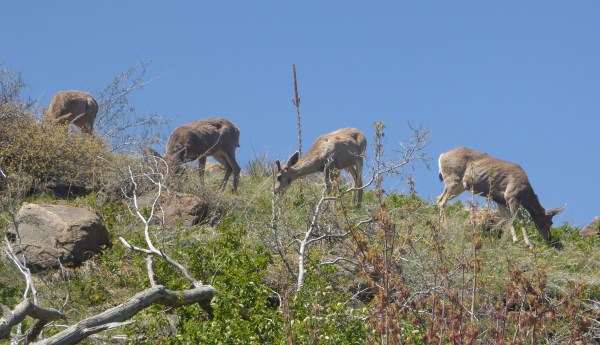
Clear Creek Canyon Deer. Notice how scrawny they are
This is the time of year with Spring in full bloom that here in Colorado, we are likely to see more wildlife. It has been my good fortune to see a fair amount these past few weeks – beaver (which I had never seen until now), muskrat, avocets and then a few days ago a herd of seven mule deer grazing on the side of a slope above Clear Creek just beyond the entrance to Clear Creek Canyon. We had been hiking. Nancy went on a bit; as usual, I waited behind and took a seat on an inviting rock, looked up; there were all seven of them making their way down along a stream bed not far from me.
Alert, the deer were typically nervous, their ears going back and forth. Apparently deciding that in the end I was not much of a threat, they inched closer until they were no more than a hundred feet away, maybe closer. Common as deer are, it is still a great thrill for a kid (well, I’m 71 now) from Brooklyn to be in the presence of a deer herd wandering freely in the Colorado mountains. I don’t remember seeing them in Flatbush where I was born, not even in the wilds of Prospect Park.
Unlike the other wildlife described above, deer are quite common – not just in Colorado, but nationwide. It is not unusual to see small herds in the mountains either in the early morning or towards dusk. In some places, like Boulder, they are something between house pets and nuisances, enjoying garden produce sometimes more than the people who are raising the crops. On his farm in Lyons, I remember that my father-in-law would scare them away by firing blanks at them with is rifle. It worked pretty well for a short while and then they returned. Read more…

Woman looking for petrified wood along the South Platte River at Ft. Morgan. (She told us that she finds a fair amount)
1.
“Why are you going there.”
“There” is the northeast corner of Colorado, north and east of Ft. Morgan to just past Julesberg where Colorado turns into Nebraska. Neither of our daughters could imagine why we would want to vacation there, little more than a way station in Colorado’s northeast corner that connects to I-80 in Nebraska and from there points east. We joked how we’d invite the girls to join us just to see how they might “politely” reject our offer.
But then, I’d have a hard time myself, explaining why it was we decided to pick that particular corner of the world for our enjoyment. I suppose several factors came into play: it wasn’t a typical tourist destination. I simply didn’t believe there was “nothing” there…although exactly what life was like there – both past and present – was not so obvious to tease out. Still, we figured…what the heck…let’s go and check it out. Its history – both human and geological interests me, especially the history of the flood of early Euro-American settlement in the area in the 1860s and how it impacted – decimated would be a more accurate term for it – the existing native populations.
How many times have we driven past Sterling and Julesberg on I-76 in the northeast corner of Colorado on our way to I-80 in Nebraska and points east? A hundred? More? My estimate is that it is somewhere between a hundred and a hundred and fifty times given that we often went to Eastern Nebraska, central Iowa (when Molly was at Grinnell) and western Illinois (when Abbie was at Knox College) at least twice a year and often more often than that over a period of 47 years. Who knows?
On those trips, how many times did we stop at Sterling, Julesberg or the small towns – more aptly called villages – Merino, Iliff, Ovid, Sedgwick – in Logan and Sedgwick counties? That’s easy. Once more than a decade ago, on a trip with Nancy and two friends, we passed through Sterling and Julesberg, heading for Sidney, Nebraska, site of the original Cabella’s, but didn’t stop. I had to shake my sagging memory to remember that I did visit Sterling once in the distant past, sometime in early 1975. It was to attend the trial of Gary Garrison, Crusade for Justice activist who indicted for bombing the Boone Paint Store in Denver. (1) Read more…
Clear Creek Again…Avocets and Muskrats
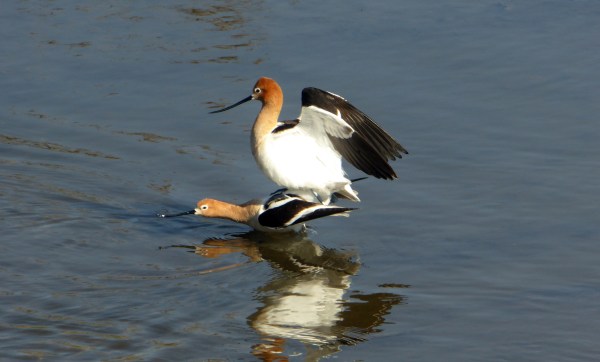
Avocets on Clear Creek near Kipling Blvd
Avocets…
Undoubtedly one of the better photos I’ve ever taken.
For those of you who are photographers, this photo of American Avocets, truly elegant birds, was taken with a little “point and shoot” Lumix camera with its Leica lens using the zoom. There they were the two of them, concentrating and busy sticking their long beaks into the mud to pull up many a treat. They seemed oblivious to the cars zooming by just a few feet away on Kipling I watched them for about ten minutes . Nor did my presence bother them much. Such a treat to watch them go about their daily routine for a short while.
The photos were taken today on a walk along Clear Creek from Anderson Park in Wheatridge to Kipling Blvd on a splendid early May day with nature here just starting to come alive. The site is downstream from where I was about ten miles, gold was first discovered in Colorado in 1859 triggering a flood of gold seekers – some 30,000 in the next year alone. About five miles from home in northwest Denver, the stretch of the creek I keep coming back to is a stunning place in all seasons. I suppose that having been big city born and raised, even at the age of 71, I cannot get over the excitement of seeing living things in their natural state – a couple of weeks ago along the same creek path, my first beaver ever – what a thrill, and now, today, avocets and muskrats. Now with Spring finally coming out in full bloom, or starting to, it is filled with activity. Read more…
RE/MAX First In Global Home Sales, First In Selling Illegal West Bank Settlement Property
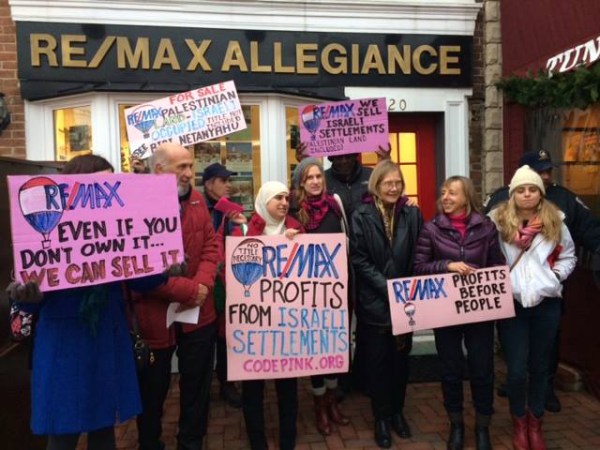
Richard Falk, author of the Dec, 2013 report to the UN General Assembly (see below) joining Washington DC protesters of Re/MAX’s real estate dealing of West Bank settlements. Falk is second from the left in the front row in a red parker
1.
At 2 pm on this coming Thursday, May 5, a group of activists will gather at the annual shareholder’s meeting of RE/Max to protest the real estate company’s policies of selling real estate in the West Bank settlements of Occupied Palestine. The sponsoring groups include Front Range Jewish Voice for Peace; Friends of Sabeel, Code Pink and Coloradans for Justice in Palestine. It is part and parcel of a national movement to press the real estate giant to stop selling land in the West Bank illegally expropriated from Palestinian landowners as a part of Israel’s intensified settlement policy there.
Short for “Real Estate Maximums,” RE/MAX, is an American international real estate company based in Colorado that operates through a franchise system. The company has held the number one market share in the United States and Canada since 1999, as measured by residential transaction sides.RE/MAX has more than 100,000 agents in 6,800 offices. RE/MAX operates in about 100 countries, among them Israel. It claims to have the largest real estate business volume in the world. Read more…
Tunisian Filmmaker Ferid Boughedir’s “Parfum de Printempts” – The Sweet Smell of Spring – Opens in Washington D.C.
 Eileen Davis, Guest Blogger
The Tunisian Embassy and Filmfest DC collaborated this weekend and brought Ferid Boughedir to open his latest worldwide, “The Smell of Spring” (“Parfum de Printemps”) at Mazza Galleria Theater. Quite a stir — the theater was packed both evenings, unusual for an Arab film in DC. In his remarks before each performance and the Q & A sessions after, Ferid displayed his brand of relaxed charm and intellectual intensity we’ve noted through the years. He’s an engaging storyteller
He wove the history of the uprisings into a kind of tale told from an ancient time, to children….there were the poor people, the good people, the bad guys and young heroes and fantastic women. There was a mean dictator and his family whom the people finally one day forced to flee. Compromise was achieved and four brave groups came together and eventually won a Nobel; and now, now there are outside forces and inner disagreements threatening to pull these good folks apart…….
And then the film itself… Read more…
 View from the Left Bank: Rob Prince's Blog