
Tunisian Mint Tea (thanks Ghaith Hajjem)
A Note on the Notes:
A number of people asked me to provide my notes from my talk on Tunisia last night (March 17, 2016) at the Alliance Francaise of Denver and I will do so below. Although a few “notes on the notes” by way of explanation are in order at the outset.
Firstly, I do prepare presentations with notes and did so this time..but then the presentations tend to have a life of their own – including this one. That said, although I did not cover the notes in the order below, most of the points made in the notes were covered below.
I would give special attention to certain links – the Francis Ghiles article, that by Hebah Saleh from Financial Times (that I could not link to because of FT‘s internet subscription policies) and the link about Olam Lamloun and Mohamed Ali Ben Zina’s research on Douar Hicher and Ettadham, two impoverished Tunisian suburbs.
Finally given the weather (it was snowing) the turnout was strong and the interaction between the audience and the speaker (me) was lively and I think productive, the liveliness of the event enhanced by the fact that two Tunisians living in Denver were in the audience and added much to the discussion.
The talk took place two days after the first anniversary of the terrorist attack on the Bardo Museum outside of Tunis Read more…
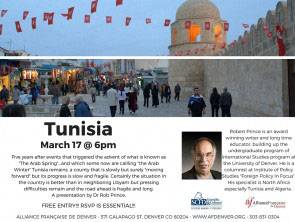
The text which is blurred reads as follows:
“Five years after events that triggered the advent of what is known as “The Arab Spring” – and which some now are calling “The Arab Winter”, Tunisia remains a country that is slowly but surely “moving forward” but its progress is slow and fragile. Certainly the situation in the country is better than in neighboring Libya but pressing difficulties remain and the road a head is fragile and long”.
The talk is at the Alliance Francaise this coming Thursday, March 17, at 6-7:30 pm. 571 Galapagos St. Denver. RSVP 303-831-0304
Tunisia Explodes Again – Part One
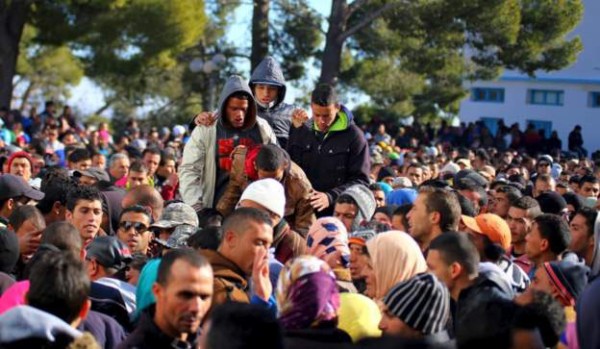
Kasserine, January 2016 – young people demonstrating for jobs. Youth unemployment in Kasserine is above 30%. Photo credit: Reuters
(Note – This article also appears at Foreign Policy in Focus and Nawaat.com. )
1.
Five years after the onset of the sociopolitical explosion, “the Arab Spring,” Tunisia, the country where it began is bogged down in a deepening socio-economic crisis, lack of political vision (this despite a highly educated, sophisticated and politically savvy population) and an ongoing guerrilla war against Islamic radicals in the western and southern regions of the country that the government has not been able to extinguish, nor even bring under control. Although put forth as a kind of poster child for what might be considered the one “Arab Spring success story,” in fact, Tunisia is a country where disillusionment at successive government’s paralysis to address the crisis runs deep. If not for the repeated intervention of Tunisia’s civil society – its youth, civil rights organizations, labor unions – to push the government to act, the situation would most probably be even worse that it currently is.
It should not come as much of a surprise then, that five brief and tumultuous years after the start of the Arab Spring, that it would once again explode. That “it” – a spontaneous uprising in the country’s interior that spread to a number of towns and cities – shook Tunisian ruling circles to their very core – is beyond doubt. For a moment it appeared that, as they have in the past, both more recent and less so, the angry protests that started in the Tunisian interior town of Kasserine and quickly ignited elsewhere (Gafsa, Jendouba, Tozeur, Gabes, Medenine). Read more…
The Denver Museum of Nature and Science’s Exhibit On Chocolate: Worth Seeing, But…
 1.
1.
A special exhibit at Denver’s wondrous – and it is! – Museum of Nature and Science features the history of chocolate. Needless to say it is quite popular. It is the latest in a series of special exhibits that the museum has brought to Denver of high quality. Among other recent special exhibits was a fine elaborate display of “The Silk Road” – that ancient trade route between China and Europe – now being rebuilt in modern times to unite the Eurasian land mass (and avoid a U.S. maritime navel build up in the Indian Ocean). It was on loan from the American Museum of Natural History in New York. So fascinated by it, I visited it four times. A second recent exhibit of equal historical value explored the many uses of poison, both natural and man-made, as a source of defense for many animals and plants and of course a means of attacking, neutralizing others. Read more…
Syria Again…(Part One)
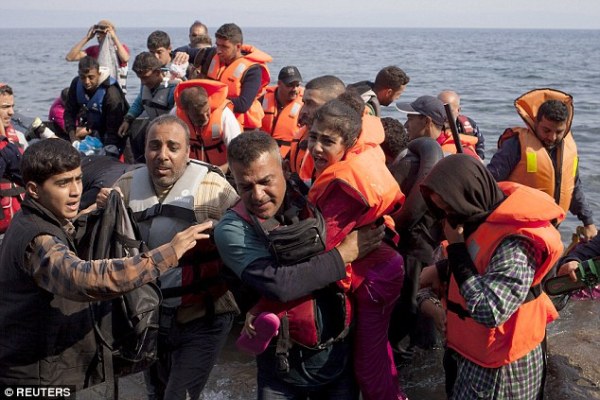
Syrian refugees – a few of the four million – fleeing the conflict
Syria Again
by Ibrahim Kazerooni and Rob Prince
(note: as this goes to press, it appears that Turkish troops are massing on the border with Syria in preparation of invading that country – more on this in Part II of this series)
(also posted at Counterpunch)
Yet again the Syrian conflict has taken the front pages of the western media outlet with the announcement that another UN sponsored Syrian peace talk is underway in Geneva. The latest round which began last Friday in Geneva; is an attempt to bring a number of groups to the negotiating table that has nothing in common. The so called the Syrian opposition group, which is supported by the Saudis, Qataris, Turks and other regressive regimes in the region have indicated that they intend to boycott this round of discussion as well unless their demands are met prior to negotiation despite US’s insistence that they should participate with no condition. Mike Whitney in his latest piece in Counterpunch, used the situation in eastern Oregon to assess the rationality of these demands under the current circumstance. He explained:
“To appreciate how ridiculous these demands are, one would have to imagine a similar scenario taking place in the United States. Let’s say, for example, that Ammon Bundy, the crackpot leader of the armed militia that seized the federal wildlife refuge in eastern Oregon, demanded that the FBI and all other federal agents vamoose while the UN convened negotiations between his representatives and the Obama administration for the establishment of a transitional government that would remove Obama from power after 18 months while rewriting the constitution so it better reflected the far-right political and religious convictions of Bundy and his gaggle of ne’er-do-well followers. Read more…

(These are the notes used for two talks on “The Literary Work of Robert Merle” – done in two sessions at Westside Books – 3434 W.32nd Ave, Denver, Colorado 80211 – on January 10 and January 24, 2016)
Intro…
Have been writing “The Rouen Chronicles” now for several years. It is not so much a nostalgic look backwards of the year I spent there (1964-65) as it is a series of spin offs, consequences of that year. So I’ve written some about the history of the city – it has quite a rich past – some of the people I knew then.
It was in that spirit that I decided to write about Robert Merle – his life, his writings and his influence on me. Merle was one of my professors that year – the one who easily made the most lasting impression.
Our group, from St. Lawrence University consisted of about 25 of us, under the direction of the chair of the French Dept., Dr. Oliver Andrews and a history prof, Dr. Robert Carlisle, both now deceased for some time. Marking the 50th anniversary of our year in France, about ten of us got together for a reunion last year (October, 2014) in Atlanta. Read more…
Dialogues – KGNU Hemispheres – January 25, 2016; Middle East Discussion With Ibrahim Kazerooni and Rob Prince

Iranian President Hassan Rouhani and Chinese President Xi Jinping. In the aftermath of the Iran nuclear deal, Iran and China have just sealed a huge trade agreement of some $600 billion over the next 25 years
Note: this is a synopsis of the discussion on last night’s KGNU (Boulder, CO 1390 AM) program from my notes combined with some of Ibrahim Kazerooni’s comments on the Iran Nuclear Deal. As with notes, what follows in the notes covers approximately what we discussed. I publish them in response to several listener requests. To hear the interview in full – go to KGNU (www.kgnu.org); from there go to the January 26, 2016 program for the interview in full.
_____________________
You would think that a month of events in the Middle East wouldn’t make that much of a difference…what is a month after all?
And yet a number of rather startling developments since we last met just prior to the new year…among them
✓ follow-up on the P5 + 1 agreement with Iran concerning its nuclear program
– this includes the dismantling of much of Iran’s nuclear program – what exactly
– the lifting of some of the sanctions (and the re-imposition of others, here in the USA
– an upsurge in commercial relations between Iran and other countries – big
economic agreements with Russia and China, smaller agreements with European
powers – not much economic exchanges with the USA
– New alignment of regional forces, especially where it concerns the situation in
Syria (enhanced role of Russia, Iran and informal cooperation with the Obama
Administration
– pouting of neo-Cons, AIPAC over the agreement and the continued opposition to
it from U.S. regional allies – Israel, Saudi Arabia and Turkey
✓ New negotiations over the future of Syria
– this is the third round – many discussions especially focused around who should represent the Syrian opposition
– situation on the ground in Syria clearly tilting in favor of the Assad government and its allies
– a number of strange events that seemed to disappear shortly after they took place – specifically the “incident” in which two U.S. naval vessels with U.S. Special forces
aboard (Navy Seals) that was picked up by the Iranians within their territorial waters – and soon thereafter released.
✓ Elsewhere – significant developments in Tunisia Read more…
Burkina Faso – Terrorist Attack Kills 30, Mostly Foreigners Targeted

Burkinese celebrate after embattled Pres…Burkinese celebrate after embattled President Blaise Compaore announced that he was stepping down in Ouagadougou on October 31, 2014. His resignation came as tens of thousands of protesters demanded that he quit immediately after a day of unrest that saw mass demonstrations, with protesters storming and setting fire to parliament. (AFP PHOTO / ISSOUF SANOGOISSOUF SANOGO/AFP/Getty Images)
1.
As elsewhere, they come in, seemingly from nowhere, guns blazing killing everyone in sight before, in turn, most of them too are mowed down by the domestic security forces that are poorly trained for this particular kind of warfare. “They” are Islamic militants, this time associated with Al Qaeda of the Islamic Maghreb (AQIM). (1) Thirty people were killed and 56 more were wounded in the January 18th attack which lasted fifteen hours before it ended. Three of the attackers were killed but it appears that another three escaped.
While some of the motives will be discussed below, the essence of this attack was to create an atmosphere of fear in Burkina Faso, which then France (and US) can use to beef up their military security presence in the country and tighten their ties with the country’s military/security force.
AQIM’s terrorist activities have a decades long history throughout the Sahara and adjoining regions. Once again, it happened, this time a bit out of what has considered AQIM’s “traditional” zone of operations as the terrorists struck in Ougadougou, the capitol of Burkina Faso, landlocked dirt-poor West African country. Indeed, in many ways Burkina Faso was an unlikely target, until recently, beyond the radar of groups like AQIM.
Why all these attacks? The motives are not entirely clear. Read more…
The Crusade for Justice – The Chicano Movement Across Generations
Robert Merle: Notes on Jan 10, 2016 Talk on “Fortunes de France” – Part One; Westside Books – 3434 W.32 Ave. Denver, Colorado 80211

Robert Merle
+++++++++++++++++++++
Note on the notes: I occasionally publish notes on the talks I give – usually at the request of the audience. Generally speaking my notes and the presentations given are not that far apart. I do wander from them as mood and questions come up, but almost always come back to the main themes. Rarely do I get through what I want to cover. It used to bother me, but doesn’t anymore. Thanks Dawn S. for the above wonderful photo of Merle
+++++++++++++++++++++
Notes:
Intro..
Thank Lois – Westside Books
Part One – Why This Subject? Why Me?
A couple of themes come together that explain these two meetings on Robert Merle…
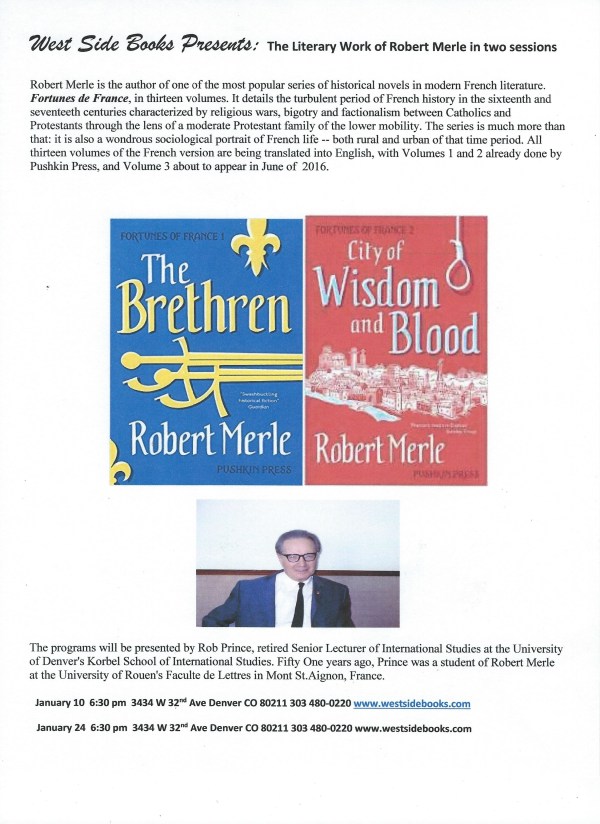
1. The beginning of the translation of his 13 volume series “Fortunes de France” into English – the historical novel series that covers a turbulent period in French history – from the mid 16th to the mid 17th centuries and the religious wars between Catholics and Protestants that dominated the period. Volumes 1 and 2 have been translated – Volume 1 as “The Brethren”, Volume 2 as “City of Wisdom and Blood.” – A third translated volume dealing with the time of the St. Bartholomew Day Massacre of 1572 is supposed to be out next month, in February, 2015
2. A personal landmark – the 50th anniversary of the Junior Year Abroad in Paris and Rouen France during which time I had Robert Merle as a professor for a seminar. Read more…
Behind the Saudi Head Lopping Orgy
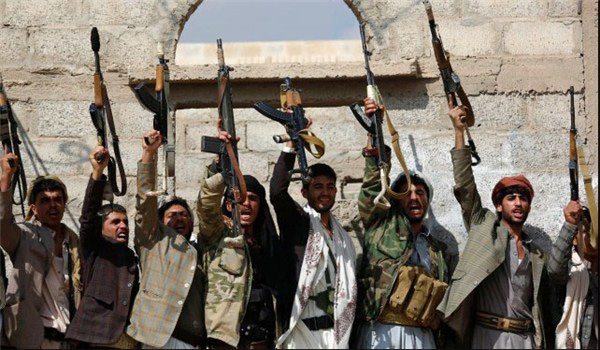
Yemenis fighting the Saudi-led invasion of their country. Unlike what we read in the U.S. media, despite its savage bombing campaign there, the Saudis are taking a regular beating in Yemen on the ground.
1. The Saudi P5+1 counter-offensive sputtering
When Israel – Netanyahu in particular, but past Israeli prime ministers as well – wants to “stick it” to Washington, knowing that it could complicate Obama’s agenda some, it announces it is going to build more settlements in the Occupied Territories at a sensitive moment for Washington, the goal being, repeatedly, to sabotage any genuine progress towards a diplomatic solution to the Israeli-Palestinian crisis.
It works like a charm every time! Washington bristles, perhaps makes a few critical remarks, but never does anything that will seriously undermine the underlying strategic relationship. This political tango has gone on for decades ad nauseam. In the end, it is based on an illusion, that being that Israeli policy is somehow independent of Washington’s over all policy. Nothing could be further for the truth as Washington holds virtually all the cards in the relationship in its hand. The idea that the “tail is wagging the dog” is, in a word, nonsense.
Saudi Arabia, that other U.S. Middle Eastern strategic ally, is also trying to influence Washington, but, it appears, less successfully at present. Like Israel, given the parameters of the “Obama Doctrine” the Saudis have a certain degree of political maneuverability from Washington although they can not stray very far, if at all, from Washington’s overarching plans for the region.
While it had other goals as well, it seems that the main purpose of Saudi Arabi’a mass execution was to provoke Iran into overreacting in such a way that the P5+1 agreement (the Iran nuclear deal) would be scuttled. While critical of the Saudi executions, Iran has so far limited its response to a verbal rebuke. It did not take the bait and over-react.
The Saudi head lopping was the largest mass execution since 1980 when 63 rebels involved in the 1979 rebellion in Mecca were likewise “put to the sword.” This time some 47 people – the most prominent among them the Shi’ite cleric Nimr al Nimra – were executed on January 2 inside prisons in twelve Saudi provinces; 43 were beheaded, the other four executed by firing squads. Most of the others were executed for organizing or participating in a series of al Qaeda-lined attacks in the years after 2003.
But the victims also included Shi’ite protestors from civil rights movements in Saudi eastern provinces that erupted as a part of the early Middle East wide Arab Spring uprisings. Shi’ites make up anywhere from 15-25% of Saudi Arabia’s overall population and have a history of suffering discrimination from the Wahhabist Sunni government in Riyadh. They are heavily concentrated in the country’s eastern regions, where, incidentally, the bulk of Saudi oil reserves are located.
Worse, the executions have backfired and become a Saudi public relations nightmare. This current wave of Saudi repression has met with near universal condemnation, including here in the United States. The media here has a long history of ignoring the kingdom’s shameful human rights record. But this time it appears the Saudis have gone too far, even for U.S. mainstream outlets. There is a growing concern that King Salman, who took over on the death of his brother, Abdullah, a year ago, has instituted a more aggressive, narrow nationalist overall Saudi regional policy has “gone too far.”
Besides shaking up some, some of the old ways the royal families ruled, Salman appointed a young, inexperienced – if articulate in the English language – Adel Al Jubeir as foreign minister who has “pushed the envelope” on Saudi foreign policy towards Syria, Yemen, but most especially antagonistic towards Iran. As an indication of the degree to which the Saudis are feeling the walls crash in all around them, Al Jubeir is the first member of the Saudi royal family itself to hold the foreign ministry post.
A January 5, 2016 NY Times article was unusually frank. It quotes Fawaz Georges, director of the Middle East Center at the London School of Economics: “…the regional turmoil the executions have caused…”could tear the social fabric between Sunnis and Shi’ites in Saudi Arabia.” Later in the article it notes that the Saudi policy of targeting Iran’s growing regional influence (at Saudi expense) as “reckless” “including a decision to go to war with Yemen.”
Add to this Saudi oil politics. Of late the Saudis, doing more damage to their own economy than anyone elses’, has decided to engage in an oil price war by flooding global oil markets with their crude, betting that they can outlast their oil competitors with the $700 billion in U.S. treasury bonds to fall back on. Such a policy ultimately will hurt those countries whose economies remain un-diversified and use oil as their only (or almost only) source of foreign exchange. Not true for either Russia or Iran, both of whom, will be negatively effected, but less so than Saudi Arabia itself. One of the ironies of the sanctions against Iran is that it has forced the country to diversify economically away from total dependence on oil and it has done so.
Beyond the cynicism, downright inhumanity and barbarism of these beheading, which merit all the international outcry they are receiving, one must ask the question: what’s the deal? After all, Salman and Al Jubeir knew well that going down such a path would provoke such a vibrant negative reaction. But they didn’t give a hoot about public opinion, did they, as long as they were assured that Washington, other than making a few feckless public statements, would stand behind them. Again, the comparison with Netanyahu’s Israel – immune to criticism as long as the White House considers Israel its strategic ally – comes to mind. As long as Washington – be it the Bush or Obama White House – stand with its regional strategic allies Israel, Saudi Arabia it matters little what the rest of the world thinks.
What comes through, as the NY Times article suggests, is that the beheadings was the not so subtle way of the Saudis “sending a message.” What message though? To whom and for what purpose?
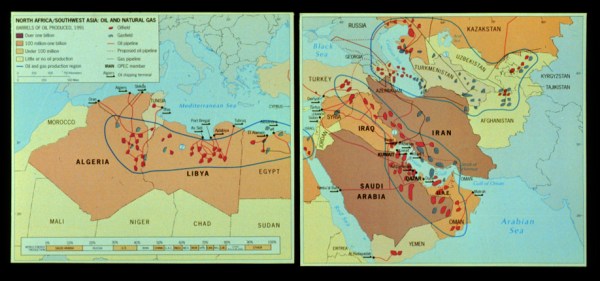
Middle East – North Africa oil and natural gas deposits
2. Iranian cautiousness
Like most public relations events – for that is precisely what these executions were – there are several purposes. The global backdrop for these primitive executions comes into play. Just yesterday (Jan. 7, 2015), the New York Times noted that U.S. Secretary of State, John Kerry had announced that Iran is close to complying with last summer’s nuclear deal, “a step that would compel the U.S. and other Western nations to immediately suspend many sanctions on the Islamic republic.” The article goes on to state that the “landmark could usher in a new phase in the budding U.S.-Iranian rapprochement.”
Should the sanctions be lifted – and there is every indication that they will be at present – it is more than likely result in an Iranian economic boom of unprecedented proportions. Even before the formal lifting of sanctions, since the signing of the initial agreement this past September, there has been something approaching a flood of foreign financial and business people in Tehran hoping for contracts with the Iranian government.
While there are other factors involved, the timing of the event suggests the Saudis are trying to sabotage the P5 +1 agreement by Iran to over-react to the killings, especially of Nimr al Nimra. Riyadh was betting that Iran would respond to the killings in such a way – militarily or politically – that pressure would be put on Washington to back out of it, which would effectively kill the process. Add to the executions, the recent Saudi bombing of the Iranian embassy in Sana, Yemen and an indication of just how far the Saudi’s are willing to go to provoke their neighbor across the Persian Gulf comes into focus.
It is no secret that the Obama Administration’s signing of the P5+1 agreement in Iran was unpopular among American hawks, AIPAC and the like who went all out to sabotage the agreement themselves. There remains pressure, significant pressure at that, to find a way out of the deal before it is finally realized. The Saudi provocations – should the Iranians “bite” – would give Washington a way to scuttle the agreement while maintaining their dignity – and of course blaming their exit on the Iranians.
But much as Russia did not take Turkey’s bait after the recent downing of its fighter jet over northern Syria by responding militarily (and thus creating a pretext for a great NATO presence in Syria) so from all appearances the Iranian response to the Saudi beheadings has been critical…but controlled. They haven’t taken the bait, and there is little indication from where I am sitting, that they will. Iran is anxious to have the sanctions lifted and was willing to curtail much of its nuclear energy program to achieve that goal.
In fact, the Iranians are, in this period between the signing of the P5+1 agreement and its implementation, being very cautious precisely not to antagonize the Saudis, not to “rub it in” so to speak that Iranian influence in the Middle East is rising while the Saudis find themselves more isolated. It suggests how important it is to Tehran that the sanctions be lifted. For they understand that should the agreement be finalized, that it will usher in – not just a new era in U.S.-Iranian relations – but give considerable dynamism to their economic development. And it is economically – rather than militarily – that Iran wants to compete with the Saudis, as they understand all to well, that between themselves and the Saudis there can be no military solution.
The Saudis understand the vulnerability of their position should the agreement be finalized and in a kind of frenzy, under the leadership of their young, inexperienced, arrogant and increasingly reckless foreign minister, Al Jubeir, – who spent too much time cozying up to neocon and AIPAC like elements at Washington cocktail parties, are seeing just how far they can push things. As the finalization of the agreements with Iran come into focus, all appearances suggest that the Saudi saber-rattling approach is backfiring and going nowhere.
_______________
Crosslisted at Foreign Policy In Focus
The Literary Works of Robert Merle (in two sessions)
Bill Wellisch, Teacher, Humanitarian
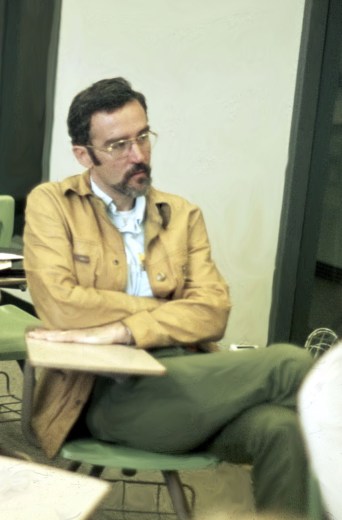
Bill Wellisch – April, 1974
Bill Wellisch died on November 19, 2015 from complications from a brain tumor. He was born in 1938 in Nazi controlled, Vienna, Austria. I was told of his death by David Colson, a mutual friend, a few days ago. Our paths separated some time ago. That said, we shared several decades together teaching at what was first called the Community College of Denver – Red Rocks Campus – and then later, as a faculty union movement gathered steam, it was spun off to become Red Rocks Community College. Bill, a number of others and myself were a part of the Social Science Division whose department chair was Dave Nelson. It included psychologists Ron Courson, Walt Schreibman, historians Carla Joy and Alan Culpin, philosophy prof Humberto Mojica, sociologist Laura Valvatne, geographer Emm McBroom. There were others too that I remember fondly, Nick Ulibarri (who also died a few years ago), Judy Harrell, Annette Adlefinger, Alan Marx, Don and Cindy Redifer just to name a few. In retrospect it was a wonderful, dynamic department in which Wellisch, a Jewish refugee from Nazi domination, was one of the intellectual guiding lights, his family having escaped the Final Solution in 1939. Read more…
Burkina faso – A New Resource Curse: Manganese

Burkina faso mining
A Nationalist Impulse?
Just a few months after a long lasting and corrupt government was swept from power, in March of this year (2015), in Burkina faso, the country’s transitional Minister of Mining and Energy suspended a major mining contract with Pan African Minerals at Tambao, forcing the company to stop operations there. Missing from most press explanations as to why the suspension order was issued was the growing local opposition to Pan African Minerals’ practices. On February 17, 2015, a march in protest was initiated by peope in the vicinity of Markoye, town closest to the mine seek Tambao mine operation stoppage until further notice. More than 3000 local people participated. They opposed the company’s environmental practices (explosions, dust) as well as the fact that the company had reneged on its promise to employ at least fifty locals in the work there and to involve the local community more in the mines’ plans. They demanded that the operations of the mine be completely shut down until these issues were resolved.
The February 17 protest was under the leadership of the regions’ youth, JUDECOM, “Jeunesse Unie pour le Développement de la Commune de Markoye.” (Youth United for Markoye Development), a local social action group that has won the support of many. More than 3,000 people participated in the demonstration which resulted in some property damage to the mine. The mine management fled. From all appearances, it was primarily in response to this local mass action that the new transitional government of Burkina faso decided to suspend the mine’s operations.
Then, just a week ago, on December 18, the suspension was lifted. It is not clear how many of the local concerns were addressed and/or corrected by either the Burkina faso government or Pan African Minerals. A new government, the result of recent eletions, headed up by the country’s new president Roch Marc Christian Kabore, is to be installed in the next few days, on December 29,and this might have been a key factor in the reversal. No doubt the temporary suspension played well with the country’s current wave of nationalist fervor which swept long-time ruler and close ally to France, Blaise Compaoré from power.
Was the suspension a part of a new wave of economic nationalism suggesting that the post-Blaise Compaoré Burkina faso government was about to take tighter control of the country’s resource production, mined overwhelmingly by foreign mining companies? Or was it something a bit more cynical on the part of the country’s transitional Minister of Mining and Energy? Was the new energy minister just showing that he now is the “new boy on the block’ who needs to be wined, dined and otherwise well-greased in exchange for mining contracts as others had been before him? If so, it would not be the first time, that a new African political leadership, and especially its minister of mining and energy, was bought off lured by foreign bank accounts, European shopping sprees and some of the world’s finest and highest paid prostitutes.
Time will tell but the turn around is rather curious. (1) Read more…

Battle of the Somme (WW1) dead
Last summer with, family friends Jamie Roth and his Dutch friend Marion, we saw – at Jamie’s recommendation, two films, Testament of Youth – the film version of the memoir by Vera Brittain – and Ken Loach’s “Jimmy’s Hall,” the story of Irish radical Jimmy Grafton’s efforts to set up what amounted to a community center outside the purview of the Irish Catholic Church. Months – and many films seen – later, these two have stuck in my mind and my thoughts keep coming back to them. Both Nancy and I were moved, touched by both. Abbie, our younger daughter, had read Testament of Youth in college and still had her copy which I borrowed and read in its entirety. I also did some research on Jimmy Grafton to try to find out why a dance hall for Irish workers and farmers was so threatening to the powers that be. In any case, while both films have somewhat different themes I’ve decided to write about them in hopes that people might be interested in seeing them. Testament of Youth is the subject of this review; one on Jimmy’s Hall will follow.
A hundred years ago, December, 1915. The “world” – but more accurately mostly Europe and the Middle East was entrenched in what today is called World War One, but what earlier was referred to as “The Great War.”(1)
And it was a great war – one the likes of which the world had never seen – until an even greater war, World War Two was unleashed a mere twenty years later.(2) In one battle alone, referred to as the Battle of the Somme, which took place on both sides of the Somme River in northern France between July 1 and November 18, 1916, more than a million men, French, British, German were either killed or wounded. Much of the cannon fodder in this battle and in both world wars came from “the colonies” – the Third World – “French” Africa, “British” India, etc.
Shortly before that, at this time a hundred years ago, according to Wikipedia’s “Timeline of World War One”, in mid December of 1915 the main fighting was taking place in the Middle East, around the town of Kut in Iraq where Ottoman forces were besieging the town’s largely Indian troops of the British Empire. Not that far away, near Gallipoli, Turkey, another British defeat was unfolding as the Ottomans were winning a shattering victory over British-held defenses which were overstretched and under supplied.
On the Western Front, the lines were drawn in Northern France but there was a lull between major mass slaughters. The first Battle of Ypes, where in April, the Germans had first used poisoned gas had stalled. The Battle of Verdun, which would start in February, 1916 was being prepared but had not yet begun. Still, trench warfare proceeded, tit for tat between the British and French lines on the one side and the German lines on the other. And it was there, just before Christmas in 1915, during a lull in the fighting that one Captain Roland Leighton, aged 20, Vera Brittain’s fiance, died of wounds suffered from a sniper’s bullet. He is buried in the military cemetery at Louvencourt. Read more…
 View from the Left Bank: Rob Prince's Blog