Tunisia’s Mosques
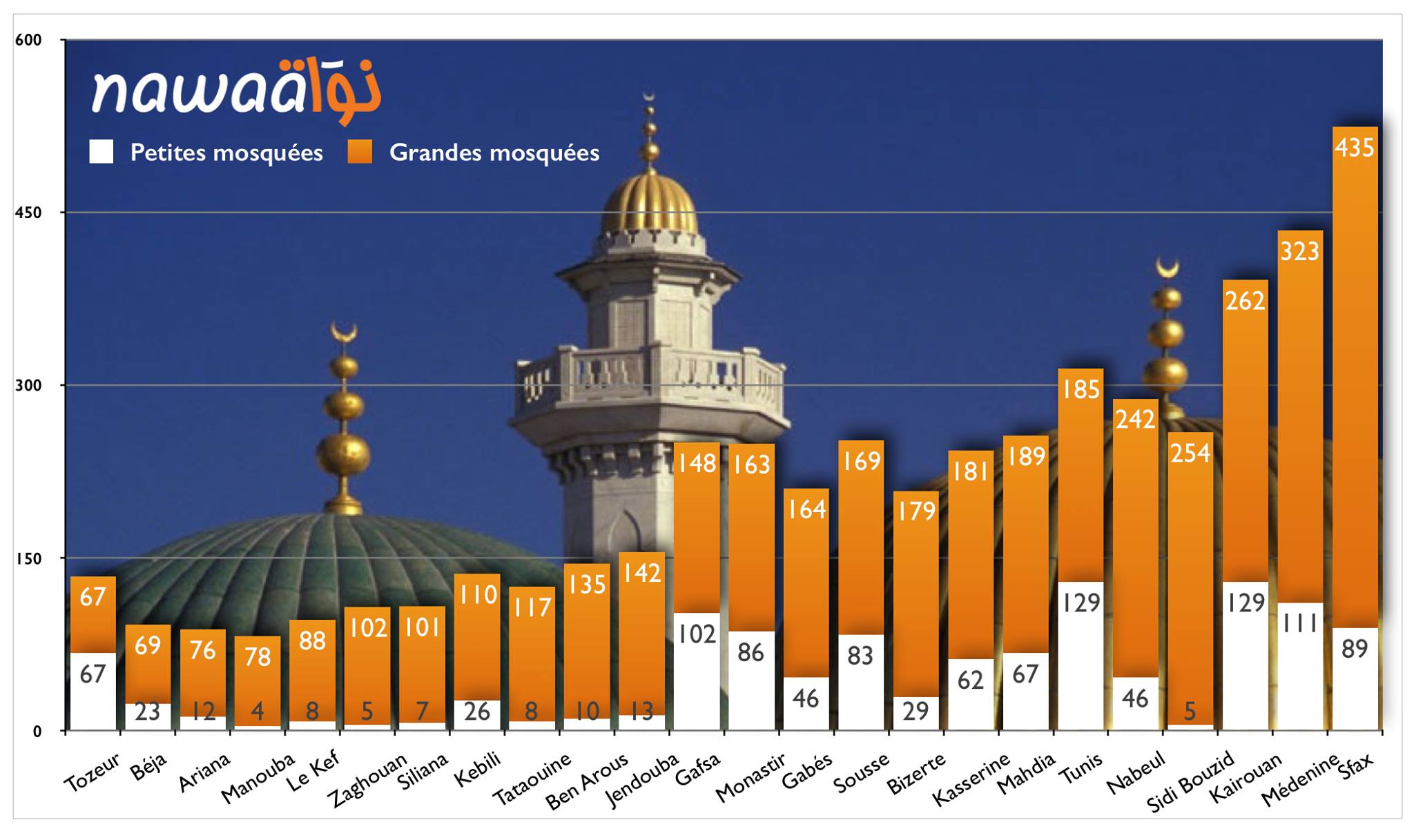
in white: number of small mosques: in orange the larger ones called “grand mosques”
This is the French original of the text accompanying this article on the mosques of Tunisia. The article “Outcry Concerning The Mosques: the state crisis of confronting religious approaches” appeared at Nawaat.org, back on September 27, 2014. Nawaat.org is an informative Tunisian website in Arabic and French, occasionally in English as well.
À noter que -et contrairement à ce que l’on aurait pu croire- ce n’est pas Kairouan (391), la ville sainte, qui détient le record de la concentration de mosquées, mais la ville de Sfax (524). Au lendemain du 14 janvier 2011, plus de 1000 seraient tombées entre les mains des fondamentalistes, selon le porte-parole du ministère de l’Intérieur, Mohamed Ali Aroui. Parmi ces mosquées, 90 ont été construites dans l’anarchie, selon le ministère des Affaires religieuses. En juillet dernier, 149 mosquées étaient déclarées sous influence salafiste, dont 25 toujours hors de contrôle. Imprenable, la grande mosquée Ezzitouna est demeurée aux mains de l’imam virulent Houcine Laabidi, qui y a réinstauré «l’enseignement zeitounien original»
The rough – but essentially accurate translation – goes something like this: Read more…
The-Dream-of-the-Celt-by-Mario-Vargas-Llosa: A Critical Review in Three Parts: Part Three

Malaysian Rubber Tapper. Today, nearly 50% of all natural rubber comes from plantations in Southeast Asia, Thailand, Indonesia, Malaysia, India and Vietnam
The Political Economy of Late 19th, early 20th Century Rubber Production
Casement’s investigations of human rights abuses in rubber collection in both the Congo and Putumayo region of the upper Amazon Basin of Peru took place at a particular moment in time when the global demand for rubber had exploded and the supply of wild rubber, the only source, was increasing unable to keep up with it. This structural situation combined with the great profits the result of limited supply was the global engine that shaped the abuses Casement revealed in his studies. In those same years (1903-1913), Britain was following a two-track strategy, on the one hand investing heavily in creating domesticated varieties of rubber on incipient rubber plant plantations in Malaysia and elsewhere in SE Asia, creating alternatives to their dependence upon equatorial rubber from Africa and South America.
On the other hand, as those alternatives were coming on-line and the viable Asian alternatives were being put in place, at first slowly and then more quickly after 1900, Britain was not particularly adverse to exposing the seamy side of rubber production controlled by other countries. In the Congo, it was Belgium that benefited most from rubber, in the Amazon, a number of local rubber barons from Peru, Bolivia and Brazil. While in both cases foreign capital, always on the hunt for high rates of return was involved, in the main it was domestic elements that controlled production and, as long as their was a rubber boom, the breathtaking profits that resulted. When the first rubber boom ended sometime between 1910 – 1913, and end it did abruptly when Congolese and Amazonian production collapsed overnight, control of global rubber production shifted decidedly to Britain with its Malaysian plantations that left its competitors in the dust.
When the first rubber boom ended sometime between 1910 – 1913, and end it did abruptly when Congolese and Amazonian production collapsed overnight, control of global rubber production shifted decidedly to Britain with its Malaysian plantations that left its competitors in the dust.
Wallerstein: U.S. Standing in the Middle East

One of the early 2011 Egyptian mass demonstrations that brought down the Mubarek government
(note: this entry is lifted in its entirety from Immanuel Wallerstein’s Commentaries, with permission. These commentaries, appearing every two weeks, are almost always worth reading. Kazerooni and I have argued that U.S. Middle East policy is in shambles, and has been for a long time. This article supports that view and explains why.)
“U.S. Standing in the Middle East”
The Dream of the Celt by Mario Vargas Llosa: A Critical Review in Three Parts: Part Two

Stamps Commemorating The Easter Rising when Irish nationalists rose in armed revolt against 800 years of British rule. Roger Casement, a man born of privilege, gave his life in support of this cause
__________________
Now give me that old-time religion
Give me that old-time religion
Give me that old-time religion
And it’s good enough for me
It will do when I am dying,…
It was good for the prophet Daniel,…
It was tried in the fiery furnace,…
It will take us all to heaven,..
– a traditional American gospel dating from 1873 –
__________________________________________
1. Did Roger Casement find God?
Vargas Llosa constructs his narrative, interspersing scenes of Roger Casement’s life with his final days before his execution. The main episodes of Casement’s life, his early life, time in the Congo, Brazil, the Putumayo investigations, his embracing of Irish nationalism, his homosexual affairs in Africa and Latin America are all covered and with feeling and considerable detail. But it is those final days and hours that are given much greater attention, where Casement appears to embrace Catholicism and a belief in God which in many ways is more central to the narrative that even his human rights work. In fact, it comes through as perhaps Vargas Llosa’s main purpose in writing the book – a case study of a non-religious man who happens to “find God” at the end of his life. Casement’s life itself filled with drama and turmoil is just incidental. Roger Casement’s biography, even in the format of a historical novel, deserves better. Read more…
The Dream of the Celt by Mario Vargas Llosa: A Critical Review in Three Parts: Part One

Enslaved Amazonian Rubber Workers, Putumayo District of Peru – early 1900s. W. Hardenburg, who snapped this photo, was one of the American journalists who uncovered the inhumane conditions of Amazonian rubber collectors. It nearly cost him his life
Mario Vargas Llosa – Dream of the Celt
Rummaging through a pile of books at home I came across one I had not read, the title of which meant as little to me as did the author – The Dream of the Celt – by Nobel Prize winning Peruvian author, Mario Vargas Llosa. While I have learned some about Vargas Llosa since, at the time I rediscovered the book, I knew little about him other than he had won “the prize.” Wondering why it was I had bought it in the first place I was about to put it in my “give away” pile when I noticed the portrait on the dust jacket which caused me to pause. Wasn’t that Roger Casement’s photo, which by now I have become familiar with? Yes it was! If I couldn’t remember where or when I had purchased the book, I certainly knew why. Casement is the author of the 1904 Report on the Congo, which played large, along with the work of E. D. Morel in the discrediting and ultimate downfall of Leopold II of Belgium’s Congo Free State a few years afterwards.
Neither free nor a state, the Congo Free State was little more than a horrific economic system of slave labor organized for the collection and extraction of Congolese rubber and ivory. It made Leopold II, a cunning bastard, one of the wealthiest men in Europe and probably the world at the time. It reduced the population of the Congo from an estimated twenty million in the early 1880s, when the help of Henry Morton Stanley he was able to gain control of the region, to less than ten million people a quarter of century later. Driven by unabashed greed hiding for a short time behind a veil of humanitarian interventionalism, the white man’s burden to help the people of the Third World Leopold’s Congo organization committed unspeakable crimes against humanity, in an unending orgy of economic exploitation, rape, and murder. Read more…
Tunisia’s Presidential Elections: Washington Wins Either Way

Amilcar, Tunisia – 2011
(Note: Also published at Foreign Policy In Focus and Blog Africa)
(Washington needs the support of both Ennahdha and Nidaa Tounes to push through its structural adjustment policies pressed on Tunisia in exchange for IMF loans these past few years. The main goals, the legal basis for which was apparently achieved in the last days of the country’s constituent assembly, have been to open up Tunisia’s soon to be developed energy sector to foreign investment, as usual on terms unfavorable to Tunisia, and to lift the subsidies on gasoline and electricity. As long as the two parties, that will dominate Tunisian politics in the coming period, cooperate on this, it is not important to Washington which one wins the presidency or dominates the Tunisian political landscape.)
First Round Results: Tunisia’s Presidential Elections
The first round of the Tunisian elections took place this past Sunday. Two of the candidates, Beji Caid Essebsi, leading figure of the Nidaa Tounes Party, won a plurality 39.46% percent of the vote. Not far behind him the incumbent president of Tunisia’s transitional government, Moncef Marzouki, came in second with a strong showing as well – drawing 33.4% of the vote. Hamma Hammami, the leader of Tunisia’s Popular Front, came in third with 7.82%. Businessman Hechmi Hamdi secured 5.75 percent; and the tycoon Slim Riahi received 5.55 percent.
Although “a secular” candidate, Marzouki, the incumbent president, owes his political prominence to his relationship with the Ennahdha Party, the Islamic political party that has dominated the Tunisian political scene since the 2011 overthrow of the Ben Ali dictatorship and who has managed to mismanage the country’s economic and political affairs to an impressive and factional degree. Although Ennadha, recognizing is current unpopularity, and most probably with a little help from friends in Washington DC, decided not to field a candidate for the presidency, it is not a very radical supposition that they stand behind Marzouki, whose own political base has been close to non-existent. Read more…
Ninety Percent of Everything…A Commentary-Book Review – Part Two

The Dutch fluyts could carry more freight with less crew, and so their rates were two-thirds or half those of England (the closest rival). Only in the long-haul trade to the East Indies and the New World (where the large, unarmed fluyt could not be used) could the English carriers compete.
_____________
_____________
Ninety Percent of Everything: Inside Shipping, The Invisible Industry That Puts Clothes on Your Back, Gas in Your Car, and Food on Your Plate. by Rose George. Picador: 2013
4.
As with many modern industries, if maritime shipping has become more productive and profitable, this has not translated into a more prosperous work force either on the ships or in the ports. Although life has long been hard and dangerous for seafarers and dock workers, the container revolution has had an especially destabilizing impact on their wages and working conditions. Before launching into the salaries and working conditions of seafarers, by way of example – there are many to choose from – I would like to relate another “industrial modernization” episode. Another situation comparable to that of seafarers comes to mind in reading George’s narrative: that of the Tunisian phosphate industry, which like the global merchant marine, went “hi-tech.” This mining sector was modernized over the course of the 1980s and 1990s. Productivity and profits in the industry rose, but a 25,000 man work force of miners was cut to less than 8,000 with no alternative sources of employment for those laid off; no Tunisian state investment of the profits gained thereby targeted the Gafsa mining region. It should be no surprise that the rebellion which toppled the Ben Ali government in January, 2011 started several years prior in the Gafsa region.
This is the way of modernization: greater productivity, more profits in a system that is constantly throwing people out of work with either less remunerative possibilities or none at all. Labor, the work force, again and again, gets the raw end of the deal. Such has been the case with the global merchant marine which frankly is little more than an extreme example of the global trends. On the one hand it has led to an explosion and re-organization of world trade that continues until present. Standardizing container shipments to move easily and interchangeably from ships to trains to trucks was a brilliant coup, as was the computerization of the industry, including satellite tracking. But if containers are one of the driving forces behind the maritime success equation, revolutionizing labor relations, the radical reorganization of the work force, is the other. There is a simple but stubbornly pursued goal here: extract more labor out of a smaller work force working for lower pay: greater productivity, fewer seafarers, lower salaries. Nowhere in commercial shipping are these changes more apparent than in container shipping where merchant marine crews and dock workers have been cut to a bare minimum and the loads they manage have grown to herculean proportions….a 20 man crew on a ship with 6200 20 ‘by 8’by 8’ containers. Read more…
Ninety Percent of Everything…A Commentary-Book Review – Part One

Ninety Percent of Everything: Inside Shipping, The Invisible Industry That Puts Clothes on Your Back, Gas in Your Car, and Food on Your Plate. by Rose George. Picador: 2013
1.
I can’t say that either the title or the subject were particularly enticing. “Ninety Percent Of Everything”…hmm, what does that mean? The notes on the cover give more clarity: it is a non-fiction work on the world shipping industry which carries ninety percent of everything from one part of the world to another. Air freight might be faster, but the overwhelming bulk of everything from raw materials to finished products are transported by ship, and a full 60% of that 90% on container transport ships which seem to grow in size with each decade.
Why read it at all?
Well frankly I hesitated and it sat around for more than six months before I finally decided the time had come. I teach more and more in my Global Political Economy class about commodity chains – everything from how a material – mineral, food, water – is mined, stolen from the earth – to how the product is transported, refined, manufactured, retailed and then recycled, or more likely simply turned into garbage. I have long been interested especially into the labor that goes into each step, how much (or how little) it is paid, the working conditions that exist a long the way. Shipping has long been a gap in my understanding of the process, and so…it was time. I figured that Rose George’s Ninety Percent of Everything: Inside Shipping, The Invisible Industry That Puts Clothes on Your Back, Gas in Your Car, and Food on Your Plate (Picador: 2013) might sugar-coat what I suspected to be a generally boring subject, and so I started there. A fortuitous accident. It wasn’t boring at all. George writes extremely well, is a careful and detailed researcher and I dare say, a humanist. Her exploration of container shipping done by taking a trip from Rotterdam to Singapore on APM-Maersk’s Kendal, a container ship with a capacity to embrace some 6200 containers on board was not just a bird’s-eye view of today’s shipping industry, it was also very much of probe of the human dimension of the industry: what it means to be what the British refer to as “a seafarer”, what we Americans more likely to call a merchant marine sailor. Read more…
The Death of the Colorado Progressive Jewish News…

The publisher and associate publisher of the Colorado Progressive Jewish News
Nobody even noticed – not even me – the editor/publisher/main article-special feature writer. Sad but true.
Actually, it is not that sad, not at all. It died a natural death and had a short but vibrant life.
It all started in 2006-7. I was trying to read an edition of The Intermountain Jewish News, but I couldn’t get past the first page. It was so much pro-Israel happy talk, so little content. By the way – I come across it today – and while the Zionist slant is still as potent as ever – its reporting on local, Colorado issues has improved. Still, I could never and will never bring myself to subscribe, it being, like me, little more than a cultural dinosaur, a relic of another age – the Cold War.
Anyhow, at the time, I complained to my wife about how thoroughly bankrupt was the publication and she, in classic form, threw a psychological dart at me: “Stop Kvetching – Do something.” Hmmm I thought, that is good advice, and thus was born, the Colorado Progressive Jewish News. For the first few years of its life, it was a printed newsletter, usually of 6-8 pages, in which I wrote virtually all the articles, although on rare occasions there was a guest writer. I paid for the first edition myself. It cost me $250 as I recall. After that, I was able, believe it or not, to raise contributions for each issue. I came out four, five times a year, usually a run of 500-700 copies, hand delivered here and there. A number of friends helped with the distribution, some Jewish, some not. One column in every printed issue which seemed to strike a chord was “Goy Of The Month”. I’d like to find a way to continue with that tradition but haven’t figure out exactly how… Read more…
Rob Prince at Seventy (November 6, 2014) – Ten Books (well actually eleven, maybe twelve) That Have Influenced Me
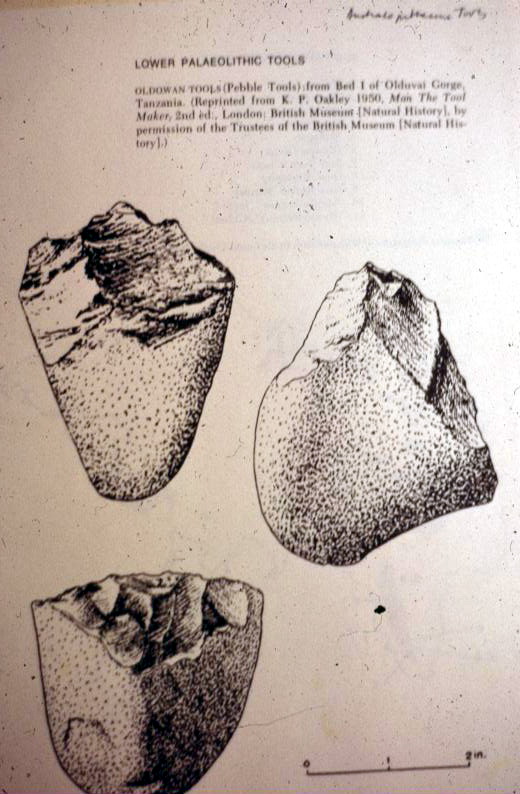
early hominid (australopithecus) technology. Not exactly the kind of stuff to face off with a saber-toothed tiger.
(note: This blog entry is lifted from an exchange on Facebook…)
_______________
I have been thinking about this entry, done yesterday…something I want to make clear – the purpose of putting these books out with short descriptions is NOT to impress people. Screw that. Who needs it? It is more of a list of recommended readings, minus the first title which is more personal, books that I consider shed some light on the world in which we all live and that I think others – everyone – might benefit from reading. No doubt if it were me who made up the required freshman reading list for my or any other university – Pfeiffer’s Creative Explosion would easily, easily top the list. Screw showing off, screw trying to impress people, which has not been very important to me much of my life anyhow – this is shared information, at least that is the spirit in which it is offered).
______________
Taking Up Brandee Hayle‘s challenge to name ten books that have stayed with me over the course of my life (and being bored with my usual bout of middle-of-the-night insomnia which strikes for no particular reason) I’ll name ten books that come to mind.
Philip Roth’s Letting Go – The only book I ever read that seemed to be about ME, the world I grew up in and moving out West, one of his early works although his ending in Iowa is far more depressing than mine in Colorado
John Pfeiffer’s The Creative Explosion. To my mind although now 20 odd years old – the most engaging analysis of human evolution I have come across, especially the chapters on Cro-Magnon (early humanity 50-10 thousand years ago) and the incredible chapter on how the Australian aborignes learn geography
Karl Marx’s Capital (of course!!) – at least the part of that I understood in our little study group 40 years ago with Nancy, Saleh, Jack and Patty, Scott K (when he didn’t show up stoned), Dick Ayre (who actually understood it all and tried, with little success to explain it). We got through Vol 1 and half of Vol 2
Braudel’s three volume – Civilization and Capitalism, that I keep coming back to again and again and again. To my utter surprise, I found it on a shelf in my father’s home in Florida. He’d read it, understood it, loved it…perhaps the only time I ever discussed a book (or books) with him. That was nice.
Chomsky’s The Fateful Triangle – still as good an explanation of U.S. Middle East politics (the USA, Israel, the Palestinians, Saudi Arabia, etc) as one can find around
Robert Merle’s breathtaking 13 volume epic historical novel of 16th, 17th century France , Fortune de France, in French- about the religious wars between Catholics and Protestants, a kind of proto-type of modern day political and racial bigotry. Am only through the first three volumes but am pretty sure I’ll be impressed with the next ten
Henning Mankel’s “Wallender series” – drunken, slovenly, essentially permanently depressed detective on the edge (and sometimes over the edge) of senility probing the seamy side of post Cold War Sweden.
Eduardo Galeano‘s “Open Veins In Latin America” – best regional history along with his more recent trilogy. There is a guy in the trilogy who is always getting the shit kicked out of him by higher powers but keeps bouncing back and never gives up.
Mohammed Samroui’s Chroniques des annees de sang (in French); former high level Algerian intelligence agent who details in a systematically riveting fashion crimes of state in Algeria during that country’s horrific civil war of the 1990s.
Colette Braeckman’s “Le Dinosaure” (in French) – the penetrating history of “our man in Kinshasa” for so many years, Mobutu Sese Seko Kuku Ngbendu Wa Za Banga (his full name which translates as “The warrior who knows no defeat because of his endurance and inflexible will and is all powerful, leaving fire in his wake as he goes from conquest to conquest”) – skunk extraordinaire – of the Congolese people, but OUR skunk – Congolese ally in the Cold War in Africa.
Oh yeah…some people read the Bible once a year – I read Charles Darwin’s Origin of Species or some other works by the master or by Alfred Russell Wallace who is just as good
This was fun, now I’ll go back to sleep
‘A Founding Amnesia’

_________________________________
DU Report: John Evans, University founder and Colorado’s former governor, ‘culpable’ for state’s most notorious massacre.
Anyone with a basic knowledge about Colorado history knows the shame surrounding the 1864 Sand Creek Massacre.
But what hasn’t been recognized is the culpability of one of the central figures behind the attack – Colorado’s own governor at the time, John Evans.
A scathing report released Monday by the University of Denver – which Evans founded – finds he created the conditions that led to the killing of members of the Cheyenne and Arapahoe tribes who were living under the protection of the U.S. Army on the eastern plains.
The massacre at Fort Lyon 150 years ago this month killed what scholars say were 73 to 200 women, children, elderly and infirmed tribal members. Sand Creek is one of the most infamous events in the Indian Wars and perhaps the deepest scar in Colorado’s history.
Historians long have condemned U.S. Colonel John Chivington as a “monster in human form” for launching the attack. And rightly so. Chivington was the killer on the spot. He and his men slaughtered tribal members, mutilated their bodies – some sexually – and then brought heads and other body parts back to Denver as battle trophies. Read more…
Burkina Faso – The Land of Upright Men – Bye Bye Blaise
(note 1: also posted at Foreign Policy In Focus)
(note 2: This dated September 16, 2015, a year after the post below was written. The news this morning is that forces in the military close to deposed president – and France’s point man in Africa, Blaise Compaore, have seized power in a coup today. Consider this piece thus, background. Hard to believe the hand of France is not intimately involved, but I’ll wait a few days before commenting further. Besides its longstanding “French Connection” Burkina faso has become a major U.S. military communication and staging area for AFRICOM forces, based in Ouagadougou, the country’s capitol)
1. Burkina Faso – Land of Upright Men (and Women)
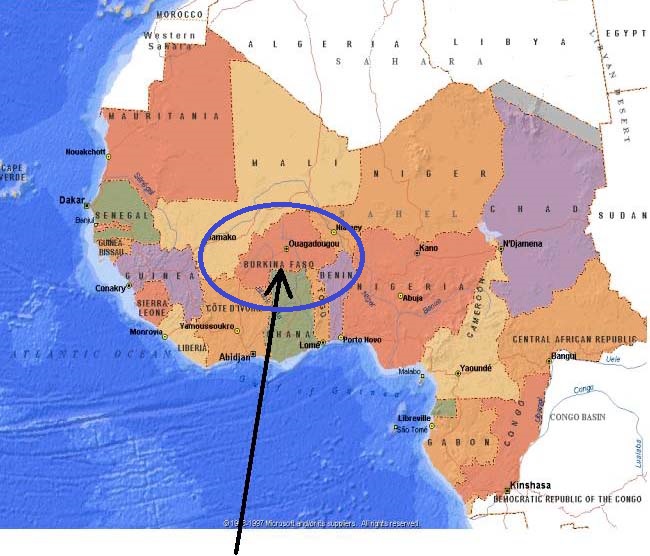
Its capitol, Ouagadougou, rocked with a week of large and militant demonstrations, Burkina Faso, formerly known as Upper Volta, is in the midst of major political turmoil that could spread to other West African countries. “Burkina Faso” translates from the local language as “Land of Upright Men.” What is known to date is that after a week of angry demonstrations in Ouagadougou in which the Parliament was stormed and set on fire. Blaise Compaore, the country’s president for the past 27 years, the target of the demonstrators. was forced to resign and give up power.
Compaore was in the process of trying to amend the country’s constitution so that he could extend his rule and become, like his Cameroonian colleague, Paul Biya, another French puppet, president for life. This apparently was more than the country’s 17 million people – 60% of whom are under the age of 25 – could take.
Like in Tunisia four years ago, the presence of hundreds of thousands protesters in the streets of Ouagadougou forced Compaore, to resign, his 27 year rule coming to an abrupt and undignified end. Compaore was then escorted out of the country to Po, close to Burkina Faso’s border with Ghana, by a military convoy. At least three people were killed although opposition spokespeople claim the number of casualties to be much higher, with dozens having lost their lives. Another comparison with Tunisia, under Blaise Compaore’s aegis, the country was considered the International Monetary Fund and World Bank’s “best pupils” driving an already terribly poor country into greater depths of economic and social collapse. Read more…
The Rouen Chronicles – Ferid Boughedir

Ferid Boughedir – December, 2011, La Marsa
(Latest in a series)
1.
Our reunion of sorts was in La Marsa, Tunisia in December, 2011. Zine Ben Ali, wife Leila Trabelsi and members of their two clans had been gone from the country for almost a year. Tunisians were both relieved and confused. In a country where previously people rarely talked politics to foreigners for fear of the consequences, now free speech flourished. A person would be hard pressed those days not to talk politics; it was hard to find anyone who had anything but contempt for the Ben Alis and Trabelsis. But now the near quarter decade of mounting economic woes, seething repression and corruption on a grand scale was over.
But it was a strange time as well.
A wave of religiosity soon overwhelmed addressing the socio-economic crisis as a coalition of Islamic forces, some moderate, others of a more radical Salafist bent, spread throughout the country, a trend at odds with Tunisia’s moderate and more politically secular modern political traditions. Ennahdha, the moderate Islamic Party, headed by Rachid Ghannouchi had emerged from the shadows of the Ben Ali regime as a disciplined and organized political force. With its fraternal ties to the Muslim Brotherhood ruling circles in Qatar and Turkey, Ennahdha benefited from considerable outside funding from these regional allies. The Salafists enjoyed financial and other support from the Saudis and other Persian Gulf emirates.
In short order more radical Islamicists had taken over many of the country’s mosques, replacing – purging would be a more apt description – more moderate imams with more Salafist (and in many cases, more poorly trained) brethren. These elements had also taken over the pre-schools. Having gained such status, the new more radical imams began influencing the country’s youth, especially in Tunisia’s western and southern more impoverished regions, but not only there. Read more…

Congolese Cobalt Miners…There are about 100,000 of them. Without him, no smart phones. Most of the cobalt in the world is found in Congo and neighboring Zambia, more than 60% of the world’s total supply in the Congo-Zambia copper belt as it is called
Preparing a lecture on the commodity cycle for smart phones (with emphasis on the [not so] lovely working conditions of Congolese cobalt miners and Chinese electronic component workers for rip-off companies like Flextronics (1.5 million employees worldwide)…came across the growing figures for electronic waste. Some interesting figures…for 2012 a whopping 50 million tons (not pounds or kilos but TONS) of electronic waste was produced – throw away cell phones, computers…all that stuff that people world-wide buy every two years. Leading the wasters is China which alone produces 12 million tons of electronic waste, the US of A nibbling at Peking’s heels, producing some 10 million tons. It is expected that by 2017 that there will be 33% increase in electronic waste worldwide predicted to top off at 65 million tons, something to look forward to…but I’m hoping we, the USA, failing hegemonic power, can overtake China by then and become NUMBER ONE AGAIN…something to aspire towards…then we can say we have the most foreign military bases in the world (more than 900 worldwide – next competitor is France with 5, China has none) and that we waste the most electronic equipment, more than any other country, I mean what kind of superpower is the United States anyway if it can’t produce more electronic waste than China.
Ebola – International Medical Aid: Cuba Leads The Way

Cuban (you read correctly) medical teams preparing to help bury Ebola victims in West Africa
So far the Ebola virus has effected exactly three people in the United States. Yet there is so little coverage these days about the Ebola outbreak where it is actually taking place – in West Africa, Sierre Leone, Guinea, Liberia or the fact that the health services in Senegal and Nigeria the outbreak has been contained. Instead we read election-produced scare tactics of the few cases that are emerging in the USA with Republicans having triggered a national fear crisis in hopes that this will help them over the top in the upcoming mid-term elections in a few weeks. As usual, the Democratic response to this cynical public relations campaign, is tepid…if that.
Although the United States has considerable medical resources to fight such an epidemic, that the Ebola virus could spread, follow a global path like that of the AIDS virus 40 years ago, is not at all impossible. Much depends right now on stemming the disease’s spread in Africa before it reaches even greater epidemic proportions there and moves aggressively beyond the continent. Read more…
 View from the Left Bank: Rob Prince's Blog