The Ebola Drone….

Fighting Ebola in Sierre Leone
1.
Ah, if Raytheon could only develop an Ebola drone!! Wouldn’t this solve everything? A technical fix to stop these undocumented, illegal microbes from entering the country. Its production would make profits for the military industrial complex to boot, always an important consideration in the country’s economic well-being these days. A micro-weapon to be directed by a microchip that could be anus inserted, like a suppository. Cutting edge technology!
As they, drones, come in all sizes these days, it needs to be made small enough to enter the human bloodstream to attack all those nasty viruses. Of course the will be collateral damage, a lung here, a kidney there, a testicle here, an ovary there ..but given precision bombing of our developing micro-weapons we could find a way to fight the virus and keep down our own organ casualties.
Go for it!
2.
Here in the United States, as would be expected to a certain degree, much media attention focuses on the growing number of Ebola cases of people States-side. On some level, this concern is needed to prevent the disease from spreading here in the United States.
But the situation has gotten more than a bit out of hand.
Let’s keep in mind that while vigilance is appropriate that the kind of scare tactics which are currently being employed by the nation’s Republican Party in an effort to swing the upcoming mid-term elections their way, have transformed a potential danger into something approaching a panic, with the media and certain elements of the government responsible for it and it is pretty cynical stuff. Read more…
Ebola and the American Christian Right: Fine-tuned Nincompoopery

Ebola virus
Ebola and the American Christian Right: Fine-tuned Nincompoopery
This country’s Christian Right, at least some of its more prominent voices, spokespeople, are at it again, defying reason in their rush to see signs of the Second Coming wherever. In this respect many of them see the Ebola virus, and the possibility of it exploding as a full-scale pandemic, as “a sign.” But then they tend to see everything as a “sign” of the Second Coming, be it Middle Eastern wars, the Black uprising against police abuse at Ferguson, Missouri, 9-11, the 2008 global financial crisis, you name it.
Many of them not only see Ebola as a “sign” but, like the wars in Afghanistan and Iraq, as a welcome sign suggesting the day of the Lord is closer at hand. Perhaps. But their campaign seems well coordinated the overall Republican Party campaign to use the Ebola crisis issue as a last ditch vehicle, a kind of “October Surprise” to push Republican candidates over the top in the upcoming mid-term elections but exaggerating the fear campaign concerning Ebola’s possible spread here in the USA. Don’t be surprised if the campaign loses some of its luster and hysteria after November 4.
The religious right’s grasping on to ebola is reminiscent of a recent idiot cocaine-brain-soaked U.S. president, who, carried away with his air force jump suit, and speaking of the unending war on terrorism he was about to launch, said, “Bring Them On.” So it is with Ebola. Bring it on…it would simply dumb if it weren’t so cruel, actually taking joy in the suffering of others, West Africans in this case. They are such a frightening, seethingly fascist element in our midst, the Christian Right, one that continues to grow and influence our body politic. Imagine, smiling, “rooting on” human suffering because it fits their pathetically narrow framework of the cosmos.
Here are a few case studies:
John Hagee has long called for Washington to attack Iran, Syria, anywhere frankly that might hasten the apocalypse. The spokesperson for the 1.8 million strong Christian’s United For Israel, explained the true causes of the Ebola epidemic for those of less mentally and intellectually endowed and in need, as I have been all my life, of “spiritual guidance.” In case you didn’t know it, Ebola is “God’s punishment for dividing Jerusalem. Read more…
Ebola: Poor Black African Epidemic…

One of the “Great Twins”…The Congo River, the other being the Amazon. Note where the Ebola River flows into the Mongala, which flows into the Congo…
(cross-posted at Foreign Policy In Focus, Z-Net)
1.
Of the many strands, that woven together, make up one of the world’s greatest rivers, the Congo, there is one which enters the river’s main waters as the great river arches to its most northern latitude. Starting from the southeast regions of what is today the Democratic Republic of the Congo, it first stretches almost due north, its main artery referred to as the Lualaba. A ways beyond Kisangani and Bumba, the main branch, fed by hundreds of tributaries, lurches almost due west, making a gentle west-north-west arch until, past the rapids just after Kinshasa, it tumbles dramatically to the ocean past Goma.
Near the northern most point of the Congo’s flow, a tributary merges in from the north just west of Lisala, the Mongala, a river that flows essentially longitudinally from north to south. Near the head waters of the Mongala, the Ebola, “a tributary of the tributary,” itself a 155 mile river, flows into the Mongala from the northeast adding to its volume and energy. At the point where the Mongala enters the Congo mainstream, the great river is flowing almost due west from the continent’s interior.
The Ebola River gave its name to viral disease which has now reach epidemic proportions in West Africa having, by official statistics already taken the lives of 5000 people. As statistical analysis in Sub-Sahara Africa is far from precise, it is possible that the actual number of victims is quite higher and that frankly, there is no accurate estimate of how widespread the disease has managed to extend its range. According to Pierre Piot, the Flemish (Dutch speaking Belgian) researcher who, in 1976 first identified the disease as a unique new pathogen, quite different from Marburg’s Virus with which it was first confused. Read more…
Tunisia and the Upcoming Elections. Part One. Waste Deep in IMF Structural Adjustment…

Tunis – November, 2011
(note: This also appeared at Foreign Policy In Focus)
1
Upcoming elections in Tunisia will be the focus of both national and international attention in the coming period. Parliamentary elections on October 26, will be followed by a presidential election on November 23. The election campaign is in full swing at the moment. With these elections, hopefully a period of rocky political transition is coming to a close, but this is far from certain. Unlike the rosy analyses coming out of Washington suggesting that Tunisia is an island in a sea of instability, the actual picture in the North African country remains essentially fragile at best and could, despite the rosy prognoses, collapse. Still, Syria and Iraq might be in shambles, Egypt in the hands of a military dictatorship, Yemen in full political crisis, Libya for all practical purposes essentially (or nearly) in a state of collapse, here in the United States, Tunisia is being showcased as the Arab Spring’s only success story, a somewhat exaggerated sketch..
It would be surprising (to this commentator) if the upcoming election would change the country’s fundamental situation very much if at all. That the political process and that freedom of speech – that hard won victory -continue since Zine Ben Ali’s hurried exit from the scene in January 2011 is accurate enough. But it has otherwise been a rocky road these past years marked by assassination of leading democrats, bizarre (for Tunisia, with its history of tolerance) growth of radical Islamic fundamentalist trends, a decidedly narrow factionalism of the leading Ennahdha Party (which still retains a sizable base in Tunisian society), virtually no progress whatsoever in addressing the socio-economic crisis which triggered the late 2010 uprising in the first place. A dangerous shift to the political right and the growth of extremist Salafist influences has been, for the moment, held in check, although many dangers remain. At different times over this period, it has only been the intervention of massive popular demonstrations which has kicked a lack luster, unimaginative transitional government back onto the path of democracy and genuine reform. Read more…

Double volume, Volumes 1 and 2 of Fortune de France by Robert Merle
(Note: It was in October 1964 at the Faculte des Lettres of the University of Rouen that along with some 25 other “junior year abroad” students from St. Lawrence University (Canton, New York), that I stepped into a classroom to listen to Professor Robert Merle lecture, on of all, things, the poetry of Robert Frost. A half century later, I still have the notes from Merle’s lectures and whenever I read Frost, which I do quite frequently, I think of Merle, who opened my eyes and heart to the New England poet, whom it turns out, also spent a year or so as a student at St. Lawrence University.)
By the fall of 1964 Robert Merle was in the full prime of his academic career although, despite having published a number of fascinating fiction works, and having 15 years prior emerged as a national literary figure, he had yet to find his voice as an author. That would come later. A full professor of English and American Literature, associated with the University of Rouen, Merle was already a major French cultural figure, having won the Prix Goncourt in 1949 for Week-end à Zuydcoote, a highly biographical account of the British-French Dunkirk evacuation fiasco, in which Merle was caught up, and taken prisoner by the Nazis. In 1964, the novel was made into a film starring French mega-star Jean-Paul Belmondo a kind of French Steve McQueen…or was it that McQueen was an American Belmondo? Read more…
Changing Colors and Private Property in the Colorado Mountains…

On Apex Valley Road – near Central City, Colorado – September 27, 2014
The photo is on Apex Valley Road, a dirt road leading up the Apex Mine just off of Highway 119 – the “Peak-To-Peak” Highway in the Colorado Rockies. The cutoff is a few miles north of the turn to Central City, which used to be a preserved old mining town – now turned into a gambling Mecca. I used to go up this road to look for mushrooms and in some years have found plenty – bolettes galour spiced with a few Steinpiltz types. It was in the late 1990s and I drove the road to the mine in my old Toyota 1984 2-wheel drive pick up on cool clear fall days like today. Then the mushrooms disappeared – they are fickle things – and for this and that no-good reason, the trips stopped. It’s about fifteen years since I ventured that way but when Nancy and I talked about taking a half day trip up the mountains to see the aspen turning, I remember the area. On the way back down the road there is a cut-off to the right which leads to the high ground above Central City. There are a few cemeteries and the Columbine Camp Ground. When our dog Cloudy was young and alive we’d take her up there and let her romp around the forests. Read more…

THE U.S. military is involved in 49 AFrican countries, 27 of which are highlighted here
(Note: This piece also was published at Foreign Policy In Focus)
AFRICOM-Lite: The Obama Administration’s Security Governance Initiative for Africa.
While the media attention in the United States is riveted on the Israeli war against Gaza, on the ISIS offensive in Iraq and Syria, accomplished for the most part with guerrilla-trained by U.S. allies (Turkey, Saudi Arabia, Jordan, Israel), and the ongoing attempts to consolidate the neo-liberal hold on the Ukraine in the name of “democracy”, some other global developments have gone largely unnoticed.
Among them is the August 6, 2014 announcement of a new Obama Administration “initiative” for Africa. Actually there are two: the so-called “Security Governance Initiative for Africa” (SGI) on the one hand and “the African Peacekeeping Rapid Response Partnership, called A-PREP for short, on the other. Old wine in new bottles?…or old wine in old bottles slightly polished up?
SGI involves providing aid – with string attached as usual – to Ghana, Kenya, Mali Niger, Nigeria and Tunisia. On one level SGI is a response to the threat to African development posed by Islamic radical groups Al Qaeda of the Maghreb (AQIM), Al Shabbab, and Boko Haram, but its ulterior motive – actually quite openly stated is to make the targeted African countries more secure for foreign investment, thus as the old cliché goes, killing two birds with one stone. The stated goal of the program is to insure the security environment of these countries as a way of encouraging future U.S. investment, and as Tunisian commentator Yassine Bellamine notes in a recent article at the Tunisian website Nawaat.org “as a way to play a more active role in what is shaping up to be a new investor El dorado in the near future , Africa.” (my translation). Read more…
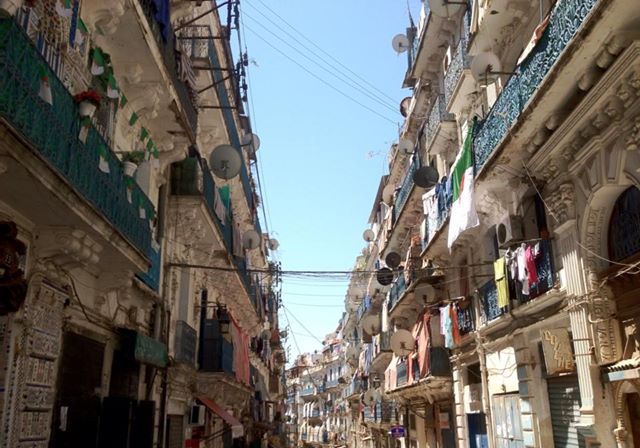
Algiers – 2014, photo credit Michael Busch
1.
The University of Denver’s Library – oh yes, it is not called a library anymore, but the “Anderson Academic Commons” – I assume named after the largest contributor to the facility’s remodeling, a vulgar, if now common place way to name a facility – does have a few of Robert Merle’s works, some in French, a few in English. Among the English translations is Merle’s “Ben Bella”. In some ways more of a hagiography than a biography – not surprising when the protagonist is given the opportunity to comment on his own life – but still in many ways timely and of historical interest.
Ahmed Ben Bella was one of the more prominent leaders, organizers of the Algerian revolt for independence against France. One of the original founders and leaders of Algeria’s national liberation front (“front de la liberation nationale” in French, hence known as the FLN), he emerged shortly after Algeria’s independence in July, 1962 as his country’s first president. This was only achieved as the result of a harsh, mean-spirited factional struggle among the FLN’s leadership, that would soon bring down Ben Bella as well, as the revolution “ate its children.” Read more…
The Rouen Chronicles: Robert Merle – 1
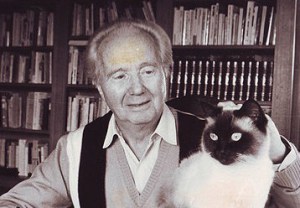
Robert Merle – 1985
(Note: About ten years ago, – actually I forget, was it 5 years ago, 10 years ago? I am not sure – I had a brief conversation with an old friend and companero named John Buttney, The name might not resonate among many, but for those who were in Colorado, specifically Boulder, in the late 1960s and early 1970s, it should ring a bell. He was one of the leaders of the student anti-war movement on the University of Colorado campus, a place from which he related, he was “banned for life.” We were talking about the intellectual influences that led us leftward politically, and were surprised to find that we had both been influenced by French thinkers. Buttney, a philosophy grad student, spoke of the impact of Merlo Ponti; for me it was, oddly enough, a French professor who taught me, of all things, about Robert Frost’s poetry who I failed to name. He is Robert Merle. I realize that most of you don’t know much – or anything – about Robert Merle. Your loss, frankly… Suggest you check out a copy of “Day of the Dolphin” from Netflix or Weekend à Zuydcoote [about the Dunkirk evacuation – kind of a French Catch 22] with Jean Paul Belmondo. I’ll be writing more about him [Merle] over the course of the coming year)
1.
Having spent almost all of my adult life in academia, I have met a series of very fine teachers, professors and as I sit here thinking of them, a flood of names and faces comes to mind. But there were few, precious few, of what I would call truly great ones, a high school history teacher, Mr. Rhodes, my freshman English teacher, Mr. Hasham at St. Lawrence University, two professors of Anthropology at the University of Colorado in Boulder, David Green and Gordon Hewes, and a colleague at the University of Denver’s Korbel School of International Studies all belong to that category. They had vastly different teaching styles, subject matter, politics but they all had encyclopedic knowledge of their fields, the ability to place the subject matter within a broader context. More importantly, they had learned the fine art of stimulating a passion for learning in their students.
I was both challenged and humbled intellectually by having studied with them.
But to my mind there is one who rises even above these, Robert Merle. No one comes close. Hardly known here in the United States today, his work is highly appreciated and well-known in France. Ours was not a long connection. If I remember correctly, he gave a series of lectures that went only over a few months after which he disappeared from Rouen. But by the time of our parting of the ways, he had left an indelible mark on me, and I would venture to guess on others with whom I shared an unforgettable year. Read more…
Hamas Cease Fire Terms Could Lead to “Normalcy”
to add a note – my sense is that a good deal of the fighting over the past month was – as is the case now – over the terms of the ceasefire. Israel and the Obama Administration wants a ceasefire that goes back to the pre-fighting status quo with Gaza sealed off to the world. The fighters in Gaza, Hamas and otherwise, refuse to accept this, in part because of the horrific casualties, in part that the ending of Israel’s war on Gaza lead to a new security situation where the Gazan-Palestinians have more breathing room and open passage of people and material in and out of the zone. The previous ceasefires offered, which Israel accepted and the Palestinians rejected, refused to change the status quo. Some of the intensification of the bombardment was to punish Hamas for not accepting “their fate”. I would also point out that if the Obama Administration pressured Israel the two Gaza entry points would be opened, but to date, despite a few encouraging words (by Obama yesterday) suggesting a U.S. shift in that direction, no such pressure has been in applied.
by James M. Wall

During their temporary cease fire, Israel and Hamas are negotiating in Cairo, Egypt, for an agreement to end Israel’s third military assault since 2007, on Gaza.
Thursday night, Ha’aretz reported that the talks were “stalled”.
Friday morning, when the 72 hour agreement ended, the New York Times reported both sides resumed cross-border firing.
These shots could be “warning shots” to signal a resumption of the conflict, or they may be part of the negotiations strategy on both sides.
The conflict is asymmetrical, suggesting that more exchanges of fire would be especially harmful to the Palestinians in Gaza.
The one-sided nature of the now 30-day conflict, is seen in the human toll of Israel’s third “mowing the grass” project in Gaza. Thus far, Israel has killed 1900 Palestinians, the great majority of whom were civilians, including 400 children.
To agree to an extended cease fire with no more firing from…
View original post 1,095 more words
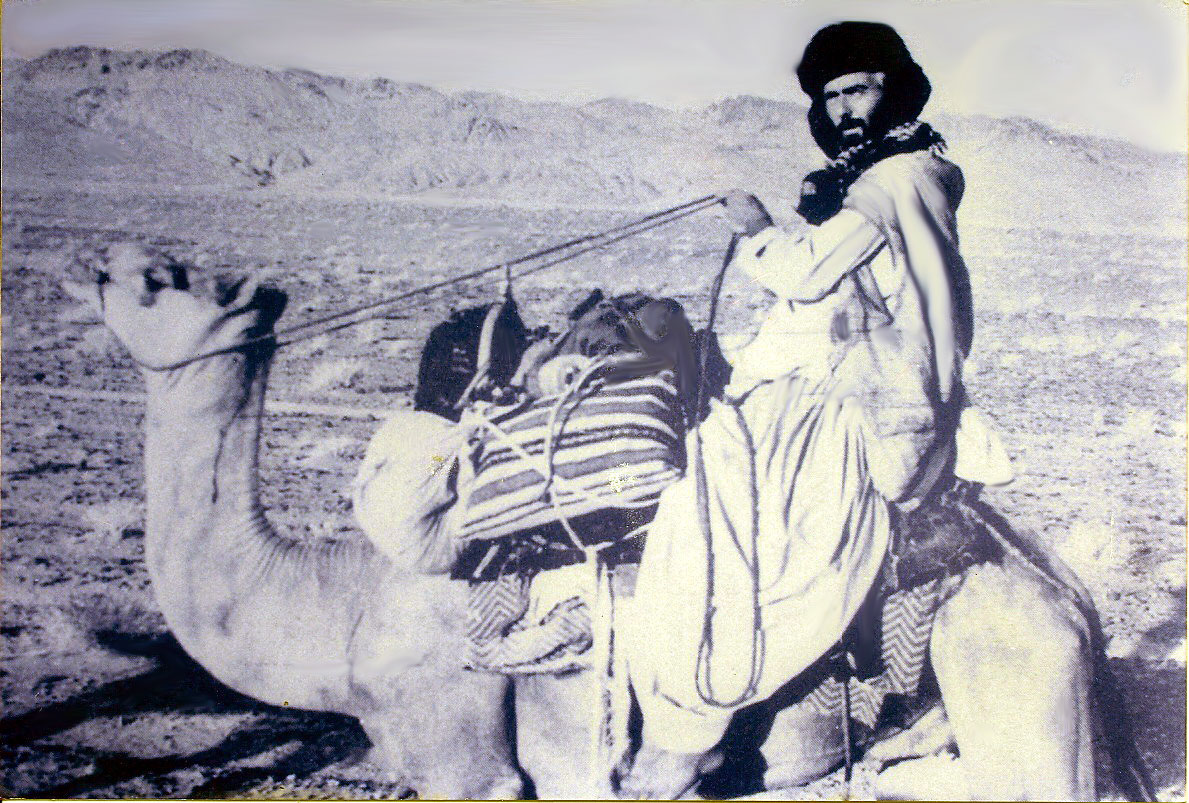
Dominique Vergos – 1980s – somewhere in Afghanistan
1.
Agreed it is a bit of an unusual – almost certainly posed – picture of a man on camel in what appears to be some Middle Eastern or Central Asian desert. For those who knew him well there is little doubt of either the man or the place. It is the Frenchman Dominique Vergos a top a camel somewhere in Afghanistan in the mid-1980s, where for a number of years he worked with the Afghan mujaheddin in their decade effort to expel Soviet troops from their country. It was related (by his family) that the Soviets placed a $100,000 bounty on Vergos’ head, never collected because he evaded them the years he slipped in and out of Afghanistan. I don’t know if the information is accurate. I am trying to remember from whom I received the picture; I believe it was from his widowed wife, thanking me for an inquiry about Dominique just after I learned of his fate.
He frequently went alone, deep into Afghanistan, where he made contact with rebel groups fighting the Soviet military occupation. In an age of cell phone intercepts and advanced satellite photography, still nothing really could compare to “on the ground” intelligence – direct contact with the many peoples and movements in Afghanistan. Very few westerners had access to it; few ventured into the Afghan heartland where the risks of not returning – or worse – really not finding anything or anyone – were great. Among the few that did – essentially a rather small handful of journalists, adventurers, spies and the like, was Dominique Vergos. That it required both a kind of stamina and courage rare in most people is undeniable. No question that Vergos possessed both. It might also help, as the British would put it, to be “a bit daft” as well. The intelligence thus provided cannot be underestimated.
When the war ended, the last Soviet troops left the country, their tails between their legs, leaving a mountain of arms and communication equipment for the Afghan rebels to use against one another. Shortly before, unable to tear himself away from the center of action, Vergos set up a household in Peshawar, in nw Pakistan, near the Afghan border, in a region largely out of control of the Islamabad government. There on Christmas Day, 1988 as the Soviet Occupation was coming to a close, returning from “The America Club”, one of his house body guards “accidentally” emptied an automatic rifle into Vergos’ body, killing him instantly, or so the story goes. (Another version of his death is that he was killed late one night when he went outside to feed the dog.) A few days prior, he had been warned by the French Embassy a few weeks prior to his death that his life might be in danger.(1) Months later, his brother, Didier Vergos, traveled from his home in Rouen, France to Peshawar where in a rather unpleasant experience, he identified the body and then had it transported back to France.
Dominique Vergos’ remains lie buried in a small cemetery sitting on a hill near Brest, the French port town in the Brittany region where I saw it in the summer of 1992 on a visit to the Vergos family where the family still owns property. After some hesitation, it was related (by those close to him) that in his Afghan ventures that Vergos was actually employed by the United States Central Intelligence Agency, a connection that was made during the Lebanese Civil War of the late 1970s where he worked as a photographer for a French news agency. Was it the C.I.A. or is that simply a generic term for some U.S. based intelligence agency? There are a fair number of them. Girardet (see below) suggests he did so for the money; my hunch is that, like some others in war zones, he became addicted to high level of drama and could never accustom himself to “a normal life” outside of a war zone. There was always something “high risk, high gain” about Dominique even before he began his adventures as a spy for Washington. I would have thought he would work for French intelligence, but Vergos had a nose for power and seemed to greatly admire everything about the United States, so the C.I.A. connection was not implausible. His assassination – for that is most likely what it was – has never been explained. My speculation, granted it is no more than that, is that Vergos knew too much and as a result needed to be eliminated so that his impressive store of knowledge of Afghan rebel groups could not be used against them in the future. Read more…
Avnery On Gaza: Meeting In A Tunnel
UN School In Gaza Bombed by Israel; 17 Dead, hundreds wounded; Even the Obama Administration, which gave the green light for this Israeli offensive, and has re-armed Israel with mortar shells and bullets, has been forced to condemn.
(Note: I rarely repost stuff on this blog others have written; occasionally I cannot resist doing it though for the pearls that my friends Conn Hallinan or Ibrahim Kazerooni write. Add to this the fact that there are very Jewish few voices of peace left in Israel; Gideon Levy, Amira Hass and my long-time favorite, Uri Avnery are among them. Here is a piece by Avnery …the last few he has written have been “on the mark”, this one especially. It came to me today in an email from him. It starts out by essentially ridiculing the purpose of Israel’s war on Gaza – that it had no strategic goal whatsoever at the outset and that as the fighting intensified, goals were fabricated, then dropped, then reshaped once again. At the heart of his argument is that there is no military solution to this conflict. The Israeli military is very strong, but the Gaza Palestinians have learned how to fight back. Militarily it might not be “a draw”, but the Palestinian ability to exact punishing casualties on Israel has shifted the balance of power. This is “better-than-good” piece)
Uri Avnery
August 2, 2014
Meeting in a Tunnel
THERE WAS this village in England which took great pride in its archery. In every yard there stood a large target board showing the skills of its owner. On one of these boards every single arrow had hit a bull’s-eye.
A curious visitor asked the owner: how is this possible? The reply: “Simple. First I shoot the arrows, and then I draw the circles around them.”
In this war, our government does the same. We achieve all our goals – but our goals change all the time. In the end, our victory will be complete.
WHEN THE war started, we just wanted to “destroy the terror infrastructure”. Then, when the rockets reached practically all of Israel (without causing much damage, largely owing to the miraculous anti-missile defense), the war aim was to destroy the rockets. When the army crossed the border into Gaza for this purpose, a huge network of tunnels was discovered. They became the main war aim. The tunnels must be destroyed.
Tunnels have been used in warfare since antiquity. Armies unable to conquer fortified towns tried to dig tunnels under their walls. Prisoners escaped through tunnels. When the British imprisoned the leaders of the Hebrew underground, several of them escaped through a tunnel.
Hamas used tunnels to get under the border walls and fences to attack the Israeli army and settlements on the other side. The existence of these tunnels was known, but their large numbers and effectiveness came as a surprise. Like the Vietnamese fighters in their time, Hamas uses the tunnels for attacks, command posts, operational centers and arsenals. Many of them are interconnected.
For the population on the Israeli side, the tunnels are a source of dread. The idea that at any time the head of a Hamas fighter may pop up in the middle of a kibbutz dining hall is not amusing.
So now the war aim is to discover and destroy as many tunnels as possible. No one dreamed of this aim before it all started. Read more…
Interview with Henry Siegman, former Executive Director of the American Jewish Committee on Israel’s War On Gaza

Rabbi Henry Siegman…Why don’t we have any rabbis in Colorado like this?…not a one of them!
This interview appeared on Democracy Now! on July 30, 2014. Here is the link to the full interview. What follows is the transcript of the first part. Here is a link to Part Two
Given his background, what American Jewish leader Rabbi Henry Siegman has to say about Israel’s founding in 1948 through the current assault on Gaza may surprise you. From 1978 to 1994, Siegman served as executive director of the American Jewish Congress, long described as one of the nation’s “big three” Jewish organizations along with the American Jewish Committee and the Anti-Defamation League. Born in Germany three years before the Nazis came to power in 1933, Siegman’s family eventually moved to the United States. His father was a leader of the European Zionist movement that pushed for the creation of a Jewish state. In New York, Siegman studied the religion and was ordained as an Orthodox rabbi by Yeshiva Torah Vodaas, later becoming head of the Synagogue Council of America. After his time at the American Jewish Congress, Siegman became a senior fellow at the Council on Foreign Relations. He now serves as president of the U.S./Middle East Project. In the first of our two-part interview, Siegman discusses the assault on Gaza, the myths surrounding Israel’s founding in 1948, and his own background as a German-Jewish refugee who fled Nazi occupation to later become a leading American Jewish voice and now vocal critic of Israel’s policies in the Occupied Territories.
“When one thinks that this is what is necessary for Israel to survive, that the Zionist dream is based on the repeated slaughter of innocents on a scale that we’re watching these days on television, that is really a profound, profound crisis — and should be a profound crisis in the thinking of all of us who were committed to the establishment of the state and to its success,” Siegman says. Responding to Israel’s U.S.-backed claim that its assault on Gaza is necessary because no country would tolerate the rocket fire from militants in Gaza, Siegman says: “What undermines this principle is that no country and no people would live the way that Gazans have been made to live. … The question of the morality of Israel’s action depends, in the first instance, on the question, couldn’t Israel be doing something [to prevent] this disaster that is playing out now, in terms of the destruction of human life? Couldn’t they have done something that did not require that cost? And the answer is, sure, they could have ended the occupation.”
Kazerooni and Prince on KGNU – Hemispheres – on Israel’s War On Gaza (July 29, 2014) – My Babblings on Zionism.
KGNU – Hemispheres – Israel’s War On Gaza
This (above) is an interview with Ibrahim Kazerooni and myself. It took place at KGNU’s Boulder studio on Tuesday, July 29, 2014. It is our analysis of Israel’s War On Gaza. The program begins about 3 minutes into “the stream”.
I am repeated asked…why do you do this? …the never-ending harsh criticism of Israel. I can answer that in a few words: They (the Zionists, Israel’s blind supporters) are doing it (their punishment, oppression of the Palestinians) in my name. I cannot accept that. Some years ago Jewish groups popped up all over the country with the same title “Not In My Name” … I have always liked that. If in the USA “our” numbers remain a minor trend within the Jewish Community, I am convinced that they are growing with national organizations like Jewish Voice For Peace and local Jewish groups popping up everywhere. Of course others who have become critics of Israel’s Occupation come to their understanding in other ways..and there are more of us, even here in the USA where the media is so one-sided and slanted towards excusing every growing Israeli war crime.
At the same time, let’s be clear about all this: this issue is more, much more than a “Jewish-Moslem”, “Israel-Palestinian” concern. It has emerged as a great universal humanitarian concern, similar in some ways to the struggle against apartheid in South Africa, and it is in this manner, that Israel’s treatment and oppression of the Palestinian people is increasingly understood…and not all the clever spin of Israel’s p.r. machine has been able to stop that. Nor will it be able to now nor in the future. The sympathy, support for the just struggle of the Palestinian people to create their own independent and viable state will continue.
I remember well, when I first questioned Israeli intentions and actions as a young adult…something in me cracked. It was as if the bubble I was living in – the Israel I wanted to believe existed, but didn’t, could never be reconstructed in my mind. Myth and reality. I’ll take reality every time, painful as it might be. Were the dollars I gave enthusiastically as a pre-Bar Mitzvah kid being used to plant trees or buy bullets for the Israeli military? From that point on – I was 23 – since, I have essentially always been suspicious of Israeli P.R., propaganda, actions and wondered, what about the Palestinians? I have seen the same process in others – for some it was the 1982 Israeli invasion of Lebanon which resulted in the horrific massacre at Sabre and Chatilla camps, conducted it is true by Lebanese fascist elements, but directed by Ariel Sharon, Israel’s military leader at the time and later prime minister. And now, as the bombs rein down on Gaza, and ultra-orthodox Israeli rabbis call for nothing short of the extermination of the Palestinians there, I hear other Jewish voices, expressing a deep pain, angst as they come to grips with the reality of “the Zionist project.”
Funny, I believe both Kazerooni and I made the points we wanted to make in this podcast…but after the program was over and I was thinking about it, I concluded that some of the more profound remarks were made by long time friend and companero, RonForthofer, who called in. His main point was that the goal of this Israeli war against Gaza was to make life so miserable for the Palestinians there, the destruction of virtually the entire infrastructure, that organized life there would simply collapse (no electricity, less and less drinkable water, all institutions of modern life – schools, hospitals, etc) and that the goal here is an ethnic cleansing. Ibrahim K spoke about how the Israeli authorities keep close track of the caloric intake of Gaza residents, and like the Nazis did at Leningrad, are trying to keep the Palestinian Gazan diet at levels barely above that necessary to sustain life. The whole idea is to trigger a complete collapse of life in Gaza, sometimes slowly by the stranglehold Israel (and Egypt) conduct against Gaza; sometimes more quickly as with the current genocidal madness military campaign.

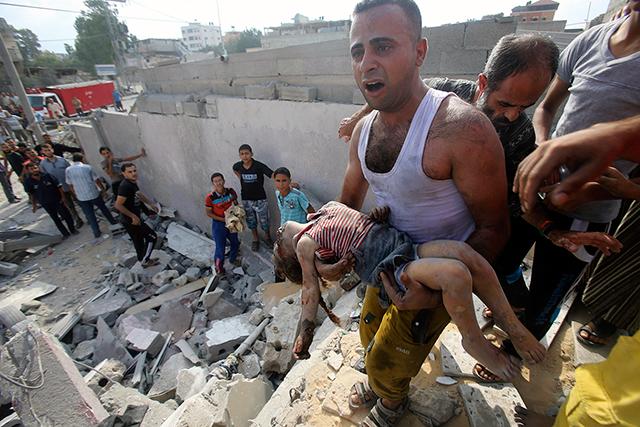
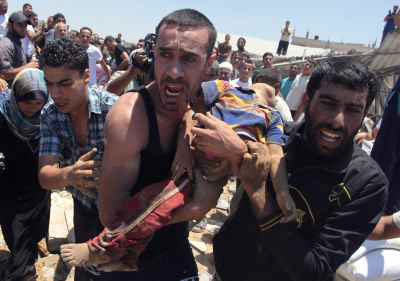
Palestinian father carrying his dead child, one of many, killed by the IDF in a senseless war on Gaza with no strategic goal whatsoever
(Note 1: This is the first of a series I hope to write on the current Israeli war on Gaza. There will be a follow-up piece specifically on U.S. policy. I also hope to be writing some stuff with dear friend and frequent co-collaborator, Imam Ibrahim Kazerooni.
Note 2: a few hours after I posted this a 12 hour cease-fire between Israel and the Gaza Palestinians was agreed by both parties. Today is “El Quds” Day…the last Friday prayer of the Ramadan month of fasting. It might not mean much to North Americans and Europeans, but in the Moslem World, it is an important day. It means “Jerusalem Day”…and today the West Bank blew up in opposition and anger to the Israel war on Gaza, so much so that Mohammed Abbas and his Fateh group fears losing control of the situation, greatly complicating the Israel’s position. It is also true, although essentially blacked out in the US, that the Secretary General of Hezbollah in Lebanon, Hassan Nasrallah, gave an important speech today in which he pledged support for the Gaza Palestinians. In the West Bank already at least seven have died, hundreds arrested. For Israel it now means that it is opposing Palestinians on two fronts, [possibly three] simultaneously – Gaza and the West Bank – it is more than likely that this deteriorating situation for Israel is behind the call for a 12 hour cease-fire.
Note 3: the piece has been published at Foreign Policy In Focus.
cheers, rjp)
It goes on…now in its 19th day…Israel’s punishing military offensive against Gaza. Although it might happen – these conflicts have ended abruptly in the past – at the moment there is no ceasefire in site. The asymmetrical blow-for-blow continues. As many have pointed out, it is not a war, but an Israeli premeditated killing spree of Palestinian civilians. Nor is this the first time. Each day the casualty numbers mount. The published statistics are at best only “guestimates”with the real figures being significantly higher. How many more Palestinian civilians will be pulled from the rubble in the months after the fighting stops? How many bodies will never be found? Read more…
 View from the Left Bank: Rob Prince's Blog