Day of the Vulture in Argentina
Day of the Vulture in Argentina
Truthdig
July 24, 2014
By Conn Hallinan
It is no surprise that right-wing Republican and hedge fund billionaire Paul Singer should be trying to wring hundreds of millions of dollars out of Argentina for a debt that Buenos Aires doesn’t really owe him. He screwed tens of millions of dollars out of poverty-stricken Peru and the Republic of Congo using the same financial sleight of hand. What may surprise people, however, is that key leaders in the administration of former President Bill Clinton are helping him do it.
To read the full article go to: http://www.truthdig.com/report/item/day_of_the_vulture_over_argentina_20140724
The Rouen Chronicles: Dieppe-2-the-botched-dieppe-raid-of-august-17-1942-in-two-parts-part-two/
“Il y a deux Histoires: l’officielle, mensongère, qui nous est enseigné, et l’Histoire secrète où se trouves les vraies causes des événements, une Histoire honteuse” – Balzac, Les Illusions perdues. (Rough translation: History comes in two versions: there is the official history, that which we learn in school with its lies and half-truths; then there is the secret history in which the more accurate causes of historical events unfolds, a shameful and shameless tale.”)

The “churt” (another name for flint) filled beach at Dieppe. The scene in the picture, a peaceful morning in late July 1989, Molly Prince in the foreground, Nancy Fey walking behind. They are looking for mussels. This is essentially the same place where the Royal Regiment of Canada landed on August 19, 1942 and were summarily slaughtered by machine fire coming from Nazi defenses on the chalk cliffs above
1. Nothing Left To Uncover About World War II?
Putting the Dieppe Raid of August 17,1942 in its more global context, at least up until recently there are a number of historians who argue that, really, there is nothing left to say about World War II, that so much has been researched, written, made into documentaries and feature films about the war that anything new would simply be in part or in large measure redundant.
Nothing could be further from the truth; to the contrary, it would be more to the point to argue that historians have just scratched the surface. True enough the general outlines of the war in Europe are clear enough although, even here, a certain blurred vision fueled in large measure by Cold War blinders endured until the collapse of Communism in 1989 and 1991. Much of the narrative has been reworked in the past quarter century. On the other hand, where, in English (or any other European based language is the complete or comprehensive of the war in Asia? It remains largely unknown both in terms of what actually transpired there and how the war itself shaped the post war evolution throughout the continent from Indonesia to China. Read more…
The Rouen Chronicles: Dieppe – 2 The Botched Dieppe Raid of August 17, 1942 (in two parts) – Part One

Memorial to the Canadians who died trying to storm the heights at Le Puys, France – just north of Dieppe. on August 187, 1942. The Royal Regiment of Canada from Toronto suffered 97% casualty rate there
1. A family vacation in the Dieppe Region
A quarter of a century ago next month, our family was fortunate enough to spend two weeks on vacation in France, a week of that time vacationing in the region in and around Dieppe. Today, Dieppe is a small French port and fishing town of 35,000 in Normandy on the English Channel long frequented by British tourists who make the 70 mile journey across “La Manche.” It includes some of 16th century Europe’s best cartographers. Although its importance has dwindled some, Dieppe has a rich history; it was a key transit point in the 15th, 16th and 17th centuries between the Mediterranean and Baltic Seas. It was in large measure from Dieppe and nearby ports that the Arcadians and Cajuns, who would make up the French-speaking populations of Eastern Canada and Louisiana, would depart. Read more…

Orangutans – photo credit: Molly Prince, Borneo, Indonesia
(Note: This summer I was thrilled to participate in a trip through OFI (Orangutan Foundation International) in which we got to see orangutans in the rainforest of Indonesia. We also got to meet Dr. Birute Galdikas, who has been studying and advocating for orangutans in Indonesia for over 40 years.)
So Vivid Yet So Fleeting
By Molly Prince
My dad suggested I write about the trip
because the experience is
so vivid yet so fleeting.
And he is right.
I can feel Indonesia
disappearing
from my consciousness
at an alarming rate
as Denver floods back in.
Denver with its dry air and Western food and high technology.
My cats and my people,
tap water I can drink and internet and phone and
quiet invaded by ambulance sirens
instead of the constant chirping of birds
and whirring of insects of Indonesia
with the hot, humid air, rice and tofu,
chicken and shrimp, cooked greens and potatoes,
dangerous tap water, mango, pineapple and durian fruit,
traffic jams and overcrowded Jakarta and the serenity of the Sakonyer River,
selamat pagi and terima kasih,
women in colorful head coverings, Muslim prayer calls,
crocodiles and black water rivers.
There is the background.
The main points seem very simple.
The gorgeous rainforest
pulsing with life
home to the majestic orangutan and a rich ecosystem
including proboscis monkeys, Bornean bearded pigs, clouded leopards,
hornbills, butterflies – a seemingly endless list.
All being destroyed
just a little bit left
melting
like the glacier at Glacier National Park
so that people can have junk food and money.
We all need money.
But we don’t need to be billionaires.
Palm oil plantation owners are billionaires.
Not just the orangutans but the whole ecosystem.
Not just the eco-system but all the ecosystems.
Not just all the ecosystems but
the macro system,
the earth
all the systems of the earth that work together
to make the planet hospitable to life.
Not hospitable to life = climate crisis = we can not eat money.
“Only when the last tree has been cut down,
the last river has been poisoned and the last fish has been caught
will we realize we can not eat money.”*
Then there are the orangutan themselves.
They are interesting and humanlike and
I love listening to Dr. Birute talk about orangutans
and evolution and their social structures and
it was an incredible experience of a lifetime
to be so close to them.
I am honored and I love them.
They are the star of the show.
But also, it is the show as a whole that I care about.
Dr. Birute Galdikas.
Also the star of the show.
A celebrity to me
although her personality is
certainly not that of a celebrity.
Deliberate and thoughtful
brilliant and patient
stubborn, tenacious and fragile.
I love her.
She has done a superhuman amount.
She has worked miracles.
And still, it is possible that
it won’t be enough.
Irene said, “most people’s favorite is the care center.”
The care center is not my favorite.
It was amazing to see the orangutans there
but the care center makes me sad.
It begins and ends with sad
although
it does have magic and hard work and
international co-operation
in the middle.
It begins with orphaned orangutans
mamas killed
rainforest killed
And it ends with
where are these orangutans to go?
Saved and cared for and ready to
be released back into the wild
and there is
not enough wild.
My favorite is the orangutans in the jungle.
My favorite is the orangutan babies with their mamas
in the jungle.
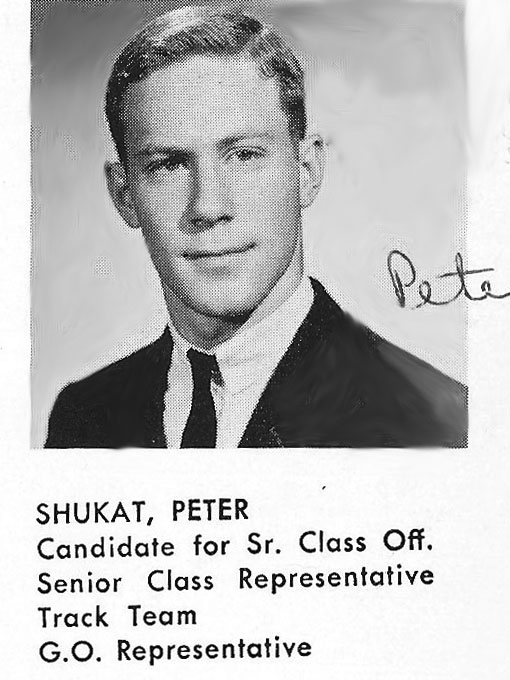
Peter Shukat, Jamaica High School 1962 Yearbook
Yoko Ono continues to oppose any effort to grant parole to Mark David Chapman, John Lennon’s assassin. Chapman shot and killed Lennon at point black range with a hand gun using hollow point bullets as Lennon and Yoko Ono returned to their apartment, the Dakota, a luxury apartment just off Central Park West in Manhattan. On August 22, 2012 Chapman was denied parole for the eighth time. Representing Yoko Ono, as he did often in the past was entertainment lawyer, Peter Shukat.
Shukat not only personally represented Yoko Ono but also the estates of Miles Davis, Jimmy Henrix and Bob Marley. Peter S. Shukat, a founding partner of New York-based entertainment law firm Shukat Arrow Hafer Weber & Herbsman, died on June 7, 2013 – a month ago – after a ten-year long battle with cancer. His obituary appeared throughout the music industry, including in Music Week, Jazz FM, Billboard.com as well as the New York Post, The New York Daily News and The New York Times. Read more…

In the 19th and early 20th Skull Measurements were used to determine “eugenic” characteristics.
http://cironline.org/reports/female-inmates-sterilized-california-prisons-without-approval-4917
1.
Some presume that eugenics, that perverse notion of genetic engineering based on flaky genetics, died in the gas chambers of Auschwitz, the factory floor of I.B. Farben where it was exposed for the inhumane, racist, class-biased bigotry that it was. This was not the case. Its advocates crossed the political spectrum from left to right. It was not just right-wing weirdos of all stripes, Christian identity types and KKK types whose eyes lit up and penises stiffened at the thought of Blacks, Native Americans, Jews, Mexicans and generally speaking poor people having their vas deferens snipped or their tubes tied.
Liberal politicians, socialists, Unitarians – those who believed in “managed progress,” “rational development” were, in the day, equally as enthusiastic – and as racially bigoted and class biased as their more conservative brethren and sisteren (if the latter is a word). It was the rage to support interfering with the reproductive rights of others as a way to make the world a better place, as long as the movement did not cut out the testes and purge the ovaries of those too close. Read more…
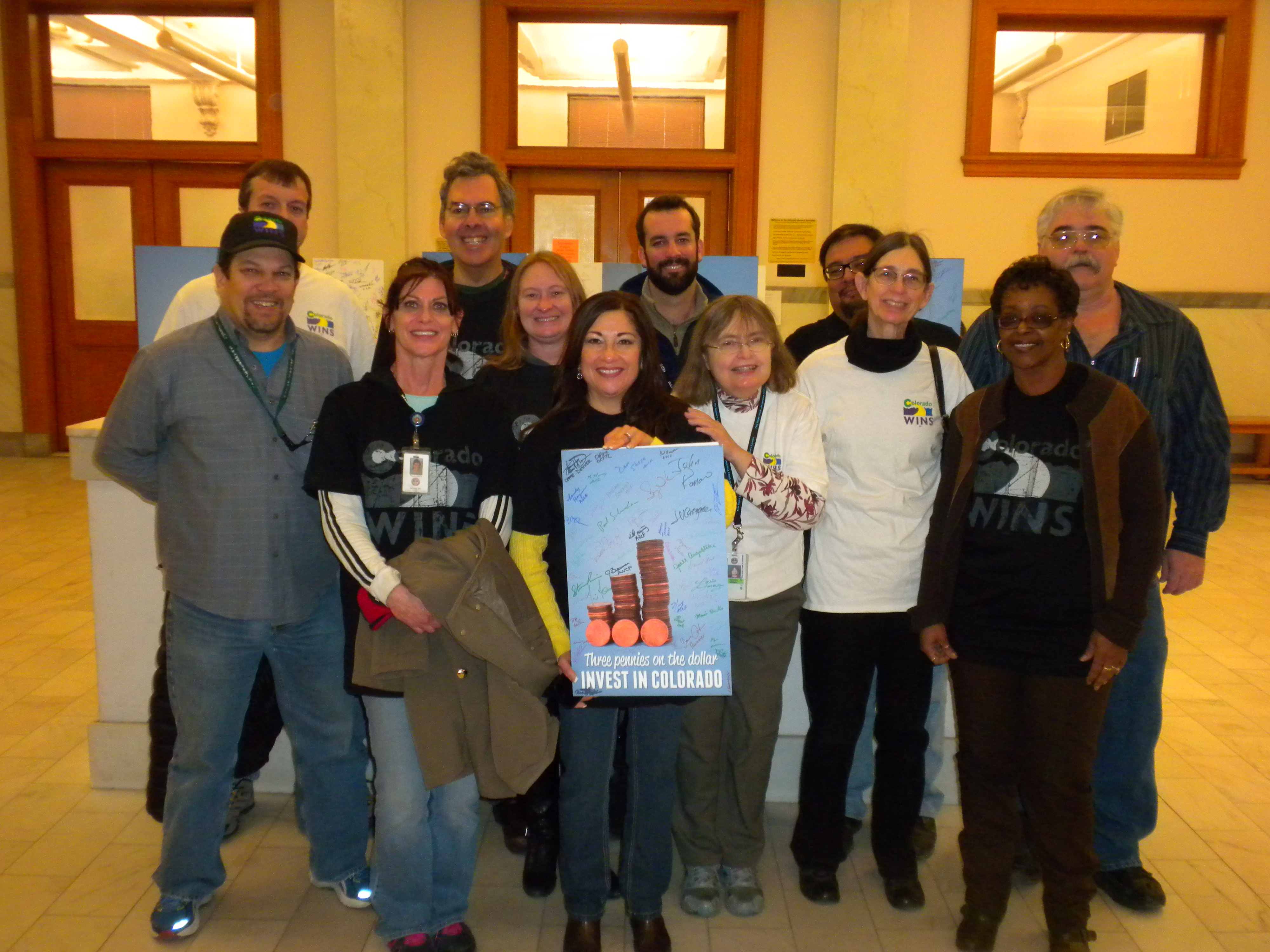
ColoradoWINS lobbying the state legislature, December, 2013
1. A New Day for Colorado’s State Employees?
November 2007 was a historic moment for union-unfriendly Colorado, or so it seemed. The breakthrough drew little attention from Colorado’s general public for labor movement developments get little to no airing in the state’s media. But the shift was noted among politically sensitive business and government circles, as well as state’s labor movement: Governor Bill Ritter issued an executive order legalizing union activity for the state’s employees.
The rules of the state sector labor-management game were about to change. Each “side” had its priorities. For labor it was use the new situation – an executive order allowing state employees to unionize – to increase its modest leverage and bargaining power in the state. The goal of business – and the business oriented bureaucracy in state government – to the contrary, was to limit the impact of the changes as much as possible.
Not long before, in February of that year, Ritter vetoed HB 1072, which, if passed would have eliminated one of two votes needed for unions to negotiate all-union shops. The two stage voting system to achieve a closed union shop is unique to Colorado and has been one of the main legal mechanisms for keeping the state’s labor movement in a weakened position. Read more…
Helping A Preschool in Bukina Faso by Geraldine Auel

Pre-school – Burkina Faso where Gerry Auel works as a Peace Corps volunteer
(Note: Gerry Auel and I worked together in the Peace Corps in Tunis 1966-1968. We have remained friends ever since for half a century now. Gerry went on to become the International Student Adviser at Oklahoma State University. She married and has four grown children. A year ago, Gerry Auel re-upped for another Peace Corps experience, this time in Burkina Faso – formally referred to as Upper Volta. She is there now; if you want to contribute to the pre-school where she works – and I hope you might consider it – here is a link below. )
Do you want to help our pre-school in Burkina Faso?
The Peace Corps adventure continues! The 125 or so children in the community preschool where I teach 5 days a week show up every morning on foot, with or without shoes. They greet me with “Bon jour, Yaba” (Hello, Grandmother) and make a little bob with their arms crossed across their chest.
The preschool is set right in the middle of the village crossroads. With motorcycles zooming across the school grounds, animals wandering through, and our playground equipment at the mercy of after-school adolescents, we are determined to build a protective fence to provide a healthy and safe learning environment for our children. Parents began to contribute their share of the project cost even before the project was approved by Peace Corps. They are eager.
The cost of the project is going to be beyond the ability of the parents alone to pay, around four million Central African Francs or CFA. To give you an idea of family resources in this rural community — the preschool charges 2,000 CFA per year, the equivalent of roughly $5.00 US dollars. We often have to wait a month or so for payment, until the harvest is finished and money is available. We are seeking funds from far and near – from the mayor’s office in Rouko, to representatives of the Rouko Sister City in Normandy, France, and to YOU!

Gerry is in Rouko; I don’t see it on this map, but she told me it was in the north of the country, not far with Burkina Faso’s border with Mali
Would you like to be part of this initiative? It’s a great opportunity to be directly connected to a project you are supporting….and there is no added administrative overhead. I’ll be administering the funds and I can’t receive a salary. Furthermore, I am committed to transparency and updates!
Because of my Peace Corps volunteer status, I submitted a grant application through the Peace Corps Partnership Program. This means the Peace Corps has approved the project and has posted it on the Peace Corps grant website to invite general contributions.
You’ll have to log in to the Peace Corps website: PCPP.peacecorps.gov and look for the project number 14-686-017. It will be exciting to work along with you to give our children in Rouko a good start to a better education and a more hopeful future.
Gerry – Peace Corps – Burkina Faso

Victor Jara, Chilean singer, tortured and killed by the U.S. backed (and planned) 1973 coup in Chile.
(Note: This is a part of a series of articles that I am posting; 10-12 page papers for a course I just finished teaching: Labor and the Global Economy. I asked permission to post several of them. Here is one.)
The Labor Movement in 20th Century Chile: A Brief Retrospective
Chile has a rich and storied history of labor struggle that extends its ideological roots all the way back to the European Revolution of the mid 19th century (Alexander, 1962). However, labor struggles in Chile truly began to gain speed at the turn of the 20th century, due to a mix of social, political, and economic conditions. This essay seeks to offer a brief insight into what factors underpinned Chile’s regionally revolutionary approach to labor relations, and how those relations changed over time.
Ultimately, it will argue that the economic oppression of Chilean laborers, which was justified through paternalistic social rhetoric, and supported with dominance of the political sphere by the capitalist class, was analyzed using the newly-introduced socialist framework in the late 19th and early 20th century. This gave laborers both a mechanism by which they could understand and organize against the forms of oppression described above. With this new analysis in hand, Chilean laborers concentrated their power in unions and other community organizations, and were ultimately able to change class relations, the political landscape, and social rhetoric in their favor. Read more…
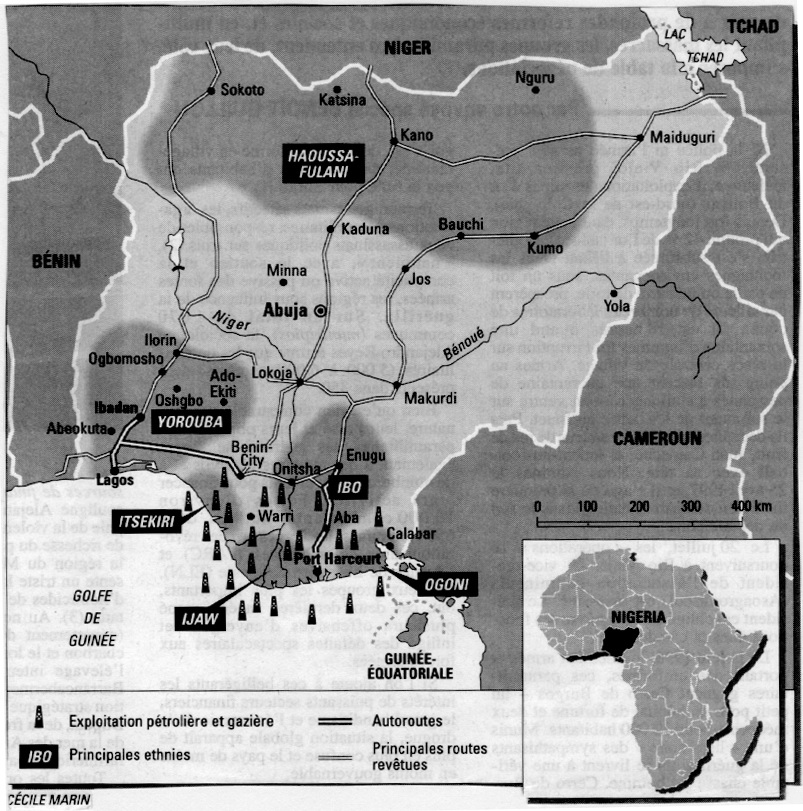 Note: This is a part of a series of articles that I am posting; 10-12 page papers for a course I just finished teaching: Labor and the Global Economy. I asked permission to post several of them. Here is one.
Colonialism and Labor Migration in West Africa
by Heather Cook
In West Africa, labor migration patterns have largely been determined by colonial and neocolonial policies that focus primarily on exploiting the natural resource endowment of a given country. West Africa, which includes Benin, Burkina Faso, Cameroon, Cape Verde, Chad, the Ivory Coast, Equatorial Guinea, Ghana, The Gambia, Guinea-Bissau, Liberia, Mali, Mauritania, Niger, Nigeria, Senegal, Sierra Leone, and Togo, have seen colonial occupation from various European powers since the 19th century. This includes British West Africa (Ghana, Sierra Leone, Gambia, and Nigeria), as well as French West Africa (Mauritania, Senegal, Mali, Guinea, Ivory Coast, Burkina Faso, Benin, and Niger). Read more…
Audi’s nazi concentration camp past
This is raw footage shot by U.S. military photographers of Nazi concentration camps at the moment of liberation in 1945. I have seen like footage before, visited several camps – Buchenwald, Sachenhausen – (although it was years ago) – but I found this film striking, the power of black and white photography is there in every scene…it emphasizes all the victims of Nazism from all over Europe – even a few Americans. I watched the first twenty minutes of it and will watch the rest tomorrow. It says a lot that what in the 19th century was one of the most cultured and liberal countries in Europe – or anywhere else – could turn into modern day barbarians shortly thereafter. The Germans are not the only ones… they killed with gas, in the post war period others killed with napalm, phosphorus bombs, drones, For those of you think that Americans are incapable of such savagery I recommend Nick Turse’s “Kill Everything That Moves” about the U.S. military intervention in Vietnam, or pretty much anything about the French war against Algeria (1954-1962)….Cheers, RJP…
Steve Weissman – on the victory of far-rightwing, neo-Nazi parties in France and Germany
This video is called HD Stock Footage: WWII German Atrocities in Concentration Camps.
From the Daily Mail in England:
Audi employed thousands of concentration camp inmates during Second World War and was ‘firmly ensnared’ in Nazi regime, shocking investigation finds
Firm hired 3,700 concentration camp inmates in deal brokered by the SS
Another 16,500 labourers also forced to work in Auto Union plants
New study was commissioned by Audi in ‘house cleaning’ exercise
Many workers were forced to live in unheated barracks, report finds
Disabled employees shipped north to be executed, according to historians
By Allan Hall in Berlin
Published: 16:18 GMT, 26 May 2014 | Updated: 18:36 GMT, 26 May 2014
Car giant Audi employed thousands of concentration camp inmates during the Second World War and was ‘firmly ensnared’ in the Nazi regime, an investigation has found.
During the war years Audi was known as Group Auto Union…
View original post 461 more words
Stuart Chase of Boulder, Colorado – long time peace activist, member of Veterans For Peace, has died.

Stuart Chase
From Tom Mayer, Boulder (June 6, 2014):
“A few weeks ago our Middle East Collective (of the Rocky Mountain Peace and Justice Center) lost one of its most dedicated members: Stuart Chase. Stuart was a Vietnam veteran who understood the insanity of warfare and the brutal injustice of capitalism imperialism. He had deep sympathy for exploited, oppressed and unfortunate people of every kind. Week after week Stuart stood on the corner of Broadway and Canyon in Boulder holding signs saying “No Attack on Iran,” “Stay Out of Syria”, and “end U.S. Funding for Israeli Aggression” among other things.”
“Stuart Chase participated in several progressive organizations in addition to our Middle East Collective including Veterans for Peace, Occupy Wall Street, and Move-On. Stuart’s friends and political comrades will hold a peace vigil in his memory on Saturday, June 21 from 11 am – 12 pm. Quite appropriately, the one hour memorial vigil will be held on the corner of Broadway and Canyon. Please join us!”
He was found dead in his Boulder apartment a few days ago. The cause of death has not yet been determined; there will be an autopsy. A very decent, committed human being and a longtime friend of mine, yet another one, has died. I cannot remember when I met him but have known him for the better part of 30 years. Stuart was a fixture in the Boulder, Colorado peace movement (and that is meant to be a compliment). He was a long distance runner for peace, a modest, disciplined, tormented soul. His torment came from the time he spent in Vietnam as a medic; his experience with war was painful enough so that he was driven, all these decades, to spend the rest of his life working for peace.
He was particularly active in the Rocky Mountain Peace and Justice Center’s Middle East Group. Whether it was support for the cause of the Palestinian people, opposing the war in Iraq, trying to prevent a U.S. military assault on Iran or calling for an end to the bloodshed in Syria, Stuart was there – on the street, with banners, petitions, leaflets. Try doing that for four decades and see how long you’d last. He had a great understanding of the psychological problems of not just of veterans, but of everyone and reached out his whole life to help people. I am concerned about how he died, but let’s wait for the autopsy before drawing any conclusion. Never much of a stylish dresser, when I last saw him three-four months ago, I noted that he looked disheveled and not in good spirits. Good bye Stuart.
Carl Bloice – Goodbye to a friend
Carl Bloice – Good bye to a friend
APRIL 13, 2014
(Note: Carl Bloice was not a showy guy. In a world of opportunists and self-seekers – many of them, anyhow – Carl stood out for his modesty, his dignity.”It” wasn’t about him, it was about the bigger picture, challenging the system, coming up with something better. On the bigger picture, his was always, always, among the keenest eyes. The man had depth of character, of analysis and general decency that few possess. In the past 25 years, I’ve seen him once, about five years ago in SF with Jean Damu, like Carl, he too recently stricken down with cancer and Ringo Hallinan.
We talked about evolving U.S. policy in Africa which I was interested in beginning to write about. But we were in touch by email fairly frequently. For all that, Carl Bloice influenced me politically, personally as much as anyone that has crossed my path. And in a good way. To the degree that I can write politically [goal – make a point, have an analysis, avoid rhetoric], it is from having worked with him. He also taught me – for better or worse – a good deal about how to work as a Marxist in these United States. And I know that I am not alone, that there are many of us whose lives he touched in the labor, peace, civil rights and environmental movements with a little bit of Carl mixed into our very beings. What follows are several tributes to Carl which give details to some part of his life journey. To my knowledge, Carl never put together a collection of his writings in book form. I am hoping that such a project will be undertaken and accomplished.)
_________
Obit for Carl Bloice
Dispatches From The Edge
Conn Hallinan
April 20, 2014
“One is responsible to life: It is the small beacon in that terrifying darkness from which we come and to which we shall return. One must negotiate this passage as nobly as possible, for the sake of those who are coming after us.”
James Baldwin
“The Fire Next Time”
Carl Bloice, Foreign Policy In Focus columnist and blogger, and long-time African-American journalist, negotiated that journey with power and grace. Right up to the moment when he lost his long battle with cancer, he was contributing to the website Portside and struggling to complete a column on the Middle East. He died in San Francisco April 12 at age 75.
He was a journalist his whole life, although he began his love of words as a poet. Born Jan. 28, 1939 in Riverside, Ca., he grew up in South Central Los Angeles at a time when racism and discrimination were as ubiquitous there as palm trees and beaches. He was one of those people who could not bear the humiliation of silence in the face of injustice and that simple—if occasionally difficult—philosophy was at the center of who he was. Civil rights, free speech, the war in Southeast Asia (and later Central America, Yugoslavia, Afghanistan, and Iraq), women’s rights, homophobia, and the environmental crisis: wherever the dispossessed were voiceless, Carl Bloice spoke for them.
He was also my friend, for 44 years my colleague and co-conspirator, and the person who taught me how to write and think. I say this because this is less an obituary about an accomplished African-American journalist than a friend’s funerary oration, something we Irish think is important.
Carl sold me on James Baldwin—and many other essayists, thinkers, novelists and poets—by convincing me that words mattered. He was utterly certain that a well-written piece of prose could tumble a government, shame the mighty, or shelter the powerless. Read more…
The Rouen Chronicles: Arques La Bataille, Dieppe
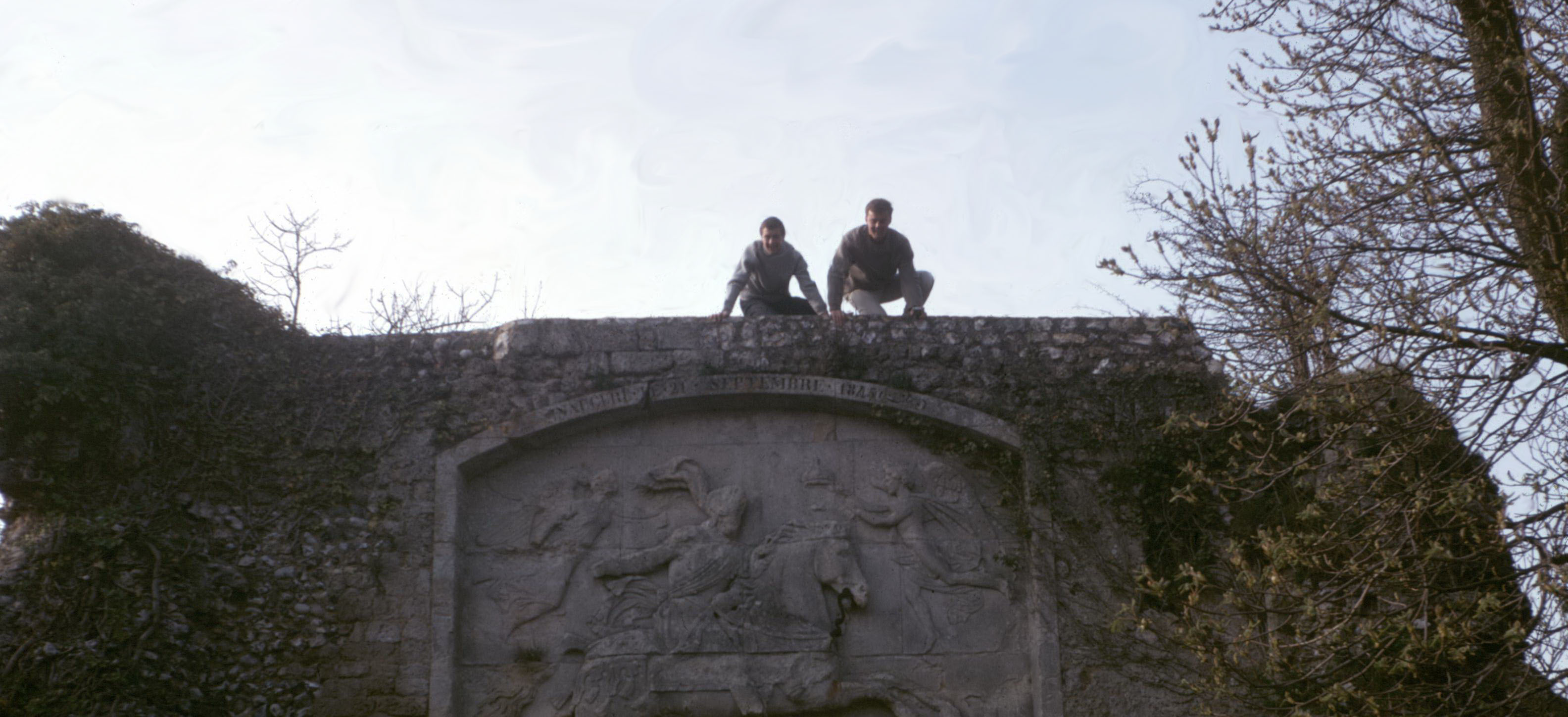
Didier Vergos and Frank Kappler a top a wall at Arques-La-Bataille chateau; April 1965 (I think)
It is fifty years since it was my good fortune to spend a year in France, a junior year abroad in a very well-organized program of St. Lawrence University, where I got my undergraduate degree (and that in French!). Now a half century on, I have tried to mark the occasion in a number of ways, among them:
– reading as much Balzac as I can
– reading the works (in French) of one of our professors at the University of Rouen – Robert Merle, who was one of the finest professors I have had the pleasure of studying with.
– seeing the films made of Robert Merle’s books (Day of the Dolphin, Weekend A Zuydcoote).
– remembering some of the places I had the good fortune of visiting that memorable year and writing about them, places whose significance I barely understood at the time, among them Arques-La-Bataille and Dieppe.
I first visited Arques-La-Bataille nearly half a century ago with Dominique, Didier and “Mr.’ Vergos and Frank Kappler. It was a part of a day trip on which the Vergoses were kind enough to take Frank K. and me. We were in the midst of our junior year abroad (September 1964 – July 1965) in Paris and then Rouen France. In Rouen we lived with the Vergos family at their home at 75bis rue de Renard (Fox St.) . After poking around the castle at Arques-La-Bataille for an hour, mostly climbing around the ruins, we went on the spend the rest of the day in Dieppe. It was a wondrous day all in all, filled with vivid impressions. Years later – 25 to be exact, in July 1989 – with Nancy, Molly and Abbie – I visited the same places. We stayed about a week just outside of Dieppe and took a day trip to Arques-La-Bataille. That summer was the 200th anniversary of the French Revolution of 1789, an interesting time to be there. Read more…
Bring Them Home – Immigration Rights Monthly Protest At the Aurora Processing Center, Colorado
Such a strange title for what amounts to a high security prison for undocumented immigrants being “processed” …ie kicked out of the country,”the Aurora Processing Center.” Just looking at it, the whole structure wreaks of oppression. Do all the security guards there have beer bellies – good corn-fed farm boys – like the three or four I saw from a distance, their stomachs hanging out over their belts?

Supporters of Coloradans For Immigration Rights
It is a fortress with high walls, barbed wire, an enormous facility a medieval dungeon in the 21st Century. But I have passed it many times driving down Peoria Street in Aurora and not even noticed it as the facility sits a block off of a main thoroughfare. If you didn’t know what was going on there, it would not be illogical to think it a meat processing center. After all what is a “processing center?” But this processing center processes people and kicks them out of the country. It breaks up families and crushes souls.Colorado “processing center” in Aurora has one of the oppressive records in the country and this country’s president has expelled more immigrants from these United States than anyone in his position in the past. A sorry record indeed and one that continues full steam.
There were about fifty of us out there protesting the treatment of undocumented residents of the United States in an event sponsored by AFSC and Coloradans for Immigrant Rights. A Jewish social justice group (finally!) in Denver, Bend The Arc, is also involved. Many present at the picket – themselves or family members – had been arrested by immigration and are facing deportation. One who had spent eight months inside the Aurora Processing Center was a woman named Kelly. She had been stopped for driving without a license and, her papers not in order, sent to the processing center for deportation. That she was able to get out of the center and remain in the country she credits to the immigration rights movement in Denver that helped her. But it would not have happened unless, as Kelly put it, she “came out of the shadows and into the light, to leave behind the fear”…go public and fight openly for her rights.
Molly, one of our daughters, had gone to these demonstrations several times before and it was about time that I joined in too. Immigration is a personal issue several generations removed. It is both a part of both the heritage of this country and of my own family. Along with many of their relatives, all of my grandparents immigrated to this country from what is today Lithuania, Poland and Belarus in the early years of the 20th century. My maternal grandmother, Sarah Magaziner (name changed to Magazine in the 1930s) was denied entry on her first try as a result of a minor eye infection. For that, – a woman who spoke seven languages fluently (Polish, Russian, Lithuanian, German, Yiddish, Swedish and Hebrew) – eight if English is thrown in – and who had the voice of an opera singer, the daughter of a long line of rabbis and fisherman on the Niemen River – was deemed “eugenically unfit” and sent back to Europe from Ellis Island in New York Harbor. Read more…
 View from the Left Bank: Rob Prince's Blog