Mother Agnes-Mariam Warning: Islamic Extremism in Syria Is Undermining The Chances For Settlement

St. James-The-Mutilated Monastery (built in the 5th Century) in Qara, Syria.
(Note: Also posted at Foreign Policy In Focus, Global Research in Canada and the Syria Solidarity Movement)
Mother Agnes-Marian Comes to Denver
Last week Mother Agnes Marian, mother-superior of St. James The Mutilated Monastery in Qara, Qalamoun District of Syria (n. of Damascas) visited Denver as part of a U.S. tour which is taking her coast to coast. She spoke at three public venues in two days (November 16, 17, 2013) – Montview Presbyterian Church, The Unitarian-Universalist Association (Colorado Blvd. and Hampton) and St. Rafka Maronite Church in Lakewood (23 Ave and Wadsworth) and then rushed off to catch a plane to Lincoln where she also has had several speaking engagements, those covered by the Nebraska press.
The Christian Palestinian family of the good mother-superior hails from Nazareth, now in Israel, from whence they were expelled and made refugee in 1948 when Israel was founded. Growing up in Lebanon, she was educated by that country’s Maronite Community. Before entering the Melkite Greek Catholic order, Mother Agnes-Mariam claims to have partnered with a group of American hippies in her youth, she, with bible in hand. While little attracted to their hashish smoking, she absorbed their commitment to world peace. Read more…
Sister Anges Mariam, Carmelite Nun, Visits Denver To Talk about the possibility of Syrian reconciliation
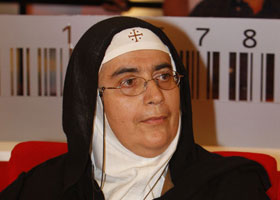
Sister Agnes Mariam
Sister Agnes Mariam, former fellow hippie, talking about the possibility of Syrian reconciliation in Denver. I was pressured not to go hear her, so I went to two of her presentations instead of only one. What a cool nun. Next to her is Father Andrew of the Maronite Church, good man in his own right.
Note, a more extensive article will follow in the next few days. Most salient point: Support the Geneva II process for a negotiated settlement of the Syrian crisis.
Cameroon: – France’s Guatemala -(Fourth of a Series): Chantal Biya – From The Streets To the Halls Of Power
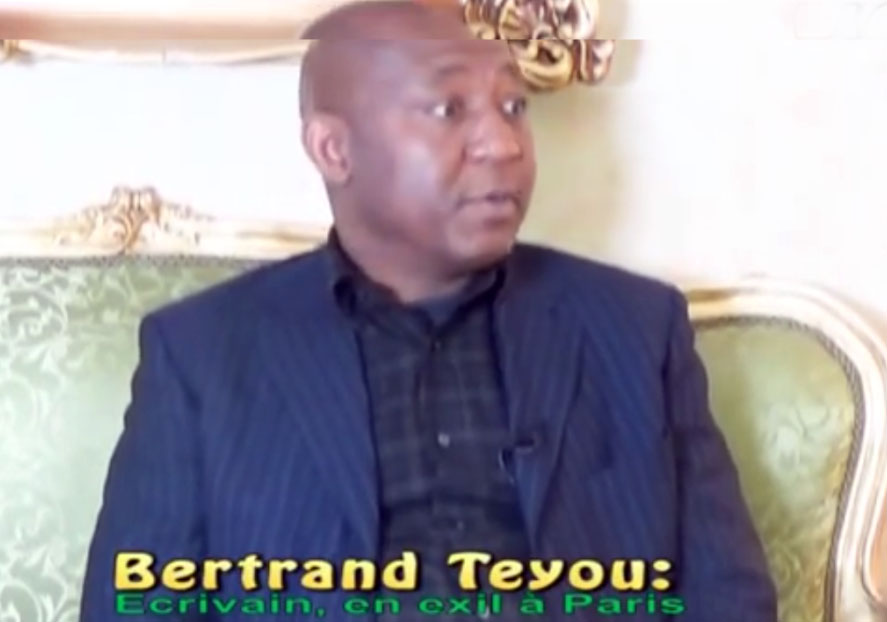
Bertand Teyou: Speaking The Truth To Power…and paying the price.
(Note: This also appears at Foreign Policy In Focus)
_____________
Library of Congress: Only U.S. Copy
I am wondering if the copy of Bertrand Teyou’s ‘La Belle de la Republique Bananière: Chantal Biya – de la rue au Palais’ which I acquired, is the only copy of the book here in the United States. Most copies of the book were confiscated by the Cameroon government itself. My search for it did produce a lone copy from the Library of Congress, which was sent me through the modern miracle of the inter-library loan system. I doubt it was an original – but seemed instead to be a Xeroxed copy, its pages poorly cut with a paper cutter, so that some of the text was cut away.
Still there it was, and I read it in its entirety.
For his contribution to our understanding of the psychology of power and female upward mobility in Cameroon Teyou was rewarded by being thrown in prison for six months where he nearly died. He would have, if not for an international campaign to free him that included publicity of his fate by organizations like Amnesty International and PEN International.
Teyou had been arrested in the Cameroon port city of Douala, long time a center of opposition, where he had organized a book signing in a local hotel. Copies of the book were confiscated; Teyou was arrested, tried and convicted of “insult to character” and “organizing an illegal demonstration” (a book signing?). Sentenced to two years imprisonment or a fine of near $4500, unable to pay the fine, Teyou “chose” the prison option.
Explaining why he wrote what amounts to a cruel – but accurate – exposé of the country’s first lady, Teyou commented: “”We are entitled to rise against the injustice that is crippling our country. We cannot let evil go unquestioned… This book is the expression of my dissatisfaction with what is going on in Cameroon, especially the macabre system that gives Chantal Biya the leeway to treat people around her with extreme cruelty.”[
The international campaign to free Teyou was successful. In poor health, he was released from prison on May 2, 2011. In an act of literary solidarity, the chair of African literature at the University of Bayreuth, in Germany, also offered to pay the expenses for La Belle de la république bananière to be reprinted in German. But Teyou paid an additional price. While in prison, his home mysteriously burnt down, killing his daughter. On his release, Teyou described the New Bell Prison where he was incarcerated as “a death chamber, particularly for the poorer prisoners. Only those who have the possibility of ransoming their way out survive.” Calling New Bell Prison “aconcentration camp – not a prison” Teyou went on to describe the deplorable prison conditions where prisoners were thrown their food on the ground `like animals’ , where many inmates went insane as a result of the conditions. Read more…
Cameroon – France’s Guatemala (third of a series) – Paul Biya, (Yet Another African) President Without A Social Base
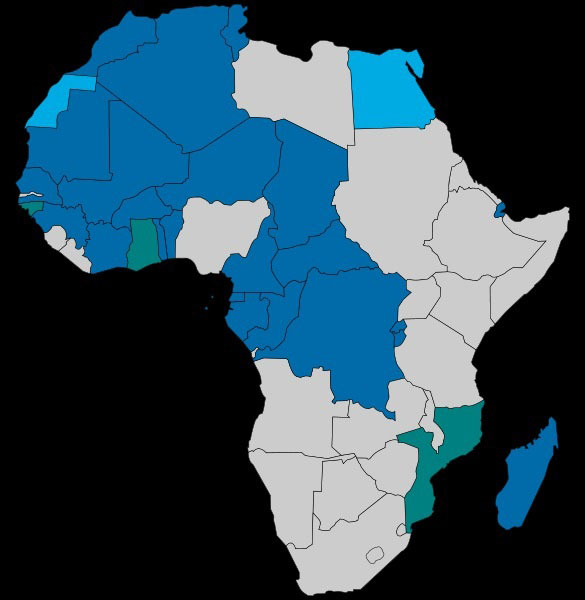
Francophone Africa
_________________
If, over the years the United States has protected, supported and promoted such human rights luminaries as Anastasio Somoza (Nicaragua), the Shah of Iran, Hosni Mubarek (Egypt), Ferdinand Marcos (Philippines), Suharto (Indonesia) – ie, essentially repressive kleptomaniacs who tortured and killed many of their own citizens and recycled gobs of foreign aid money into private tax haven accounts worldwide, France has done likewise with a number of leaders of its former French colonies in Africa.
Right up there with this cast of political detritus is the Cameroon’s present president, Paul Biya, one of France’s key African allies. Biya – think of him as Cameroon’s very own Zine Ben Ali – is a classic example of how the system of `Francafrique’ works. It is difficult to put into words in a single article how corrupt, how repressive his rule has been – and degree to which his political career has hurt the people of his own country while lining the pockets of the political class and wealthy in France.
A Cameroon blogger, Zuzeeko, sums up Biya’s accomplishments succinctly:
“His presidency has been marred by allegations of corruption, electoral fraud, economic stagnation, poverty and gross human rights violations including extrajudicial killings, arbitrary arrests and imprisonment of journalists and authors, and brutal crackdown on peaceful demonstrators, including University student demonstrators. Freedom of speech and expression – the foundation of free democratic countries – are restricted. Intimidation by security forces is rife. The right to good quality education is limited. Dilapidated schools abandoned by the government are a common sight. The regime has failed many of its young school goers. In certain government schools, children have no benches or tables. Good roads are almost non-existent. Health care in nothing to write home about. The list goes on.
Allegations of corruption and embezzlement of huge sums of money by government officials are rampant, while many ordinary people live below the poverty line. Police corruption is endemic and happens with impunity in broad day light.
Unemployment stood at an estimated 30% in 2001. [Source]”
So impressive and rampant is the corruption in Cameroon that the Catholic Community against Hunger and For Development, awarded Paul Biya with its prestigious and much coveted “Corruption Hall of Shame” award where he joins other French supported kleptomanics and close collaborators, Omar Bongo Ondimba (Gabon), Denis Sassou Nguesso (Congo Brazzaville) and Teodoro Obiang Nguema (Equatorial Guinea). Poor Biya, reputedly worth somewhere between $100-200 million while Bongo, Sassou-Nguesso and Nguema Mbasogo have all reached billionaire status.
Paul Biya is a classic example of how the system of `Francafrique’ works. Read more…
“American Jewry, Israel and Palestine 46 Years After The 1967 War” – Remarks of Rob Prince, St. Barnabas Church, Denver, Sunday, November 3, 2013

Lithuana – Prienai, from where my paternal grandfather’s line comes, is just s. of Kaunas. They, the Prenskys (people from Prienai) moved to Grodno at the bottom of the map, today in western Belarus. 10 miles west, in eastern Poland is Bialystok from where my maternal grandmother, Sarah Wishinsky, hails. Priania, Vilnius, Grodno, Bialystok…The Baltic Sea is to the west, Latvia to the North, Poland to the southwest, Belarus to the South.
(Note: What follows are notes from the talk. I usually wander from my notes a bit – but not very far – and usually come back to the main themes. RJP)
American Jewry, Israel and Palestine – always an `alive’ topic…
While I am glad to speak to you on this issue, I want to raise a point from the outset for you to consider: There is a tendency to emphasize Jewish voices – either for or critical of Israel – keeps the dialogue restricted – Plenty of Palestinians in Denver who know the issue well and whose voices need to be heard. We all need to break out of a box that has for too long stifled – if not smothered – the Palestinian narrative as told by Palestinians themselves.
Want to urge you from the outset – to invite a Palestinian speaker to address you…you need to hear from Palestinians in their own voice…
Still, I applaud you for trying to deal with, come to an understanding of this issue in your church. I have spoken on it – for better or worse, to friendly and hostile audiences for nearly 40 years now. And I find that once one leaves the more emotionally connected audiences that believe it or not, it is not so difficult to speak about it all, that it is not `impossible’ to resolve, even if it is difficult. People actually hear what I have to say. How novel!
Want to give you three reference points: Will briefly address three issues – those I was asked to address:
a. the 1967 War
b. my family history
c. developments in American Jewish Community. Read more…
Fukushima – A Global Threat That Requires a Global Response

Chernobyl Nuclear Power Plant – April 24, 1989
In April, 1989, with a delegation of U.S., (then) Soviet and European scientists, I visited the Chernobyl Nuclear Power Plant and the surrounding area, including the now dead and radioactive town of Pripryat a few miles away. Like fools, for several minutes we stood within 500 yards of the plant. The year before, I was in a place called Hiroshima.
All that is a quarter of a century ago.
For years we have lived in the shadow of the Rocky Flats Nuclear Weapons Plant that made plutonium triggers for atomic and hydrogen bombs. A massive local peace movement – one of the most `creative’ and militant movements I have every seen, closed Rocky Flats. Nancy and I were, in the end, only a small part of that, but we were, like so many people in the Denver-Boulder area, a part of it. Now Fukushima. From Hiroshima to Fukushima, a very dangerous place for all living things, but one that is not on the radar of many people.
Laying By Time Gives Diplomacy A Chance by Jim Wall
(note: I have lifted Jim Wall’s entire piece on Obama’s shift in Middle East Policy, ie, the opening of negotiations with Syria, Iran. Jim Wall locates the public announcement of this shift to Obama’s United Nations speech last month. A link to Wall’s blog, which I read regularly, is on the right.)
http://wallwritings.me/2013/10/28/laying-by-time-gives-diplomacy-a-chance-2/
“Laying by time” Gives Diplomacy a Chance
by James M. Wall
 In the rural South of the 1930s,”laying by time” usually came, according to one writer, “when the last weed-hoeing was done, marking the start of a down-time until harvest”.
It was also a time of anxiety as “farmers looked for second jobs or, as James Agee put it in Let Us Now Praise Famous Men, ’hung as if on a hook on his front porch in the terrible leisure.’”
President Obama was thrust into his own foreign policy “laying by time” September 24, when he went before the United Nations General Assembly and delivered whatNew Republic writer John B. Judis called “his most significant foreign policy statement since becoming president”.
The UN speech also began a “time of anxiety” for the president’s foreign policy team which found itself hanging on Agee’s hook on their own “front porch in the terrible leisure”.
Susan Rice, Obama’s new national security advisor, seized the “terrible leisure” time the president gave her by setting up a series of Saturday morning policy review meetings with a small number of administration officials.
Their assignment was “to plot America’s future in the Middle East”. The New York Times’ Mark Landler describes the policy review:
At the United Nations last month, Mr. Obama laid out the priorities he has adopted as a result of the review. The United States, he declared, would focus on negotiating a nuclear deal with Iran, brokering peace between the Israelis and the Palestinians and mitigating the strife in Syria. Everything else would take a back seat.
Egypt, which had earlier been a “ central pillar of American foreign policy”. At the UN Obama, “made clear that there were limits to what the United States would do to nurture democracy, whether there, or in Bahrain, Libya, Tunisia or Yemen. Read more…
Turkey and the New Middle East Regional Political Realignment

The Dream of the Ottoman Empire II just collapsed…
(note: This also appeared at Foreign Policy In Focus)
by Ibrahim Kazerooni and Rob Prince
The news broke less than three weeks ago, on October 3, that Turkey, a longtime, staunch NATO member, just broke an unwritten rule of that global military alliance: it has announced it is considering a major $3.2 billion arms purchase from China of an advanced missile defense systems. The announcement triggered something approaching a panic in NATO circles. A number of commentators argue that this is Turkey’s revenge, Turkey being dissatisfied with NATO’s refusal to engage more militarily in the Syrian conflict, and worse, the U.S. change of gears – or seeming one – from an attack mode to negotiating.
This is undoubtedly true to a certain extent, but other, weightier factors are most likely at play, among them a regional shift in U.S. Middle East policy – a shift, in the aftermath of the popularly supported Egyptian military coup away from supporting the Moslem Brotherhoods towards once again, giving Saudi Arabia a freer hand in helping to implement Washington’s regional strategic objectives. Enhancing the Saudi role – which bodes ill for the region – entailed somewhat downgrading Turkey’s role and slighting Ankara, after having courted and encouraged them to play a more active role in the Arab World. All that blew up in Turkey – and Washington’s face – in the Syrian conflict.
At the heart of the shift is the Obama Administration’s new attitude towards negotiating a settlement of the Syrian conflict and opening what appears to be, by all accounts, the opening of a serious political dialogue with Iran. This has somewhat shaken Washington’s traditional allies, Israel, Saudi Arabia and Turkey, all of whom were confused and surprised – and in no small measure – irritated by Washington’s new political posture. As the dust clears, it is apparent that Washington is somewhat downplaying Turkey’s role as a key element in Washington’s Middle East supporting cast of players. This has created no small amount of resentment in Ankara (and in Tel Aviv, Jeddah as well). Read more…
Largest Northwest Denver Major Development Plan Challenged by Neighborhood Groups, Activists

Sloan’s Lake – Looking East Towards Downtown Denver
October 19, 2013
Dear Residents of West Denver, West Colfax, Sloan’s Lake, and Northwest Denver:
As you know, the former St. Anthony Hospital site is being planned for a massive development by EnviroFinance Group (EFG). The City of Denver Zoning Code requires a “General Development Plan” (GDP) process and approval prior to re-zoning of the property. The GDP process does not include City Council. Only the Denver Planning Board need approve the GDP and, as a general rule, City Council approves zoning in conformance with the GDP. Here is what is being proposed:
– Up to 1,745 new households crammed into 6 blocks
– 12 to 20 story buildings along 17th Avenue just across from Sloan’s Lake Park
– Less than even the 10% minimum open space required by Code while inundating the existing
Sloan’s Lake Park with more than 2000 new users
This process began in May 2013 with the developer’s submittal of a preliminary Plan to Community Planning and Development (CPD). The process required the developer to hold a community meeting which took place on June 26, 2013. There was a two week period of time for members of the public to submit comments on the Plan to the Planning department. Many of you receiving this letter submitted comments which expressed reservations about that preliminary Plan.
The developer had planned on taking a final version of the Plan to the Planning Board in August.
However, as a result of the volume and nature of the public and agency comments submitted, the
developer was delayed in revising their plan, and it was not until October 14 when they submitted a final version of their Plan to the Planning department. The developer has said now that they intend to have the Planning Board public hearing and decision on the final GDP on Wednesday, November 20.
You will be interested to know that the revised GDP still does not adhere to the vision of the St.
Anthony Redevelopment Task Force Plan or the West Colfax Plan in any significant way. Both of these plans were developed over a long period of time with extensive community involvement in 2005 and 2006.
The new Plan still features 20 story buildings along 17th Avenue, even less open space than what is required under the Zoning Code and a new population density which may reach as many as 1745 households, more than 2000 people in a six block area.
You may also be interested to learn that by a 2 to 1 margin, the comments submitted to CPD in July were either negative or had reservations about the development plan. Although, EFG has publicly claimed that 65% of the comments were favorable to their development, the truth is that 67% of the comments were negative or had serious reservations.
This is the largest, most important development in the history of Northwest Denver. It will have
impacts on our neighborhoods that will be dramatic and far reaching. If it is done wisely, with
sensitivity and a good sense of economics and design, it will benefit all. If not, we will have to answer to our children and grandchildren, “How did you ever let that happen?”
We believe that the vast majority of Sloan’s Lake and Northwest Denver residents are unaware of what is really being planned. We are a group of neighbors from throughout West and Northwest Denver, who have organized to challenge this Plan for massive private over-development adjacent to our primary public park. Now that we know what the developer’s final plan is and that it is moving forward, we urgently need your help to notify and motivate others to take action.
We invite you (and any of your neighbors you may interest!) to attend a meeting to learn more about EFG’s strategies and plans and what can be done to ensure a more harmonious and desirable redevelopment of the site and to provide an acceptable outcome for our community.
Please join with us. Our first meeting will be held on:
Thursday, October 24 7:00 p.m.
Highlands Recreation Center
2880 Osceola Street
If you are unable to make this meeting but would like to help, if you have questions or concerns or would like to be taken off this list please contact Larry Ambrose at LDA@earthnet.net or call him at 720-490-1991.
Good sense can prevail and we must have a say over our own futures.
Sincerely,
Jacob Werther, Sloan’s Lake Citizens Group
Steve Kite, West Highlands Neighborhood Association
Michael Smilanic, Sloan’s Lake Neighborhood Association
AJ Steinke, Sloan’s Lake Citizens Group
Shirely Schley, Sloan’s Lake Citizens Group
Larry Ambrose, Sloan’s Lake Neighborhood Assoc
April L. Crumley, Concerned Citizens of Barnum
Jerry Olson, Jefferson Park United Neighbors

Napoleon Crossing the Neiman River To Invade Russia – June 24, 1812
My paternal grandmother, Molly Prensky, was born in Vilnius, Lithuania. At the time of her birth in 1893, the Jewish population call the place Vilna, which was the term by which I knew it as a boy. She came to the USA prior to WW I, in 1903 at the age of 10, this according to a notation in the 1930 census. At the time she was growing up in Vilna, it was a part of the Russian Empire. Shortly thereafter Vilna would be annexed by Poland and remain in Polish hands until the advent of WW2 in 1939. Her maiden name was `Jackson’ – most likely an Americanism, certainly not a typical Eastern European Jewish or Lithuanian name. Read more…
Letter From Sofia: Old Tanks and Modern Mayhem
This guy – Conn Hallinan – is always worth reading…one of the finest political minds around, and he writes well to boot!
Letter From Sofia: Old Tanks & Modern Mayhem
Dispatches From The edge
Oct. 15, 2013
Sofia, Bulgaria
The military museum in this sprawling capitol city consists of a tiny building and a huge outdoor display of weapons that look as if they had been wheeled in fresh from the battlefields and parked, higgledy piggledy: mountain howitzers that shelled Turks in 1912 rub hubs with Cold War era Russian artillery. MIGs, dusty and weather beaten, crowd a sinister looking Luna-M “Frog” tactical nuclear missile. Two old enemies, a sleek German Mark IV Panzer and its dumpy, but more lethal adversary, a Russian T-34, squat shoulder to shoulder.
Poor Bulgaria. The Russians won’t be back, but once again the Germans are headed their way, only this time armed with nothing more than a change of currency and the policies of austerity that go along with it. The devastation those will inflict, however…
View original post 1,312 more words
Humanitarian Intervention: Destroying Nations To Save Them..

An incomplete list…
(note: this also was posted at Foreign Policy In Focus)
By Ibrahim Kazerooni and Rob Prince
“The fate of Iraq is a sideshow, the terrorist threat is a red herring, and the radical Islamist’s dream of a worldwide jihad against the west is a fantasy, but the attempt to revive Pax Americana is real.”
The notion of “humanitarian intervention” by former imperialist and now neo-colonial powers is as old as the hills. One can trace such pretexts back far in modern history. Two examples, among many, suffice: the 1898 U.S. invasion of Cuba, Puerto Rico and the Philippines was done in the name of saving those peoples from the Spanish yoke. Hitler used it as the excuse to annex the Sudetenland regions of (then) Czechoslovakia to supposedly “save” the poor German residents of that country.
More recently, humanitarian interventionism has yet again gained currency, a needed pretext to extend empire or maintain its geo-political clout. Like all excuses for war-making, it hides the deeper political and economic factors for attacking a country, suggesting to the victims, that the aggression launched against them, are, really in the end, for their own good and that such intervention “preempts” worse suffering. In fact humanitarian interventionism is the doctrine of “pre-emptive military strikes” twin brother; they go together like a horse and carriage.
We are somewhat befuddled by the manner in which, all the same, so many, so willingly, fall for this and cannot see humanitarian interventionism for what it is? Read more…
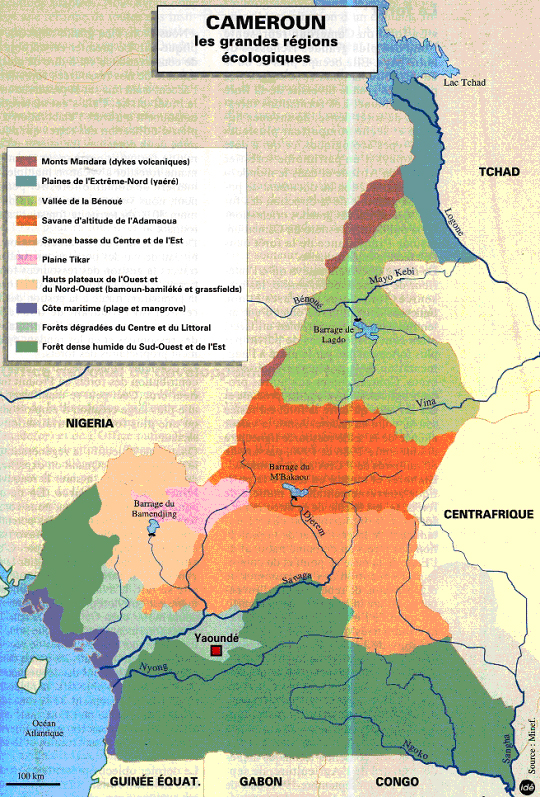
Cameroon
Cameroon is a part and parcel of a larger system, set up by De Gaulle and his sidekick, Jacques Foccart during the 1950s and 1960s, the purpose of which was to insure that independence for France’s former African colonies would result in maintaining a French stranglehold over the countries’ resources and markets while feigning respect for African independence. Depending on whose point of view to be believed – it was either an on-going, never-ending success, or it has resulted in more than a half century of poverty, famine, and unending oppression. In fact many French people are quite proud of “France’s accomplishments” in Africa. Not so for many Cameroonians whose fate and sufferings rarely reach European/American eyes.
This is in part out of ignorance. Knowledge of France’s role on the continent is scant. Yes, there was Algeria…but wasn’t the horror inflicted on the Algerian people an exception – many French would ask? The media coverage of some of France’s other African ventures – Madagascar, Congo Brazzaville, Angola, Togo – and certainly, Cameroon – are hardly known. Africans, particularly those who have lived under the system known as Francafrique have a more somber view “France’s contribution to African development.” Wonder why?
Africans, particularly those who have lived under the system known as Francafrique have a more somber view “France’s contribution to African development.” Wonder why?
Cameroon – France’s `Guatemala’ (first of a series)…

Ruben Um Nyobe
Ruben Um Nyobé, Félix Moumié, Ernest Ouandié, Albert Ndongmo…
Here in the USA these names ring virtually no bells. Not very many bells ring in France either, although given France’s role in squishing Cameroon’s legitimate anti-colonial movement – it took France 15 years – all of these should be household names. But in Africa, particularly the Cameroon where more than half a century after all of them were killed (minus Ndongmo), their memory as principled nationalists, as fallen leaders of their country’s independence movement from France, remains fresh, even vibrant, this despite efforts to slander their reputations and the movement for which they sacrificed their lives.
The gap between French rhetoric about supporting decolonization and its frenetic attempts to maintain economic and political control of its former colonies, especially in Africa could not be greater. There is a french word for this gap between the ideals of 1789 on the one hand and its efforts at all costs to dominate and control the economies of its former African colonies: `un gouffre‘ its called. In order to maintain this control while feigning support for African independence, the French systematically eliminated potential nationalist leaders, including the four Cameroon anti-colonial militants cited below and crushed independence movements – or tried to – with a ferocity and brutality of unspeakable proportions.
The Algerian case is perhaps better known – in part because it is almost impossible to hide the torture and killing of nearly a million people in eight years. But there were other places, less known, where the French military stopped at nothing to destroy the challenges to their continued neo-colonial rule – Madagascar and Cameroon – examples hardly known outside Africa,. Several hundred thousand locals died in Madagascar struggling for independence; in the Cameroon, the figure might have reached close to 400,000 killed over a 15 years period before France and its local satraps finally snuffed out the light of democracy and African progress. These war crimes were hardly reported in the French or world press; the suppression of the independence movement in Cameroon was supported by all sectors of the French population, from right to left. It is only decades later that in drips and drabs, the outlines of the events have come to light.
The Cameroonian Nelson Mandela
Ruben Um Nyobé, founder and first leader of the Union des populations de Cameroun (UPC), was killed 55 years ago, on September 13, 1958 by French led counterinsurgency forces in the Cameroon hoping to neutralize the genuine nationalist movement Nyobé led. Although French and French Cameroon sources claimed he was killed in a skirmish with their forces, the events concerning his death have never been confirmed. Considered by many Cameroonians as nothing less than the George Washington of his country, Nyobé was one of a handful of African nationalists, considered of the caliber of Nelson Mandela.
He is a part of a pantheon of African nationalists that includes Patrice Lumumba (Congo), Sylvanus Olympio (Togo), Barthélémy Boganda (Central African Republic), Thomas Sankara (Burkina Faso), all of whom, like Nyobé were killed, eliminated by French military, special forces or their local pawns. All understood that while France (or in the case of the Congo, Belgium) was willing to give African colonies titular independence, that Paris – most specifically Charles DeGaulle – would do everything in its power to retain political and economic control of these countries (and others) and their raw materials and strategic resources. A small volume of Nyobé’s writings “Ecrits Sous Maquis” appeared in 1989, published by Harmattan. Read more…
Obama Hesitates To Bomb Syria; KGNU – Hemispheres – September 24, 2013. Interview with Ibrahim Kazerooni and Rob Prince
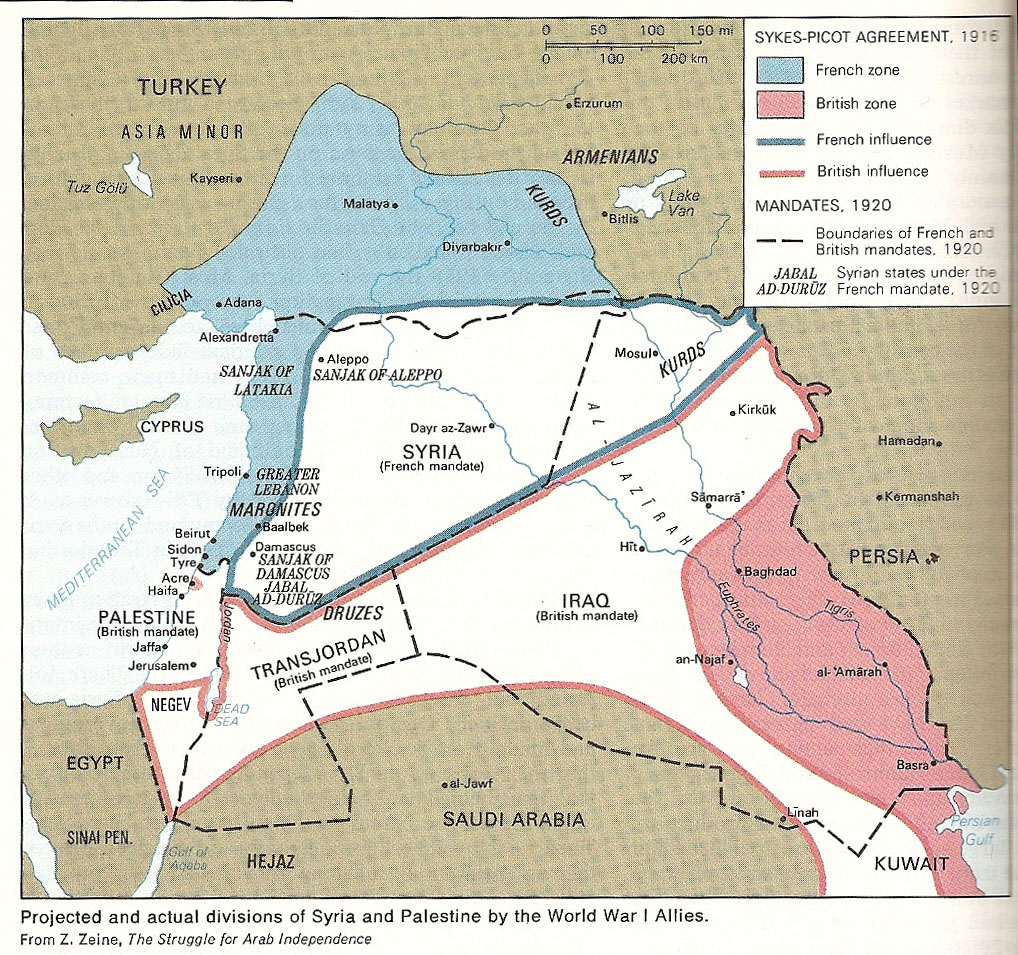
Syria – created as a result of the 1916 Sykes-Picot Agreement, secret agreement which carved up the old Syrian vilayet of the Ottoman Empire…
The link here is to a 59 minute interview on KGNU `Hemispheres’ program hosted by Jim Nelson with guest commentators Ibrahim Kazerooni and Rob Prince. I consider it one of our better programs. We’ve been doing these programs on Middle East developments with Jim Nelson for three years now. This one deals mostly with the Obama Administration’s change of direction towards Syria. Several weeks ago, by all appearances, the United States was on the verge of bombing Syria, punishing it for allegedly having used chemical weapons (serin gas) against its own people on August 21, 2013 resulting in the deaths of 1400 people. The Syrian government denied the charge , the Obama Administration, despite much bluster and `assurances’ that it had the proof, never provided it. In any case, suddenly a change of course with what could be the beginnings of a negotiating process possibly in the making. American hawks, Joe Lieberman, John McCain, AIPAC types having something approaching apoplexy that the bombing did not take place.
 View from the Left Bank: Rob Prince's Blog
