Preliminary Remarks About The Escalating Crisis in Egypt.

The Obama Administration Holds Its Nose And Realigns Itself With Old Ally – Saudi Arabia
I know what follows will sound a little esoteric to American ears, but I am convinced there is something to it and want to add my take on bloodbath unfolding in Egypt, if only because I have not seen the explanation I offer anywhere else – at least in English. And I think it might help – at least in part – explain the unfolding Egyptian tragedy.
While the Obama Administration is not an innocent player in the slaughter unfolding in Egypt – it supported the Egyptian military coup – there is another factor at play which is as decisive in explaining the recent dark turn of events: the re-emergence of Saudi Arabia as a key player in the Arab World and the factional struggle between the Moslem Brotherhoods, supported by Qatar and Turkey on the one hand and the Salafist and Wahhabist elements supported by Riyadh on the other.
While the Obama Administration is not an innocent player in the slaughter unfolding in Egypt – it supported the Egyptian military coup – there is another factor at play which is as decisive in explaining the recent dark turn of events: the re-emergence of Saudi Arabia as a key player in the Arab World and the factional struggle between the Moslem Brotherhoods, supported by Qatar and the Salafist and Wahhabist elements supported by Riyadh. Read more…
Tunisia: Washington’s Grip Tightens…

Paying homage to Farhat Hached, Tunisian anti-colonial and labor leader, assassinated by `La Main Rouge’ , French special operations force in 1952
_______________________
This was published by Open Democracy in the UK and Foreign Policy In Focus in the USA
_______________________
1
Two years ago it was a Tunisian uprising that triggered the events in Egypt which brought down Hosni Mubarek. Now it is the Egyptian mass movement – which in conjunction with that country’s military that is fanning the flames of opposition in Tunisia. Is Tunisia on the verge of imploding along `Egpytian-like’ lines?
There are parallels between the two situations of the two countries – most particularly, the pervasive collapse of confidence in the recently elected governments. Just as the Muslim Brotherhoods failed to address the socio-economic crisis that swept them to power just a short year ago, so too, Ennahdha – Tunisia’s version of the Brotherhoods for all practical purposes, has been singularly ineffective in addressing Tunisia’s woes. Read more…

Africa – Ethnic Groups
_________________________
Part Five also appears at Counterpunch
__________________________
1.
Bush’s Contribution to Fighting AIDS in Africa: A Freddy Krueger Mask?
The thin thread – the pretext – for offering George W. Bush what was originally entitled an “Improving The Human Condition Award”, now referred to as `a Global Service’ award (by the University of Denver) – is his supposed work to fight AIDs in Africa.
By emphasizing Bush’s Africa anti-AIDS campaign, most recent explanation for this award, the Korbel School is not doing anything original. A look at the mainstream American media over the past months – starting in the early Spring – suggests nothing short of a coordinated media campaign to reshape Bush’s image. But in many ways, this “re-branding George W. Bush campaign” is worse than trying to put lipstick on a pig—it’s more like putting a Freddy Krueger mask on a pig. It makes the pig look worse.
It has included virtually the entire news media, from newsprint to television and tended to sing the same song: that Bush made a major contribution to fighting AIDS in Africa through PERFAR, an initiative begun in early 2003 – in fact, just before the Bush Administration launched its war against Iraq. Add glowing comments from the likes of Bono, Elton John and Matt Damon (his `I would kiss George W. Bush on the mouth for his AIDS work‘ tops the list) to spit shine the image. Bush’s evangelical supporters – a key element to his constituency – chipped in as well. What stands out about this campaign – check any source – is the nearly complete absence of any remarks critical of the PERFAR program. Read more…
Below is the written text of an interview conducted this morning with Press TV – Iranian news outlet – concerning the announcement that Bradley Manning will speak in his own defense this week. I was asked to respond to an article that appeared in the British`Guardian’ concerning the case:
 First I want to join all those who support an end to Bradley Manning’s persecution and who call for his immediate and unconditional release. On the surface it appears that Bradley Manning is on trial, but on a deeper level, of course, it is not Manning that is on trial so much as it is the U.S. wars in Iraq and Afghanistan.
The Obama Administration is trying to use the Bradley Manning case to prop up the legal basis for its illegal wars and to give a moral cover for what is essentially an unethical foreign policy and to use the case, not only to frighten whistle blowers , but to justify its plans for further military interventions – very likely next in the African Sahara, Yemen and who knows where else.
It is significant that Manning is going to speak in his own defense, and that the world hear what he has to say in his own voice.
Much is being made of the fact that the release of Manning’s documents put both American soldiers and some Afghan villagers in harms’ way and that the release of the documents also compromised “long range – US led battle plans”.
The charges, so narrowly formed – miss the main point…and are a fine example of what in English is referred to as `blaming the victim’ – the victim in this case being Bradley Manning himself.
It is not the leak of classified material by Manning that have put Afghans and members of the U.S. military in harm’s way – but the continued US-led wars against the Iraqi and Afghan peoples – that is the source of the problem, wars whose legal framework are very shaky according to international law – and whose ethical motivation is completely lacking.
The material that Manning offered to Wikileaks – that which has been published – has simply reinforced many public media reports emphasizing that the U.S. led wars in Iraq and Afghanistan were cynically and poorly conceived, fiascos from a humane and political view point. They have been human rights debacles of the first degree and finally, they reveal something else – that the United States, like in Vietnam – and like the Russians before them in Afghanistan – lost the wars. These were not victories in any sense of the word.

Egypt Rising In Revolt – 1919 – against British Colonial Occupation
______________________
published at Foreign Policy in Focus
______________________
The situation unfolding in Egypt is confusing to many Americans trying to follow the events. A number of questions have emerged in the aftermath of the Mohamed Morsi’s removal from power and the blow suffered thereby to the Moslem Brotherhoods.
What are the questions people are asking?
Was the United States involved – in conjunction with the Egyptian military, supported by the vast masses of the Egyptian public – in Morsi’s removal?
Aren’t the Moslem Brotherhoods allied with the United States? Don’t they support U.S. Middle East policy economically (neo-liberalism) and politically (trying to bring down the Assad government in Syria)? And if indeed the Brotherhoods are U.S. political allies, why would the United States not just support, but actively participate (as they did) in Morsi’s removal? Read more…
`Jeremy Scahill’s Film, `Dirty Wars’ and `The CELL’ – Counter-Terrorism Museum in the heart of Denver.

A more detailed analysis than the video – but worth reading and buying…
Remarks of Rob Prince – First Unitarian Society of Denver.- July 28, 2013 to the church’s peace and justice committee.
Hi…
Good to be back amongst you…
Let me begin with my conclusion: I’d like to think that the same kind of movement that grew in Colorado to shut down the Rocky Flats Nuclear Bomb Plant can be organized to close the doors of the CELL, Denver’s very own Orwellian nightmare – peaceful, non-violent activism that proved more powerful than the war machine.
Arnie C. told me that some of you were upset to see a full page ad in the Denver Post – what do they cost these days?- advertising an event at the University of Denver, co-sponsored by the CELL and the Korbel School of International Studies where I teach.
It was on July 16. Did any of you attend?
OK – There was some talk about possibly picketing the event, but in the end that was going to boil down to Arnie and me..
We decided that – while picketing the CELL is a most honorable gesture – indeed I am committed to working with people – one and all – in a campaign to close down that operation as a stain on the peaceful traditions of the city of Denver and to work on this as long as it takes – we realized that there is so little knowledge about the place and the operation it might be better to start with one – or a series of – educationals on the project.
What is it?
Why is the Korbel School co-sponsoring events with the CELL? (and has been for the past several years).
Let me begin with my conclusion: I’d like to think that the same kind of movement that grew in Colorado to shut down the Rocky Flats Nuclear Bomb Plant can be organized to close the doors of the CELL, Denver’s very own Orwellian nightmare – peaceful, non-violent activism that proved more powerful than the war machine.

Also posted at Foreign Policy In Focus
___________________
___________________
by Ibrahim Kazerooni and Rob Prince
While media in the United States has focused on the Egyptian uprising that triggered a military-led coup in which the Muslim Brotherhood (MB) led government was dissolved, hardly any media reports here have considered the regional implications of the Egyptian events, nor the implications for U.S. Middle East policy. Reeling from the coup’s impact, the echoes of which extend far beyond Egypt, the MB is now scrambling to limit the regional damage to its influence. U.S. Middle East policy slips back into disarray.
Yet, analyzing Egyptian politics, economic, and social structures requires taking into consideration the country’s role in the region, and not in isolation. Assessing the Egyptian crises, the subject matter at hand, in abstraction, without due attention to the Egypt’s regional context misses the proverbial forest through the trees. To better understand what happened in Egypt and the ramification of the recent events we need to explore a number of issues:
1- The Muslim Brotherhood (MB) and its regional and internal politics
2- The Regional Power Players
3- The Sectarian Campaign against the Shia’s. Read more…

____________________
Links:
_____________________
1.
In an email from a recent D.U. alumni from Oregon, who as an undergrad majored in International Studies, a former student wrote me:
“I felt quite outraged, even though I have been quite removed from the Denver community since graduation. Mostly it just seems so wrong that the university administration acts with such an extreme disconnect from the students it is supposed to be serving.”
Since the news broke that George W. Bush would be the recipient of an award at the upcoming Korbel Dinner, an annual fund-raising affair, I have many such protest emails, telephone calls. The message repeats itself: how could the university stoop so low, or something to that affect. Is there no limit?
A private university like the University of Denver essentially gets its funding from three sources: tuition, foundation and government grants and donors. So many private universities over the past decades have `gone under’, lost their funding base and gone out of business. The University of Denver is not one of them. It has not just managed to survive, but these last decades it has managed to transform itself into something better – academically and otherwise – than it was previously.
But now it appears that there are small cracks in the wall. Read more…

The Korbel Family. I think daughter Madelaine Albright is on the far right
_________________________________________
Links:
_________________________________________
The Korbel School of International Studies, University of Denver
Responding to the news that the University of Denver’s Korbel School of International Studies was going to present George W. Bush with Global Service Award, a close friend – graduate of both the University of Denver’s Law School and the Korbel School of International Studies, commented wryly – as he is apt to do:
“Poor Joseph Korbel, he is turning over in his grave for the third time. First was when his own daughter, then Secretary of State Madelaine Albright commented that the economic sanctions that the United States had imposed on Iraq was worth the 500,000 children whom it is estimated died of malnutrition and lack of medical care in the 1990s. The second time was when his protege student – one Condoleezza Rice – who in her student youth was a liberal democrat, `saw the light’ and became a neo-conservative. The third time is now, when the institute that Korbel founded would award George W. Bush with such an honor. It denigrates the school’s dignity. Sad day.” Read more…

Guantanamo Prison: George Bush’s legacy to `Improving The Human Condition’
________________________________
Links:
University Faculty Joins Students In Opposing Bush Award. Colorado Independent. July 17, 2013
________________________________
Honoring Bush: What’s It All About?
In the end, what is all this racket about, the University of Denver’s Korbel School of International Studies giving an award to George Bush? True, as a result of widespread protests, the name of the award Bush will be granted has changed from an `Improving The Human Condition’ to an award for service – now called the `Global Service Award‘ as if tinkering a bit with the title changes the goal. A minor tactical shift; the strategic goal remains.
Global service?
In the end, changing the name of the award means little: the university seems bent on giving Bush an award for something, anything. So they downplay Bush’s record on unleashing two major wars (Afghanistan, Iraq) and other `achievements’, and magnify any straw they can grab on to – in this case, Bush’s dubious contribution to fighting African AIDs.
In the end, changing the name of the award means little: the university seems bent on giving Bush an award for something, anything. So they downplay Bush’s record on unleashing two major wars (Afghanistan, Iraq), and magnify any straw they can grab on to – in this case, Bush’s dubious contribution to fighting African AIDs.
So what is the deal? Why the award? Why would the University of Denver’s Korbel School of International Studies lend its prestige to such an effort? Read more…
`Do you hear the people sing, singing a song of angry men, it is the music of a people who will not be slaves again’.
Les Mis…

Suez Canal – One of the world’s great choke points
by Rob Prince and Ibrahim Kazerooni
__________________
Note: This piece also appeared at Foreign Policy In Focus, ZNET and Portside
__________________
32 million Egyptians in the streets can’t all be wrong…
This time the Egyptian people did not wait 41 years to bring down what could be called the Sadat-Mubarek government. With a little help from their friends in the military, they did it in less than a year. Mohamed Morsi’s Muslim Brotherhood government is history.
As in 2011 when their mass demonstrations forced out Hosni Mubarek, once again, in extraordinary numbers, the Egyptian people took to the streets of Cairo and virtually every other Egyptian city to protest the policies of the Muslim Brotherhood-led government of Mohamed Morsi. Two years ago, impressive enough at the time for sure, it was over a million people who converged on Cairo’s Tahir Square forcing Mubarek, a long time key American partner in the Middle East, from power.
Two years later – a mere week ago – this time, an almost unbelievable 32 million – let’s write that out long-hand – 32,000,000 Egyptians took to the streets demanding Morsi’s resignation and a change in government. To believe that Morsi could continue in his presidency after such a resounding public rejection borders on the delusional. It was over. The people had spoken and far more decisively than those 12 million who had voted for Morsi in Egypt’s national election. Other than the faithful of the Moslem Brotherhood and Qatari money, Morsi had completely lost his legitimacy in the eyes of the nation. Read more…

Geoge W. Bush’s human rights legacy: Abu Ghraib
____________________
Links:
______________________
(Introductory Note: The University of Denver’s Korbel School of International Studies, where I teach and work, has decided to give George W. Bush a humanitarian award at its annual `Korbel Dinner’ for “Improving The Human Condition”, proving once again that reality is often more convoluted than fiction. From what I can glean, this decision to honor George Bush – cynical in its extreme but logical from the point of view of locating future funding sources – included neither faculty, nor student input and was largely agreed to at a higher level.
I would note, that it is one thing to offer Bush a platform to speak, hard as it is for him to give a talk using complete sentences, and a horse of different color to honor him with a humanitarian award from what is, in this part of the country, a prestigious institution. What’s the deal? I hope to explore this in a number of blog entries on the subject.
Also I would ask those of you who read this to sign and circulate the petition protesting the award) Read more…
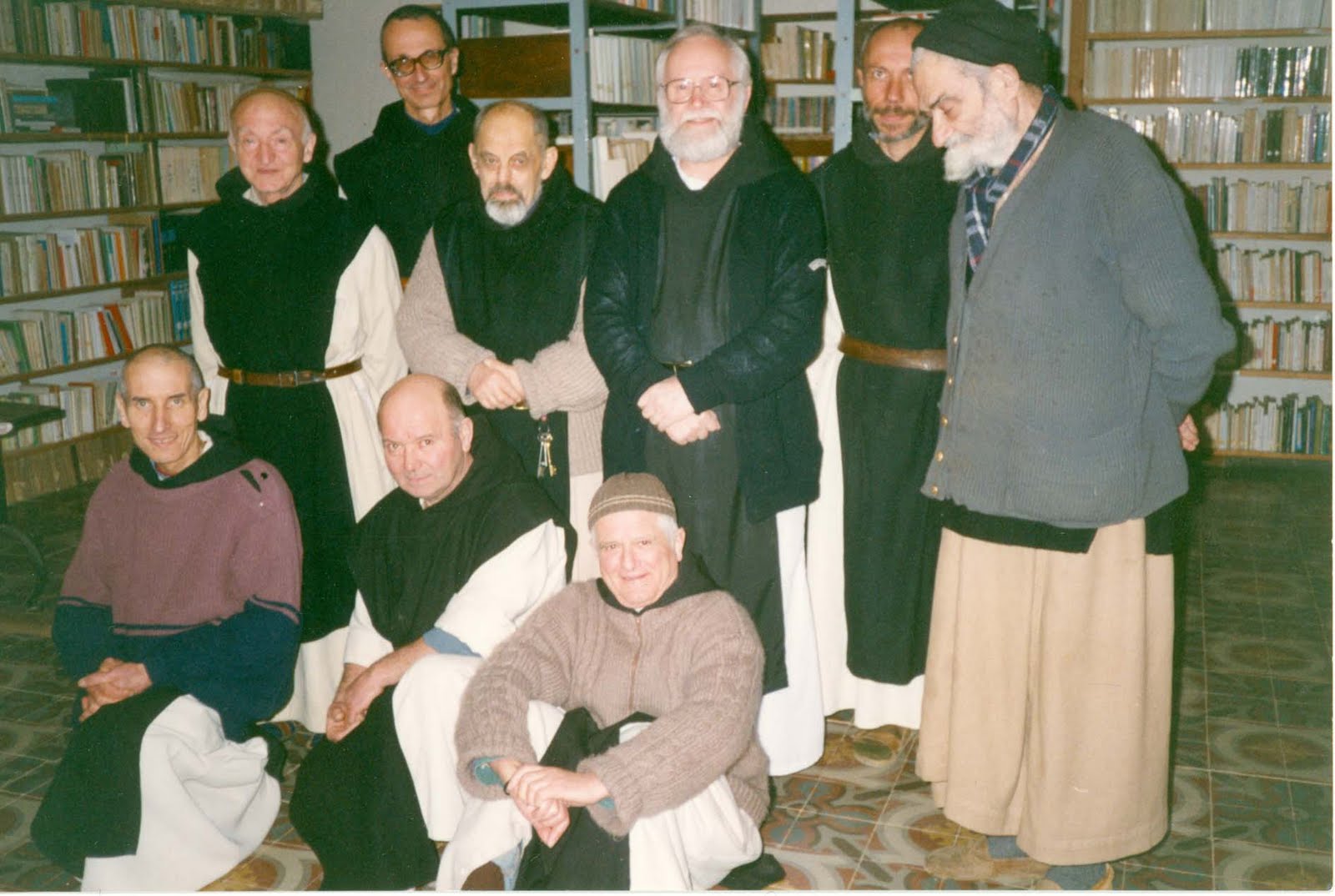
The Beheaded Ones – The Monks of Tibhirine, Algeria
(Note: This is also published at Foreign Policy In Focus)
The Case That Won’t Go Away
It’s the case that won’t go away, that of the Monks of Tibhirine (Algeria), killed and then beheaded in March, 1996. Among the most gruesome killings in recent times, no U.S. administration in the past 17 years has deigned it important enough to press either Algeria or France to investigate.
To the contrary, the brutality of the Algerian government during the 1990s seems to have greatly impressed Washington policy makers. Washington might talk the talk of human rights and democracy, but the U.S. has a long and sordid list of close allies who specialize in various and demented forms of mass repression, from Pinochet in Chile, the Argentinian generals, to Mobutu of the Congo, Mubarek of Egypt, Sharon of Israel, the Shah of Iran and the `Kings’ of Saudi Arabia and Qatar, just to name a few of the usual suspects.
Now add the Algeria to the list. Read more…
South Dakota…Probing The Heartland

The Corn Palace, Mitchell, South Dakota
“You Make A Plan For Life…And Then Life Makes A Plan For You”
– a favorite quote of Beattie Magaziner
North Dakota: The Trip That Was Not To Be…
It wasn’t a `plan for life’ – just a plan for a trip, to see North Dakota. There were three reasons: 1. I’ve lived in the West now for 44 years – never stepped foot in North Dakota; I figured it was about time 2. I saw an article about fracking in the northwest corner of North Dakota in a National Geographic (which, truth be told, I stole from the office of my health provider). The print edition showed a map of a very small area of the state, where, on both sides of the Missouri River there are 3000 natural gas drill sites. North Dakota has been transformed into an energy production giant. It ranks second after Texas in oil production output.
I wanted to see the place – there is something about seeing a place – so that I could study and learn more about fracking. 3. I’ve wanted to trace the journey of Lewis and Clark as far as I could, especially that strip of the river that runs north from the northeast corner of Nebraska, first turns west and then swings back north again cutting through most of both South and North Dakota, before north of Bismark, it swings west yet again into the high Rockies. My goal was to reach Mandan, North Dakota where the Lewis and Clark expedition spent the winter of 1804 – 1805 among the Mandan Indians. Read more…
Libyan Oil Reserves…The Largest In Africa

 View from the Left Bank: Rob Prince's Blog