
The Boulder Farmer’s Market – one of Colorado’s largest, most successful and most interesting.
(note: This piece also has appeared at Counterpunch and Religious Investigations of News and Film)
_______________
The headline in the Boulder Daily Camera, whose editorial page supported the project, read: “Boulder City Council Denies making Nablus a sister city,” and indeed that is what happened at last night’s city council meeting in that university town with a history of taking controversial, but ethical decisions for decades. Not this time…
Boulder: A history of controversial Sister City Projects that have worked
It was the Boulder City Council, which at the height of Reagan’s war against Nicaragua voted to make Jalapa, Nicaragua a sister city, a relationship that has continued for 30 years or so now (and in which my father-in-law, Lowell Fey, actively participated). It was the Boulder City Council, which at the height of the Cold War had the moral courage to make Dushanbe, capitol of Tajikistan a sister city as well. It resulted, for Boulder, in the construction of a magnificent `tea house‘, one of the city’s pearls.
It should not be surprising then that participants in the two sister city projects would be among those who attended last night’s special meeting of the Boulder City Council to defend a proposal for Boulder to develop a formal Sister City relationship with Nablus, West Bank, Palestine and to argue for the advantages of such projects. Even before formal `official’ recognition, the project has generated a number of rich exchanges between Boulder and Nablus, which will continue despite the City Council `No’ vote. Read more…
`The Dying Sahara: US Imperialism and Terror in Africa’ – A Review of Jeremy Keenan’s Latest Book (Pluto Press: 2013)

Region of the Tuareg (Azawad) peoples of the Sahara whose lives have been destablized in large measure by the U.S. Global War on Terrorism in the Sahara
(note: this article also appears at Foreign Policy In Focus)
By Rob Prince
Their main outlines by now hardly secret, still, the extent of U.S. military machinations in Africa, which intensified after 9/11, are neither well known, nor appreciated. The pretext for the military build is, once again, a terrorist threat to the region, the claim that the Sahara in particular has become a hotbed of terrorism requiring nothing less than a `second front of the Global War on Terrorism (GWOT)’. Or so it has been argued in a U.S. mainstream media that rarely questions the intentions of its military abroad and takes their oft distorted version of events as sacred truth. .
Although it might be much closer to the truth, in American academic, media and government circles it is of course rather crude and graceless to assert that the U.S. role in Africa is little more than a scramble for oil, natural gas and strategic minerals. Indeed, the U.S. Africa policy stripped of human rights and democracy rhetoric is essentially a repeat of the late 19th century colonial scramble to get a piece of `that magnificent African cake’. The epicenter of the concern is the Sahara, the region which straddles the Algerian oil and natural gas fields to the north, the Niger uranium mines in the center and the oil, gold and diamonds of the West African `Gold Coast’ as it used to be called. Read more…
Statement of Some Denver-Boulder Jews In Support of the Boulder-Nablus Sister City Project

Nablus, West Bank
The following letter, originally signed by 11 local area Jews, has been submitted to the Boulder Daily Camera:
(Note: Although the letter has already been submitted, more names of people willing to sign keep coming in and as they do, I will post ALL of them here at the blog site which is also posted on Facebook; We are now up to 40 Jewish signers and two supporters with names still coming in)
To the Boulder Daily Camera:
We, the undersigned, members of the Boulder – Denver – Longmont more broadly based Jewish Community of Colorado, want to express our support for the current proposal being placed before the Boulder City Council, for Boulder to establish a `Sister-City’ relationship with the city of Nablus, West Bank, Palestine. People-to-People projects such as the “Sister City” program are highly effective in increasing good will, dialogue and open communication between and among communities. To this end we want to encourage the Boulder City Council to pass this resolution
Some of us who have signed this letter are religious Jews, some not, but we all believe such People-to- People initiatives are important and within Boulder’s long tradition of humanism and empathy for people everywhere. We see such a gesture very much as `a Jewish thing’ to do, to express our sympathy for a people who has long suffered and who deserves the justice and dignity long denied it. There is nothing anti-Semetic, anti-Jewish, or quite frankly, even anti-Israel about such an initiative as some have suggested. To the contrary, it is, instead, a gesture of friendship.
We urge the Boulder City Council to support this initiative.
Signed (in alphabetical order)
Members of the Jewish Community:
Bob Bronstein, Sonia Bronstein, Les Canges, Ira Chernus, Nancy Commins, Ami Dayan, Michael Dayan, Joel Edelstein, Melodye Feldman, Zhenya Gallon, Alan Gilbert, Joan Graff, Irving Greenbaum, Karla Horowitz, Cheryl Kasson, Jennifer Klein, Henry Kroll, Randall Kuhn, Leslie Lomas, Pat Madsen, Tom Mayer, Barbara Millman, Rabbi Adam Morris, Charles Nadler, Danny Postel, Abbie Prince, Mollly Prince, Rob Prince, Doug Reichlin, Dr. Ilene Naomi Rusk, Sheldon Sands, Miriam Schiff, Ruth Seagull, Lynn Segal, Barry Sharoff, Rob Smoke, Elissa Tivona, Evan Weissman, Juliet Wittman, Betty Zeitman
Supporters:
Arnie Carter, Pete Peterson

The Fey – Princes join about 125 others – half of them at least young Palestinians living in the Denver area, to protest the Israeli carpet bombing of Gaza. Nancy’s sign says `End the Occupation’, Molly’s says “Calling for Wisdom and Human Decency”
February 28, 3013
Boulder Colorado – Nablus, West Bank, Palestine Sister City Project: ADL Tried To Derail (What A Surprise!)

An all too common scene: Palestinian Youth Arrested in West Bank for protesting Israeli bombing of Gaza…Jan, 2013
The Boulder-Nablus Sister City Project has been functioning out of Boulder Colorado for several years now. I don’t work with them, but have met and had coffee with a few of the key players in that organization and very much like the tone and the content of what they are trying to do – essentially build – if you like – `people to people’ relationships between Boulder Colorado and Nablus, West Bank, Palestine.
I would hope that the city of Boulder, with its humanistic, environmentally friendly traditions would not give into such pressures that they are now experiencing that would torpedo the project and that they, the city council, evaluate the Boulder-Nablus sister city project on its own, very considerable merits.
If, on some vague level, the project is – as the Anti-Defamation League (ADL) suggests – `political’, it is so in the sense that any and all human relationships are, on some level political, either for their direct political program or lack there of.The work of this project is thoughtful, carefully thought out and within a generically humanistic tradition of building non-governmental human bridges between Boulder, Nablus and the people in both places.
Actually it is not the project itself that is political so much as the Anti-Defamation League’s, brain-dead, narrow-minded, bullying and typically bigoted (when it comes to anything having to do with Middle East oriented peace activities) approach that has politicized the issue and made it into a political football that it shouldn’t be. Read more…

Tunis Brique a l’oeuf maker…
“I get by with a little help from my friends” lyrics to an old Beatles song.
____________
____________
News reports suggest that Tunisia and the International Monetary Fund (IMF) are `very close’ to coming to terms over a $1.78 billion loan to the North African country to help navigate it through the current stormy economic seas. In the short term, there is no doubt that an accord of such a large amount to such a small country will help the country get through the next few years, and help stabilize what has been an unstable and increasingly unpopular transitional government. But at what price to the country’s medium and long term future? Rosy IMF projections that with the loan’s help, the Tunisian economy will grow by 4.5% next year are hardly credible.
There seems to be something of a `rush to the finish’, an effort on both the IMF’s and Tunisian government’s part to wrap up the negotiations as soon as possible. It is as if they are looking over their shoulders nervous that, as the agreement’s terms get out, opposition could grow among the Tunisian people, thus the mutual effort to get the whole thing over with as soon as possible. There is mounting concern within Tunisian civil society about the agreement, both in terms of the process which has been typically secretive and the “structural adjustment conditions” that the country will be forced to submit to in order to fulfill the Tunisian part of the deal.
In traditional IMF fashion, – the negotiations were very much `under wraps’ with virtually no input from anyone other than one member of the Tunisian Central Bank and another from the finance ministry. But in this post Ben Ali age of Tunisian freedom of speech, it turned out to be difficult to impossible to hid the agreement terms, which several talented Tunisian researchers have been able to unearth. Read more…

The Bread Machine Gunner Takes On Ben Ali’s Security Force…
(Note: This also appears at the Foreign Policy In Focus Website;
_______________
Faced with a deepening socio-economic crisis that has only intensified since the collapse of the Ben Ali government in January, 2011, it appears more than likely that Tunisia is about to enter into a major agreement with the International Monetary Fund – IMF – for a $1.78 Billion loan. As is almost always the case, the loan is conditionally based upon Tunisia fulfilling what the IMF calls structural adjustment criteria, a part of which has already been implemented – eliminating the subsidies on fuel which has increased their cost.
All this is being done in the classic IMF fashion – with as little public discussion as possible either with the Tunisian government – its Constituent Assembly – or with Civil Society, which have had no input whatsoever into the process. For an international organization that talks the talk about `transparency’ its long held traditions of secrecy, especially where it concerns granting sizable loans to semi-peripheral and peripheral countries, is much more the norm.
That said, in this new post-Ben Ali era, confused and directionless as it is economically and politically, one thing that the Tunisian people have won is their freedom of speech. As a result, alas, (for IMF, Tunisian Central Bank and Finance Ministry bureacrats) it has more difficult to hide the details and conditions for this loan as in the past. A growing number of Tunisia’s talented political and economic researchers have been able to break through the traditional wall of silence to unearth the details of the loan and press the Tunisian government to do what it really seems to want to avoid – engage in a public, wide scale discussion on the loan itself, and more basically, on the direction of the economy itself.
Many of the revelations about the loans have appeared in Arabic, French and English at the Tunisian alternative media website, Nawaat.org., which has broken key elements of the story to the Tunisian public, enough so that government has been pressed to publicly respond. It is precisely this kind of discussion which has been missing from the Tunisian public since the Ennahdha-led government came to power in the October, 2011 elections.
The Imrali Promise and the New Middle East by Ayoub Massoudi

Kurdistan
(originally published at Nawaat.org)
(translated from the Arabic by Ibrahim Kazerooni and Rob Prince)
From all appearances, nothing short of the cornerstone for a regional Middle East civil war was laid on Imrali, a Turkish island in the southern region of the Sea of Marmara. Those who do not understand how to read history always fall behind. And those who are not acquainted with Abdullah Ocalan, the Kurdish leader and the message he sent out to his people on March 21, are not in a position to comprehend the depth and the enormity of the threat directed toward the Arab world and Middle East in general that this communication represents. Read more…
Guest Blogger: Molly Prince: Sand Creek and Suncor

Suncor, Commerce City, Colorado
by Molly Prince
Last April I read an incredible, beautiful book: The Spell of the Sensuous. It ends with a call from the author to KNOW your local environment and its issues. Well, that sounds nice I thought but I have no idea how to go about doing that. Researching it on-line makes my eyes glaze over.
In Denver this the past week, there have been three protests/marches about environmental issues. I wish there had been no need for them, but since there was a need, I was grateful to the organizers for making them happen. Among other things, these events served as a gateway for learning more about current local and global issues Read more…

Marabout at Tozeur, in the Tunisian Sahara
This article also appears at Foreign Policy In Focus
1. From Timbuctou to Tunis…Marabout desecration
Fueled with Saudi and Qatari money and arms as they are throughout the Middle East and North Africa, Salafist Islamic radicals on the move in Mali hijacked the Tuareg-armed insurrection giving it a decidedly Islamic fundamentalist tinge which the rebellion did not originally have. Among their main targets was the historically vital city of Timbuctou.
In early times Timbuctou was a key transit point for the trans-Sahara caravan trade. It remains a key center of African Islam with an extraordinarily rich heritage of Sufi (Islamic mystics) shrines and written documents going back a thousand years. Its manuscript collection is acknowledged as one of the richest treasure troves of human culture anywhere.
One of the goals of the Islamic radicals that temporarily seized and held Timbuctou was to destroy as much of that heritage as possible, understood by Salafists with their stone-age concepts of Islam, as heretical. Countering such destructive activity has become a pretext for big power intervention, be it the United States in Afghanistan or France in Mali (although both countries have more significant, ulterior motives).
The Salafist militias radicals sought to snuff out Timbuctou’s rich regional Islamic heritage – destroying mausoleums, called marabouts[i], purging Sufi holy men and destroying as much of the city’s precious manuscript collection as possible. In the short time that they ruled Timbuctou, the Islamic militants instituted a typical regime of Wahhabist-like Sharia law with its usual retrograde practices (the subjugation of women, outlawing singing, dancing, stoning women to death for violating Salafist versions of sexual misconduct, ie – the usual Taliban-like/Saudi-like nonsense). Read more…
Review of `The Gatekeepers’: `We Became Cruel’

Palestinian youth being arrested by Israeli military in West Bank, circa 2013
This also appeared at Foreign Policy In Focus
______________
A good place to start this review is at the end, the very end of The Gatekeepers, the Israeli documentary by Droh Moreh that was nominated for best documentary feature at the 85th Academy Awards .
Just before the film stops rolling, `they’ – the six interviewees – all come to the same conclusion: they’ve had it with the occupation, that further repression against the Palestinians in the Occupied Territories – that includes extensive torture to create and army of informers, targeted high tech assassination, daily harassment and humiliation of the Palestinian population simply won’t work. And `they’ should know, as they perpetrated much of it.
`We’ve become cruel’ one of them says, himself one of the cruelest Shin Bet chiefs of them all, as if the Occupation was ever `kind’ in its earlier days? Read more…

1.
Such is the title of Michael T. Klare’s latest book, one which for better or worse, my students at the University of Denver have no choice but to read. They have been submitting questions to me about it these past weeks, intelligent ones. Mostly they can’t seem to `get it’ why the United States and other `core’ countries are not seriously investing in alternative energies, or why the environmental and human consequences of some of the world’s biggest mining and petro-chemical projects are not taken more seriously especially when the start up costs for these projects are enormous and that it will take a decade to build the infra-structure necessary to make such projects viable – that is, if that is even possible.
Several friends are not impressed with the book.
They think that it doesn’t cover new ground and that it overstates its case that the world is running short of, or out of petro-chemicals and strategic minerals. In some cases these friends, for various reasons, have learned about the book’s content from other sources so for them it’s not original.
Others believe that Klare overstates his case. Perhaps some experts are aware of the book’s content, but I doubt that this is true for `the general public’ for which this book is a most valuable contribution to our understanding of global processes, not just about mining in naturally or politically dangerous places or the alliances made between large scale global mining giants like Rio Tinto, Anglo-American Mining, the Chinese National Machinery and Equipment Import and Export Corporation (CMEC) and different African dictators. Read more…
Primary Producers
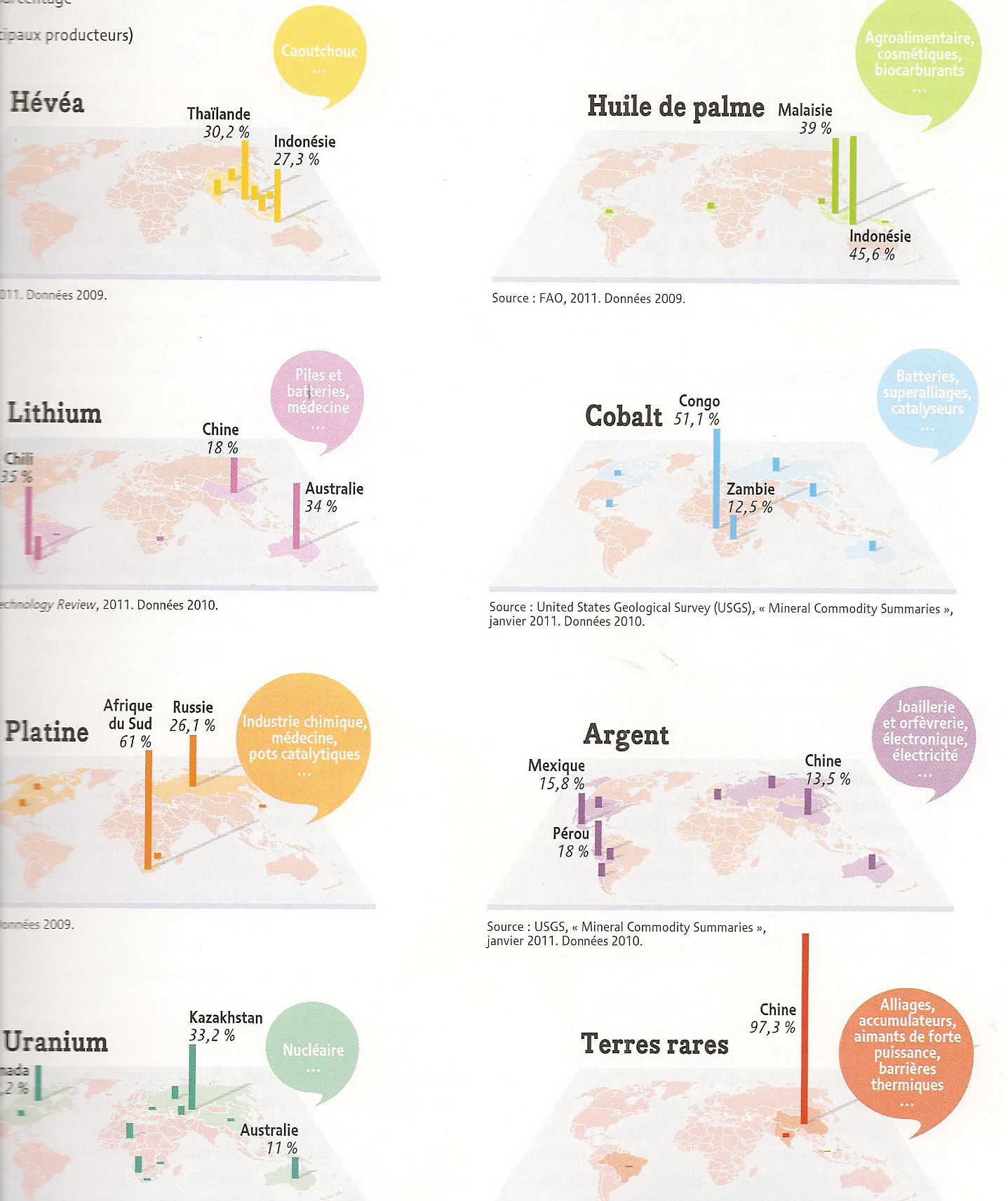
source: Monde Diplomatique: Atlas: 2013
________________
Key:
Hevea = Natural Rubber
Huile de palme = Palm Oil
Platine = Platinum
Argent = Silver
Terres Rares = Rare Earth Elements
________________
or put another way…
– more than 50% of the world’s natural rubber comes from two countries – Indonesia and Thailand
– 85% of the world’s palm oil comes from two countries – Malaysia and Indonesia
– 87% of the world’s lithium comes from three countries – Chile, China and Australia (although there are reports that Afghanistan could possibly become the `Saudi Arabia’ of lithium production). Think of what would happen to the anti-depressant industry if half of their populations turned out to be like ours: bipolar.
– 53% of the world’s reserves in copper come from three countries – Chile, Peru and Australia.
– 64% of the world’s cobalt comes from two adjoining African countries – the Congo and Zambia
– 87% of the world’s platinum comes from two countries – South Africa and Russia
– 47% of the world’s silver comes from three countries – Mexico, Peru and China
– 63% of the world’s uranium comes from three countries – Canada, Kazakhstan and Australia.
– 97.3% of all rare earth elements come from one country, China.
____________
Links:
Debtocracy – a YouTube program produced in Greece with subtitles in English. Runs an hour and fifteen minutes. Is quite good.
General “Tewfik” – Algeria’s God (an open letter to Mohamed Mediene from Hocine Malti)

Demonstration, February 2012, a year ago – calling for Algerian president Bouteflika to step down.
(Note: This is an open letter to the current head of the Algerian security apparatus, the DRS – Departement de Renseignement et Securite – who has been the behind the scenes master of Algerian politics for more than two decades. Malti, a former SONATRACH employee, is the author of L’Histoire Secrete du Petrole Algerien published by Decouverte Publications, Paris, 2012. For those trying to follow the cruel reality of Algerian politics, this is a key document. Keep in mind, that over the past decade the United States has entered into a growing security relationship with Algeria and is currently pressing the Algerian government to send its troops to Mali. This an English translation of the `open letter’ which was previously published on this blog in its original French. Thanks to anonymous translator for invaluable, professional quality translation.)
_________________________
General Toufik: Algeria’s God
An Open Letter to Mohamed “Toufik” Mediène
Hocine Malti, Algeria-Watch, 16 february 2013
Hocine Malti, former vice-CEO of Sonatrach (1972-1975), is the author of Histoire secrète du pétrole algérien (La Découverte, Paris, 2010). First French version of this paper is here.
This time it is not your staff investigators I’m addressing myself to but you, Rab Dzayer, “God of Algeria”, head of the almighty DRS (Department of Intelligence and Security) since 1990. Wasn’t this the way you presented yourself one day in 1999, under circumstances you well know? As the popular saying goes, “It’s better to speak to God than to his saints” — which is what I’m doing today. Given that you are in a position to decide and impose what you deem fit to all of Algeria, to every man and woman and, most particularly, to every civil, military, political and legal authority, I am convinced that you will provide positive answers and follow-up to the questions and requests that I herein submit.
We have just learned that on February 10, 2013, the Prosecutor of Algiers decided to launch a new investigation concerning corruption within the national oil & gas conglomerate, a dossier that he has designated “Sonatrach 2[i]“. In order to give the impression that they are tuned in to public opinion — without acknowledging that they are in fact following on the heels of their Italian colleagues — the Algerian judges indicated in their official statement that they had launched this investigation following information reported in the national press, which, as you know, merely reported the decisions of the Milan Prosecutor as diffused by Italian media. But we Algerians know the truth: our judges were in fact waiting for your instructions before deciding whether to act or to ignore the media uproar of these past days. If they have instigated this new investigation it is because you, Rab Dzayer, have given the green light.
Is the green light that you have conferred clear, definite and permanent or is it furtive and blinking? Will the judges in charge of the case be able to carry out all the necessary investigations, pursue them until truth be determined, carry out all appropriate perquisitions, bring before investigators and the Court every person implicated in any way whatsoever in this matter? Simply put, will they be able to act solely according to the dictates of their conscience or will they be obliged to obtain your green light at every step along the way? Are we going to see Chakib Khelil, Farid Bedjaoui, Mohamed Bedjaoui, Reda Hemche, Pierre Falcone, Samyr Ouraied and tutti quanti auditioned one after the other in the judge’s chambers before possibly being indicted and then, who knows, perhaps even condemned? As you are aware, some of the aforementioned have acted as intermediaries on behalf of silent partners invisible to the eyes of common mortals, but which you, God of Algeria, know only too well. Is it then too naive to imagine that a certain number of your colleagues, Generals or Major-Generals, Ministers, shady businessmen, other personalities who make up the pyramid of which you are the apex as well as members of a certain clan[ii] will also be brought to justice?
Will we also see the Italian, Chinese, French or Canadian corruptors — the list is far from being exhaustive — testify before the Court or answer to their acts before a rogatory commission? Or, as usual, will only the “small fry” be the targets of this new procedure? The Italians have not hesitated to shine a light into the darkest corners: what they’ve discovered and revealed is however merely the visible part of the iceberg. They have gone after the highest level managers at ENI, who in their country are powerful political figures — as opposed to Algeria, where Sonatrach executives, including the CEO, are but technocrats fronting for those who really exercise power, such as you. So will you do as the Italians are doing? Or will it be necessary to listen in on the happenings at the Milan Prosecutor’s office to find out the sad reality of our country and discover how certain personalities whom you know perfectly well, persons you have often frequented during your long professional career, have stuffed their pockets with millions of dollars and Euros plundered from Algeria’s oil revenues? And all this with your tacit agreement, if not your blessing. Do you know the three terms that business and financial circles worldwide use to qualify Algeria? Corruption, incompetence and criminality.
Corruption, indeed, since Algeria was classed in 2012 105th out of 176 countries in Transparency International’s ranking, corruption that has become widespread over the past thirty years. Since 1999, with the complicity of your president Abdelaziz Bouteflika, — and I say your president because it is you and your General friends who chose and imposed him upon the Algerian people – you have transformed Algeria into a land of plenty for a certain caste whose dealings you have covered up if not encouraged to act. Since 1999 the two of you have engaged in an unending guerilla war-like dispute for control and power: Abdelaziz Bouteflika trying to be something other than “three-quarters of a President” and you defining the red lines over which not to cross? All of this with often tragic and cruel consequences for the Algerian people! You have made managing the affairs of the country a private playground in which the only ones allowed to intervene are the infernal couple the two of you make up and your two clans. The destiny of this country has been and continues to be for you both a chess game in which each of you in turn tries to advance his pawns, mark points against his opponent, without either of you succeeding to check or mate the other.
What you are seeking in this hushed-up struggle, invisible to the untrained eye but nevertheless ferocious, is not only to affirm your supremacy but also — and especially — to lay hands on this country’s wealth, an objective for which, despite your bickering, you share an unfailing solidarity. In each of the two clans, your respective henchmen have taken advantage of the guarantee of impunity you have afforded them and stuffed their pockets, garnishing to the hilt their bank accounts and tax havens. But not only that. They have also acquired sumptuous residences, notably in the most chic quarters of Paris, haciendas in Latin America, palaces in Abu Dhabi or Dubai, and offered their children the latest model luxury cars which are then indecently exhibited in the streets of Algiers while others rummage in garbage dumps and landfills for food to feed themselves and their children. Many of your acolytes have decorated their mistresses with jewels, dressed them in Haute Couture and availed them with first-class airline tickets that they have not even paid for. These are VIP, they get this genre of knick-knacks!
Where do they get all this money? First of all, from commissions perceived from foreign companies which have found in your respective succor the mother lode guaranteeing them fabulous contracts in Algeria. Or from import-import operations which have flourished over the past twenty years; monopolies on imports that some — and you know perfectly well who — have self-attributed; fraudulent set-ups of phony bank loans which have become an Algerian specialty; customs “agreements” on false imports or exports. And much more that I can’t even begin to enumerate, such being the panoply of fraudulent operations which appeared in the 1980s and have become widespread since 1999; such being the fertile imaginations of the members of your two clans to create niches from which to extract the maximum of profits. You and Abdelaziz Bouteflika knew all this, but you let it happen. And the day that it becomes necessary to put the adverse clan in a difficult situation, you will need but to disclose compromising files that you detain on the other. A perfect example being the BRC affair, which exploded in 2006 and in which millions of dollars were embezzled by some of your acquaintances as well as by certain corrupt Americans! To your great satisfaction, oil prices — and revenues — have skyrocketed over the past twenty years, thereby facilitating these wheelings and dealings. Such revenues have permitted you and Abdelaziz Bouteflika to buy consciences and support from inside and outside the country, to finance parties in Algeria and abroad, and, finally, to reinforce and perpetuate your power, up to the point that you, yourself, have become Rab Dzayer.
Incompetence is the other term used in foreign business circles to characterize Algeria. They of course know that all Algerians — thank God! — are not incompetent, although the overwhelming majority of those with whom they are in contact are just that. How can we explain this particularity? The Algerian upper-level managers they meet and with whom they have business dealings have been chosen and placed in their positions of responsibility by none other than you two. Now the fundamental criterion for you in this choice is, above all the rest, obedience to the clan chief, not competence. In your microcosm, only the “yes man” can succeed. As proof one need only look at the obsequiousness and servility of the persons in your entourage. These “yes men” moreover help you to marginalize competent people, who risk upstaging them.
Finally they speak of criminality. What a horrible term when investors speak about Algeria. Criminality, of course, since even before going to Algiers, foreign businessmen will have been approached by the missi dominici of the Algerian godfather charged with the affair who will indicate the terms of the “contract”. Not the contract concerning the project itself, but rather the contract pertaining to the amount of the tithe, the commission to be paid, the account into which the payment will be made. And God knows the voraciousness of these Algerian godfathers who demand percentages far superior to the “average percentages normally perceived”. This commission is included in the total amount of the deal, without being deducted from the profits of the company receiving the contract, such that the commission is not particularly bothersome. It is this greed, this voracity, which leads others to speak of criminality. Poor Algeria, what have they done to you?
Rab Dzayer, are you today willing to erase these infamous marks that dishonor the image of this country? Gods can do that. You, yourself, have proved this on several occasions. For just once will you be able to put a stop to this kind of behavior? Will you be more perspicacious, more efficient than the Italians who have announced 200 million Euros in kickbacks? For a series of contracts totaling 11 billion, the 200 million Euros-worth of announced commissions represents less than 2 percent. There is just one comment we can make here: Ridiculous!
P.S. Dear God of Algeria, One last request: Will you authorize the Algerian press to publish this letter?
___________________
Hour of the Furnaces – (in three parts)

The great 1969 documentary about Latin American fascism – the word is accurate – brought via the French and U.S. military aid programs to South America…
Dependence (a segment)
 View from the Left Bank: Rob Prince's Blog
