Tunisia’s Salafists: Brownshirts of the Arab Spring

Grand Mosque of Carthage…overlooks Tunis from north of the city
(Note: This piece also appeared at Foreign Policy in Focus, Nawaat.org, ZNET and the Magreb Center)
All is not well in Tunisia
Although it – the Arab Spring – began in Tunisia, much of the media attention here in the United States has moved on to Libya, Yemen, Egypt, Syria where in some ways the stakes are higher and the dangers multiplying. True enough Tunisia did have relatively peaceful, democratic elections in October of 2011 and a political process continues to unfold. Strangely, during the Ben Ali years, Tunisia was put forth as a poster child for IMF structural adjustment programs, programs which helped undermine the country’s economy and trigger the uprising. In the post Ben Ali period, Tunisia is again being held up as a model!! – this time a model of transition (but from what to what?)
But all is not well in the country.
The socio-economic crisis continues to deepen by the day. Throughout the country there are daily strikes, demonstrations, protests. Virtually every sector of the economy has been on strike be it in the public or private sector, but unemployment continues to rise and is worse than during the Ben Ali period. Outside of the main cities social and government services remained crippled; infra-structural relief to the interior is virtually non-existent. While Ben Ali’s old ruling party, the Rassamblement Constitutionnel Democratique (RCD), was dissolved, many of its former cadre and players have found a home, or made their peace, with the main party in power, Ennahdha, a moderate Islamic party that supports neo-liberal economic policies and U.S. strategic interests in the Middle East and Africa
The economic program of the new government is virtually no different from that of the deposed one; the ministry of interior – the source of repressions, if not crimes against humanity against the population in the Ben Ali years – has hardly been touched; nor has the police force, both of which are now being integrated and mobilized to serve Ennahdha’s interests and to solidify their control of the Tunisian political space. Read more…
A Word From the Coffee Heretic…Mark Overly…

Kaladi’s Coffee Shop – E. Evans, near the University of Denver
(note: Mark Overly owns Kaladi’s – a coffee shop near the University of Denver, on Evans Ave a few blocks east of University Blvd. One of my daughters, unsolicited from me, described Kaladi’s coffee as `easily the best in Denver’. Agreed. Mark knows as much about coffee as anyone … and also about commodities markets to which coffee is tied. Here is an interesting column – lifted from his blog `The Coffee Heretic‘ to which a link has been added on this blog site. It concerns info on yet another scam – that of `speciality coffee’…well written and fascinating)
Source Washing and the Illusion of Transparency.

Hormuz Straits…if closed by war, an attack against Iran, it would seriously disrupt the global economy…
Hello peace activists and C-CAATI* participants:
Congratulations to Rob Prince, Doug Vaughan, and the other members of the Denver C-CAATI group for putting on an excellent conference about the nuclear crisis in the Middle East on Saturday! It was well organized,informative, and even inspiring. The Denver Unitarian church at which the conference was held was comfortable and had a most welcoming feel. The food was both delicious and plentiful. The conference was attended by at least 70 people, and I heard many favorable comments about the event from the attendees.
The first presentation was by Dr. Leroy Moore who spoke about the Iranian nuclear program. He presented a lot of useful information about the history of the Iranian nuclear program. He also compared the Iranian nuclear energy program to the nuclear weapons programs in Israel and the United States. Leroy emphasized that Iran does not now have nuclear weapons and has apparently not made a decision to produce them. The power point presentation that Leroy used is attached to this e-mail. You can learn a great deal by viewing it.
After Leroy’s presentation we broke into small groups that discussed methods of anti-war organizing. Many useful organizing ideas emerged from these sessions. Among these were the following: (1) a website devoted to anti-war letter writing, (2) a systematic campaign to introduce anti-war resolutions at city councils, (3) a campaign to enlist churches within the anti-war movement, (4) a mass effort to lobby Congressional representatives, (5) preparing anti-war materials that can be used in high schools, (6) pressuring candidates for election to oppose an attack on Iran, (7) more and better teach-ins at higher education institutions, (8) a sustained hunger strike conducted in a relay fashion, (9) picketing industries that profit from war, (10) enlisting labor unions in the anti-war movement, etc.
After the organizing workshops concluded a fine lunch featuring Middle Eastern food was served. I overheard many energetic political conversations while people were eating. After lunch we heard music and anti-war poetry. Then Rob Prince presented a brief summary of the ideas emerging from the organizing workshops.
The final event of the conference was a stirring speech by Ibrahim Kazerooni, an Iraqi theologian and political analyst, on the political forces underlying the threat to attack Iran. Ibrahim discussed a variety of factors, but placed particular emphasis on the weapons industries that stand to profit from an attack upon Iran. Ibrahim’s passionate and eloquent oration drew sustained and standing applause.
I for one came away from the conference feeling energized and elated. I was elated to be in the company of so many good people committed to preventing an attack on Iran. I was energized by gaining a clearer sense of how we can build a strong anti-war movement. Thanks again to the event organizers. The Saturday conference made an important contribution to our common cause.
Peace and Justice,
Tom Mayer
*CCAATI = Colorado Coalition Against Attacking Iran. conference was organized by the Denver chapter.
 May 10, 2012
Dear Friends,
Support for a military attack on Iran is, plain and simple, support for mutually assured destruction, not only for the State of Israel, but also for Israel’s Palestinian neighbors.
Any military escalation in an unstable Middle East is akin to throwing a lighted match onto a powder keg. The consequences cannot be contained by any conventional strategy, and regional diplomatic efforts will be set back decades.
This opinion is widely shared well outside peace activist circles. It has been heatedly expressed by Major General Meir Dagan, former Israeli Mossad Director (2002 – 2011) who said, “[Attacking iran] would mean regional war and in that case you would be giving Iran the best possible reason to continue the nuclear program.” He adds it’s “the stupidest thing I ever heard.”
And US Secretary of Defense, Leon Panetta agrees. “The consequences [of military action] could be that we would have an escalation … that would not only involve many lives, but could consume the Middle East in confrontation and conflict we would regret.”
Clearer heads must prevail!
The nuclear arms race during the Cold War left the world with nuclear arsenals estimated by the Stockholm international Peace Research Institute in 2009 at 23,000, which is 2000 times the total firepower used during WWII. In this regard, We agree with both the Obama administration and J-street, the staunchest pro-Israel, pro-peace lobby in the U.S. The world does NOT need another nuclear weapon ready state. However, a military strike sends precisely the opposite message.
To folks who believe America and Israel should and will hold the upper hand in the nuclear balance of power indefinitely, you might want to think again. Perhaps, the most persuasive argument to the rest of the world for nuclear non-proliferation would be good-faith reduction in nuclear firepower among the current super-powers. That makes a whole lot more sense than bombing an adversary to make sure they never build bombs.
Toward sustainable peace,
Haim Beliak, Rabbi, Los Angeles
Betty Carr
Ira Chernus
Alan Gilbert
Jean Gore
Karla Horowitz
Pat Hewett
Cheryl Kasson
Leslie Lomas
Patricia Madsen
Barbara Millman
Aaron Ney
Rob Prince
Elissa Tivona
Evan Weissman
Juliet Wittman
(from “Just Foreign Policy website – May 11, 2012)
To trim the deficit, Americans favor much deeper reductions at the Pentagon than their leaders do
R. Jeffrey Smith, Center for Public Integrity, May 11, 2012
http://www.iwatchnews.org/2012/05/10/8856/public-overwhelmingly-supports-large-defense-spending-cuts
[noted by NPR: “Survey: Americans Overwhelmingly Support Defense Cuts,” http://www.npr.org/blogs/thetwo-way/2012/05/10/152426302/survey-americans-overwhelmingly-support-defense-cuts]

Cut Military Spending; Use Money for Human Needs; No War Against Iran
While politicians, insiders and experts may be divided over how much the government should spend on the nation’s defense, there’s a surprising consensus among the public about what should be done: They want to cut spending far more deeply than either the Obama administration or the Republicans.
That’s according to the results of an innovative, new, nationwide survey by three nonprofit groups, the Center for Public integrity, the Program for Public Consultation and the Stimson Center. Not only does the public want deep cuts, it wants those cuts to encompass spending in virtually every military domain – air power, sea power, ground forces, nuclear weapons, and missile defenses.
According to the survey, in which respondents were told about the size of the budget as well as shown expert arguments for and against spending cuts, two-thirds of Republicans and nine in 10 Democrats supported making immediate cuts – a position at odds with the leaderships of both political parties.
The average total cut was around $103 billion, a substantial portion of the current $562 billion base defense budget, while the majority supported cutting it at least $83 billion. These amounts both exceed a threatened cut of $55 billion at the end of this year under so-called “sequestration” legislation passed in 2011, which Pentagon officials and lawmakers alike have claimed would be devastating.
“When Americans look at the amount of defense spending compared to spending on other programs, they see defense as the one that should take a substantial hit to reduce the deficit,” said Steven Kull, director of the Program for Public Consultation (PPC), and the lead developer of the survey. “Clearly the polarization that you are seeing on the floor of the Congress is not reflective of the American people.”
A broad disagreement with the Obama administration’s current spending approach – keeping the defense budget mostly level – was shared by 75 percent of men and 78 percent of women, all of whom instead backed immediate cuts. That view was also shared by at least 69 percent of every one of four age groups from 18 to 60 and older, although those aged 29 and below expressed much higher support, at 92 percent. Read more…

Jacob Lawrence Migration Series…Weighing the cotton
The Jacob Lawrence Migration Series Website
The period after the Civil War in the United States saw the economy explode in the industrial age. For the next sixty years, until 1924 – and sometime thereafter – the U.S. economy was troubled with labor shortages. A good portion of those labor shortages were addressed by massive immigration, immigrants recruited from Eastern and Southern Europe, from China, Japan and India in the main and by the early 20th century from Mexico, Latin America and later Puerto Rico.
But the labor shortages were also addressed by the shifting status of groups already present, among the women and Blacks. Women enter the U.S. labor force in the period after the Civil War in unprecedented numbers. For Blacks, released from the shackles of slavery as a result of the 1863 emancipation proclamation and other legislation at the end of the Civil War, a new kind of subjugation was introduced; today it is referred to as `Jim Crow’ that included extreme forms of segregation, lynching and a more generalized officially sanctioned reign of terror and it lasted a full century until the Civil Rights Act of 1964 put an end to its most egregious forms (although the residue of racism, and a rather sizable residue at that, continues until the present).
Beginning in the early twentieth century `a way out’ of the Southern predicament was offered to the former slave population: escape to the northern and western industrial cities – Chicago, Detroit, Cleveland, Buffalo, New York City where the pay was sometimes ten times what a Black could earn in the cotton fields of Alabama or Mississippi and where, if segregation still reared its ugly head, still it was in many ways a milder form, especially in the big cities.
Over the course of about thirty years, the Black population of the United States shifted from a predominantly southern, to a predominantly northern population. Before 1900 more than 90% of this countries Blacks lived in the South. By 1950, that same percentage had found homes, jobs and a degree of refuge in northern industrial cities. This population shift was the largest internal population migration in American history. It changed the texture of the country not only population-wise but culturally, sociologically and ultimately politically.
Much has been written about the shift.
It is also portrayed vividly in the art of Jacob Lawrence – artist of the great migration. Some years ago – it must be five or six – I had the good fortune to be in Washington DC at the time when Lawrence’s migration series was exhibited in its entirety at a small art gallery just off Dupont Circle. A powerful exhibit, especially when seen in its entirety. Today a poster from the series (the washer woman cleaning an apartment floor) is on our living room wall and I look at it, take pleasure in it and think about the great migration and its implication, pretty much every morning (well – after I’ve had my first cup of coffee)
Around the same time that the Jacob Lawrence migration series was making the round (part of it came to Denver and was exhibited here in the Denver Art Museum) a serious historical study of lynching in the south was undertaken by a number of Black scholars. It produced a number of pretty definitive – if deeply disturbing – studies on the practice – referred to in the famous song sung by Billie Holliday `Strange Fruit’. A Colorado historian, Steve Leonard of Metro State College has written on the same subject concerning the history of lynching in Colorado. Lynching was not simply killing innocent people because of their race or ethnic background. An extreme form of social control – the essential message was: this is what is in store for you if you don’t `remain in your place’. Often it entailed a whole ritual; the lynching would be announced in local papers, days before `the event’. Tens of thousands of people often showed up; in one case, a lynching in a Dallas suburb, the press estimates were 100,000 were on hand. Lynchings took on the air of picnics – with music, food that went on casually for hours as people casually watched what was usually a Black male publicly tortured, humiliated and killed as if they were at a baseball game. It is the casualness of the ritual that has long haunted and horrified me, that people could – and still do – commit such crimes against other human beings.
There is a direct line between these lynchings to the tiger cages in Vietnam and the torture of prisoners at Abu Ghraib. And now torture in America – if one can `prove’ a person to be `an enemy of the state’ is legal in the USA. In any case, I suggest people first click on the `lynching’ link…it helps explain in part why it was that Blacks stampeded out of the South in the early twentieth century. Then click on the Jacob Lawrence series and the passage into `the new world’; it wasn’t a world without problems nor without racial discrimination, but it was still a more dignified, hopeful world
Colorado State Wide Conference: No To Attacking Iran; Saturday, May 12 @ 9am First Unitarian Society, Denver


1300 Palestinians in Israeli Jails are currently on a hunger strike for more humane conditions. This news has hardly made a ripple in the U.S. media
Also published in Foreign Policy In Focus
____________________________
An open clash between high ranking Israelis at a major meeting in New York City gives ample evidence of a growing divide in Israel over attacking Iran. One result is that it will be less likely that Israel, as a divided nation, would `surprise’ the Obama Administration by unilaterally attacking Iran.
The tensions have been brewing under the surface for some time now, with hints of the depth of the antagonism surfacing from time to time. But just a few days ago, on April 29, 2012, in New York City, before a mostly Jewish, and mostly pro-Netanyahu audience of 1000 attendees, the political boil was publicly lanced, and nothing Alan Deshowitz had in his bag of articulate tricks could paste over the bitter polarization that has erupted. The meeting was sponsored by the generally conservative and right wing Jerusalem Post.
The issue: Iran. Read more…
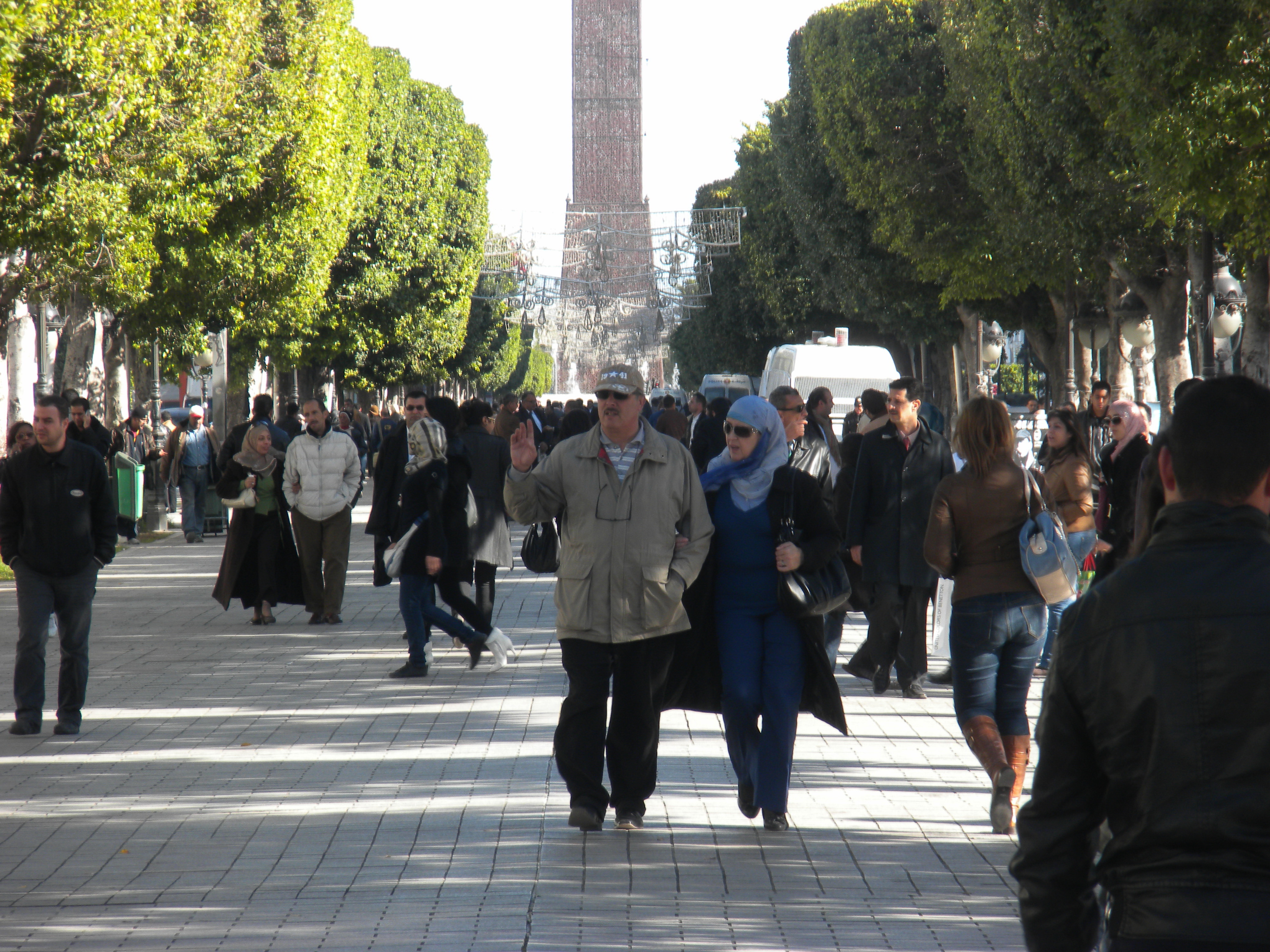
Ave. Habib Bourguiba, Tunis, December 2011
Related pieces: The World Bank/IMF’s Strange Fruit: Uprising in Tunisia
Notes to presentation…Rob Prince (These remarks are specifically about Tunisia)
“The Political Economy of the Magreb Spring and Its Aftermath” – The Magreb Center. Washington DC. April 24, 2012
Thank you to the Magreb Center– for Nejib Ayachi for inviting me back. Pleasant surprise. I note that not accidentally, this panel discussion takes place at the same time as the annual meeting of the World Bank and International Monetary Fund here in Washington DC.
I would add here, that thanks to the help of the Tunisian Community of Colorado – small but active – I was able to spend nearly a month in Tunisia from late November to late December of last year.
My visit to Tunisia was both promising and unsettling. Promising, because the political atmosphere was more open that it has been in half a century.
Unsettling, because the course ahead, as with other great reforms, is not entirely clear and from the point of view of political economy, not much has changed, if anything, but minor tampering with the model that just collapsed. Read more…
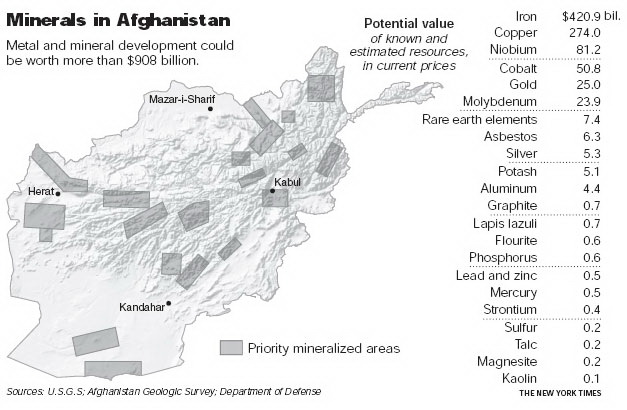
Afghanistan's Mineral Wealth...source: NY Times
On Mar. 15 the Taliban ended preliminary talks with Washington, because, according to a spokesman for the insurgent organization, the Americans were being “shaky, erratic and vague.” The smaller Hizb-i-Islami group followed two weeks later. Read more…
No Attack On Iran! – Flyer Distributed by the Colorado Coalition Against Attacking Iran
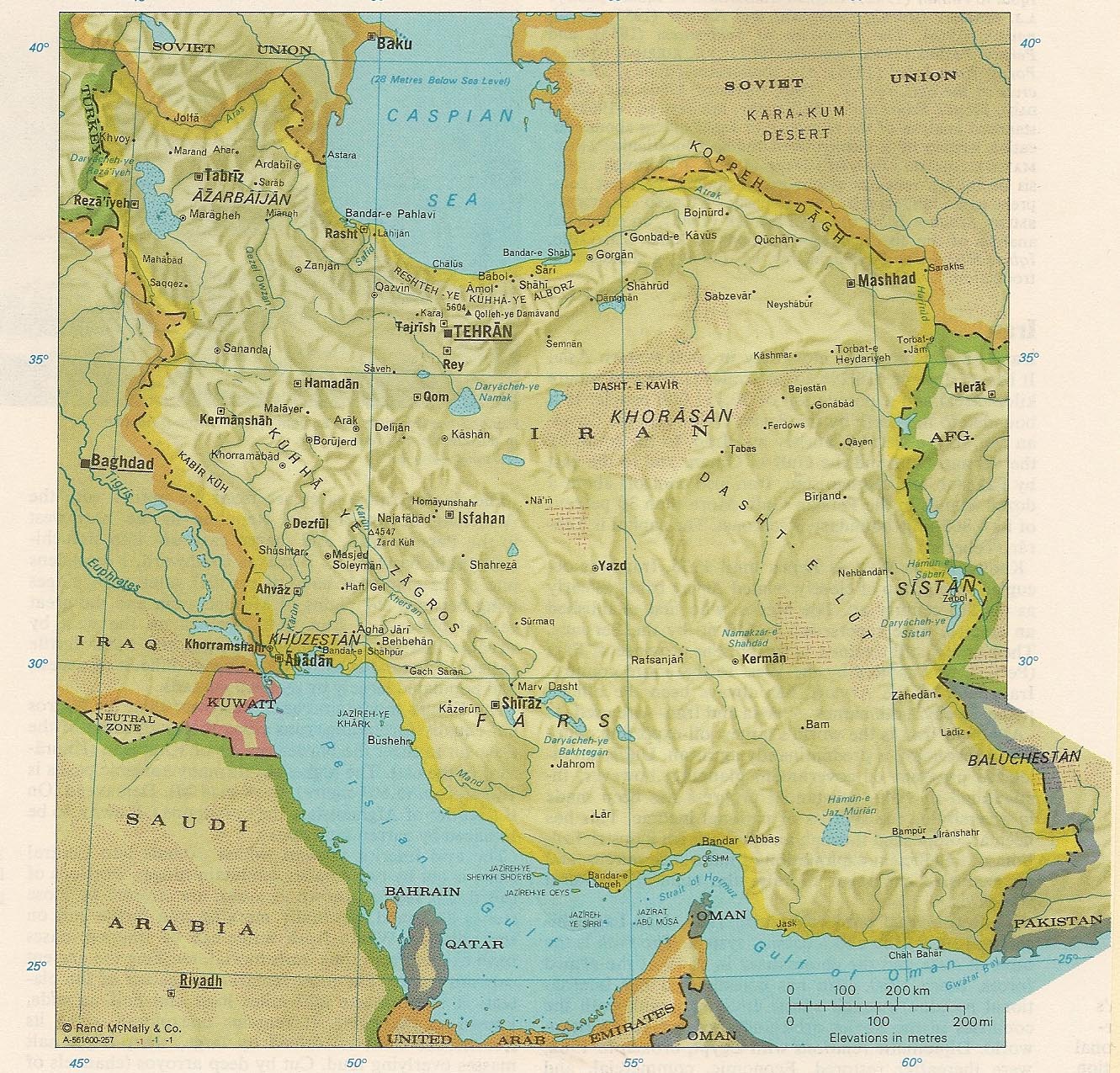
Iran
“Wars are how God teaches Americans geography.” Stephen Fry
________________________
NO ATTACK ON IRAN!
Attacking Iran would be a triple disaster:
Political disaster Attacking Iran will NOT make us, Israel or anyone else safer; instead, it will:
- Punish a country that, inspectors say, is not now building nuclear weapons, even though Israel, India and Pakistan already have them;
- Trigger an Iranian response, ignite the volatile Mid-East when the US is still stuck in Iraq and Afghanistan;
- Poison relations with China, India, Russia among others;
- Possibly lead to the use of nuclear weapons by Israel or the United States;
- Make every other country want nukes as the only safeguard against being attacked.
Economic & environmental disaster Attacking Iran will:
- Send the price of oil through the roof, rewarding speculators, punishing the rest of us with soaring prices for food, fuel;
- Destabilize the economy which is barely recovering from a severe recession;
- Divert resources from education, health care, and rebuilding infrastructure; increase the national debt already out of control;
- Reduce the value of the dollar, inflating the prices we pay for consumer goods ;
- Devastate poor countries by increasing energy costs.
- Destroy the Iranian economy for decades to come.
- Poison the land, sea and air for generations.
Moral disaster – Attacking Iran will:
- Kill many thousands of Iranians, many of them children;
- Produce widespread hunger, disease, and permanent disabilities among civilians;
- Make us an international outlaw — an unprovoked attack is illegal, the ultimate crime against humanity is aggressive war;
- Make millions of people hate the US – again.
Stop the war on Iran before it starts!
Conference: Sat., May 12, 9am: 1st Unitarian Church, 1420 Lafayette, Denver.
Colorado Coalition Against Attacking Iran (C-CAATI) AgainstAttackingIran@gmail.com https://sites.google.com/site/cocaati/
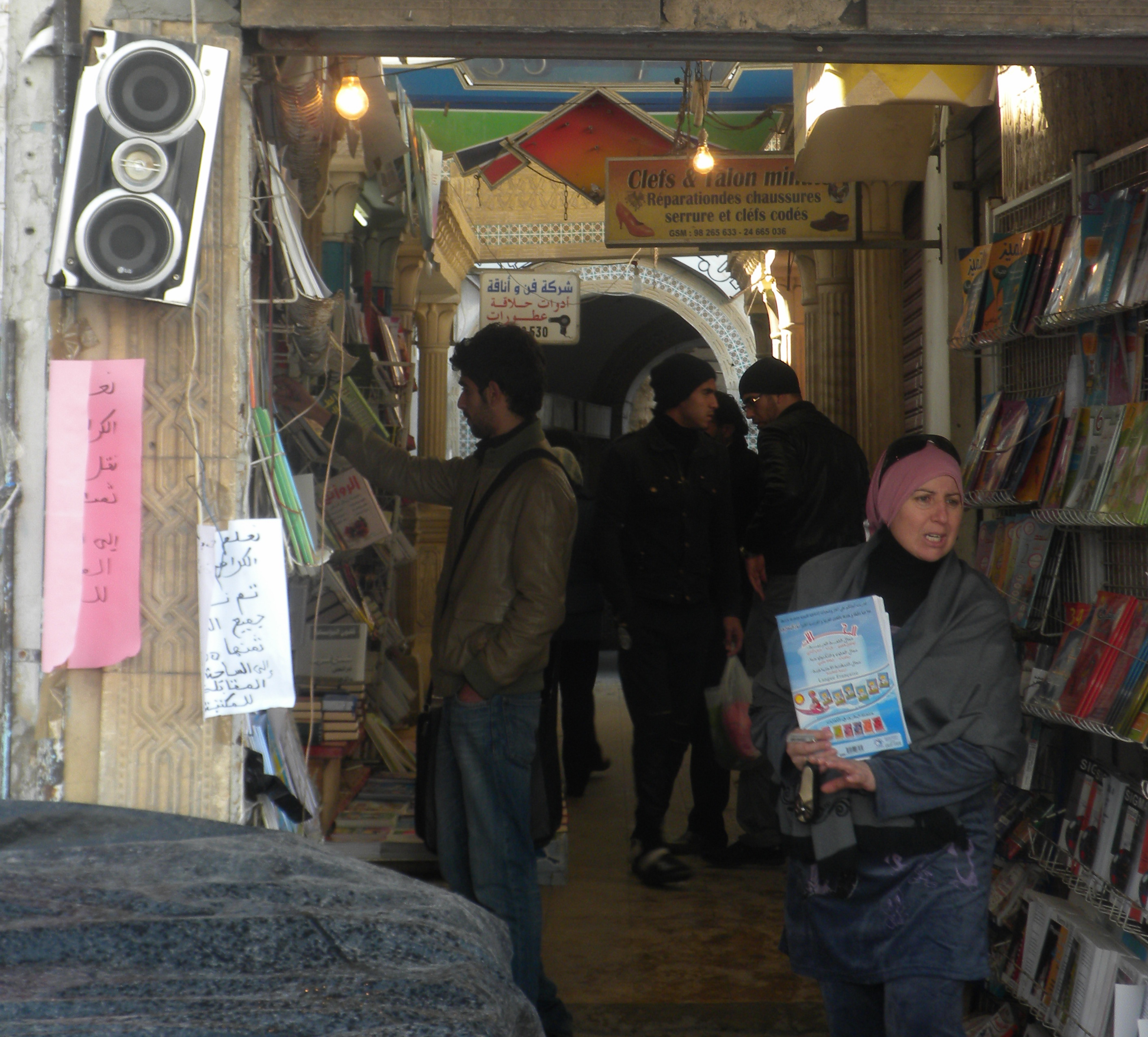
Salafist bookshop in the Tunis medina, at what used to be called `Place des Israelites'...
by Ibrahim Kazerooni and Rob Prince
____________________
Note: This piece also appeared in Foreign Policy In Focus
____________________
In March 2004 , one of us submitted an op-ed to Denver Post titled “Wahhabism is a threat to World Peace.” The article posited that it was of no wonder that Wahhabism, the official religion of Saudi Arabia, has become the philosophical guide for terrorist organizations like al-Qaeda and Taliban. It fits the terrorist mentality well. Its pseudo-philosophy dictates dogmatic, outward acts of worship and rigid intolerance to others; its opposition to any refinement of Islamic culture, philosophy, theology, and the arts freezes cultural innovation. Its austere and regressive world view, and with its inflexible doctrine sows intolerance, discord, sedition, violence and hatred in the Muslim world and elsewhere.
Still, we are not surprised that a piece like this never saw the light of day in the American mainstream media. It might be difficult to openly criticize Israel’s treatment of the Palestinians; It is even more difficult to challenge the Saudi regime.
____________________________
The critical question that bewildered everyone was the total support of the successive US administrations provided to Wahhabism and its enigmatic and more palatable sister Salafism. Salafism is the older literal interpretation of Islam out of which Wahhabism emerged in the 18th century. Wahhabism is the official religion of Saudi Arabia. Wahhabism and Salafism, while slightly different, remain closely related. The Saudis and the Gulf States support Salafism, seeing it as a step towards creating a Wahhabist-dominated Middle East.
Wahhabism: Anathema to U.S. policy…or strategic ally?
On the surface it would appear that Wahhabism – a form of radical Islamic fundamentalism – would be an anathema to U.S. and European `values’ and that in fact, it is against precisely this form of Islam that the war on terrorism is being fought. History tells another story. Closer, more carefully analysis of U.S (and earlier British) Middle East policy suggest quite a different picture: that for nearly a century both American and British policy makers not only made their peace with Wahhabism (and Salafism) but have been in close cooperation with these movements throughout, and even more so today. Read more…

Berra and Marilyn Barden - Turku-Marienheim Ferry, July, 1987
An email from old friend and companera, Marilyn Barden, this morning. Her husband, Berra Barden, died in his sleep last night in a nursing home near their home in Varmo, Sweden. Berra was 88. A man with a gentle wit and sharp mind, he was a fine political cartoonist and life long socialist who has watched Sweden’s lurch to the right politically `the Americanization of Sweden’ these past years with consternation. The Bardens and our family were a part of the same circle during our Helsinki years in the late 1980s. We visited their Varmo home outside Stockholm several times and have remained in touch with Marilyn and Berra all these years. Here is an extract from Marilyn’s email announcing Berra’s death. A daughter, Molly, preceded Berra in death.
“Berra, my husband since 51 years left us last night. After 2 weeks in hospital and a new pacemaker he was sent to an elder centre for sick people. He was therefore 10days and got more and more tired despite good care. He passed on in his sleep at 10.15 last night. He had his stroke 15 years ago and despite that has had a relatively good life. He was 88, older than any of his relatives and got to love and hug both children, grandchildren and great grandchildren. They and dogs were his real loves, aside from me. A huge golden retriever who worked as care dog at the centre jumped up in his bed and lay there with him for a long time. It is more and more common with dogs working in elder care centres. Jenny and family are on ski holiday in Northern Sweden but are coming home today to say goodbye to grandfather. Rebecca is here in Stockholm and after several years of misunderstandings Berra got to experience a loving daughter again. We will have memorial ceremonies in our home for friends and family in a couple of weeks. He will be cremated as he wished and the ashes will be spread in the beautiful memorial park in our Varmdo cemetery where Molly is buried.”
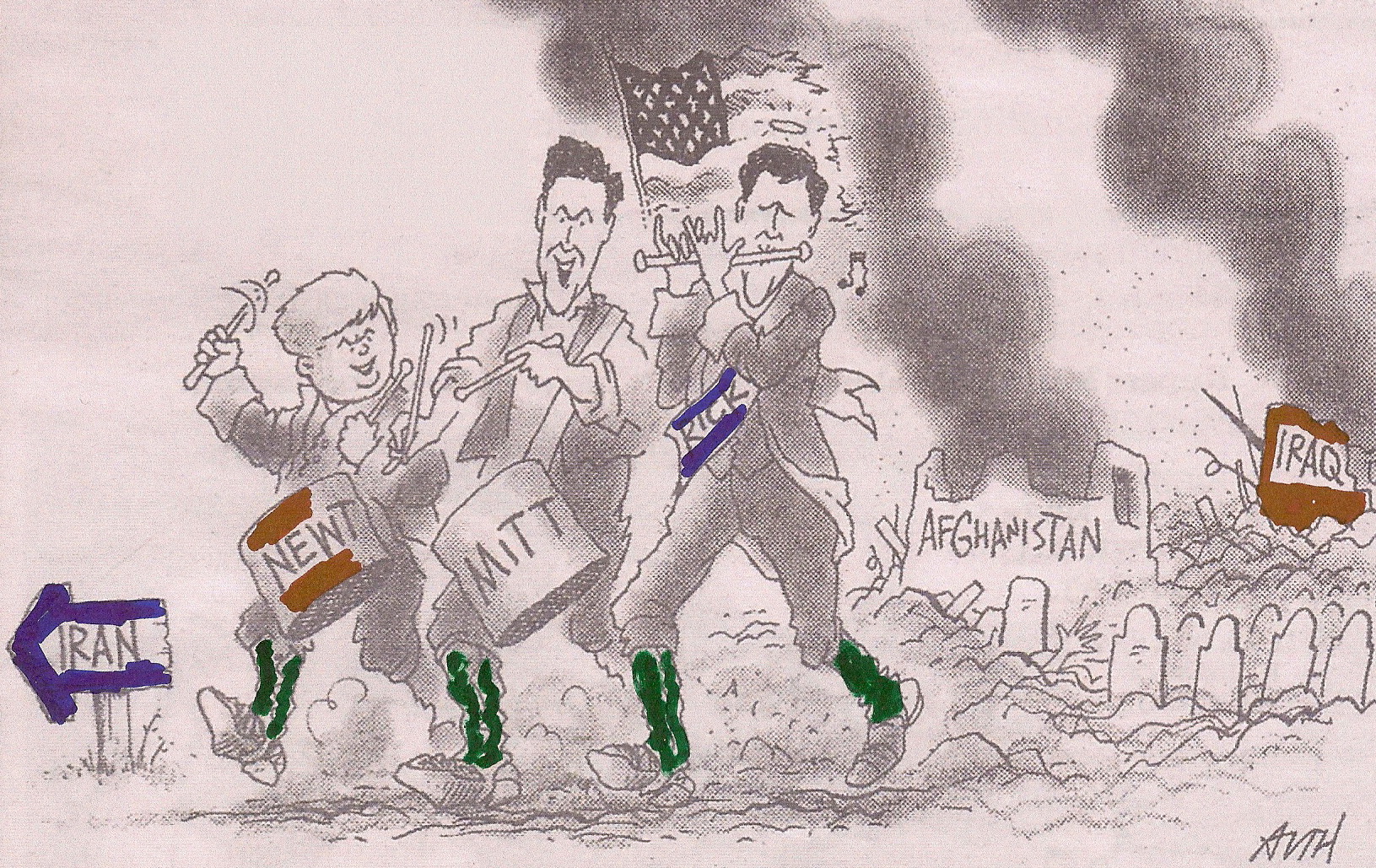
Waltzing To War Again?
(note: This is an initial call for the conference. It is meant mostly for people living in Colorado; but hopefully those of you living elsewhere might do likewise)
______________________________
Call for a Statewide Peace Conference to Oppose Attacking Iran
Dear Friends,
The cry for an attack on Iran has reached unprecedented, near-hysterical proportions in certain well known quarters.
Like the period before the attack on Iraq, many of the same themes are at play with many of the same players trying to drive our country to war again: creating or greatly exaggerating a threat; vilifying the country’s leadership to suggest that they are `crazy’ and capable of anything; the pliant media that swallows pro-war propaganda and spit it out as truth.
Far from preventing Iran from developing nuclear weapons, an attack would justify their pursuit and will in all probability trigger a regional if not world war, in anticipation of which oil prices have spiked and threaten to a global recession if not worse.
Our elected representatives both in the Oval Office and in Congress who succumb to this propaganda are complicit in dragging us once again down the path to death and destruction as they have in Afghanistan, Iraq, Yemen and Somalia.
We must stop this madness
With this in mind, the Colorado Coalition Against Attacking Iran was formed recently with representatives from Boulder, Ft. Collins and the Denver Metro Area.
The Coalition is already active:
One of our first steps is to organize a conference on Saturday, May 12, at the First Unitarian Society of Denver Church (14th and Lafayette) in Denver from 9 am to 5 pm. The goal is to organize a Colorado statewide campaign to oppose attacking Iran and for re-orienting our country’s priorities toward rebuilding our fragmented and devastated communities. (Detailed program will follow)
We, the undersigned, long-time Colorado peace activists, endorse this conference and urge you to help build the conference and the campaign to stop yet another insane step toward the abyss. Please contact the Coalition to invite speakers to your area or organization to build the Conference and Campaign.
You can contact the coalition at:
https://sites.google.com/site/cocaati/
or contact:
Tom Mayer: Thomas.Mayer@Colorado.Edu
Ibrahim Kazerooni: mikazerooni@gmail.com
Rob Prince: robertjprince@comcast.net
Yours,
Gary Anderson
Ida Audeh
Bijou Community, Colorado Springs
Citizens for Peace In Space, Colorado Springs
Clair Cafaro
Arnie Carter
Stuart Chase
John Cruikshank
Beth Daoud
Cheryl Distaso
Bill and Genie Durland
Lynn Farquehar
Nancy Fey
Ron Forthofer
Mary Ellen Cuthbertson Garrett
Alan Gilbert
Barbara Hanst
Nader Hashemi
Pat Hewett
Ibrahim Kazerooni
Bob Kinsey
Leslie Lomas
Tom Mayer
Jan Miller
Judith Mohling
LeRoy Moore
Sally Netzl
Elizabeth Ordonez
Peter Peterson
Rob Prince
Michael Rabb
Tom Rauch
Ken and Mag Seaman
Lynn Segal
Cheryl Stevenson
Arnie Voight
Doug Vaughan
Ernesto Vigil
Evan Weissman
Jim Wilkinson
Dan Winters
Phil Woods

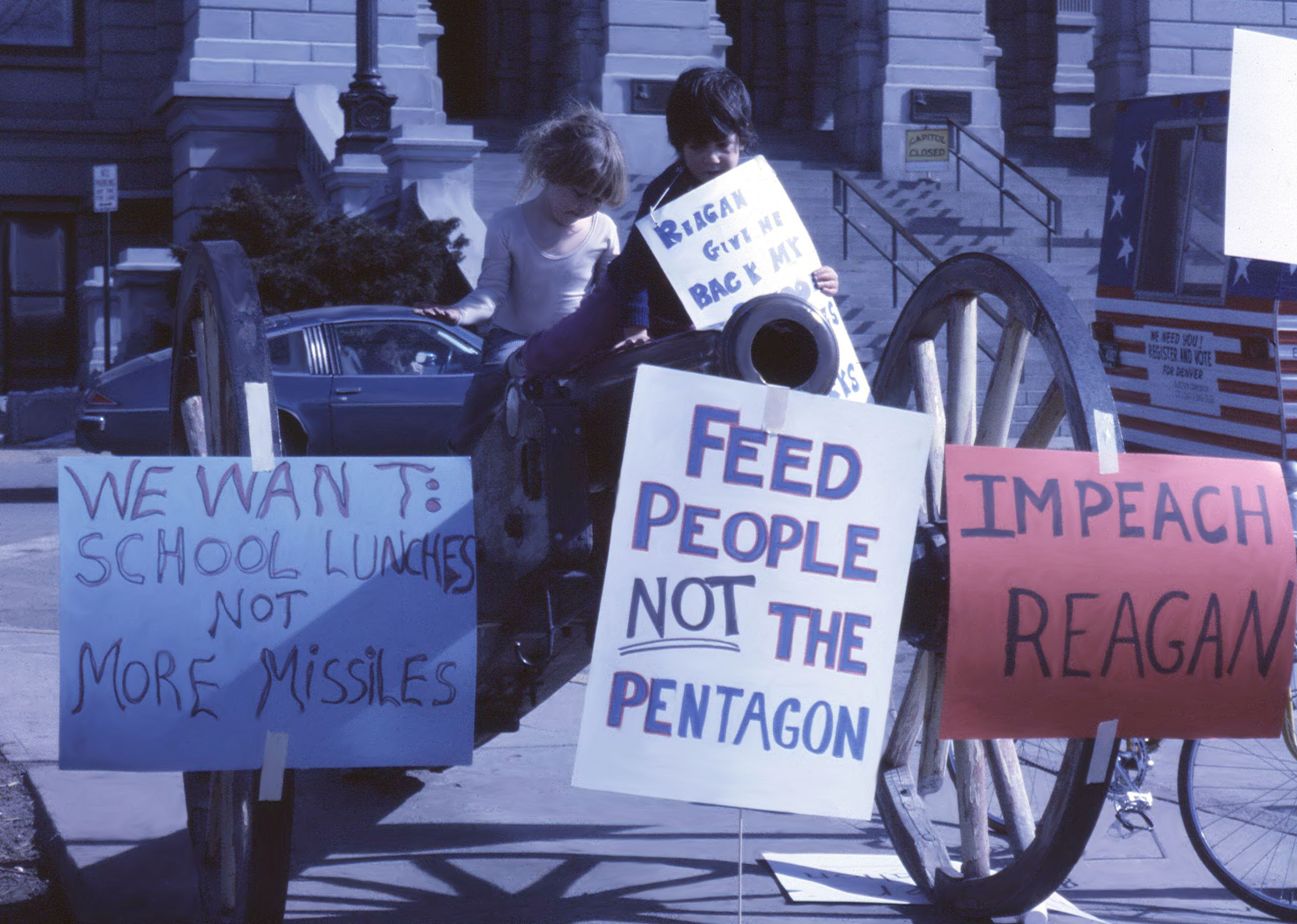
February 1982 protest against the Reagan military build up, Denver, Colorado
Links:
Obama and Netanyahu: Horsetrading Iran For Palestine – Part One
This piece appeared under a different title in Foreign Policy in Focus
_______________________
Part Two
By Ibrahim Kazerooni and Rob Prince.
1.
Thirty years ago, the Reagan Administration went on a crash program to increase the U.S. military budget, cut social programs, escalate the nuclear arms race to a degree unprecedented during the Cold War (1945-1989) and revive U.S. interventionalism in the Third World.
Looking back, it’s not hard to discern the Reagan Strategy:
– most of all – either fabricate or greatly exaggerate `the threat’, giving the impression that `the end of the world’ is at hand through nuclear holocaust
– surround the Soviet Union with U.S. bases, with sea-based Trident submarines, – a single sub armed with possibly 154 nuclear warheads
– impose an economic embargo and engage in counterinsurgency
– construct an anti-communist alliance (NATO)…
– use the nuclear arms race to push the Soviet Union to the limit makin it difficult for the communist government to both re-tool its economy and keep up with military expenditures at the same time
It worked.
Understanding that the USSR could not participate in an arms race and reform its economic and political structures at the same time, Mikael Gorbachev tried to reduce global tensions to reshape his country economically. But it was too little too late – the USSR had long before lost its moral compass; its economy was so hopelessly grid-locked that reform proved impossible. The whole structure collapsed, with the World Bank and IMF finishing off what remained of Soviet Communism with their punishing structural adjustment programs in exchange for financial aid.

June 1982 demonstration against the nuclear arms race - State Capitol, Denver, Colorado. More than 20,000 came. Jimmy Buffett and John Denver sang.
2.
Fast forward to today.
A similar political witches brew, with slight modifications, is being concocted to bring down the Islamic Republic of Iran…one way or another by both the USA and Israel. The exaggerated threat, the vilification of the Iranian leadership, the economic boycott, the ring of military bases surrounding Iran combined with the presence of a naval armada in the Persian Gulf all follow the Reagan prescription for triggering Soviet collapse. The much inflated Soviet threat has been replaced by the much inflated Iranian threat; the anti-Iranian coalition has replaced the anti-Communist crusade. Add to that the new, often insidious role of NGOs and special forces operations and the more modern day version of `regime change’ – ie, overthrowing governments, comes into focus.
These last months both the United States and Israel have ratcheted up the anti- Iranian rhetoric to an unprecedented level reaching a new crescendo of hysteria in Netanyahu’s March 5, 2012 speech before AIPAC. The Obama and Netanyahu administrations have painted Iran with such dark colors that should they want to change gears and NOT attack Iran, they would have difficulty explaining it to their peoples who have been worked into a frenzy; it is reminiscent of the media build up preceding the March 2003 U.S. led invasion of Iraq, or as one colleague compared put it – the period just before the outbreak of World War One.

Anti-nuclear peace conferene, Prague, Czecheslovakia, April, 1983
3.
With an election around the corner, Barack Obama is trying to cool down the flames and put the brakes on the very sentiment his administration has helped unleash.” Too much war talk,” the president told a meeting of AIPAC, that powerful and reactionary pro-Israeli lobbying group a few days ago! Unfortunately, that message was embedded in an otherwise groveling-to-AIPAC, militaristic series of remarks about Iran which watered down Obama’s `message of peace’
Cut out the war talk?
It suggests that the Obama Administration does not want to attack Iran, and does not want Israel to do so… for now, at least until after the elections.
But if Obama and his defense secretary, Leon Panetta, are saying this is not the time for an invasion, Israel’s Benjamin Netanyahu along with the Republican Party presidential candidates, neo-conservatives, Zionist organizations in the USA like AIPAC , the looney tunes Christian Zionists like Hagee and his band of `end-of-the-worlders’ are all pushing hard for military intervention.
Do they mean it? Is it not, as Colorado peace activist Arnie Carter suggested`just plain nuts’ to engage Iran militarily?
What is crystal clear is that for different reasons, both the United States and Israel are doing their utmost to overthrow the Islamic Republic. The means by which they hope to accomplish this is more a tactical than a strategic question at this point. But the indications are growing that any planned major military action – if it indeed takes place – will be put on hold until after the November 2012 U.S. presidential elections. Unleashing a war against Iran now with all its possible complications could cost Obama the elections and he will do what he can to avoid it.
Obama’s caution on attacking Iran is clashing with Netanyahu and American Republican presidential hopeful’s recklessness. Netanhayu and the Republicans are using the increased Iran war talk to pressure Obama.
What is going on here?
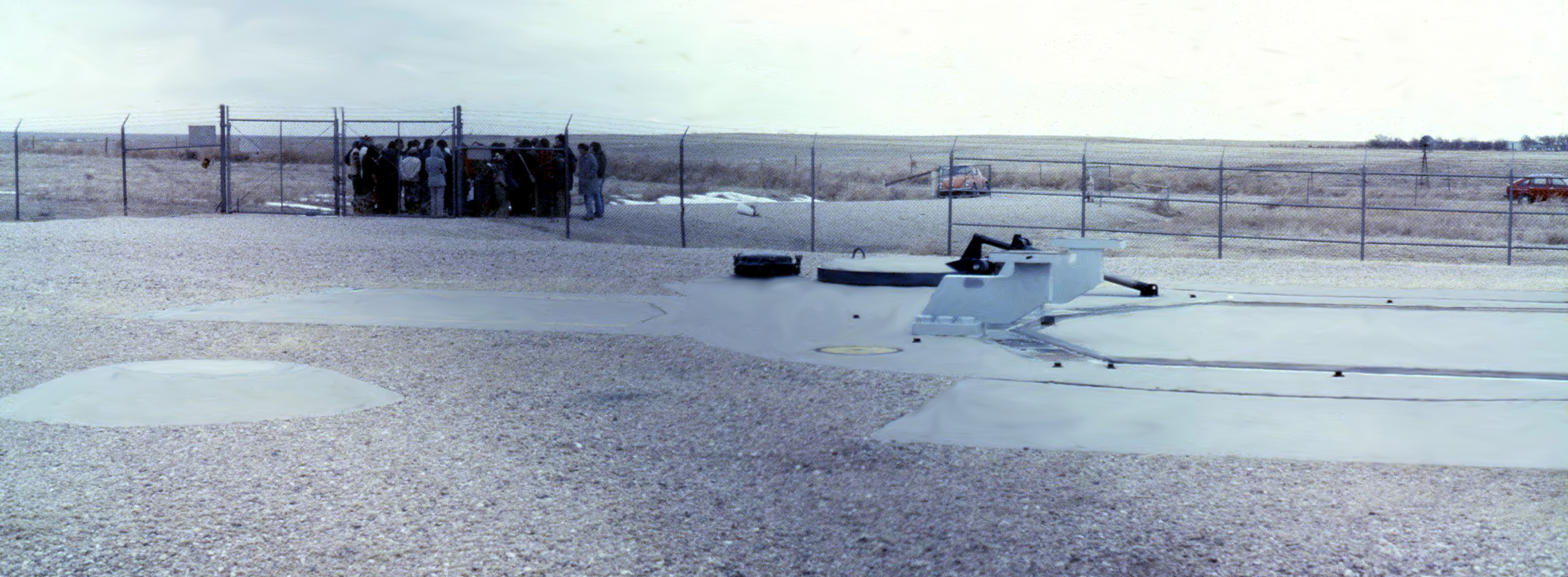
Protest-Prayer Vigil, MX Missile Silo, N.E. Colorado, April, 1982; the silos and the missiles are still there as well as in N.W. Nebraska, S.E. Wyoming
4.
As stated in Part One, we believe Netanyahu is talking tough on Iran in an effort both to weaken Obama’s chances for a second term and to press the President for major concessions on the Palestinian issue (more settlements, complete annexation of Jerusalem, even greater integration into US strategic operations in the region).
As for the Republicans, throughout the primary campaign, other than attacking each other, the main candidates have failed to come up with an issue to get traction against Obama.
Attacking Charles Darwin just didn’t fly; not even the abortion issue is getting the attention it used to. Balancing the budget on the backs of the unemployed, working class and middle classes while cutting taxes for the rich does not seem to have the appeal it used to either.
Now the Republicans think they have come up with the answer: using the Iran issue to create global jitters which push up oil prices which in turn, among other things, threatens the weak economic recovery here in the United States. This could not only hurt the fragile U.S. economy but undermine the weak global recovery. Having contributed in large measure to the oil jitters and understanding well its consequences, then they attack Obama for the economic slowdown. Nice!
Openly nervous, Obama made reference to the spike in oil prices in his AIPAC talk and called for a toning down of the rhetoric. In an effort to drive oil prices back down again he has continued since his AIPAC speech to publicly challenge the Republican hopefuls on Iran, calling their tough talk bluff. Obama and his coterie have responded to their offensive by arguing that the sanctions against Iran are working.
The rational case against a US and/or Israeli attack on Iran has been repeatedly stated1 (see end note 1).
There is now another consideration that enters the picture, the Syria crisis, which Obama is also using as a pretext for not attacking Iran. Regardless of outcome of the present crisis there, the Syrian regime will be weaker and accordingly, its regional coalition with Iran, Hezbollah and Hamas somewhat diminished in strength, placing Iran in a more difficult, weaker position visavis the U.S. and Israel. Iran will be more isolated – it is only a question of how much more. Hamas has already jumped ship (with promises of Saudi and Qatari money?) from the Iranian-Syrian-Hezbollah-Hamas alliance. Attacking Iran at this moment (or a Libyan NATO-like invasion of Syria) could only bring together and unify what is an increasingly less potent Iranian-Syrian-Hezbollah alliance.
But if the timing is not right for a U.S. and/or Israeli attack on Iran, will the plans for military intervention turns to Syria?
Ibrahim Kazerooni is finishing a joint PhD program at the Iliff School of Theology and the University of Denver’s Korbel School of International Studies in Denver and publishes on Imam Kazerooni Blog
Rob Prince is a Lecturer of International Studies at the University of Denver’s Korbel School of International Studies and publisher of the Colorado Progressive Jewish News
________________________
End note:
1.1. It would probably further strengthen the authority and position of the mullahs, uniting the Iranian nation against the outside aggressor (as the threats have already done) and weakening the democratic movement in the country considerably.
2. There is nothing to indicate that invading Iran – whatever shape the military action might take – would result in the collapse of the government there as it did in Iraq in 2003. Without overstating the case – the 2009 protests revealed deep fissures within the country – still, the current government in Iran has considerable mass support. It is easy to forget one of the worst wars of the 20th century – the Iraq-Iran War of 1980-1988 when Ronald Reagan, Henry Kissinger and the like argued that supporting Iraq would result in the collapse of the Iranian regime. Didn’t happen then; won’t now either.
3. If war did break out, it would probably not be as one-sided as the U.S. led 2003 Iraq invasion where the Iraqi military all but collapsed. Iran is in a position to hurt the U.S. and its closest allies in the region militarily and politically. A `shock and awe’ type military offensive would cause great suffering in the country, but it is doubtful such a campaign would either bring down the regime, or for that matter, eliminate its potential to strike back militarily and politically.
4. Although rarely discussed, the U.S. actually needs (and cooperates with) Iran for stability in both Iraq and Afghanistan. Any U.S. military operation against Iran would seriously undermine the U.S. position, already quite tenuous, in these two countries. The U.S. military is obviously much stronger, but in any war, you can expect that there will be serious U.S. casualties with the naval fleet in the Gulf being essentially sitting ducks. Then there are the Saudi (and Kuwaiti and Emirates) oil fields. One has to be either pretty stupid or blinded by arrogance to believe the strategic resources the U.S. military is in the Middle East to protect, would not be hit in the event of war.
5. An attack on Iran – or some kind of regional military confrontation involving Iran, Israel, the US and other regional players – would almost certainly lead to a spiking in the world price of crude oil, something which could easily cause the current very weak global economic recovery to collapse. Such price increases would seriously undermine both the European and East Asian economies that are more reliant on Gulf oil than the USA.
 View from the Left Bank: Rob Prince's Blog