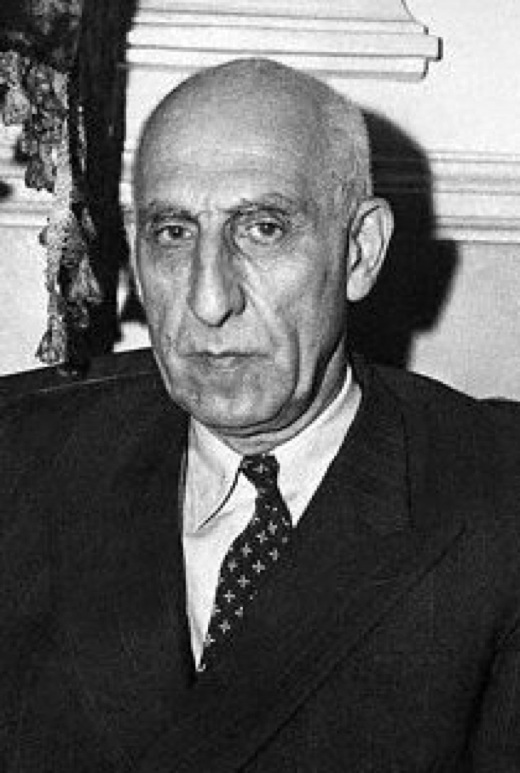
Mohammed Mossadegh, Iranian prime minister who nationalized Iranian oil and was overthrown in an C.I.A. orchestrated coup d'etat in 1953
(Note: this article appeared at Foreign Policy In Focus : for Part Two of the series, click here)
Part One:
By Ibrahim Kazerooni and Rob Prince.
In politics, a `gaffe’ is a politically inconvenient truth. The `first’ George Bush committed a gaffe when he said that the idea that cutting taxes would increase government revenue was “voodoo economics”. Similarly, it was a gaffe when Barack Obama said that insecure right-wingers “cling” to religion and guns.
Israeli Defense Minister Ehud Barak gaffed big-time last November. This gaffe is even more colossal than what he said back in 1999 that if he were a stateless young Palestinian, he would “have joined one of the terror organizations”.
Barak’s November 2011 remark is breathtaking in both its honesty and in its deviation from Israeli government line (Iran being an existential threat to Israel, Europe and the rest of the world) that has not only been sold to the Israeli people, but also to the United States government – especially to Congress, where anything from Netanyahu’s office is treated as gospel.
Appearing on PBS’ Charlie Rose, Barak was asked if he would want nuclear weapons if he were an Iranian government minister. He said he probably would. Read more…
Notes from `Syria Panel’ – University of Denver – Korbel School of International Studies

Syria…
Links:
– Conn Hallinan: Syria – A Way Out?
– Hamid Dabashi: Syria Caught in a Proxy War
_____________________
Note on the Notes (August 31, 2013)…What follows was written 18 months ago… given the much anticipated air strike against Syria there have been many hits on this particular site in the past days…It is a reflection of how three different panelists saw the conflict in Syria at that time. What is interesting is the degree of unity that existed them among the three – ie – the crisis could only be solved politically, not militarily. Since then the views of the three have diverged some.
_______________________
A panel discussion was held on March 1, 2012 at the University of Denver on the escalating bloodshed in Syria. The participants were:
Christopher R. Hill, Dean of the Korbel School of International Studies
Jonathan Sciarcon, Assistant Professor of Jewish History, University of Denver
Rob Prince, Lecturer, International Studies, University of Denver, Korbel School of International Studies.
The forum was sponsored by the Middle East Discussion Group at the Korbel School
The panel was well attended – not sure of the number but believe there were 75-100 in the audience, mostly University of Denver graduate and undergraduate students. Read more…
Colorado Progressive Jewish News Blog Surpasses 100,000 Hits…

Iran Videos: The Overthrow of the Mossadegh Democracy in 1953

U.S. Bases Surrounding Iran...Who's Threatening Whom?
Mossadegh – Stephen Kinzer – Iranian Democracy
Operation Ajax: Iran and the CIA Coup of 1953 (Part One)
Operation Ajax: Iran and the CIA Coup of 1953 (Part Two)
John Perkins: The Secret History of the American Empire – starts 4 minutes into the video
British and American Coup Topples Dr. Mossadegh in 1953 (Part One)
British and American Coup Topples Dr. Mossadegh in 1953 (Part Two)
British and American Coup Topples Dr. Mossadegh in 1953 (Part Three)
British and American Coup Topples Dr. Mossadegh in 1953 (Part Four)
Norman Finkelstein on the viability of a 2 state solution to the Israeli-Palestinian Crisis

Illegal Israeli Settlements in the Palestinian West Bank
(Note, originally written in 2012, now seven years later, at the end of 2019, I have revised it. The message is the same… just updated with a few additional thoughts).
________________
During World War II, the small (population wise) nation of Finland – seeing the writing on the wall after the Soviet victories of Stalingrad and Kursk – switches alliances, literally, from being an allied to the Nazis to becoming a partner with the Allies (USSR, US, UK, France). That dramatic turn about saved Finland as a nation – and very much saved it from a postwar Soviet Occupation.
Israel should learn from Finland.
________________
The link here is to an interview that Norman Finkelstein gave in early February 2012 in Great Britain. It runs about a half hour. In it Finkelstein lays out, concretely and I believe as effectively as anyone, why a two state solution to the Israeli Palestinian conflict remains not only viable, but quite frankly the only possible viable solution to ending the conflict. He has not, to my knowledge, abandoned this position, but has come to the conclusion that the possibility of getting to a two state solution is “dead” – killed by the explosion of illegal settlement growth, by U.S. support of Israelis proposed annexation of portions of the West Bank.
With the possibility of an overall political settlement fading, now the challenge is oppose the strangulation of Gaza, the increasingly heavy and unremitting oppression of Palestinians in the West Bank.
In a recent interview, Finkelstein commented:
Asked about the prospect of a settlement of the Israel/Palestine question in the near future, Finkelstein was not optimistic. He said that, for the moment, solidarity activists should focus on pressuring for the lifting of the blockade of Gaza. He stressed: There’s no political prospect of two state, one state, no state, ten states. It’s not on the drawing board now… There’s a horrific, illegal, immoral, inhumane blockade of Gaza. We have to focus on what’s possible. I think lifting the blockade of Gaza is a possibility.
For Finkelstein, there are now a series of impediments to reaching a two-state solution: The game-changers have been: the open Saudi alliance now with Israel; the fact that there’s been a succession of humanitarian crises in the Middle East which have overshadowed the Palestinian question; the fact that there’s a completely corrupt, collaborationist leadership among the Palestinians, which is incapable of inspiring any sacrifice by Palestinians or inspiring people abroad; and there has been the fact that the struggle has died in the West Bank. There has not even been any political mobilization in the West Bank in support of Gaza. It’s nothing. There is no resistance anymore. And as a result of all of those factors, the two-state solution is dead.
This is a harsh, but not unrealistic take on the state of affairs coming from someone who has shown such integrity.
Finkelstein – after being popular – almost an icon – in left circles – is today shunned in many of these same circles because of what has been over the past decade – his current pessimism aside – his clear cut position in support of a two state solution. I believe that the quality of his intellectual work will endure and regret that the movement for Middle East peace is so politically immature and factional that it would treat him so cavalierly (or worse).
I remain – after forty years of working on this issue – committed to that solution, and simply want to publicly reiterate that position, as unlikely as it is to be realized. Yes, the two-state solution IS dead. There is nothing – in terms of an overall solution – to replaced it, ie, that is on the international drawing board although it remains the stated position of the International Community, the United Nations – both the General Assembly and the Security Council.
In the end ideologically challenging Zionism has two aspects to it – the first is the de-construction of the Zionist narrative, making the desert bloom, “the only democracy in the Middle East” and simply poppy cock. The on-going Israeli mistreatment and ethnic cleansing of Palestinians in the Occupied Territories, the increased restrictions on citizenship of Palestinians living within Israel by themselves have done much to undermine the Zionist narrative. Don’t need complex historical analyses – just watch the news of Israel’s murderous Gaza policies. But there IS plenty of solid research to substantiate the claims that Israel is little more than a settler state with a record on non-stop brutality against the Palestinian people. Read more…
Shifting Targets: Iran in the Crosshairs Again…
 1.Republicans having troubles `finding their voice’
Although there is time for some kind of a comeback, at present, the Republican Party campaign to win back the U.S. presidency continues to implode almost daily. The three most likely candidates at this point – Romney, Santorum and Gingrich – continue to duke it out nationwide. Each of the three contenders has struck stunning blows to their opponents, the result being all three have lost the temporary momentum each once enjoyed. Now, some nine months before the election, it’s difficult to see how the Republicans can turn the situation around.
The Republicans have had difficulty `finding the issue’ that might ride both them individually and the Republican campaign to victory. There is already talk of a possible stealth candidate emerging at the Republican convention, but even then, it will probably be too late to effect the outcome without some `dramatic’ event. Read more…
Tunisia Crossroads…
Tunisian Cross Roads..

The mosque at Amilcar
(note: this piece – slightly edited – well more than slightly edited and greatly improved by the editors I might add – is now posted on Foreign Policy In Focus)
Links:
Robert Fisk: Poisoned Spring: Revolution In Tunisia Brings More Fear Than Freedom. The Independent. February 21, 2012
____________________________
1.
A little more than a year after its onset, some of the bloom is off the Arab Spring rose. The region looks to be a much more sober place than it was then.
Tunisia is often portrayed as a bright spot in this increasingly somber regional picture. It did have an orderly election, has put together a three party coalition transitional government and now has a constituent assembly in its legislature working on a new constitution. The country appears on track to elect a more permanent government, as promised, during the next year. It is not inaccurate to note, despite the problems it faces, compared to its neighbors – ney – to almost any country with a Mediterranean sea coast, minus perhaps only one or two, Tunisia is more stable, and seems to have the possibility of coming out of this crisis better than the others.
The Obama Administration generally supports the changes in Tunisia. Attempt to resurrect the American image throughout the region and to give credence to U.S. support for the Arab Spring, Obama is `playing the moderate Islamic card’ and gambling on the prospect that ultimately the structural changes taking place in Tunisia will not be that great. For all its problems, Tunisia is the most stable place in the Magreb for a major U.S. embassy to monitor the Magreb and the Sahara. It’s new `moderate’ Islamic direction includes an unambiguous commitment to neo-liberal economic policies, achieved ironically without a Chilean-like C.I.A. directed coup or an Iraqi-like U.S. led military intervention. For Washington it’s like `having their cake and eating it too’ on both counts.
But all this is somewhat overstated and misleading. Read more…
World – Oil and Gas Pipelines…
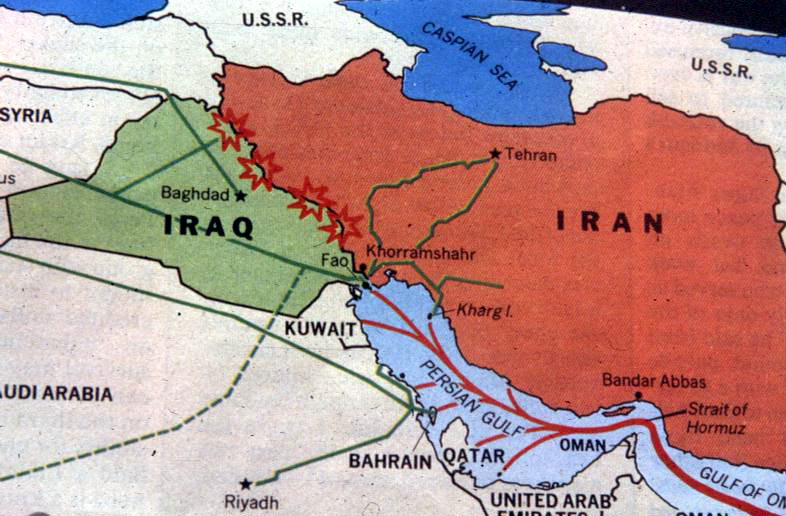
Middle East - Oil Pipelines
A collection of oil and natural gas pipelines from different places around the world. I’ll be adding to this entry over time
Finland (and a little Estonia) – photos from Summer, 2011

Nancy picking blueberries near Salameh in central Finland - July, 2011
A summer in Finland after 21 years. We enjoyed ourselves, spending most of our time with old friends. It remains a stunningly beautiful country, although its knockout social programs are somewhat weaker and the polarization between rich and poor – hardly noticeable in the late 1980s – is striking today, the impact of neo-liberalism somewhat eroding this bastion of Nordic social democracy.
Click here for the photo album posted on google photo. I’ll label them over the next few days
Tunisia: Bourguiba and Tunisian Women (videos)
Bourguiba and Tunisian Women (Part 1) …in French
Bourguiba and Tunisian Women (Part 2)…in French
Bourguiba and Tunisian Women (Part 3)…in French
The Amilcar Notes -10 …Remembering Farhat Hached: An Afternoon with `We Love Kerkennah’

`We Love Kerkennah’ participants at Farah Hached’s mausoleum. photo credit: `We Love Kerhennah!`
- 1. We Love Kerkennah!
It was December 4. The next day, December 5, would mark the 59th anniversary of the assassination of Farhad Hached, founder of the Union Generale des Travailleurs Tunisiens (UGTT) – the national Tunisian trade union movement. Nationwide commemorative activities were planned to mark the occasion. On December 5, 1952, Hached was gunned down by a French paramilitary hit squad called La Main Rouge (The Red Hand).
Fifty nine years after his murder, Farhat Hached remains nothing short of a much loved national Tunisian hero of the anti-colonial movement. Hached was one of the least factional figures of his day during a period when factionalism was rife. Read more…
The Amilcar Notes – 9: Little Country – Big U.S. Embassy: Tunisia’s Place in U.S. Strategy Toward North Africa….
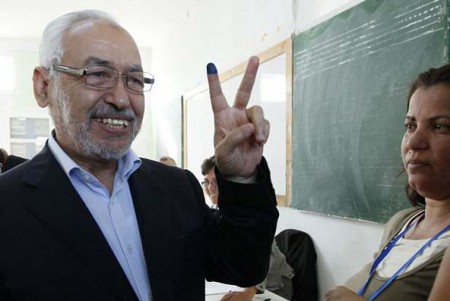
Rachid Ghannouchi, leader of Ennahdha, the moderate Islamic Party that won 41% of the seats in Tunisia’s October 23, 2011 elections for a Constituent Assembly
1. First love, first protest demonstration
If I had a bit more energy, I would have spent my last day in Tunisia walking down Ave. de la Liberte. I’d walk past the central synagogue where in June 1967 I watched angry crowds trash Jewish shops. Then I’d say one last good bye to `Bourguiba School’ – “L’Institut Bourguiba des Langues Vivantes” where I taught with a group of other Peace Corps volunteers and finally, I’d walk past the radio station to what used to be the old U.S. embassy. There, I would permit myself a few moments of nostalgia. It was in the garden there that I first demonstrated against American foreign policy. Hard to forget, first loves, first protest demonstration (against the Vietnam War and Hubert Humphrey’s presence)
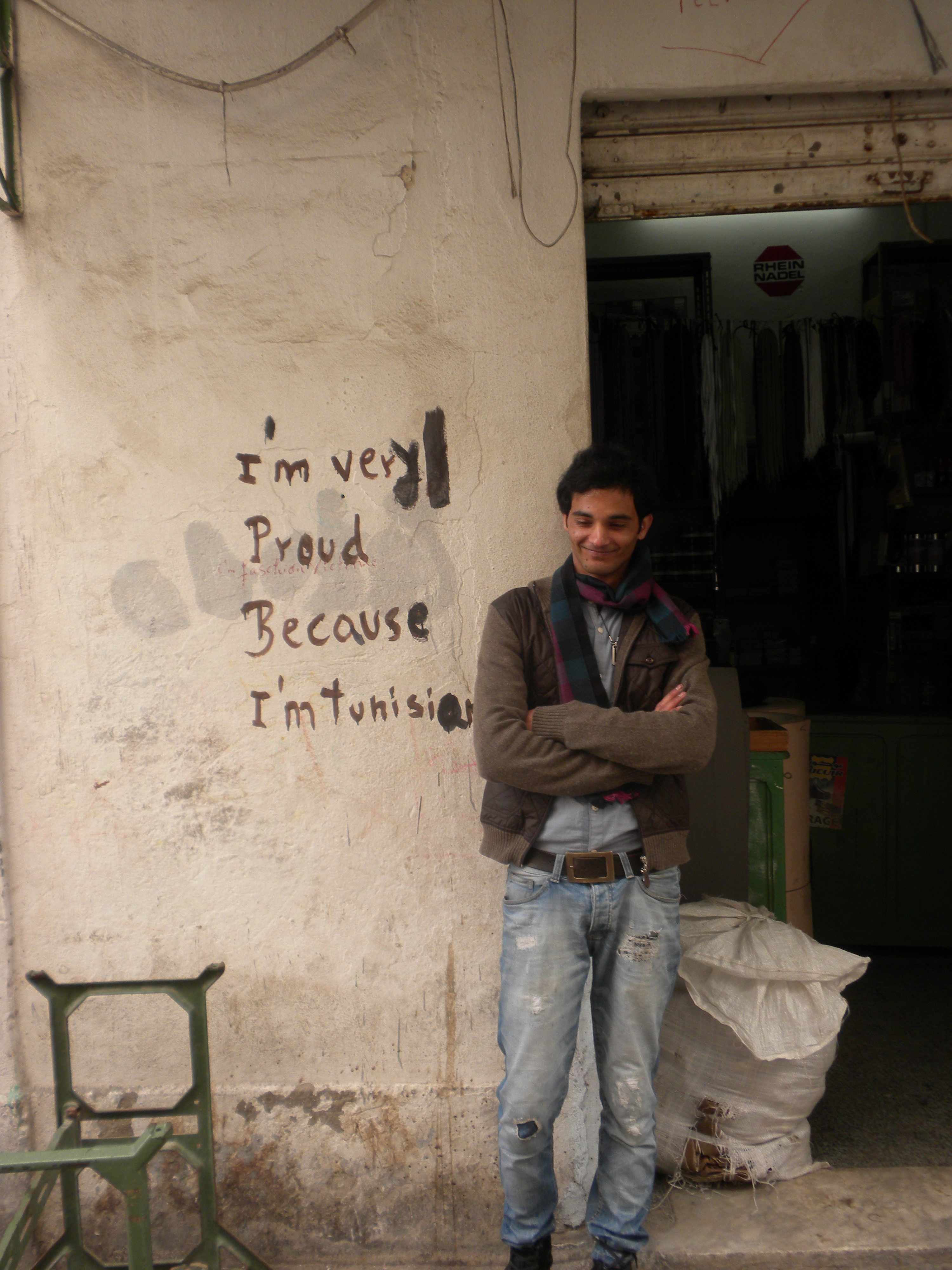
A proud Tunisian…the whole country is proud, very proud that they stood up to Ben Ali and forced him to leave the country; in so doing, it seems that whole country got back its dignity
2. U.S. diplomatic community: Living in an insulated world
The U.S. diplomatic community here hasn’t changed much in half a century – minus a few career diplomats who have learned Arabic and know how to use the Internet. Boring group on the whole who live in their own insulated world, most living in the same plush and guarded neighborhoods, sending their kids to an American school, going to the same restaurants and bars, socializing with the same people, throw in a Frenchman or Brit or two and maybe even a Tunisian!
They might as well be living on Long Island or Los Angeles. Might help explain why the intelligence gathered is often of such low, useless quality. What would be worse, a well functioning U.S. diplomatic corps and intelligence apparatus or a continuation of what we have now? Read more…
The Amilcar Notes – 8: Tunisia’s Jews ‘Now’ and ‘Then’…(Part Two)

"Muslims, Christians and Jews...We are all Tunisians"
The Glory That Was: Tunisian Jewry
Though nothing can bring back the hour
Of splendour in the grass, of glory in the flower;
We will grieve not, rather find Strength in what remains behind
Willam Wordsworth…
_______________________
Carthage – Dermeche, December 16, 2011
Andre Abitbol
He wore thick glasses.
He was standing in front of me at the Café Uranium where we agreed to meet, but couldn’t see me. His first words, and, as I recall, also his last, were apologies. He told me in French, “I don’t see very well, excuse me.” I was sitting right there but couldn’t hear him because my hearing is going. What a team! But we managed to find each other anyway. Call it fate, but more likely the element of luck entered into it too.
Admittedly, it is the case that Abitbol might not be able to see right in front himself. That is not important; he might not be able to see the present, none of us really can see the future, but when it comes to the past, to Tunisia’s 3000 year old Jewish history, Abitbol has x-ray vision. it is no small skill these day to see back into history. Might even be worth as much as looking forward and in some ways, less depressing!
Even from our brief encounter of less than an hour, I sensed that his knowledge of the subject is encyclopedic. He knows the details, `the facts’ as they say. But facts are of little consequence without context. Abitbol has that too, what I would call a feel for the flow of history, for the richness of it all. He understanding the dialectic of Tunisian Jewish history; he understands it `without blinders’ and that is something quite special. So it was a delight to sit with him, was very stimulating and if I never see the man again, he’s touched, or better yet, rekindled something in me. Thanks Andre Abitbol Read more…
The Amilcar Notes – 7 : Tunisia’s Jews, `Now’ and `Then’ (Part One)

Kosher butcher shop, Tunis…there used to be many; still a few
Tunisia’s Jews Now and Then…(Part One)
(First `now’… and after, in Part Two,` then’…)
The setting – 2008 – Socio-economic crisis hits mining district
In 2008, Act One of what would be the great Tunisian revolt of late 2010, early 2011 broke out in the country’s Gafsa phosphate mining industry region. What had formerly been a work force of 18,000+ was cut to less than 6,000 in less than a decade. The cuts came not because the phosphate industry was suffering but, to the contrary, because it had done so well. It was a result of modernization with high tech machines replacing people.
Old story. Profitability and production went up in the industry during these years (1990 – 2008) but jobs went out the window too. Nor was any of that new found wealth re-invested in any manner to compensate for lost employment. After all this was not a private but a state run industry! Read more…
The Amilcar Notes – 6..Tunisia installs a new government, the constituent assembly
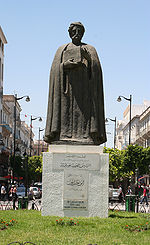
Ibn Khaldun, great Tunisian philosopher, historian, sociologist and humanist
Links:
– Tunisia’s Arab Spring (Al Jazeera)
________________________
1. Remembering a history teacher
A half century ago, I was beginning Jamaica High School in Queens, New York, rather far from Tunisia. It was a wonderful, very academically sound public high school which produced the likes of the great evolutionary biologist Stephen J. Gould. I had a history teacher named Aaron Rose, the best teacher I ever had anywhere, anytime. It was only later that I understood how much he had influenced me, how I wanted to be a teacher and to teach like `Mr. Rose.’ It was from Aaron Rose, a Jewish New York City high school teacher that I was first introduced to the name of Ibn Khaldun and his work, the Muqadimmah.
Rose also gave two memorable lectures on the French Revolution that relates in its own way to the events in Tunisia. After the first one I came home excited, so excited in fact that when my father got wind of what I was saying he got a little nervous. `That French Revolution,’ I started, `look what they did, they got rid of the corrupt monarchy’ (whatever shortcomings we Americans have, one of our better points is that we are not interested in monarchies – at least at home), and `the people’ won and got `liberte, fraternite and egalite’. Wow. Cool. I’m for it. I was also 12 years old. Read more…
 View from the Left Bank: Rob Prince's Blog