The Great Western Sugar Refinery in Ovid, Colorado – Gone
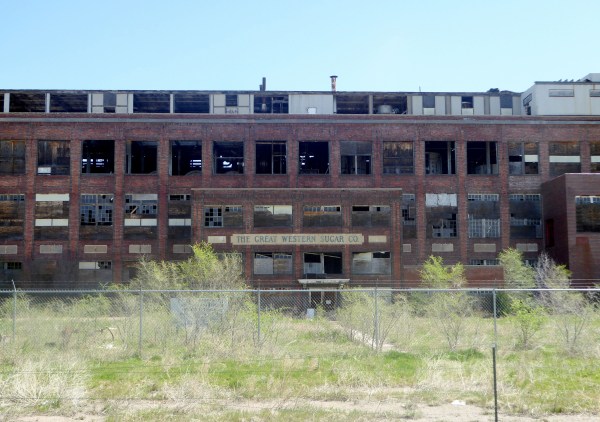
The site of the shell of the Great Western Sugar Company refinery in Ovid Colorado (just south of Julesberg) in April, 2016
Sugar Beets and Colorado
Sugar beets are still grown in Colorado, but on nothing close to the scale that they once were. Foreign competition, the automation of the production process and other factors decades ago caused a decline in what once was one of the state’s most lucrative agricultural businesses – the growth and refining of sugar beets. According to my 2019 calendar and map put out by the trade publication “The Sugarbeet Grower“, sugar beets continue to be grown in the state’s northeast corner – as well as the adjoining areas of the Nebraska Panhandle and southeastern Wyoming.
Contemporary sugar beet production continues but not on the scale of the first half of the 20th century when for all practical purpose, sugar beet were at the heart of Colorado agriculture, with the profits coming from that industry in large measure helping fuel the state’s economic transformation and growth. As of the turn of the millennium, 2002, there were still more than 1000 sugar beet growers in this tri-state region. (1)
If the first major wave of European settlers came to Colorado in search of gold, silver and other metals for the state’s Rocky Mountains, starting sometime in the 1880s and early 1890s, a second wave came to take advantage of the state’s agricultural potential; it included investors with money from mining as well as East Coast and Chicago financiers, and a work force whose numbers have populated the state today – Volga Germans, Mexicans, Japanese labor.
What is referred to as “The Sugar Building” in downtown Denver, with its original iron cage Otis elevator, used to be the financial nerve center of Colorado’s sugar beet production. Today the building has, of course, like virtually every inch of spare space in Denver, been turned into condos.
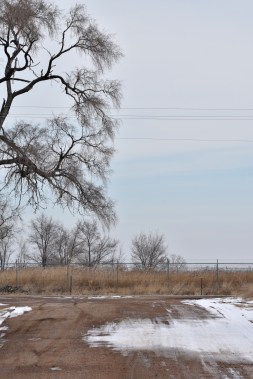
The site of the Great Western Sugar Factory, Ovid, Colorado. February 2018
Great Western Sugar’s Refinery in Ovid, Colorado
Three years ago, Nancy and I literally stumbled on the shell of one of Great Western Sugar’s largest refineries, in Ovid, Colorado, about ten miles south of Julesberg, Colorado’s most northeastern city. During WW2, Ovid was also the site of a German POW camp. The plant sits very close to the South Platte River.
The very town of Ovid was laid out in 1908 as the center of that region’s irrigation district agricultural activity. Sixteen years later, in 1926, after investment funds were organized, Great Western made the decision to build the factory. Two years later, in 1928, the factory was built, giving Ovid its biggest economic shot in the arm; at the time it was among the most modern, high-tech factories of its kind. No doubt both the town and the region’s prosperity was connected to this factory. (20
With the 1974 expiration of the Sugar Act, which protected domestic sugar growers from foreign competition, along with sugar production in the rest of the country, Colorado’s sugar production plummeted. The Ovid factory closed down in 1976. With its closing, Ovid and the region around it went into an economic tail spin from which it has yet to recover, nor is it likely. Then in 2017, after six years of planning by state authorities, Ovid’s Great Western Sugar Plant was demolished over an eight month period.
Returning To Ovid. “The Sugar Got Us”
Yesterday as a part of a trip to the Eastern Plains of Colorado with my brother-in-law, we stopped by Ovid. I wanted to show him the shell of the Great Western Sugar Company factory there. Nancy and I had stumbled upon it in April, 2016 on a similar trip when we were poking around the region at that time. Just seeing this huge factory, even in ruins, in this now town of Ovid, was enough to bring home how much the factory had meant to the region. It had lasted a bare fifty years.
We (Nancy and I) are not ones to poke around abandoned mines and factories and we didn’t do so on that chilly April morning three years past. But we did stand in front of it, walk around it, trying to absorb the significance of what the factory must have meant to Sedgewick County in which it was located. Knowing how David appreciated old things – cars, machines and the like – and has a pretty decent knowledge of such things, I built up the visit to Ovid plant, thinking we’d probably spend a fair amount of time there, just viewing it and talking about it.
Ovid being a pretty tiny town, I knew exactly where the plant was and how to get there, admittedly not difficult.
But what a surprise.
What had been a ruined, abandoned factory, a kind of industrial fossil of days gone by, a shell of a vibrant past, had, literally evaporated. Well, the fence was there but nothing, no structure behind it. My gosh! How did that happen. Nothing there where only three years ago, with the grounds being turned to tall prairie grass! It took my breath away. Literally. Hard to imagine how such a structure could be taken apart and to appear as if, in fact, nothing of the sort had ever been there.
An older (than me) man in a pick up passed by. I waved him over and he stopped. He told me that he would have stopped anyway because he saw me in front of the plant with a camera.
What had happened, I asked.
He related how the plant had been dismantled over an eight month period in 2017. He added not without pride, how he had worked there for 36 years, that is, most of the period when the factory was in operation. What was it like working there, I asked. “Oh, it was ok but the sugar got us.” I didn’t ask a follow up to that, simply out of politeness to a stranger, but later I wondered if he wasn’t referring to employees, himself included, who had come down with diabetes.
An excellent article on the rise and fall of Ovid, and the dismantling of the plant (from which I have drawn some of the information for this blog entry) was written by Sue Rose, “Ovid’s Metamorphsis” in “The Construction Specifier” (April 3, 2017). In fact Nancy and I had met Sue Rose in 2016. I would have liked to have seen her on this trip, but as we didn’t know if or when we’d get to Ovid, I didn’t contact her.
______________
1. The same region houses several hundred Trident 2 nuclear missiles on hair-trigger alert, many of them in the same locations as the sugar beet farms.
2. Some of this information on the Great Western Sugar’s Ovid plant is drawn from William May’s The Great Western Sugarlands: The History of the Great Western Sugar Company and economic development of the Great Plains. New York : Garland Pub., 1989.
 View from the Left Bank: Rob Prince's Blog
Enjoyed the article and it reminds me of my childhood. I was born in Sterling, Colorado and several generations of my family are buried in the cemetery there. I imagine they came here for the farming. My mother and father met in grade school in Sterling. I had a great uncle written up in the history of Logan County for the same kind of behavior against the Indians that the current Zionists demonstrate to Gaza. I never met the guy, I knew his wife, my great aunt, who was about 20 years younger. I will never forget the smell of those Sugar Beet factories and the narrow two lane road to Sterling that we drove many times. It seems like another world.
God bless your deceased ones and that is kind of terrifying having a member written in all that mess.
I enjoyed your article. My Grandfather started as a guard on the building site for the plant in 1926 and worked there for nearly forty years finally retiring as assistant Superintendent.
My father was very proud of being from Ovid and went back when he could for reunions. He also worked in the plant during campaign.
Thanks for your comments Jay. It underlines a sense of what I have been thiinking: that the Ovid plant offered employment to a very large circle of people in the area at the time.
Yes, My grandfather and grandmother were newlyweds and moved up from Longmont to Ovid for the opportunity.
holy cow that was a lot. Must have been mind boggling to see the factory just gone. My great grandma was born in Ovid and her uncle or great uncle (sorry if I got it wrong) worked at the sugar factory next to the building there. We go there every time we visit her grave.
I used to work at Northern Ohio Sugar in Fremont Ohio in the late sixties and early seventies as a design engineer. It was a part of the GW Sugar Company with its 16+ plants. One year I drove from Ohio to Los Angeles and back. On the way back, I happened to be driving through Ovid. I stopped in at the factory and the manager was Don ?? (forget his last name) I knew from Findlay, Ohio. We had coffee, chatted and I took off. Always wondered what happened to the whole company. I read that in 1974 some laws changed and allowed foreign sugar to be imported. In the early 70s, the group of growers in MN and DA started a cooperative and hired our manager Gerry Shannon to work there. Some others joined him. Most have now passed. Lot of happy memories from those days. I could list about 30 names, many from management in Denver and many from Ohio. They moved people back and forth per their requirements and interests of the people. From Colorado to Ohio and back. Would love to hear from someone who used to work there.
I don’t know any of them but … if you give me a name or two I’d be willing to look them up and see if they’re still around.
At done point I got it through my thick head that the sugar beet industry was key to the economic development of the state and wanted to learn more about it
Thank you for your intervention