Doing Biden’s Bidding, A Century-Old Henry Kissinger Goes to China. Treated with Warmth, Respect, Gets Nothing Politically
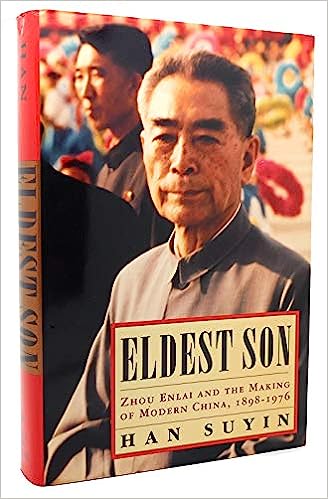
Chou Enlai whom Mao once referred to as “his housekeeper” – architect of modern Chinese foreign policy, still very much alive today
___________________________
China greets Henry Kissinger with considerable respect and warmth for past work reconciling China and the USA back in the 1970s but doesn’t give an inch to the Biden Administration on the main reasons for the Kissinger visit
___________________________
It is simply not credible that Henry Kissinger went to Beijing without prior coordination with the Biden Administration, the latter hoping that Kissinger might achieve something along the lines that Blinken, Yellen and Kerry could not. It is even possible that he went with the open encouragement of the Biden Administration, increasingly worried at the current precipitous decline in Sino-American relations that appear to be moving towards a possible military confrontation, especially over Taiwan.
Add to that the increasing stampede of countries looking for alternatives to conducting their economic affairs in currencies (or other) exchanges outside of the dollar much of which will be discussed in the upcoming BRICS summit next month in South Africa, which bodes for the future of US global hegemony.
With few options left open to him to halt the deterioration of U.S.-China relations, is U.S. President Biden resorting to playing “the Kissinger card” with China? A picture of U.S. foreign policy in general, a fragile 100 year old Henry Kissinger flew to China for several days of “private” (come on – please!) meetings that included an interview with Chinese President Xi Jinping.
Kissinger’s China trip comes after U.S. Secretary of State Anthony Blinken, Treasury Secretary Janet Yellen and special presidential envoy for climate change, John Kerry all made the same journey that produced paltry results, if any, in improving U.S. China relations in the period running up to the 2024 U.S. présidental elections.
As Arab analyst Abdel Bari Atwan, asked in a recent article, could Kissinger achieve what Blinken, Yellen and Kerry failed to do? That is to throw Biden a lifeline by halting what has been an avalanche in the decline of U.S. – China relations? Or, despite the respect that China exhibited to Kissinger, would the visit be full of symbolism but lacking in no real concrete content? While Kissinger was a key player in the restoration of U.S.-China relations in early 1970s, the China of the 1970s is history as is the United States of the same era.
Fifty years ago, Washington had the upper hand in the relationship with China, despite certain undeniable accomplishments resulting from its revolution of 1949 was still a very poor country lacking in industry and high technology and very much behind not just the West, but even its large Asian neighbor India in virtually all economic indicators. What a different story today as China has “leaped forward” to become the world’s industrial workshop and one of the world’s great powers while Washington, although still a force to reckon with internationally, has seen its industrial base close to gutted and its influence on the world scene diminished to some degree.
Add to that the increasing stampede of countries looking for alternatives to conducting their economic affairs in currencies (or other) exchanges outside of the dollar much of which will be discussed in the upcoming BRICS summit next month in South Africa, which bodes for the future of US global hegemony.
Atwan points to two issues of Kissinger’s visit that are either downplayed or ignored (from what I have read) in the mainstream Western media. It is well known, especially to the Chinese. that Kissinger warned US President Biden in his first meeting after winning the presidential elections of this Sino-Russian rapprochement and its potential political and military dangers to the United States and its leadership of the world.
While Kissinger was deftly able to take advantage of what was already a serious split in Soviet-Chinese relations, and deepen it in the interest of strengthening U.S. global power at the time, it is unlikely, virtually impossible for him to achieve anything like similar results today. Still, in his visit there is little doubt that Kissinger was looking for some kind of formula that could at least freeze the increasingly solid Chinese-Russian all round cooperation with an eye on engineering a political and military disengagement between China and Russia, and drag China into the “American camp” again somewhere down the road.
While I have no doubt that the very fact of China’s welcoming Kissinger to Peking makes

“Aunt Mal” – Malvina Magaziner – 1930, long before she met Henry Kissinger’s sister
the Russian leadership a bit weary, I doubt that Moscow has anything to worry about.
The second goal of the Kissinger trip is to explore someway out of the Washington/NATO quagmire in Ukraine. Indications are increasing that the Zelensky government and its NATO allies, its press statements to the contrary, are on the verge of an all round, perhaps historic military defeat. Kissinger is in Peking probing some kind of diplomatic exit for Washington from the war in Ukraine that would both “freeze” the conflict along “Korean” lines (no war, not peace – but a peace in which Washington can still walk away saying it had not suffered defeat). If such a truce could be engineered it would lead to Washington’s main goal visavis China in Ukraine: the hoped-for Chinese neutrality, even in its minimum limits. If this plan succeeds, then this will be a great gain for America.
If the weakening the Chinese-Russian alliance is near impossible from where I’m sitting, this second goal, achieving some kind of cease-fire and freezing the conflict in Ukraine is not totally out of the realm of possibility. Here Kissinger is playing on 76 years of Chinese practicality in foreign policy, a policy constructed by the master of Chinese foreign policy, Chou Enlai. Still, the question here is what is Washington willing to offer not just China, but China and Russia in return. This I don’t know other than it would have to be something very weighty and such concessions, from what I can tell, are not the usual fare for a Biden Administration loaded with the likes Blinken, Sullivan, Nuland, ie, the ideological neo-cons of U.S. foreign policy.
But … one never knows. Underneath all their “macho talk” there are some signs of growing desperation and as engaging China in open warfare is not on the table, some form of negotiations, meaning compromise, might be in the air. A long shot? Admittedly.
Finally, concerning Ukraine, Kissinger believes that any political solution to this Ukrainian crisis that requires dividing Ukraine is the solution, similar to what happened in the Korean War in 1952 with the establishment of two states, one loyal to Russia (in the five regions annexed by Moscow), and another loyal to America in what is left of Ukraine. It is true that Kissinger did not and could not express this position directly to the Chinese. However, he confirmed it in a malicious way by suggesting that Ukraine not join NATO or the European Union, that it remain neutral, and that Russia must understand geographical and ethnic demands and make territorial concessions.
My personal take – the Chinese played the “Kissinger card” shrewdly out of respect for his role in the past. He was wined, dined and toasted, offered access to China’s highest officials, but that the diplomatic results of the visit were empty, nothing at all. They were acknowledgement Kissinger’s historic role – Chile, Vietnam and who knows how many other war crimes aside – in opening U.S.-Chinese relations without which, current tensions aside, China would not been able to achieve the dramatic economic and technological revolution it has gone through. They did likewise to Richard Nixon, inviting him in his personal capacity even after he was forced from office by Watergate.
A show of respect and friendship for past deeds … but not an inch of compromise towards the Biden Administration.
_______________________________________
Abdel Bari Atwan is a Palestinian journalist from Gaza living in London with a rich history in Arab journalism. Respected for his secular radical analysis, he publishes an online news source with articles concerning the breath of Middle East as well as global political developments. A bit slow on the draw (I am referring to myself here – not Atwan) it is only recently that I have learned how to translate his articles electronically using “Google Translate”. I cannot say that the translations are precise but generally speaking I believe I get the gist of his analysis and what he is trying to say.
Atwan’s take almost always goes against the grain of American mainstream narratives of events transpiring in the Middle East; as such he is a useful counterpoint to whatever is coming out in the New York Times, CNN and the U.S. State Department.
______________________________________
(Personal Note: I had in a distant way, a personal relationship with Kissinger.
My Aunt Mal and Uncle Sam Stone lived for years in a rent control apartment in Astoria, New York, just off Queens Blvd where, at least when I returned to New York City to visit, there was a Macy’s department store across the street. Once when I was visiting, Aunt Mal revealed that the property manager with whom she would, over the years, have tea, was none other than Henry Kissinger’s sister.
My aunt, nothing short of the family matriarch, was a very proper sort, careful with her English except when it came to one Grade B actor who by some fluke became President of the United States, a man whose man talents consisted of eating jelly beans and reading other people’s scripts, none other than Ronald Reagan. A died in the wool life long Democrat, the very mention of the name “Reagan” triggered an immediate, almost Pavlovian reaction: that son of a bitch! I used to love to hear her say it and have no doubt that had Aunt Mal ever met Ronald Reagan she would have addressed him in an identical manner to his face.
Back Kissinger’s sister. I was rather stunned by Aunt Mal letting this little secret slip out and asked her. Did Kissinger’s sister ever talk about her illustrious brother? Yes, she did, often repeating that while Henry was a dedicated brother, she didn’t understand how Henry had evolved such “bizarre” (I remember that word distinctly) political views and wondered out loud if his problem was that he spent too much time at Harvard, which, apparently she repeated to Aunt Mal “was not good for the soul”). Henry Kissinger has outlasted Aunt Mal, but not by much. The middle daughter of a Belorussian father (Grudno) and a Polish (Bialystok) mother, both Jewish, Aunt Mal died a few months before her 100th birthday in 2008.
That is the extent of my personal connection to Henry Kissinger. )

Who’s threatening whom
 View from the Left Bank: Rob Prince's Blog
Always nice to see War Criminals get al little travel in while in their dotage.
>
You have a way with words, my friend