Niger – 5: In Niger, Washington Implements “the Ethiopian Model” – or tries to.

Among those in the photo: Dawit Agonafer, Nebiyu Asfaw, Nahome Yifru (and yours truly)
Taste of Ethiopia 2023 – Denver, Colorado; Attempts to disrupt Eritrean Celebrations in Seattle, Toronto and Stockholm fail miserably
Here in Colorado, the first “Taste of Ethiopia” event since the advent of COVID took place this past Saturday, August 5 in Montbello. It was a wonderful day of culture (dancing, singing, speeches. food, booths selling all kinds of things from the Horn of Africa) and a “ton” of people, overwhelming Ethiopian. A few politicos – Governor Polis, new Denver Mayor Michael Johnson – both Democrats – spent time there as did Republican Aurora Mayor Mike Coffman. The latter, who has shown consistent support for Colorado’s Ethiopian Community – much more than any Democrat, is highly respected – if not loved – among a broad base of Colorado Ethiopians.
As I have some dear Ethiopian friends, several of whom invited me to attend I went too. Through the good auspices of the friends in this photo, I was able to meet dozens of local Ethiopians and talk to them briefly about their lives here in the USA and the situation back in Ethiopia which concerns them all. Given how tense Ethiopia is this days I was worried that those tensions might spill over here, but at least at “Taste of Ethiopia” all was calm, the mood completely relaxed, even mellow. This was not the case of big celebrations of Eritreans, fellow Horn of Africa folk, in Seattle, Toronto and Stockholm where thugs unsuccessfully tried to disrupt similar festive events. Eritrean participants pointed the finger of responsibility to Washington’s Horn of Africa proxies, supporters of the Tigre People’s Liberation Front (TPLF), those who were swept from power in Ethiopia in 2018-2020 and who were militarily defeated by a combined Ethiopian-Eritrean military offensive. The TPLF was then saved from being completely suppressed and “knocked out of the ball game” by Washington’s intervention.
Frank and difficult talks. “Daughter of Hillary” gives Niger military an ultimatum.
What is happening in Niger? Who is the leader who was deposed? Who was he replaced with and why?
As Break Through News’ Eugene Puryear put it:
“I think that when we look at what’s happening in Niger … the best way to actually describe what’s taking place is a social explosion, the accumulated contradictions of the extreme poverty of Niger … we’re talking about a country where roughly 43% of people are living on less than $1.90 a day … also in the context of a challenging security situation – not just in Niger, but really, you know relatedly across the entire Sahel, the uptick of terrorist activity over the past several years has even been less intense than perhaps, let’s say, Mali and Burkina Faso, but nonetheless it’s been very significant, very intense and that has also been a factor in what is moving forward (ie. – the coup). And then on top of that there are the immediate proximate causes: the poverty of Niger, the security crisis that’s happening in the Sahel are overlaid over the top of the fact that in general, Africa as a continent is at quite an inflection point in terms of a generation of people, the youngest continent – something like 70% of the African population is under the age of 35. In Niger, half of the population is under the age of 15. … There is a generation of people who don’t want to live in poverty, marginalization and humiliation
The West’s “man” in Niger was overthrown, Mohammed Bazoum, a pliant proxy of both the United States and France who permitted American and French military bases, one of the largest (U.S.) drone bases in the world, was critical of his neighbors in Burkina Faso and Mali for improving relations with Russia and was alleged to have been exceedingly corrupt along with his cortege of advisors and ministers. Yes it was a coup of a elected president but the movement that swept him and his team from power, the coup, has widespread popular support in the country especially among the country’s burgeoning youth.
The tensions over such an ECOWAS invasion of Niger – at the best of Washington and Paris – remain high, after the visit of U.S. Under Secretary of State Victoria Nuland to Niamey, Niger’s capitol, yesterday. Unlike in Kiev a decade agom in Kiev, this time Nuland did not come offering cookies to give to coup supporters . Nuland, “daughter of Hillary Clinton, ” “daughter of Madelaine Albright”, held what she described as “frank and difficult talks” with the Nigerien military. No cookies this time, instead in a classic imperial voice, an ultimatum. “Frank and difficult talks” as Nuland put it does not suggest a successful meeting. Representing both the United States and France, Nuland demanded military coup leaders in Niger step down and return the country’s deposed president, Mohammed Bazoum, another Western proxy, to power. That the coup leaders appear very popular among the Niger masses was, as is usually the case, irrelevant to Nuland and the State Department.
The Nigerien military rejected Nuland’s demands increasing the possibility of some kind of military intervention taking place. There will be an upcoming meeting of ECOWAS in a few days (August 10) to discuss what to do. Given its uranium, gold deposits which France has milked for three quarters of a century, the largest American drone base in the world and the growing likeliness that France is about to experience its modern version of Dien Bien Phu and have its military kicked out of the country, all the signs are that Niger is too important for either Washington or Paris to “let go of”.
To cover what amounts to U.S. and French neo-colonial and imperial designs, both Washington and Paris are complaining about “Russian involvement” in the Niger crisis. Old wine in new bottle. But to the contrary, as Alexander Mercouris notes there is no Russian involvement in the crisis in Niger. Nor does he expect there to be. He goes on to argue that “not only are the Russians not behind this coup; they have straightforwardly condemned it, they have said that they too want to see the constitutional order and the civilian authority in Niger restored.” There is no evidence – at all – of any evidence of Russia’s “Wagner fighters” in Niger. Furthermore, nor is there any evidence that Russia had anything to do with the coup in any way, that it was entirely a domestic matter. All indications are that the Nigerien coup took Russia by surprise as much as any country. At the same time, they adamantly are opposed to foreign military intervention in Niger.
That Nuland would moan on warning Niger of the consequences of it improving relations with Russia is just the same old cliched, invalid song – a Cold War lie regurgitated to cover yet another major failure in U.S. foreign policy, this time in Africa. Speaking about – and greatly exaggerating the Niger-Russian connection, U.S. State Department spokesman Matthew Miller, who tried to denigrate the massive pro-coup upsurge in Niger by claiming that perhaps the protesters were paid, said that he didn’t understand why Niger “loves Russia so much”
Megatron (on Twitter) helped enlighten Miller:
So let’s explain it to him in brief. Because for 100 years already private corporations of yours and those in France have been draining Niger’s resources of heavy billions of dollars, throwing them only some ridiculous sums as some kind of help. Even though Niger has huge reserves of Uranium, 80% of the population is without electricity. You could have built at least one nuclear power plant for them. Children are forced to work in the mines for a piece of bread, while you and your colleagues in the Biden administration take heavy millions from those corporations
Regardless of whether or not Washington can push ECOWAS to invade Niger, Washington has already shifted into full hybrid war mode against the new Niger government, employing what I refer to as the Ethiopian Model. Washington’s goal visavis Ethiopia – in both the Trump and now Biden Administration – has been the same. It is a misnomer to suggest that one party has a better, more humane position toward the Horn of Africa giant than the other. As with U.S. Niger policy, the goal fo Washington’s Ethiopia policy is not to destroy Ethiopia as a country but to weaken it, to prevent it from playing a leading role in the Horn of Africa, one that appeared to be on the road to unify a region that over the past decades has been shattered and partitioned (Sudan, Somalia and Ethiopia itself to a certain extent) along the lines of Henry Kissinger’s 1970s dictum that at its heart U.S. policy towards the Horn of Africa must be to keep it week and divided. Since the 1970s every Administration has followed Kissinger’s advice, including the present one.
What is the current methodology that the Biden Administration has used to accomplish this goal – a goal very similar to its approach to Niger?
- In the case of both Ethiopia and Niger, Washington has relied heavily on regional proxies to carry out its policies. For Ethiopia, the main proxy has been the former Addis government – the Tigray People’s Liberation Front – or TPLF. Despite a murderous failed military attempt to regain power supported militarily and politically by Washington, the TPLF, thanks to Washington’s intervention has not only been neutralized, but given a role in the government it has tried to overthrow. Washington’s call to re-certify and resurrect Mohamed Bazoum is along the same lines. It is an attempt to get him back in the door any which way, and so position him later on to regain power.
- In both cases putting in place progressive sanctions meant to choke economic and social activity, cause social unrest – to bring both countries to their knees – that makes the two governments vulnerable to Western pressure is at work. In Ethiopia’s case, it was sanctions that not only pressured the Abi Ahmed government to reconnect to the TPLF but also to distance itself, or try to from its Eritrean partners, without which Ethiopia could not have defeated the TPLF terrorists (and that is what they are).
- Attempts to isolate both countries from their neighbors and the broader international community. the Biden Administration had some successes distancing some of Ethiopia’s neighbors – Kenya, Sudan, Egypt in particular. U.S. and French efforts to isolate Niger from its neighbors are well on their way as is seen in the hostility towards the new government from Nigeria, Senegal and the possibility of an ECOWAS invasion, again, something that simply would not happen without ‘a green light” from Washington and Paris.
- Heavy duty political pressuring, posturing behind human rights concerns. In Ethiopia’s case, placing the blame for the civil war on the Addis government rather on the TPLF which initiated the hostilities and engaged in deeply disturbing human rights violations. The card the West is playing in Niger is to smear the new government as a stronghold for Islamic terrorists.
There is a danger that Ethiopia could implode as a country as sectarian violence, much of it funded by outside sources, has continued on a disturbing level. In informal discussions at “Taste of Ethiopia” I kept hearing the term “Rwanda” thrown around. If such a tragedy results, U.S. policy will be in part responsible as they have now created a level of chaos which appears to be beyond their control. In Niger it’s not possible to tell whether Washington and Paris will opt for direct military intervention or as some commentators suggest follow the Ethiopian Model of Hybrid Warfare instead. Either way, frankly, in the long run, it doesn’t matter for where I am sitting. Confidence in the United States and France is shattered, their credibility, like Humpty Dumpty, cannot be put together again. It’s over for France in West Africa. ideologically for certain and it really doesn’t matter how many more AFRICOM troops Washington places in the Sahel; just one too many IMF loans that went nowhere, one too many U.S. or French sponsored coups to protect the interests of multinational mining and agricultural concerns, one too many corrupt proxies – greedy and vicious to their own people. The game is up even if it takes decades for Niger and the rest of Africa to clean up the mess. The only question left – will Francafrique and AFRICOM go gracefully or gracelessly; for the moment “graceless” – with all that it entails has the upper hand.
Today we’re all Pan Africans!
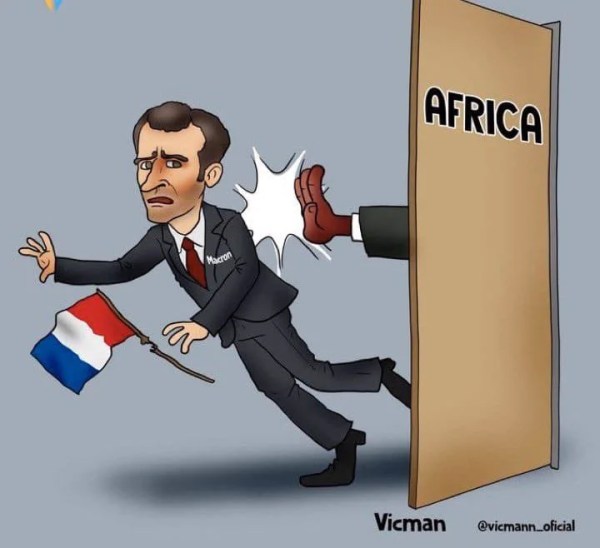
Bye Bye Francafrique (and AFRIOM)!

