Back at Quivira, Cheyenne Bottoms during fall bird migrations.
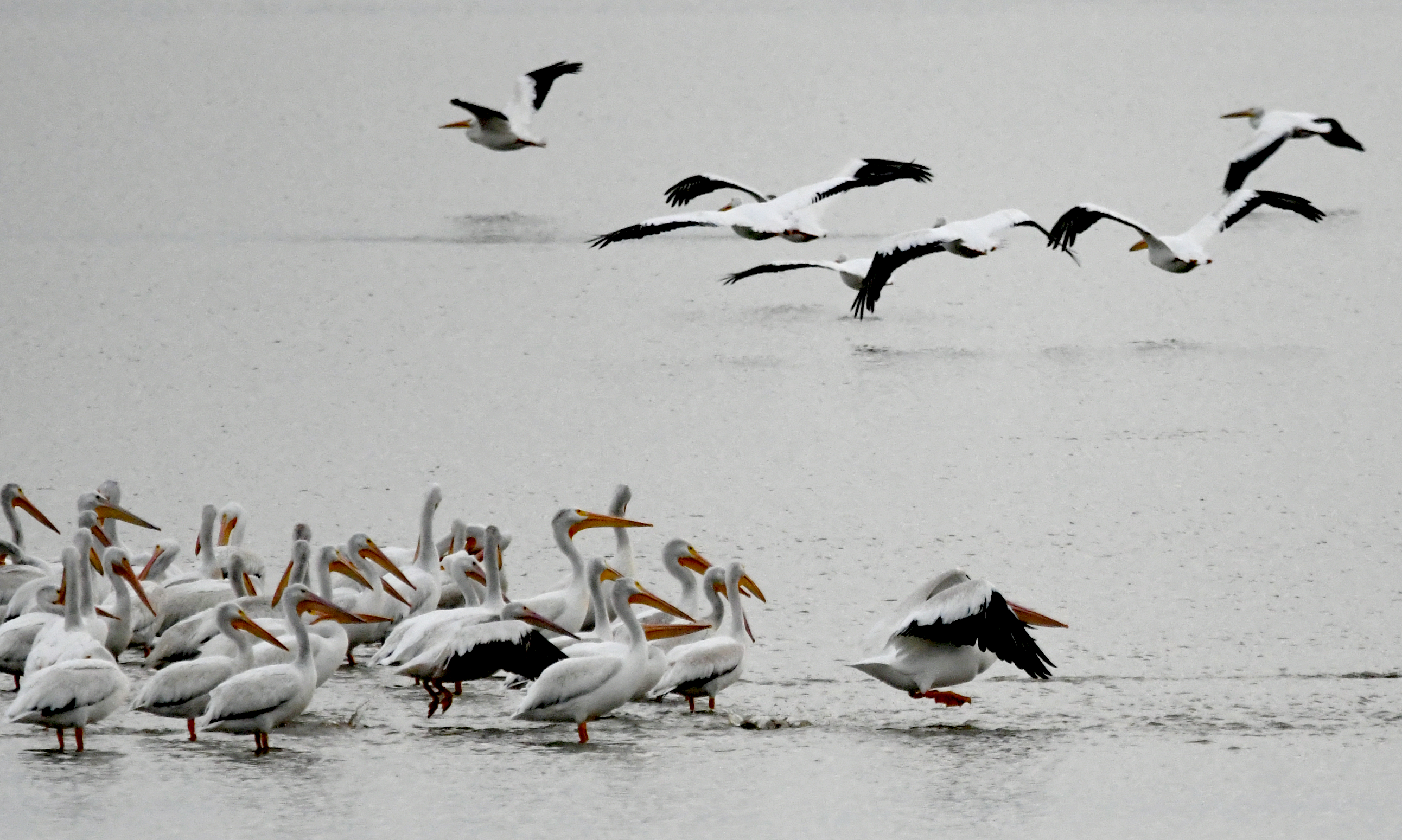
Pelicans at Quivera National Grasslands in South Central Kansas as a part of the fall, 2025 bird migration.. September 30, 2025. (R.Prince photo)
____________________________________
Although I have been coming to South Central Kansas for more than a decade to witness the bird migrations taking place here at Cheyenne Bottoms and Quivira National Wildlife Preserve, I’ve missed much of the past five years. First there was COVID which kept me grounded. Then there were my own health issues. Finally Mother Nature stepped in as only she can. Two years ago when I passed through about this time of year (October) the area both marshes were dry as a bone as the result of intensive long-term drougth. The area was a central target of the Dustbowl in the 1930s and for the previous three years, had suffered the same drought that had seriously affected New Mexico, Arizona, Colorado – especially in the south and on the Eastern Plains – and southern Colorado.
But this fall the rains were back and so were the birds.
Two years ago, on October 6, 2023, BirdCast, which forecasts “when, where and how far birds will migrate”, noted that on that evening as many as a billion birds migrated south along the North American flyways. As they almost always fly at night, such a dramatic incident passed unnoticed by all those save avid birders. Two years later, but two weeks earlier, on the night of September 2025, that record was breached, reaching new heights when as many as 1.2 billion birds flew down from Canada across the eastern and midwestern regions of the USA on their fall migrations to Mexico, Central America and points further south.
As Birdcast notes on its website:
Bird migration forecasts show predicted nocturnal migration 3 hours after local sunset and are updated every 6 hours. These forecasts come from models trained on the last 23 years of bird movements in the atmosphere as detected by the US NEXRAD weather surveillance radar network. In these models we use the Global Forecasting System (GFS) to predict suitable conditions for migration occurring three hours after local sunset. These maps also show precipitation forecasts (outlined and shown in grayscale). Note, areas forecast to experience precipitation and bird migration may overlap, and predictions for migration intensity may be highly variable in these locations.
Colorado State University and the Cornell Lab of Ornithology currently produce these forecasts … with additional support from University of Massachusetts Amherst and University of Oklahoma. The BirdCast project was created with grant awards from the National Science Foundation and subsequently supported by awards from Leon Levy Foundation.
These documented migrations have taken place mostly east of Colorado along the Mississippi River and Eastern Coastal flight zones. Here in Denver, the migrations are today and for the next few days at a very low level but in South Central Kansas, where I try to go regularly, the activity is more intense. Today (October 7, 2025) it is expected that anywhere from 9000 to 24,000 migrating birds will be stopping at Cheyenne Bottoms, just north of Great Bend, and probably even more at the Quivira National Grasslands, some 35 miles to the south. Among those migrating birds that I saw last week at both places were what I estimate to have been thousands of American White Pelicans clustered in groupings of several hundred each and hundreds of white-faced ibises.
Migration season is an unstable time for many bird species. Should we be surprised that although weather – storms, sudden temperature changes, can adversely affect successful migrations that one of the biggest factors threatening migratory success comes from collisions with built structures, especially brightly illuminated buildings and communications towers, with the most prominent factor being collisions with large urban buildings, especially those made of glass where lights are left on at night. Shutting off lights in urban skyscrapers decreases collision counts by 11 times in the spring and 6 times in the fall. Although shutting off the lights are encouraged, I doubt it is done much to improve the situation in this respect.
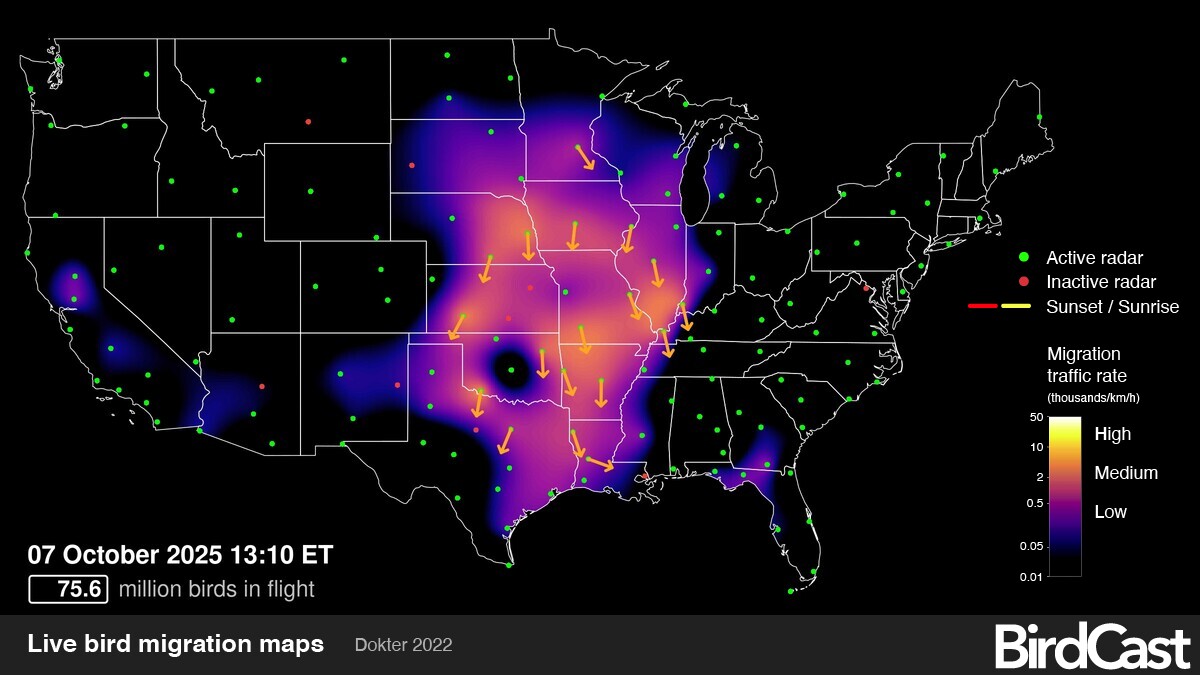
The map above, from BirdCast, indicates the migration patterns for last night, the night of October 6, 2025. Note that the highest intensity of bird migrations today is solidly centrally located both sides of the Mississippi River with major migrations at the moment that includes Kansas where I visited. Colorado remains outside of the main path. This map is taken, frankly at a slow hour during the migration. At 1:10 in the afternoon there were, throughout the nation, some 75.5 million birds in flight, mostly flying through the Midwest. While hours later, in the middle of the night, birds moving south during the October 6-7 overnight peaked at 400 million. Evolvingly accurate satellite technology has been key to more accurate counts as has continued technological improvements in climatology.
When drought has not drained Cheyenne Bottoms and Quivira of water as it has for the previous three years, both wetlands are so crowded with birdlife that it is almost impossible to take it all in. According to one source, “Rootstalk“, a publication of Grinnell College (from where one of our daughters graduated), as many as forty-five percent of all North American shorebirds pass through Cheyenne Bottoms marsh during the spring and fall migrations, along with 60,000 people. They include ducks, geese, herons, egrets, I saw precious few ducks this time, but don’t remember ever seeing so many herons (including green herons),egrets and pelicans this trip is large numbers as well as a good number of ibises and yellow headed blackbirds. Late September, early October is actually somewhat early for the height of Kansas bird migration. The swarms of ducks come later, from mid to late October into early November. There is also the fact that funding cuts have hurt maintenance at Quivira already and are likely to get worse. Still Cheyenne Bottoms and Quivira did not disappoint.
____________________________________
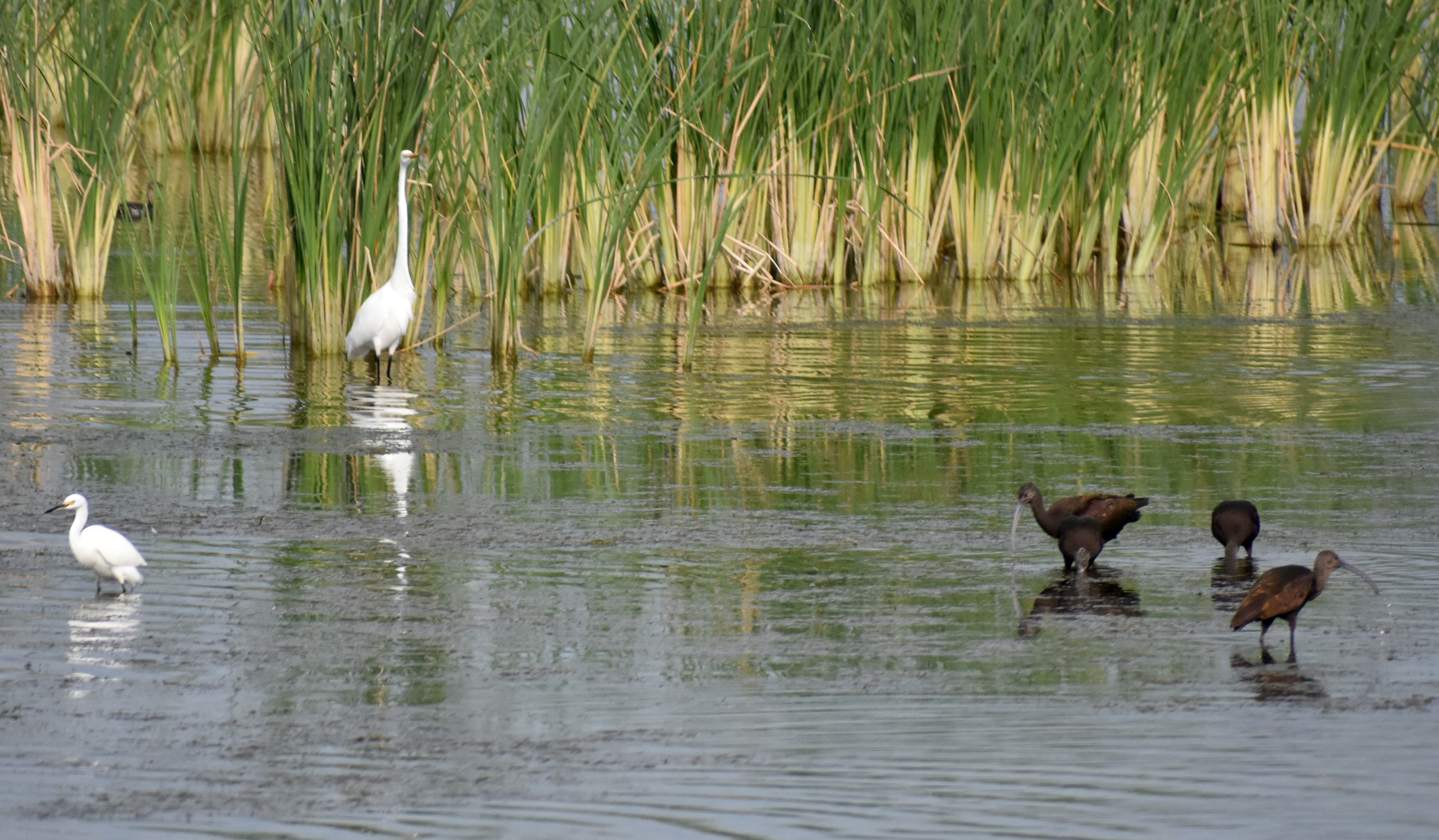
Snowy Egret, Great White Heron and White-faced Ibises at Quivira National Wildlife Preserve (R. Prince photo)
 View from the Left Bank: Rob Prince's Blog
You should post more photos or have a link to your photos they are incredible. I am visiting in the fall and would love to see photos of what to expect. Great and informative post!
Give a call 720-398-7719 in the evening but not this one .. will share what I know – which isn’t much but is something
Glad you are going there
Rob P