Fall 2025: Bird Flu back in the lower 48, earlier than in the past and with a vengeance.

Great White Heron at Cheyenne Bottoms near Great Bend KS. October 1, 2025. There were hundreds of them there
________________________________________
1.
What will this current bird migration bring? Will bird flu strike again with a vengeance? Will some variety mutate in such a way that humans can transmit it to one another? Or can it be brought under control.?
It’s referred to as “HPAI” which stands for Highly Pathogenic Avian Influenza, known more commonly as simply bird flu. It appears that with this fall migration that it is back with a vengeance. As noted online by the Rocky Mountain Raptor Program:
HPAI has returned to the lower 48 with the Fall migration and cooler temperatures but earlier and at a level that previously was not seen during the this time of year. (This time of year being late September/early October)
Already with the raptor/duck migration hardly having begun there have been multiple positive detections in wild birds (living and dead) across northern tier states from Idaho and Utah to the East coast. While previous outbreaks on poultry farms generally followed the coasts, this year the continent’s interior has felt the brunt. Commercialy poultry farms in North and South Dakota, Minnesota, Wisconsin and Michigan have already, in early October been affected with some 600,000 birds infected and the number growing.
Locally HPAI has now already been confirmed in Colorado.
Several weeks ago the Rocky Mountain Raptor Program got a great horned owl from Loveland Colorado by Boyd Lake. It was lethargic, unresponsive and died en route to their facility. The next day an infected turkey vulture was also found near Loveland. Tests at Colorado State University revealed HPAI in both cases.
In a disturbing trends suggesting bird flu’s mutational jumps to mammals, the Colorado Veterinary Medical Association noted back in February of this year that fourteen cases of HPAI-H5N1 had been identified in felines (the cat family) in the state. Of these, ten were found in domestic cats while four cases were in exotic big cats.
Two of the most recent cases in domestic cats were indoor only cats that had exposure to raw poultry meat (chicken, turkey). While most confirmed cases in domestic cats have resulted in death, one cat in Colorado has survived the acute illness. A history of raw pet food consumption in this case prompted H5N1 testing in this cat.
The United States Department of Agriculture (USDA) watchdogs the outbreaks of HPAI in mammals nationwide, monitoring the condition jumping from birds to mammals and thus, potentially humans as the map here indicates. .

Although the risks of bird flu jumping to mammals remains lower than in birds domesticated as well as wild mammal cases have been known for some time. Note the heavy concentration of bird flu jumping to mammals in Colorado, one of the heaviest, if not the heaviest concentration of such cases nationwide. It has infected skunks, wild cats (I presume mountain lions), wolves (described here as wild canines), raccoons, domesticated house cats and rodents. That is quite a list with the Central Flyway during migration seasons being seriously infected. Over the past six months or so bird flue has appeared in house mice and squirrels in North Dakota, dometic cats in California and Texas, and skunks in Texas, such a wide both species and geographic distribution to suggest that the disease is spreading.
2.
Human awareness of strains of influenza in birds goes back to the late 19th and early 20th centuries. The condition is nothing new although its spread has grown dramatically in recent decades.
Several out breaks were recorded already in the 19th century and referred to as “fowl plague”. It was only as late as 1955 that Schafer determined that fowl plague virus was a variety of influenza.Across the 20th century, bird flue has been identified the world over. Some of these cases, almost all in domesticated chickens include:
- a 1902 outbreak in Brescia, Northern Italy
- a 1927 outbreak in the Netherlands
- a 1934 outbreak in Rostock, Germany
- a 1959 outbreak in Scotland
- a 1961 outbreak in South Africa (this one from contaminated wild terns
While some of the infections were virulent, many were not. But all that changed in the early 1960s with a literal explosion of an enormous variety of strains that have effected both domestic and wild birds. As the National Laboratory of Medicine (NLM) in the United Kingdom notes:
The relationship between fowl plague, avian influenza and human influenza was not apparent before the 1950s, but by 1967 Pereira, Tumova & Webster suggested that the human H2N2 and H3N2 pandemic viruses might have had an avian origin on the basis of antigenic cross-reactivity
According to the NLN, at least twice, avian flu has jumped from birds to humans, once in 1957, the second time in 1969. The study goes on to note that since 1969 that “a limited number of avian virus subtypes (H5, H6, H7, H9, H 10) have been identified but without as yet leading to sustained human-to-human transition. These cases are severe in humans, often causing death. But they remain limited, the key factor being that up till now, while bird has mutated to jump to humans, the condition is not such that once transmitted the virus jumps from one person to another, creating an epidemic.
3.
Who are the main carriers of bird flu?
They include water fowl especially ducks, geese and swans as well as gulls, terns and sandpipers (the formal name of the latter is Charadriiformes). It has been shown that migratory birds may carry bird flu viruses (there are several varietes) over long distances and that through the main migratory flyways. In the case of the Americas it has been shown that bird flu appearing in Mexico was introduced from migrant birds coming from further north. The same is true for the distribtuion of HPAI across East Asia.
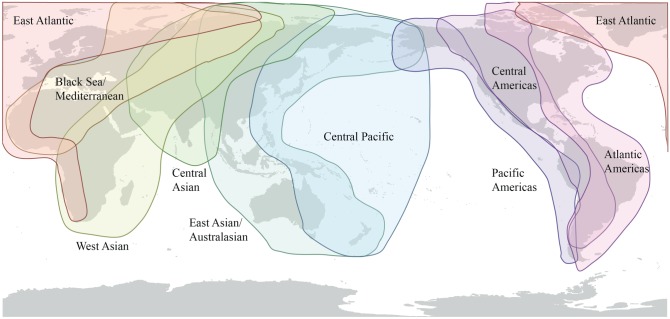
The above image shows the global pattern of bird migration flyways, the main point being that they are very much north-south/south-north routes. Infection patterns mirror these flyway geographies. So one source of infection is a result of migration. Given the fluidity of bird life with its seasonal migratory patterns makes it more challenging to tract the pattern of these ever mutating conditions. That said, although migratory birds are good vectors for bird flu transmission the spread of the disease is also the result of “trade of infected domesticated birds”.
One of the more recent virulent strains was found to be driven by human activities in China and there appears to be a kind of synergy between the trade in infected domstic birds and wild bird movement through migratory flyways. This synergy is the result of the fact that wild birds and domesticated poultry can share the same habitat, water and food as wild waterfowl with their presence and concentration are thought to make them key intermediary hosts.
In terms of the more highly infectuous varieties of bird flu …
In 1996, an HPAI variety labeled H5N1 was noted in commercial geese in Guandong Province of China. It was speculated that this strain originated from H5 viruses in wild migratory birds, thus establishing the wild-domestic strain growth. These Goose/Guangdong (Gs/Gd) lineage strains gave rise to outbreaks of HPAI H5N1 in chicken farms in Hong Kong the very next year, in 1997 that further led to fatal human infections The danger of further spreading was so serious that the entire flock of Hong Kong poultry was culled (killed) in the winter of 1997/1998 to stem the spread of the condition. At that time between 1.3 and 1.6 million chickens were exterminated.
The result was that the virus was temporarily frozen, the caveat being that the particular strain of bird flu involved mutated creating a new wave of the influenze and problems. Outbreaks of the more deadly varieties were recorded again in mainland China afterwards as wellas in other countries of Southeast and East Asia resulting in fatal human deaths from the conditions in Vietnam, Thailand and China.
From there it continued to spread worldwide into Europe, the Mediterranean and Africa where its growing intensity was noted alreaedy in 2005. Reports of infected birds were noted in Russia and Kazakhstan (July 2005) and then in Turkey, Romania and Croatia (October 2005), An infected flamingo was found in Kuwait at te end of 2005. By February 2006 it spread to Ira and Iran whre both backyard pultry and wild brids as well as human and domestic cat cares were recorded. Still in 2006 there were several more detections in Central and Western Europe. That same year the bird flu epidemic moved on to Africa where Nigeria and Egypt both reported infections in domestic poultry. The virus continued to spread in Africa, west and northwards in Europe and through the Middle East and South Asian subcontinent in 2006 and 2007.
Given the bird flu virus’ uncanny ability to mutate – the genetic basis of species variation and change otherwise known as evolution – it should not be surprising that varieties of bird flu, some of them potent and deadly, should begin to be found in humans. Zoonotic diseases are those infectious diseases that can be transmitted between animals and humans. A new variation H7N9 is a zoonotic type which, according to the NLM, killed 623 people of 1625 infected, most of these cases being in China.

Snowy Egrets hanging out early morning. Cheyenne Bottoms Wildlife Preserve. October 1, 2025
4.
Although pretty much all of the above data and analysis comes from Eurasia, eventually, the Americas would be targeted by bird flu as well although it doesn’t appear in some kind of full blown form until 2022, when it explodes. Highly pathogenic avian influenza (HPAI) A(H5) viruses were first detected in U.S. wild birds, poultry, and backyard flocks in November of 2021 and hitting particularly hard in January 2022. The U.S. Department of Agriculture confirmed the first case in a commercial flock on February 8, 2022. The virus spread rapidly, leading to the first confirmed human case in April 2022 and subsequent infections in mammals and humans in 2024 and 2025
- 1924–1925: Avian influenza caused outbreaks in live bird markets in New York City.
- 1968: A flu pandemic that killed an estimated 100,000 Americans involved genes from a bird flu virus. This was the same year that avian influenza A virus infections were confirmed in U.S. wild birds through blood tests.
- 1983: An avian influenza virus began circulating in chickens and later evolved into a highly pathogenic strain.
- 2002: The first human case of low pathogenic avian influenza (H7N2) was identified in the U.S..
- November 2021: The current highly pathogenic avian influenza (H5N1) outbreak began when the virus arrived in North America from Europe.
- February 2022: The first detections of the H5N1 virus were reported in U.S. commercial and backyard poultry flocks.
- April 2022: The first human H5N1 case in the U.S. was reported in Colorado in a person exposed to poultry.
- 2024–2025: The H5N1 virus was detected in dairy cattle in several states, and the first known cow-to-human transmission was identified in Texas in April 2024. Human cases, including the first U.S. death from the virus in Louisiana, were reported through 2024 and early 2025.
What will this current bird migration bring? Will bird flu strike again with a vengeance? Will some variety mutate in such a way that humans can transmit it to one another? Or can it be brought under control.?
____________________________________
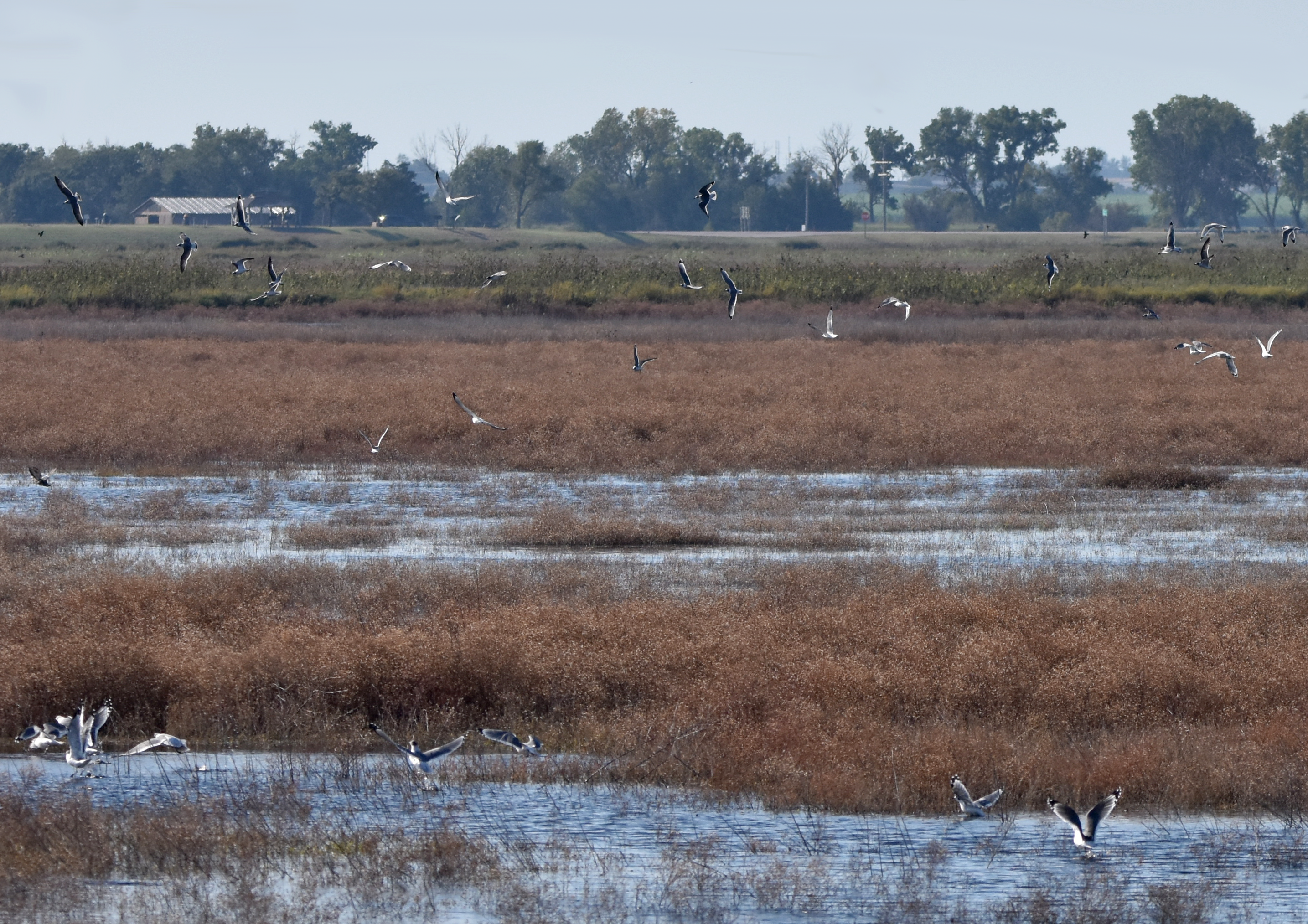
Early morning at Cheyenne Bottoms Wildlife Preserve. So much activity. October 1, 2025 (R. Prince phot)
 View from the Left Bank: Rob Prince's Blog