Some Useful History of Libya
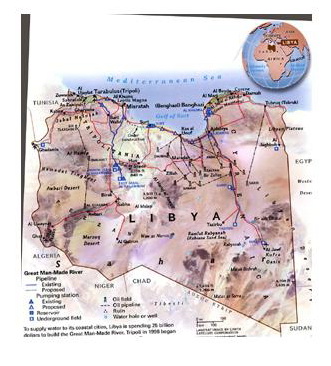
Libya
Fred Halliday (British author of Middle East subjects of long standing) on the background of the Khadaffi years in Libya
Libya At Forty
The fortieth anniversary of the Libyan “revolution” of 1969 – more accurately a coup d’etat by Colonel Muammar Gaddafi and some of his associates and relatives – brings to mind a conversation I had just after that event with a friend who was (and remains) a senior Algerian diplomat. The Algerian government had been as surprised and bemused as any other about the emergence of this bizarre, radical and eccentric regime in a fellow north African state. The then Algerian president, Houari Boumedienne, had asked my friend to visit Tripoli and assess the new leadership there. To continue, click here.
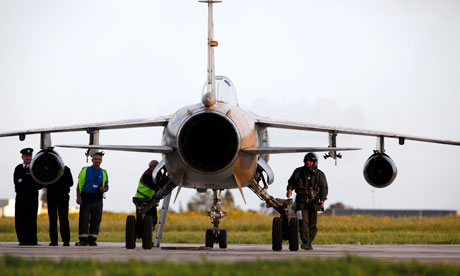
Libyan F-1 Mirage Jet Fighter in Malta. Its pilot defected rather than bomb Libyan protesters. Another jet fighter and now it appears two warships have also defected to Malta
2. Robert Fisk on Khadaffi (note…the latter’s name is spelled a number of different ways…
Gaddafi raved and cursed, but he faces forces he cannot control
So he will go down fighting. That’s what Muammar Gaddafi told us last night, and most Libyans believe him. This will be no smooth flight to Riyadh or a gentle trip to a Red Sea holiday resort. Raddled, cowled in desert gowns, he raved on.
He had not even begun to use bullets against his enemies – a palpable lie – and “any use of force against the authority of the state shall be punished by death”, in itself a palpable truth which Libyans knew all too well without the future tense of Gaddafi’s threat. On and on and on he ranted. Like everything Gaddafi, it was very impressive – but went on far too long. To continue, click here.
3. Pepe Escobar – The Roving Eye (name of his column in Asia Times) – The Tribes Against The Bunker.
The Tribes against the bunker
Libya’s is a tribal revolution. It was not, and it is not, being led by young urban intellectuals, like in Egypt, or by the working class (most of it in fact composed of foreign workers). Even though the actors of the anti Muammar Gaddafi uprising may be a mix of ordinary Libyans, educated and/or unemployed youth, a section of the urban middle classes and defectors from the army and the security services, what trespasses all them is the tribe. Even the Internet, in the Libyan chapter of the great 2011 Arab revolt, has not been an absolutely decisive factor.
Libya is tribal from A to Z. There are 140 tribes (qabila), 30 of them key, one of them – Warfalla – boasting 1 million people (out of a population of 6.2 million). Click here to continue
How To Kill A Toyota…in 3 parts
Part one

Camping McClure Pass, July 1984
There are a few ads…but this is…magnificent. nothing short. Hope you take the time to see all three parts.
Had a truck like this (left) – 84 long bed two wheel drive. Sold it to a friend a few years back. Have always had this sense that the engine would outlive me, my daughters and the generation after…
Thanks David Adelman for passing this along to me. rjp
Algeria, Where Demonstrators Carry Black Flags: Part One
Part One…

Algeria
While they showed the same kind of courage as those who brought down Ben Ali in Tunisia and Mubarak in Egypt, the demonstrators on the streets of Algiers on Saturday, February 12 really never had much of a chance. The odds were not good. 3-5000 protesters braved a security force that was estimated to be no less than 30,000, outnumbering the protesters by 6 or 7 to 1.
Still the Algerian government is nervous. 30,000 security police sent out to surround 3,000 demonstrators suggests a high degree of state paranoia. While Egypt is key to the transport of oil through a pipeline and the Suez Canal and Tunisia has very little of the `black gold’, pretty much the entire Algerian export economy is based on crude oil and gas production. Algeria is the third largest African oil producer after Nigeria and Angola. This helps explain the security police overkill presence, that along with this shaky regime’s nervousness. Read more…
Mubarak Steps Down: Let The Spin Begin
“Bliss was it in that dawn to be alive/ But to be young was very Heaven!”
William Wordsworth – The Prelude 1805 (commenting on the French Revolution of 1789
___________________
Early Note: 9 am, Friday, February 11, 2011
It was announced just now that Hosni Mubarak has stepped down as president of Egypt; he has turned all power over to the Egyptian military. The revolt of the U.S. proxies has, for the moment, failed. (see below)
A time to rejoice. Democracy has won a big one. Geriatric authoritarian kleptomaniacs the world over, take note!
Comments from Tunisian friends about the events in Egypt:
“Ah the Egyptians beat us; it took us 28 days, they did in 18!”
“Tunisia and Egypt were the toughest (referring to the levels of repression), the others will be easier. Look what we started. Who’s next?”

The people of Egypt force Hosni Mubarak from power...peacefully
——————-
Late Note: 6 pm, Thursday, February 10, 2011
The news has broken a few hours ago that Hosni Mubarak refuses to step down as Egypt’s president despite enormous domestic and international pressure for him to do so.
This is a dangerous moment with events moving rapidly, although it is not clear towards what. At the moment – U.S. Middle East policy is in shambles, utter confusion with Obama’s key Middle East advisors split over how to proceed. This is a defining moment for Egypt and for the Obama presidency.
What I think is going on is `a revolt of the U.S. proxies’… in which Egypt, Saudi Arabia and Israel (a strange, but strong coalition) are making a common stand, and `putting the ball’ back into Obama’s camp. They are challenging him to act understanding that Obama’ options are limited; Their goal is to bring down his presidency rather than Mubarak. It might work. Obama’s options are fraught with problems.
Mubarak’s rejection (after hinting that he would step down and getting the international media into a froth) of leaving office is tantamount to challenging Obama to move in the direction of military intervention. But a direct U.S. military intervention would throw the entire region into complete chaos.
On the other hand, if Obama does not intervene it would suggest his weakness under pressure. He would find himself in a situation similar to Jimmy Carter facing the Iran crisis in 1979. Whatever, the crisis is shaping up to be the defining moment in Obama’s presidency. He is not handling this situation well.
Much depends now on the response of the Egyptian military caught between a rock and hard place. Its upper ranks are closely connected to Mubarak. There is a danger in a split between pro and anti Mubarak factions, a development that could have ominous consequences.
Perhaps there are other options that I do not see? Of course, I’m sure there are. Regardless, these next days are going to be an extremely sensitive period. Earlier in criticizing U.S. foreign policy in the Middle East I labeled the current situation somewhere between a set back and debacle for U.S. policy. The diagnosis is leaning a bit more towards the `debacle’ scenario.
rjp
________________
links:
Juan Cole on `what now Egypt‘ – pretty good
Uri Avnery `Tsunami In Egypt‘ – another Avnery pearl
Richard Falk `Post Mubarak Revolutionary Chances’
A War Israel Is Ill-Equipped To Fight
Hosni Dumpty sat on the wall
Hosni Dumpty took a great fall
$70 billion in U.S. military aid
and all of that Israeli and Saudi pressure
Couldn’t put Hosni Dumpty back together again…
——————–
(note – I changed the title of this blog from `Egypt’s Democracy and Israel’s Identity crisis to the present one `A War Israel Is Ill Equipped To Fight’ as this is the title given to the piece at Foreign Policy In Focus and it is under this banner that it is circulating rather widely…rjp)
Egypt’s Democracy and Israel’s Identity Crisis.
1. How To Win Friends and Influence People
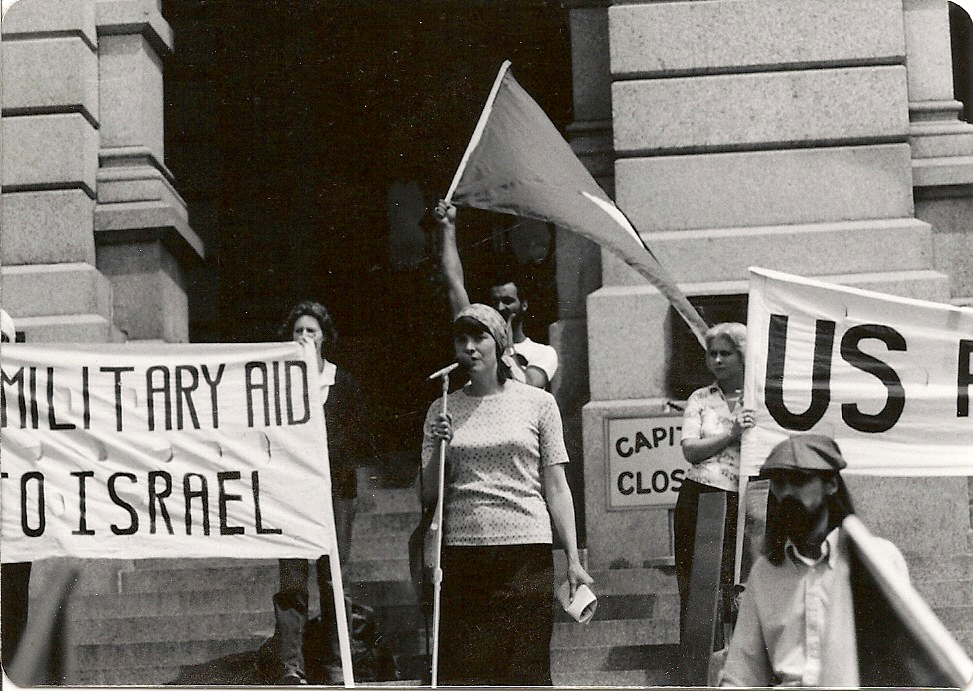
1982 Protest Demonstration Against the Israeli Invasion of Lebanon. Denver Colorado
In late 1980, not long after the Camp David Accords were signed between Israel and Egypt, I was invited to give a talk to large gathering – perhaps 500-600 people – at Colorado State University in Ft. Collins. Asked to comment upon the Accords, which were, in those days, immensely popular throughout the United States, I did so.
In my usual inelegant style, I criticized the agreements as little more than a military alliance that would not decrease but increase Middle Eastern regional instability. It would all cost U.S. tax payers a pretty penny. I suggested that the agreement would lead to a tightening of the Israeli hold on the Occupied Territories and that with Camp David consummated, the likelihood of a negotiated agreement to end the Israeli-Palestinian conflict would vanish for some time in the future.
I wondered out loud as to the fate of the 2 state solution. There were other consequences, the puncturing of Arab secular nationalism, strengthening U.S. control over Middle East energy resources, etc.
The speech had a number of minor repercussions.
- First, my remarks, which I thought quite reasonable, were met by angry cat calls, boos, a fair number of those in attendance walking out. That was new.
- Then, my relations with the mainstream Colorado Jewish Community, already fragile, were permanently shattered. Unkind telephone calls, death threats followed – the usual histrionics that accompanied criticisms of Israel and U.S. support of it at the time – as did several visits to my employers by delegations of the `committee of the faithful’ organized by what was then called the Colorado Zionist Federation. Read more…
U.S. Middle East Policy: See No Evil, Hear No Evil, Speak No Evil…just practice them and then act surprised…

Three Wise Monkeys from left to right`Hear No, Speak No, See No Evil'...Toshugu Shrine, Nikko Japan
1. A bit of disconnected, but not irrelevant history…
Many years ago – 43 to be exact – Phil Jones and I, both Peace Corps volunteers stationed in Tunis at the time, walked into a reception in the garden of the U.S. embassy there where Hubert Humphrey was doing his best to give a pro-Vietnam War pep talk, trying to explain how the February 1968 Tet Offensive wasn’t a U.S. military setback despite Walter Cronkite’s suggestion on national television that indeed it was.
As Humphrey launched into his remarks, Jones and I, somewhat nervous and uncertain as to our impending fate, took out our anti-war posters from under our sports coats and held them high in the air.
According to `an informed source’, present at the historic event (and still this side of the great divide), Humphrey was quoted as saying: `”I can’t even give a talk to the embassy staff in Tunis, for Christ’s sake!” Read more…
Three Pieces on the developments in Egypt
________________________
related links:
Phyllis Bennis – Tunisia’s Spark and Egypt’s Flame
Gideon Levy (Haaretz) – Egyptians Won’t Play Israel’s Game
Hellan Cobban – Why Washington Was So Blind To Egypt
Pepe Escobar – The Brotherhood Factor
________________________
Haider Khan: Egypt: What’s Next

Haider Khan
Events in Egypt have unsettled the media pundits and Western academic advisers alike. After all, how can the recipient of the largest amount of U.S. foreign aid in the Arab world and a close U.S. ally be in such dire political trouble from within?
As a CNN pundit put it recently, “among Arab nations Egypt enjoys a near-unparalleled relationship with Washington.”
But now Washington is worried. to continue… click here
note: Haider Khan teaches at the University of Denver’s Korbel School of International Studies
Jesse Myerson’s Blog: Dispatches From My Couch

Jesse Myerson
On January 25, as the Egyptian revolution began, President Obama was ascending to the podium to deliver his second State of the Union address. Understandably, there was not much by way of foreign policy discussion in that piece, but Obama did, in response to the recent Tunisian uprising, echo President Bush’s second inaugural address, proclaiming “tonight, let us be clear: The United States of America… supports the democratic aspirations of all people.” At press time, as we enter yet another period of defied curfew in Cairo, the most radical defense the U.S. has mounted of the Egyptian people’s democratic aspirations was this morning’s call from Secretary of State Clinton that General Mubarak engage in a national “dialogue” about reform. Well, I’m sorry, madam, but the Egyptians have had their dialogue, and it has sounded variously thus: to continue…click here
Jesse Myerson: up and coming political commentator; theater producer and director; contributor, `The Busy Signal’
Juan Cole: Egypt’s Class Conflict

Juan Cole
On Sunday morning there was some sign of the Egyptian military taking on some security duties. Soldiers started arresting suspected looters, rounding up 450 of them. The disappearance of the police from the streets had led to a threat of widespread looting is now being redressed by the regular military. Other control methods were on display. The government definitively closed the Aljazeera offices in Cairo and withdrew the journalists’ license to report from there, according to tweets. The channel stopped being broadcast on Egypt’s Nilesat. (Aljazeera had not been able to broadcast directly from Cairo even before this move.) The channel, bases in Qatar, is viewed by President Hosni Mubarak as an attempt to undermine him. to continue…click here
Juan Cole is a professor of Middle East Studies at the University of Michigan…he has done much to reorient the field of study to make it more objective, more scholarly. He writes `Informed Comment’ – one of the better commentaries on Middle East affairs.
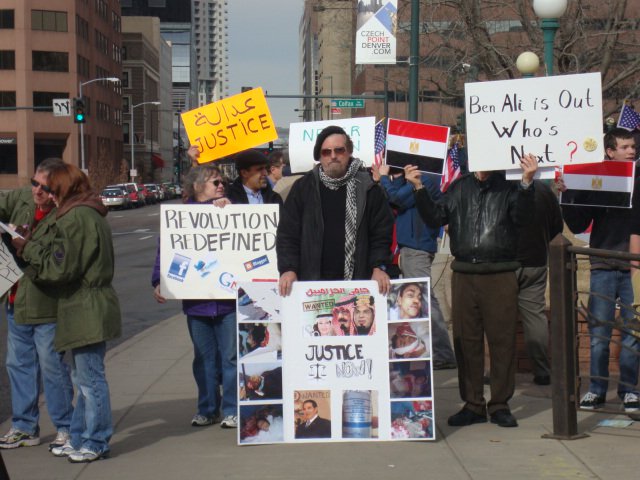
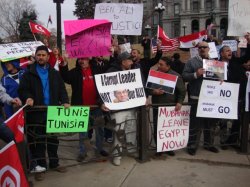
Demonstration for Egyptian and Tunisian Democracy. Denver, Colorado. January 30, 2011. photo credit: Mourad Ksouri
U.S. Middle East Policy In Crisis…Tunisia, Egypt, Who’s Next?
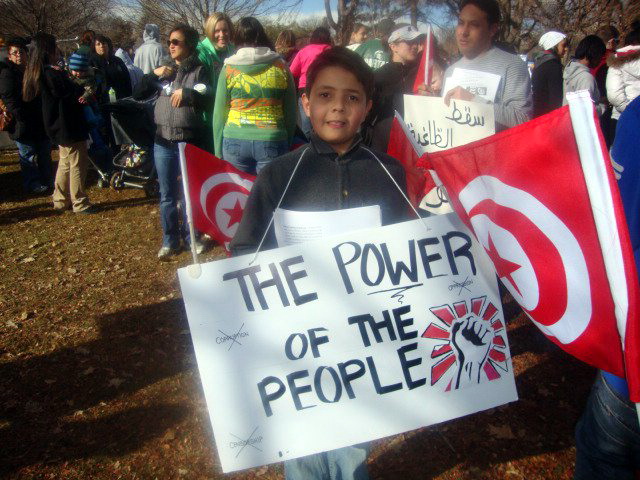
Denver, Colorado - Martin Luther King Day `Marade' - Tunisian Community Delegation. photo credit: Mourad Ksouri
It is not just the governments of different Arab countries that are in crisis, as the media would have us believe. U.S. and European Middle East Policy is also suffering from the events. For Washington, London, Paris and Berlin, the current upsurge of regionwide protests in the Middle East is something between a setback and a debacle, the extent of which remains to be seen.
And right now the Obama Administration is scrambling to scratch together a policy to keep up with events that change daily.
Protests that began in Tunisia with the immolation of Mohammed Bouazizi, a university graduate reduced to selling fruit and vegetables in Tunisia’s interior city of Sidi Bouzid, have now spread like wildfire throughout the Middle East. Read more…
The Busy Signal: Interview with Rob Prince on Tunisian Situation
Here is my first `skype’ interview – done by Jesse Myerson on a website called `The Busy Signal. It’s on the Tunisia event and runs close to an hour. Jesse Myerson – the interviewer – is shaping up to be a `Charlie Rose’…with brains, dangerous combination
If my mother were still alive she’d be horrified, not by what I said so much, as by the fact that I need a haircut… rjp
Tunisia: Magreb Center (Washington DC) Panel on Tunisia January 24, 2011, Georgetown University: Rob Prince Remarks
Notes: Magreb Center Event on Tunisia: January 24, 2011
Rob Prince
– Unusual moment..
– Much has been said, much left out…
Media concentrates on 3 themes..
1. the economic issues
– high unemployment including among university groups
– low wages in tourism/agriculture/mining/textile sector – also in state sector Read more…
Rally For Tunisian Democracy: Denver, Colorado – January 22, 2011
Notes on Talk, Rob Prince: Tunisian Community of Colorado Rally for Tunisian Democracy: January 22, 2011. Denver
____________________
(note…these are the themes I will touch on – so it written in a somewhat abbreviated form) – rjp
______________________

Manoubi and Basma Bouazizi - Mohammed Bouazizi's mother and sister respectively
Events in Tunisia `historic’…not just for country, but already for the region and possibly beyond.
– It is one of the first successful post-cold war social movements – has a different chemistry than many earlier ones
– First grassroots democratic movement to unseat/overthrow a repressive regime in the Arab World
– One of the first responses to the global financial crisis that hit 2 years ago…
On the other hand, it has been described as somewhat `unusual’ for Tunisia suggesting that social movements there rarely exist and people rarely demonstrate.. Read more…
Tunisia: Illusions – Ben Ali’s and Ours (Obama’s)
relevant links:
Juan Cole: Tunisian Revolution Shakes And Inspires Middle East
Robert Dreyfus: In Tunisia, An Unfinished Revolt
Yasime Ryan: The Tragic Life of a Street Vendor (Al Jazeera) – Part One of a two part series
Sidi Bouzid: Birthplace of Tunisian Revolution (Al Jazeera U-Tube)
______________________________
Nowhere to run to,
Nowhere to hide
Got nowhere to run to,
Nowhere to hide
Martha and the Vandellas
Is this the song that Zine Ben Ali and Leila Trabelsi are singing in Jeddah?
There is a story floating around in the media that from his new vantage point in Jeddah, Saudi Arabia, deposed Tunisian president Zine Ben Ali phoned Tunisia’s interim Prime Minister, Mohamed Ghannouchi , informing the latter

Tunisia...what it's all about caught in a photo
that he was `considering’ returning from exile to Tunisia. The news report continues that Ghannouchi diplomatically responded to Ben Ali that `it was impossible’. This story first appeared on YNetNews, an Israeli website.
Is this one of the many rumors flying through cyberspace, yet to be substantiated?
If true, it suggests the degree to which Ben Ali’s thinking remains, at best, delusional. He doesn’t seem to understand that the world he ruled in Tunisia has just crumbled. Actually perhaps for Zine Ben Ali, denial is the only viable psychological strategy he has left. The alternative is to engage in the kind of self-criticism that tyrants and sociopaths find difficult. Read more…
Langston Hughes – A Dream Deferred
|
What happens to a dream deferred? Does it dry up Like a raisin in the sun?
Or fester like a sore– And then run? Does it stink like rotten meat? Or crust and sugar over– like a syrupy sweet? Maybe it just sags like a heavy load. Or does it explode? _________________________  Langston Hughes This poem by Langston Hughes – more precisely than any academic or political ananalysis – sums up succinctly the Tunisian events of the past month. Thanks to Aaron Ney for sending it my way.
|
Tunisia: On `The Voice of the Cape’ Radio Station: South Africa

This is what happens to a people denied for so long...
Note: there is a problem with this link. I’ll see what i can do, which means I’ll get help. It comes up on my machine, but no one else’s…. rjp
Here is an interview I did with `The Voice of Capetown’ in South Africa on the situation in Tunisia. To listen, click here. It starts a bit slurred, but it clears up after a few seconds. Whole interview runs 19 minutes. rjp
Note: Fahed Boukadous – tunisian journalist jailed for his coverage of the social protest movement in Redeyef, Tunisia in 2008, whose situation was decribed in this blog – has been freed today………news just came in.
Tunisia and the New York Times…

Tunisian delegation to the MLK Jr Annual `Marade' in Denver Colorado. According to the Denver Post, more than 30,000 people were expected to attend
Related Links:
CNN video just before Ben Ali Fled Tunisia
Foreign Policy In Focus: NY Times Finally Deigns To Cover Tunisia. (the same article as below, covered by FPIF)
Leila Trabelsi’s Flight from Tunisia (in French)…before leaving Tunisia, despite family wealth worth billions, Leila Trabelsi went to the Bank of Tunisia and withdrew 1.5 tons of gold worth an estimated $65 million, this according to French intelligence
Campaign for Peace and Democracy’s Statement on Tunisian Events – pretty solid statement.
Vendor Cart – a song by Dutch-Moroccan singer Kashmere Hakim. The song is dedicated to the memory of Mohamed Bouazizi, the 26 year old university grad from Sidi Bouzid whose immolation triggered the protest movement that brought down Ben Ali and Leila Trabelsi in less than a month. It is seen through a link on Nawaat.org
Interview with Samer Shehata on Real News – good in depth background on the protest movement begun on December 17, 2010
Tunisia: No Domino Effect – but a US dilemma over Arab Democracy by Tony Karon – in Time Magazine
Jasmine and Gunsmoke – good analysis, worth reading
____________________________________
(Note: written just before Zine Ben Ali gave up power and fled the country. On the one hand, Tunisians I am in contact with are exhilerated – the first time in modern history that demonstrations have brought down an undemocratic Arab regime. On the other hand, a complex moment filled with political mine fields lies a head. What happened yesterday as the Ben Alis and Trabelsis tried to scatter to the wind is only the end of the beginning..)
Tunisia and the New York Times…
By Rob Prince

Tunisia (area in red is where social protests began 3 years ago in Gafsa phosphate mining district, centered in Redeyef)
What a difference a month makes. After more than 50 deaths, hundreds of wounded, perhaps thousands of arrests and tortures in Tunisia at the hands of Zine Ben Ali’s security forces and repressive apparatus, the mainstream media in the West has `discovered’ the Tunisian crisis.
And now the race is on: which media outlet can win a Pultizer by feasting on the political corpse of Zine Ben Ali? Will it be the NY Times which has awakened from its Tunisian stupor with a series of hard hitting, excellent pieces? Will it be NPR that is trying to recruit Tunisian bloggers and Facebook addicts (admittedly I am one too) to gave an `authentic’ flavor? Are members of Congress now getting out their atlases, trying to get it straight that Tunisia is not a part of the Indonesian island chain?
That the New York Times is taking the Tunisian crisis seriously, is of course, welcome and not only because the story deserves coverage. It suggests something else far more important: that the powers that be in the United States have given the Times the go-ahead. And this is important for another reason: when trying to learn about Tunisia, the Congressional flock pretty much always takes its lead, advice from the State Department. This in turn opens doors for peace movements, human rights organizations who have long been well informed on the Tunisia situation to exert genuine influence.
Speculation? Of course. But I’ll be dollars to high quality donuts – even bagels – that this is what is transpiring. Read more…
 View from the Left Bank: Rob Prince's Blog