It’s semi official. Zine Ben Ali, Tunisia and his corrupt, oppressive regime are now history. There are numerous reports, including one from Le Monde that

The Banner says, in English `Freedom'. Tunis, January 14, 2011 - the day that the familes of Zine Ben Ali and Leila Trabelsi left Tunisia in two airplanes for Malta, accompanied by and under the protection of the Libyan Air Force
Ben Ali is gone and turned the governing of the country over to the Tunisian army. He did this after several press conferences these past days spoken in a language I am told he has not used for 23 years – the Tunisian Arabic dialect – offering the people of his country much of what it is that he has taken away these past decades: economic opportunity and democracy. Too little too late, his concessions were laughed at and did nothing to dampen the opposition.
Unable to rule anymore, his entire government resigned, with many of those in the two ruling families – the Ben Alis and Trabelsis – (the latter his wife’s family) fleeing the country where they wait in the shadows hoping that in the confusion for the country that lies ahead, they can find ways to return to power.
- The rumors as to their destination flew early on – France, Dubai, other places.
- But according to my `well placed sources’ (ha!) Ben Ali left Tunis for the Mediterranean island of Malta along with some members of his and his wife, Leila Trabelsi’s families, their two planes under the protection of the Libyan Air Force.
- Now I’m hearing that neither Malta or Paris would let their planes land so they had to seek refuge in Dubai…whatever
People are sending around the hotel rooms and phone numbers of the different Ben Ali-Trabelsi family members in flight. Don’t bother too much with the confusion. In a day or two most of their whereabouts, for those interested, will be well known and verified.
Some members of the two families are already under arrest, some in hiding or in cognito assumed in Tunisia, others have fled. In two days many of their villas have been burnt to the ground and looted by angry demonstrators. There is a report that one member of the Trabelsi family tried to leave the country on a regularly scheduled Air Tunis flight. The pilot recognized him and refused to take off.
Do not underestimate their willingless, nor Ben Ali’s cunning to achieve this as the road ahead for Tunisia is quite complex as will be analyzed in future postings here.
Still for the moment, cause for celebration. A genuine tyrant – a real first class skunk and thug – is gone from power, removed from power by a democratic upsurge that virtually no one, including progressives, could have predicted would succeed. Also gone are his wife’s corrupt and greedy family that has milked the country’s prosperity for their own pleasures. Hopefully some of these people, including Ben Ali and his former hair dresser wife, Leila Trabelsi,

The Ben Ali's...in happier days. Maybe the former hairdresser can open up a salon in Paris or New York or the Tunisian prison to which she could be sentenced for massive corruption and abuse of power
will someday soon be brought to trail and have to face a Tunisian court of law.
There will be more, much more on what follows.
Just hours before Ben Ali grabbed his bags and ungraciously left the country, I finished some thoughts on why it took the New York Times so long to connect with the story. What follows below will appear, I am told, on the `Foreign Policy In Focus‘ website in the next day or two. I’ll post it later…
_____________________________________________
hem all, Saudi Arabia…
Tunisia Explodes – 3 Pieces:Boulder Daily Camera, Counterpunch and Open Democracy 1/13/2011
This piece appeared in today’s (1/13/2011) Boulder Daily Camera, Boulder, Colorado
Another one in `Counterpunch’
A third in `Open Democracy’
____________________________________

Tunis, January 13, 2011 - Demonstrating for jobs, democracy and an end to the tyranny and corruption which marked the Ben Ali years
Nearly a month after the protests in Tunisia began, finally, today, January 13, 2011, more coverage in the USA, starting with pieces in the NY Times and San Francisco Chronicle.
The NY Times also printed a seering editorial on the situation `Tunisia Seethes’
There are others.
The fact that the NY Times has decided to publish such a hard hitting piece suggests, in my view, that the State Department has, now after a month, given up on Ben Ali. I might be wrong about this but think there is some loose connection between what the Times prints and what the State Department thinks. The Times piece is especially hard hitting, exposing the situation accurately with no holes barred. It seems that they have sent a correspondent to Tunis and that he is reporting on the ground. Here he is reporting the looting of a mansion of the ben ali clan. And it appears he is right there watching the looting take place. Let us see if the reporting continues tomorrow. It is a fine report. I thank my old PC Tunisia friend Rachel Freed for sending along David Kirkpatrick’s article and my friend here in Denver, Steve Moss, for sending me the Times editorial.
Tunisia: Yezzi Fock (It’s Enough!)
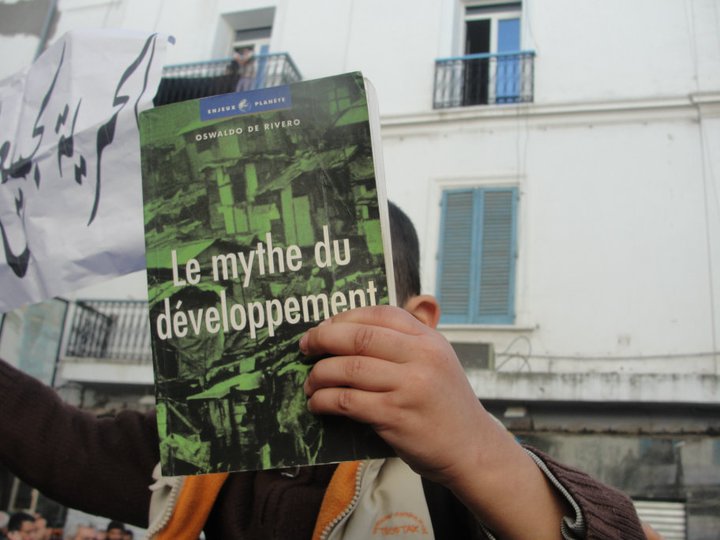
photo credit: Djeja Moslia. Young demonstrator in Tunis. As the `Tunisian Economic Miracle' unravels. The young man is holding up Oswaldo de Rivero classic critique of World Bank/IMF Structural Adjustment Programs: The Myth of Development
Note: just after posting this, the Tunisian army has taken control of the city of Tunis. It is not clear at this time, whether or not this is a military coup. That said, strange as it might seem, there is the sense that at the least, the army is there not only to restore order, but to protect the populace, much of which is protesting, from the security police. More tomorrow morning when, perhaps, some of the fog over the situation will clear.
rjp – 1/11/11 at 10:15 pm mountain time.
____________________
Yezzi Fock!
This has become the theme of the nationwide protests in Tunisia which continue unabated. `Enough’ refers to the high levels of unemployment in the country, the pervasive corruption, especially of the two ruling families and the decades of seething repression which has kept Zine Ben Ali in power now for 23 years.
And with that, protestors in different parts of the country are tearing down President Zine Ben Ali’s portrait, a harbinger of things to come perhaps.
Triggered originally on December 17, 2010 by the suicide of a 26 year old university graduate who had had his unauthorized fruit and vegetable stand confiscated in Sidi Bouzid – and who soaked himself with gasoline and lit a match – the protests have only intensified, despite government attempts to suppress them continue. Read more…
Phil Woods Poems: Negation, Blessings

Phil Woods, Denver Poet
Phil Woods is a former high school teacher, poet, and long time friend. Together we are in a book club which I refer to as the `burnt out lefty old guys book club’. The 6 or 7 of us have read a slew of books and had good discussions. Many of these books wind up on my recommended reading list for students at the University of Denver.
His latest collection of poems, Lucid Dreaming is available from Phil – yamabushi3@yahoo.com. He read some selections from it at West Side Books (on 32nd Ave and Lowell Blvd) in NW Denver about a month ago. I thought it was quite fine.
Here are two of Phil’s latest…
The first, called `Negation’ is a poem he read after getting depressed about reading our book club’s next selection `The Punishment of Gaza‘ by Gideon Levy.
The second poem is `Blessings’ about meeting an old friend in New Mexico. I like them both:
NEGATION
Waiting for phone that my truck is done

Gaza... Operation Lead Cast, December 2008
I set the book about Gaza down.
Collective punishment is against
International law & yet, it goes on & on.
I’m tired of human cruelty,
Bureaucratic indifference.
The first time I heard the story
Of the Good Samaritan I knew
It was true like gravity.
Our first black president
Becomes expert at symbolic gestures.
That’s what progressives get.
The money boys with the real power
Have a different kind of access.
To have grown old & see the world
Morally in such shape
Leaves a hole in your gut
As though the meaning of your life
Has been cancelled out.
It’s up to the young now
To go along or try to redirect
The failing project so many
Have given their lives for—
Human dignity, human freedom.
Sometimes life is a mocking bird.
_______________________
BLESSINGS
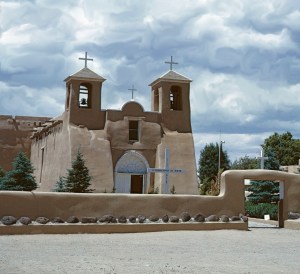
Chimayo New Mexico, June 1975
Drove over to Abiqiu after fish tacos.
Enjoyed the drive, the blue snake of the
Rio Grande below its steep walls
As I crossed the bridge over the gorge.
Listened to a hodgepodge of songs
Loosely connected to coal mining.
“Mr. Peabody’s coal train hauled it away.”
Noticed the austere beauty of the
High desert foliage when I stopped
North of El Rito. All the grand,
Splayed yellowed stocks
Displayed just right, arranged
In the still life of winter.
The olive green juniper & pinion
Pine contrasting with these brown &
Yellow stalks & dead seed pods.
In the river bottoms the willows
Already carrying the red tint of
The emerging spring weeks away.
My friend & I talked in his living room.
At eighty he decided he must put in
His hearing aids which naturally
He doesn’t like. We covered a lot
Of ground, but when I told him
About our mutual friend, the French
Lay shaman, Jean, & how Jean
Made a corn meal Mandala when
We were camping. The Mandala
Told the story of creation through
Creation & constituted an ephemeral
Prayer. John leaped at this notion
So much like Tibetan sand painting.
He scurried over & handed me
A book of photographs of roadside art
In India as he related a story
Of hearing a lecture with slides
Concerning ephemeral art. He
Talked of once almost applying
For a Canadian grant to go to India
To do his own investigating. The sun
Was sinking lower as we talked
I came to the photo of Vishnu.
The caption said “preserver
Of the world.”
The haunting eyes
In the modest image spoke
That truth. Before meeting Jean
For dinner we agreed there is something
Good about enacting ephemeral blessings.
They are like the tender blessings
Of enduring friendships.
_____________________
related links
A Family In Gaza Two Years Later (by James Wall)
RealEconTV – some samples

BP gas station (Little Neck, New York) trying to bribe consumers with free pop after the Gulf oil spill
Note. below I will post a number of interviews on the economy, the financial crisis, both domestically and internationally. There is some excellent material `out there’ which explains how this financial crisis exploded, and what might be done…I’ll build this entry over the next week or so, so you might check in..
Municipal Bonds: The Next Disaster
The Tunisian Intifada…
1. They Just Don’t Stop Protesting…
Not even torture, which is rampant or live bullets which the Tunisian authorities are using with greater frequency, stop them..
It is more than two weeks since a distraught and unemployed young university graduate, Mohammed Bouazizi, sat down in front of the town hall in the central Tunisian town of Sidi Bouzid, poured gasoline on himself and lit a match. Bouazizi’s act of self-immolation and protest against Tunisia’s high unemployment, rampant corruption and decades of repression by the government of Zine Ben Ali triggered a protest movement, first in the country’s center and south, but now virtually everywhere, including the capital, Tunis.
Unwilling to admit how his own regime has contributed to the crisis, Ben Ali, predictably blames the protests on `radical elements,’ `chaos mongers’ ( an interesting and empty phrase) and `a minority of mercenaries’ rather than on the policies Tunisia has implemented during his 23 years in power.
The intervention of the Tunisian security forces and army using live ammunition has not stopped the wave demonstrations. Nor has Ben Ali’s sacking of 4 members of his cabinet combined with promises of a $5 billion state jobs program softened the opposition. At the time of
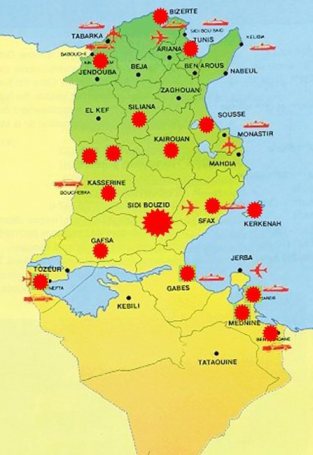
Demonstration Sites in Tunisia: It's Not Just Sidi Bouzid Anymore
this writing (January 2, 2011) the Tunisian protest wave continues and is more and more taking the form of a national uprising. While some property has been destroyed, the overwhelming amount of violence has come from the state and the security forces. Virtually all of the demonstrations have been peaceful to date. That said, the economic grievances which fueled the initial outbursts now have a more political aspect to them as more voices outside of the ruling party, the Rassemblement Constitutionelle Democratique (RCD) are calling for Ben Ali and his increasingly influential wife, Leila Trabelsi, to step down and relinquish power.
Ben Ali is giving no indication of stepping down. He is combined increased repression on the one hand, with a media campaign and promises of economic and social reform on the other. Ben Ali is gambling that the protests, which seem to led mostly by unemployed youth as well as some elements of Tunisian’s student and labor movement is a spontaneous expression of frustration that will fizzle sooner rather than later.
While this might be the case, it appears that broad sectors of Tunisian society are more supportive of the protestors than the government and that Ben Ali’s promised reforms are too little too late. Ben Ali has made such promises in the past and failed to deliver, as happened after the 2008 protests for jobs and against corruption that centered around Redeyef, the Tunisian phosphate mining town in the Gafsa region.
Even if he is able to maintain his grip on power for the moment, Been Ali’s social base support has narrowed to the military, police and security apparatus, along with the support of a few key European governments, France key among them. Other than members of the two ruling families and the thinnest base of support atop Tunisia’s economic pyramid, there is little enthusiasm either for his continued rule or for the plans now set in motion to make his wife, Leila Trabelsi vice president of the country
2. The United States Remains Silent
The United States State Department remains silent in face of the Tunisian protests. Since the protests began on December 17, 2010, there has been little media coverage in the mainstream US media, virtually nothing on mainstream television, nothing in the New York Times or Wall Street Journal, or for that matter even Democracy Now! This is in sharp contrast with the European, North African and Middle Eastern media where the

Sarkozy and Ben Ali...birds of a feather
Tunisian protests have become big news. In two articles in the British Guardian, columnist Brian Whitaker calls the Tunisian protests the `most important and most inspiring story from the Middle East this year’. In another story a few days earlier, he wrote a scathing critique of the Tunisian government commenting at the end that Ben Ali’s days in power are probably numbered.
The Obama Administration’s failure to comment on the Tunisian events is another indication of its more general hypocrisy when it comes to supporting human rights in Middle East countries. The administration is well aware of the situation in the country. The WikiLeaks cables concerning Tunisia, from a former US ambassador to the State Department, contained very explicit and damning information, detailing the repressive environment in the country, the rampant corruption most especially of the families of President Ben Ali and his wife Leila Trabelsi, at one point labelling the regime as a `kleptocracy’.
So why the measured silence for the Nobel Peace Prize winner?
A number of factors come into place, central among them:
- the Obama Administration is wary about opening up another front of social unrest with Iraq, Afghanistan, Yemen and Somalia on its hands.
- If Washington has no particular love for Ben Ali, still they worry about a replacement, wanting one that would, like Ben Ali and Bourguiba before him, support US strategic policy in the Middle East and Africa, who will cooperate with NATO and AFRICOM as Ben Ali has. It would not be the first time that the Obama Administration has thrown a U.S. commitment to human rights concerns to the winds to maintain strategic support for this or that tyrant.
There are also economic considerations. Tunisia has been played up as an IMF-World Bank poster child, an example of how following `the Washington Consensus’, – ie IMF

IMF: `Tunisia's Economy Is In Good Health'
structural adjustment program leads to success. Except it didn’t. Take for example Tunisia’s rush to privatization, one of the IMF’s sacred cows – you know, that line of reasoning made popular by Ronald Reagan and Margaret Thatcher, that somehow the private sector sector can conduct business better than the state. According to the dogma, privatization is supposed to lead to increased competitiveness and greater efficiencies. Perhaps under certain (increasingly rare) circumstances the logic works.
But in Tunisia – as in many other places, privatization became a means of the two ruling families, the Ben Alis and Trabelsis to buy up state property at bargain basement prices and make a financial killing. It did not lead to a growth of Tunisian entrepreneurial ship, but simply to a greater concentration of economic power in the hands of the two families, and the corruption involved was so bad that even the U.S. ambassador (in a WikiLeaks cable) was embarrassed.
Yet despite the current economic crisis, which these structural adjustment programs only exacerbated, the IMF continues to pressure Tunisia to `stay the course’…cut remaining subsidies on basic food stuffs and fuel, privatize its social security system and open up its financial sector even further. And once again, the IMF is oblivious to how those policies have only deepened the socio-economic crisis in the country and that an entirely different economic strategy is in order
3. `Most Inspiring Story Coming Out Of The Middle East This Year’
There is another reason for Washington’s hesitancy, call it `revolutionary contagion’ …what starts in one place, as in the strategically not particularly important Tunisia, could spread to…Egypt, Saudi Arabia and who knows where else. Signs abound. Just to the west, Algerians are protesting inadequate housing that they have been promised for years. Although current turmoil in Egypt appears to center around the bombing of a Coptic Church, with accusations of the hand of an al Qaeda like attack, under the surface for all its differences with Tunisia, Egypt too is facing serious socio-economic problems.

Bread and democracy: demands that people in other Middle Eastern countries could easily embrace as Tunisians have
And throughout the Middle East, governments are nervous. The Iranian and Syrian press have commented on Tunisia’s unemployment and corruption problems, as if they too don’t have to deal with similar drawbacks. Saudi commentators (of all people) are lecturing Ben Ali on the need for democracy, etc etc. Throughout the region among the ruling elites there is the growing concern that the Tunisian protests could spread to their countries. And they have reason for concern for despite many differences, unemployment, corruption and dictatorship are by no means limited to Tunisia.
So already, `the Tunisian example’, in two short weeks has spread beyond the country’s borders and governments are taking the events seriously. If Ben Ali will not relinquish power (yet), still, he reshuffled his cabinet firing four ministers and promised a $5 billion jobs program. He also was careful to visit Mohammed Bouazizi (the young man who set himself aflame) as well as meet with the families of those killed by the security forces. As the protests grew in Tunisia, Hosni Mubarek, speaking to the ruling political party in Egypt, seemingly `out of nowhere’, announced that Egypt too would launch a $3.5 billion jobs program to deal with Egyptian unemployment. Coincidence? In a gesture to help Ben Ali, Muhammar Khadaffi in nearby Libya announced that Libya would not limit entry to Tunisians seeking jobs. Khadaffi also announced a major government financed housing project not long ago.
Nesrine Malik, like Brian Whitaker, writing in the Guardian on New Year’s Eve calls the Tunisian protests `one of the most inspiring episodes of indigenous revolt against a repressive regime. Referring to the Tunisian protests she comments: `Change is sometimes more likely to happen when people know what it looks like, when the first person dares to point to the emperor and say that he is naked.’
And if events continue in Tunisia, what does it mean for the other `geriatric regimes’ of the Middle East, many of which themselves are on the verge of transitions of power? For if the Tunisian people can stand up to power and oppression, why not the others?
Meanwhile the protests in Tunisia continue…La Lutta Continua..
_____________________________
Tunisia’s Ben Ali…So Will The End Be Gracious or Graceless?
Basel Saleh: IMF Economic Medicine Has Resulted in Mass Poverty and Unemployment (good piece – deflates the exaggerations, long repeated like a mantra of Tunisia’s so-called economic miracle…which is appearing more and more like another not so unusual IMF economic basket case)
Tunisia’s Protest Wave: Where It Comes From and What It Means – by Christopher Aledxander. Appeared in Nawaat.org where I found it. Originally printed on the `Foreign Policy’ website. Careful and thoughtful analysis of the current crisis. Along with Basel Saleh’s piece, it appears serious academics in the USA are starting to probe the current events in Tunisia more seriously
Inspiring Story of Tunisian Protests Ignored By Washington – same article as above appears on `Alternet’ and `Foreign Policy In Focus‘
Guardian (the British newspaper) – articles on Tunisia…
Algeria: Bring Us Sugar! – and now Algeria is also exploded. a 24 minute clip on Algeria
African Challengers – This is a study by what is called the Boston Consulting Group. I thank Basel Saleh (link above) for the reference. It is basically an argument to invest in a number of `emerging’ African based multinationals. Two Tunisian companies, Groupe Ellouni and Poulinan Groupe are included. Study has some interesting facts, trends about some of Africa’s more successful companies. Wonder how the Boston Study Group explains the current unrest in Tunisia, which suggests a somewhat different picture than their study suggests…
IMF Analysis of Tunisian Economy a few months before the crisis broke – From this link you can, if you like read the more detailed IMF report on the Tunisian economy, issues in August, 2010
IMF Selected Reports on Tunisian Economy – These reports from 2009, again interesting information, but something fundamental missing..
2010 in review
The stats helper monkeys at WordPress.com mulled over how this blog did in 2010, and here’s a high level summary of its overall blog health:

The Blog-Health-o-Meter™ reads Wow.
Crunchy numbers

The average container ship can carry about 4,500 containers. This blog was viewed about 24,000 times in 2010. If each view were a shipping container, your blog would have filled about 5 fully loaded ships.
In 2010, there were 104 new posts, growing the total archive of this blog to 356 posts. There were 323 pictures uploaded, taking up a total of 219mb. That’s about 6 pictures per week.
The busiest day of the year was November 16th with 271 views. The most popular post that day was Open Letter: John Hagee’s Pool: Swim At Your Own Risk; No Lifeguard On Duty.
Where did they come from?
The top referring sites in 2010 were worldmapfinder.com, mail.yahoo.com, blackboard.du.edu, facebook.com, and mail.live.com.
Some visitors came searching, mostly for gaza, military bases in iraq, guadeloupe, rob prince, and larry mizel.
Attractions in 2010
These are the posts and pages that got the most views in 2010.
Open Letter: John Hagee’s Pool: Swim At Your Own Risk; No Lifeguard On Duty November 2010
7 comments
Farhat Hached and the Struggle for Tunisian Independence March 2010
6 comments
When Dems Court `The Left/Peace Movement’… July 2010
3 comments
Tom Engelhardt’s `The American Way Of War: How Bush’s War Became Obama’s July 2010
1 comment
The Second Coming of John Hagee to Denver September 2010
10 comments
Hagee-Brog Denver Postscript…

Three Denver Leaders Discuss Unprecedented Rebuff To Christian Zionist Leader (John Hagee)
I have been called many things in my days here in Colorado, in large measure because of my criticisms of Israel’s treatment of the Palestinian people living under Occupation: `a self-hating Jew’, `a wild eyed radical’, `supporter of terrorists’, the usual blah, blah, blah.
But then once a local musician asked in all naivety `Are you some kind of rabbi?’ And now my status has been permanently marred by being labeled `a leader’ of Denver’s Jewish Community. Look to how far things have degenerated?
I’m not leading anyone anywhere. I’d get lost along the way anyhow. Still, I appreciate the kind words from Rabbi Haim Beliak of `Jews On First’, a website concerned with the growing Jewish ties to right wing Christian fundamentalist groups like Christians United For Israel. Read more…
Tunisia’s Zine Ben Ali: So…will the end be graceful or graceless?
End of an Era: Beginning of …something new?
“I’m leaving on a jet plane; don’t know when I’ll be back again…”
The words of John Denver forty years ago in the mouth of Zine Ben Ali today?
Is it all coming to an ignonimous end for Tunisia’s president Zine Ben Ali, and his wife Leila Trabelsi?
`The word on the Tunisian street’ … or on the internet social networks – almost the same thing these days – is that it is
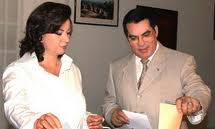
Zine and Leila: Next Stop…Nice? Rome? Cairo? Miami? Buenos Aires?Prison?
almost over for Tunisia’s first couple, that they are emptying out what is left in Tunisia’s coffers, that an airbus is fueled, ready and waiting to take off, as are the private jets of members of their two extended families… just in case the protests rocking the country cannot be crushed. As the protests spread, Ben Ali’s grip on power appears to be fading. Are we looking at the final hours, days of Ben Ali’s long 23 year `reign’ in which human rights violations have become so commonplace that they have hardly attracted attention until, this last week, it all reached another level?
Perhaps.. Read more…
Deconstructing Tunileaks: An Interview with Professor Rob Prince, University of Denver; Part Two

Decontructing TuniLeaks…Part 2
`TuniLeaks’ is the term that the European based website dealing with Tunisia has called WikiLeaks dealing with Tunisia, many of which deal with the relations between the U.S. embassy in Tunis and the State Department. This is `Part 2′ of a three part interview. `Part 1′ is already posted both on this blog and on Nawaat.org. (click here). Part 3 should be ready in a few days. Again I want to thank Nawaat.org for asking me to do this interview and for posting the results.
______________________________
Deconstructing TuniLeaks: Part Two, Economic Consequences…
Interview with Rob Prince
Nawaat:
So far the topic of corruption surrounding the (Ben Ali, Trabelsi) family seems visibly dominant in the cables.
Do you think we are dealing with institutional corruption that could harm the relationship between Tunisia and the West in general, at least on an economic level?
Prince:
1.

Mohammed Bouazizi, suicide by immolation in Sidi Bouzid Tunisia
As I respond to your question…at the moment in the Tunisian interior, in Sidi Bouzid, there have been four days of protests – what the government of Tunisia calls `riots’ or `social unrest’; and now I read that similar protests have begun in Kasserine and elsewhere. The Sidi Bouzid events appears to have been a spontaneous uprising of people in the region over economic and social issues after a poor lad in his early 20s, one Mohammed Bouazizi poured a can of gasoline on himself and then lit a match in front of the police station there.
Tunisian friends relate that this is the third young Tunisian in about six months, who chose to protest the grim economic and social prospects in the country by burning themselves to death. Then today, (December 22, 2010), also in Sidi Bouzid, another despondent Tunisian unemployed youth, Hussein Naji, climbed a lamp pole near the Cafe Ittihad near the offices of the Union General Tunisien de Travail (UGTT – Tunisian trade union federation) and electrocuted himself by touching high voltage wires, this in front of a crowd protesting the Tunisian government’s lack of response to the economic and social crisis.
Two youth unemployment related suicides in Sidi Bouzid in less than a week!
Words cannot describe…
I cannot put into words, how sad it makes me to see a photo of Mohammed Bouazizi seeming to be running down the main street of Sidi Bouzid his body nothing more than a ball of fire while Zine Ben Ali parrots old and worn nonsense about non-existent economic miracles and complains that those who criticize his regime’s human rights record are exaggerating. Read more…
Upcoming Crisis in State and Municipal Bonds
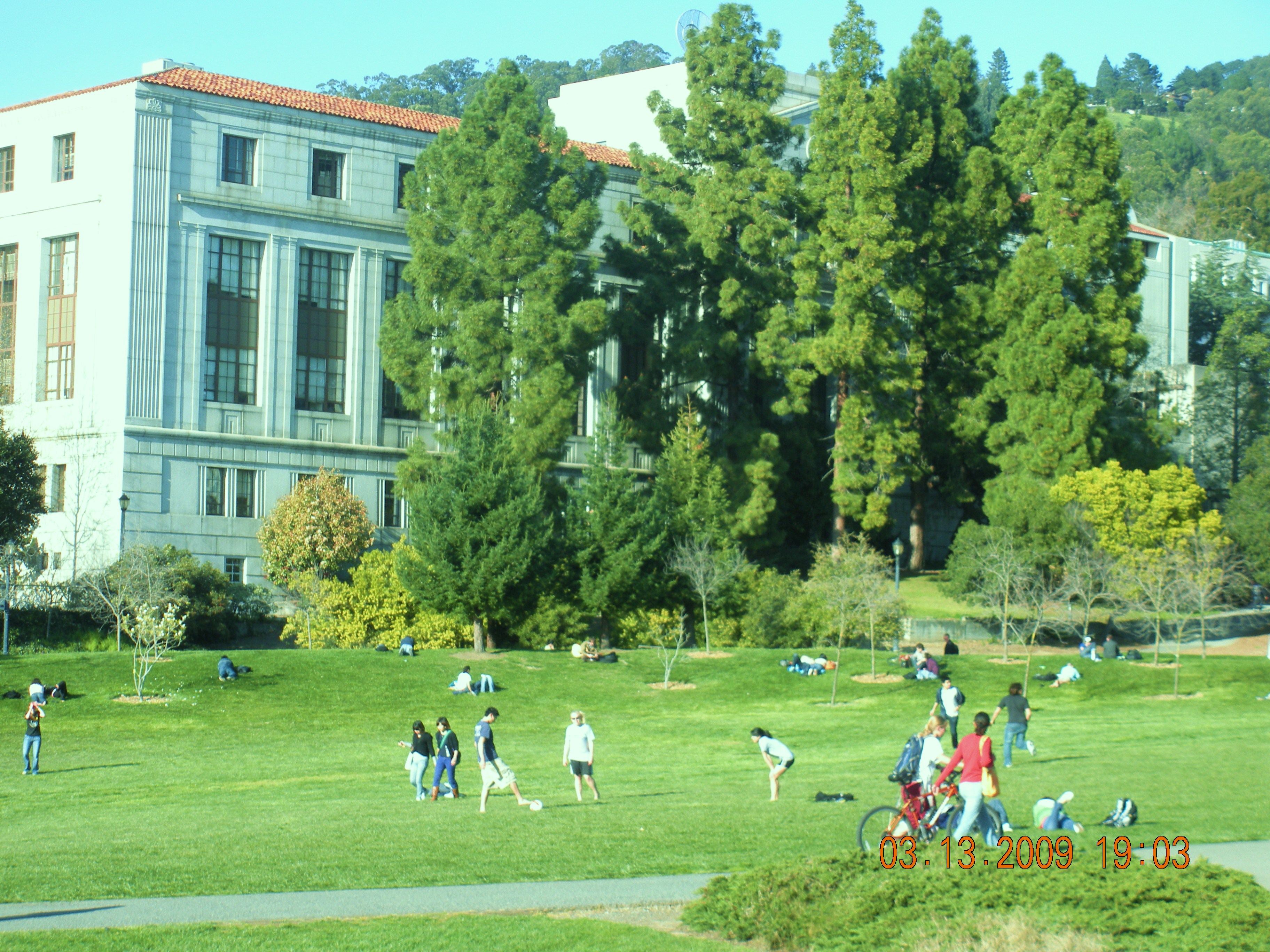
University of California Berkeley, one of the nation's finest - getting clobbered by state budget cuts
Here is a segment on another part of the financial crisis: the approaching bankruptcy of state and municipal budgets and with it, the failure of states and cities to meet their bond obligations. The last stimulus package helped a bit, but now the money is running out. Used to be that among the safest investments were municipal and state bonds. No more… Here is a CBS `60 minutes’ segment. Very well done.
Deconstructing Tunileaks: An Interview with Professor Rob Prince, University of Denver; Part One
Note:
1.what follows is Part 1 of an interview with `Nawaat.org’ – a Tunisian opposition website that publishes a great deal of material on Tunisia in Arabic, French and English. `TuniLeaks’ refers to WikiLeaks cables recently released about Tunisia and collected by the Nawaat people and placed on their website. The interview with me appeared today (December 20, 2010). Other parts of the interview will follow over the next week or so I would guess. I provide Nawaat.Org’s link but as the site is continually corrupted by `outside interference’, it is possible that the link will be broken. But try it anyway; click here
2. This piece also has appeared on ZNET, national left of center website associated with `Z’ Magazine and in Foreign Policy In Focus in 2 parts
link to `Part Two’ of this series
Deconstructing Tunileaks: An Interview with Professor Rob Prince, University of Denver – Part One
 Professor Rob Prince, University of Denver
 In order to have an “American” perspective on the Tunileaks affair, Nawaat invited Rob Prince to share his thoughts on the leaked diplomatic cables from the US embassy in Tunisia. Rob Prince is a Lecturer of International Studies at the Josef Korbel School of International Studies, University of Denver. Rob served as a Peace Corps Volunteer and Staff Member in Tunis and Sousse. For more insight into Rob Prince thoughts on Tunisia, please listen to his interview with the KGNU Radio – Hemispheres about the human rights situation in our country. In this interview, we asked professor Rob about his first impression after reading the diplomatic cables; the state of the “institutionalized corruption” in the country and the consequence of these leaks on the US-Tunisia relationship; and how the Tunisian civil society, the opposition and the Tunisian online citizen media initiatives can use the leaks in their favor and push for a real change.
1. Introduction
Let me start by thanking Nawaat for collecting and posting these cables in the first place. That is a public service. It is only through reading them, discussing, analyzing them that the fog around them begins to clear.
At the outset let us also remember that of 251,000 or so cables that – as of this writing – a little less than 700 WikiLeaks have been released or .002 %. Not much.
It is important to consider the process. WikiLeaks divided the overall number between 5 news outlets and then let the news outlets decide what to release to the public. What El Pais or the New York Times releases is what they want to release. The releases are selective and therefore can be used to create a certain spin, a certain reality. The leaks are not “lies” …or what is referred to as “black propaganda”, but are instead “gray propaganda”…one releases a part of the picture, holding back in this case what seems to be the lion’s share…thus public opinion can be manipulated. Read more…
An Irishman Explains the Financial Crisis
I have always appreciated the ability of the Irish to say what needs to be said poetically, so gently and with such poise..
Stephen Zunes on U.S. Diplomat Richard Holbrooke

Afghanistan: Graveyard of Empires
I don’t always agree with him, not that this is particularly important, but if Stephen Zunes writes something, I do want to read what he has to say and respect his opinion. His book on US Middle East Policy Tinderbox is quite good and I have used it as a text and supplementary reading in a number of classes.
It is reported that just before he passed into unconsciousness on his journey to the beyond that U.S. Diplomat, Richard Holbrooke told his Pakistani doctor `You’ve got to do something to stop this war in Afghanistan”…a suitable parting shot. The media is filled with glowing tributes to Holbrooke but the legacy he leaves behind is more about wading in darkness than bringing peace to the world. I don’t like to dump on the dead, so I am glad that Zunes has done so for me and quite eloquently – and accurately – at that..
So click here to read `the other side of the story’…
As Sweden Moves Right, The Country Suffers Its First Suicide Bombing

Stockholm, July 1987 – Jewel of the north…
(Note: This particular blog entry has been picked up and circulated by Foreign Policy In Focus and Greanville Post website.)
The news of two explosions in the heart of Stockholm – according to Yahoo!News the first suicide bombing in Sweden’s history – shook not only Sweden, but the whole Nordic region. Already fingers are pointing at Islamic radicals as the culprits, and this might very well be the case, although it helps not to jump to conclusions. Remember how the rush to judgment in Oklahoma City played out.
The Swedish government moved quickly – too quickly – to increase its troop presence in Afghanistan. Even before all the facts are in, the the right center Swedish government has tried to use the event in a somewhat cynical fashion. Before the bombing, in November, Sweden had announced a gradual withdrawal of its 530 troops in Afghanistan, to be completed by 2014. Immediately after the bombing, it changed direction and is now trying to increase its military presence there.
Memories
News of the bombing triggered a flow of personal memories of the country. I never lived there, but in the late 1980s traveled through Sweden repeatedly and got to know the different strands of its peace movement as they existed in those days rather well.
Was deeply impressed with the place; so was Mikhael Gorbachev, who openly admitted that the goal of his failed effort of reforming Soviet Communism was to render the USSR `more like Sweden’. And then there were the fair number of Vietnam era draft dodgers from the U.S. who made Sweden their permanent home, many of whom never looked back or returned States’ side. Read more…
 View from the Left Bank: Rob Prince's Blog