Things are getting a bit out of hand once again.
First we had to hear how Hillary Clinton would `obliterate’ Iran to defend Israel and then defend such an indefensible and vote-groveling remark and so doing is blithely endorsing genocide. To `obliterate’ a nation is to destroy it, all of its people into the tinyest of pieces so that it could never be reconstructed. What else might it mean? That according to the United Nations Convention on Genocide is a form a genocide. It’s pretty difficult to commit a genocide – or consider it – that is not profoundly racist..
Although eliciting little media response nationally – this is the nation that some 29 years ago did have `nuke Iran’ graffiti from coast to coast – it did provoke a storm of protest abroad. So strange that here at home, Clinton could get away with such a profoundly chauvinist and deeply racist remark with so few challenges. Obama’s response was tepid enough, but at least he responded.
Then we have to listen to a rightwing militarist neo-con John Bolton, carted out of a brief refreshing obscurity to whip up pro-war sentiment and support for an attack.
In between there has been the following (a partial list)
– Petraeus’ and Crocker’s testimony before Congress trying to blame Iran for the failure of US policy – the occupation that is – of Iraq. You’d think it was Iran that invaded the country, destroyed its infrastructure, left as many as a million Iraqis dead and 4.5 million refugees both inside Iraq and in neighboring countries rather than the United States.
– Then there is Lieberman’s bill before the Senate to get the federal employee pension fund to divest from Iran’s energy sector
– Add to that the `re-evaluation of the Iran Intelligence Estimate’ suggesting that Iran does have something of a nuclear weapons program – this cheered in Israel and among AIPAC/ADL and wacko Christian fundamentalists types, all despite the fact that there is not a shread of independent evidence supporting the claim.
– Andrew Cockburn, one of the more perceptive British journalists, has revealed details of a secret order signed by President Bush for a multi-faceted attack on Iran
– Then there was another `incident’ in Persian Gulf in which a US warship claimed Iranian ships came too close..
– the reporting of Michael Gordon, the NY Times reporter who willingly spread so many lies about Iraq before the invasion seems to be doing more or less the same thing again, with once again, an apparent green light from the Times management.
– and then last but not least, the United States has at the moment, the largest naval arsenal in history currently stationed off the coast of Iran. There are also reports that special operations – destablization and intelligence – have been going on in Iran (and then denied) for several years
For some time, several friends and I have argued that the Bush Administration, despite some signs to the contrary, had not given up on attacking Iran and that `bringing it down’, or at least weakening Iran so that it could not possibly play a regional role for a long time into the future was still very much on the agenda. We have reasoned that the attack would come in the last months of the Bush Administration as a part of its unfinished political agenda to reshape the Middle East according to Washington’s dictates.
Most of the arguements against an attack come from what I would call a rationalist position, ie ..it would `crazy’ for the US to attack Iran, that the US is already dangerously overextended militarily in Iraq and Afghanistan, that who knows what the Iranian or regional response might be, that it would be a strategic blunder, etc. These are not irrelevant points, but they fail to take into consideration that this is the most ideological administration in US history and that with Bush and Cheney ideological considerations trump reason every time.
Also while the invasion and occupation of Iraq is considered a moral and humanitarian disaster illegal by international law, some fail to notice that while this is of course true, that the Bush Administration has accomplished most of its goals in Iraq. The oil might not be flowing as they wish nor has it been privatized as they hoped, but there is now a permanent US military presence in the country (those US bases are permanent and will not be dismantled for a long time), that a major energy-nationalist regime – the first to successfully nationalize its oil production facilities – has been `taught a lesson’, and that from Iraq the US can monitor and control the entire region.
There are a few voices that have predicted this attack would happen, that it was something close to inevitable, among them Scott Ritter the former weapons inspector in Iraq (who also argues that Iran never had a nuclear weapons program, not even before 2003). My old friend out in the Bay Area, Conn Hallinan wrote rather assertively that sometime before the end of his administration, Bush would attack Iran.
In addition Clinton’s remark suggests that if Bush does attack Iran, such a traversty will have bipartisan support. It’s not so much that the support for bombing Iran is that strong, it’s just that the opposition to an attack is weak enough for Bush to get away with it. That the public here in the USA – or elsewhere – is not particularly behind attacking Iran does not seem to matter much at the moment. Attempts to build a solid anti-Iranian front in the Middle East have not gone particularly well, but then the countries in the region – as well as the Europeans and Japanese do not seem intent on blocking the effort. Indeed, like the Democrats in Congress, the governments of these countries have played something akin ot a cravenly cowardly role on the subject.
Oh yes, and I cannot end this entry without adding the degree to which an attack on Iran has been supported by mainstream Jewish organization for the past four or five years. While there are other forces directing, pushing for an invasion (neo-cons, wacko fundamentalists, militarist types), Israel and AIPAC here in the USA get `A’s’ for effort. In some way they are in on the plans… the details to be revealed as they invariably will seep out.
I fear it’s going to be a hot summer filled with war in the Middle East. I don’t know if this can be stopped, but I can think of nothing better to do with my time than try.
Below are a few recent articles documenting the recent more active push towards war:
– Andrew Cockburn article in Counterpunch
– Times of London on-line report of `enhanced’ Iranian nuclear threat
– John Bolton’s latest `Bomb Iran Rant’
– LeRoy Moore’s article in the Colorado Daily: Will Bush Attack Iran
– Tom O’Donnell’s piece in Z-Magazine: Understanding The Washington Teheran Deals. (Excellent analysis of why attacking Iran might happen)
Stephen Zunes on Obama-Hillary and the 1972 Democratic Party Presidential Nomination Race
Zunes makes interesting comparisons with the McGovern-Humphrey race. Click here to go to the article
Avnery: Israel At 60
Israel is celebrating its 60th anniversary. Here in the United States it enjoys strong support from mainstream political and social organizations, from the media. Much work has been done to prop up, polish its image. I would expect that here in Colorado, the political class will be out to show their support for Israel as they have done for so many years. Perhaps in their remarks some of them will, gingerly of course and with many qualifications, mention `the word’ Palestinian. As usual, although I support Israel’s right to exist within its 1967 borders, I will not be among the celebrants, either in body or spirit.
Under the surface, all this hooplah is deceptive. There is much criticism, cynicism both about Israel’s 41 year occupation of the West Bank and Gaza and how the state came into being in the first place. On what might be called a `grass roots’ level globally, Israel has lost a good deal of its moral capital. It reminds me in a certain way of the USSR in the 1930s. Although the rest of the world saw the situation clearly, only true believers could not admit to its dark side, a side that would eventually bring down the whole ediface. The Soviets managed to even celebrate their seventieth anniversary, but by then 1987, the whole structure which looked so impentrable just a few years before, was coming unglued. There would be no 75th anniversary (except in those circles who denied – and continue to deny – that the USSR had collapsed)
Indeed, the more I think about it, the more the parallels between Communism and Zionism are apt. Both communists and zionists hoped to build utopian societies, one based upon a workers’ state (or world), the other on an ethnic basis. Both built their utopias based on a historical experience of oppression and exploitation. Both, for difference reasons, turned sour rather early in their existence. Ofcourse the contradictions of communism caused its collapse – and while that collapse had many contributing features, I would argue that the Stalinist repression of the 1930s – the complete suppression of democracy in the country was prime among them. Israel is far from collapsing. It will continue as a nation state for sometime in the future, but the seeds of its undoing are there and growing stronger as is the levels of denial among its supporters.
But then ideology puts blinders on the best of us, whether it be the Marxist-Leninist or the Zionist variety. It forces us to exagerate the positives and to one degree or another deny the negatives. Criticism is seen as a threat to the very existence of the project. Perhaps it is. How else explain the high levels of denial of the facts of the situation.
For a number of reasons, among them the relative success of American Jewry to assiminate here in the United States (despite the tragedies in Nazi Germany and to some degree in E. Europe) and some of my own personal experiences and values, I have never been drawn to nor committed to Israel. The fundamental reasons are quite simple: That Jews, the overwhelming majority of whom never had any connection to the land called Israel have `a right of return’ while Palestinians who have lived there for centuries if not millenia don’t has always struck me as the height of moral hypocrisy. It still does. Israel’s genuine achievements are countered by its sixty years of war with its neighbors and its long term and unconsconable treatment of the Palestinians, which shows no signs of abating.
And despite a desire to put a positive spin on the possibility of Israel, the Palestinians and Israel’s Arab neighbors making some kind of viable peace – which I support – the prospects look grim. The balance of power has never been more unbalanced against the Palestinians, their movement is weaker and more splintered (mostly through US, Israeli and Arab regime machinations) than ever before. The current peace talks, although I would like to believe otherwise, are something approaching farcical proportions. They will produce nothing, maybe less than that. The conflict will go on for decades, probably more, or so it appears to me from where I am sitting.
Here in the United States, one of the great moral imperatives of the current period is to expose the injustice of the Israeli Occupation of the 1967 territories, to work for its end – including the dismantling of all illegal Jewish settlements in the Occupied Territories – and to work for a two state solution to the crisis based upon United Nations resolution and international law. Let us work for a solution so that the occupation does not last another forty, or thirty or twenty or ten years.
Once again, Uri Avnery, who in his youth fought for the Irgun to help establish Israel as a state, has a way of putting things together in an interesting if not profound manner. For his remarks click here
Almost a week ago, last Saturday, the state’s Democratic Platform Committee under the chairmanship of John Walsh, a lawyer with the Hill and Robbins Law Firm, met in Denver to finalize the work being done on platform planks that had been submitted from the caucuses a few months prior.
As mentioned below (see April 21st entry), although there were many issues addressed as potential platform planks – mostly state issues but some international ones as well – only one provoked written responses from about a dozen Colorado elected Democratic officials, including from Governor Ritter and US Senator Ken Salazar – the Israeli-Palestinian conflict. All of the letters had a `similar chemistry’ – they called for supporting the 2006 state Democratic Platform plank on the issue which called for the US to maintain its special relationship with Israel, while recognizing Palestinian national rights.
Although most of the current proposed Israeli-Palestinian platform planks (coming from a fair number of grass roots caucuses all over the state) basically were using the same framework – a call for a two state solution – their emphasis was somewhat different. Some called for an `evenhanded’ US policy towards Israel and Palestine (suggesting that there isn’t) and others were openly critical of the Israeli occupation of the 1967 territories, insisting that the occupation end, so in a certain way they nudged the state’s position ever so gently to the left.
Omitting the `O’ Word
The word `occupation’ seemed especially threatening to Israel’s more ardent Colorado defenders, because it suggests that Israel is violating Palestinian human rights and that it is the occupation itself which is the central cause of the current tensions between Israel and Palestine. These defenders prefer to talk about suicide bombers and Hamas, neglecting the realities of occupation and settlements as if they didn’t exist.
Had normal procedures been followed – which apparently weren’t – these resolutions coming from the grassroots would have been synthesized into a coherent platform plank (or two) and then voted up or down as is done with virtually all other issues. But that didn’t happen. Instead a special meeting was set up to discuss the issue. Great pressure was put on the platform committee from some of the state’s elected officials, procedural abnormalities, guided mostly by Walsh, abounded.
Attempts to raise alternative planks were snuffed as was any serious open discussion of the issue, this according to several of the participants. And when on Saturday afternoon (April 26), the vote on the issue was taken, the 2006 position on the issue won the day by a large margin (if I am not mistaken something like 35 to 9) with seven Democratic state legislators standing in front of the room something akin to thought police, to insure the vote’s outcome. The seven legislative apostles of Zion were Morgan Carroll, Mark Ferrandino, Jerry Frangas, Jeanne Laboda, Karen Middleton, Brandon Shaffer and Nancy Todd, all of a generally politically liberal persuasion
Carroll argued that the 2006 plank was already balanced. Frangas and Laboda were described as particularly one-sided in their remarks.
The position that was pushed through read:
“”We are fundamentally committed to using dialog and diplomacy to achieve a comprehensive just and lasting peace between all the peoples of the Middle East. We strongly reconfirm support for Israel and for the right to self determination of the Palestinians. We look forward to joining with all parties to work towards peace based on a respect for human rights.”
In some ways it is not such a terrible position. So what is wrong with it (from where I am sitting)?
1. the `term strong support for Israel’ keeps the door open to the unending flood of US military and economic aid to the country and essentially argues that in any negotiations the US should take Israel’s side (at least that is how I read it)
2. although the term `Palestinian self determination’ is mentioned, it is vague and thus can be defined in virtually any manner. Does it mean `Palestinian self determination’ within the 8 larger and 22 smaller bantustans that exist in the West Bank? It doesn’t refer to the need for a viable Palestinian State in the West Bank and Gaza, nor does it say anything about a complete Israeli withdrawal from the Occupied Territories, the dismantling of settlements etc. All this could have been easily addressed by calling for a US support of a peace process in conjunction with relevant UN resolutions and international law.
3. The formulation in no way recognizes the Israeli violation of Palestinian human rights in what is now the longest military occupation in modern history.
I suppose those who crafted it, think of it as something of a compromise, but if so it is a very, very weak one.
Answering the Call..
So…. once again a good deal of backroom political pressure was concentrated on making sure that no change in position would be forthcoming on the Israeli-Palestinian issue. It was all a little cynical as, in the end, candidates rarely take their party’s platform seriously if they know it at all. So why then all this political capital expended on something that would mean so little?
I suspect the state’s Dems would prefer not to deal with this issue at the upcoming national convention in August
In a more general manner, anytime the Israeli-Palestinian issue flows over from more isolated radical to more mainstream circles, there is the fear among AIPAC/ADL types that their control of the issue might be challenged where it counts. Indeed, the more moderate the position, it seems, the greater the threat. It is ok if the issue is raised in isolated radical circles, but not in unions, mainstream political parties, academic institutions or the mainstream press.
Who’s Pulling The Strings?
Again, I am not sure, but have a pretty good idea.
In an email I received from a state legislator, `a call from’ the Jewish Community Relations Council’ was mentioned as having had a behind-the-scenes hand in orchestrating all this. These are the same people who were very active in getting the state pension fund PERA to divest from Iran’s energy sector.
Apparently the seven Democratic Party state legislators who turned up to answer zion’s call came at least in part, on the behest of Andrew Romanoff and Ken Gordon, who had the state Democratic Party office urge them to attend.
But then in Romanoff’s letter to the party on this issue, he refers himself to having `gotten a phone call’ alerting him to the situation. It would be interesting to know where, precisely, that call came from. I have a pretty good, but not yet verifiable idea.
Finally, a number of voices suggested that the Democratic Leadership Council people were involved. As both Romanoff and Ken Salazar are state co-chairs of that august body that led to the Democrats to two presidential defeats to the little putz currently in the White House, that is a distinct possibility as well.
As for John Walsh, he seemed to be coordinating with somone(s). A young and obviously talented lawyer, his law firm, Hill and Robbins, has a history of good relations with the upper ranks of the state’s Republican not Democratic Party. Perhaps he is Hill and Robbins’ attempt to extend their influence to the Democrats as well. If so he certainly wouldn’t be the only example of politically sensitve legal firms, keeping a hand in both parties, something the likes of Bronstein and Farber learned long ago.
A minority report on the plank will probably be issued
Chalmers Johnson on the US Economy and Imperial Overstretch
click here
`Obliterating’ Iran
The language was shrill and threatening. Once again a `threat’ is being exagerated and then further magnified to prepare the ground for yet further US military aggression in the Middle East. A few months ago, Republican presidential hopeful and unrepentant militarist, John McCain, snidely joked about bombing Iran. This past week it was a Democrat’s turn, specifically Hillary Clinton.
The day of the Pennsylvania primary, showing that she could be just as tough, macho and wreckless as McCain, Mrs. Clinton threatened to `obliterate Iran’ should the Islamic Republic consider using nuclear weapons against Israel. A few days later, a Washington Post article blandly spoke of the United States `weighing readiness for military action against Iran’. So now the debate can be framed over who hates Iran more, Clinton or McCain. Racist gutter politics, little more, veiled with a false concern for human rights and blowing the `Iranian threat’ all out of proportion. And it is all the more dangerous as it blesses an atmosphere that could still easily lead to war. Again.
Based upon current well documented realities, Clinton’s is the most bizarre of statements. Iran has no nuclear weapons with no likelihood, according to reliable sources – that it will have nuclear weapons capabilities for at least a decade, that is if it even planning to develop them at all. The prospect remains questionable and despite loud noises to the contrary from Vice President Cheney, Israel and now Hillary Clinton there is no credible evidence of an Iranian nuclear weapons program.
The National Intelligence Report on Iran (finished in February but released only in November of 2007) claims that Iran stopped development of weapons grade uranium five years ago. Scott Ritter, the former US weapons inspector goes further, arguing that Iran never had a nuclear weapons program. Either way, like with the media build up before the US invasion of Iraq, it no appears that the American public is being pummeled with half truths and lies to build support for a major military strike, an idea that the Bush Administration has never taken off the table.
Israel on the other hand already had more than 200 nuclear warheads some 22 years ago when former nuclear weapons employee Mordecai Vanunu, who remains under house arrest in Israel since 2004, exposed the Israeli nuclear weapons program to the Sunday Times of London. Given that the Israelis were able to build that many bombs in about 20 years, one has to wonder how many more nukes are in their possession today? Add to that the fact that Iran is surrounded on all sides by US military bases many of which are nuclear-weapons capable and one of the largest naval armada’s in history many of whose ships have nuclear weapons, and a clearer of picture of who is threatening whom quickly emerges.
Reckless statements like Clinton’s combined with a number of other recent events – the incident in the Persian Gulf last week, Petraeus’ continuing attempts to blame US failures in Iraq on Iran along with his promotion to the head of the Middle East Command, suggest that far from abandoning plans to attack Iran, that such schemes are dangerously alive and well. Bombing Iran might just be one of the final desperate acts of the Bush Administration, a last ditch attempt to restructure the Middle East that much more before Bush and Cheney leave office in November.
It could also be viewed as an opportunity to bolster Republican electoral possibilities.
Clinton’s remarks make it clear that Democrats close to the Democratic Leadership Council and AIPAC would actively support such a strike giving the Bush Administration more latitude to proceed in such a deadly direction. For the past several years, `regime change’ in Iran – an obscure way of trying to overthrow the current government in Teheran has been on the top of AIPAC’s agenda both nationally and here in Colorado.
A major attack sometime before November is still a real possibility
Colorado Democratic Platform Committee To Debate Israeli-Palestinian Issue Next Saturday
For the most part, elected officials in both major parties here in Colorado – and I would guess nationwide – don’t take the party’s platform, developed by their constituents at grassroots settings, too seriously. Candidates and elected officials cherry pick the issues, and although they try not to stray to far from the general philosophy of the party they’ve given their hearts to, it has sometimes been known to happen that their ideas morph rather regularly, depending upon circumstances, – circumstances being determined largely by lobbyists and other unsavory types.
Too bad.
Looking at what is shaping up to be the Colorado Democratic Party platform this year, I’d say that it is far to the left of its elected officials on pretty much everything. With 300+ platform `planks’ – shortly articulated positions on essentially every state, national and international question imaginable, if Democratic legislators followed `the party line’, frankly the politics of the state of Colorado would be transformed overnight, and for the better.
Cynics should have no cause to worry though. I doubt the revolt triggered from below is in the offing. The platform will be what it has been in the past, a release of pressure from the rank and file, a useful indicator to elected officials to see just how far they’ve wandered from their base in accepting advice from seedy and greedy developers, mining, energy, real estate and financial interests, and the likes military contractors and Colorado Springs right wing Christian fundamentalists.
And business will go on as usual, slightly, but not very much modified by the fact that the state is run by a Democratic governor and legislature.
And yet the discussions around the 2008 platform do generate a good deal of interest from grassroots dems. Alot of energy goes into putting together the planks (positions), in tabulating the votes and in making the process as genuinely democratic as possible. The little that I’ve gleaned about it suggests that grass roots dems take the development of their platform seriously, to their credit.
Enter AIPAC?
It is interesting that of all the 300+ suggested platform planks to be considered in this year’s state convention, only one issue has drawn the attention of important state elected officials enough to merit sending in written commentaries to platform committee. I have 12 such letters sitting in front of me. They are from Governor Bill Ritter, State Treasurer Cary Kennedy, from US Senator Ken Salazar, US Representatives Diana DeGette, Mark Udall, John Salazar, Ed Perlmutter, Colorado State Senate President Peter C. Groff, former Colorado legislator Andrew Romanoff, Colorado State Reps Nancy Todd and Joel Judd. There is another letter worth reading, from a member of the state platform committee which challenges the position of `the gang of 12′.
These letters have nothing to do with any state issue – not the debt accumulating from DIA, the status of oil and gas drilling excesses on Colorado’s Western Slope, the ever increasing water crisis in the state, the army’s attempt to annex land in the state’s southeastern corner so they can experiment with more new bombs, the sorry state of public education in Colorado, the fate of the state’s hundreds of thousands undocumented workers most from Mexico and elsewhere in Latin America, the intensely anti-labor atmosphere which permeates the state or the numerous environmental boondoggles which the state keeps trying to hide and that Adrienne Anderson, through her careful research, keeps exposing.
No.
Instead there are 12 letters from many of the state’s most prominent Democrats on the Israeli-Palestinian issue, and this is the only issue, at least to date, that these elected officials deemed important enough to comment upon, all on official letterhead stationary.
What a coincidence that all of these letters essentially follow the same pattern and reach the same conclusion! A cynic would say that they were written by the same hand, or that they used the same provided fact sheet (but by whom I wonder?) to write their commentaries. But since we’re not cynics, we won’t make such an unjustified charge. They simply all came to the same conclusion on the same issue in the same way at the same time using essentially the same language.
And what was it that triggered this outpouring of carefully contrived legislative angst?
Those Damned Unruly Democrats
Apparently, the legislators and the governor are responding to the fact that from all over the state, Democratic caucuses produced resolutions addressing the Israeli-Palestinian conflict. These resolutions came from literally every corner of Colorado and while they had somewhat different political chemistries to them in the details, the overwhelming majority – all passed by wide margins in their local areas – all called for a negotiated two state solution to the conflict, some openly criticizing the Israeli occupation of the 1967 territories, some simply calling for a more even handed US policy. There was also one – that passed 37-to-1 in its caucus – opposing the use of force by the United States in resolving current US-Iranian tensions.
The legislative letters on the Israeli-Palestinian issue, all going to the state platform committee, all called for the platform committee to reject these moderate-to-left resolutions on the subject and replace them with the 2006 state platform plank on the issue. That plank was adopted in the face of a similar grassroots challenge two years ago only after Mark Udall and Diana DeGette sent similar letters to the platform committee calling the use of the term `occupation’ to describe Israel’s current posture in the West Bank and Gaza as `inflammatory’.
The 2006 plank reaffirms `strong support for Israel’ while acknowledging `commitment to self-determination for the Palestinians’. As such, even in this stilted language, it does support a two state solution. But it keeps the door open, given the way it is formulated to the unending flow of US economic and military aid, and suggests at least by its wording that any Israeli-Palestinian peace would be constructed largely on Israeli terms. Perhaps more than any other factor, this wording erases the moral stigma – recognized virtually universally – of Israel’s 40 year occupation of Palestinian territories.
In any case, a great deal of behind the scenes organizing and political energy went into the generating of these letters and with them, the attempt to pressure the platform committee not to break ranks on the issue. All this will come to a head at the upcoming platform committee meeting this next Saturday – open to the public like all Democratic Party meetings. Too bad I’ll be in Utah. I’d like to watch the political tap dance in person.
Remembering The Poor Armenians.
`Remember the poor Armenians’. That is how people used to refer to the Armenian Genocide in the period before and just after World War One. The Armenians were never really forgotten – despite the fact that in moving against the Jews Hitler once cynically stated, that just as the Armenians were forgotten, so would be the Jews.
No. It didn’t happen that way.
Political expedience – the need to ally itself with Turkey against the USSR in the 1920s – discouraged the British, French, Italians from raising the Armenian Question at Lausanne in 1923 where Turkish sovereignty was recognized and the Armenian Question, only eight years after 1.5 million Armenians were slaughtered by Turkish authorities, was not even given a footnote. Today, political considerations dominate once again. Turkey’s key role in the `war against terrorism’, the fact that it is a bastion – a bit wobbly of late – of secularism in a growing see of Islamic fundamentalism (or is so perceived) and that it is a NATO ally, make it unlikely that the United States will raise the Armenian issue – now 93 years old – in any substantial manner.
In a like manner, Israel’s strategic alliance with Turkey makes it unlikely that the Jewish state will raise the Turk’s Armenian treatment publicly either. Mainstream Jewish organizations in the United States usually tend to do likewise, their uncritical support for Israel most of the time interfering with much overt sympathy for the horrific fate Armenians suffered at Turkish hands – not only in 1915 when the most heinous and unforgivable crimes were committed, but before and after. Turks killed several hundred thousand Armenians were killed in the 1890s. After 1915, the genocide continued well into the 1920s when there were simply too few left in Turkey to round up.
The Armenian Genocide and the Anti-Defamation League
These last few years though the Armenian issue has found at least a few Jewish allies. Sympathy for the Armenian fate – and its obvious parallel to that of Jews suffering at the hands of the Nazis – became an issue within the Anti-Defamation League last year in an episode that garnered national attention. It resulted in what can only be called a purge of a regional leader who raised the Armenian issue publicly. In July, 2007, the ADL fired Andrew Tarsey, its New England regional director. Tarsey, who considered the ADL’s position on Armenia `morally indefensible’, had publicly called on the ADL to reverse its silence on the issue and acknowledge the 1915 genocide.
According to the Boston Globe (Aug. 18,2007), Tarsey’s firing `prompted an immediate backlash against the ADL’s national leadership and its national director, Abraham Foxman’. Steve Grossman, a former ADL national board member from near Newton, Mass near Boston, was particularly sharp in his criticism of Foxman. He is quoted as saying `My reaction is that this was a vindictive, intolerant, and destructive act, ironically by an organization and leader whose mission — fundamental mission — is to promote tolerance.” Under what appeared to be intense pressure, the very next day, the ADL: caught between political expediency and moral principle, was forced to somewhat backtrack and in a written statement, acknowledged the Armenian tragedy as `tantamount to genocide’ while still, fearing Turkish diplomatic reaction against Israel, urged the US Congress not to pass a resolution more or less asserting the same thing.
And in Denver…
I do not know how or even if this issue was discussed within the ADL’s Rocky Mountain Region. Perhaps it was. Its regional director, Bruce Deboskey, is generally considered an admirer of Foxman. It is difficult to impossible for such an issue not to have filtered down in some way throughout the organization. Be that as it may, last April (2007), that is a few months before this flap went public in the national media, one could discern a modest shift in Denver mainstream Jewish thinking towards the issue. The Mizel Museum here hosted a talk sponsored by Armenians of Colorado by a Turkish human rights activist and scholar who argued for Turkish acknowledgment of the Armenian Genocide and for the opening of a process of Turkish-Armenian reconciliation in tandem with it.
I could not help but notice that the Jewish museum was hosting the event, and it seemed some kind of shift if not breakthrough. Curiosity, along with a moral sense of acknowledging this particular crime against humanity, got the better of me, so, along with a Spanish friend in Denver at the time, I went. A police security force – small but noticeable – suggested some local resistance (from the local Turkish Community?) to the proceedings. Although I don’t know what might have happened behind the scenes, there were no disruptions. On the other hand, But despite the fact that the event was hosted at a prestigeous Jewish museum (or at one of its annexes) there was virtually no Jewish presence, none of the more prominent rabbis or other publicly known Denver Jewish figures were anywhere in sight. I found that curious and disappointing.
This year’s Armenian commemoration event, held at the University of Denver yesterday, had a similar chemistry in that a few prominent Jewish organizations and individuals lent their names to the proceedings in one way or another. The moderator publicly thanked Dr. David Schneer, currently Chair of the Judaic Studies Dept. at DU for helping secure the facility. This year the event was co-sponsored by the History and Political Science Departments of the University of Denver and an organization called Facing History and Ourselves. Facing History and Ourselves provides educational materials to teachers on the Holocaust and for the past few years, also on the Armenian Genocide. They are represented locally by Fran Sterling, a Jewish mother of 3, who addressed yesterday’s audience of about 100 people. But although the university’s official presence was noted and again, certain Jewish liberal voices lent their name to the event, the audience was overwhelmingly from Denver’s small but active Armenian Community and the university presence – from what I could tell – was light to non-existent.
Still…
Sami Al Banna’s Powerpoint on the War In Iraq
I didn’t imagine – when I read his name – that it could be anyone else but the Sami Al Banna that I knew more than 25 years ago. And it was indeed the same. He’d been invited by the Rocky Mountain Peace and Justice Center in Boulder to give a talk there as a part of their Middle East Series. He was also scheduled to come to Denver as well, where I heard his excellent presentation, a political analysis on the US War in Iraq, which teased out the main lines of what the United States is doing in Iraq and why the US military will probably be there for some time unless world public opinion – that other superpower as it is sometimes called – can get it to close down the operation, dismantle all those bases and high-tail it out of a place it has no business being in the first place.
I have very many memories of Al Banna from the old days, but one stands out. In July 1981, I had the good fortune to visit Syria and Lebanon. It was a year before the 1982 Israeli invasion of that country. In Syria there was what I can only today refer to as one of those bullshit international conferences I used to attend, interersting only in the sense of those present, but otherwise of much fanfare and no substance. In my excitement of being in the presence of so many players, I failed to appreciate the conference’s irrelevance to the general flow of events. Par for the course, I’d soon learn. Still, many of the main players in the Arab world in those days – most now dead, politically obsolete or investing in strip malls in central Florida – were in attendance lending the impression of seriousness to the circus atmosphere. That conference was followed by what I can only describe now as a `rather colorful’ trip to Lebanon to see the sights. The sights included the Sabra and Chatilla Palestinian refugee camps outside of Beirut, the south (Sidon and Tyre) during which time I got within a few miles of the Lebanese-Israeli border.
There were many meetings, insights – the kind of powerful impressions one remembers 27 years later as if they were yesterday. Two days after I left Rashidiyyah, a Palestinian camp in the South, US made Israeli F-16s bombed the place, destroying I was told, the home of my host among others. Four days after I flew out of Beirut, the Israeli’s dropped a 600 pound vacuum bomb on the apartment building where I was staying, killing hundreds, mostly civilian women and children. The memory of Al Banna is a part of that tapestry. He was living in Beirut at the time. There was a party at his home to which I was invited. Early on in the evening, I heard the sound of machine gun fire which seemed to me right outside the window. Not accustomed to the mix of machine gun fire, music and good cheer all blending together in one strange symphony, I went to Sami to ask if perhaps we should take cover, …or something. Showing the degree to which he’d adjusted to `the normalcy of war’ he listened for a moment and then commented quite calmly `Oh, it’s a block away’..and went on partying.
I came away from that journey with the strong impression that war was in the making, that an Israeli invasion – with US permission if not complicity – was in the making – as I could see no diplomatic momentum heading towards any kind of peace settlement. With some minor differences, it bares an eery resemblance to the current situation.
In any case, for those interested in Al Banna’s excellent powerpoint on Iraq, just email me for the pdf version. I’ll try to put it up on the website but for the moment, I can’t seem to get it up here.
Avnery (again!) On Tibet and Palestine
A few days ago I was asked by one my students in an upper division class on world poverty to comment upon the situation in Tibet, the uprising of Tibetans against Chinese domination. It was not a part of the class lecture which had to do with the imposition of market economies on African cultures in the 19th century – otherwise known as European Colonialism – but I decided to take some time to reflect upon this latest of global tragedies.
As I made it clear to the class, although I know a good deal about classical Chinese culture and the transition taking place in that country from Communism to some form of Capitalism, that my knowledge of the details of the situation in Tibet are somewhat sketchy. I did refer them to an article by Jared Diamond in Guns, Germs and Steel entitled `How China Became Chinese’ which deals with harsh conditions under which China was unified some 2230 years ago which is a nice synopsis of the process, emphasizing the way in which China crushed cultural diversity at that time. The article gives some insights into one of China’s historic weaknesses (a respect for cultural diversity within its borders) which has some impact on the current situation.
I also made it clear that from where I was sitting that the Tibetans are an oppressed people, that China has, despite offering some economic improvements in the region, followed a policy of settler colonialism in order to shift the ethnic balance in its favor in relation to the Tibetan people, that it reminds me, at least on some levels, of the Zionist settlements in the Occupied Territories and that as a result, I was and am critical of Chinese policy and hope that it changes, although I am not certain would be be the most humane or rational solution – complete independence for Tibet or some kind of autonomy.
Having said that, I mentioned that I supported China’s holding the Olympics, and that I hoped that a worldwide Olympic boycott did not develop, that the Olympics are in my mind an international forum that should be respected like the United Nations and gave them a little bit of the history of Olympic boycotts of which I am familiar including the the boycott of the 1980 Moscow Olympics because of the Soviet invasion of Afghanistan, which seemed to me far more serious …but I still opposed that too.
Finally I commented that I was suspicious about the way that the international media campaing had exploded surrounding Tibet and I would not be surprised if there was some kind of CIA-type foul play going on although I admit that I cannot prove that as of yet. But it all exploded so quickly and continues to remain in the forefront of the international media – much of which is US dominated. Were we seeing the declining superpower try to undermine the ascending one, I wondered?
And then, once again, I read Avnery, who deals with pretty much the same issues. He goes further than I did yesterday, wondering why it is that the US media spends so much time in support of Tibetans, so little time giving any credibility to the Palestinians, Chetchnians etc. I think it’s another find Avnery piece, the beginning of which you can read below. For the whole article click here:
A Liberal Jewish Lobby?
As Bob Dylan, put it in one of his more famous songs, `the times they are a changing’. I must admit I wish the pace were a bit faster, but then there isn’t much one can do about that. Change and social movements have their own timetable and agenda.
An example of the changing times came to me earlier today.
A piece is circulating on the internet by Gerson Gorenberg, an Israeli Zionist Jew, calling for a progressive alternative to AIPAC, the Jewish Lobby well known for its one-sided support for Israel (plus its support for the war in Iraq, and currently for pushing the United States into a military confrontation with Iran). The article, available in full by simply clicking on the above title, is an interesting read, the general substance of which I agree with. It first came to me from an old friend in NYC, then it appeared on `Portside’ – electronic voice of the Marxist Committees of Correspondence – where my wife read it. She forwarded it on to me.
Gorenberg gives a fair number of statistics essentially reinforcing the notion that American Jewry is not so rightwing on Middle East questions – be it the Israeli-Palestinian conflict, Iraq or Iraq – as AIPAC or the ADL, that it remains in its great majority, moderate if not somewhat left leaning and that organizations like AIPAC and the ADL – or the Rabbinical Council here in Colorado – are actually out of step with mainstream American Jewish sentiment and that as a result, the door is opened for new American Jewish formations more in line with mainstream policies. This is the latest of such surveys done over the years, most of which echo the results of the current report.
Gorenberg takes the opportunity to criticize Mearsheimer and Walt’s critique of AIPAC for overstating the extent of AIPAC’s power, although in so doing he makes it clear that he too is a critic of AIPAC’s legacy and describes it rather harshly as a barrier rather than a bridge to peace making. While Mearsheimer and Walt overstate AIPAC’s strength and leave out other key players in shaping US Middle East policy towards Israel-Palestine, I do believe that their piece pierced a taboo of openly criticizing organizations like AIPAC, made it easier for the rest of us to do so, and that in so doing performed an important intellectual service that Gorenberg should have acknowledged but didn’t.
If they are a bit off base – and they are – neither are anti-semites and both showed no small amount of political courage. They might have gotten some things wrong, but their critique of the reactionary – there really is no other word for it – role that AIPAC has played in the US body politic is accurate. They simply left out some of the other players and magnified AIPAC’s power out of proportion. AIPAC does have power, but it doesn’t have and never has had `all the cards in the deck’. By opening up the discussion, Mearsheimer and Walt help all of us, put AIPAC into perspective so that we can more objectively – without being accused of being anti-semitic – evaluate both the extent and the limits of its power.
Gorenberg also criticizes – or at least exposes – Hillary Clinton’s groveling support for Israel noting that Barak Obama’s position is not much different. He goes on to admit that the one-sided pro-Israeli positions of both Clinton (the other one – Bill) and the little putz currently in the White House, actually go against US strategic interests in the region, citing an interesting paper written by McGeorge Bundy some forty years ago. Gorenberg calls openly for a two state solution, for an end of the Israeli occupation of the 1967 territories arguing that peace with the Palestinians is vital to Israel’s long term interests as is Israel’s integration as an active partner – politically and economically – into the broader Middle East region as a whole.
In making his case, Gorenberg – more or less – point by point – argues positions that I have held for the past 40 years – and still hold. I’m glad to see them coming from a self-defined Zionist (I am not particularly enthusiastic about Zionism although I do support Israel’s right to exist within its 1967 borders) and believe that the trends of which he is speaking exist and are taking shape in the Jewish Community nationwide, including in the backwater, provincial, politically insulated environment of Colorado.
These shifts are taking place at a somewhat uneven pace …as usual far more slowly and unevenly than I would like, but then, as mentioned above, it seems that political change has its own frustrating rhythm and the chemistry necessary to create new viable and progressive social movements (in this case among the nation’s Jews on the Israeli-Palestinian conflict) remains elusive. Had a long talk about such mysteries (under what circumstances movements do or don’t take off) with a student today.
Still, there is much activity, new movements (B’rit Tzedek, Jewish Voice for Peace, Tikkun), some fresh blood at least in the sense of new players on an old playing field, some voices, until recently were more or less silent, now speaking up. I don’t know that I would call these developments `heartening’ – it’s dangerous to be too hopeful – and too early in their evolution to evaluate their contribution, but it is good to see some Colorado Jews speaking up, showing a bit of courage (now and then anyhow) and exploring ways both to reach out to get to know Palestinians and to explore how to raise the issue in the Jewish Community itself. Can they maintain themselves as an independent voice within American Judaism, or will they succumb to the intense pressures under which they function (and for which we should have some sympathy for what is they are trying to do) which will be coming at them from all sides?
It is unfortunate, although not so surprising in a way, that in `finding their voice’ as I call it, some of these folks find it necessary to distance themselves from, and/or openly oppose groups like the Rocky Mountain Peace and Justice Center in Boulder, an organization which has done more good to change the thinking of Coloradoans towards the Middle East conflict than any other movement I can think of. Without the work of the peace center, I would argue, these new trends in the Jewish Community would not have had the space – or the courage – to emerge.
Although there is no way of proving it, I believe the peace center’s efforts have, at least in Boulder County, helped changed the public dialogue on the subject. Nay, there virtually was no dialogue, or very little to speak of. Their work opposing the war in Iraq and on, if possible, preventing a US military strike against Iran also deserve mention.
And although I am not deeply involved in the Peace Center’s activities very much (did help a few years ago with the first Middle East Series) and really am not `affiliated’ with any organization these days, nor do I intend to be, I consider the Rocky Mountain Peace and Justice Center something of a spiritual home whose activities for peace in many areas – going back close to 30 years – are unparalleled in the Rocky Mountain region, and not just on the Middle East question.
It’s not that the peace center has done everything `right’ or is above criticism, but on the Israeli Palestinian issue it is they who have carried the moral torch by addressing the issue head on and refusing to back away from it. For the work they have done, these past five years or so on the Israeli-Palstinian issue, they deserve support, not the kind of scorn to which most recently they have been subject to.
It all represents to my mind, the very best of what a peace movement is capable of: becoming a moral compass, and through peaceful, non violent means, working to shift public opinion away from war and in the direction of peace making. Whatever criticisms – some valid, most not, (at least the ones I am hearing) – to which they might be subject, these should be dealt with with an eye on strengthening, not undermining this precious, hard earned resource and institution.
As with new movements feeling their oats, getting off the ground so to speak, in the new movements for Middle East peace, both Jewish and otherwise, there is quite a mix, saints, assholes and everything in between. New `players’ trying to stake out their turf, some trying to establish a political base where there is none or hardly, the usual fair share of opportunists combined with some extraordinarily decent and humane people who are – at long last – seriously grappling with the issue, with the moral bankruptcy and extraordinarily inhumane reality of the Occupation.
There are also the `old players’, the old guard who work out of the ADL, AIPAC, the rabbis and the like. These days, they feel `the earth shake under their feet’ and are busy,,,no, `frantic’ is a more apt term, to blunt the new initiatives whose political visions and view points are out of their control. Some of them are quite skilled at snuffing out new social movements, having spent a life time honing such skills. But the tactics have shifted a bit. Unable to stop the grassroots tide, they, the old guard, now try to tame these movements into irrelevance by first embracing them with a kind of Russian bear hug, and then gutting them of their substance, by trying to control the debate on the issue, and defining what is `kosher’ and `non-kosher’ progressive.
There are some, working under what I believe to be an illusion, that think organizations like AIPAC and the ADL can be reformed from below. In a somewhat different context, I tried that once. The idea is that good organizers, sincere and progressive in old organizations, can out organize the old guard and pressure it to change it ways, to genuinely reform such organizations – in this case, to have a more humane, moderate policy more in line with mainstream Jewish-American thinking as suggested above.
Perhaps it’s overstating the case to say that such initiatives to reform the old structures are impossible. Ok. I won’t say that. What I’ll say is that it is almost impossible and highly unlikely, particularly in organizations that have developed a long history and internal culture and approach. But then, in the struggle to do so, something positive can emerge, even if one gets the shit kicked out of oneself, figuratively or literally (as some of us have along the way).
But such Sisyphean efforts build character. Besides, whatever is `new’ and `humane’ is only born in pain and struggle, or so that seems to be the way things go from what I can tell. So for those who take such paths — and do so sincerely — (after all there are also a fair share of hypocrits), my thoughts, my solidarity, for whatever that is worth, is with them. My only advice, worthless as it might be, is to suggest, to the degree possible in going about such goals, try not to be schmucks about it. This is, of course, acheived only with the greatest degree of difficulty. And it is very difficult not to be a schmuck, especially when one is going through that born-again self righteous phase of starting to learn something about an issue but thinking, really one already knows everything. But enough advice. It never helps anyhow. No one listens. Ever.
It’s all very interesting to watch and, in the long run, it is possible that something wholesome, some genuinely new direction will emerge. The new liberal Jewish lobby that Gorenborg calls for, is coming together. Hopefully it’s not too late. So much damage has been done, of the kind that is not so simple to undo. There are an awful lot of settlements in the West Bank these days with more being constructed, expanded etc to such an extent that a viable Palestinian political and economic entity appears to be fast slipping away.
Israel’s policy of talking peace and building settlements continues as does US support for such policies. What is happening in Gaza – Israel’s seige of the area, turning it into a huge prison, not unlike the Warsaw Ghetto, is choking the life out of Palestinian society there. The US contribution to all this has been to support all Israel’s military actions and to help engineer a profound split in the Palestinian movement that has only weakened Palestinian negotiating position that much more.
Rosengarten and Prensky; Obama or Hillary

It was an unlikely meeting of the minds
At the time I was standing in front of my hotel in Antwerp looking at a dramatic window display of chocolate. Before me, riveting my attention, was a chocolate Easter egg 8-9″ in length, itself filled with more luscious looking little goodies. And it could be mine to bring home to a household of chocolaholics for a mere $90. And yes I was as impressed with the price as I was with the artistry – it was genuinely a culinary masterpiece – but couldn’t justify the purchase (at $90 with the dollar dropping every minute it wasn’t a hard decision).
So….I did the next best thing. I took out my trusty little digital camera and decided to immortalize the thing in a jpg file, including if it could be done, the hardly visible price tag. Working as best I could to position myself for the shot, my attention was distracted by a man passing by, mumbling something, apparently at me, under his breathe in Flemish.
Enter Rosengarten. (pictured above)
He was a little man, short, dressed in a dark suit, a dark hat to round out his outfit. He wasn’t so much walking as shuffling along and it was clear that the act of walking was not easily accomplished for him, but that he persisted all the same. He was elderly, in his mid 80s, maybe older than that I thought.
I decided to engage him, and not knowing Flemish I simply turned to him and asked in English `Are you talking to me?’
He understood me perfectly, spoke good English as do many people in Belgium (and the Netherlands) and an exchange followed. It seemed that Rosengarten distrusted my motives for photographing the over-priced, but stunning Easter egg. He was convinced that I was not just trying to photograph the egg, but to steal the patent so that I too could make a financial killing on overpriced Belgium chocolate. I insisted this was not the case, that mine was an existence rich in real life experience, little of which had been, is, or will be marketable, that I didn’t care because money was both the blessing and curse of all humanity and that I wasn’t an agent for a competing Belgium chocolate company nor had I any interest whatsoever in either starting my own chocolate company or selling my photo for a handsome profit to Godiva (you know that nude lady who used to ride around town on a white horse who somehow got into the chocolate business).
`Oh’, he said, as my answer had adequately explained the situation.
I had this feeling about Rosengarten, this before I knew his name, that he was Jewish. It wasn’t so much a `feeling’ as an impression. It was Saturday morning around 9 am. The evening before in the neighborhood of the hotel (near the city park) – before it got dark of course – a number of orthodox Jews with locks and broad black hats were riding around on bicycles in the diamond district nearby. And I figured there must be an orthodox synagogue somewhere in the neighborhood.
And so I asked Rosengarten where he was going and if I could walk with him a couple of blocks. Yes, he was going to the synagogue and yes, I could, if I wanted, accompany him, as if it were something of a great honor he was bestowing on me. (For an article on the Jews of Antwerp click here)
After a brief silence of about two minutes, he began to talk. We covered a number of subjects in our 8 minute relationship, human greed the first among them. Rosengarten was sickened by the financial crisis unfolding before the eyes of the world and I do think he got immediately to the heart of the problem. He understood that the sub-prime crisis was triggered in part by the desire to up profits as those low interest payments became high interest. The proverbial `they’ are never satisfied, he said, their greed insatiable?
Both agreed that insatiable greed was the underlying cause of the financial meltdown in the USA, I had to hear how he’d been to the USA many times, but not to Colorado, and why was I living there, what is in Colorado anyway? and how his son had gone to Harvard and was now with some big financial firm and not a lowly teacher like me. To which I responded `so…is his firm going under?’…`No not yet…you can’t help being a little stupid with an mba from Harvard, but he’s not that stupid’, he said with considerable pride. I liked the man’s choice of words.
After telling me that he was a survivor from Auschwitz, how the Belgian civil authorities had turned him in to the Nazis, how his family had all died there and how he’d written a book about it all published by Cornell University Press, … all this said very casually, making it all the more moving…he turned to me and said,
`So…now to the most important question. Obama or Hillary? What do you think?’…this on a street in Antwerp, Belgium on a Saturday morning!
How could I tell him I didn’t like either of them, had preferred Edwards who was now out of the race. I couldn’t see much difference between Obama or Hillary on major policy questions but was impressed by how many young people were becoming involved in the political process because of Obama’s candidacy. So, I simply said,…`I don’t know, what about you?’
Oh he was for Hillary and hoped she won.
It really wasn’t fair for me to ask `why’..as I had a pretty good idea of the answer, but I did anyhow. Rosengarten, who had not shown himself to be particularly shy during the first 7 minutes of our relationship, appeared a little sheepish, embarrassed even, but finally very softly, but honestly, said `the Ismaeli thing, I worry about Israel’. `What do you think?’ he asked. By`Ismaeli’, he was referring to Moslems.
`Rosengarten’, I began (by now we had exchanged names and he had asked how anyone with a name like `Prince’ could be Jewish), `the difference between the two on Israel is rather small. Obama is 98.7% for Israel, Hillary is 102%. What are you worried about?’..Besides, we have to settle this thing (the Israeli-Palestinian conflict) fairly, it’s gone on too long.’
He looked at me, smiled, held out his hand and said, `Maybe you’re right, I don’t know. Where will it all end?’…and then he turned and opened the door to an unmarked building which I assume was his synagogue. Oh yes, and he let me take his picture.
Remembering Adam Rayski (whom I never knew)
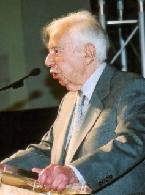
Adam Rayski
On the plane home to Denver from Brussels by way of Washington DC, I was struck by an article in Le Monde (March 20) about the death of Adam Rayski. I had never heard of the man till reading his obituary. Several things stood out.
0 1. He was born in Bialystok (now in E. Poland), just a few miles away from Grodno (now in Byelorus) from where all my grand parents immigrated.
o 2. His picture – that of a dapper, shortish man in a suit and fashionable hat, reminded me of Meyer Lansky (who also hailed from Grodno, who at least in his life style – fine dresser, picky, extremely good with numbers and from a dirt poor Jewish background) reminds me of my father, Herb Prince. Indeed Rayski, Lansky and Prensky (that was the original name before it was legally bastardized to Prince) could easily have been triplets they look so much alike.
o 3. But although they might have looked and dressed alike, there the resemblance ends. Rayski was a leader in both the French and Polish Communist Parties. I’m told my father’s venture into left politics was limited to a weekend at a summer camp in those formidable mountains, the Catskills, where, unsure of marxist etiquette, he asked someone to `please pass the salt comrade’. He never used the word again. I don’t fault him for that, but I wish he hadn’t changed the family name.
As for Lansky, he was, most of his life what I would call a `left-liberal gangster’, working especially well with Italians and Blacks, paid his staff well, didn’t mind – if the book Little Man is accurate – paying some taxes, and believed in `the American Dream’ although granted, he took an original path to get there. But then what he was doing then, mostly gambling, is now legal, so he could be called something of a cultural pioneer although I admit that is overstating the case. And true he never forgave Fidel Castro for nationalizing his biggest financial venture, a casino in Havana…but still, politically, he was no rightwnger.
There is little doubt that Rayski used the term on a daily basis, first with utter sincerity, later with more than a dose of cynicism. He served in the Polish post war government until 1956 before being victimized by the anti-semitic purges which plagued the Polish Communist Party in the fifties and sixties.
In death, Rayski will be in good company. He was buried in Pere-la-Chaise cemetery in Paris where lie the remains of Chopin, Sarah Bernhardt, Simone Signoret and Yves Montand side by side, Jimmy Hendricks and Richard Wright, a whole group of prominent French Communists, many victims of Nazi oppression and a fair number of communards, who as members of the Paris Commune, were lined up against the wall of the cemetery and shot to death in the summer of 1871 for daring to show that the working people of Paris could run the city as well as their more bourgeois counterparts. The bullet marks are still there 137 years later.
Rayski’s political career was especially interesting.
His was a full life of commitment to others and political radicalism. A true believer and from all appearances, one hell of an organizer. One indication of his talents is the fact that Le Monde chose to write his obituary. It began with his work in the Polish Communist Party in Bialystok early on. Forced into exile in Paris in 1932, he decides on a career as a journalist. Fluent in Polish, Russian, French and German (not uncommon for Jews from Bialystok – my material grandmother spoke seven langauges fluently) he continued his political career within the French Communist Party where he becomes a leader of what was referred to as `the Jewish Section’ (that part of the party that worked among the Jewish working class elements in France). He was instrumental in creating a communist Yiddish journal Naie Presse (the new press) and wrote regularly for L’Humanite, mass circulation newspaper of the French CP, still published and still read by several hundred thousand people every day (although its circulation used to be in the millions).
He followed the French CP line in support of the Hitler-Stalin Pact (several of my uncles quit the American CP over that) but once the Nazis invaded the USSR in June 1941, he became active in the resistance movement where he helped direct the clandestine press. Actually, his anti-Nazi activism started prior to that date. Arrested and imprisoned during the Nazi invasion of France, he managed to escape from a POW transit camp in Nantes and make his way back to Paris. There, Rayski helped protect French Jews against Nazi raids and was a leader in the FTP-MOI, a largely Jewish partisan group that engaged in armed struggle against the Nazis. Hunted by the Vichey police, he left Paris in July 1943 for France’s south (not yet occupied by the Nazis). There he helped create what is referred to in French as the CRIF (Conseil representatif des israelites de France). After the war for a while he became, like many leftists of his day (and Lansky and my father) an active supporter of the Zionist movement.
As a result of his left politics he was forced to leave France in 1949. Thanks to the help of Jacques Duclos (one of the larger figures in the history of the French CP – who Le Monde described as `the KGB’s man in the French CP – perhaps an overstatement although he was ardently pro-Soviet), Rayski is able to wrangle a position in the young Polish post war government where he becomes – if i read the translation correctly – national press secretary. He would have been in that position during what are referred to as the Slansky show trials of the early 1950s that was the first of a series of Stalinist directed purges of Jews (and Polish nationalists) from the leadership of the Polish CP. I tried to see what role if any Rayski played in these sorry events but as yet have not found anything, but for someone whose Jewish identity was rather important to him – and whose every brain cell oozed with political sensitivity, he could not have been oblivious to these trends.
He, in turn, would be purged from the Polish CP during the anti-semitic campaign of 1956 which saw the wholesale amputation of Polish Jews from many positions of leadership of that party. Demoted, he is re-assigned to Paris to develop a publishing company there, suspected of being little more than a front for Polish intelligence. For this he was brought to trial and sentenced to seven years of prison in June 1961, but due to the intervention of many allies from his days in the French Resistance, the sentence is commuted after two years. After this, he seems to have dropped out of Communist politics, although he remained active the rest of his life in causes for social justice.
In 1985, just as Gorbachev was coming to power in the USSR, Rayski published a critique of his experience with Communism entitled `Nos Illusions Perdues” in which he criticizes the Communist governments as dictatorships and totalitarian regimes. It seems getting purged triggered a change of heart. I’d like to read it. He does not give the impression of being one of those run-of-the-mill turncoats who left the Communist left to embrace one of the garden varieties of conservatism.
He was a good man, a Jew who started from Bialoystok, like my grandfathers. And he was my kind of Jew…like Curiel, Memmi and Serfati. I’m going to read more of his stuff and write more about him in the future.
——-
For a British obit on Raysky, click here
——-
————————————————————————
Below is the article from Le Monde…if you look closely you’ll see the English translation (i’ll highlight the English) after the french text. Some of it is a bit stilted, but the main ideas come through
Mort d’Adam Rayski, figure de la résistance juive et cofondateur du Crif Death of Adam Rayski, figure of the Jewish resistance movement and co-founder of Crif
12.03.08 | 17h56 12.03.08 | 17h56
Résistant d’origine juive polonaise Adam Rayski, ancien dirigeant de la section française de la MOI (Main d’oeuvre immigrée), est mort mardi à son domicile parisien à l’âge de 95 ans, ont annoncé mercredi le Conseil représentatif des institutions juives de France (CRIF) et son fils l’historien Benoît Rayski. Resistant Jewish Polish Rayski Adam, the former leader of the French section of the MOI (Manpower immigrant), died Tuesday at his home in Paris at the age of 95, announced Wednesday the Council representative institutions Jewish France (CRIF) and son historian Benedict Rayski.
Il était le dernier survivant des fondateurs du Crif, créé en 1943 par les responsables de la communauté juive, en pleine période d’Occupation. He was the last surviving founders of Crif, which was established in 1943 by the leaders of the Jewish community, in the midst of Occupation.
Né à Byalistok en Pologne, engagé très jeune dans les rangs du parti communiste clandestin, il émigra en France dans les années 30, où il devint rédacteur en chef d’un quotidien communiste en langue yiddish. Born in Poland in Bialyistok, committed very early in the ranks of the clandestine Communist Party, he emigrated to France in the 30’s, where he became editor of a communist newspaper in Yiddish language.
Il était arrivé en 1932 à Paris et avait entrepris des études de journalisme à la Sorbonne. He had arrived in 1932 in Paris and had begun studying journalism at the Sorbonne. En 1934 il entre au quotidien yiddish “la presse nouvelle” avant de rejoindre la rédaction de l’Humanité. In 1934 he joined the daily Yiddish “new media” before joining the drafting of Humanity.
Basé à Paris sous l’Occupation, il fut nommé responsable politique de la section juive du PCF et fut l’un des dirigeants des “Francs-tireurs et partisans – Main-d’Oeuvre immigrée” (FTP-MOI), la section immigrée des FTP, mouvement armée de la résistance communiste à l’Occupation nazie en France. Based in Paris under the Occupation, he was appointed political leader of the Jewish section of the PCF and was one of the leaders of the “Francs-tireurs and supporters – Main d’Oeuvre-immigrant” (FTP ME), section immigrant of FTP, movement of armed resistance to the Nazi occupation in France.
En 1943, il participe à la fondation du Crif dont la première mission fut de porter assistance aux Juifs en leur fournissant des faux papiers ou en les aidant à quitter la France occupée. In 1943, he participated in the founding of Crif whose first mission was to provide assistance to Jews by providing them with false documents or by helping them to leave occupied France.
Décoré de la médaille de la Résistance et de la croix de Guerre pour ses actes de résistance, il rentra après la guerre en Pologne où il devint responsable d’éditions de la presse communiste. Awarded the Medal of the Resistance and the War Cross for his acts of resistance, he returned after the war in Poland, he became head of editions of the Communist press.
Revenu en France en 1957, il rompit avec le Parti communiste polonais et se consacra dès lors à l’histoire de la résistance juive en France. Returning to France in 1957, he broke with the Polish Communist Party and therefore devoted himself to the history of the Jewish resistance movement in France.
Il est l’auteur de plusieurs ouvrages dont “Nos illusions perdues” (1985 – Balland) sur le communisme et l’engagement politique, “Le sang de l’étranger – les immigrés de la MOI dans la Résistance” (1989 – Fayard) et “le choix des Juifs sous Vichy – Entre soumission et résistance” (1992 – La Découverte). He is the author of several books, including “Our lost illusions” (1985 – Balland) over communism and political commitment, “The blood from abroad – immigrants from the MOI in the Resistance” (1989 – Fayard) and the choice of Jews under Vichy – Between submission and resistance “(1992 – Discovery). Il a également écrit avec d’autres historiens “Qui savait quoi?” He also wrote with other historians’ Who knew what? ” (La Découverte). (Discovery).
Il a continué jusqu’à la fin de sa vie à militer pour les droits de l’homme. He continued until the end of his life to campaigning for human rights.
Ses obsèques auront lieu jeudi à 14H00 au cimetière du Père Lachaise, indique le Crif. His funeral will be held Thursday at 14:00 at Père Lachaise cemetery, said the Crif.
 View from the Left Bank: Rob Prince's Blog