_________________________________________________________________________
Below is an email I got about a new Jewish peace group that formed in Colorado. It has been in the process of taking shape for some time now. Last Wed (October 10) was its `inaugural meeting’. Appears to have gone very well from the email.
Let us wish them the best.
Alternative voices – especially peace voices – are badly needed in Denver’s Jewish Community. For a number of years in the 1980s there was a vibrant chapter of New Jewish Agenda. Once it folded (along with the national organization) there has been precious little to replace it except for a few voices here and there pissing in the wind.
To contact the group – btvshalom@denver.org
From Colorado Brit Tzedek v’Shalom:
The inaugaral meeting of the Colorado Brit Tzedek v’Shalom chapter was a
resounding success!
We are now on the path towards formalizing the Colorado Chapter. We are
bringing a strong voice for peace and justice because we care deeply about
Israel and support a negotiated two-state solution.
The commitment of Colorado Jews to Brit Tzedek’s mission was demonstrated
by the twenty-five members and subscribers who attended the meeting
including Rabbi Brian Field of Judaism Your Way and Rabbi Jamie Arnold of
Beth Evergreen. The evening focused on how Brit Tzedek can help us find
ways to discuss Israeli and American policies critically within our own
community and how the peaceful majority needs to become a louder voice in
American Jewish politics.
***Mark Belkin, Colorado Chapter co-Chair, shared his goal to organize the
majoriy of Colorado Jews who share the Brit Tzedek vision.
***Diane Cantor, Executive Director of Brit Tzedek, spoke about how
dialogue for peace must come from within the Jewish community at the local
level.
***Jessica Gorelick, Manager of Chapter Development, described some of the
events such as peace sedars and movie nights that other chapters use to
mobilize their communities across the country.
***Roger Kahn, a National Board member and Colorado resident, explained
how far Brit Tzedek has come in the last several years in gaining the
attention of elected officials and the prime location that we have as
Coloradans to be a force for justice and peace for a negotiate two-state
solution.
Mark Belkin and Sara Jackson volunteered to be the Chapter co-Chairs, but
we our still looking for more members to join our steering committee. If
you are interested and/or have any questions, please respond to this
email.
***Rocky Mountain Rabbinic Council Meeting***
During their visit, Diane Cantor, Jessica Gorelick and Mark Belkin also
presented the mission and principles of Brit Tzedek to the Rocky Mountain
Rabbinic Council. It was an exciting week that is just the beginning of
the dialogue we can generate in Colorado.
Our next meeting is scheduled for November 7th at 7pm, location TBA.
Please come with your ideas for an inaugural event that will mobilize Jews
throughout the state.
If you are a subscriber, we invite you to become a Colorado chapter member
by clicking on the following link: https://secure.btvshalom.org/.
If you are interested in joining the steering committee or have any
questions, please respond to this email or email the Colorado Chapter at
denver@btvshalom.org .
We look forward to seeing you in November in the pursuit of peace and
justice.
shalom,
Mark and Sara
More on Rachel Corrie…
Some of the discussions triggered by the play `My Name Is Rachel Corrie’ are worth sharing. I am referring to discussions that younger folk have had since seeing the play two nights ago. For starters, a number of us have been thinking and talking about it. We can’t seem to get the play’s content out of our minds. I thought of it all day yesterday.
Two themes (beyond what was mentioned below) have appeared.
1. The play raised the question among young women around Rachel’s age: What would they be willing to die for as Rach did? The people involved had different answers to that question, but The play – and Rachel’s life and death – made them examine their own situation. The very fact that young people (mid 20s to early 30s) are thinking in such terms suggests the play struck a deep chord among some of them. I don’t think about such things any more, or hardly and haven’t for years. I’m more in the category of those who wake up in the morning and simply nod in gratitude that I’m still around. But I remember thinking like that – asking, for what would I be willing to sacrifice it all for, my job, my family life, my life. Never talked much about it – no, never talked about it all to anyone that I can remember – even to close friends, even to Nancy, but thought about it a good deal. Some of it has to do with the never ending effort to struggle against fear that most of us try to deal with in one way or another. But in Rachel’s case it all went much deeper.
2. There were a number of people who felt the play was one-sided, only showed one side of the story. They are right for the most part. It is simply that there is nothing wrong with such an approach from where I am sitting, as what they got a dose of was the side of the story they don’t hear normally in the media, academia, etc. – referred to by some as `the Palestinian narrative’ to the conflict (through the eyes of an American peace activist). In having to confront the Palestinian narrative head on, they get a much richer sense of the overall picture in the end. What people deeply immersed in this issue need to be reminded is that there are an awful lot of people in this country that still don’t have a clue about the conflict or the narrative – either Israeli or Palestinian (or American) and their natural reaction to a play like `My Name Is Rachel’ is to be quite confused, to wonder if what is being presented is fair and accurate (which it is). Having either been spoon fed on pro-Israeli propaganda all their lives or as in many cases, completely in the dark about the whole issue, they are a bit dazzled and upset by it all and can’t help wondering if in some way they have been taken. People are often very defensive about their own ignorance. Overall, I think this is a normal and positive reaction. The more honest elements, their curiosity awakened, their sense of justice stirred will take the next step, and learn more, in their own time and in their own way, but it is the start of a process.
I am thinking that I want to go back and see the play as many times as possible – as much to study and listen to the audience, to gauge their reactions, impressions – as much as to be inspired, moved by the life and death of Rachel Corrie. I have no heroes. Haven’t for decades. It’s a good thing actually for heroes, being human always disappoint. But lately I’m considering three exceptions – Mario Savio, Norman Finkelstein…and of course Rach. There’s another friend of mind I have such feeling for but I’d never tell him as it would go to his head. Well their not heroes but they are examples….they show it’s not only George Bushes and John Bolton’s this society can produce, but something quite the contrary – kid of mutant Americans that break the mold, the best kind.
See the play `My Name Is Rachel Corrie’ – for info call – 720-221-3821 http:www.countdowntozero.org/
Remembering Rachel
Remembering Rachel
slowly
slowly
in Rafeh
the bulldozer moves the orange shirt
pushes the mound
stops
backs over
broken
Rachel Corrie
– Alan Gilbert –
Rach
`My Name Is Rachel Corrie’ Plays In Denver
1. Raches I Have Known.
For some time now I simply refer to her as `Rach’, undoubtedly because my younger daughter has a friend Rachel we all called `Rach’. She’s Abbie’s `Rach’. My `Rach’ is Rachel Corrie and since her death – run over by an Israeli bulldozer in Gaza just about the time the US invasion and occupation of Iraq began in March, 2003 – I think about her a lot, and continue to mourn for her as if she were my own. I see her face before me, wonder mostly about how she mustered up all that courage, how she processed what she saw with such honestly, such devastating accuracy and such speed. After all she was only in Gaza a couple of months before she died. Probably having two daughters – the older a few years older than Rach, the younger a few years younger, has something to do with it I am sure. And I think of Cindy and Craig Corrie too and wonder simply …how can they stand the pain, the pain of losing their daughter, of hearing about it not through the Israeli embassy or the US State Dept – that simply would have been human decency – but on the radio one morning. And then having to struggle to retrieve the body. I don’t think I’d have the resources to stand up to all that. All this is not anything that most parents the world over have difficulty understanding.
Shortly after Rachel Corrie `died’ – a very polite way of saying that she was murdered-by-bulldozer – a small group of us held a vigil in her honor in front of the courthouse in Boulder. About 30 people in all. It got the usual amount of media coverage for these events: not a word. It was all dignified and emotional, quiet, a tribute. Mostly we just stood in silence but Ida Audeh read the names of some Israelis who died and Leslie Lomas of Colorado Jews for a Just Peace read the names of Palestinians. I think that was Leslie’s idea. Irving Greenbaum, then in his early 80s, now in his late 80s, was on the mall nearby giving out leaflets. The somber mood was pierced by two schmucks, one in military fatigues, the other an animal rights activist who seems to value the lives of cooking chickens more than Palestinians. The two of them honed in on Irving, wolves zeroing in on prey, becoming more and more aggressive until finally a mall policeman intervened, neutralizing them.
In the weeks and months that followed Rach’s death she was subject to abuse in the media bordering on – no – exceeding the obscene. Savaged on talk radio, in newspapers an eruption of bile became her epitaph. She had broken a taboo the myth of Israel’s fair treatment of the Palestinians; Palestinians were again the victims, Israelis the occupiers, the oppressors and the occupation itself revealed for what it is: a human rights travesty of the first order. Rach witnessed that, wrote about it and died protesting it. That was unforgiveable. The media would have preferred their usual approach to Palestinian suffering. Silence. But an American citizen had suffered a fate not unlike what Palestinian Gazans face every day. And the incident was simply too awful to deny.
Alan Gilbert wrote a short stunning poem about it that captures the moment of Rach’s death (see below this article). She had been crushed – run over by a bulldozer – not your ordinary run-of-the-mill type that Edward Abby fantasized about sabotaging here in the West, but a militarized one, more like a big tank, made especially to destroy homes and gardens – a true weapon of mass destruction if ever there was one, that the Israelis have used to destroy more than 11,000 Palestinians homes in the West Bank and Gaza since 1967. Made in the United States by Caterpillar for special use by the Israeli military, it crushed Rachel Corrie’s lithe body and poetic mind, not once but twice – slowly forward, slowly back – in an obscure corner of Gaza where Rach, a member of the International Solidary Movement, tried to stop the demolition of a Palestinian home. It is actually illegal according to US law to sell weapons to be used for offensive purposes to foreign nations. Caterpillar has made out like bandits on this, raking in the dough. Death and profits. But to add a touch of irony, Caterpillar offers an annual `human rights award’ at commencement ceremonies at Knox College in Galesburg, Illinois just down the road from Caterpillar headquarters.
2. What’s Up With the Denver Post?
No need to write a review of the play, `My Name is Rachel Corrie’, because Juliet Wittman’s in Westword is as good as it gets, dissecting the play both artistically and thematically. These are just some reflections. The play has opened here in Denver and has shown in a few cities including Atlanta and New York. Here in Denver it is produced by a small theater group, Countdown To Zero. They rented what seems to be an empty warehouse right next to the Mercury Café, a local landmark. Just before the play opened, it was featured in a two page spread in the Sunday, September 28, morning edition of The Denver Post written by John Moore that is highlighted on p. 1! There is a huge photo too of Julie Rada, the actress who plays Corrie as well as anyone could. My friend and companero, Evan Weissman, himself an actor and member of a theater group, is quoted.
I went to see the play last night with my other daughter, Molly and two of her friends, Heather and Nicole, pleased to attend in the company of `young people’. As expected, some of the faces in the audience were familiar. Jim and Gabriella Walsh who have their own theater troop were there, as was Eric Bard from the peace movement and Vicki Armstrong – a kind of soul sister since we were both in the Peace Corps at the same time and on the same continent – she in W. Africa (Guinea I believe) myself in Tunisia. But most of the audience of 35-40 people I didn’t know and that always pleases me, giving me the illusion that interest in the Israeli-Palestinian conflict might be broadening. I was as interested in the reactions of Molly and her friends – and those of the audience in general – as I was in seeing the play. What impressed them? What questions did it raise? Heather seemed to absorb the difference between supporting Israel and being Jewish, not an insignificant pychological breakthrough. In a discussion held after the performance in the theater someone commented – somewhat amazed – that he did not view anything he had seen that night as especially `radical’, a telling remark as outside of the USA the ideas presented in the play are essentially mainstream.
I can only speculate as to why the Denver Post gave the story such prominence and as to why, at least to date, the Anti-Defamation League’s regional office has chosen not to launch a campaign to shut it down or disrupt it. Concerning the Post, is it an attempt to break through the silence, `the bubble’ my friends and I call it, the untold story, a hint of what life means for Palestinians living under occupation? One of the lines in the play that struck me as particularly relevant were the words of Rach’s mother, Cindy. Cindy writes her daughter that the Palestinians `have been invisible’ to her. In life, Rach forces her mom to explore that reality. In death, through her writings and now the play, Rach presses many more Americans to do likewise. `I didn’t know’…was the comment several people made afterwards. The bubble was punctured, at least a little. The Post article helped do that.
Or was it a bit more cynical than that?
Just another chapter in an on-going newspaper war? The Post is well aware that across the hall (they are lodged in the same building) the people who run The Rocky Mountain News, one of the more blatantly (and blindly) pro-Israeli papers in the country, would be provoked into responding and that the conflict would sell papers? Interestingly, the Rocky waited a week before responding, doing so in its Saturday issue in a scathing piece by Dave Kopel. Kopel, a fixture on Denver talk shows and in local papers, is the research director of the Independence Institute, a rightwing think tank based in Golden. The Independence Institute is always predictable, supporting unrestrained capitalism at home, support for US wars in the Middle East, knee-jerk support of Israel. I described him in an email to some friends yesterday as `bright, articulate and usually full of ….`, which is pretty much my take on him. Denver’s very own little home grown neo-con since Clifford May was shuffled off to Washington DC. A political hatchet man essentially, no more, no less.
My problem with Kopel is that I can’t help confusing him with his father, Jerry Kopel, a long time consistent liberal Democrat in the Colorado legislature who used to introduce (unsuccessfully usually) pro-teacher, pro- teacher bills there. He was the only legislaturer I remember who would show his face at union (Colorado Federation of Teachers) socials, a decent man. But then the Kopel-the-elder was influenced by World War II, the civil rights movement, Kopel-the-younger by the Reagan Revolution. Besides the conservatives can pay more, we (the left, the peace movement) have nothing to offer – no think tanks, no money, no political influence and just a lot of flak from people like John Andrews, Vince Carroll, Bob Ewegen and Kopel. I suppose I expected Kopel to follow in his father’s footsteps and become (at least) a labor lawyer. Alas.
As for the content of Kopel’s piece slamming the play, it’s not worth commenting on.
3. What the ADL Didn’t Do
As for the ADL, predictably enough, there was Bruce Deboskey, its regional director, doing what I suppose he considers to be his duty, quoted in the Post article, claiming the play `distorts the facts’ (which it doesn’t, not in the least). Still, he expressed some sympathy with the Corrie family and the very way he spoke about Corrie’s death `a horrific accident’ is far more restrained and sympathetic (even if misguided) than I would have expected.
But perhaps more importantly I was more impressed more with what the ADL didn’t do than with De Boskey’s quote in the article.
They didn’t try to derail or stop the production. I know because I asked Brenda Cook, part of the `Countdown To Zero’ team who insisted there had been no pressure of any kind. No calls to the production company, to the building owner, no orchestrated telephone campaign – all that behind the scenes stuff the ADL so excels at. Nor were there pickets outside the theater or plants in the audience making predictably snotty comments. At least not yet. Given the ADL’s recent track record concerning any events where the Palestinians are treated sympathetically and as victims of Israeli Occupation, I would have expected they’d pull something. And I was worried that a small theater production company would not be able to stand the heat and that the whole project would fold.
So what’s this new ADL restraint about?
I dunno. Speculation abounds.
A. Because it would have been worse for the ADL to kill the project (bad publicity) they decided it better to let the play proceed hoping it would pass unnoticed or nearly? (If so, the Post story blew that line of thinking).
B. They’ve had a genuine change of heart and are now more open to hearing `the Palestinian narrative’ to the conflict? (Possible but frankly hard to believe).
C. They’ve been hammered hard lately (Mearsheimer-Walt paper, Jimmy Carter’s book, claims they pushed, or help push, the US into war with Iraq and are now pushing for war with Iran) and needed to make something of a tactical retreat?
D. That under the surface there are intense struggles over how to approach this question with the ADL’s membership pushing the leadership and staff to the left, to be more sympathetic to the Palestinian plight the way they pushed Foxman (who reminds me of Gus Hall) to be more sympathetic to the plight of the Armenians? (wishful thinking on my part?).
Some combination of all that…or something else?
My own admittedly unprovable speculation goes something like this: the ADL (and like-minded folk) are watching the Denver production and public reaction to it very carefully, using it as a kind of test case to see what kind of public reaction the play provokes. How it all plays out here – most especially the public dialogue as well as attendance and general interest – might influence how the ADL and likeminded organizations, will deal with the production elsewhere. And the play will be produced elsewhere, the theme is simply too powerful, and relevant to today’s world, the Palestinian narrative too compelling (the suffer the longest military occupation in modern history), the US-Israeli connection too blatantly cynical and reactionary.
Although those of us who live here would like to believe Denver the center of the West, the nation and the world, even with its over-priced airport and awfully designed (to my tastes) gaudy art museum, and now (finally!) outstanding baseball team, alas and alack, Denver is just a regional center, the American Irkutsk, a staging platform for those vultures in the oil and gas industry, a pleasant enough town to be sure but, run mostly by developers, their shyster lawyers and the usual thugs from the oil and gas industry (and their shyster lawers), isolated from the rest of the country by mountains to the west and 800 miles of high plains to the Mississippi. Doubt that a play produced in Denver will pierce the national insomnia on this issue very much. Still…
In any case and for whatever the reason, it is a relief to see the ADL backing off a bit. Too early to know if they’re just retooling to come out swinging once again, or if some deeper more substantial change is taking place. While hoping for the latter, I expect it’s the former. Time will tell.
See the play `My Name Is Rachel Corrie’ – for info call – 720-221-3821 www.countdowntozero.org
The Iceberg
The drama surrounding pressure from the oil and gas industry in Colorado to drill for natural gas within a three mile radius of Project Rulison – a 1969 underground nuclear blast site – is, as the expression goes, just the tip of the iceberg.
But what then, is `the iceberg’?
The ice-berg is six years of unfettered drilling for oil and gas – a mad stampede – throughout the the western states – with virtually no restraints since the Bush-Cheney presidency came to office now seven painful years ago. Under the cover of the energy crisis, when necessary invoking national security, Bush and Cheney have pried open federal lands for oil and gas drilling to an extent unprecedented in American history in what a Wilderness Society researcher aptly refers to as a `drill everything’ frenzy.
While state agencies here in Colorado and elsewhere in the West issue the drilling leases, for the most part, the drilling is being done on federal lands controlled by the Bureau of Land Management or the Department of Energy. During the Bush-Cheney years the BLM has supported a relentless push to turn over more public lands to oil and gas drillers, so much so that not much remains unspoiled. Bush gave the BLM and DOE the mandate to lease and drill everything. According to a BLM report , already in 2003, 85% of the oil and 88% of the gas on federal lands in Colorado, New Mexico, Montana, Utah and Wyoming were under lease for oil and gas development.
Not much left to plunder.
And if I can make a comparison with Bush’s war in Iraq, in the same way that, should they win in 2008, Bush will leave Dems with a mess in Iraq that will be difficult or impossible to undo, he will leave behind a similar tsunamo of destruction on federal lands. Even if the Dems are sincere about reining in the oil and gas industry, they will have their work cut out for them, and not all of them – particularly in Colorado where a number of prominent Dems are themselves oil and gas industry lobbyists – are that sincere to begin with.
As if to put on the final touches, to hammer the last nail in the coffin, the new Bureau of Land Management Director Jim Caswell, who thinks Colorado voter backlash against the oil and gas industry `overblown’, let it be known that he sees no let up in the aggressive pace for Western oil and gas drilling. As if he had any interest in the matter he added (in an interview with the AP [10-6-2007]) `the key though, to me is how do we develop that resource in the most environmentally sensitive way’. Please.
The Broader Regional Oil and Gas Picture
The broader regional picture is chilling, best explained by environmental groups who have watched it all unfold, documented the process to the best of their ability and sent out the alarm.
According to an in-depth report, the Wilderness Society estimates that the Bush Administration has plans to approve as many as 126,000 leases to drill for oil and gas in the West. It should come as no surprise that Cheney’s home state of Wyoming with its small population and powerful oil and gas industry is slated to approve more than 50,000 new leases, Montana comes in next with 26000+, then comes Colorado with almost 23,000 anticipated. As `To Wild To Drill’ comments, these are conservative estimates and `likely underestimates the magnitude of drilling activities that could occur on public lands in the .
Here in Colorado, oil and gas interests have enjoyed the support and protection of (now ex) Governor, Bill Owens, a former oil and gas company lobbyist with close ties to the industry in Texas from where he hails and where, as governor, he spent many a weekend during his governorship huddling with his with oil and gas industry handlers.
Having Owens in the governorship in Denver and Bush and (more especially Cheney) entrenched in Washington for eight years singing a duet of narrow religion (on slightly different keys as Owens is Catholic and Bush Protestant) and free markets, provided the oil and gas industry with the necessary political chemistry for an unprecedented romp against nature, common sense and any restrictions limiting what has been an orgy of profit (in the name of progress and national security of course)
Owens Juggling His Affairs
Owens, a baseball fanatic who was never above pawning himself off as a sportscaster on the side (he wasn’t very good at it), tried somewhat unsuccessfully to juggle personal affairs with the affairs of state. The former were largely substantiated by Owen’s admission of marital infidelity. I’m actually trying to check into these but it seems that Owens’ staff was more adept in covering his personal footsteps (with a willing media?) far more effectively than an earlier Colorado Governor Roy Romer whose 16 year `intimate relationship with an aide the media pursued `like pitbulls’ – as one friend put it. In any case Owens appears to have been a busy `on the personal front’.
Although he received some heat for his personal affair (his wife left him for a while), the green light he gave to oil and gas interests to rape the state hardly produced a murmur in the press statewide. Another one of those Christian fundamentalist moral hypocrites a la Ted Haggard, his personal dalliance probably cost Owens a serious run for the 2008 Republican nomination for the presidency, this according to a number of conservative commetators and blogs. Since leaving office he has faded back into the lucrative corporate oblivion from when he first emerged.
Concerning Owens’ concern with the affairs of state, Coloradoans are just now learning the degree to which Owens continued lobbying for oil and gas interests while in office. The welfare of the state’s oil and gas industry was never far from his thoughts. During the eight years Owens was governor of Colorado oil and gas interests exploded to a $22 billion a year industry employing 70,000 people statewide. The oil and gas lobby should build him a statue and maybe they already have for all I know. Key to opening the oil and gas floodgates was the reshaping of the state regulatory body, the Colorado Oil and Gas Conservation Commission (COGCC). Under Owen’s inspiring direction, 5 of the 7 commissioners charged with conserving the state’s oil and gas came from the oil and gas industry itself. What a surprise. Over the Owens years, the COGCCs record was second to none in granting oil and gas leases to drilling companies on a virtually `come one come all’ basis. These companies, in turn, have racked up a rather extraordinary record of drilling violations that resulted in 1500 complaints of environmental degradation, threats to public health and wild life maintenance over a five year period. Given an indication of the COGCC’s level of vigilance and defense of public interest, of these complaints the commission found a whopping 23 complaints worthy of fines.
.
If the Colorado Oil and Gas Conservation Commission could not find the time to fine oil and gas drillers, this is quite understandable to all but the most unfairest of critics. The Commission was indeed very busy, handing out drilling leases to one and all. In 2006 the Commission set a record, granting 5904 drilling permits. There are some press estimates, after a slow start that in 2007 the number might reach 6000. The state currently has 30,000 active oil and gas wells but that number is expected to double in just six years. By way of example, in Garfield County, Colorado, the county that currently hosts over half of the state’s entire inventory of gas drill rigs (somewhere over 120), COGCC and the county ok’d 1623 new leases last year alone. Already in 2007 1800 leases have been granted and it is expected that before year’s end it is possible that the number will exceed 2300 at the current pace. Such an explosion of leases makes it very difficult for state regulatory agencies to monitor drilling standards and abuses even if they wanted to do so.
(next – Colorado’s House Bill 1341 to reorganize the COGCC. An honest enough attempt at reform but how effective can it be)
Gather ye rose-buds while ye may,
Old Time is still a-flying;
And this same flower that smiles today,
Tomorrow will be dying.
Robert Herrick. To the Virgins, to Make Much of Time
English lyric poet (1591 – 1674)
1.
Change a word or two and the poem has a certain relevance to the dilemma of independent oil and gas drillers in the Rockies in the last months of the Bush Cheney Presidency. The glory days – when gas drillers could obtain permits with little concern for environmental concerns or federal oversight – just might be coming to a close, making the scramble for the remaining crumbs among the main independent players that much more intense. So gather ye gas drilling leases while ye may…
The party for the oil and gas companies might not be over, but it won’t be as much fun as it used to be after 2008. As a result there is a flood of activity to get as much as possible done between now and November 2008 when more than likely, the licensing environment will stiffen some, and the companies will lose their `democratic right’ to drill radioactively polluted natural gas.
Add to this the fact that the change from a Republican to Democratic governor already has cramped their style. The new composition of the state’s oil and gas commission is not especially to the liking of independent gas drillers. But this is just a taste of things to come. Should the Republicans lose in November of 2008, it is more than likely that the Department of Energy’s staff and emphasis will shift a few notches away from granting drilling leases to every fly by night operator wanting one. In what would be a truly novel development, environmental considerations just might be taken more seriously and the department’s information and data on contamination around Project Rulison might become transparent.
Craven Greed or the Ordinary Variety?
Perhaps this is what Dick Cheney warned his oil and gas supporters in Colorado last week: better get in there while the going is good before next November. Of course it remains to be seen if a Democrat will be elected president next year. The Dems has a developed a keen sense of how to give away presidential elections if the last two are any indication. And furthermore, it’s not at all clear to what degree the Dems will rein in independent oil and gas companies – both domestically and internationally, any less than the Republicans did.
Still such logic does go a long way in explaining why it is that an oil and gas drilling company with such extensive international contracts would find it necessary to grovel for a lease on land within earshot of a nuclear blast site. It seems odd that a company as prosperous as Noble Energy – and with such powerful assets both in the US and globally – would apparently waste its time and energy nitpicking for a license to drill for natural gas within the 3 mile radius of Project Rulison. Rulison is the spot where in Sept 10, 1969, the Atomic Energy Commission in conjunction with the private sector exploded a 43 kiloton atomic bomb underground creating a natural gas cavity that has been, not surprisingly, radioactive ever since. Although it seems (because monitoring data is hard to come by) that the radiation caused by the explosion as been contained these 38 years, still the very presence of the nuclear bomb created cavity represents a significant environmental threat. Why play with fire for a few dollars of profit?
It all seems – to put it politely – quite undignified. Is it just a case of craven greed or the ordinarily run-of-the-mill variety?
Nor is Noble Energy alone. For the past few years a slew of oil and gas companies have been swarming around the site, pushing the Colorado state agency involved – the Colorado Oil and Gas Conservation Commission – to grant drilling licences within three miles of the blast site. The three mile radius had previously been considered a safety zone within which drilling was considered dangerous because of possible radioactivity leaks.
Independents Pushed by the Majors (Exxon, BP, etc)
And until recently, recently being the election of Democratic governor Bill Ritter, the Commission was quite receptive to these licensing requests. This was, in part, no doubt because under the former governor, Republican Bill Owen, with his close – no incestuous – ties to Texas oil and gas money. Owen stacked the Commission with oil and gas men. Ritter has re-organized the commission, expanded its membership and although the oil and gas reps are still there, they do not run the show as they did previously, a fact which they find terribly annoying it appears.
Before the Commission’s reorganization, the natural gas companies made out like bandits. The commission granted many licences to drill closer and close to the blast site. Currently there are 19 natural gas wells in various states of completion within the three mile radius of ground zero and 31 approved applications for a permit to drill. One well has been drilled a mere 851 feet from the blast site.
The situation in the oil and gas industry perhaps helps explain the rush to Rulison. According to Chuck Davidson, chair and CEO of Houston-based (why is this not surprising?) Noble Energy, the majors already control many of the potential oil and gas sites. `Here in the United States’, he commented in a 2004 interview, `we’re challenged if we can even pull together a few thousand acres of land’. Very sad, indeed.
This situation has pushed independent companies like Noble in two directions – first outward, to explore internationally. As described below, Noble Energy has been one of the more successful, if not one of the most successful independent companies to move into the international arena (which they began to do energetically after 1998). The majors’ stranglehold on leases also has pressured independents to fight for the remaining domestic scraps (mostly among themselves) more aggressively, even if they butt up against radioactive contaminated sites like Project Rulison.
This seems to be what the flurry of activity in the vicinity of Project Rulison is all about.
2.
Noble Energy: A Company On A Roll
A person who had the financial acumen – or the luck of the dice – to have invested $10,000 in Noble Energy stock – five years ago would be sitting pretty. She would have watched the value of each share climb from around $16 then to $71.20 cents today, a rise in value of close to 450%. Not bad. Other indicators also suggest just how well the company is doing and that overall, it continues what might be described as being on a roll.
1. For example, it continues to move up the Fortune 500 ladder. In 2006 it was rated overall the 761st strongest company in the world, up from 980 the previous year. Then in 2007 it moved up again to the 660th place. In the `Forbes 2000′ ratings it placed 994 in 2007. These are not at all shabby numbers if you’re into this sort of thing
2. Within the Fortune Mine and Crude Oil Production sector, its numbers look even more impressive. In 2006 it ranked 18th overall with 2005 revenues at $2.187 billion up a whopping 60.3% from the previous year and profits, at $645.7 million, up an obscene 96.4%. Now in 2007 its rating has jumped up five notches to 13th among mining and crude oil producers with revenues at $2,940.1 billion for 2006 and profits down at $678.4 million, up only 5.1% over the previous year, but still not bad at all
3. The company has struck black gold in significant quantities in a number of places. In June of this year the company announced that it had made a new discovery containing both oil and gas `an extremely high quality Miocene reservoir’ (Miocene = from 25-12 million years old) in the Douala Basin of the coast of Equatorial Guinea, a discovery which `delighted’ H.E. Atanasio Ela Ntugu Nsa, the country’s Minister of Mines, Industry and Energy. Not mentioned in the article is the fact that the country has one of the most repressive governments – not only in Africa but in the world. (See Ken Silverstein’s 2002 piece in the Nation). The country is ruled by Teodoro Obiang who came to power in 1979 after executing his uncle.
4. By 2004 the company’s energy reserves had grown more than 400% over its 1970s levels. At the end of the year before, 2003, Noble announced the discovery of a major natural gas field called Mari-B in the Mediterranean off the coast of Israel. Three months later, in February 2004, the company began producing natural gas for Israel. `Israel now has a safe, clean and inexpensive energy source’ the company’s president, Charles B. Davidson was quoted as saying. Noble has a working interest of 47.059% in the project on a contract that is to last 11 years.
5. The company also has major operations in other countries including Argentina, China, Ecuador, the North Sea and Vietnam
The company’s fortunes began to change in the late 1990s when its focus shifted dramatically from domestic to international oil and gas exploration. By 2004 the percentage of Noble’s foreign assets had risen to 65% of the company’s reserves, up from 28% in 1998 and the percentage of output from its international properties had soared as well.
Given these stats, why does a company like Noble need to drill near a nuclear contaminated cavity?
Juliet Wittman Reviews `My Name Is Rachel Corrie’
Dear Commission Members:
Thank you for providing me the opportunity to give testimony before your body concerning the request of Noble Energy to drill for natural gas within 3 miles of the Rulison nuclear weapon blast site. And thank you Kim Phillips for your willingness to read my testimony (or part of it) to the Commission.
I teach International Studies at the University of Denver’s Graduate School of International Studies. One of my areas of interest is the political economy of the energy industry (worldwide). Recently, with a colleague from the University of Barcelona, Dr. Aurelia Mane Estrada, I taught a special seminar entitled `Energy Development and Democracy’ that was a combined graduate-undergraduate level course the main focus of which was the structure of the global energy industry – both oil and gas. I have taught a number of courses that looks at energy development specifically in North Africa (Algeria), which is a long time special interest.
I should like to say that 38 years ago in early September of 1969, at a time when I was a graduate student at the University of Colorado in Boulder, that I joined a group of protestors in an effort to stop the detonation of a 43 kiloton nuclear weapon 8426 feet below the surface at Rulison, Colorado. Although it is incidental, it so happens that I met my wife to be at that site, she, who was upset of the effect that the blast would have on `her mountains’. My concern at the time was that any natural gases flowing into the cavity thus created would be contaminated with radioactivity and therefore not viable for commercial use. I was also concerned about the possibility of the blast itself causing earthquakes in the surrounding area. My understanding is that these concerns were justified and remain valid
It was only a few years later that I familiarized myself in some detail with the broader project entailed `Project Plowshare’ of which Project Rulison was simply one small part. As I assume you are aware, there was a four stage program – Project Gasbuggy, Project Rulison, the Rio Blanco Project, and Wagon Wheel – which together were meant to use nuclear explosions to produce commercially viable natural gas. The first three involved the detonation of nuclear weapons; Wagon Wheel, scheduled to take place in S. Central Wyoming was cancelled.
The project was – in every sense – a failure and we – the people living in the Rocky Mountain Region have been living with the consequences ever since.
My request to this board is simple and in two parts:
1. That you deny Noble Energy’s request to drill within the three mile radius of ground zero of Project Rulison
2. That you consider revoking the 19 permits that already exist to drill within the same three mile radius.
3. That the Department of Energy be more forthcoming about the information that it has in its position on the Project Rulison site and that state of Colorado improve its monitoring capacities which seem rather limited.
The basic argument for taking this position gravitates around public safety issues and what I would describe as the need in this situation to put caution before profits.
Drilling within the 3 mile zone is extraordinarily imprudent and opens Garfield County and the surrounding areas to risks of nuclear contamination.
Why play with fire when the stakes are so high, the variables so unclear?
My reasoning is as follows:
1. Some natural gas drillers, unwilling to accept restrictions on their drilling rights are arguing that the 3 mile `danger zone’ is arbitrary and not based upon a scientific known calculation. In a certain way, they are correct. But what is interesting is how they interpret this arbitrary measurement. One could logically argue that because the 3 mile danger zone is not clear that it should be extended to a 5 or even a 10 mile radius, and in so doing, placing caution before greed.
The industry has chosen, it appears, and certainly not for the first time, to go the opposite route and place greed before caution. They want to penetrate the 3 mile danger zone, drilling ever closer and closer to the blast site. As they do, the danger of mining radio active natural gas from the blast site increases considerably.
2. It is simply irresponsible – and cynical – to argue that drilling in the vicinity of the site of Project Rulison site is safe. Fissures (cracks) in the sandstone surrounding the blast site could currently exist, or given the continual movement and motion of the underground structures, possible in the future. Recently local residents discovered a leakage of natural gas (not Project Rulison related) into a nearby creek. The leakage was traced to a nearby drilling site which, it had been argued, was secure. Was the drilling company lying outright about the environmental impact or was it simply that their technical abilities, despite many claims of great advances, simply couldn’t pick it up?
3. There is still no clarity as to how much low level radiation is considered safe.What we do know, thanks to the pioneering work of Rosalie Bertell and others, is that the dangers have been irresponsibly – if not criminally – understated. More and more the scientific community is coming to the conclusion that there are no `acceptable’ amounts of low level radiation. Substances with half lives of a half million years will be toxic for here to eternity, or nearly.
4.Add to that the state’s (Colorado’s) admission that their own monitoring capabilities are lax, how difficult it is to track down federal monitoring results and the `safety’ arguments quickly. It is completely unacceptable that the major monitoring of radiation at the site is done by the commercial enterprises doing the drilling. I’d like to believe that such self-monitoring is serious but experience suggests that independent monitoring – with results shared with the public – is a far more prudent path to take.
5. Given the lack of transparency in monitoring, we simply don’t know how much radiation has escaped from Project Rulison – nor how much might be unleashed in the future.
6. From the point of view of history – not a petty detail – Project Rulison (along with Project Gasbuggy and the Rio Blanco Project – three of the four energy related projects of Project Plowshare to detonate underground nuclear blasts in conjunction with the oil and gas industry) was a colossal failure, nothing less. It was a reckless and ill conceived project that has mauled the mountains in Colorado and New Mexico and would have done untold damage to Wyoming as well had Project Wagon Wheel gotten off the ground which fortunately enough it did not.
The futility (and absurdity) of the program is reflected in the fact that not one cubic foot of gas has been extracted from the three blast sites for commercial uses until the present and that the last phase, Project Wagon Wheel, which in terms of kilo-tonnage would have been the grand finale – was cancelled. It seems – at least in the 1960s and 1970s that customers declined to natural gas contaminated with traces of radioactivity.
Noble Industries should be prohibited from drilling near Rulison and should seek its fortune on more stable grounds. Let us hope that the Colorado Commission on Oil and Gas has the common sense and decency to reject Noble’s request. Wish I could be in Grand Junction on Tuesday to testify, but can only be there in spirit through this testimony
I urge to not to let this genie out of its bottle any more than you already have. There are many other places in the Colorado mountains to drill for natural gas, more safely and without such grave environmental consequences.
Yours Sincerely,
Rob Prince
Senior Lecturer/International Studies
University of Denver/Graduate School of International Studies
The Dark Domain: Resurrecting Project Rulison: Part Two
 What does Noble Energy want from the Colorado Oil and Gas Conservation Commission?
…Or Alas!..Greed Trumps Caution Once Again
Under the cover of an emerging energy crisis, oil and gas companies the world round hope to bypass environmental concerns in their stampede for oil and gas drilling rights and the sizeable profits that go along with them. In this spirit, Noble Energy, an oil and gas company involved in drilling natural gas on Colorado’s Western Slope in Garfield County, is pressing the Colorado Oil and Gas Conservation Commission for a permit to drill within three miles of Project Rulison. Other companies with interests near the site include Williams Production and EnCana. The Commission meets in two days (October 2) to consider Noble’s request.
But the three mile exclusion zone has already been breeched and significantly so.
According to an article in the Grand Junction Daily Sentinel from July 24, 2007, there are currently 19 natural gas wells in various states of completion and 31 approved applications for a permit to drill within three miles of the blast site that have already been approved. The October 2 hearing comes after a US Department of Energy report, recently released, claiming that a gas well drilled a mere 851 feet from the blast site would not risk radio active contamination. (Daily Sentinel, Sept. 29).
For those not familiar with it, Project Rulison is the site of a September 10, 1969, 43 kiloton underground nuclear blast to create a natural gas cavity in the mountains. It was the work of the Atomic Energy Commission, in conjunction with Texas based natural gas producers at the time. The blast did take place (see Part One of the series – September 29, 2007) but the project was considered a failure because no one – not even corrupted utilities commissions of the day in western states – would buy its radioactive contaminated natural gas. Imagine.
At the time of the Rulison blast, many locals in Garfield County either supported Project Rulison or were neutral about the project and looked askance at demonstrators (among them my wife and I) that came to the ground zero to protest and try to prevent the project. Despite the presence of 25 or so protestors in the vicinity of the site, the atom bomb was detonated and protestors were lifted 6-8″ off the ground by the wave it triggered. Concern for resulting earthquakes closed mines that day as far away as Paonia on the far side of Grand Mesa.
Among those opposing Project Rulison in those early days were a pair of brothers moved to Colorado from Wisconsin (as I recall) Tom and Dick Lamm. Together they filed unsuccessful legal suits to try to stop the blast. Dick Lamm was already in the state legislature at the time, honing his considerable skills of sensing which ways the political winds blow. Long before he discovered his own `duty to die’ or how much mileage he could get from kicking undocumented Mexican workers in the teeth, Lamm already understood the untapped potential of the state’s emerging environmental movement. He sensed correctly that he could milk the environmental movement for everything it was worth, – which was a fair amount – an insight he rode to the state’s governorship after which he somehow made his peace with the state’s oil and gas interests (and much of the rest of the corporatocracy here). Still, for one shining moment Lamm positioned himself as one of the public spokespeople against Project Rulison, did some genuine work for the common good and filed a suit against Project Rulison. The suit failed, but the publicity launched Lamm’s image as a left-of-center Democrat. He’s since modified the image to adjust to changing times.
Today, the mood of many living in Colorado’s Garfield County towards natural gas drilling has hardened some There is some opposition to Noble’s plans to drill near Project Rulison.
What is it that Noble hopes to accomplish at Rulison?
First, the company is not planning, along with the government, to explode another underground nuclear bomb to release natural gas. I suppose we can be grateful for that.
Nor is it asking for a permit to drill into the blast site itself to recover the natural gas – much of it radioactive – bottled up there in the cavity that the September 10, 1969 explosion produced.Defying common sense and human safety, the natural gas producer is hoping to drill for new gas sources very close to the Project Rulison site. Undeterred by prospects of radio active contamination leaking from the Rulison cavity, the gas men in the area argue that people living close to Project Rulison are fine, and they, the drillers ought to have `the right’ to drill potentially radio active contaminated natural gas. The logic of the free market taken to its extreme. Milton Freeman must be cheering Noble on from his grave.
This reminds me of a hearing I attended 30 years ago in Broomfield Colorado not far from Denver. It had been determined that the Broomfield’s water supply had been contaminated with traces of radioactive isotopes seeping through the ground from the Rocky Flats Nuclear Plant. The results were not contested but all the same, a number of people testified – they happened to be family members of Rocky Flats workers – that they had an `inalienable democratic right’ to drink radio-actively contaminated water.
Coming from a sheltered home environment, I never knew that democracy could be extended to swallowing significant amounts of radioactive iodine and was somewhat startled by the argument (and never forgot it). Perhaps it wasn’t so much a question of democracy but rather an ordinary example of narrow self interest besting caution?
Drilling dangerously close to Project Rulison isn’t exactly the same thing, but still the parallel holds. At the very least it is something of an overstatement to argue that drilling for natural gas within three miles of the Rulison blast site is safe. All the drillers want is a few extra bucks and of course, a few less regulations. Perhaps though this is precisely the time when government should jump right back on their backs and stay there for the foreseeable future.
In the aftermath of the 1969 Rulison nuclear blast, it was determined by both federal and state regulatory agencies to establish a zone within a three mile radius of the blast site considered dangerous. Within this zone, no drilling for natural gas has been permitted. Reasonable enough. The actual cavity created by the bomb is surrounded by layers of sandstone rock that act as a natural sealant, insulating the radio-active natural gas from its surroundings. To date, according to the existing data available, there has been little known radio active contamination from the blast, but given current testing procedures and the lack of government transparency, combined with the long term dangers of radio active materials, this is not especially convincing.
What Noble hopes to do is to penetrate the 3 mile `danger zone’ surrounding the blast cavity to probe for other natural gas sources. Some natural gas drillers, unwilling to accept restrictions on their drilling rights are arguing that the 3 mile `danger zone’ is arbitrary and not based upon a scientific known calculation.
In a certain way, they are correct. But what is interesting is how they interpret this arbitrary measurement. One could logically argue that because the 3 mile danger zone is not clear that it should be extended to a 5 or even a 10 mile radius, and in so doing, placing caution before greed. The industry has chosen, it appears, and certainly not for the first time, to go the opposite route and place greed before caution. They want to penetrate the 3 mile danger zone, drilling ever closer and closer to the blast site. As they do, the danger of mining radio active natural gas from the blast site increases considerably.
There are a number of concerns here – all well known – that need to be considered.
1. It is simply irresponsible – and cynical – to argue that drilling in the vicinity of the site of Project Rulison site is safe.
Fissures (cracks) in the sandstone surrounding the blast site could currently exist, or given the continual movement and motion of the underground structures, possible in the future. Recently local residents discovered a leakage of natural gas (not Project Rulison related) into a nearby creek. The leakage was traced to a nearby drilling site which, it had been argued, was secure. Was the drilling company lying outright about the environmental impact or was it simply that their technical abilities, despite many claims of great advances, simply couldn’t pick it up?
2. There is still no clarity as to how much low level radiation is considered safe.
What we do know, thanks to the pioneering work of Rosalie Bertell and others, is that the dangers have been irresponsibly – if not criminally – understated. More and more the scientific community is coming to the conclusion that there are no `acceptable’ amounts of low level radiation. Substances with half lives of a half million years will be toxic for here to eternity, or nearly.
3. More or less the same logic being used to justify drilling closer and closer to Project Rulison has been used to argue that major nuclear weapons clean up sites – like Rocky Flats or Chernobyl in the Ukraine – have become detoxified and safe. As with Project Rulison, an arbitrary, bureaucratic decision – not based on science so much as on expediency – is being marketed to the public.
To place a foot or so of top soil upon a toxic radio active site like Rocky Flats – where the winds coming out of the mountains during the spring Chinooks can blow at more than 100 miles an hour – and then to declare by bureaucratic edict that the area is safe enough to transform it into a nature preserve – defies both caution and common sense.
Add to that the state’s (Colorado’s) admission that their own monitoring capabilities are lax, how difficult it is to track down federal monitoring results and the `safety’ arguments quickly dissolve. We simply don’t know how much radiation has escaped from Project Rulison – nor how much might be unleashed in the future.
4. Project Rulison, along with Project Gasbuggy and the Rio Blanco Project – three of the four energy related projects of Project Plowshare (see yesterday’s blog) to detonate underground nuclear blasts in conjunction with the oil and gas industry – was a colossal failure, nothing less. It was one of the most reckless and ill conceived projects in American history that has mauled the mountains in Colorado and New Mexico and would have done untold damage to Wyoming as well had Project Wagon Wheel gotten off the ground which fortunately enough it did not.
The worst part of it all was how transparent were its down sides: that the natural gases produced in such nuked cavities would contain levels of radio active contamination – which they did – and thus render them useless for commercial use for millennia (500 millennia to be exact). It was also predicted that such blasts – especially in the case of Project Rulison could easily trigger earth quakes (which it did near Aspen). The project was deemed completely commercially inviable, the sites themselves dangerous due to the actual and future dangers of radio active contamination. The only appropriate consequence of the whole project was the decision to close it down and to declare the surrounding areas as potentially dangerous. Nothing has transpired in the past 38 years to change that.
The futility (and absurdity) of the program is reflected in the fact that not one cubic foot of gas has been extracted from the three blast sites for commercial uses until the present and that the last phase, Project Wagon Wheel, which in terms of kilo-tonnage would have been the grand finale – was cancelled. It seems – at least in the 1960s and 1970s that customers declined to natural gas contaminated with traces of radioactivity.
Noble Industries should be prohibited from drilling near Rulison and should seek its fortune on more stable grounds. Let us hope that the Colorado Commission on Oil and Gas has the common sense and decency to reject Noble’s request. Wish I could be in Grand Junction on Tuesday to testify, but can only be there in spirit…through this blog.
http://cogcc.state.co.us/ = the website of Colorado Oil and Gas Conservation Commission. Contact info is on the site – a letter or email protesting Nobel’s plans before Tues would help.
________________________________
The Dark Domain: Resurrecting Project Rulison: Part One (in two Parts)
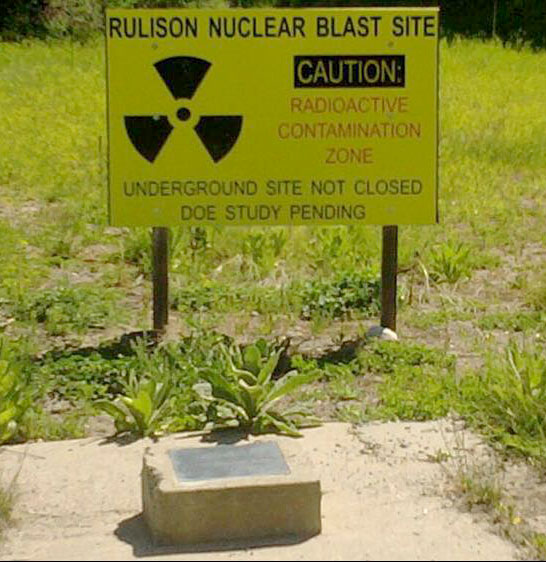 On Tuesday,
October 2 – just a few days from now – The Colorado Oil and Gas Conservation Commission will hold a meeting at the Old Court House in Grand Junction to consider a request from the oil and gas industry to drill for natural gas within the three mile perimeter of the epicenter of what has been known for 38 years as `Project Rulison’.
These must be a trying few days for many oil and gas reps, having to scurry from Denver where they attended a major Republican Party fund raising dinner keynoted by Vice President Dick Cheney (who went on to speak to oil and gas people in Utah and Wyoming) to the other side of Colorado to Grand Junction to make their case as to why drilling for natural gas within 3 miles of Project Rulison is good for Colorado, the nation and the world. It’s going to be a tough sell for sure, but its more than likely those oil and gas lawyers will get their way. After all, who – outside of some people who live nearby Rulison, in western Colorado in 2007 – remembers `Project Rulison’?
Actually, it turns out that the `Project Rulison’ does ring a certain bell for my wife, Nancy Fey, myself – and a dear friend about to arrive today at our home from California, Jo Ellen Patton. Why? Because we were there in the mountains south of Rulison in the early days of September, 1969 with a somewhat rag-tag group of environmental protestors hoping against hope, but all the same intent on stopping the detonation of a 43 kiloton underground nuclear blast set to go off 8426 feet below the surface. Also with us was another life long friend – Melinda Dell Fitting – now of Baltimore. While Nancy and I cannot prove it, as we recall, our presence at Rulison did (or did contribute to it) stop the detonation….for six days. Not bad when you’re up against the military industrial complex, the oil and gas industry and a fair share of people living around Rulison (who believed that the blast might trigger oil and gas development, jobs and money to the county. After nearly 40 years of dealing with the oil and gas industry, most of them know better now).
Indeed it was at the Rulison protest site that I met Nancy Fey. There she was, I recall, sitting on a boulder, in what seemed a contemplative mood. It turns out, I completely misread her: she was sitting there seething – that the government, in conjunction with private industry, would detonate a nuclear bomb in `her mountains.’ And she was there – in one of her early protests – to express her dismay and opposition. Coming from a place where for many, myself included, nature hardly existed, New York City, I didn’t then consider the Colorado Rockies as `my mountains’ and the environmental concerns that touch so many here in Colorado were only vaguely on my mind. I just thought that exploding a nuclear bomb underground to produce natural gas commercially – was, next to the Vietnam War which was very intense at the time, the most awful thing I could ever imagine.
Project Plowshare
Project Rulison was one leg of what was supposed to be a four stage program a part of a more extensive project called, ironically, Project Plowshare. Project Plowshare was conceived in 1957 supposedly to use the power of nuclear explosions for peaceful purposes. All tolled between 1958 and 1973, the program included 27 nuclear blasts (in which 35 nuclear bombs were exploded, many of them at the Nevada Test Site). In the mid 1960s, as a part of Plowshares, a joint government-private sector program to use nuclear weapons for energy development was initiatied. The problem is, that while it might be possible to turn swords into plowshares, although I’m not sure how it can be done with cruise missiles, it is virtually impossible to detonate nuclear weapons for peaceful purposes.
The project was the brain child of one of the nation’s most demented geniuses, Edward Teller, the `father of the hydrogen bomb’, whose faith in the utility of nuclear weapons both for war and peacetime uses was unbounded. The fact that none of the natural gas cavities thus produced could be commercially used gives an inkling of the failure of the project. That the natural gas at Project Rulison would be contaminated with radioactive isotopes did not require a doctorate in geology or chemistry. As my good friend Danny Graul (owner of Black and Red Books in Arvada) commented `It (Project Rulison) always seemed such a preposterously stupid idea’. Actually Teller’s plans to use nuclear explosions went far beyond the bounds of Project Plowshare. The man had really lost it. His overall enthusiasm for starting his nuclear construction company comes through in a letter he wrote to heads of state `If your mountain is not in the right place, just drop us [the Atomic Energy Commission] a call’.
• Teller argued that nukes could be used to build a second Panama Canal to connect the Pacific and Atlantic Oceans accomplished by detonating mere 300 hydrogen bombs rather than TNT. What a deal. Actually over 25 possible routes for the project were considered with plans for five of them developed in considerable detail (two through Panama, one through Mexico, one through Costa Rica and Nicaragua, one through Colombia close to the Panama border). The shortest of these routes would have required more than 100 nuclear explosions, longer projects needed 250 or more bombs.
• Likewise he argued that a harbor for shipping in Alaska could be built in the craters left from nuclear blasts.
• Another Teller idea, mentioned by Donna Gray writing in The Glenwood Springs Post Independent (Feb. 26, 2006) was to nuke the Sacramento Valley for a water transportation project.
If, thank heaven, none of the above projects came to fruition, Project Plowshare, a 4 stage program to increase the collection of natural gas through nuclear explosions, largely did. The idea was to create, through the wonders of nuclear explosions, vast underground cavities into which natural gases would flow and then extract those radioactive gases for commercial uses to help meet the nation’s energy needs and as President Nixon told it `to alleviate the nation’s natural gas shortage’ at that time.
Four nuclear blasts were planned:
1. Project Gasbuggy (see below) was a single nuclear bomb detonated near Aztec New Mexico (near Farmington) on December 10, 1967. A single 27 kiloton device was detonated at a depth of 4227’ below the surface.
2. Project Rulison was scheduled for September 4, 1969, but detonated on September 10, 1969 near Rulison Colorado (w. of Glenwood Springs in Garfield County). The blast was larger than Gasbuggy. A 43 kiloton bomb was used, 2.6 times the strength of the bomb dropped on Hiroshima.
3. Rio Blanco Project (also in Colorado). Located in Rio Blanco County Colorado entailed the detonation of 3, 30 kiloton nuclear bombs (I cannot bring myself to call them `devices’) stacked vertically and simultaneously detonated. It took place on May 17, 1973. The stated goal was to use three bombs to create a larger cavity and thus collect more natural gas than had been created by the Rulison blast. Technically the project was considered a failure, because the three sections of the cavity never joined and it was impossible to measure the size of the resulting cavity.
4. Project Wagon Wheel was to have been the fourth in the series of nuclear explosions, the climax, if you will of the series. But, mercifully for the land and people of south-central Wyoming, it was never detonated. Still the plan is worth noting. Wagon Wheel would have been on a larger scale and deeper than the previous three tests. It would have detonated five nuclear bombs sequentially from bottom to top between 9,220’ and 11,570’ (deeper than Rulison). The result would have been a significantly larger cavity than either Rulison or Rio Blanco. AEC predictions suggested the test would result in low levels of radioactivity. Nor did the AEC anticipate any ground water contamination. Had Wagon Wheel succeeded, El Paso Natural Gas Company had plans to detonate as many as 40-50 nuclear bombs annually in south central Wyoming.
(for a map of Project Plowshare, click here)
As Project Gasbuggy preceded Project Rulison, it is worth exploring the dynamics and results of that test. What is initially striking is the degree to which the political class in New Mexico not only supported the project but pushed it through. Project Gasbuggy had strong support at the time from the state’s governor, legislature and Congressional delegation that pressured the Atomic Energy Commission to conduct the test sooner, rather than later. Participating in the project were the Atomic Energy Commission (now a part of the Dept. of Energy), the Bureau of Mines and the El Paso Natural Gas Company. Locals in the area of the blast, near the Navajo Reservation, were less enthusiastic and worried about radio active fallout and contamination. Their concerns were basically brushed aside.
At first, Project Gasbuggy was considered a success because it created a cavity into which natural gas did flow, Some geologists at the time believed that nuclear explosions could create `more bang for the buck’ than could nitroglycerine and would be, as a result, cost effective. (I’d like to know precisely who these geologists were who could make such specious arguments).
In fact, the success claims were little more than hype. From the very outset the program was plagued with serious problems. Although the detonation happened as planned, water broke into the shaft and the bomb was left in boiling hot water for several weeks. Just how much radioactivity was released in the air and the degree to which workers at the site were subject to contamination was not determined.
As Wade H. Nelson noted in a copyrighted article written in 1999, the test was a failure in other ways as well, although this conclusion was little publicized.
• Although special `cleaner’ nuclear bombs had been engineered for Project Plowshare, they turned out to be rather `dirty’ all the same, producing radiation contamination in the surrounding area. The natural gas produced was seriously contaminated.
• As Nelson relates: “Among the hundreds of declassified records are memos and reports discussing increased tritium levels in surrounding vegetation, the release of radioactive Krypton-85 gas, and testing of milk from nearby dairy cows for Strontium 90.”
• The California Public Utilities Commission objected to any gas produced by Project Gasbuggy being shipped to California even though they had tested only `slightly’ radioactive. Again, Nelson: “Scientists suggested that mixing it with gas from other wells would bring the radiation levels down to what was considered “an acceptable level,” but gas customers would reportedly have none of it.”
• Serious questions also emerged as to whether radioactivity from Project Gasbuggy would contaminate other wells in the San Juan Basin. Early test results suggested that initial contamination was minimal but measurable amounts of radio-active tritium were being recorded several decades later.
• A 1973 New York Times Magazine investigation pointed out that radioactive Krypton-85 escaped through gas flaring and that “undoubtedly some of it would enter the food chain
• Nelson’s final verdict on Project Gasbuggy is worth quoting:
“Perhaps because of the project’s five million dollar pricetag, geologists and scientists involved with Gasbuggy were reluctant to declare the test a failure. Yet it didn’t create nearly as much fracturing of the shale as geologists had hoped. Nor did Gasbuggy stimulate the levels of increase in gas production needed (10-20X) to pay for the half-million dollar nuclear bomb. What gas it did produce, customers wouldn’t buy.”
Project Rulison would produce much the same results. (to be continued)
SEPTEMBER 1, 1939 (thanks to Bob Ross)
I sit in one of the dives
On Fifty-second Street
Uncertain and afraid
As the clever hopes expire
Of a low dishonest decade:
Waves of anger and fear
Circulate over the bright
And darkened lands of the earth,
Obsessing our private lives;
The unmentionable odour of death
Offends the September night.
Accurate scholarship can
Unearth the whole offence
From Luther until now
That has driven a culture mad,
Find what occurred at Linz,
What huge imago made
A psychopathic god:
I and the public know
What all schoolchildren learn,
Those to whom evil is done
Do evil in return.
Exiled Thucydides knew
All that a speech can say
About Democracy,
And what dictators do,
The elderly rubbish they talk
To an apathetic grave;
Analysed all in his book,
The enlightenment driven away,
The habit-forming pain,
Mismanagement and grief:
We must suffer them all again.
Into this neutral air
Where blind skyscrapers use
Their full height to proclaim
The strength of Collective Man,
Each language pours its vain
Competitive excuse:
But who can live for long
In an euphoric dream;
Out of the mirror they stare,
Imperialism’s face
And the international wrong.
Faces along the bar
Cling to their average day:
The lights must never go out,
The music must always play,
All the conventions conspire
To make this fort assume
The furniture of home;
Lest we should see where we are,
Lost in a haunted wood,
Children afraid of the night
Who have never been happy or good.
The windiest militant trash
Important Persons shout
Is not so crude as our wish:
What mad Nijinsky wrote
About Diaghilev
Is true of the normal heart;
For the error bred in the bone
Of each woman and each man
Craves what it cannot have,
Not universal love
But to be loved alone.
From the conservative dark
Into the ethical life
The dense commuters come,
Repeating their morning vow;
‘I will be true to the wife,
I’ll concentrate more on my work,’
And helpless governors wake
To resume their compulsory game:
Who can release them now,
Who can reach the dead,
Who can speak for the dumb?
All I have is a voice
To undo the folded lie,
The romantic lie in the brain
Of the sensual man-in-the-street
And the lie of Authority
Whose buildings grope the sky:
There is no such thing as the State
And no one exists alone;
Hunger allows no choice
To the citizen or the police;
We must love one another or die.
Defenseless under the night
Our world in stupor lies;
Yet, dotted everywhere,
Ironic points of light
Flash out wherever the Just
Exchange their messages:
May I, composed like them
Of Eros and of dust,
Beleaguered by the same
Negation and despair,
Show an affirming flame.
You’d Think We’re Already At War With Iran
Woke up this morning to an email from Claire Ryder that a bill sponsored by Senator Tom Lantos to place additional sanctions against Iran was introduced in Congress today. I take it that the sponsors are in both the House and Senate. Congress’s little welcome gift to Ahmadinejad? You’d think we were already at war with Iran from the hysteria that has been whipped up to a frenzy. We, in Colorado, got a memorable taste of something like this a few years back when Palestinian political figure Hanan Ashrawi came here. At that time, an unforgetable outpouring of spleen and overt bigotry was unleashed in which main stream Jewish groups joined hands with their Christian fundamentalist comrades from Colorado Springs with the media relishing its role of character assassination and symbolic lynching.
Juan Cole, in his blog, puts all this noise in perspective:
“Demonizing the Iranian president and making his visit to New York seem controversial are all part of the neoconservative push for yet another war,” he wrote last night.”
This legislation gives more texture to the Sept 16 op ed that Ken Gordon and Joan Fitz-Gerald signed calling for more sanctions against Iran. The piece was a part of a broader, most likely national effort to win support for the new legislation. Lantos bill once again suggests the stubborn power of AIPAC and like organizations to effectively work the Congress. He’s often an AIPAC point man on key issues, a role he plays with pride if not relish.
It all stinks. What is it all about in the end?
While the sanctions will have some modest effect, more importantly the legislation `sends a message’ – such nonsense – Bush, the Congress are always `sending messages’ that not only is Congress behind Bush should he launch a major air strike against Iran, but that they’ll cheer him on. It’s nothing short of a green light to war and if – as I expect they will – Bush and Cheney unleash such a misguided attack, they will rightfully point to the fact that, once again, they have Congressional backing that includes whole truckloads of Democrats. Afterwards of course we’ll hear these Congressional reps whine about how they were `misinformed’.
I haven’t followed Ahmadinejad’s visit second by second, just picked up snippets here and there. He’s being rightfully taken to task for stating Iran has no gays – pretty dumb thing to say. Of course if the King of Saudi Arabia had been asked the same questions on homosexuals the answer would have been more or less the same…but then, of course, it’s different as the Wahhabists in Riyadh are our allies while the Shi’ite fundamentalists in power in Teheran are our adversaries. But the rest of Ahmadinejad’s remarks were generally conciliatory and therefore far more threatening to the Bush Administration riveted on going to war. Harder to go war with someone who says, `hey, let’s sit down and talk about all this’. Ahmadinejad seems to be calling for negotiations with Washington, an idea that seems especially threatening and is, of course rejected out of hand. His criticisms of Israel are generally tame (and accurate) and he has repeatedly said there are no plans for an Iranian pre-emptive strike against the Jewish state. Almost like a mantra he’s repeated:`No Iran won’t attack Israel’. The NY media seems unable to absorb this. They respond with `Why do you plan to attack Israel?’ I’d like to hear a statement from Olmert that Israel would not launch a pre-emptive strike against Iran but am not holding my breath.
Still More Yet on Fitz-Gerald, Polis et al.
What I find gratifying is the numerous responses I have gotten from people about these entries on Fitz-Gerald and Polis. There are a number of very savvy people out there whose insights are helpful, others who are careful researchers. Won’t mention names – but it helps and it makes this blog a bit more of what I envisioned it to be, something of a dialogue more than a simple monologue. As people write me emails and they are generally in private – I quote from them without citing the source because I feel it unfair of me to do otherwise.
1. From a Northwest Denver neighbor who knows the Democratic Party rather well, this on Polis and Fitz-Gerald;
” I also noted your comments regarding Fitz-Gerald. I had the opportunity to meet her recently, but, unfortunately, I forgot to question her about her support of Israel and a possible war with Iran. I was more focused on education. I know that she opposes charter schools and I know that Jared Polis is an enthusiastic charter school supporter. My limited research indicates that charter schools create a financial drain on the local school districts that supposedly regulate them. As you and I know, the education pie that is baked each year is smaller than the pie from the previous year. That means smaller pieces for all. Fitz-Gerald understands this. Polis apparently does not. While we, in Colorado, create a parallel public school system (charter schools), the old one languishes. The poorest of the poor are left in situations where, for example, a student’s desk sank through the floor while the student sat in it. So, the next time you post your blog, don’t forget to point out that charter schools take from the many to give to the few.”
“I don’t have a vote in Cong. Dist. 2, but if I did, I’d vote for her over Polis because I believe so strongly that we must preserve what’s left of the public school infrastructure. Otherwise, even our own children could live in the impoverished conditions that you described of your youth, ones familiar to me from my own youth. We might be able to influence her position on Israel and Iran. Polis appears to have a rigid stance on charter schools. In the last session of the state General Assembly, five Democratic senators prevented the passage of SB 61 that would have restored some control to local school districts over charter schools. Polis opposed SB 61, as I understand it.”
2. From another NW Denver sage (we’ve got a whole slew of them. They hang out at ever expanding number of neighborhood coffee shops, bemoan the fate of the earth, sometimes alone, sometimes in concert, hobnob with city auditor, Dennis Gallagher who it is virtually impossible to avoid, so we have stopped trying. Besides Dennis is an interesting man in his own way) – this on Polis:
“He’s got his own dough (Blue Mountain greeting cards went digital and got bought by Hallmark); he’s younger (than `Fitz’) but considered an upstart who hasn’t paid his dues but has bought influence. Among Colorado Dem’s he’s resented more than appreciated; so even though he helped elect the Dems in 04 and 06, he got towel-snapped by the locker-room boys over the Amendment 25 (anti-“bribery”) snafu. Lots of state employees, not just lobbyists, got pissed; he’s deliberately got friendly with Miles (pay-back for money to MM’s campaign?). (note: Polis supported Mike Miles in his 2004 bid for the Democratic nomination for the US Senate. Perhaps now Miles is supporting Polis in return?)
“Would be interesting to know where Pat Stryker, Tim Gill come down in this (they helped Perlmutter, dumped a bunch on Paccione but party seems to have abandoned her re-run against Musgrave)”
For those unfamiliar with the lingo here:
Amendment 25 – (which Polis crafter in large measure and worked for) – it was meant to curtain some of the excesses of lobbying. Few bigger whorehouses in the world than the Colorado state legislature, but it was very poorly written, so much so that regardless of the intent – which was, in my view positive – it was easily defeated
Pat Stryker and Tim Gill – along with Polis and Rutt Bridges are together 4 Colorado millionaires active in the Democratic Party. The four little millionaires who have gone astray! Bah, bah, bah. They are upstarts, challenging the Party’s old guard, and trying to buy influence.Together, a few years ago, they spent a combined total of $2 million to get Dems elected to the Colorado state legislature and were voted the `Best Behind The Scenes Political Power Brokers of 2005′ – a real high honor. Of course without the organizing muscle of Colorado’s labor movement – which played a decisive grass roots roll – all their money wouldn’t have meant much. Although all over the map politically if you probe their policies carefully, on a number of issues – (like Polis on Iraq) generally speaking the four little millionaires are quite liberal.
In a September 5, 2006 article in the Rocky Mountain News by Stuart Steers, they were described as:
“A disparate group of self-made entrepreneurs and heirs to family fortunes, the four wealthy Democrats have helped spark a resurgence for the Democratic Party in Colorado. They worked together closely in 2004 and helped to fund the Democrats’ takeover of both houses of the state legislature for the first time in decades”
“If you were to do a list of the most powerful people in Colorado, those four would be at the top,” said Katy Atkinson, a Republican campaign consultant. “Their impact has been enormous.”
The article goes on to describe the sources of their wealth:
• Tim Gill was the founder of software company Quark, where he made a fortune that Forbes Magazine estimated at more than $425 million.
• Pat Stryker was born into one of the wealthiest families in the country. Forbes has estimated her net worth at more than $960 million. She ranked 512th among the world’s richest people in 2006. Stryker is the grand daughter of Homer Stryker, surgeon and founder of the Stryker Corporation, a medical technology company
• Jared Polis is a member of the state board of education. His parents founded the Blue Mountain Arts greeting card company, and he helped them create an Internet site that was sold in 1999 for $900 million.
• Rutt Bridges, founder of The Bighorn Center, created software for the oil and gas industry that earned him more than $30 million. ”
Together they are trying to challenge the party’s old guard (to be probed in a later entry). To do so, they’ve had to make alliances with different elements of the party’s base. Polis is probing Dems on the Western Slope (sometimes neglected by Denver and Boulder centric old guard power brokers) and has come out to the left of his adversary for the Congressional Seat in District Two on Iraq. Stryker made a key contribution a few years ago to help defeat an `English Only’ amendement. Bridges who tested the waters for a gubenatorial challenge to Bill Ritter (he, Bridges dropped out after a short while) was a champion of Women’s rights for abortion (among other things) to attract the considerable constituency of Democratic women (that include many professionals both with savvy and money). Gill helped found the foundation in his name (the Gill Foundation) which funds a variety of gay, lesbian and trans-gender causes.
For all that, the old guard has held its ground, amazingly actually, a sign of their political sophistication and maturity (and some would argue – their ruthlessness – not in the old mafia sense – but in the more modern political sense). And it would be premature to conclude that the money of the four little millionaires has yet morphed into political power. They have not quite figured out how to break the granite wall to gain entrance to the `inner sanctums’.
In many ways Mike Miles’ bid for the Democratic Party nomination for Senate in 2004 was a test case for the four little millionaires. They were able to see the different fissures in the state party – that rambunctuous, almost rebellious, genuinely progressive base that ambushed Salazar at the State Convention in Pueblo and supported Miles over Salazar (although the later did win the primaries and by a long shot). What Miles showed is that a left-of-center Democrat running for Senate could generate alot of enthusiasm and could give the old guard something they hadn’t had for years – a real run for their money. Don’t get too excited, the old guard absorbed the blow, made a few minor adjustments (throwing a few crumbs to the anti-war Dems on Iraq – not much, but enough), and is very much back in business. Whatever else they might be, they’re no idiots.
So………..if the four little millionaires are the upstarts, our post-millenial Democratic rebels (isn’t it pathetic!), then who is `the old guard’? and why are they good at what they do…because they are? Stay tuned
More on Joan-of-Boulder Fitz-Gerald
Two days of not-so-serious investigations – including many interesting responses to my `Wanted Dead or Alive’ (but mostly alive) poster – suggest the following to me:
Most likely Joan Fitz-Gerald has the Democratic Party nomination for Congress in Colorado’s 2nd District sewn up. Jared Polis has some interesting ideas and is better on the Iraq war but he is a big supporter of charter schools which pretty well knocks out his support from teachers – an important voting constituency among Dems.
It’s possible that there could be a revolt from below, but unlikely. Something of a political `hard-nose’, she’s done her homework well for this campaign. That counts for alot. She has the support of the labor movement (again, no small thing – although the labor movement might reflect upon how Bill Ritter didn’t hesitate to betray them as soon as he became governor), key figures like Gail Schoettler, who has her own following among liberal Democratic women. Fitz-Gerald has also genuflected before the altar of Brownstein-Farber-Hyatt (again) by signing an op ed last week (with Ken Gordon and two Republicans) calling for Colorado companies and foundations (particularly PERA) to divest from Iran – (the Netanyahu line) and, as a cynical bone thrown to the peace movement, chose Dorothy Rupert, symbol of the Boulder-Dems for peace, as her chair, (although I doubt Dorothy has much actual say in the campaign) hoping to siphon off some peace votes that way. Might work too.
On this subject, the title of my recent blog `Gordon and Fitz-Gerald: Once Again Doing AIPAC’s bidding on Iran’ – produced some concern from friends who felt the title slandered Fitz-Gerald unfairly. I would argue to the contrary, that I am criticizing her fairly, almost too politely. She’s been pretty well entrenched in one-sided, pro-Israeli activities here in Colorado these last years so much so that she’s something of a fixture.
So…a few more details….
+ in 2005 Colorado lobbyists for Israel – doing what they do so well – paid the $2618 in expenses for Fitz-Gerald – and a number of other prominent Coloradoans – to participate in `Mission To Israel’ to attend an intensive course on pro-Israeli p.r. Hard to tell if this comes from the heart, or simply what Fitz-Gerald felt she had to do to continue her political career. After all she’s not a multi-millionaire like her main opponent Jared Polis.
+ That investment paid off last summer when Fitz-Gerald along with Ken Gordon and two Republicans pushed a resolution through the Colorado legislature (interestingly enough when it was not in session) supporting Israel’s unconscionable war against Lebanon (under the pretext of freeing 2 Israeli soldiers captures by Hezbollah).
+ Just before Shaul Amir in June 2007, former director of Allied Jewish Federation of Denver, left Colorado for Israel, Fitz Gerald presented him an outstanding citizenship award. She commented on that time how `her trip to Israel had impacted her life’. Of course there is nothing `illicit’ about this, it simply shows a consistent, long-term pattern of support.
At the press conference announcing the July, 2006 pro-Israeli legislative `sneak attack’, some peace activists did a little guerilla action of their own. About a dozen of them showed up at the capital to have a `counter press conference’. It was perhaps the most creative thing done by peace activists during the Lebanon War. Peter Blake of The Rocky somehow got wind of the story and did a rather interesting investigative background story on how a resolution could be passed when the legislature was not in session. Peace activists in attendance that day related to me that while Ken Gordon was mostly embarrassed and saddened to be so caught in the act, that Fitz-Gerald went `ballistic’ (I believe the term that one of them used).
Perhaps that little encounter – so fleeting but suggestive – had something to do with Fitz-Gerald’s recent turn to peace on Iraq. Of course it would be completely cynical and unfair to suggest that Fitz-Gerald came to the conclusion that if she didn’t come out for peace in some way, she might not win the Democratic slot for Congress. But since I am fundamentally a cynical and unfair guy (and `unspiritual’, with no sense of humor I have been told), I’ll suggest it anyway.
True that 20 years ago, Fitz-Gerald, who lives in the hills above Rocky Flats, was involved in that great peace campaign (as was Gordon, Bruce Deboskey of the ADL and a number of others) and since has kept personal contacts with some Boulder peace activists. But it’s hard to tell what it is she has done peace-wise since.
Actually, since last summer there a number of liberal Colorado Dems have tried to re-fashion their positions on the Iraq war, So Fitz-Gerald, whose friends call her `Fitz’ is not alone. They almost had to do so because of the swing in public opinion against the war, but have chosen to take minimal steps – calling for troop redeployment to US bases. No calls for ending the occupation nor dismantling the bases though. It becames not much different, in essence, to what President Bush is proposing.
Here is how Fitz-Gerald seems to have proceeded.
1. She has let it be known that the she had wanted `different language’ in the last summer’s pro-Israeli legislative resolution, but blames Gordon for not making the changes. (I have several emails to prove it). Gordon is decent enough not to blame her for the language but has said semi publicly that he regretted signing the document. So much for Fitz-Gerald’s contrition on the issue.
2. Secondly there was a need to take a public stand against the war in Iraq. Again, she and other Dems including all the presidential hopefuls minus Kucinich, were responding to the fact that public opinion polls against the war in Iraq began to zoom to 70% levels (including in Denver’s Jewish Community where the opposition to the war reflects national trends). I wouldn’t call waiting to come out against the war in Iraq until the polls reach 70% particularly an act of political courage (although I do welcome her position) on any of their parts.
Perhaps Fitz-Gerald is learning from Tom Strickland, former Democratic candidate for the US Senate (he lost to Allard) who was pro-war until the last weeks at which time he gingerly approached a number of Colorado peace activists asking for an endorsement. They might have given him something but Strickland refused to come out publicly against the war. And they refused to endorse. He lost. Perhaps his failure to win the support of Colorado peace activists had something to do with his defeat. Actually I suspect it did (although there were other issues too).
Still, Fitz-Gerald’s epithany – that the war in Iraq is immoral and must end – is modest, minimal at best. She stays away from any calls for complete withdrawal or the dismantling of the base network the US has built as fire bases to dominate the region. There are fair number of Republicans whose position on the war is better than hers. It is a weak anti-war position at best, cynical and self-serving at worst and is no different from what Ken Salazar is trying to do: straddle the fence – appear anti-war – because popular opinion demands so – while doing the minimum possible to end the war and then calling those who call for an immediate withdrawal `impractical’…or worse. It might work for a while to boot.
3. Shift the focus of her energies on the Middle East to supporting those (I wonder who they could be?) who pushing for the US to attack Iran. Of course some of them (AIPAC/ADL et. al) are clever. For example, AIPAC’s meetings – both nationally and in Colorado – have been nothing short of anti-Iranian orgies featuring Vice President Cheney. You know – the Ahmadinejad = Hitler stuff. Several of the people who attended the last AIPAC meeting in Colorado (in February I believe) were so offended by the anti-Iran rhetoric that – to give an idea of how bad things got for them – they actually contacted me! But the approach is clever. They don’t call for military action against Iran – simply choking the Iranian regime to death by any other means (boycotts, divestments of companied doing business with Iran etc) as if this position is somehow better.
Let’s not be coy.
People in the peace movement might not have political power – and although it might on occasion seem otherwise – we (in the main) are not idiots.The anti-Iranian campaign which Fitz-Gerald unhesitatingly is a part of – is basically about drumming up popular support for an attack. Bush knows that he probably won’t get 50% of the American people behind it, but if he get’s 30%, that’s enough. And it appears – if the p.r. campaign to attack Iran does not have the momentum of the war drums before the 2003 attack on Iraq, still, Bush, Cheney and friends are making headway.
And Joan Fitz-Gerald has lent her name to this effort.
As to who actually wrote that op ed, I can only speculate (although the speculation has rather narrowed to a few sources, the likely suspects).
As Dave Chandler of Colorado’s Green Party wrote in his blog (worth reading) on Fitz Gerald’s op ed on Iran:
“Nevertheless, Fitzgerald and Gordon may think that they can buff-up
their foreign policy and ‘macho’ credentials by agitating for a course
of action that promotes a ‘tough’ line towards Iran … they might want
it to sound as if divestment of any PERA funds in “foreign companies
investing more than $20 million in Iran’s energy sector” is a ‘tough’
sanction. But the real effect of their language is to diminish diplomacy
and raise fear through unfounded allegation.”
4. Finally, the last point of the approach seems to be…if at all possible,
– keep the subject on Iraq within strick limits but away from the Israeli-Palestinian conflict – away from the Occupation, Israel’s unjust, inhumane war against Gaza – because focusing on that does not play so well in the public eye as it used to.
– and of course, don’t be inviting Jimmmy Carter to address the Jefferson-Jackson Day dinners this year.
Despite the strength of her position in the Congressional race, Fitz-Gerald appears to be moderately nervous about her support in the peace camp and not sure what to do. She can’t seem to gauge what is worse: talking to peace movement people in Boulder (whom she knows well and for many years) or not talking to them. At this point, I’m not sure how to advise her to address this nagging dilemma. Maybe, for starters she should give Dorothy Rupert a call.
As for myself, I’m looking at the ideas of one of her opponents , Jared Polis (I’m far from supporting him as of yet) who opened a campaign office today in Boulder…and waiting to see if the Green Party or some other independent left candidate might through their name into the hat.
 View from the Left Bank: Rob Prince's Blog