Skip to content

Shift in Public Opinion Towards Israel and the Palestinians in Gaza?

September 20, 2025

I have noticed something in my discussion with neighbors and friends about how they are reacting to the news about Gaza. It’s anecdotal but still, I believe it’s a trend and it corresponds to growing public opinion polls showing greater sympathy for the Palestinians, more critical stances towards Israel’s slaughter of Palestinians in Gaza and the continued erosion of what has been called the “Zionist Narrative”.

That this has not been translated into national policy (U.S. demanding Israel end the genocide, stop arming, financing and political supporting Israel) is due to the Trump Administration’s total support for the crimes that Israel, in the end no more than a U.S. proxy, is commiting in Gaza.

With a number of people I am in contact with socially – if the question of the genocide taking place in Gaza was mentioned – and most of the time it has been Nancy or myself that has had to raise it if it has been raised at all – the discussion ALWAYS centered around the role of Hamas on October 7. But in the past few days, something has shifted on 3 completely unrelated occasions. Now it is our friends that our friends, contacts that initiate the discusisons… and with NO MENTION OF HAMAS – or if there is, it has lost much of its emotional appeal; instead, in reference to the killing fields in Gaza, it is “Why is Israel killing women and children in Gaza?” “How is that human beings do such horrible things?” This indicates a complete shift in tone, and in emotional solidarity suggesting that after 600,000 deaths (read murders), the myth of Israeli victimhood is eroding as the mainstream media, ever so gingerly, reveals the horrors of Gaza.

I note this at a moment when
1. the United Nations – still, even if not respected in this country very much – is still the world’s conscience and the standard of international law. It has come out with a General Assembly report defining what Israel is doing in Gaza as genocide.

2. A few – admittedly a precious few – members of Congress are taking an openly critical stance on U.S.’s greenlighting the Gaza genocide. I am hearing reports that many members of Congress are privately abhorred by Israeli’s slaughter in Gaza, that they “wish they could say so publicly” (but f-ing cowards can’t)

3. A number of European countries – and others – including U.S. allies are talking about recognizing the state of Palestine

4. Here in Colorado a number of liberal Zionists are having growing angst about Gaza and expressing it publicly

5. The worn argument that “Israel has a right to defend itself” is wearing thin.

Support, admiration for Israel globally is at a longtime low, so much so that Netanyahu has had to admit as much, noting that Israel has go into a “Sparta mode” … meaning it is increasingly isolated worldwide

################################

Colorado Sun: A Denver pediatrician in Gaza: “The most dangerous place on Earth to live as a child”

September 19, 2025

Colorado pediatrician Dr. Mohamed Kuziez poses with Palestinian children he helped care for during volunteer service in Gaza.(Provided by Mohamed Kuziez)

A Denver pediatrician in Gaza: “The most dangerous place on Earth to live as a child”

by Peter Moore. September 18, 2025.

Dr. Mohamed Kuziez, 35, is bragging about one of his favorite patients. “She is fierce,” the Denver pediatrician says, fishing out his phone like a proud dad.

He volunteered in Gaza for three weeks earlier this year, which is why his phone also contains images of decaying corpses in the wreckage of a building, a lineup of torched Palestinian ambulances, and human organs, red and incongruous on surgical sheeting, outside of the bodies they once served. He also photographed a message he scrawled in the dust left on a wall, after a missile struck al-Shifa Hospital in Gaza: “With love from Colorado,” it says.

Finally, Kuziez locates the photo of his 7-year-old patient Habiba, her hair glossy, a smile lighting up her face, and “Hello Kitty” earrings in both ears. Her name means “the little one who is beloved” in Arabic, and she is. When her mom posted about her on Instagram, the king of Jordan interceded on her behalf, asking the Israeli government to release her to his country for treatment.

In the photo Kuziez called up, Habiba’s dark eyes are riveting, so it takes a moment to register that both of her arms have been amputated above the elbow. Her left leg — her only remaining limb — is out of the frame. But to look at that photograph, you’d think “birthday party,” not “humanitarian crisis.”

In December 2023, UNICEF declared Gaza the most dangerous place on Earth to live as a child. Even back then, the United Nations estimated that there were about 130,000 children under age 2 in Gaza who weren’t receiving the food they needed to survive. Last month, a report from the UN sounded the alarm over a half-million Palestinians facing famine; 132,000 of those victims are children.

The UNICEF declaration flipped his switch into action mode. “Once there was a critical mass of 3,000 children killed, I knew I had to act,” Kuziez says. He began applying to medical aid charities, but they were looking for emergency room doctors and surgeons. At the end of 2024 he at last fielded a request for a pediatrician willing to risk his life in Gaza.

Before he left for the Middle East he visited his parents. “When I went into medicine,” he says, “they told me it’s not about how much money you make or how big your house is or how nice your car is. What actually matters is what you have given back to the world.”

After delivering the news to his family, and saying a provisional goodbye, he wrote his will. Then he saw a therapist, to help him prepare emotionally for the task ahead. She acknowledged the difficulties of what he’d be seeing and doing in Gaza, and counseled him to bring tokens of home, for comfort. “I ended up bringing the blanket I covered myself with as a child,” he says, “and a bar of my mom’s favorite soap.”

He would need all that and more.

In a talk he gave at the First Unitarian Society of Denver, Kuziez shared his experiences in January and February while working at the Patient Friends Benevolent Society Hospital in the al-Rimal neighborhood of Gaza City. The images were beyond shocking: The remains of a dialysis center that was targeted by Israeli artillery; a playground plowed under by Israeli tanks; a former fig orchard that now serves as a mass grave; a hospital facade pockmarked with gunfire. He also filmed a wooden donkey cart rolling through a street that had been reduced to rubble.

A child with dark hair pulled back from her face smiles while holding a sticker from the movie "Frozen" as her American doctor leans into the frame to take a selfie

Dr. Mohamed Kuziez with one of his young patients in Gaza, who holds a sticker of a character from the Disney movie “Frozen.” (Provided by Mohamed Kuziez)

There were also many photographs of children, because they are Kuziez’s touchstone. One video shows three kids bouncing on a trampoline set down amid the rubble. Another shows a young boy swinging like Spider-Man from a severed telephone wire. If you’re a kid in Gaza, anything can be your playground.

“They manage to find joy in the silliest things,” Kuziez says. “It’s amazing. I talked to kids in Gaza who have had their classmates killed. But they don’t say ‘F the Israelis, they did this to us.’ They say: ‘I hope the sky stops raining bombs so we can go out and play.’” One of his young patients begged him for one of the “Frozen” stickers he brought to distract his young patients, saying she needed it for her friend. Later, he spotted it on the friend’s gravestone.

Asked what he takes away from all of this, Kuziez pauses for a few weighty seconds. “Being in Gaza showed me that, sadly, the world does not care about kids the way I do,” he says. “A lot of kids will die before their time. But we have to fight for the ones who are still around.” He pauses again and then shares his personal mission statement: “I have taken on a personal challenge that, regardless of the hour of the day or what the request is, I will always show up for my patients.”

Now, he awaits the call to return to Gaza — soon, he hopes. If the Israeli government lets him in, he will show up for his young patients, like always.


Mamdani’s Election Campaign: Lessons for Colorado Progressives

September 19, 2025

Mamdani’s Election Campaign: Lessons for Colorado Progressives

The link above is to a discussion that took place at the University of Denver’s Korbel School of Internationial Studies on September 10, 2025, concerning the impact of the Mamdani campaign for mayor of New York City and how it might influence local politics in Denver, Colorado. The meeting was organized by ourrevolution. metro.denver@gmail.com, introduced by Mark Belkin of Our Revolution, moderated by the university’s Dr. Aaron Schneider. 75 people were in attendance, many from the Denver Community.

The program lasts close to two hours

The participants were:

Colleen Johnston, Denver DSA Member and National Political Action Committee Member (2023-2025)

Sandra Parker-Murray, Secretary-Treasurer, Communications Workers of Local 7777

Joe Salazar, Civil Rights Attorney, former Colorado State Representative and candidate for state Attorney General.

Wynn Howell, State Director, Colorado Working Families Party.


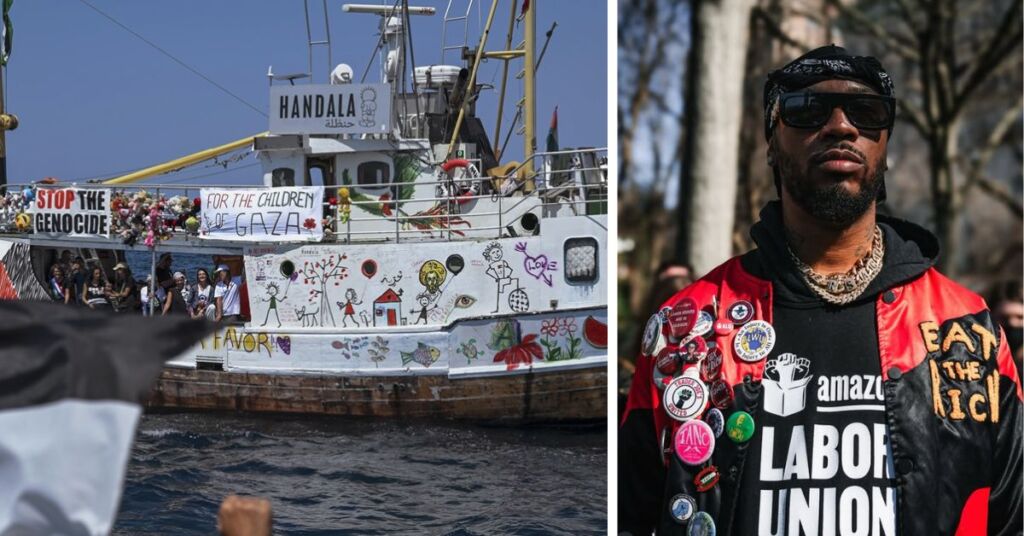
Chris Smalls Speaks Out: Why I Joined the Global Sumud Flotilla

September 15, 2025

Chris Smalls Speaks Out: Why I Joined the Global Sumud Flotilla

U.S. labor leader, organizer of the Amazon Union details his experience as a part of the Gaza Flotilla.

The New Finnish Doctrine: Stupidity, Lies, Ingratitude by Dmitri Medvedev

September 12, 2025

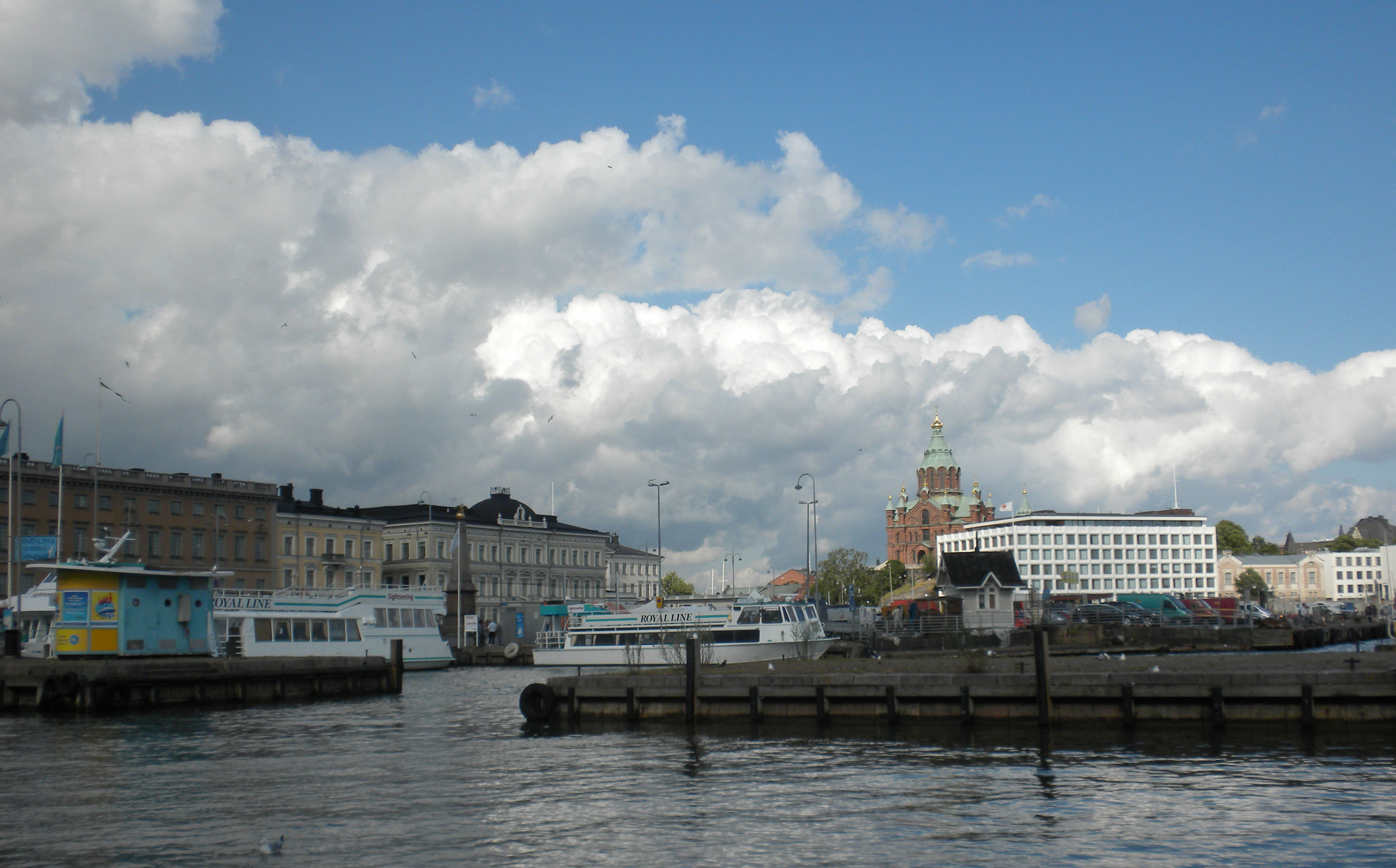
Helsinki, summer 2011

________________________________

(Note: This is a harsh analysis by Dmitri Medvedev of Finland’s radical shift over the past 35 years from a country that was a model of neutrality to an active partisan of NATO. It details Helsinki’s role as an ally to Nazi Germany during World War II and Finland’s current transformation into a frontline state of NATO’s campaign against Russia. As the U.S. NATO war against Russia  using Ukrain as cannon fodder winds down with a complete defeat for Washington, Brussel and the Banderites in Ukraine, the question of where Washington will open a second front in its near eternal effort of exhaust and weaken Russia is coming into play, Will the military confrontation shift northward from Ukraine at Russia’s southern front to its northern, Baltic region with Finland becoming the new ground zero?
I hope not but then hope is rather useless emotion when faced with the emerging realities on the ground (and in the Baltic Sea).
I winced at every paragraph of Medvedev’s angry – but accurate – polemic: I have been trying to make sense of Finland’s political shifts over the past decades from afar. The angry tone aside, what Medvedev writes below rings true: Finland’s role in the horrific blockade of Leningrad (in some fundamental way, a model for Israel’s blockade of Gaza), its World War II establishment of concentration camps in occupied Soviet Karelia, Finnish anti-Slavic prejudices, its “lebensraum” approach to Russian Karelia, its current embrace of NATO – all those ARE FACTS, and not figments of Russian propaganda.
On some basic level the Finnish transformation is a response to “which way the geo-politiccal winds are blowing”. Small countries like Finland are always alert to larger shifts and how they might adjust. Having so noted the shift, and with a personal interest in developments in the Nordic countries, I still do not know how it was that this transformation of Finland’s geopolitical position has shfited so dramatically. A study of the Finnish media since 1991 (the collapse of the USSR), the role of U.S. and European weraponized NGOs and non profits in Finland,  Washington’s cultivation of the new generation of post-Soviet Finnish leadership along with Washington’s long and highly successful courtship of the Finnish military all played a role but that is just my speculation.
Not that it matters in the broader scheme of things, nor that I can do anything about it, but I am deeply saddened by the direction Finland has taken. And I fear that if the current trends continue that Finland could easily be “the next Ukraine” as Washington squeezes all the life out of one proxy, Ukraine and seeks to shift gears and replace Finland with Ukraine as the latter collapses militarily. Finland is on a collision course with Russia It will be used as Washington’s proxy to keep Russia tied down in pretty much the same way that Ukraine has been used. Should this occur, the results will be painful for both but far more devastating for Finland. RJP

________________________________

The New Finnish Doctrine: Stupidity, Lies, Ingratitude

Deputy Chairman of the Security Council of the Russian Federation Dmitry Medvedev finds historical parallels in the behavior of the current leaders of Finland and their predecessors from almost a century ago and recalls how their aggressive attacks on Russia ended for them

Dmitry Medvedev Deputy Chairman of the Security Council of the Russian Federation, President of Russia (2008–2012)

Last week I visited the Russian-Finnish border in the Leningrad Region. I talked to the heads of the authorities of these territories and our border guards. There is no movement on the border, and just recently it was very crowded. At the initiative of Helsinki, normal mutually beneficial relations that had been built over decades have been completely destroyed. And ordinary citizens of Suomi are the ones who suffer from this first and foremost. They had serious advantages from the development of bilateral trade and economic relations and therefore today they express dissatisfaction with the stupid policy that the Finnish authorities are clearly pursuing not in their interests.

I would like to say a few words about the root causes of this situation. Unfortunately, it is not accidental. The whirlwinds of turbulent geopolitical processes only tear the covers off old problems, revealing their true essence. This is what happened in the case of Finland.

A visit to our northwestern regions at the beginning of autumn invariably gives reason to think about the most tragic date in the history of the city on the Neva – the establishment of the blockade on September 8, 1941. However, it seems that today we are the only ones who remember those black days. The direct culprits of these events are trying to carefully erase the traces of their atrocities from historical memory. At least so that there are no “uncomfortable” associations with their current political line. And we are not talking only about Germany, which even at the official level blasphemously disowns the recognition of the blockade of Leningrad as a crime against humanity.

It is worth remembering that without the participation of the Finnish armed forces, the siege of Leningrad, which took the lives of hundreds of thousands of civilians, simply would not have been possible. Having succumbed to the thirst for revenge and seeking to revise the results of the Soviet-Finnish confrontation of 1939-1940, the leadership of Suomi recklessly threw itself into the crucible of war on the side of Nazi Germany in the summer of 1941. Ultra-nationalist propaganda narratives reigned in Finnish society at the time, and with the approval of their Nazi brothers, the idea of ​​Finland’s “lebensraum” — “living space for Finland” — was seriously discussed in Helsinki. The country’s military-political authorities intended not only to regain the territories that had been transferred to the USSR under the Moscow Peace Treaty of March 12, 1940, but also to reach the “natural borders of Greater Finland” — from the Gulf of Finland to the Barents Sea, including Eastern Karelia, Leningrad and its environs, and the Kola Peninsula. Along the way, ridding these lands of the presence of the hated “Russya”. In the boldest fantasies – to advance beyond the Urals to the Ob River. Such territorial claims (in percentage terms to the real area of ​​the country) were at that time among the most greedy in Europe. They even surpassed the claims to neighboring states, expressed by “colleagues” in the fascist international – Italy, Romania, Hungary. Read more…

Longmont for Palestine: Jewish Anti-Zionism and the Struggle for Palestine

September 9, 2025

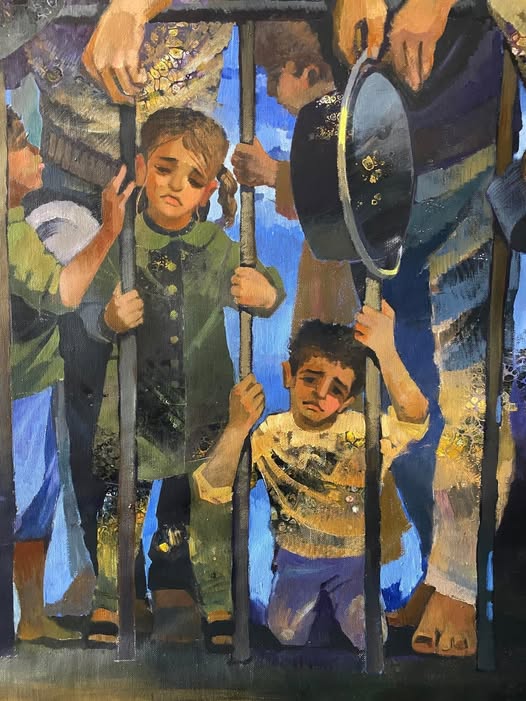
Irina Naji Palestinian kids in Gaza

Longmont for Palestine: Jewish Anti-Zionism and the Struggle for Palestine

The Genocide in Gaza is Being Fought on the Streets and in the City Hall of Boulder, Colorado

September 7, 2025

Taisha Adams – Boulder City Council member attacked as “anti-Semitic” for having intoduced a ceasefire resolution

The Genocide in Gaza is Being Fought on the Streets and in the City Hall of Boulder, Colorado

by Guy Benintendi 

In February, 2024, just four months into the genocide in Gaza, a courageous Boulder city council member, Taishya Adams, introduced a measure to consider a ceasefire resolution for Gaza. It failed, with only two council members voting to even consider it. Over 100 other US city councils have issued resolutions for a ceasefire in Gaza, yet Boulder which has had a long history of progressive politics, refused.

A year later, in February, 2025, council member Adams proposed a resolution to divest the city’s portfolio from companies supporting the genocide in Gaza. The council  decided not to even consider this possibility. This issue has divided the Boulder community and enraged those who believe the city council is on the wrong side of history.

This rage has played out every two weeks on the floor of city council chambers. Anti-genocide protesters have talked passionately during the public comment period, and they have interrupted council meetings for almost two years in vain attempts to get their voices heard. But, like university camp-ins that have been quashed by pressure from the federal government, Boulder city council protests have been suppressed by the introduction of new rules – suspending public comment, regulating the size of political signs, eliminating the video feed of the public, and the suspension citizen activists.

Anti-genocide protesters have talked passionately during the public comment period, and they have interrupted council meetings for almost two years in vain attempts to get their voices heard. But, like university camp-ins that have been quashed by pressure from the federal government, Boulder city council protests have been suppressed by the introduction of new rules – suspending public comment, regulating the size of political signs, eliminating the video feed of the public, and the suspension citizen activists

Anti-genocide protesters have talked passionately during the public comment period, and they have interrupted council meetings for almost two years in vain attempts to get their voices heard. But, like university camp-ins that have been quashed by pressure from the federal government, Boulder city council protests have been suppressed by the introduction of new rules – suspending public comment, regulating the size of political signs, eliminating the video feed of the public, and the suspension citizen activists

Then, on June 1, 2025, there was an attack on a group called Run for Their Lives. This is an international group with chapters around the world. They march on Sundays waving Israeli flags ostensibly supporting the release of the Israeli soldiers and civilians captured during the Palestinian resistance’s incursion into Israel on October 7, 2023. During its march on the Pearl Street Mall in Boulder twoMolotov cocktails were thrown at the group by a man shouting “Free Palestine”; one protester was killed and several were injured.

Within days, eight members of the Boulder City Council denounced this as an antisemitic attack. One council member, Taishya Adams, the only person of color on an otherwise lily-white council, refused to sign the resolution, saying that it was an anti-zionist attack, not an antisemitic one. Subsequently, Taishya posted on social media a post about the genocide of indigenous peoples on Turtle Island. In turn, she was vilified by other council members as an antisemite. Seven of the eight other members wrote letters denouncing her. I have lived in Boulder for thirty-three years and have never before seen a council member denounced publicly by a fellow council member, let alone by seven of them.

Then, in August 2025, council member Adams attempted once again to introduce a resolution for the council to divest from four companies facilitating the genocide in Gaza. Her resolution was not even considered based on a technicality: “Is there a material change in law or fact such that five council members would have reconsidered their prior decision?” In the six months since the previous vote, Israel had escalated its genocide in Gaza by cutting off nearly all food, medicine, and humanitarian assistance, launching relentless bombardments, expanding ground incursions, and displacing virtually the entire population.

All over the world, people are calling on leaders and politicians to do whatever it takes to put a stop to this holocaust before it goes any further. And after all this, all but one city council member indicated that they would not reconsider their earlier vote because there was not a material change in law or fact!

Just days ago, on September 4th, the Boulder Police Department conducted a search at the home of one of the citizens who had interrupted city council meetings repeatedly. After the search warrant was executed she was arrested on charges of misdemeanor harassment and felony retaliation against an elected official.

And then, to top off this litany of misconduct and repression, last night a small group of CU students, some of whom are members of the local Students for Justice in Palestine group, were threatened with disciplinary action if they screened the film, The Time That Remains, a sweet and quirky film by Palestinian director Ilia Suleiman about life under Israeli occupation. Two state police officers had the building locked in an attempt to keep movie goers out, and one cop explained to the students that they would be subject to sanctions if they screened the film. What next – book burning?

Boulder citizens have become deeply divided on the issue of supporting the Palestinians in Gaza. Many people want the city council to divest from genocide and others think local governments should attend to local matters only. Some even support the genocidal actions of the Israeli Occupation Forces!

I stand with those who believe that when a genocide is occurring right before our eyes that we should do everything we can to stop it. In my opinion, this is the moral issue of our time and we have an obligation to stand on the right side of history.

Why am I telling you all this? Because now we have two city council candidates, Aaron Stone and Rob Smoke, running on platforms centered on stopping the genocide. They believe that we must do whatever we can to stop the genocide that Israel is committing in Gaza with US financial, military, diplomatic, and media support.

Genocide is the crime of crimes – nothing matches it. The US’ explicit support and Boulder’s tacit support for genocide implicates all of us in a policy we do not approve. By facilitating Israel in violating every red line, every norm of international law, the US is making the world a more dangerous place. We believe that every city council around the world has a right and obligation to express its opposition to this.

WE NEED YOUR HELP! There are four seats being contested by eleven candidates including the four incumbents. We’ve got our work cut out for us. Six candidates have already reached their matching finds limit. We need to catch up if we want to win.

If you want Boulder to stand up for the rights of Palestinians DONATE TODAY – whatever you can. The max limit is $100 for each candidate, $200 total. If you can afford that, it would be great……………..and, even $5 helps. You do not have to live in Boulder to donate. Here is a link to our fundraising campaign: <https://www.gofundme.com/manage/divest-boulder-from-genocide>.

Thank you so much.

FREE PALESTINE!

Guy Benintendi

P.S. If you’d like to volunteer for the campaign please let me know. Most of the volunteer work will be done in Boulder, and some can be done anywhere.


Is Another Europe Possible – Interview with Wolfgang Streech done by Walden Bello

September 6, 2025

Here’s hoping that the Nordic Countries – Finland, Sweden, Norway and Denmark – don’t become the next Ukraine. The 47 U.S. military bases recently installed in the region bode ill for Europe

________________________________
(note – Walden Bello, who produced this interview with German thinker Wolfgang Streech, is a Filipino political scientist of great depth. Long ago I used a book he produced Dragons In Distress – Asia’s Economic Miracles in Crisis – which I used as a text in my teaching. It detailed the process in which Washington essentially clipped the wings of its Asian ally/competitors and reduced them to a more subservient role under U.S. control and influence. From where I’m sitting, it’s a political economic masterpiece. In this interview Walden Bello probes Europe’s future at a similar moment, ie, when the USA has now clipped Europe’s independent wings and forced the key players there into, again a subservient role. This is precisely what Washington is trying to do with China, Russia and Iran – to make this growing triad subservient to Washington’s dictats. Not working very well.
Europe is in crisis. Only the most ideologically blind can avoid this analysis and far from developing some kind of program for ascending from the abyss, it appears to be deepening the hole it finds itself in and at a time when Asia, Africa and Latin American are coming into their own. The history of my family is European, from what I can tell, eminating from three countries: Lithuanai (Brienai, Vilnius), Belarus (Grodno) and Poland (Bialystok). I live either in Europe (France, Finland) or nearby (Tunisia, across the Mediterranena) for nealy a decade. I am not giving up on either Europe or the United States even though for both there are hardtimes ahead that I expect will continue for decades until they find themselves again and their proper, human, democratic place in the world. I do believe such a Euro-American complete shift in goals and thinking – getting away from its imperialist and colonial heritage with its arrogance, racism and sorry, sorry record of exploiting the peoples of the global south – that it is possible but it will be a long, difficult and painful process, or so it seems, and bound to get worse before it gets better.
Germany has, for the past 150 years, probably somewhat more, been pivotal to Europe’s fate. As it lurches into economic and political decline, still, there are voices that suggest pathways out of the morass that is today European geo-politics. Wolfgang Streech is one of those voices. RJP
________________________________

Counterpunch

Is Another Europe Possible?

by Walden Bello

How Will Capitalism End: Reflections on a Failing System – A Lecture by Wolfgang Streeck. Tuesday, April 4, 2017. Photograph Source: Center for the Study of Europe Boston University – CC BY-SA 2.0

Wolfgang Streeck, director emeritus of the Max Planck Institute for the Study of Societies in Cologne, is in the front ranks of Europe’s social thinkers, having come out with some of the most penetrating analyses of the crises of neoliberal economics and the ills of neoliberal society over the last 30 years. No stranger to controversy, he has criticized the technocratic elites in Europe and the United States for placing adherence to so-called “universal values” rather than the democratic process as the basis of the right to rule, called for an end to Europe’s subjection to the United States, dismissed the Russian threat as a fiction manufactured by the Baltic states, and called for the transformation of Europe and the global order into systems of small states.  Though a man of the left, he has distanced himself from both the German Social Democratic Party (SPD) and Die Linke (The Left Party) on matters of peace, immigration, and social policy and become identified as a strong supporter of the party (BSW) of the controversial Sahra Wagenknecht in the lead-up to the 2025 Bundestag elections. His latest book is Taking Back Control? States and State Systems after Globalism (2024)

Trump: Purveyor of Chaos and Uncertainty

WB: Let me turn to another issue. What do you think is going to happen with Trump and Europe?

WS: Before I address that issue, let me say that we have, in Germany, 40,000 American troops, the same as Okinawa. In addition, we have an unknown number of American nuclear warheads stationed in Germany. In Ramstein and Wiesbaden, we have the two most important command centers of the American military apart from the Pacific. Anything that is being done in the Middle East is being done out of the American military command in Wiesbaden, Germany. So, German foreign policy must always be seen in this perspective. And we have a political elite that over decades has been trained that Germany on its own cannot do anything unless the United States supports us.

Now to Trump, I’ve never been in a situation where it’s so difficult to make predictions. As a leader this man is a source of chaos—chaos means you don’t know what’s going to happen next. For this reason, one needs to look at the deep state in the United States. Trump is sitting on something. That something is the biggest military in the history of mankind and the biggest espionage and sabotage operation. In Europe, the two former fascist countries that were defeated in the Second World War, Germany and Italy, are still basically occupied by the United States. By the US military. Will they leave if Trump tells them to? I don’t think so. What they’ve dug into the ground in terms of technology, you can’t even speculate on this sort of thing. But there must be billions and billions worth of high technology on German soil, or underground. Will they pull it out? Career opportunities in the U.S. military have to do with their 750 military bases around the world. 750! If Trump is thinking about making “America Great Again” by rebuilding American society, finally building decent high schools and finally getting a decent health care system in place and ending the drug epidemic, then he would have to bring these people back into the real life on the American ground. They would have to learn to be decent policemen or decent doctors. Can you imagine this? This is what I think what Trump will have to get done to keep himself in office if MAGA is about the United States as a society rather than an empire.

In Europe, the two former fascist countries that were defeated in the Second World War, Germany and Italy, are still basically occupied by the United States. By the US military. Will they leave if Trump tells them to? I don’t think so. What they’ve dug into the ground in terms of technology, you can’t even speculate on this sort of thing. But there must be billions and billions worth of high technology on German soil, or underground. Will they pull it out? Career opportunities in the U.S. military have to do with their 750 military bases around the world. 750! If Trump is thinking about making “America Great Again” by rebuilding American society, finally building decent high schools and finally getting a decent health care system in place and ending the drug epidemic, then he would have to bring these people back into the real life on the American ground. They would have to learn to be decent policemen or decent doctors. Can you imagine this? This is what I think what Trump will have to get done to keep himself in office if MAGA is about the United States as a society rather than an empire.

WB: Let’s talk a bit about the deep state and how there might be dissatisfaction there with Trump’s policies. Do you think there are people in the US military who would be willing to move against Trump?

WS: It’s hard to think about someone in the U.S. military who would want to become a dictator. But J.D. Vance might fit the bill. To me he seems like someone who’s both very intelligent and absolutely ruthless. There’s a procedure in the American constitution, the 25th Amendment, to declare the president incapable. The procedure has to be started by the vice president. If he can convince the Speaker of the House and the Senate Majority Leader that Trump is mentally incapable, according to the constitutional procedure for removing the president from office if he’s no longer mentally fit, he might do it. Then he will be president.

Will Capitalism Again Reorganize Itself through War?

WB: Do you see the relations between Europe and the US as irreversibly deteriorating?

WS: When Trump came in during his first term and also at the start of his second term, there was this sense that European countries must have a common foreign policy and security capacity because the United States will leave. Then in a very short time, we had the NATO chief sucking up to Trump. From one extreme to the other. My view is that we need to have something different from both a United States of Europe and from Europe as a trans-Atlantic extension of America. In recent writings I have tried to point out the difficulties involved in both extremes, in order to really understand what Europe is and where it should go.

But before discussing that, let me share my biggest nightmare, which is capitalism reorganizing itself through war. Capitalism, in fact, has again and again organized itself through war. Capitalism was reorganized when the Dutch took over from Genoa and the center of capitalism moved from the Mediterranean to the Atlantic, then the British defeated the Dutch and the center moved to London, then came the First World War which destroyed the old quasi-feudal European empires, replacing them with the modern nation-states, after which came the chaos of the 1930s, when Britain could no longer maintain world order while the United States still refused to do the task, leading to the Second World War, which saw Germany and Japan become allies, each seeking their own “zone of influence,” modeled after the Monroe Doctrine, then the postwar settlement—the second after 1918—which gave rise to the bipolar order and the colonial wars of liberation, and finally the end of the Cold War—without bloodshed only because of the wisdom of Gorbachev—making the United States the new hegemon, bringing in three decades of neoliberalism—George H. W. Bush’s New World Order—which is now in ruins.  Around which power, or powers, will capitalism reorganize itself this time? And will it, once more, be reorganized by war? There are just two candidates, the United States and China.

What is frequently being discussed in the United States is the scenario Thucydides gives when trying to account for why Athens, the leading power of its time, lost the Peloponnesian War. As he recounts it, Athens was defeated by Sparta because it didn’t strike early enough, when it still had the strategic advantage. It watched the new hegemon rise until it was too late, Sparta having become too strong to be defeated. Note the ambivalence in Trump’s posture in relation to China. Sometimes he sounds very warlike, sometimes you’re not so sure. If Trump told an American military planner today that 10 years from now the United States would probably have to go to war with China, the answer might be that this would be too late because the Chinese would by that time have become too strong. So, the army might prefer to do the job now. Europe would inevitably be dragged into this conflict, unless it takes steps now to move away from its dependence on the United States.

Europe’s Crisis and the German Question

WB: So where is the thinking among European elites on this question?

WS: Since German unity in 1990, the rhetoric was always that Germany must accept its responsibility and act as the leading country in Europe. What this meant, however, was that Germany would pay the costs of keeping Europe together, but that being the leader did not mean telling others what to do. And that led to Merkel in particular, always hiding behind other countries, especially France.

The present German government, under Friedrich Merz, the new chancellor, has changed the tone. Now the rhetoric is about Germany as Europe’s most powerful nation. What this really means is that they actually want to lead, not just to pay. This makes for conflict, certainly with France. For the French always saw the Europe of the European Union as being led by a tandem, with them steering and the Germans sitting at the back. Now, things seem have to become different. Recently, someone suggested that one reason why the current German government has taken on such a lot of debt is to preempt Italy and France from getting their way by allowing the EU to take on debt on their behalf and with the Germans providing the de facto collateral. If the EU would now acquire debt on a large scale, interest rates would become prohibitive. Generally, I think that the new German leadership under Merz now aspires to a leading role of Germany in EU and Europe beyond just picking up the bill, basically out of political necessity, to avoid having to act in the interest of others instead of its own interest. In a longer perspective that points to Germany as the hegemon of the Western European state system in a multi-polar world.

My view, as I have said several times, is that Germany does not have the military capacity to support this kind of project. Since the 1960s, when France set up the Force de Frappe, the French governments have always had a deal in mind along the following lines: their nuclear force is expensive, so if we promise to extend our nuclear deterrence to the defense of Germany, Germans can pay for some of it. Since they don’t and can’t have a nuclear force, they have enough money to pay for a strong conventional army, the opposite of the French situation. There were several efforts by France to set up a deal like this, and Germany was sometimes willing to entertain something like it, paying part of the costs of the Force de Frappe in exchange for French nuclear protection. But when the Germans asked for the target catalogue for the French nuclear missiles, they heard that targeting had to remain a French prerogative as a sovereign nation. The problem behind this was that most of the targets were in Germany, since the idea was to stop the Russian army from getting to France, and where you stopped them was and could only have been in Germany. So, they never even came close to a deal, and this reinforced the dependence of Germany on the United States.

Interestingly, the new floor leader of the CDU in the Bundestag recently raised the question of whether Europe would need a nuclear umbrella of its own and where Germany would fit in this. If my memory serves me right, this had not been discussed since the 1960s. He repeated in an interview that Europe would need its own nuclear capacity but left unanswered who would be in charge of the nukes, saying it was still a problem that needed a solution and going on to propose something completely ridiculous like in the likelihood of war, countries could draw lots. Can you imagine giving Giorgia Meloni or Marine Le Pen the nuclear trigger? So, the implication is, if you can’t have a European nuclear weapon, then it has to be a national nuclear capacity for Europe, and if you don’t want it to be a French one, then Germany is the obvious candidate to develop this.

Is Russia the Enemy?

WB: Let me go to the question of Russia. Is Russia the enemy?

WS: No, I don’t see that. The official rhetoric in Europe is that Russia is the enemy, and that in five years’ time, the Russians will be ready to march on Europe. Now this is a picture that is above all spread by the Baltic states. The three Baltics countries are very small. They need someone else to fight their wars for them, and this can only be the Germans. They had tried this alliance in the last world war, and it did not end very well for them. They, in fact, wanted German protection so much that they armed several SS regiments fighting Russia under German command and assisted the Nazis in the persecution of the local Jewry. Very much like Ukraine.

Realistically, it seems totally ridiculous to think that Putin would want to conquer Germany or any other West European country. In principle they can sell gas and oil and other resources to the West Europeans and prosper. Why should they want to rule Germany or, for that matter, Finland, if they have a hard time ruling their own country?

One reason why the Baltics are so excited is that they  have sizeable Russian minorities that some of them treat very badly. The tensions with Russia might be more manageable, without these immense preparations for war, if the Russian minorities would be given full citizenship and language rights and federal autonomy. That would mean they would no longer call on Moscow to help them against their governments. The worse they treat their Russians, the more Moscow might feel forced to do something for their compatriots. It is up to the Baltic states to decide how much pressure to put on their Russian minorities so that at some stage they will turn secessionist or irredentist. Instead there are wild dreams about getting the West to defeat Russia for the benefit of the smaller nations on the Russian periphery. For example, Kaja Kallas, the former Prime Minister of Estonia, who is now responsible for the foreign policy of the European Union, is said to have once suggested that Russia should be sliced up into four or five different states, and that only then will Europeans—that is, the Baltics—be safe. This, of course, has been tried before, and it turned out a disaster, including costing the lives of 15 million Russians alone. I claim that a safe life in Europe and in Germany is only possible if we find an arrangement to coexist in peace with Russia on the Eurasian continent, and this is linked to the bigger question of where Europe should go.

Is Another Europe Possible?

WB: And where is that?

WS: Europe is a collection of old societies and states, and the idea that someone can come and merge this into one, either a United States of Europe or as a trans-Atlantic extension of America—that is a very mistaken idea. So, my view is that if we can talk the Baltics out of dragging us into a war with Russia, we need to move into something that is both realistic and good for everyone.

That is, European countries cooperating voluntarily, and extending their freely chosen relations to the rest of the world. Nowadays, logistics are much easier than the 1930s. Germany, or other European countries, could develop amicable relationships with places like the Philippines or South America, or whoever. We could deliver things these countries urgently need, take desalination plants for example, and they could deliver things to us that we need. So, if different European countries on their own initiative, moving together with other European countries that have similar interests, could strike up relations with countries on the Southern side of the world, but also inside the continent of Eurasia, in particular with Russia, that would be something. In this context, we must deal with Russia in a positive way. In a Eurasian perspective, the old idea from Gorbachev to Yeltsin to Putin, “a zone of peace and prosperity from Vladivostok to Lisbon,” if that could be constructed, then we could see the end of our dependence on the United Sates, a dependence which partly depends on resources, since Russia has all the resources the Americans have. There will, of course, be security issues, but there needs to be shared security, with arms control, disarmament, confidence-building measures—none of this is new. If we manage to have a stable system of international security in Eurasia, the Americans can go wherever they want, hopefully in peace. Is that an illusion? I don’t know but if you ask me, what could be a positive legacy for our children and grandchildren, I’d say something like that.

Walden Bello, a columnist for Foreign Policy in Focus,  is the author or co-author of 19 books, the latest of which are Capitalism’s Last Stand? (London: Zed, 2013) and State of Fragmentation: the Philippines in Transition (Quezon City: Focus on the Global South and FES, 2014).

________________________________

John Mearsheimer on the sorry state of Europe these days. You need access to “X” (Twitter) to see this unfortunately.

Essence of his remarks:

John Mearsheimer doesn’t mince words: the US owns Europe, full stop. Washington pulls the strings, sets NATO’s agenda, and bankrolls the whole charade. Europe’s militaries are pathetic, its leaders spineless, and its opinions worthless to Moscow. In the realm of real power, only America exists, Europe is nothing but a servile appendage, stripped of pride, autonomy, and any shred of sovereignty.


Black America & Palestine: Different Histories/Same Fight: African-Americans, Jews, and Palestinians in the Shadow of the Gaza Genocide.

September 5, 2025

Our view: Silencing Gaza’s journalists silences the world. Durango Herald. August 31, 2025

September 1, 2025

Durango Palestine Solidarity Coalition reads the names of all the journalists so far killed in Gaza. Shortly thereafter, the Durango Herald publishes the op ed below


Nearly two years of war have turned Gaza into a graveyard. More than 60,000 Palestinians are dead, likely more. Two million are displaced. Over a million face famine. Schools, hospitals and food-distribution sites have been bombed. Eighty-four percent of Gaza’s health and sanitation facilities have been damaged or destroyed, and water systems function at less than 5% of prewar capacity. Children are dying from malnutrition. Even those seeking food have been killed desperate to reach limited aid. Fifty Israeli hostages (30 living) and 10,000 Palestinians remain in captivity, a grim reminder of the human cost of war.

Hamas is a terrorist organization that launched its own campaign of violence. But Israel’s overwhelming response – backed by the U.S., which provides over 90% of its foreign military aid, more than $25 billion in two years – has inflicted devastation that cannot be justified. Entire cities lie in ruins. Families have been annihilated. History will remember not only those who carried out the violence, but also those who enabled it or stayed silent.

Among the dead are the witnesses, observers, recorders and documentarians: the journalists, who risk everything to expose the truth and hold power accountable. Since Oct. 7, 2023, at least 270 journalists and media workers have been killed in Gaza (Al Jazeera, Aug. 11), making it the deadliest conflict for the press in modern history. Though uncertain in number, journalists are being targeted while reporting – a war crime. This is not collateral damage; it is the systematic silencing of voices telling the world what is happening. Israel has denied American and other foreign journalists access to Gaza since the war began.

A haunting reminder appeared last weekend outside the Herald office: names of Gaza’s fallen journalists written in chalk on the sidewalk and front steps – including those killed in the latest attack on Aug. 25 – 278 Palestinian, three Lebanese and two Israeli journalists. It is both a memorial and a warning.

This Monday, Sept. 1, Reporters Without Borders (RSF) and Avaaz are coordinating a global newsroom mobilization to demand an end to attacks on journalists and independent press access in Gaza. More than 150 outlets across 50 countries are joining. Their message is clear: Stop killing journalists, protect Palestinian media workers and open Gaza to the world’s press. Details are at https://tinyurl.com/y5u6w3fy.

As RSF’s director general put it: “At the rate journalists are being killed in Gaza by the Israeli army, there will soon be no one left to keep you informed.” This is not only an assault on Palestinian lives, but an intentional assault on the truth itself.

And truth matters. In war, when propaganda spreads faster than facts, journalists cut through the chaos to report reality. They document civilian suffering, blockades and destroyed communities. Silencing journalists shields war crimes and criminals from accountability.

For Americans, there is a moral reckoning. Our tax dollars help fund this war, as they have supported Israel for decades. Now is different. Elected officials are silent as bombs fall, which makes us complicit. The Herald’s editorial board calls on Rep. Jeff Hurd, Sens. Michael Bennet and John Hickenlooper to stop funding this war, demand an immediate ceasefire and insist on humanitarian access. Readers should, too. Innocent lives depend on it.

Here in Durango, we can raise our voices. On Saturday, Sept. 13, from 5 to 8 p.m., Bread Bakery (135 E. 8th St.) will host Poetry for Palestine 2.0, an open mic to support five Palestinian families. It’s a local step toward global solidarity – a reminder that care and compassion can ripple outward, even from a small town.

The history of Israel and Palestine is complex. But complexity cannot excuse the scale of death and destruction we are witnessing. Hamas’ actions do not warrant the deliberate leveling of Gaza, the starvation of innocent civilians or the killing of hundreds of journalists whose only weapon was a notebook or camera.

Journalism is not the enemy. Silencing journalists silences the world. If truth dies in Gaza, humanity looks away. We cannot afford that silence. Do not look away.

Celebrating our 50th Anniversary in Durango, Colorado

September 1, 2025

Paul Cuthbertson, Mary Ellen Cuthbertson and Nancy Fey – demonstrating for an end to the Gaza genocide in Durango Colorado. August 31, 2025

What better way to mark our 50th anniversary and our long commitment to each other, to social justice and to building a socialist America than to demonstrate for an end to the U.S.-Israeli genocide in Gaza in Durango, Colorado on Labor Day Weekend, the same weekend that the city in the southwest corner of Colorado was having something akin to a “biker convention”.

Here’s how it came about we found ourselves in Durango irritating bikers and calling for an end to the Gaza genocide, and in support of cutting U.S. military (and other) aid to Israel.

I had posted on social media about the hot springs in Pagosa Springs (where we’re staying) who boasts of being the home of the deepest hot springs in the world, over 1000 feet deep. A “Facebook friend” and someone I had long worked with on Palestinian solidarity, Mary Ellen Cuthbertson Garrett (pictured above with husband Paul and Nancy) saw the post. She and husband Paul had moved to a co-housing community 40 miles down the road to the west just outside of Bayfield.

Mary Ellen invited us for a visit. She and Paul had been active in Friends of Sabeel, a national organization in support of all Palestinians, but particularly the generally underpublicized Palestinian Christian Community in the West Bank. She is also a musician of skill that has played both Celtic and African music. Nancy and I have worked with “Sabeel” people for sometime now, a dedicated, thoughtful group of Christian, and among the best in countering Christian Zionist apocalyptic nonsense. Interesting seeing their co-housing community in action.

Durango Colorado’s Opponents of Genocide in Gaza

Sitting and drinking an old, questionable bottle of champagne, made drinkable by adding orange juice to transform the liquid into mimosas, Mary Ellen mentioned a weekly Sunday afternoon demonstration and march in downtown Durango, just 20 miles from Bayfield. Unable to show our concern about the unprecedented slaughter, now almost normalized in the U.S. media, we decided to join the group in their peace and anti-genocidal efforts.

It was a small group, a dozen in all maybe, mostly young folk – by that I mean probably all except one –  under the age of 40. A tipsy Navajo Indian was talking to the group about how native peoples had survived Euro-American attempts at genocide, wiping out native culture, but had endured and survived. He might have been “on the bottle” but regardless, his words were nothing short of profound and relevant.

And then we – all a dozen of us – marched through downtown Durango. I was given the high honor of drumming – or mor accurately – banging on metal post as we chanted slogans of peace and solidarity with Palestine with a few pointed criticisms of Trump, Biden, and Colorado’s two worthless U.S. Senators, Michael Bennet and John Hickenlooper. My impression was – the sneering bikers aside – most of the people we pass didn’t have a clue what we were doing, what is Gaza, Palestine, Zionism – these are not terms too many Durango-ers think about much – which is exactly the point. Perhaps the’ll go home to find out what were “these people” – us – marching and chanting about anyway?

Some of the bikers showed verbal hostility and the usual unfriendly hand gestures, but there were clearly many people who noded, some who gave a thumbs up. One religious fundamentalist got up in a dander and retched the usual apocalyptic nonsense. A police SUV passed by several times but did not stop. But overall, I have to admit, the reception to our protest was better than I expected. Perhaps this  shouldn’t have been so surprising as in Durango during the “No Kings” demonstration some 5000 people showed up to give Trump the same finger that some of the bikers gave us, itself an indication of the extent of the growing anger and opposition that exists everywhere in the country to Trump’s fascist moves to the right domestically and his foreign policy failures which are mounting up daily.  In the same vein, the local news source, the Durango Herald owned for decades by the Ballantine family, has covered both the activities of lcoal protesters and the situation in Gaza – well – considerably better than the Denver Post on Denver’s tv media.

____________________________

Durango Herald: Our view: Silencing Gaza’s journalists silences the world

Burkina Faso: Traoré Blocks 57 Trucks at Border – What Were They Really Carrying?

August 22, 2025

Photo by Marxist cartoonist Robert Miner done 100 years ago. “One Day They’ll Wake Up” … Well “they”, the people of Africa, have awakened.

________________________________

According to this video – quite credible in every way – the Burkina Faso government just exposed and neutralized a major campaign to overthrow its revolutionary government as well as the governments of Mali and Niger. The campaign included the seizure of more than $100 million in weapons being transported into the country, the collusion of a number of opposition figures and former Burkina generals. According to confessions, the plot was hatched in Accra, Ghana. It included (but was not limited to) the participation of the Nigerian government. The plot was devised in France with the Trump Administration  having given it the green light.

Such a nefarious plot should not be a surprise to anyone familiar with the roles of the United States and France in Africa, their efforts to sustain the system of neo-colonial control and extraction of the continent’s wealth which they are fast losing, and not only in Burkina Faso. What a pleasure to see “Franc-Afrique” in its death throes and U.S. Imperialism in Africa exposed and in full crisis. More, much more on these developments, in the near future.

Colorado Sun: As fires rage on Colorado’s Western Slope, some worry about the region’s radioactive history

August 21, 2025

Chester McQuerry who spearheaded opposition to Project Rio Blanco and Project Rulison “fracking with nuclear weapons”.

___________________________

Colorado Sun: As fires rage on Colorado’s Western Slope, some worry about the region’s radioactive history

Colorado’s history of uranium mining, milling and nuclear bomb testing adds a level of complexity to firefighting operations

Parker Yamasaki – August 21, 2025

a firefighter feels for heat while “cold trailing the Turn Gulch fire. (Courtesy Inciweb)

Six weeks into the Turner Gulch fire’s run on the Uncompahgre National Forest, fire crews have corralled the nearly 32,000-acre fire into 79% containment, bulldozing fuel breaks and dropping buckets of water and setting small, controlled fires to hold their lines.

While the crews’ main focus is the future movement of flames, some individuals are concerned about the region’s radioactive past.

Along the fire’s western edge is Niche Road — also known as 6 3/10 Road — a historic corridor between hundreds of uranium mines in the Uravan Mineral Belt, the 1,500-square-mile uranium-rich chunk of Colorado and Utah, and the Climax Mill in Grand Junction.

South and west of the road is Calamity Camp, a mining camp founded in the early 1900s that the Bureau of Land Management says contains “residual radiation at this site, because of radioactive minerals in the area,” right above a set of directions to the camp. Surrounding Calamity Camp is a cluster of abandoned vanadium, radium and uranium mines, active from the 1910s until the industry crashed in the 1980s.

Then there are the hundreds of thousands of tons of tailings — the fine, sand-like byproduct of crushed uranium ore — that were famously “donated” to the city of Grand Junction starting in the 1940s to be used as construction material. (The material was never officially given out to individual residents, but they weren’t discouraged from taking it, either, and many residents stockpiled it in their yards.) Building with tailings went on until the U.S. Department of Energy realized, in 1969, that mixing radioactive dust into the streets, sidewalks and housing foundations wasn’t a great idea.

Operating in an area awash in atomic-era infrastructure means taking extra precautions during firefighting. Firefighters on the Turner Gulch fire received letters documenting their potential exposure to radioactive materials, “to support any future claim or change in circumstances,” Stacey Colón, field manager for the BLM, told The Colorado Sun.

The letters are “for them to hold on to for their records,” Colón said.

So far, she added, the agency has been monitoring air quality; is analyzing soil samples along Niche Road for Ra-226 and Ra-228, isotopes found in the decay of Uranium and Thorium; and deploys a dosimeter to measure accumulated exposure to radiation.

As of Wednesday, the BLM has not received the results from the soil samples, and has requested additional dosimeters for workers on the fire line.

Burning hot and fast

Uranium mining has been notoriously relaxed when it comes to public safety, and though the word “historic” is often used to describe shuttered mines from Colorado’s peak mining days during the Cold War, many communities are still dealing with the legacy of those loosely regulated operations — from scattered tailings in Grand Junction, to leaky Superfund sites like the Cotter Mill outside of Cañon City.

The frequency and intensity of wildfires in the West adds another variable to the equation, given the high concentration of uranium mines, mills and disposal sites on the Western Slope and in the Four Corners region.

About 23 miles southwest of the Turner Gulch fire, the Deer Creek fire, which ignited in Utah in July and crossed the Colorado border, burned through a patch of former uranium mines near Paradox.

That fire ignited about 15 miles north of the recently approved Velvet Wood Project in Utah, the first uranium operation to get the go-ahead under the Trump administration’s newly accelerated environmental review process for unlocking oil and gas, uranium, coal and other critical minerals on federal lands.

Before President Donald Trump’s declaration of a National Energy Emergency, the process required a lengthy public comment period that weighed cultural and environmental concerns against the project’s stated outcomes. The Velvet Wood project skipped that public comment period, and the BLM was given a 14-day deadline to analyze the permit. They approved it in 11.

It’s worth noting that the rush to reignite the uranium industry in the U.S. is bipartisan. Last year President Joe Biden banned the import of Russian uranium and unlocked $2.7 billion in federal funding to expand domestic uranium enrichment. And earlier this year the Colorado legislature passed a law declaring nuclear energy as “clean,” opening it up to special grants and funding opportunities.

Meanwhile, Energy Fuels, the Lakewood-based mining company with a focus on uranium and rare earth metals, has been quietly striking deals and firing up uranium production across the West, including a 1,000-acre property on the Colorado-Utah border 4 miles southwest of Gateway, the tow closest to the Turner Gulch fire.

Raising red flags

In 2009 the BLM requested an assessment of firefighter exposure to “naturally occurring radioactive material,” nicknamed NORM, when operating in and around abandoned uranium mines.

The report assumes a maximum allowable exposure of 100 millirems of radiation per year.

To assuage exposure fears, the report offers an equation in the form of a radioactive word problem:

You are at an abandoned uranium mine preparing to fight a fire and measuring 0.04 mrem/hr on a Geiger Muller Tube Radiation Counter. Your maximum yearly allowable exposure is 100 mrem/yr, so how many 12 hour work days can you work at the site?

Answer: 208.3 days per year.

The BLM did not provide exact measurements from the Turner Gulch fire, but Colón said readings were “at or below normal background levels.”

Even with what the agency considers “conservative conditions” laid out in the report, “the inhalation dose of radionuclides will be below the recommended exposure limit from radioactive sources,” Kathleen DuBose, a program director for the interagency Federal Wildland Firefighter Health and Wellbeing Program, said in an email to The Colorado Sun.

The report focuses on exposure near uranium mines specifically, the majority of which are located on federal and tribal land. It does not address hazards elsewhere along the nuclear supply chain, like disposal sites, ore corridors or cities built on tailings.

The disposal cells south of Grand Junction are covered with several feet of clean soil and capped with a rock armament top, which would prevent the fire from interacting with the materials, Branden Ingersoll, spokesperson for the Colorado Department of Public Health and the Environment, told The Colorado Sun. Chances of the Turner Gulch fire coming into contact with these tailing specifically is “extremely low,” Ingersoll said.

In northwestern Colorado, the Lee fire, 68% contained as of Wednesday morning, grew quickly to 137,755 acres in barely two weeks, spreading south from an initial lightning strike Aug. 2, toward the site of underground nuclear detonations that took place in 1973.

As part of the Plowshare Program, a government initiative to explore alternate uses of nuclear energy beginning in 1957, a total of four nuclear bombs were detonated outside of Rulison, about 10 miles southwest of Rifle, and on BLM lands 30 miles northwest of Rifle. The goal was to use bombs to unlock natural gas stores. The bombs did, in fact, unleash new stores — though none of it could be sold on the market due to its radioactivity.

Rob Prince, a retired senior lecturer of international studies at the University of Denver, protested the blasts in the late 1960s and early ’70s. As the Lee Fire raged south, Prince contacted The Colorado Sun with concerns about leakage at the sites, especially the Rio Blanco site, where three bombs were exploded less than 10 miles from the fire’s western perimeter.

“There is no radioactive contamination on the ground above the former underground nuclear blast sites,” Ingersoll of CDPHE said. “Following detonations, the Department of Energy monitored the area above and sent probes into the blast zone, which confirmed that no contamination was present on the surface and there were no impacts to human health or the environment.”

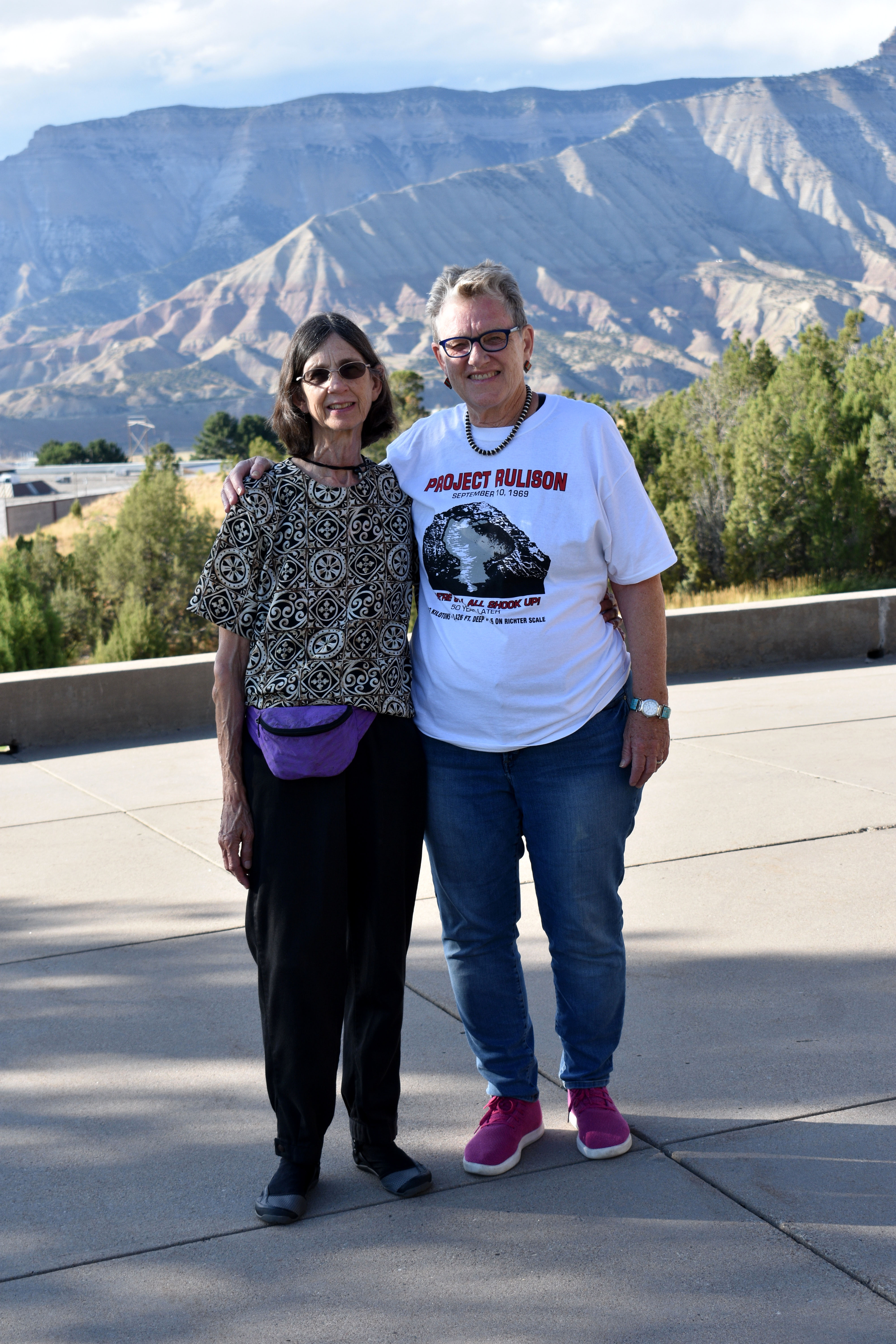
Nancy Fey and Melinda Dell Fitting (d. 2025) who protested both the Project Rulison and Project Rio Blanco underground nuclear blasts “fracking with nuclear weapons). They are back at Rulison in this photo to mark the 50th anniversary of the Project Rulison blast.

__________________________________________

Parker Yamasaki began her work covering arts and culture at The Colorado Sun as a Poynter-Koch Media and Journalism Fellow and Dow Jones News Fund intern. She has freelanced for the Chicago Reader, Newcity Chicago, and DARIA, among other publications,… 

How To Fight A Military Occupation Friction. Obstruction. Demoralization by Laura Jedeed

August 21, 2025

____________________________

How To Fight A Military Occupation: Friction. Obstruction. Demoralization.
Laura Jedeed Aug 14, 2025

(AMAugust will happen on Thursday, October 21, at 8:30 PM ET! I’m opening this one up to everyone: you are all invited to join me to talk about whatever horrible stuff is happening at the time. I’ll send links and stuff next week; you have a question, you can email me at laura dot jedeed at gmail dot com or ask anonymously here.)

On Monday morning, Trump federalized the DC police. He did so in the name of protecting our capital city from the violent teenage crime wave he made up and cleansing the city of homeless people who are, apparently, corrupting Our Children by overdosing on fentanyl in front of them. What fate awaits these homeless people remains unclear, but Trump’s recent “Ending Crime And Disorder on America’s Streets” executive order suggests the answer might be uglier than the usual cruelty of sweeps. Law enforcement can now involuntarily institutionalize “individuals with mental illness who pose risks to themselves or the public or are living on the streets and cannot care for themselves.” Who makes the mental health diagnosis? Unclear. What institutions will these people be sent to? “Appropriate facilities.” For how long? “Appropriate periods of time.” Careful readers will note that this executive order covers any mentally ill person who poses a risk to the public which, considering Trump’s definitions of mental illness and public risk, could mean damn near anyone.

Nothing like Trump’s occupation of DC has ever happened in this country before. Even when Trump sent the National Guard into LA two months ago, their orders were to quell protests and support ICE. These instructions, bad as they were, at least confined the danger of state violence to small areas of the city: people not at protests or an ICE kidnapping were largely safe from harm. That’s not the case in DC. There is no set building declared off-limits, no protest line to join or avoid as you see fit. The FBI, DEA and National Guard are conducting armed patrols throughout the city, which Trump says will continue into the foreseeable future. The DC charter allows the federal government to take control of the city’s police force for 30 days; Trump is already moving to obtain “long-term extensions” to that mandate. And if Congress doesn’t approve these extensions? “If it’s a national emergency, we can do it without Congress.” Read more…

More on the Putin-Trump Alaska Meeting: Classic Case of “Confidence Building Measures” that precede more serious negotiations. No more, no less

August 20, 2025

Putin and Trump: Since we’re neighbors (Siberia-Alaska) ,,, let’s be friends

________________________________

As previously mentioned , what happened in Alaska between the Russian and U.S. Presidents Putin and Trump was mostly symbolic, or if you will “psychological”, but sets the grounds for further meetings and possibly more serious negotiations. We’ll see if, despite fierce opposition to U.S.-Russian reconciliation by neo-cons, Zionists, and end of the world wacko Christians (the latter also have considerable clout in Washington) whether the negotiating processes can proceed.

Fewer barriers to proceeding seem to exist in Russia, considerably more here in the USA.

By the way, for all practical purposes, those who don’t realize it, the U.S.-NATO war against Russia in Ukraine is essentially over. Russia won. It has defeated a U.S.-NATO armed, trained and financed Ukrainian military that was little more than a proxy for its masters in Washington DC and Brussels. As in Vietnam, Afghanistan the United States has reached the “face-saving” phase: how to turn the defeat in the battlefield into a media “victory”.

Can Washington recoup its failures on the battlefield with some kind of diplomatic victory at the negotiating table? Lindsay Graham and his ilk will try and this approach is proceeding apace. Might not work as well as in the past … but we’ll see.

In the end – all that Trumpty-Dumpty was doing in his meeting with Putin was a classic example of pre-negotiations’ confidence building steps using Alaska as the turf for such improvements in bilateral relations. Such gestures are important and vital preliminary steps in ANY negotiating process. In fact they are common place and traditional for any major negotiation.

Confidence building measures entail showing both respect for a negotiating opponent and a willingness to listen to his/her side of the story, ie, to at least a bit put yourself in the other side’s shoes. And it is this good will, confidence building that the Europeans, the neo-cons and some misplaced elements of the left that have swallowed mainstream narratives on Ukraine with its pervasive Russophobia have also swallowed. Put more crudely Washington cannot engage in serious negotiations with Russia that begin by attacking Putin personally nor Russia as a nation.

______________________________

For a more detailed take on what confidence building measures were taken, click here