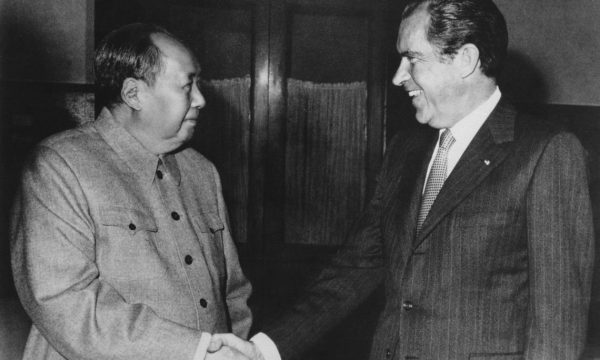
Chinese communist party leader Mao Tse-Tung, left, and U.S. President Richard Nixon shake hands as they meet, Feb. 21, 1972. If they could do it, why not Xi Jingping and Donald Trump?
I rarely read Foreign Affairs anymore, the flagship publication of the Council on Foreign Affairs, the informal intellectual-academic publication, source of soft power that for decades greatly influenced U.S. foreign policy. Teaching International Studies at the University of Denver’s Korbel School of International Studies for 23 years, it was something of a necessity. Over the years I found that, increasingly, I was learning little about the actual state of affairs in the world, that rather than intellectually leading on global cooperation – even within the context of U.S. hegemony – that it had essentially joined the neo-con fantasy of U.S efforts at world dominance through military power.
It had lost its way.
Then every once in a while… a flash of its former brilliance, a momentary sense of what its role in the world could be…in cooperation with other global players.
Such is the article below which I will provide at the end of this blog entry.
Of course the article, written by Kurt M. Campbell and Rush Doshi, flies in the face of what is currently going on. It calls for U.S.-China cooperation in contrast to the current growing nasty ideological and security boxing match. It calls for a complete change in course for both countries towards one another, as a precondition for the global effort to eradicate the Coronavirus. Despite its “idealism” – ie., it is difficult to to imagine China and the Trump Administration coming together to fight the Coronavirus – the article makes some salient points, most especially that neither country is in a position to undermine the influence of the other. Each has levers to hurt the other and has used them with increasing frequency, ideologically or otherwise. In such a contest where there can be no winners a truce is a rational response, not just for China and the U.S. but for the world at large.
That is what is argued here and well argued at that.
Here and there I not that the article misses the point. It dismisses the Chinese assertion that the cause of the virus came from U.S. military biological and chemical laboratories. While I am not completely on board that this was the case, the mainstream narrative – which Campbell and Doshi seem to swallow whole – that the virus originates from the sale of bat internal organs at a Wuhan food market has never cut it from where I am sitting.
But then the world will come back to the question of the virus’ origins; there is no way around that. It is possible that when all the evidence comes in – that one way or another the U.S. will be terribly embarrassed. But for the moment what needs to be done is to reverse the course of this pandemic worldwide, to stop it in its tracks. This can only be accomplished by global cooperation in which the Trump Administration and the Chinese leadership find some modicum of common ground to cooperate with one another in the effort. By the way, the strongest point made below concerns the consequences for U.S. world leadership if the Trump Administration continues on its merry way.
I’m not read to renew my sub to Foreign Affairs but a few more pieces like this and who knows?
Please read: Foreign Affairs: The Coronavirus Could Reshape Global Order
People On Our Side by Edgar Snow – a review
 (note – reprint, slighly revised and expanded that appears at “Goodreads”)
Fascinating read in all, although the part I will focus on is Snow’s period in the USSR, during and just after the Battle of Stalingrad (July 1942-February 1943) and his analysis of the consequences of that battle. Snow arrived in the USSR at the time of the great battle of Stalingrad, which along with the Battle of Moscow (late 1941, early 1942) marked the beginning of the end of the Nazi juggernaut. After Stalingrad, with few exceptions, the Nazis found themselves on the defensive and never again gained the initiative. However it appeared from the outside, the Soviet Union did not collapse and essentially single-handedly until June 6, 1944 dealt the Nazis blow after blow, pushing them out of their territory and in 1944 and 5 throwing further west back into Germany.
In 1941, Snow, by now well known – and in conservative circles, notorious for the book – was called into the office of Franklin Delano Roosevelt, who seemed to know that Snow was on his way to Europe and Asia to report on the war. I found it interesting that Roosevelt asked Snow to send him private reports on the state of affairs in Soviet Union (and later China). This was at a time when it appeared that the Soviet Union would collapse under the weight of the Nazi invasion, Operation Barbarossa. Thee is no mention in the book whether Roosevelt ever received Snow’s communications or read his news articles. This was at a time when it was difficult to impossible, even for the president of the United States to get accurate information on the state of affairs in the USSR and, specifically on the status of the war.
Snow was able to report both about life on the front – he was in Stalingrad already on February 4, two days after the Nazi surrender there, was among the foreign journalists who was able to verify the capture of German Field Marshall Friedrich von Paulus. His reports on the how the battle had proceeded – the pincer operation from north and south of the city, the failure of the Nazi general von Mannstein to break through to the Soviet encirclement and the final collapse of the Nazi war machine involved in the six month battle.
Attacked mercilessly in the U.S. media of the day as little more than a Communist stooge, his descriptions of the Stalingrad battle along with the overall socio-economic situation in the USSR at the time have, easily stood the test of time as some of the finest journalism of that period. After the battle he visited several collective farms as well as industrial parks that had been relocated to the east into the area of the Ural Mountains and Siberia. That reporting helped explain how the Soviets were able to “win the battle of war material production” as it is often described, again reporting that was later verified as deadly accurate. His description of some of the leading military figures, Chuikov in particular, also has endured.
While Snow would go on in “People on our Side” to visit China – and that part of the book is also worth reading, I was particularly interested in the six months he spent in the USSR. At the time there was a heated discussion within the Roosevelt Administration as to whether the Soviet Union would collapse and just how much Washington should provide material support, and more importantly, open a second front against Hitler from the West. As long as it appeared that the USSR was losing the Americans – and already their junior partners the British were weary of offering too much support. Indeed there is a famous comment by Churchill of letting the Nazis and Soviets mutually destroy each other, – nice way to treat an ally.
But after Stalingrad – and months later the biggest tank battle in history – at what is called “The Kursk Salient” there was no doubt that Stalin had turned the situation around and was now on the offensive. As a result, aid poured in (a good deal of it – US aid – from Iran) and although it took another year, in June 1944 the second front was opened by the Normandy invasion – the beginning of the end for Hitler and Germany’s vile experiment of Nazism.
How much did Snow’s analyses play in convincing the Allies to get off their butts and get serious about opening a second front? We’ll never know but at the same time Snow was writing from the USSR, Roosevelt sent another private emissary to Moscow, his friend Wendell Wilkie (whom he defeated for the presidency in 1940)to assess the situation as his personal representative. Interesting that Roosevelt had more faith in the take of his Republican opponent for the presidency and a Marxist journalist than the analyses of his own foreign service, both State Department and Department of Defense.
Wilkie arrived in Moscow in the summer of 1942 as the Battle of Stalingrad was heating up, a few months prior to Snow. Wilkie actually met with Stalin; my knowledge Snow didn’t. Wilkie not only reported back directly to Roosevelt that the USSR would withstand the Nazi onslaught, but he did report back to Roosevelt directly with essentially the same message as Snow’s reporting – that USSR would not collapse. In October, 1942 Wilkie gave his “Report to the People” on his journey, a radio program listened to by 38 million people. Engaging Wilkie as he did was yet another example of Roosevelt’s political cunning, getting his Republican opponent on board – and with him the Republican Party with its isolationist, anti-war involvement stance – behind Roosevelt’s war plans.
Wendell Wilkie and Edgar Snow.
Snow does not mention Vasily Grossman, the Soviet journalist later turned dissident but Grossman mentions having met Snow – and traveling with Snow for several days in the aftermath of the February 2, 1943 Nazi surrender at Stalingrad. Snow does mention, repeatedly, his close friend and associate “Alex Werth” (Alexander Werth) who would go on the write one of the definitive volumes on World War II, “Russia At War” – another one “The Year of Stalingrad.” Snow and Werth interviewed the same people, and had essentially the same take on what was transpiring in the USSR at the time, today, regardless of political orientation, taken as accurate and some of the best reporting on the war by American journalists, but in its day, suspect.
Like Red Star Over China, Snow’s reporting in People on Our Side is a major journalist achievement that some 78 years later has met the test of time.
Trump Axes the Peace Corps

Me, in Tunis, Tunisia. February, 1967 in the Peace Corps. On Ave de la Liberte across the street from the Monoprix. I still have the same blanket, a gift from my mother. My father had gifted to her on a trip to Canada before they married in 1942 or so the story goes.. It sits on my bed today in Denver.
Peace Corps isn’t just bringing home 7,300 volunteers, because of the Coronavirus. It’s firing them.
Year of the Plague – 3 – Reflections on Albert Camus’ “The Plague” and “the New Normal”.
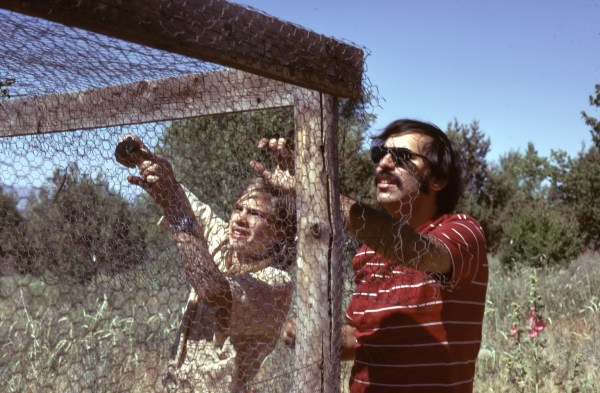
Summer, 1973 (I think). David Fey constructing a chicken coop on Stucker Mesa in Paonia Colorado. I’m there, appearing to be help, but mostly amazed with the proficiency with which David, then all of twelve year’s age, could build such a solid, well constructed structure.
Again, what follows are simply musings., food for thought.
The story of The Plague is simple enough – a plague, seemingly bubonic plague breaks out in a non-descript seemingly North African City. No one knows 1. from whence it developed 2. how to fight it although without understanding it, the medical community tries to anyway 3. why it finally disappeared and what it is that humanity did or didn’t do to neutralize it. How to survive emotionally – to say nothing of physically in such an environment.
Yesterday it was warm and balmy, nearly 70 if I recall correctly here on the Front Range of the Rockies Today the snow is falling in Denver, lightly, but without stop for several hours now, big wet snowflakes for the moment mixed with rain. The forecast is for it to continue for through sometime tomorrow (Friday, March 20). One has to adjust to these extreme changes in temperature, rather common place here in Colorado and to Nature itself. So no walks in the neighborhood today. Besides, I chain-sawed too much wood yesterday morning in the back yard and woke up with my lower back “reminding me” once again that I am not 45 anymore but 75… Oh well. Outside – the pandemic grows everywhere and with it anxiety and fear, uncertainty of what might happen has become pervasive among the folks with whom we are acquainted.
And we’re only four, five days into this mess. but already it seems that each day there is yet another shift in what my recently deceased friend, Joe Grindon, keep referring to as “the new normal.” Joe was brought down by emphysema, the last two years of which were not pretty to watch. He reached a point where he couldn’t drive, then he couldn’t walk around the block, shortly after it took all of his effort to get out in front of his house and in the last month could only with the greatest of efforts make it from the couch to the bathroom. The “new normal” keep shifting, his world shrinking but he tried to adjust and pretty well did, till the end.
Yesterday, visiting Nancy’s brother, David Fey, at his home – maintaining the recommended six foot separation – our discussions vacillated far and wide – personal concerns, the state of the Trump Administration’s delayed response, future dangers (food supply chains, possible break down of the country’s social fabric – the same things being discussed – minus those idiots sunbathing on the Florida beaches with their governor’s approval – the world over).
Mostly the three of us were trying to figure out how to deal with “the new normal” that the Coronavirus demands seemingly each day. It will take some technical – ie, medical skills, but also emotional and although I rarely use the words – spiritual – skills as well. Some of us have more of one kind than the other – so we all have to chip in, in a collective effort, and offer our particular strength to “the common good.” Read more…

The Green Frog in Rocky Mountain Park. Northwest Denver
These are musings, nothing more.
1.
Today on our daily walk we went by the local Safeway just to see how busy it is. There were several dozen cars in the parking lot, people coming and going, one wearing a face mask. Then a round-about walk to Rocky Mountain Park. A lot of youngish joggers, all giving us a lot of space, people gingerly waving or acknowledging one another …from a distance.
I had a strong desire to visit the green frog there; then up Hooker St. past the split level house on the corner of 45th and Hooker, where the man who built it forty or so years ago – claimed to have been in a Special Forces unit that killed Che Guevara in Bolivia. Never could verify that but he was a nasty, right-wing fellow, even back in those days.. Remember how pleased he was in telling the tale. Son-of-a-bitch. His wife developed cancer and he unceremoniously dumped her, leaving her to die alone. He’s long gone from the place.
Can’t go by the place without cursing him and his fate.
But then there are more pleasant memories. The green frog.
Actually with its recent paint job it looks better than I do. It’s been there a good half century, maybe more. an anchor of neighborhood stability in a sea of contractor-developer cancerous change. Both our daughters played on it, climbed on its back, stayed on top, explored its cement body in great detail.
I cannot go to the park without giving it a nostalgic glance, happy to see, although most of the playground equipment has been modernized and changed, that the green frog remains – just as green, just as much of a challenge for a 3, 4 year old to climb, just as enticing. Read more…
Year of the Plague -1- A Walk in the Neighborhood

Trudene – in front of her run-down rented apartment on Zuni and 39th in Denver. Although no longer Zuni from 38 to 44 Ave used to be very much of commercial street, the house that Trudene lives is a former sausage factory.
Trudene
She was putting out recycling in front of her rented apartment – the front end of a three unit building right on Zuni street. In a neighborhood where virtually everything is being “yuppified” and developed with contractors buying up any and all pieces of property, the place stood out. It was what I would call “tasteful ramshackle.”
As we walked by, Nancy and I, a little chihuahua behind a fence began to do what chihuahua’s do – bark “enthusiasticly”. But I noticed that, uncharacteristically it was also wagging its tail furiously, kind of torn between deciding whether it wanted to rip into my calf… or simply be petted.
“Ah he doesn’t even know how to bite – all he wants is to be petted.”
Thus spoke Trudene, who was, as the photo suggests was in the process of trying to put an old chair in her recycling bin. It didn’t quite fit. Maintaining our required distance of six feet from each other (more like ten), a conversation ensued. Trudene related how she was not stressed, that she was at peace with the world and she had her Bible that she could depend upon. She had gone shopping at a nearby “Dollar Store” – we have many of them in Denver – and was upset, that in the current pandemic that a young family had brought their two infant kids into the store. “Why didn’t they do the prudent thing and simply keep them in the car?”
Trudene is thinking cautiously about how to proceed as the virus spreads, both globally and here in Denver. We talked about how yesterday, with the city’s burgeoning young population, how the restaurants and bars were filled with people who – pandemic or not – were not going to miss their St. Patrick’s Day celebrating. It was all “business as usual” – or was it because, the city’s youth know that the virus effects them less than us more elderly folk and they simply don’t give a shit? But the photos of the downtown drunks and party goers were a bit too much. Interestingly enough, as noted below, the next day, today, Denver’s mayor closed all restaurants and bars for on-sight consumption. Read more…
Turkey’s Failed Gamble in Syria

They Syrian Army liberating regions west of Aleppo and in Idlib Province
Syria-A Turkish Dilemma
Dispatches From The Edge
March 6, 2020
Turkish President Recep Tayyip Erdogan’s latest gamble in Syria’s civil war appears to have come up snake eyes. Instead of halting the Damascus government’s siege of the last rebel held province, Idlib, Turkey has backed off, and Ankara’s Syrian adventure is fueling growing domestic resistance to the powerful autocrat.
The crisis began on Feb. 25, when anti-government rebels, openly backed by Turkish troops, artillery, and armor, attacked the Syrian Army at the strategic town of Saraqeb, the junction of Highways 4 and 5 linking Aleppo to Damascus and the Mediterranean. The same day Russian warplanes in Southern Idlib were fired upon by MANPADS (man portable air-defense systems), anti-aircraft weapons from Turkish military outposts. The Russian air base at Khmeimim was also attacked by MANPADS and armed Turkish drones.
What happened next is still murky. According to Ankara, a column of…
View original post 1,145 more words
Ode To Joe Biden (from a Sanders’ Supporter)
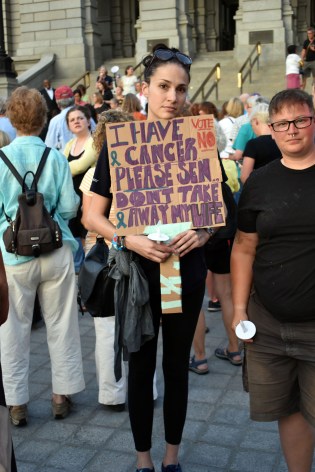
Healthcare for All could help her; Bernie Sanders an ardent supporter; Joe Biden probably doesn’t even know what it means
Trying to figure out what’s the deal with Biden – of course the part that is clear from the Clinton et. al. – anyone but Bernie. But Biden? Plenty of stuff coming out about his piss-poor history – his racism, his caving to Reagan-Trumpites, his war mongering re Iraq, his “disposition for appeasing the right,” etc. Don’t need to go through that. Friends on social media have exposed him for his awful politics.
It’s an issue thing… In the end, their rhetoric aside – the Clintons oppose Healthcare for all, forgiving student debt, any serious lid on natural gas fracking, strong anti-racist legislation, affirmative action, free public higher education and any attempt to cut the military budget for infrastructural improvements or social programs, the issues Bernie stands for. All of these programs are considered “impractical” – except they are all doable and eminently practical.
It looks to me that moderate Dems – Clinton et. al – tried everything to see what would fly and now they’ve settled on mediocrity and increasing senility – Joe Biden
Of course I couldn’t prove it…by my sense is they’ve tried a series of trial balloons to counter Sanders including:
Buttigieg (who tried hard to sound like Obama), Klobuchar, Beto O’Rouke – none of whom worked. I am convinced that Mike Bloomberg’s trying his hat – and half a billion dollars – into the ring was another trial balloon from another angle, but in the end the Democratic National Committee (D.N.C.) settled on Biden. Between then all they have some delegates to deny Bernie S. a first ballot nomination at the Democratic Convention.
What sad – no, pathetic – choice. I am among those who argue that Donald Trump will make mince meat out Joe Biden and very possibly Trump’s victory in 2020 will rival Ronald Reagan’s in 1984. Indeed Walter Mondale was a much stronger candidate than Biden could ever be. Joe Biden is such a weak candidate, and the whole world – including the D.N.C. – knows it.
The burning question, in the unlikely prospect there would be a Biden presidency is – who will run the show behind the scenes? The oil and gas industry as it was under “W”, the military industries as it was under Ronnie “Jelly Bean” Reagan, or Goldman Sachs (as it was under Obama) or some combination there of.
From this I draw two conclusions..
– That the D.N.C. and the forces behind it (big business, the military industrial complex, the pharmaceutical industry, health insurance, high finance) knowing what a weak choice Biden is, still, when all is said and done prefer a Donald Trump victory to a Bernie Sanders’ presidency. Again it speaks to the venality of the “mainstream Democratic Party leadership
– That should accidentally – and it would be that – Biden becomes the next president – he will preside in the same fashion as two other intellectual lowlifes who won the position in the past – Ronald Reagan and George W. Bush. In fact, Biden is little more than the Democratic Party’s version of Reagan – hardly a brain in his head, inarticulate and despite his years of experience – pretty much of a dolt.
– Reagan main skill, besides eating jelly beans, was little more than reading other people’s scripts; as for “W”, his mind addled by years of cocaine addiction, I have read somewhere that he’s pretty good with a chain saw.
These personal limitations reveal how the Reagan and Bush presidencies actually worked. Reagan’s was run by Casper Weinberger, James Watt, Ed Meese and Alexander Haig; in “W”‘s presidential team, Vice President Dick Cheney had a dominant role along with the likes of Donald Rumsfeld. The last few years of Ronald Reagan’s administration it was later admitted that “Ronnie” was already suffering from Alzheimers. But frankly he wasn’t much more alert the first years either. As for “W” he was good at photo

Earth Day. March for Science. Denver, Colorado. April 22, 2017
ops, but then got caught reading a children’s book upside down.
Biden is cut out of the same mold. He fits the bill for the lyrics of a John Forster song:
Way down deep, you’re shallow, superficial to the core!
Beneath your surface, there’s just more surface, and beneath that, nothing more.
The burning question, in the unlikely prospect there would be a Biden presidency is – who will run the show behind the scenes? The oil and gas industry as it was under “W”, the military industries as it was under Ronnie “Jelly Bean” Reagan, or Goldman Sachs (as it was under Obama) or some combination there of.
Cause he’s just a mouthpiece or front for others.
It’s not to late; Bernie Sanders is still very much in the running.
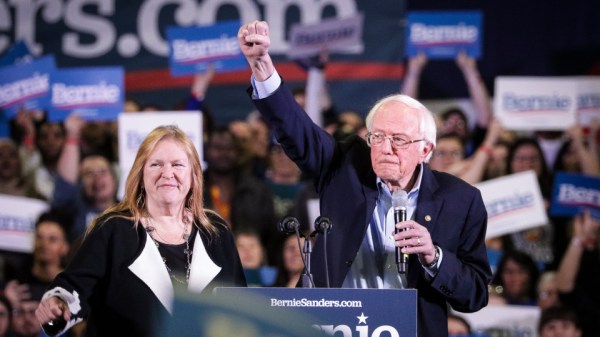
DENVER, CO – FEBRUARY 16: Democratic presidential candidate Sen. Bernie Sanders (I-VT) and his wife Mary Jane O’Meara Sanders acknowledge the crowd and support before Sanders spoke to his supporters at a rally in the Colorado Convention Center on February 16, 2020 in Denver, Colorado. (Photo by Marc Piscotty/Getty Images)
(slightly edited “the morning after” – one short paragraph)
Don’t kvetch, Organize! (…or OK you can kvetch, but then try to get over it and organize)…
So…OK. The race has tightened. Doesn’t bother me. I like a good fight and it appears we’re in for one. Bernie did not appear discouraged… neither am I about his campaign.
A Brisk March 1 in Denver
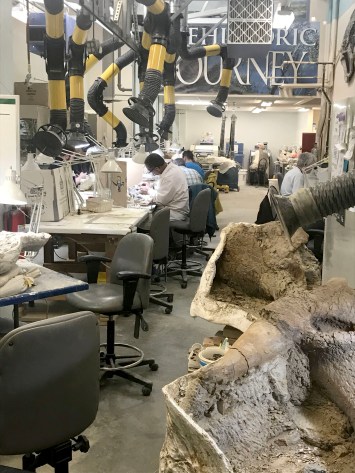
Fossil lab at the Denver Museum of Nature and Science; Volunteers are working on a triceratops fossil
A brisk morning with temperature in the 30s and a forecast for snow later in the day.
We decided to get out and head to the Museum of Nature and Science as early as we could to avoid the crowds and we made it by 10 am. Didn’t matter. We didn’t avoid the crowds; the parking lot was full and we had to park outside, in City Park, still a short walk from the museum. And the museum itself was packed. We asked when the museum might not be so mobbed with people. Wednesdays after 1 pm we were told…or in October.
Together Nancy and I decided to look at an exhibit with which we were unfamiliar – we decided on insects, me in part because a friend of mine in Kansas has taken a great interest in spiders. But other than appreciating the difference between moths and butterflies – and their considerable diversity here in Colorado – yet another example of Darwin’s natural selection at work – I have to admit that my interest was not piqued other than in a general way. Part of the problem was absorbing, once again, the great detail involved in learning about yet a family of living things. More interested in the general patterns. My ability to absorb too many details has become quite limited Read more…
They Syrian Army liberating regions west of Aleppo and in Idlib Province
______________________________________
Postscript on March 1.. Turkish military confrontation, its defense of al Qaeda elements in Idlib has intensified over the past 48 hours. In the end, it only results in Turkey digging the hole it is in, in Idlib Province, Syria, that much deeper. I’m not much on predictions but… Turkey will lose big time in Syria. It is on the wrong side, its goals are predatory, its rhetoric increasingly shrill, its actions unconscionable and its overall political approach completely cynical and reactionary.
______________________________________
“My country is fighting terrorism on its soil. Idlib is Syrian land, not Turkish territory, nor a piece of land belonging to NATO. Idlib is not located in Belgium, Estonia, France, Germany, or California but in Syria. My country is fighting terrorism on its soil and not on any other nation’s territory. It is determined to confront, by all legitimate means, Turkish aggression in support of terrorism, to protect its people, to defend Syria’s land and people, and to adhere to its sovereignty and its independent national decision.”
– Bashar Jaafari. Permanent Representative of Syria to the United Nations –
– China’s U.N. Ambassador Zhang Jun speaking at the U.N. Security Council – February 28, 2020
______________________________________
Time for Tayyip Erdogan and Turkey to eat crow over its Syria policy. The burning question is are they willing to do so, to cut their losses, leave Syria, give up any neo-Ottoman goal of annexing Idlib Province, address the refugee problem that it has done so much to create in the first place and realize the Washington based project to partition Syria has collapsed. It has no future.
Can Turkey do it? Sure it can! Will it do it? Hmmm, at the moment the odds are against. But then there are always choices: dig the hole it is in deeper, or face reality and find ways to climb out of it. Turkey is a wonderful country in spite of its current leadership…Stay tuned.
Turkey is in a quandary of its own making in Syria. It’s objectives are obvious to anyone willing to look honestly at the situation: the Erdogan government not just hoped – but intended – to use the current crisis in Syria’s northwest Idlib Province as a pre-text to annex the province at first de facto, later, almost certainly, de jure.
As a foreign policy expert and former colleague (naturally extremely shy he prefers to remain anonymous) aptly put it:
Let’s face it: this is a crisis purely of Erdogan’s making. He broke off talks and then went to war against the Kurds to win an election a few years back; then became a sponsor of the anti- Assad Syrians and foreign mercenary elements, creating a refugee crisis inside Turkey and on the Syrian border. He now has an economic crisis on his hands and, to try to deflect domestic public opinion, becomes an adventurer abroad to recreate the Ottoman Empire. Plus he’s a cruel autocrat. On the other hand he’s a counter to the Saudis which pleases Washington.
by a Guest Blogger.

Asma and Bashar al Assad in 2012…
_____________________________________________________
Last night during our KGNU – Hemispheres – Middle East Dialogues (February 25, 2020) a caller made disparaging remarks about Syrian President Bashar al Assad, referring to him as “the dictator Assad” and to his government as “his criminal murderous regime.” Mainstream narrative par excellence – whether he was listening to Fox News or CNN – taking his cues from the Obama or Trump Administrations.
In fact the portrayal of Assad in this manner – along with the calls that he resign in order that peace be achieved – as an essential part of what might be considered “the mainstream narrative – the pretext for the U.S. led and organized proxy war to bring down the Assad government.
Many Americans have taken such a description of Assad as accurate, referred to the Syrian government as “a regime”etc.
In response both to the program itself and to the caller’s description of “the dictator Assad” and “his criminal murderous regime” an informed friend living in the Mid West wrote a lengthy response. Her thoughts focused around two themes – first on Assad himself – a portrait far different, almost diametrically opposed to the caller’s common-enough harsh description. Just for that, this commentary is worth publishing. But also, she goes on to describe how Syria was not prepared for the kind of proxy-mercenary war – 4th generation hybrid warfare as it is called – that it found itself engaged in from 2011 onward, also accurate.
Keep in mind that before the U.S. goes to war – whether directly as in the case of Iraq in 2003, through NATO in Libya in 2012 or in Syria using regional proxies giving it the cover of “plausible deniability” of responsibility – regardless – Washington vilifies the leaders of the countries involved – be it Saddam Hussein, Muammar Khadaffi or Bashar al Assad.
The “Hitler analogy” is dragged out to soften public opinion for American war-making. No doubt, had Washington had its way, Bashar al Assad would have met the same fate as Saddam Hussein and Khadaffi.
You’d think the U.S. public would be on to this cynical tactic by now, but no, seems to work like a charm every time
Here is an entirely different view of Assad – one much more honest and closer to the truth about the man. When it comes to Syria, the American public must keep in mind the degree to which the truth has been turned into pulp fiction, starting with the description of the country’s president.
Finding these remarks well written and well thought out – I am publishing them as “a guest blog entry.”
_____________________________________________________
Very informative, authoritative, and educational (the KGNU Middle East Dialogues segment).
It really is one of those eras where your task is educating one mind at a time. I realized that after listening to the first caller, who perfectly parroted the “Washington Consensus” propaganda about the ‘evil, brutal Syria dictator, bla, bla, bla.’ At first I thought the caller was doing a parody, but towards the end of his call, I changed my mind – he was serious!
President al-Assad, who is indeed a great leader and very much a man of the people, has, because of his steadfastness and commitment to his people, acquired great charisma, prestige, and hard-earned respect among his own citizens and in the Arab and Muslim world for standing up to the US, himself has said in many interviews with foreign press and international visits that his power depends on the people of Syria and the Syrian Arab Army (SAA). He has bluntly said that if the people and the Army didn’t want him as president, he would have left, or been ousted long ago. Read more…
Killing Qassem Suleimani – Seven Weeks After The Assassination: Intended Consequences Backfiring. Taped Interview
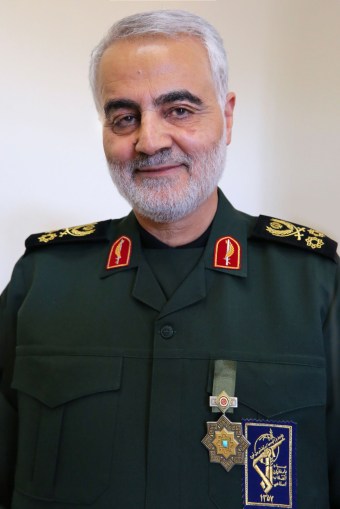
Qassem Suleimani
KGNU – Hemispheres – Middle East Dialogues with Ibrahim Kazerooni and Rob Prince, hosted by Jim Nelson.
To listen to the interview. It begins 2 minutes and 25 seconds into the taping.
It is now some seven weeks since Iranian General Qassem Suleimani, Iraqi government official Abu Mahdi al-Muhandis and their entourage were assassinated leaving the Baghdad Airport by missile fired by US killer drone on the early morning hours of January 3, 2020, an assassination authorized by U.S. President Donald Trump seven months prior to the murder.
What was the thinking of the Trump Administration this flagrant murder? Its political goal?
The main idea was that by killing a leader of the movement “decapitating the leadership” in the language of politics would through the coalition – the movement being the Axis of Resistance – into chaos. Without its “leader” the coalition – Iran, Iraq (parts of it), Syria, Hezbollah in Lebanon, the Yemenis, and Hamas among the Palestinians – would collapse.
It is essentially the logic that led to the assassination of Martin Luther King Jr. and Malcolm X here in the United States a half century or more ago.
It worked (up to a point) in the case of King and Malcolm X. However times of changed and the Middle East is very different region with a whole different history and set of relations.
Now, some seven weeks after the Suleimani assassination we want to address the question: Has the “Axis of Resistance” been weakened by this event, and what has it achieved since then?
Let’s start with what has transpired in Iraq since…
(transcribed text will follow in a few days)
Bernie Sanders, Barack Obama – Similarities, Differences and the Mounting Media Hysteria Around the Sanders Campaign – a Few More Thoughts.

Medicare for all – at the heart of the Sanders’ campaign
Wrote yesterday about my thoughts on the Bernie Sanders primary victory in Nevada, which was a kind of “watershed moment” in the Democratic primary campaign. Several other thoughts/insights have come to mind since that I want to share with blog readers. And will continue to do so time permitting and if/when I get this or that epiphany…
Today two points to consider – only the first of which I’ll get to… will deal with Sanders and foreign policy in a later blog entry
1. What is all this hysteria about the Sanders campaign about?
2. Sanders and foreign policy (which he tends to avoid)
Not meant to be long detailed torturous readings…just some ideas to throw out for friends to consider.
After Bernie Sanders resounding victory in the Nevada Democratic Primaries it is now impossible for the mainstream media to ignore his campaign as they did for the most part up until now.
Last night with family I watched the CBS “60 Minutes” Anderson Cooper interview with Bernie Sanders. Found Anderson Cooper basically the snotty turd I always thought him to be, asking the usual mainstream stupid questions that have become typical of the attacks on Bernie – your programs will cost too much, you are in an ineffective legislator, single payer (or whatever you want to call it) is too expensive and unmanageable, you’re dividing the Democratic Party, etc, etc, etc. etc. etc.)
CNN – CBS’s soulmate called Sanders’ interview “a disaster.” Nonsense. Sanders was excellent
Sanders responsive were spot on, short to the point deconstructing literally every nasty point that Anderson – and behind him – CBS – was trying to make. Bernie was mostly relaxed, succinct, quick on his feet and cut Anderson off at every ugly political pass he was trying to climb. He’s really quite good at this mainstream media game.
Others have pinpointed the source of the media hysteria and that among “moderate” Dems concerning the Sanders reach for the Democratic presidential nomination. Don’t need to go on about it other than to mention – many of those so-called “moderates” should be called for what they are – not so much moderate as “corporate” Dems, “finance industry” Dems, etc – those who circle around the Clintons and the stranglehold that the Democratic Leadership Conference with its Cold War foreign policy – even though the Cold war is now 25 years behind us – and buy into cutting social programs to feed the military.
Classic example of the anti-Sanders fear mongering appeared in the Sunday (February 16, 2020) edition of the Denver Post. Adding to the anti-communist hysteria rather than challenging it Doug Friednash, a partner with Brownstein, Hyatt, Farber and Scheck and former chief of staff for Governor John Hickenlooper wrote in an op-ed
“Republicans are salivating over a Sanders nomination. Trump has already begun calling Sanders a communist, a the part will certainly label key Democratic Senate candidates across the country as socialists too!”
Ah if only it were true (that Dem candidates were socialists and communists)! Alas, hardly.
Rather than defending Sanders against slander, ineffective as it is since the end of the Cold War, Friednash, shamefully I would note, pours it on. He also suggests that it is the “Sanders team” that will “burn down” the (Democratic) party. More scare tactics. But then, no real surprise, is it? After-all the law firm in which he is a partner has a long history of shilling for energy companies, getting contractor-criminals off the hook (legally, but still) and playing a dominant role in the politics of Colorado.
Actually there has been far more acid thrown at Bernie Sanders from the Clinton Dems like Friednash – who are at the moment ratcheting up their attacks – than from Trump and the Republicans. Trumpty-Dumpty has done an occasional anti-Bernie Tweet but he’s been mostly restrained as compared with the Clintons and their ilk. Adding to the usual – ie, a grassroots Democratic insurgency against an out-dated and increasingly conservative leadership – I would like to add the following.
Up until the Nevada primary the Clinton-“moderate” Democratic attack against Sanders was to try to stop his campaign. It included a menu of “moderate” (meaning funded by big $ Dems) from Joe Biden to Elizabeth Warren, Pete Buttigieg, Amy Klobuchar, playing down Sanders’ mainstream media time while playing up that of his competitors, adding that skunk billionaire Bloomberg (pardon the language but it’s accurate) to the list, short-changing Bernie on the debates, turning Warren against him, etc, etc. etc. Really dirty shit from day one to the Nevada primary.
My sense is that while the attacks continue, the goal has changed.
More and more – grudgingly the powers that be are coming to conclude that Sanders very well might win the nomination. There is some kind of debate going on among the power elite as to how to handle it.
Option one: on the one hand there is the Bloomberg scenario – prevent Sanders’ from winning the Democratic nomination on the first round at the convention, throw the process into a brokered convention which can then purge the great social democrat from Brooklyn’s nomination. Thus the fucking skunk Bloomberg’s effort toss around hundreds of millions of dollars (last I read it was $350 million – maybe it’s more by now) to cut into Sanders’ delegate count.
Option two: Pepe Escobar – Brazilian columnist par excellence – even though I occasionally disagree with him – recently let us in on this. His contacts in NY “high finance” – whomever they are – I couldn’t really care – have “made their peace” with a Sanders’ candidacy. As Escobar puts it – they would rather see a Social Dem like Sanders than another four years of Trump. The left wing of high finance? Mebbe. In the end these folk don’t see Sanders as particularly dangerous or radical to finance capital.
Of course they have a point. There are limits to Sanders’ “radicalism.”
What is this faction up to?
They are negotiating with Sanders so to speak. Unable to stop his campaign, now the effort concentrated around attacking Sanders’ program and whittling down its progressive essence to the kind of pablum Obama gave us. Not necessarily directly although it is possible that is going on too, but certainly through the media (and other ways). They are looking for concessions from the Sanders’ camp on his main issues. Is he willing to “give ground” on his federally funded free medical care for all Americans? He is speaking of cancelling student debt? OK and how much? Will he – like Obama did – essentially dissolve or ignore his grassroots organization once in office.
Is he willing to follow Barack Obama’s example and essentially gut his administration of progressive voices in his cabinet appointments, closest advisers and turn the running of the country over to the whores of capital – Larry Summers, Hillary Clinton and the like – while being “permitted” from time to time – to make a vaguely progressive but meaningless speak as he did in Cairo – and take photo ops with his lovely (and they do look lovely) family.
How much of his program is Bernie Sanders willing to compromise – if any of it – to neutralize at least a part of the moderate Dem – corporate-high finance opposition?
Of course “in the real world” – which isn’t all that real filled as Congress is with more lobbyists than legislators, Bernie Sanders, should he be elected president of this country will have to “adjust”, and frankly to make certain compromises. Look at the Senate he’d inherit with a House of Representatives really not that much better.
To my mind the challenge for the Sanders’ base: how to prevent Bernie from being “Obama-ized”..
Without a highly organized mass base – the kind that he is building nationwide, the kind that in 1988 Jesse Jackson started to build before he too was cut off at the knees – Bernie Sanders’ programs will go nowhere. In fact, to get anything done –from now to when he is elected President – he’ll be more dependent upon his multi-cultural, multi-racial solidly working class base than he has been up and until now. We’re going to have to fight like hell to get him the nomination, win the presidency and then fight even more actively to get his programs – almost all of which are needed – implemented.
So let’s do it.

Syrian army liberating swaths of Idlib Province in northwest Syria in late January, 2020
“The Assassination of Qassem Suleimani – Consequences – The U.S. Shoots Itself In the Foot in the Middle East…Again” – continued – with Ibrahim Kazerooni and Rob Prince. KGNU 1390 AM, 88.5 FM – Hemispheres, Middle East Dialogues. Tuesday, February 25, 2019. 6 pm Mountain Time. Hosted by Jim Nelson.
We’ll discuss the latest developments in the Middle East, trying as usual to deconstruct the mainstream government and media narrative and explain – or try to – what is actually going on. Building on our last program in late January we continue discussing the regional consequences of the murder-by-drone of Iranian Quds leader, Qassem Suleimani.
It is now some seven weeks since Iranian General Qassem Suleimani, Iraqi government official Abu Mahdi al-Muhandis and their entourage were assassinated leaving the Baghdad Airport by missile fired by US killer drone on the early morning hours of January 3, 2020, an assassination authorized by U.S. President Donald Trump seven months prior to the murder.
What was the thinking of the Trump Administration for the targeted assassination of Qassem Suleimani? What did Washington hope to accomplish by this?
The main idea was that by killing a leader of the movement – the movement being the Axis of Resistance – that the movement left leaderless would collapse – or go into crisis thus strengthening the position of the U.S., Israel, the Saudis in the region. The Axis of Resistance is that web that of nations and social movements that brings together Iran, Iraq, Syria, Hezbollah and the Houthis of Yemen into coalition.
It is essentially the same logic that led to the assassination of Martin Luther King Jr. and Malcolm X here in the United States a half century or more ago.
In the case of King and Malcolm X these assassinations did hurt the movements they led. However times have changed and the Middle East is very different region with a whole different history and set of relations than the United States in the 1960s
Now, some seven weeks after the Suleimani assassination we want to address the question: Has the “Axis of Resistance” been weakened by this event, and what has it achieved since then?
Let’s start with what has transpired in Iraq since…
This and much more
 View from the Left Bank: Rob Prince's Blog