Allison Huguenin

December, 1987. Allison Huguenin holding Pixie. Abbie looking on next to Pierre, Molly standing by Alison. The picture is taken in our apartment in Kaivoksela, Finland just north of Helsinki.
“Allison left us on Friday morning. We lived with the knowledge that her illness was terminal from the beginning of June.”
So began an email from long-time friend and former companero – Pierre Huguenin announcing Alison’s death from cancer. Allison and Pierre were good friends, she English, he French. We worked together in Finland at the World Peace Council for five years, socialized a fair amount, went mushrooming together, Pierre and I doing what we could to counter the powers that be. Some years later, Nancy and I stayed at their Paris apartment together, I believe in 2008 at which time we spoke to Alison by phone. They had talked of visiting us sometime in Colorado, but it never happened…although we would have very much loved to have hosted them, an invite still open to Pierre.
Allison was a simultaneous English-French, French-English interpreter and translator. Try it some time. Even if you are bi-lingual, it takes considerable skill. She was a real pro. Of course, she used to regularly love to attack my “American English” (“not the real thing you know”) and replace it with British spelling and grammar. I would then rewrite her edited versions back into “American English.” Alison wrote us every Christmas. I was (far) less disciplined in responding., but it didn’t matter as we had shared a rather fascinating moment in history together in a wonderful place, Finland…the kind of ties that bind.
Rest In Peace…
Cardin and Bennet: AIPAC’s Cat’s Paws: Bennet’s Iran Duplicity
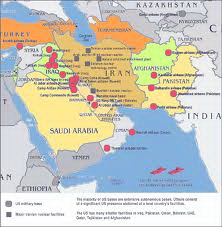
The red dots are U.S. military bases surrounding Iran. The map suggests that it is not Israel that faces “an existential threat” (wonderful, yet meaningless term) from Iran, but Iran that faces a serious military stranglehold from the USA.
________________________
(Note: also posted at Foreign Policy In Focus)
_________________________
“What fools we are.”
(Quote from an old friend concerning the machinations described below)
The more one actually studies what Senator Michael Bennet has done concerning the international agreement concluded between the five permanent members of the U.N. Security Council plus Germany (the P5+1) and Iran, the more it seems, like with the basketball move that he faked left while moving right. Classic Bennet, I might add. At the time when his vote no longer was critical to the outcome, Colorado’s U.S. Senator Michael Bennet finally came out and endorsed the nuclear agreement with Iran. By all indications, he is determined to find a way to deep-six the agreement, days prior, Bennet endorsed.
True enough, Bennet threw his hat into the ring, committing to support the Obama Administration on the agreement. But virtually simultaneously, Bennet has agreed to co-sponsor “accompanying legislation,” referred to by some as “AIPAC’s Plan B” to undermine it. Concerned about what might be a tough re-election campaign, he is trying to satisfy both supporters and opponents, and as a result, could end up satisfying neither.
It should come as no great surprise, that having failed to kill it one way, that the agreement’s opponents would try yet another.It is, in the end, little more than an attempt to slightly improve U.S.-Iranian relations, a move away from 36 years of non-stop efforts to overthrow the government of the Islamic Republic and replace it with something more subservient to U.S. strategic and regional interests. Having failed in that multi-decade effort, more sober heads – including the President’s – have concluded it is time to recognize the fact that regime change by military means is not an option, thus time to negotiate! Even though this shift in approach, in the end is quite modest in scope, it sits poorly with anyone that might lose a bit of influence as a result – ie, Israel, Saudi Arabi and the assortment of American war-mongering mushugginahs who still want the mullahs heads on platters. And so in an effort to keep the U.S. on a warpath with Iran, they – be they Netanyahu, neo-cons, AIPAC or Tea Party types have gone on their own political warpath. As a result, it turns out that the agreement is still in big trouble in Congress, through another route: a back-door plan to kill the agreement. Read more…
Gary Hart Comes Out Clearly For Agreement With Iran; He Hints Michael Bennet Will Too..

Danielle Glover (left) and Captain Crowe (right) of the Truman Project , with Gary Hart in the center in the John Denver Room at the Colorado State Capitol.
Note:
I ran into Gary Hart in the halls of the State Legislature. It turns out we were both trying to locate the room where he was to give a press conference on the Iranian Nuclear Deal and were having difficulty finding it. We exchanged a few words, and after asking a maintenance man working wiring in the hall, found our way. I don’t know how old he is, near 80 maybe? Whatever, he still cuts a handsome figure, thin, impeccably dressed, a fine head of hair although it is all gray. As with many of us growing older, he seems to be somewhat hard of hearing…but what the body might lack, the intellect makes up for.
He was very sharp and clear in his comments. He know his stuff about the agreement, came out four square for the agreement that would limit Iran’s nuclear energy program in exchange for an end to sanctions against that country and the freeing up of sequestered Iranian funds in U.S. and European banks. He fielded essentially everything thrown at him in the question and answers, calmly and systematically. The press, with its usual gutter level understanding of the agreement, seemed obsessed with two issues: first the verification questions. They seemed to have swallowed – and then regurgitated – the same old stuff coming out of the country’s right wing, AIPAC and the like. They were also curious as to how Michael Bennet might vote on the issue. Hart thought Bennet would probably make a public statement very soon, in a day or so. Some one in the audience suggested that Diana De Gette, the Congresswoman representing Denver would also shortly announce. Read more…
The Jews of North Africa: From Dido to De Gaulle by Sarah Taieb-Carlen (Translated by Amos Carlen). University Press of America: 2010 – Part Two
 _____________
Part One
_____________
- North African Jewry: a long and distinguished history…
A theme often repeated in Moslem countries concerning the treatment of Jews living there before the 20th century is that Moslems and Jews got along fairly well, that Jews were “a people of the book,” protected according to the Pact of Omar (Or Umar) and as a result, having a rightful, if clearly inferior, place with the broader Islamic society. It is often repeated by Moslem writers that through most of history until the modern era Jews living in Muslim countries were treated much more kindly and fairly than they were over the same period in “Christian” Europe. There is something valid in this statement although a more careful review of the history of the Jews living in the Muslim World in general and the Maghreb in particular suggests a much more nuanced, conflictual and rocky relationship throughout its 1300 year history.
As Jacques Taïeb notes in another excellent small volume, Être Juif au Maghreb á la viellie de la colonisation (Éditions Albin Michel: 1994) the Jewish experience in the Maghreb goes through four period: a “productive opening during the period of Classical Islam – in spite of the cruel excesses of the Almohads, a period of extended repression during the long centuries of Berbero-Arab domination, the period of “Turkish modernization” “full of contrasts” (ie, tolerance and repression combined) and the modern pre-colonial period, confusing and conflictual with many revolutionary and innovative aspects. Taïeb-Carlen’s work in many ways fleshed out Jacques Taïeb’s briefer sketch essentially using the same (or closely similar) historical periods. Read more…
Michele Hobart Obituary
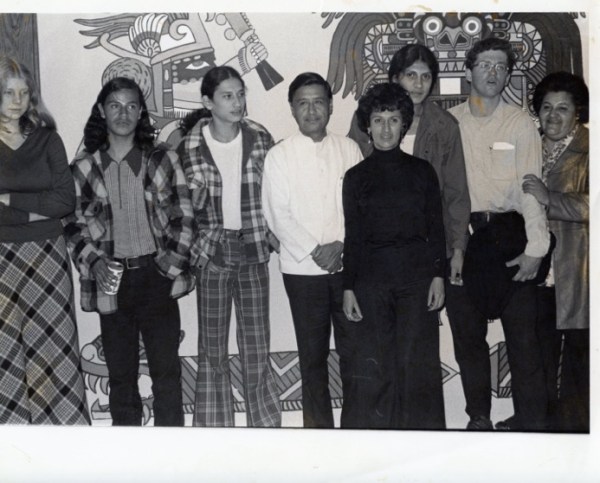
Michele Hobart (on the far left) in a group photo with none other than Cesar Chavez in the basement of Our Lady of Guadeloupe Church in NW Denver. The date – at least as my records show it – 1975
Michele Hobart Obituary
August 19, 1957 – August 30, 2015
Resided in Cayce, SC
The quest for the end to suffering and the elimination of injustice among humans lost a dedicated and passionate advocate with the death of Michele Hobart of Cayce, SC.
Born in New Orleans to a liberal librarian (Mary Mitchell Hardy, Red Lodge MT) and a libertarian ex-Marine (Robert E. Hobart, deceased) and raised in oil boom towns large and small throughout the western US, Michele had an innate kindness, a natural curiosity, a zest for understanding, a staunch independence, a Bill of Rights bookmark, and an uncompromising compassion-based vision of what that document implied for the responsibilities of her country and its citizens in pursuing peace and justice.
Americans grow up regularly reciting our pledge of “liberty and justice for all”. Most of us don’t often reflect on what that really means while some say the words but hear “liberty and justice for those just like me”. Michele, with an unwavering clarity of purpose, fully embraced that clause as written and knew that until the last two words, For All, become universally practiced, then we have not truly achieved liberty and justice.
While her greatest joy was as a single mother helping her daughter, Rachel Rhiannon Hobart (Pullman, WA) grow to become another strong, passionate woman with a beautiful heart and a clear sense of right and wrong, Michele dedicated much of her free time to seeking nonviolent paths to peace and justice. Her kindness, her laugh and her smile were revered among those who knew her, but her fierce compassion and empathy for the powerless is what guided her throughout her life.
At age 15 in Denver, Michele graduated from high school, achieved “Emancipated Minor” status, and headed off to save the world. First stop was as a volunteer for Cesar Chavez in the United Farm Workers movement, traveling the country in support of UFW efforts. In 1975, at age 17, she participated in a peaceful, informational picket line around a liquor store in suburban Denver, urging patrons to purchase UFW-friendly wines. All the picketers were arrested, but Michele and two other women were singled out to be strip-searched and held in solitary confinement. The women were awarded compensatory and punitive damages in a civil-rights lawsuit after a jury trial. Michele and her co-plaintiffs used their monetary award to set up the End Police Abuse Fund, the balance of which was recently transferred to the NAACP Legal Defense Fund (http://www.naacpldf.org) to support efforts to change the culture of police forces in a continuing effort to truly end police abuse. She spent the ’80s pursuing, primarily, labor causes while also raising awareness of social injustices around the world.
In the early 1990’s, Michele and Rachel moved to Seattle, where Michele developed two new passions that would be major influences in her life: Buddhism and her future husband, Tom Owens (Cayce, SC). Buddhism spawned a spiritual element to her desire to end human suffering. In Tom, she found a kind, kindred spirit who became an ever-tolerant and (mostly) silent partner in her quests while sharing her wanderlust and her desire for quiet solitude. Their relationship relied on a unique bond of strongly independent souls with a similar zest for life and firm grasp of the absurd that allowed them both to laugh, thrive and grow over the next 20 years. Tom’s job brought her to South Carolina, where she first put energy into building a Buddhist community. Around the turn of the century, she pursued this effort to the tune of over 1000 miles/wk driving “The Monk Shuttle” from a then-nascent, now thriving, Buddhist Meditation Center in Atlanta (http://meditationingeorgia.org) to Columbia, SC and Asheville, NC to bring teachings to introduce her Buddhist tradition (http://kadampa.org) to the Carolinas. Those efforts bore fruit and 16 years later there are thriving communities of Buddhist practitioners at the Kadampa Meditation Center in West Columbia (http://meditationinsouthcarolina.org) and the Vajradhara Buddhist Center in Charlotte, NC (http://meditationcharlotte.org). Through these centers, Buddhist teachings are provided throughout the Carolinas and many individuals will benefit from her efforts for years to come. To develop her personal meditation practice, Michele spent the winter of 2002-2003 in a 4-month silent meditation retreat in Scotland.
South Carolina is not without its own social justice challenges and so Michele marched and sang in 2000 with 46, 000 others to pressure legislators to finally remove the Confederate Flag from atop the State Capital and was pleased to live to see the symbolic job completed this summer, although saddened that such a tragic loss of life was necessary to move forward. In fact, Michele spent many hours on the State House grounds, standing in silence regularly on Wednesdays with the Women in Black (http://womeninblack.org) protesting the continuous state of war in which we have lived almost since her arrival in South Carolina, joining the Carolina Peace Resource Center (CRPC; http://www.carolinapeace.org) to support numerous marches and protests, and sleeping on the steps of the State House during the Occupy Columbia protests. Her long-held concern for the plight of the Palestinian people became a focus of her activities over the last decade of her life. She was active in the CPRC efforts on this issue, wrote often and met with her senators and congressmen or their staff in both Columbia and Washington, DC to address concerns, served as a local contact for the American Association for Palestinian Equal Rights (http://www.aaper.org), hosted educational lecturers from the Jewish Voice for Peace (http://jewishvoiceforpeace.org), and sponsored and helped organize Palestinian Film Festivals and film nights. In 2009, she traveled to Egypt as part of the Gaza Freedom March (http://www.gazaark.org). While she did not make it to Gaza, the young people of Egypt and the March participants she met in Cairo from around the world (often through shared time under house arrest!) were inspirational and provided Michele hope that the rest of the world may eventually come together to solve the unjust situation in Palestine at a time when her faith in her own government’s commitment to contribute constructively was at a low ebb. She also mounted clandestine incursions into local retail outlets to strategically place educational information about manufacturers who engage in unjust practices toward the Palestinians (Some displays lasted weeks; Walmart and Target were oblivious!). She was a strong believer in the Boycott, Divest, and Sanction movement (http://www.bdsmovement.net ; http://www.endtheoccupation.org). Michele’s last action was in July of 2014 in Five Points where she struggled to overcome the effects of chemotherapy to join others from the Carolinas in protesting the bombing of civilians and children in Gaza.
Michele died on August 30, 2015 at age 58 of small cell lung cancer. Yes, she smoked for a couple of decades in her youth and she wishes she had not. True to form, her self-education into her disease over the last year left her concerned that lung cancer’s Marlboro Man image is detracting from research efforts to save others, both non-smokers and smokers alike. Did you know that lung cancer is the #1 killer of women in this country, surpassing breast cancer more than 3 decades ago? She had immense respect for the commitment and focused efforts of those working to eradicate breast cancer, but she also learned that, take away the “evil” smokers, annual deaths in woman who have never smoked a day in their life may be only 20% less for lung cancer than for breast cancer. Lung cancer is among the top 10 causes of death in this country for non-smokers. Yet, research expenditures on breast cancer per annual death are about 10 times more than spent on lung cancer (the same is true for prostate cancer). Remember that when the celebrities and the pink football shoes disappear at the end of October each year. November is Lung Cancer Awareness Month. Anyone who has ever had sweet nothings whispered in their ear knows that the lungs are also a sexual organ. #savethelungstoo
There are no words to describe the love Michele feels and the debt she owes to her parents, her daughter, and her husband. Michele wants her siblings Lee Hobart, Art Hobart, Wanda (Dotty) Hobart, Eric (Elaine) Hobart, and Craig (Sabrina) Hobart, her dear Auntie Clare Witcomb and uncle Sam Hardy, and her cousins Jennifer Robeson, Claudia Hauser, Chris Hardy, Lisa Patton, and Ed Kleemola, and her sister-in-laws Ann Owens and Christie Balsam to know that she is humbled by the friendship, love, and support that they provided during her life. She misses her step-mother Judy Kleemola Hobart, who died in April (also of lung cancer). Nieces, nephews, their children, her many co-workers, and all those who have helped her, befriended her, and taught her during her lifetime are also thanked with love.
To the tens of thousands of people who stood with her over the last 40+ years to change the world: Thank you; You must carry on. To those who have yet to free their Inner Activist, ask yourselves: Does your inaction advance the causes and values in which you believe?
A traditional Buddhist Powa Ceremony (transference of consciousness) for Michele was performed at her bedside beginning shortly after her death. Powas have been and will be held on her behalf at Kadampa Buddhist Centers and by individual practitioners around the globe during the 49 days following her death. A traditional American Memorial Service may be held at a future date, likely in Red Lodge, MT.
In lieu of flowers, those who are so inclined are encouraged to contribute to the Kadampa Meditation Center in West Columbia (http://meditationinsouthcarolina.org), any of the organizations cited by URL above or any other organization that advocates for non-violent change in the world.


The Jews of North Africa: From Dido to De Gaulle by Sarah Taieb-Carlen (Translated by Amos Carlen). University Press of America: 2010 – Part One

a closed down synagogue near downtown Tunis, rue Louis Lumiere
- 1.
The book is surprisingly readable.
Why “surprisingly”? It’s not so easy to condense the nearly 3000 years of a Jewish North African presence in 140 or so pages, do the subject justice, say something of value, but the author, Sarah Taieb-Carlen manages to pull it off. She creates a useful and interesting sketch of the main themes of the long Jewish presence in North Africa with many pertinent insights. As much as anything, the book is essentially a cultural history, that looks at Jewish relations with other major groups – Berbers, Bedouins, Phoenicians, Romans, Islam, French colonizers over that extended period, and how the Jews fared with each. the book strikes me as being something of a phd thesis turned into a more readable manuscript as the references to academic figures like Fredrik Barth, Albert Memmi suggest.
The writing is controlled, thoughtful and from what I know of the subject (about which I have some working knowledge) accurate. After reading it, one comes away with an appreciation of the historical depth and breath of the Jewish presence in North Africa, a sense of the historical vicissitudes of that experience, of its extraordinary cultural richness over time, it ability to survive through periods of tolerance and bigotry. And then there is the final speedy collapse. Well perhaps not total, but near-total collapse. Of the hundreds of thousands of Jews who lived in French North Africa (as it was then called) just at the turn of the 20th century precious few remain. By the century’s end, the populations had shrunk to naught, a couple of thousand in Morocco, supposedly around 1500 in Tunisia, not a one in Algeria.
As a quote from S. Trigano (p. 108) put it only five years after the massive exodus of Algerian Jews took place that corresponded with the country’s 1962 independence:
From the point of view of its conscience Algerian Judaism had already forgotten in Algeria its specificity, avoiding even the thought of it. But this sparkling world which was ours has disappeared. It lives inside of us. It does not live any more inside of our children. The identity of the Algerian Jews is no longer.
If Moroccan and Tunisian Judaism clings on for dear life, a shadow of their former historical richness, most of these worlds too have disappeared; gone. That the Jewish presence in North Africa might some day rebuild, as it did, repeatedly over the centuries and millenia, is difficult – if not impossible – to imagine. As such, Taieb-Cohen’s book reads like a long and loving cultural obituary, an attempt through the written word, to record some of the main themes of a lost world, a great and humane one I might add for all its foibles. Read more…

Colorado State Veterans Home At Fitzsimons, a part of the Dept. of Human Services Dept. plagues with problems, crises
(Note – Update – February 6, 2018. I add some commentary at this juncture because for reasons known only to the internet gods, a fair amount of people are coming to read this piece although it is five years old. The bottom line is the situation at Fitz has calmed down some, although a number of structural problems still nag at the place, high employee turn over among them. This crisis of five years past came and went. It took with it some high level folk at Human Services, and that deservingly so, although the director, Reggie Bicha, ultimately responsible for this and other problems, survived, I expect, with the help of the governor. Bicha’s demise might have reflected poorly on Governor Hickenlooper, at least that is my take as to why Bicha is still standing (so to speak). As for the governor, at the time, hushing up this – and other scandals within Human Services was important to his frantic attempts to put himself forward – with a little help of his power broker friends here in Colorado – as a presidential hopeful. From what I can tell, he’s still running, or trying to. As to the situation at “Fitz” and throughout Human Services…there continue to be outbreaks. In the end I have concluded that at the heart of the matter – an underpaid, overworked staff that is being pushed by management. Management itself is pushed by the legislature to produce more for less…and now state employees are facing severe cuts in their pension plan, PERA – a plan pushed by the governor. If implemented it will be one of the biggest take aways in state employee’s living standards ever. Very few Democratic voices speaking out against the plan. Typical whimps.)
As fast as it appeared on the media horizon, it disappeared. Here one day, virtually gone the next.
A major scandal involving mismanagement, abuse and intimidation at the highest levels of the Colorado Department of Human Services (CDHS) – and throughout the department – has come and gone from the news. CDHS is a state agency with a budget (if I could get the figures correctly) of more than $22 billion; it has responsibility over everything from the mentally ill, to prisons, to foster care and veterans nursing homes. The scandal, described below, resulted in what amounts to an administrative shake up, but little more.
In order to stem the tide of criticism and avoid a more serious investigation, high level administrator, Vicki Manley, CDHS’s Director of Long Term Care Services, was let go (given the choice between quitting and being fired), but the Human Services executive director, Reggie Bicha, ultimately responsible for the mess in the system remains on the job, tenaciously defended by Colorado’s Governor John Hickenlooper. Beyond the firing of Manley, the department’s accumulated grievances have not been addressed. An administrator is let go, but other than that, the CDHS hasn’t changed a bit, an eerie foreboding of more to come. But through what amounts to clever political maneuvering, the governor has put out a fire that could threaten his legacy and undermine his national political aspirations.
The mess continues Read more…
Nuclear Arms Deal with Iran – War or Peace? Sunday: August 16 11 A.M. at: First Unitarian Society of Denver 1400 Lafayette Denver, CO
The Great Late Cretaceous Interior Seaway: A Visit to the Sternberg Museum of Natural History in Hays, Kansas

Look carefully and you will see it: Gillicus inside Xiphacticus, or put another way – a little – well actually NOT SO little – fossil fish inside the belly of a larger one that has swallowed it whole. The “Mona Lisa” of the Sternberg Museum
If possible, when I go to eastern Nebraska (Nebraska City, at the far eastern edge Nebraska near the Missouri River) on a visit, afterwards, I try to dip down and return through central Kansas. That is what I once again did this past week.
Leaving Nebraska City and stopping off at Holton, Kansas, from where a life long friend’s family hails, I wind up for a few relaxing – and always intellectually stimulating – few days with Margy Stewart and Ron Young at their Bird Runner Wild Life Refuge on Lower McDowell Creek, south of Exit 307 on I-70 ten miles east of Junction City. On route to Denver again, I find it difficult to bypass the small town Wilson, Kansas, whose welcome sign claims it to be the “Czech Capitol of Kansas” and whose sole grocery story offers the best hometown made sausage available in these parts, and for the most reasonable prices. Then it’s off east of Wilson to Hays, Kansas for what is one of the great thrills of the whole trip: a visit to the Sternberg Museum of Natural History.
The Sternberg is best known, among paleontologists, at least, for its extraordinary collection of what are referred to as “Kansas Cretaceous marine life” and specifically, the wonderfully preserved “fish-within-a-fish.” “Gillicus” is the six-foot long fish swallowed by the fourteen foot Xiphactinus some 70 million years ago. The suggestions are that while Xiphactinus was able to swallow Gillicus whole, no small feat for the ancient glutton, that the experience killed him, a prehistoric example of biting off more than you can chew. The extraordinarily well perserved fossilized skeletal remains of both predator and victim locked in a lethal display. For those interested enough, this fossil is just a gateway to a long-lost world.
As with most other museums, what is displayed is a small, if not tiny part of a much larger collection. In the Sternberg’s case, those displayed for viewing are a sliver of the museum’s 3,750,000 specimen collection. For those of you unfamiliar with the language of geological historical slices of time, don’t let words like “Cretaceous” scare you away. “Cretaceous” refers to a geological period beginning at about 145 million years ago extending to 66 million years past. The climate during this time was generally warm, with rising sea levels. The oceans and seas were populated with now extinct marine reptiles, ammonites and what are referred to as rudists; on the land this was the age of the dinosaurs while new species of mammals, birds and flowering plants came on the scene.
The Cretaceous itself is a part of “an era”, – a longer geologic stretch of time, known as the “Mesozoic.” These geological “periods” and “epochs” were first clearly delineated in the early 19th century by a number of scientists (Lyell and others), and with modern dating methods (tree ring, radio-active carbon ), scientists have been able to put very accurate dates on these timelines. The Cretaceous ends around 66 million years ago and is marked by what is referred to as the KT boundary. At that moment 66 million years back, a dramatic shift took place for life on earth that affected the planet. It is at that time that a large number of species went extinct – most well-known of which are the dinosaurs, that went the way of all flesh suddenly and forever after a long – 80 to 100 million year – run. Slam, bam – they’re gone. Less known is a whole variety of “mega” maritime life (“mega” – meaning very, very large – big dinosaur sized) that were to the oceans what Tyrannosaurus Rex, Stegosaurus and Triceratops were to the land. Others left the scene suddenly too. Looking at the geological record, scholars have come to conclude that at that 66 million year ago moment, the world had experienced the fifth of a series of “mass extinctions”.
One of these earlier mass extinctions, referred to as the Great Permian Crash, some 248 million years ago, is estimated to have wiped out some 96% of all living things. In the Cretaceous ending case of the KT boundary 66 million years ago, for a long time it was unclear what might have caused such a sudden catastrophe, until in 1981, Luis and Walter Alvarez suggested it was the result of a giant asteroid fell in the Yucatán Peninsula, at Chicxulub, Mexico. It changed the earth’s atmosphere producing a dust cloud that kept out the sun, spiked global temperatures changing climatic conditions and killed off much of life on earth. Looked upon skeptically at first, with time, the hypothesis has gained strength and credibility as KT boundary layers have been discovered in many rock formations worldwide. As recently as 2010, a world conference of scientists endorsed the Alvarez hypothesis which is generally accepted as the cause of the dinosaur extinction.

North American Cretaceous Interior Seaway 90 million years ago
Getting Back to Kansas…
The other animals that died out at the same time where the maritime mega-forms, as oxygen levels and water temperatures also plummeted. Many of these long-lost maritime species roamed the seas of Kansas (yes, that is not a mistake) and the fossilized remains of many of them have been continually uncovered over the course of the past 150 years throughout, especially, the western parts of Kansas.
Although it might goose the state’s influential – and increasingly wacko – Christian fundamentalists, the Kansas of today is quite different from its appearance 100-80 million years ago, that geological period known as the “late Cretaceous”. It was entirely under water as was much of the Great Plains. In fact what today is the Eastern United States was separated from West by what was known as the Cretaceous Interior Seaway that split the North American continent in two (and sometimes in three) sections). At its largest, it was 2,500 feet (760 m) deep, 600 miles (970 km) wide and over 2,000 miles (3,200 km) long. Its seashores fluctuated overtime, but through most of its long history what is today the state of Kansas, as well as much of the West up to the edge of the Sierra Nevada Mountains in eastern California was under water. The current generally flat-ish landscape of this region in western Kansas and the high plains of eastern Colorado was, 100 million years back, the bottom of the sea and one can still see not far from the surface in many places large quantities of the sand that made up the sea bottom.

Bison skulls piled high – 1870s
The Western Dinosaur Hunters
The period of western expansion and development after the end of the American Civil War was marked by intense economic and political developments, “the closing of the frontier,” the decimation of the buffalo, and the wiping out of the last remnants of independent Native American culture (from the Sand Creek Massacre in 1865 to the Wounded Knee slaughter in 1890). It was in this period between the end of the Civil War and 1900 approximately that western regions of the United States from the Missouri River to eastern California were more intensively probed, settled and economically exploited.
Fossil hunting along with archaeological discoveries, such as the discovery and excavation of the Mesa Verde Anasazi site in SW Colorado were an integral part of the period. Hunting for the bones of dinosaurs of all sizes and shapes in the western regions – but especially Colorado, Wyoming and Western Nebraska intensified and was followed with some excitement in the national press. In these regions O.C. Marsh from Yale University in New Haven Connecticut and E.D. Cope of the American Philosophical Society in Philadelphia engaged in what became known as the “Bone Wars” in which each tried to discredit each other in the press the others discoveries, destroy each other’s discoveries with each claiming that their most recent dinosaur discovery outdid their competitors in evolutionary significance, a classic example of the utter stupidity of academic competition setting the stage for the future, although in the process, the two did make a significant number of dinosaur (and other) fossil discoveries, most of which had to be re-interpreted later by more sober analysts.
While Cope and Marsh were slugging it out intellectually, not far away, in Western Kansas, Dr. George M. Sternberg was making less publicized, but equally dramatic discoveries of maritime giants from the same period, the late Cretaceous. As the Sternberg Museum brochure – inexpensive but informative – explained:
Dr. George M. Sternberg, renowned Civil War surgeon and later Surgeon General of the United States Army, was assigned to Fort Harker (Fort Ellsworth), Kansas in 1866. While stationed in Kansas, Dr. Sternberg often visited poss along the Smoky Hill Trail. During his travels, Sternberg helped to identify fossil bones that had been found by soldiers on patrol in western Kansas.
Sternberg would stay in the region for the rest of his life and continued fossil collecting. Unlike Cope and Marsh whose collecting passions centered around “trophy fossils” and the press attention they garnered, Sternberg became interested in collecting fossil leaves found in the sandstone hills near his home. Many of these specimens are now a part of collections worldwide. George Sternberg passed on his interest in fossil collecting to his sons, George F., Levi and Charles M. At the tender age of 9 George F. had already made a major discovery, a fossil reptile called a plesiasaur, a giant carnivorous marine reptile, a kind of tyrannosaurus-rex of the seas. In 1952, George discovered the famous “fish-within-a-fish,” discussed above, the most complete specimen of its kind known. The museum in Hays, Kansas where Sternberg did much of his work was renamed in his honor after his 1969 death.

the quilted version of Xiphactus swallowing Gillipus in the museum lobby.
“Life’s Sunny Side” by Harriet Patton

Jim Davis, approximately the age of 9, in around 1938. He’d made his own banjo out of the top of an axle grease bucket lid, a stick and bailing wire for strings. The fact that it didn’t work in no way deterred Jim from playing it and singing anyhow. His favorite song, appropriately enough in those hard times was “Keep On The Sunny Side.” He would sit on the south hay mow (part of a barn where the hay was stored) and sing with siblings.
Harriet Patton lives alone in a pleasant track home just south of Chalk Creek in the shadow of Mount Princeton just outside of Nathrop, Colorado. Her daughter, Jo Ellen is Nancy and my life-long friend. We visited them and some of their family members this week in Nathrop, in the valley between Buena Vista and Salida, Colorado, near the headwaters of the Arkansas River. Chalk Creek runs into the Arkansas River at Nathrop. Harriet and her siblings grew up on a farm in the 1930s Dust Bowl era in Eastern Kansas. Hard times. People had to “make do” and with very little. – and did. Jim Davis, pictured here, was her brother. After receiving this picture from her sister, Harriet wrote a poem about that period to go along with the photo which is just below. Perhaps today when one hears story of people in this period who were “poor but happy,” people respond cynically, thinking that it is just nostalgia. But I have heard similar stories many times now of people growing up in the Depression Years (1929-1940 approximately) when life WAS hard, very hard, for everyone, rural or urban dwellers but that still, people had each other and a strong sense of the need to help one another. The social bonds, the sense of the importance of “service,” of “community” the manner in which people were “there” for one another, in many ways appears today like a lost world. Of course, not to “glorify” it – there is nothing pretty about poverty, then or now – but there was something – and those of us who knew people who lived through that era – and the World War II that followed – know that the word’s in Harriet’s poem ring true. At 85 she is spry, sharp as ever. 
The Pope and the IMF Have Moved Left…and Oh Yes, There’s A Bridge In Brooklyn I’d Like To Sell You Cheap…

Bamako – a Malian film by Aderrahmane Sissako – that puts the IMF on trial (literally), while showing the impact of its policies not just on Mali, but the whole African continent.
First the Pope, the head of what is arguably, perhaps the most conservative – nay reactionary – social movements in world history since Constantine legitimized its approach so long ago – doesn’t miss an opportunity to sound more leftist than Che Guevara…now the IMF is moving into the ranks of socialists….what is the world coming to? Genuine, deep going change or simple demagoguery? Do the Pope’s statements represent the beginning of a shift in the long history of that institution?; does IMF position paper mean that much either. Or are these gestures little more than recruitment tactics, and image polishing approaches, a bit like – as the old saying has it – putting make up on spiritual and economic corpses? Read more…
Tunisia: Seiffeddine Rezgui’s Last Break Dance

Sousse, Tunisia
_______________
This also was published at Foreign Policy In Focus
_______________
The idea that Tunisia represents something of an Arab Spring success story in contrast to the turmoil experienced elsewhere in the Middle East, has been an integral part of the Western media narrative about the region. Yet, from the outset, the post-Ben Ali Tunisian transformation has been a bumpy and frankly, fragile affair in many ways. True enough, the Ben Ali repressive yoke has been lifted. That much has changed for the better. However, the recent massacre of foreign tourists in Sousse underlines many of the thorny structural problems that remain. I mention this, by the way, as one who has confidence – boarding on faith – in the Tunisian people’s ability to overcome these difficulties in the long run. RJP
________________
Tunisians Back On The Streets Demonstrating Against Terrorism.
As they did right after the assassinations of Chokri Belaid (February, 2013) and Mohammed Brahmi (July, 2013) were assassinated and in the aftermath of the terrorist attack against (mostly) foreign tourists visiting the Bardo Museum in March of this year, Tunisians once again took the streets to protest the Friday, June 26, 2015 cold-blooded murder of 38 tourists at the Spanish-owned five-star Riu Imperial Marhaba Hotel, in the El Kantaoui district of the seaside resort city of Sousse, some 75 miles south of the capitol, Tunis. Carrying banners which read “Non au Terrorisme,” “Why,” the day after the slaughter, crowds of mourners and demonstrators gathered in both Sousse and Tunis to protest the killings.
A number of themes have converged to make Tunisia more of a target of terrorist attacks from ISIS-like radicals than in the past, much of a blow back from the NATO attack on Libya that brought an end to Khadaffi’s rule. Read more…
Reforming Popes – Moving The Mountain…Or Something Less?

Catholic Church, outside of Mora, New New Mexico (March, 2013)
_________
note: also published at Foreign Policy In Focus
_________
Popes…and Reforming the Catholic Church
The Catholic Church is again stirring.
Among many of my Catholic friends, a sense of hope is replacing decades of resignation. They now cling to Pope Francis’ every word, looking forward to what the pontiff will say next. Although ideologically distinct from them, I have found myself working with and living next to Catholics all my life, especially those who have been associated with The Catholic Worker, Sisters of Loretto, some elements among present and former Jesuits. At times we have struggled to find the common ground…and have often succeeded. Of course, it should come as no surprise that I find myself working more closely with those critical of, or trying to reform the institution. They are a serious, dedicated lot of present and former priests and nuns, some who refer to themselves as “reformed Catholics.”
Over the decades, especially here in Colorado, we have developed a pattern of cooperation and trust – and from my perspective at least, respect – in struggles for social justice, against racial and religious discrimination and for peace. They are long distance runners for social justice. They spilled blood (literally) in their efforts to close the Rocky Flats Nuclear Facility just northwest of Denver, work with the homeless and have been among the strongest critics of U.S. foreign policy worldwide, but especially in Latin America. One does not have to lecture them or explain what might be referred to as the shortcomings or inequities of capitalism; that they understand well. Some have taken on the Sisyphean task of democratizing, reforming their Church, others have, frankly, given up on that effort. Regardless – reformers and/or dropouts – it is their religious commitment, something deep in the spirit of their religious upbringing, which has shaped their values and commitment to social justice. Their commitment is genuine and enduring and has endured the ups and downs of Vatican policy shifts over the years.
As has been the case with previous statements over the past two years, there is both interest and no small degree of excitement over the expected papal statement by Pope Francis on global warming. The environmental movement is hopeful the Pope’s statements will give added “oomph” to the global efforts to bring CO-2 levels down. Conservative Republican Party hopefuls Ted Cruz and Rick Santorum, Congressional snow ball king Jim Inhofe are all worried. Read more…
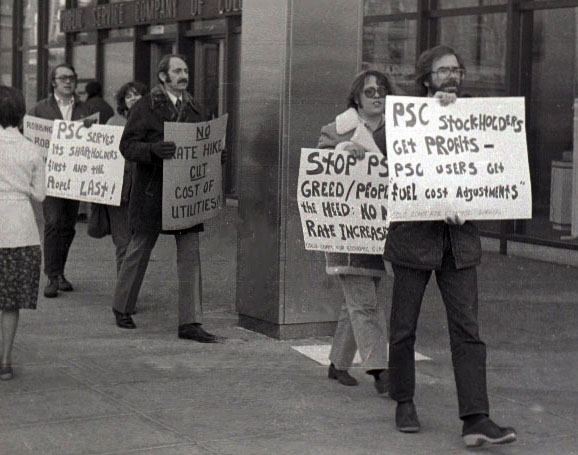
September, 1979 – Harry Nier – third on the left with the sign “No rate hikes, cut the cost of utilities.” Immediately behind him, part hidden, Elaine Schell; behind her Dick Ayre. In front of Harry, Danny Graul, leading the pack with the sign “PSC stockholders get profits, PSC users get fuel cost adjustments” is Jack Galvin.
The news came to me this evening that Harry Nier, Denver lawyer, a lifelong socialist, secular Jew, with a particular love and knowledge of Fidel Castro’s Cuba, died this past Monday. I do not know the details beyond the fact that Harry suffered from Alzheimers for these past 4-5 years and that the condition overwhelmed him in the end. I believe that he was about 90 years of age.
The last time I saw Harry was at a Middle Eastern restaurant about five years ago on South Colorado Blvd, known to locals as “The Gaza Strip.” I was coming out with hummus and he and a friend were entering. It had been years since I’d seen him; but he recognized me and I, him; We spoke briefly; I made one of those mental notes to track him down, see him again, but as often happens, never got round to it and he died.
I especially thought of Harry when the Obama Administration announced it was going to end the more than half century economic blockade against Cuba, which Harry had worked so hard and persistently for all of his life. I wanted to drink a toast with him, to congratulate him on his commitment to improving U.S. Cuban relations. If I remember correctly, Harry Nier visited Cuba more than 20 times, during all those years when it was technically illegal to do so. On several occasions Harry met with and had long discussions with Cuban leader, Fidel Castro whom he knew personally.
I don’t know that Harry Nier ever joined this or that left group, but he was, even as a successful and prosperous lawyer, a life long socialist with a genuine commitment to poor and working class people. Harry Nier was born in New York City on August 13, 1926. At the age of six months his family came to Denver. He went to East High School and then to the University of Colorado in Boulder and then from University of Colorado Law School in 1950. Nier was a part of a group of extraordinary lawyers that included Rudy Schware, Gene Dykeman,Walter Gerash in the 1950s. Together they defended those Colorado Communists and leftists called before the House of Un-american Activities Committee; SDS, the Crusade For Justice, Vietnam draft resisters, etc. this they did successfully, virtually for free and Harry, as well as the others, stayed in Denver and built his practice and his life here.
I first met Harry in the summer of 1970.
I had been arrested, along with life-long friend and associate Jay Jurie as a part of what was then referred to as the Boulder 17. We were a part of a group on the University of Colorado Boulder campus protesting an ROTC drill. Most of us, myself included were arrested and charged at first with felonies. I went to jail. It was then that I met Harry. As a part of the National Lawyers’ Guild he represented me gratis, got me and others, out of jail on bail and through his work – along with that of Gene Dykeman – got the felony charges first reduced and the thrown out by a Boulder Federal Judge. At the same time the University of Colorado lodged charges against me as well which could have led to my expulsion from graduate school. Again, Harry Nier successfully represented me and won the case.
During the years I knew and worked with him, Harry bounced around between this and that left group, never, at least to my knowledge, joining any – working with all. He belonged, identified with all of us, gave us support and never held back with his criticisms of what he understood to be our shortcomings I didn’t know much about his personal life although I saw him often enough, but I don’t believe he had a lifetime partner or was married. For a number of years he worked with the Denver International Film Festival to bring Cuban films to Denver.
I hear that Harry wants his ashes spread on Mt. Elbert in Colorado – which he climbed not once but frequently – and in Cuba. Harry…rest in peace. I regret that those of us who knew you and in spite of all your damned quirkiness – respected and loved you…couldn’t see you off on your journey to wherever.
I will add to this obituary as I collect information about Harry’s life. Yours was a lifetime of commitment to others,, a rare bird indeed. Harry Nier, Rudy Schware, Gene Dykeman, Walter Gerash…the likes of these in the Colorado legal profession are rare these days.,.and were then.
Harry rest in peace.
Rob P.
______________________

In order to help pay his way through law school, Harry Nier drove a cab…and thus was part of a tradition of radical Denverites who did a stint at the cab company. This is a copy of his cab driver’s license. It is dated 1953
This from Allan Hafley:
Richard Roth was kind enough to send me the link to Rob Prince’s blog concerning the death of Harry Nier.
Many of you knew Harry or knew of him and I thought you might like to see the tribute Rob wrote.
Harry and the other lawyers named in Rob’s piece were “Movement Lawyers” in the finest sense of the word and helped countless individuals and organizations.
I first met Harry in the fall of 1967. Shortly after the Day of Draft Resistance on 10/16/1967 I was indicted by the Feds for non-possession of my draft card. Harry and Gene Dykeman took on my case, filed a 75 page brief challenging the legality of the draft and the Vietnam War.
Within weeks the Department of Justice decided they did not want to argue the case and dropped the charges.
As Rob mentions Harry was passionate about the Cuban Revolution, loved to talk politics and to challenge us about what we doing and advocating. Because we were in Boulder and Harry was in Denver I did not really see him that often but considered him a friend who went out of his way to help when most people thought we should be imprisoned or worse.
When I Googled Harry’s name a batch of FBI documents came up from the Harold Weisberg Archive (the file was too large to attach to this email) . Weisberg was one of the early critics of the Warren Report and wrote a number of books on the JFK assassination. At the time of JFK’s
murder Harry was the head of Fair Play for Cuba in Colorado. The gist of the heavily redacted reports is that the FBI was trying to prove that Harry knew Lee Harvey Oswald. Of course it was all garbage, another attempt by the FBI to smear and/or indict innocent citizens.
As the years roll on it is easy to forget all the people who stepped forward to help in our hour of need.
Harry was one of the good guys.
Allan Haifley
_____________________________

Harry Nier, an avid mountain climber, here a top a Cuban mountain.
The War in Yemen and Its Fallout on Saudi Political Structures: Deconstructing The Mainstream Narrative
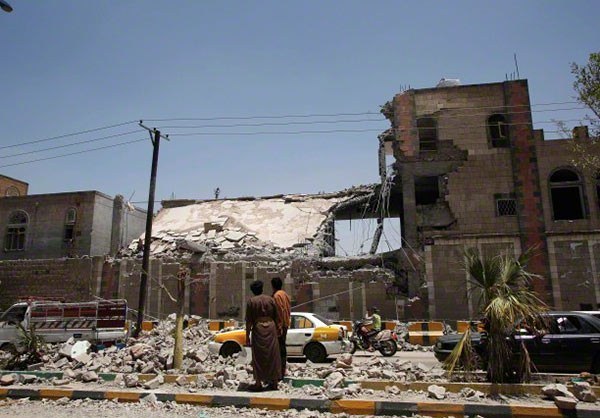
Saudi bombing of Yemen continues despite some momentum for peace. It has caused more than 70 deaths in the last 24 hours alone (June 9, 2015), more than 6000 in the three months since the Saudi bombing campaign began.
by Ibrahim Kazerooni and Rob Prince
(Note – published at Foreign Policy In Focus)
__________
The narrative being put forth in the U.S. media is that the current war in Yemen is a proxy war between the Saudis and Iran, and that the opposition in Yemen consists of a small religious minority, the Houthis, who have forced a “legitimate” government from power. Here is a considerably different assessment of the Yemen crisis which tries to bring the main themes of the crisis back into a more objective focus.
___________
1. Some Historical Considerations…
By now it has been close to three months that, with green light from the US and a helping hand from few Persian Gulf Emirates, Saudi Arabia attacked Yemen under the pretense of self-defense. We are now beginning to witness the fallout of Saudi aggression on its political structure. To have a better picture of what is going on in Yemen a brief recap of its relations with the Saudi monarchy is necessary. Although poorly appreciated by many, the fact remains that historically, Saudi Arabia has been at war with its southern neighbor in one way or another, virtually non-stop since 1932.
The two countries have fought six wars so far. The most critical of these wars was Yemen’s 1962 war of independence. In September 1962, the Imam of North Yemen was overthrown in a popular coup led by Arab nationalists within the Yemeni military. Until then, 80 per cent of the population had lived as peasants under a feudal system of government, with control maintained by graft, a coercive tax system, and a policy of divide and rule. Once the uprising began, Nasser, the Egyptian president at the time, sent troops to bolster the new Republican government. Royalist forces supporting the deposed Imam fled to the hills and began a conservative insurgency backed by Saudi Arabia and Jordan. Read more…
 View from the Left Bank: Rob Prince's Blog